Plumbing Service for Henderson HOA Boards and Property Managers

Looking for a Plumber? Contact Us Now
Open 24/7. Written price before work starts.
Get Your Quote
Tell us what's going on and we'll get back to you. We're open 24/7.

Key Takeaways
- With 33.9 percent of Henderson homes rented, the decision maker on a plumbing repair is often the landlord or property manager, not the tenant in the unit; the owner-versus-association split lives in the governing documents.
- Pipe material drives every repipe conversation: galvanized in Pittman, polybutylene in early Green Valley and Whitney Ranch, Kitec in Gibson Springs and MacDonald Ranch, and PEX in Inspirada and Cadence, always confirmed on site.
- Henderson is its own city, so permits run through the City of Henderson Development Services Center, not Clark County; Whitney township next door is unincorporated county.
- Backflow assemblies on multifamily and irrigation systems must be tested by a certified tester at least annually under the Las Vegas Valley Water District program.
- SNWA reports water hardness of about 280 ppm, roughly 16 grains per gallon, so flushing, softening and scale reduction extend shared equipment life rather than being optional.
- Caliche hardpan makes trenching slower and more expensive, so buried line and sewer work carries higher excavation cost, and poor backfill compaction is what pulls lines out of grade.
- Typical ranges help boards budget: whole-house repipe $4,000 to $15,000, sewer line replacement $4,000 to $12,000, with a written price given before work begins.
- Active Plumbing holds Nevada license NSCB #0047021, verifiable at nvcontractorsboard.com, arrives in 30 to 60 minutes valleywide, and has served the area since 1991.
In This Article
A Saturday morning leak call comes in from a Green Valley townhome, water spreading across a shared wall. The board president does not know whether the association pays or the owner does, which city issues the permit, or whether the person reporting the leak even has the authority to approve a repair. For a Henderson HOA board or property manager, that uncertainty is the real headache, not the water itself.
Henderson is its own city with its own building department, and it holds roughly eighty years of plumbing history inside its limits. A leak in Whitney Ranch is a different conversation from a leak in Cadence, because the pipe behind the wall is a different material installed in a different decade. Knowing the era settles most of the question before anyone opens a wall.
Who Authorizes Plumbing Work in a Henderson HOA Community?
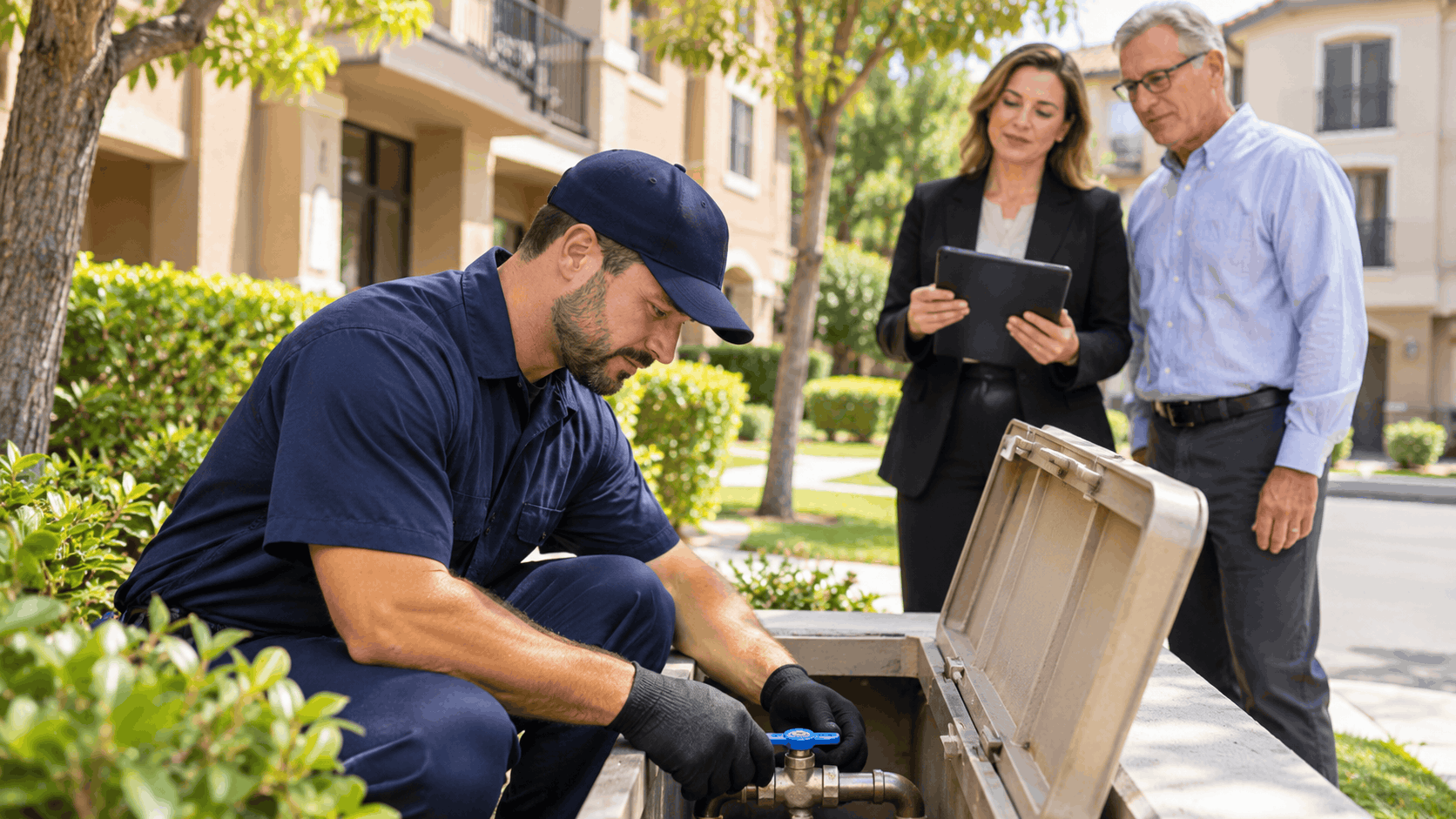
The decision chain in a Henderson community is rarely as simple as the person standing in front of the leak. A large share of Henderson homes are rented, so the one who notices the problem is often not the one who signs off on fixing it. A property manager and the HOA board each hold a piece of the authorization, and the governing documents decide where one ends and the other begins.
Getting authorization right protects the board, the owner and the vendor. When a plumber arrives without clear sign-off, the work stalls, billing gets disputed, and a simple repair turns into a multi-call problem. Establishing who approves spending before a truck rolls keeps the job moving and the paperwork clean.
Owners, Renters, and Who Signs Off
Census figures for Henderson put the owner-occupied rate at 66.1 percent, which means 33.9 percent of homes here are rented. On a large share of jobs, the person inside the unit is a tenant, and a tenant does not authorize or pay for structural plumbing repairs. They call the landlord or the property manager, and that person becomes the decision maker.
This changes how a job gets scheduled. A tenant can grant access to the unit, but a manager or owner has to approve the scope and the cost. When those two people are different, the plumber needs both: the tenant for entry and the manager for the green light on spending.
Billing follows the same split. The invoice goes to whoever authorized the work, not to the tenant who reported it. For rented homes, that usually means the owner or the management company, and confirming the billing contact up front prevents a dispute after the repair is done.
We treat the first call as a chance to sort this out. Who owns the unit, who manages it, who is paying, and who can let us in are four separate questions, and answering them before the appointment saves everyone a return trip.
Common Area vs Owner Responsibility
On association property, the line between what the HOA covers and what the owner covers usually tracks the plumbing itself. Shared lines, mainlines and common-area fixtures often fall to the association, while fixtures inside a unit fall to the owner. A clubhouse water heater or an irrigation mainline is association territory; a leaking faucet inside a condo is typically the owner's.
That general pattern is a starting point, not a rule for every community. The exact responsibility split lives in each association's governing documents, the CC&Rs and bylaws, and those documents can draw the line in a different place. Some associations cover the pipe up to the unit wall, others to a different boundary entirely.
Boards should confirm the split in their own documents before authorizing a repair, especially on walls shared between units. A leak inside a party wall can involve both a shared line and an owner fixture, and the documents decide who pays for which part. When the answer is unclear, the board's attorney or management company is the right source.
For the plumber, this matters because the scope and the billing follow the responsibility split. We can identify where a line runs and whether it serves one unit or many, which helps a board apply its own documents to the actual plumbing in front of them.
Working With On-Site and Off-Site Managers
Many Henderson communities are run by an off-site property management company rather than an on-site manager. That means coordinating access, keys and sign-off with someone who may be across the valley when the call comes in. A clear point of contact and a way to approve work remotely keep the repair from waiting on a drive-over.
Guard-gated communities add another layer. Anthem Country Club, MacDonald Highlands and Lake Las Vegas all control entry, so a plumber needs a gate code, a name on an access list, or an escort arranged by management. Sorting that out before the appointment avoids a technician sitting at a gate while the clock runs.
Access to shared spaces matters too. A clubhouse mechanical room, a pool equipment building or an irrigation controller may be locked, and the person with the key is not always the person who reported the problem. We confirm who holds access to the relevant space as part of scheduling.
When a manager is remote, written approval and a clear scope become the way the job gets documented. A written price sent before work starts gives an off-site manager something to approve and file, which is how we keep association billing clean across properties we may not be standing in front of.
Get Your Quote
Tell us what's going on and we'll get back to you. We're open 24/7.
Why Pipe Age Decides Everything in Henderson?
Henderson runs from Pittman's galvanized lines of the 1940s to Cadence's PEX of the 2010s, roughly eighty years of plumbing in one city. The build era of a community is the single most useful fact on any call, because it tells us what pipe material is likely behind the wall before anyone opens it. That material drives every repipe and leak conversation.
Material must always be confirmed on site, since tracts get repiped, remodeled and patched over the decades. But knowing the era narrows the field fast and lets a board plan. The table below maps Henderson's communities to their likely pipe material by build era.
| Community | Build Era | Likely Pipe Material |
|---|---|---|
| Pittman | 1930s, merged 1953 | Galvanized steel, cast iron, original laterals |
| Green Valley | From 1978 | Polybutylene in earliest phases, copper later |
| Whitney Ranch | Late 1980s - 1990s | Polybutylene, copper |
| Gibson Springs | From 1993 | Kitec era, copper |
| MacDonald Ranch | Mid-to-late 1990s | Kitec era, copper |
| Inspirada | Mid-2000s, built out 2010s | PEX on slab |
| Cadence | 2010s, still building | PEX on slab |
Pittman and the City's Oldest Pipe
Pittman, strung along Boulder Highway in the east, is older than the city itself. It began as informal housing around 1930 as workers arrived, took the name Pittman in 1942 after Senator Key Pittman, and merged with Henderson in 1953. It is a working-class area of older single-story ranch housing.
That history means Pittman carries the oldest pipe in the city. The supply lines are galvanized steel and the drains are cast iron, with original laterals running out to the sewer. Both materials fail the same way, from the inside out, and that failure mode is predictable enough to plan around.
Galvanized steel corrodes internally and collects scale, which narrows the bore of the pipe over the years. Water pressure drops, the water can discolor, and eventually the pipe wall thins enough to leak. The valley's very hard water speeds the scale buildup, so an old galvanized line in Pittman has been collecting deposits for decades.
Cast iron drains rust from the inside and lose wall thickness until they crack or collapse. For an association with older Pittman-era buildings, these materials are standard repipe and sewer-replacement candidates. A sewer camera inspection shows the real condition of an old cast iron lateral before anyone commits to a trench.
Green Valley and Whitney Ranch: the Polybutylene Window
Green Valley is Henderson's original master-planned community, developed from 1978 and now mature, spanning detached tract housing, semi-custom homes, attached product and association-governed tracts. That 1978 start puts its earliest phases squarely in the polybutylene window, the gray plastic supply pipe used widely from roughly 1978 to 1995.
Whitney Ranch sits in west Henderson and was built late 1980s through the 1990s, mixing detached tract, attached product and condominiums. It should not be confused with the unincorporated Whitney township, which is county rather than city. That distinction matters for permits and sewer authority, which we cover below. Our Whitney Ranch service work deals with this era of housing regularly.
Polybutylene is a standard repipe candidate because it fails at the fittings. The plastic becomes brittle over time and the connections let go, often without much warning. A board managing an early Green Valley or Whitney Ranch tract should treat polybutylene as something to budget for replacing, not something to patch indefinitely.
Because these communities also contain copper and later plastics depending on the phase and any prior work, the material has to be confirmed in the specific building. Two tracts a street apart can carry different pipe. Confirming on site keeps the repipe conversation honest and the budget accurate.
Gibson Springs, MacDonald Ranch and the Kitec Era
Gibson Springs covers about 400 acres and more than 2,200 homes, started in 1993 by Lewis Homes and built out by several builders through the early 2000s near the Galleria at Sunset, in the 89074 and 89014 zip codes. It mixes townhomes and patio homes with single-family and larger-home tracts, which means mixed ownership responsibility across one community.
MacDonald Ranch is mid-to-late 1990s in the southeast foothills around its golf courses, in 89012 and 89052, including the 55-and-over Sun City MacDonald Ranch and guard-gated MacDonald Highlands. These 1990s and 2000s build dates put both communities in the Kitec window.
Kitec appears in some later 1990s and 2000s construction, roughly 1995 to 2007. It is a flexible pipe with brass fittings, and the fittings are the problem. The brass corrodes internally and restricts flow before the system actually leaks, so a community can see pressure and flow complaints that point back to the fittings rather than a visible leak.
That restrict-before-leak behavior makes Kitec a repipe candidate like polybutylene, and it means flow complaints deserve a look at the pipe material rather than just a cleaning. Both communities also carry copper, so the material is confirmed on site before a board plans any whole-house repipe work.
Inspirada and Cadence: PEX on Slab
Inspirada began in the mid-2000s, paused during the downturn, and was substantially built out from the 2010s. Cadence, in east Henderson, launched in the 2010s and is still building. Both are newer communities on the city's growing edges.
Both are PEX on slab, with no polybutylene question. PEX is a flexible plastic supply pipe that has dominated newer construction across the valley, and it does not share the brittle-fitting failure of polybutylene or the brass-fitting restriction of Kitec. That simplifies the repair conversation considerably.
For a board in Inspirada or Cadence, the plumbing concerns shift away from wholesale repipe and toward fixtures, water heaters and shared systems. The supply pipe is young, so the common calls are leaks at connections, fixture wear and hard-water effects on equipment rather than a failing pipe material.
Slab-on-grade construction, standard across most of the valley, still means that any under-slab supply line failure is its own category of work. PEX runs under the slab in these communities, so slab leak detection remains part of the picture even in the newest tracts, just without the material-failure clock ticking on the pipe itself.

Need Help in Las Vegas?
Active Plumbing serves Las Vegas and all of Las Vegas Valley.
Henderson Permits and the City Development Services Center
Henderson is its own city, so permits, plan check and inspections run through the City of Henderson Development Services Center, not Clark County and not the City of Las Vegas. For a board or manager, the first step on any permitted job is confirming that the address actually sits inside the city limits and that the right counter is handling the paperwork.
Because jurisdiction is decided address by address, the permit position should be confirmed for the exact property rather than assumed from the mailing address. A quick check at the front of a job prevents a permit being pulled at the wrong counter, which delays inspections and complicates sign-off.
Henderson Is Not Clark County and Not Las Vegas
A Henderson mailing address is frequently confused with the unincorporated Whitney township nearby. Whitney is county, run by Clark County and the Clark County Water Reclamation District for sewer, while Henderson runs its own building department and its own sewer system. The two sit close together but answer to different authorities.
That difference decides where the permit comes from, who inspects the work, and which sewer authority governs a drain or grease-related job. Pulling a permit from the wrong jurisdiction means redoing the paperwork and can stall an inspection, which matters when a board is trying to close out a repair on a schedule.
Establishing the correct jurisdiction before any permitted work begins is a routine first step for us. For a Henderson property it is the City of Henderson; for an adjacent Whitney address it is Clark County. Telling a board which department governs their address is a small thing that reflects knowing the valley.
The same logic applies to the broader valley. Clark County, the City of Las Vegas, the City of North Las Vegas and Boulder City each run their own permit counters, so a management company with properties across the region deals with more than one authority. Matching the counter to the address keeps each job clean.
What the Southern Nevada Amendments Mean for Multifamily Work
Henderson adopted the 2024 Uniform Plumbing Code with Southern Nevada Amendments effective January 2, 2026, replacing the 2018 editions. These amendments are developed by the Southern Nevada Building Officials and then codified by each jurisdiction, so they apply to permitted plumbing work across association property in the city.
Several points bear directly on multifamily and common-area work. Backflow assemblies must be tested by a certified tester at installation, repair or relocation and at least annually thereafter, with the tester leaving certification on site. For an association with irrigation and shared buildings, that annual test is a recurring obligation worth tracking.
Fixture flow limits are set under the amendments: public lavatory faucets at a maximum of 0.5 gpm at 60 psi, private lavatory faucets at 1.5 gpm at 60 psi, showerheads and body sprays at 2.0 gpm at 80 psi, water closets at 1.28 gallons per flush, and urinals at 0.5 gallon per flush. Replacement fixtures in common areas have to meet these limits.
Relief valve drain materials inside a building are specified as galvanized steel, hard-drawn copper, CPVC, PP, flexible corrugated connectors or listed drain tube. Water heater drain pans are required where a leak would cause damage, which applies to many stacked and attached configurations. These details shape how a clubhouse or shared-equipment job gets done to pass inspection.
Licensed, Permitted Work on Association Property
Work requiring a permit must be performed by an appropriately licensed contractor. Plumbing contractors in Nevada are licensed through the Nevada State Contractors Board, and a customer is entitled to ask for a license number and verify it. For a board, hiring a licensed contractor is part of protecting the association from liability on permitted work.
Active Plumbing holds Nevada license NSCB #0047021, verifiable free at nvcontractorsboard.com, where classification, status, bond and workers compensation are all public record. A board or manager can check all of that in a few minutes before authorizing a job, which is a reasonable step on association property.
Southern Nevada has a significant unlicensed trade problem, so verification is worth the minute it takes. An unlicensed worker on a permitted association job can leave the board exposed if the work fails inspection or causes damage. Checking the license number closes that gap.
The Building Official is the authority on any alternate material or method, since the amendments allow approved alternates that are not specifically prescribed. On association work, that means a complex job may involve the city signing off on an approach, which a licensed contractor handles as part of the permit process.
Backflow, Legionella and Large-System Concerns for Managers
Larger association buildings, clubhouses, pool houses and attached product bring commercial-style concerns that a single home does not face. Backflow programs and stagnation risks sit on the manager's list in a way they never do for a detached house, and Henderson's large hospitality and resort sector makes these real rather than theoretical.
These are the systems that need tracking rather than just reacting. An annual backflow test and attention to low-use lines are the kind of recurring tasks a manager can schedule, and they protect both water quality and the association's standing with the water provider.
Backflow Assemblies on Multifamily and Irrigation
Backflow prevention and cross-connection control are run by the water providers, not the health district and not the building department. The Las Vegas Valley Water District backflow program requires backflow prevention assemblies on commercial buildings, multifamily properties and irrigation systems.
Nevada has required builders to install these assemblies on new commercial properties since the 1990s, and the Water District retrofits older buildings. Other valley water providers run their own programs, so the provider for the specific address is the right contact. For most association property with shared irrigation, an assembly is already in place.
The assembly has to be tested by a certified tester at least annually, and the tester leaves certification on site. For a manager, that is a scheduled, repeating task across every irrigation point and shared building in the community. Missing a test can put the association out of compliance with the water provider.
We perform backflow testing and can install or replace an assembly when a test fails or a line is added. Keeping a simple calendar of every assembly and its test date turns an annual scramble into a routine, which is exactly what a manager wants on a recurring obligation.
Stagnation and Dead Legs in Low-Use Lines
SNWA notes that while Legionella is found in low concentrations in surface water and groundwater, it can proliferate in any large plumbing system such as those in offices, hospitals, hotels and high rises, where under the right conditions the bacteria grow in biofilm along the interior of water pipes. Association buildings with large systems fall into that category.
Dead legs and low-use lines are where stagnation sets in. A capped stub that no longer serves a fixture, a seasonal pool building shut down for months, or a vacant unit with water sitting in the lines all create conditions where water stops moving and warms to a range that favors growth. These are the spots a manager should flag.
Temperature management, dead legs, stagnation in low-use lines and recirculation design are legitimate commercial plumbing concerns in a market with this much hospitality and attached housing. A clubhouse kitchen that runs seasonally, or amenity restrooms that sit idle in the off months, deserve a plan for flushing and keeping water moving.
For a manager, the practical response is identifying the low-use points and keeping water circulating through them, plus managing water heater temperatures in shared buildings. We can help map the dead legs in a shared system and advise on recirculation so the water in those lines does not sit stagnant for long stretches.
Guard-Gated and Resort Communities
Anthem Country Club, MacDonald Highlands and Lake Las Vegas carry larger systems and tighter access controls than a conventional tract. Anthem is really three communities with three different customers: guard-gated Anthem Country Club, conventional Anthem Highlands and Sun City Anthem. Lake Las Vegas is the guard-gated resort community in the east around a man-made lake, the most remote part of the city.
These communities have more shared amenity plumbing to track: clubhouses, pools, fitness buildings and extensive irrigation across golf-course settings and common grounds. Every irrigation point with a backflow assembly adds to the annual testing list, and every shared building adds fixtures and a water heater to the maintenance schedule.
Access is the other complication. A guard gate means a plumber needs a code, a listed name or an escort, and amenity mechanical rooms are usually locked. Coordinating that in advance keeps a repair from stalling at the entrance, which we arrange with management before heading out. Our Lake Las Vegas service work is set up around those access realities.
The size of these systems also raises the stakes on a single failure. A mainline break or an irrigation backflow failure in a large community affects many residents at once, so phased inspection and tracked maintenance pay off more here than anywhere. A manager running one of these communities benefits from a vendor who already knows the gate and the grounds.

Hard Water and Caliche: What Shortens Equipment Across Henderson
Two local conditions drive repeat calls on association property more than anything else: the valley's very hard water and the caliche under the slab. One shortens the life of shared equipment across many units at once, and the other raises the cost of any buried-line work. Both are predictable enough to plan and budget for.
Understanding each one honestly lets a board set maintenance and reserve budgets that match reality. Hard water calls for flushing and softening; caliche calls for realistic trenching costs on outdoor and mainline jobs. Neither is a surprise to anyone who works in Henderson.
280 PPM and What Scale Does to Shared Equipment
The Southern Nevada Water Authority reports treated water hardness of about 280 parts per million as calcium carbonate, which is roughly 16 grains per gallon, categorized as very hard. That one figure explains more plumbing failures across the valley than anything else, and it affects every shared water heater and fixture in a community.
Very hard water deposits calcium and magnesium scale throughout a system. Scale builds on water heater elements and tank bottoms, which makes the heater work harder and fail earlier than its rated life. In a community with many shared heaters, that effect shows up across unit after unit on roughly the same timeline.
The scale also clogs aerators, shower heads and the small passages inside mixing valves and cartridges, and it fouls inlet screens on dishwashers and washing machines. It leaves the white crusting on fixtures that residents describe as hard water stains. For a manager, that means a steady stream of fixture complaints that trace back to the water, not to a defect.
Tankless units feel it most, because the heat exchanger is a narrow passage that scale restricts. A community running tankless heaters in amenity buildings should expect descaling to be part of regular upkeep. Knowing the hardness figure lets a board predict these calls instead of being surprised by them.
Why Flushing and Softening Are Maintenance, Not Luxury
In this valley, whole-house softeners, scale-reduction systems and regular water heater flushing extend equipment life rather than being optional extras. A tank water heater left unflushed collects sediment on the bottom and works harder than one that is maintained, so it fails earlier than its rated life. Flushing on a schedule pushes that failure back.
For a manager overseeing shared heaters, flushing is a schedulable maintenance item that belongs in the annual plan. Setting a regular interval across every shared tank, timed before the summer heat raises incoming water temperature and stresses the equipment, keeps the fleet of heaters running closer to their full life. Our water heater services cover flushing and descaling on both tank and tankless units.
Softening and scale reduction address the problem at the source by reducing the calcium and magnesium that cause the buildup. A whole-building or point-of-use softener protects heaters, fixtures and appliances across the units it serves. For a community fighting constant fixture and heater complaints, treating the water is often cheaper over time than replacing the equipment it damages.
The honest framing for a board is that this is maintenance that protects reserve-funded equipment, not a luxury upgrade. Scale is going to form from very hard water no matter what, so the choice is managing it on a schedule or replacing equipment early. A water treatment plan sized to the community's shared systems is the preventive side of that equation.
Caliche and the Real Cost of Buried Line Work
Caliche is a cemented calcium-carbonate hardpan common across much of the valley. It is abrasive, and where a buried line runs through it, the caliche can abrade the pipe over time. More to the point for a budget, it makes excavation slower and more expensive than digging in softer ground.
That is the honest mechanism, and it belongs in any discussion of repair cost. Trenching a sewer line or a mainline through caliche takes more time and heavier effort, so the labor on buried-line work runs higher here than in a region with easy soil. A board planning a sewer repair or an outdoor line job should expect that trenching cost to be a real part of the number.
Caliche does not shift, swell or crack pipes, and it is not an expansive soil. What actually moves lines out of grade is poorly compacted backfill settling under the pipe over time, which creates bellies and pulls a line off its slope. Proper bedding and compaction at install time is what prevents that settling later.
For association property, the takeaway is to budget outdoor and mainline work with the trenching reality in mind and to insist on proper backfill when a line is replaced. A sewer line repair or replacement through caliche costs more to excavate, but good compaction keeps the new line in grade and avoids a repeat in a few years.
Need Help in Las Vegas?
Active Plumbing serves Las Vegas and all of Las Vegas Valley.
Typical Plumbing Costs for Henderson Association Property
Boards and managers plan budgets, so realistic ranges for the work they authorize most help more than a vague answer. The figures below are typical market ranges for the Las Vegas Valley, presented as ranges rather than a quote. The actual price for a specific job depends on that job, and Active Plumbing gives a written price before work begins.
These ranges let a board set reserves and approve spending with a sense of scale. On a cost question, remember that caliche trenching and the per-unit nature of multifamily work can push a community total well above a single-home figure, since a job may repeat across many units or runs.
Leaks, Repipes and Slab Work
For pipe and leak work, typical ranges run as follows: whole-house repipe $4,000 to $15,000; burst pipe repair $200 to $800; slab leak detection $150 to $300 and slab leak repair $500 to $3,000; and electronic leak detection $150 to $350. On association property, these often apply per unit or per run rather than once for the whole community.
A repipe is the big-ticket item in a polybutylene or Kitec community, and the range reflects the size and complexity of the home. Across a tract of similar units, a board can estimate a phased program by applying the per-unit range to the number of homes that need it, which turns a scary total into a manageable schedule.
Slab leaks are their own category because so much of the valley is slab-on-grade. Finding the leak under the slab with slab leak detection and repair is step one, then the repair itself. Electronic leak detection locates a hidden leak without tearing out finishes, which keeps the disruption and cost down on a unit a tenant is living in.
For communities with many occupied rentals, minimizing the opening of walls and floors matters. Pinpointing a leak before cutting keeps a job focused and the bill lower, and it limits how long a tenant's unit is disrupted. That precision is worth the detection cost on occupied association property.
Drains, Sewer and Shared Lines
For drain and sewer work, typical ranges are: drain cleaning $150 to $350; hydro-jetting for residential lines $300 to $600; sewer line repair $1,500 to $5,000 and full sewer line replacement $4,000 to $12,000; and cleanout installation $250 to $600. Shared and mainline drains in a community fall on the association side of the responsibility split, so these land on the board's budget.
Drain cleaning handles a single clogged line, while hydro-jetting scours a line clean with high-pressure water, which suits a shared line that collects buildup repeatedly. For a community with recurring backups on a common drain, jetting addresses the cause rather than just clearing the latest clog.
Sewer line repair and replacement carry the caliche trenching cost discussed above, which is why the replacement range runs higher than a simple repair. A camera inspection first shows whether a line can be spot-repaired or needs full replacement, which keeps the board from over-spending on a line that only needs a section fixed.
A cleanout installation is worth considering on older shared lines, because it gives future service a proper access point and speeds up every cleaning after that. For a Pittman-era or early Green Valley community with original laterals, a cleanout is a modest investment that lowers the cost of every future drain job.
Water Heaters, Backflow and After-Hours
For heaters and recurring service items, typical ranges are: tank water heater installation $800 to $1,500; commercial water heater installation $1,500 to $6,000 and up; backflow preventer testing $50 to $100; and backflow device installation $300 to $600. A clubhouse or amenity building often needs a commercial-grade heater, which explains the wider range.
Backflow testing at $50 to $100 is the recurring annual item across every irrigation point and shared building, so a community with several assemblies should multiply that figure by the number of devices. A failed test may lead to a device installation in the $300 to $600 range. Tracking these keeps the annual cost predictable.
After-hours emergency calls carry a service fee of $150 to $300 plus repair costs. For a board, that is the cost of a leak that cannot wait until morning, such as a burst line flooding a shared wall. Our emergency plumbing service covers those overnight and weekend calls that associations cannot schedule around.
Across all of these, the written price before work starts is what lets a board or manager approve a specific number rather than a range. The ranges here set expectations for reserve planning; the written quote on the actual job is the figure that gets authorized and documented.

Planning Maintenance Across a Henderson Community
Reacting to each call one at a time is the expensive way to run plumbing on association property. A repeatable plan built around pipe era, shared equipment and the valley's climate turns scattered emergencies into scheduled work. The payoff is fewer floods, better budgets and less disruption to residents.
The plan starts with knowing the community, then layers in the seasonal risks and the pipe materials that need watching. A board that sets this up once can run it year after year with small adjustments.
Start With the Build Year of the Community
The single most useful question on any Henderson call is when the homes were built. From Green Valley's late-1970s start to Cadence's 2010s PEX, the era sets the repair priorities for the whole community. A board that knows its era knows which problems to watch for first.
An early Green Valley or Whitney Ranch community prioritizes polybutylene, because that pipe fails at the fittings and is a repipe candidate. A Gibson Springs or MacDonald Ranch community watches for Kitec, because the brass fittings restrict flow before they leak. A Pittman community plans around aging galvanized and cast iron.
A newer community like Inspirada or Cadence shifts the focus away from the supply pipe, since PEX is young, and toward water heaters, fixtures and the effects of hard water. The maintenance dollars go to flushing, softening and fixture upkeep rather than repipe reserves.
Knowing the era also tells us what we will likely find before we open a wall, which speeds up diagnosis and keeps estimates accurate. Material is always confirmed on site, but the build year gives the board and the plumber a shared starting point for every conversation.
Seasonal Risks: Monsoon, Freeze and Summer Heat
Southern Nevada's climate runs to extremes, and each season brings its own plumbing risk to association property. Building a seasonal check around these keeps a community ahead of the predictable failures rather than reacting to them.
Late-summer monsoon storms produce short, intense rainfall that overwhelms drainage and backs up floor drains and yard drains. Before monsoon season, a community should clear and check its floor drains, yard drains and any drainage that handles storm runoff, so a sudden downpour does not flood a garage or a common area.
Winter nights can still freeze exposed or poorly insulated lines, which surprises residents who assume the desert never freezes. Before the cold months, exposed hose bibbs and any unprotected lines in unheated spaces should be insulated or protected. A frozen line that bursts is a preventable emergency.
Summer heat raises incoming water temperature and stresses outdoor and garage-located equipment, and it degrades hose bibbs, irrigation backflow assemblies and exposed lines through intense UV and heat. A pre-summer check of outdoor fixtures and irrigation assemblies catches sun-damaged components before they fail in the heat. Tying each risk to a seasonal walkthrough spreads the work across the year.
Tracking Repipe Candidates Before They Fail
Polybutylene and Kitec communities are standard repipe candidates, and tracking them before they fail is how a board avoids a flood of emergency calls. Polybutylene gets brittle and fails at the fittings; Kitec restricts flow through corroding brass fittings before it finally leaks. Both give warning signs if a board is watching.
Rather than waiting for failures to arrive one unit at a time, a board can budget phased repipes across a community. Replacing the pipe in a planned block of units each year spreads the cost over a reserve schedule and avoids the far higher expense and disruption of back-to-back emergency repairs and water damage cleanup.
Flow and pressure complaints are the early tell in a Kitec community, since the fittings choke the water before a visible leak appears. Repeated fitting failures are the tell in a polybutylene community. Logging these complaints by unit helps a board see which buildings are closest to needing work.
Material is always confirmed on site before planning a repipe, because tracts get patched and partially replaced over the decades. Once the material is confirmed across a sample of units, a board can build a phased budget with confidence. A pipe and fixture service assessment gives the board the information to plan that schedule.
Need Help in Las Vegas?
Active Plumbing serves Las Vegas and all of Las Vegas Valley.
How Active Plumbing Handles Association and Property Manager Work
Working with boards and managers is different from working with a single homeowner, because the approval, access and billing all run through people who may not be on site. Our approach is built around that reality: clear licensing a board can verify, a written price to approve, a known response window, and coordination across multiple units and gates.
The aim is to make association work predictable. A manager should know what to expect on sign-off, scheduling and documentation, so plumbing becomes a managed line item rather than a recurring scramble.
A Written Price Before Work Starts
Active Plumbing gives the customer a written price before work starts. For a board or manager, that document is what makes approving and recording the spend straightforward, because there is a specific number to authorize and file against the community's budget.
This matters most when the decision maker is remote. An off-site manager can review a written price, approve it and keep it on record without standing in the unit. That keeps the job moving while giving the association the paper trail it needs for its own accounting and reserve tracking.
It is a business practice, not a guarantee, and the price reflects the specific job in front of us rather than a generic rate. The typical ranges earlier in this guide set expectations for budgeting; the written price is the figure the board actually approves once we have seen the work.
For communities running many small jobs across units, consistent written pricing turns plumbing into a documented, repeatable line item. A manager can compare, approve and track spending the same way every time, which is what makes association billing clean across a property.
Response Across the Valley and Confirming Jurisdiction
Technicians arrive in 30 to 60 minutes anywhere in the Las Vegas Valley, including Henderson communities. For an association facing an active leak in a shared wall, that response window limits the water damage and the number of units affected while the problem is contained.
On any permitted job, our team confirms the correct permit authority for the address before work that needs a permit begins. For a Henderson property that is the City of Henderson Development Services Center; for a nearby unincorporated county area such as Whitney, it is Clark County. Getting that right the first time avoids a stalled inspection.
A management company with properties spread across the valley deals with more than one jurisdiction, and we match the counter to each address. That saves a board from the delay of a permit pulled at the wrong office, which can hold up closing out a repair.
Confirming jurisdiction up front is also how we give a straight answer on timeline. Once the right authority is identified, the permit and inspection path is clear, and the board knows what the schedule looks like for a job that needs sign-off.
A Licensed, Local Family Business Since 1991
Active Plumbing is a fourth-generation family business that has served the Las Vegas Valley since 1991. Some of its owners are US military veterans. That span of time means the team has worked across the full range of Henderson's build eras, from Pittman's galvanized lines to the newest PEX in Cadence.
The company holds Nevada license NSCB #0047021, verifiable free at nvcontractorsboard.com, where a board can check classification, status, bond and workers compensation in a few minutes. On association property, that verification is a reasonable step before authorizing permitted work, and it is public record anyone can pull.
Local experience shows up in the small things a board notices: knowing that Whitney Ranch is city and Whitney township is county, knowing the gate situation at Lake Las Vegas, knowing what pipe to expect behind a Gibson Springs wall. That knowledge comes from decades of actually working the valley's neighborhoods.
For a Henderson property or any community across the region, a licensed local family business gives a board a vendor it can verify and a team that knows the city's housing history. That combination is what makes association work smoother over the long run.
Set Up Association Plumbing the Right Way
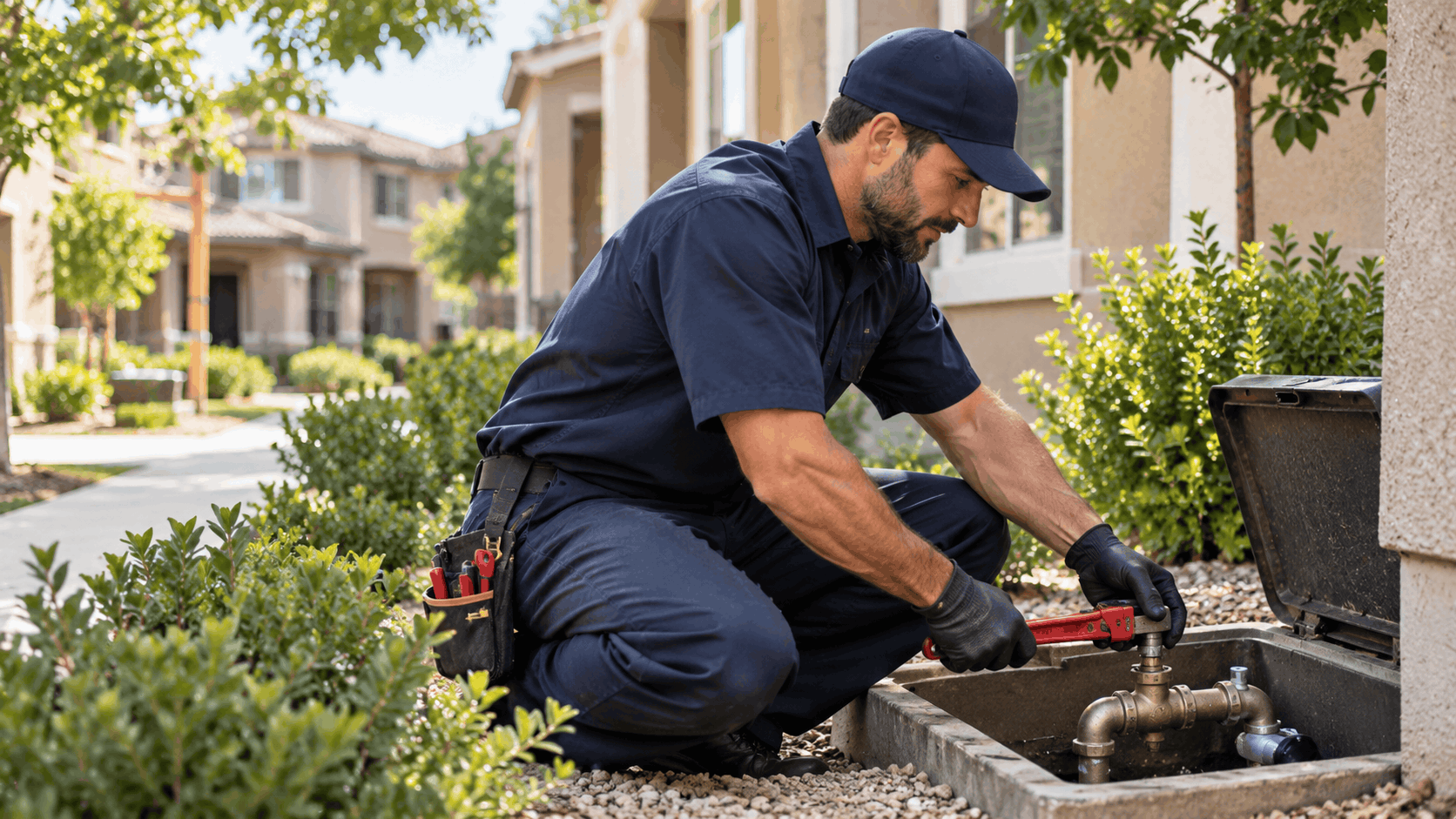
Boards and managers who want a vendor that confirms the right jurisdiction, verifies its license up front, and sends a written price before work starts can reach Active Plumbing at (702) 438-3357. Our team will look at the community's build era and shared systems and map out the work for your exact Henderson address.
Frequently Asked Questions
- Who handles permits for plumbing work in a Henderson HOA community?
- For a Henderson address, permits, plan check and inspections run through the City of Henderson Development Services Center, not Clark County or Las Vegas. Henderson is its own city with its own building department. Because a Henderson mailing address can sit near unincorporated county areas like Whitney township, the permit position should be confirmed for the exact address before any permitted work begins. Getting the jurisdiction right the first time avoids a stalled inspection.
- Does the HOA or the owner pay for a plumbing repair?
- Shared lines, mainlines and common-area fixtures often fall to the association, while fixtures inside a unit fall to the owner. That general pattern is a starting point, not a universal rule. The exact responsibility split lives in your community's governing documents, the CC&Rs and bylaws, and those documents can draw the line in a different place. Boards should confirm the split in their own documents before authorizing a repair, especially on walls shared between two units.
- What pipe is likely in our community?
- It depends on the build era. Pittman carries galvanized steel and cast iron. Early Green Valley, from 1978, and Whitney Ranch fall in the polybutylene window, roughly 1978 to 1995. Gibson Springs and MacDonald Ranch sit in the Kitec era, roughly 1995 to 2007. Copper appears throughout the middle decades, and PEX dominates newer areas like Inspirada and Cadence. Material is always confirmed on site, since tracts get repiped and patched over the years.
- How much does a whole-house repipe cost in Henderson?
- The typical range for a whole-house repipe is $4,000 to $15,000. On association property with similar units, a board can estimate a phased program by applying that per-unit range across the homes that need it. The actual price depends on the specific job, including the size of the home and the pipe material, and Active Plumbing gives a written price before work begins. The range here is for budgeting, not a quote.
- How fast can a plumber reach our property?
- Technicians arrive in 30 to 60 minutes anywhere in the Las Vegas Valley, including Henderson communities from Green Valley to Cadence and out to Lake Las Vegas. For an association facing an active leak in a shared wall, that window limits the water damage and the number of units affected. For guard-gated communities, arranging a gate code or an access-list name in advance keeps a technician from waiting at the entrance.
- Do multifamily and irrigation systems need backflow testing?
- Yes. Backflow prevention is run by the water provider, not the health district. The Las Vegas Valley Water District backflow program requires backflow prevention assemblies on commercial buildings, multifamily properties and irrigation systems. Each assembly must be tested by a certified tester at installation, repair or relocation and at least annually thereafter, with the tester leaving certification on site. For a manager, that annual test is a recurring task across every irrigation point and shared building in the community.
- Why does water hardness matter for shared equipment?
- SNWA reports water hardness of about 280 ppm, roughly 16 grains per gallon, which is categorized as very hard. Scale builds on water heater elements and tank bottoms, clogs aerators and mixing valve passages, and shortens equipment life. Across a community with many shared heaters and fixtures, that effect shows up on roughly the same timeline. Regular flushing, softeners and scale reduction extend equipment life in this valley, so they belong in a community maintenance plan rather than being treated as optional.
- What happens if there is a suspected gas leak on the property?
- Leave the building, avoid light switches and open flames, and call Southwest Gas from outside before calling a plumber. Gas line work in the valley relates to Southwest Gas, the natural gas provider, not NV Energy, which supplies electricity. Once the utility has made the area safe, a licensed plumber can handle the repair. We never walk a customer through repairing, capping or reconnecting a gas line over the phone, because the safe first step is getting people out and the utility notified.
- How do we verify the plumber's license?
- Plumbing contractors are licensed by the Nevada State Contractors Board, which is statewide. Active Plumbing holds license NSCB #0047021, verifiable free at nvcontractorsboard.com, where classification, status, bond and workers compensation are all public record. A board or manager can check all of that in a few minutes before authorizing permitted work on association property. Southern Nevada has a significant unlicensed trade problem, so verification is a reasonable step that protects the association.
- Why is buried line and sewer work more expensive here?
- Caliche is a cemented calcium-carbonate hardpan common across the valley. It is hard to trench through and hard to bed a pipe into evenly, which makes excavation slower and more expensive than digging in softer ground. That trenching cost is a real part of any sewer or mainline job here. Caliche does not swell or crack pipes; it is poorly compacted backfill settling under a line over time that pulls it out of grade, which proper compaction at install prevents.
Licensed plumbing professionals serving Las Vegas and Las Vegas Valley.
Licensed in Nevada · License #0047021
Last updated on
Why trust Active Plumbing?
Founded in 1991, Active Plumbing is a licensed and insured plumber serving Las Vegas and Las Vegas Valley. All content is reviewed by our licensed technicians.
Need Help in Las Vegas?
Active Plumbing serves Las Vegas and all of Las Vegas Valley.
Related Articles
Active Plumbing Service Area Map: Every Las Vegas Valley Neighborhood Covered
See the full Active Plumbing service area map covering every Las Vegas Valley neighborhood, from Summerlin to Henderson to Skye Canyon, plus local plumbing tips.
Drain and Sewer Service in Henderson Green Valley: Slab-Era ABS and Root Barriers
A local guide to drain and sewer service in Henderson's Green Valley, covering slab-era ABS pipe, tree root intrusion, root barriers, camera inspections, and repair options.
Plumbing Service for Summerlin HOA Boards and Property Managers
A guide for Summerlin HOA boards and property managers on confirming permit jurisdiction, pipe material by village, shared-line responsibility, hard water, backflow and typical plumbing costs.