Water Heater Replacement Cost in Spanish Trail for Multi-Unit and Custom Homes
Key Takeaways
- Typical valley ranges: tank $800 to $1,500, tankless $1,500 to $3,500 plus a $150 to $300 pre-filter, and commercial-scale or multi-heater estates $1,500 to $6,000+.
- The single biggest cost driver in Spanish Trail is property type: a detached custom estate runs multiple heaters while villas and condos usually have one.
- On attached and stacked homes, NRS Chapter 116 and the CC&Rs decide whether the owner or the association commissions the replacement, so confirm ownership first.
- Spanish Trail is unincorporated Clark County, so permits run through the Clark County Department of Building and Fire Prevention, not the City of Las Vegas.
- Valley water is 280 ppm, about 16 grains per gallon, categorized very hard, which scales heaters and shortens their life without flushing and treatment.
- Tankless units here need a pre-filter and regular descaling at $150 to $250 because scale clogs the narrow heat exchanger.
- Guard-gate access is arranged in advance through the homeowner, and many Spanish Trail calls come from managers or absentee owners on second homes.
- Active Plumbing is licensed since 1991 under NSCB #0047021, arrives in 30 to 60 minutes valley-wide, and gives a written price before work starts.
In This Article
Behind the guard gate off Tropicana Avenue near Rainbow Boulevard, two Spanish Trail homes can sit a few hundred feet apart and face completely different water heater jobs. A detached custom home on the golf course might run two or three heaters feeding long recirculated hot water lines, while a villa next door shares walls and sometimes shared infrastructure with the unit beside it. A condo in the same community can sit above or below a neighbor, which turns a simple heater swap into a two-property conversation. That is why one address can carry one price and the home across the street carries a very different one.
Here are the typical Las Vegas Valley ranges so a reader has an answer right away. A standard tank water heater installation runs $800 to $1,500. A tankless water heater installation runs $1,500 to $3,500, with a pre-filter adding $150 to $300 where hard water calls for one. A commercial-scale or multi-heater estate job runs $1,500 to $6,000+. These are typical market ranges for the area, not a quote, and the real number for a specific home is given in writing before work begins.
What a Water Heater Replacement Costs in Spanish Trail?
The price depends less on the brand on the box and more on the kind of home it sits in. Spanish Trail was developed from the mid-1980s around its country club, and inside one gate you find custom and semi-custom detached homes, villas and condominiums. Each of those carries a different water heating system, so each lands in a different price band. The table below sets out the typical area ranges for the work most Spanish Trail owners ask about.
| Job | Typical Las Vegas Valley Range | Where It Usually Fits |
|---|---|---|
| Tank water heater installation | $800 to $1,500 | Single-heater condo or villa, or a secondary heater in a larger home |
| Tankless water heater installation | $1,500 to $3,500 (pre-filter adds $150 to $300) | Space-saving or whole-home hot water in any property type |
| Commercial water heater installation | $1,500 to $6,000+ | High-demand or multi-heater custom estate |
| Recirculation pump installation | $400 to $900 | Long hot water runs in a large footprint |
| Water heater repair | $150 to $500 | A single fault on a newer unit |
Treat these as typical ranges for the valley. The written price for a specific job accounts for the heater type, the number of units, the location of the equipment, and any code work the replacement triggers. Our water heater services team settles that scope at the first call so the number is clear before any work starts.
Tank Water Heater Installation: $800 to $1,500
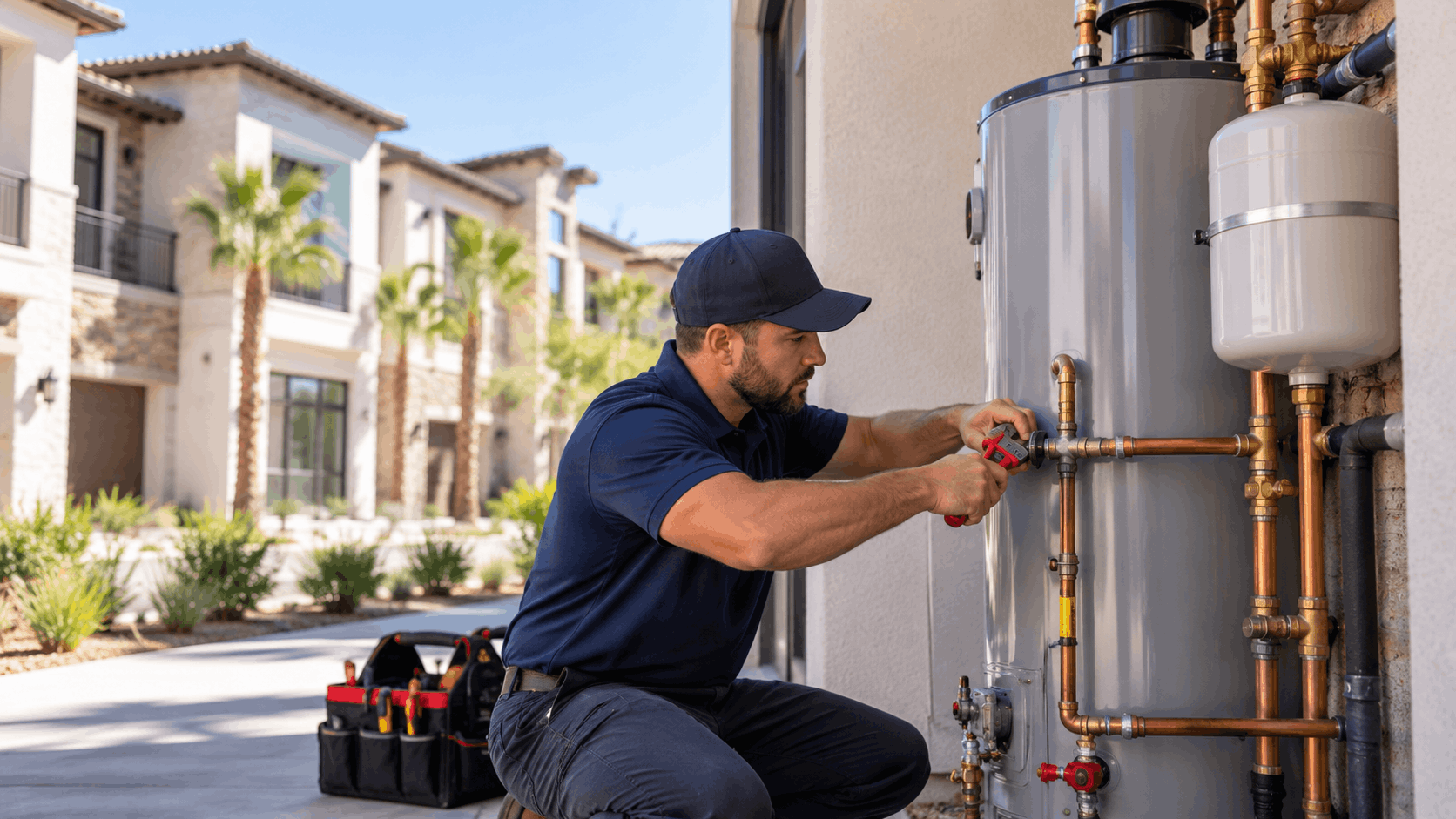
A standard storage tank water heater installation runs $800 to $1,500 across the valley. This is the band most single-heater condos and smaller villas fall into, where one tank serves the whole unit. It also covers a secondary tank in a larger home, where a second heater handles a wing or a guest casita that sits far from the main unit.
A tank heater stores and keeps a volume of water hot, so the cost reflects the tank size, the fuel type, and how the existing connections are set up. In a tight villa closet or an interior utility space, the swap is usually straightforward because the gas, water, and venting are already in place. The installer disconnects the old unit, sets the new tank, reconnects the lines, and brings the setup up to the current code.
Where the number climbs toward the top of the range, it is usually the extras. An older install may lack a proper drain pan, the shut-off may need replacing, or the venting may need correction. On a 1980s-era Spanish Trail home, the original tank is often well past its rated life, so the replacement also becomes a chance to correct anything the first installer left behind. The tank water heater installation scope makes those items clear in writing first.
Tankless Water Heater Installation: $1,500 to $3,500
Tankless water heater installation runs $1,500 to $3,500. A tankless unit heats water on demand through a heat exchanger instead of storing a hot tank, which saves space and gives continuous hot water. That appeals to custom owners who want to free up a utility closet or who run out of hot water on the last shower of a busy morning.
In this valley a tankless unit almost always needs a pre-filter, which adds $150 to $300. The reason is the water itself. The Southern Nevada Water Authority reports valley water at 280 parts per million, or about 16 grains per gallon, categorized very hard. Scale from that hard water collects fastest in the narrow passages of a tankless heat exchanger, so a pre-filter and regular descaling protect the unit from early failure.
Converting a home that never had tankless before can push toward the upper end, because gas sizing, venting, and sometimes a new gas line run come into play. On a straightforward tankless-for-tankless swap the job sits lower in the range. Our tankless water heater installation work accounts for the pre-filter and the descaling plan upfront so the hard water does not quietly shorten the life of a new unit.
Commercial-Scale and Multi-Heater Estates: $1,500 to $6,000+
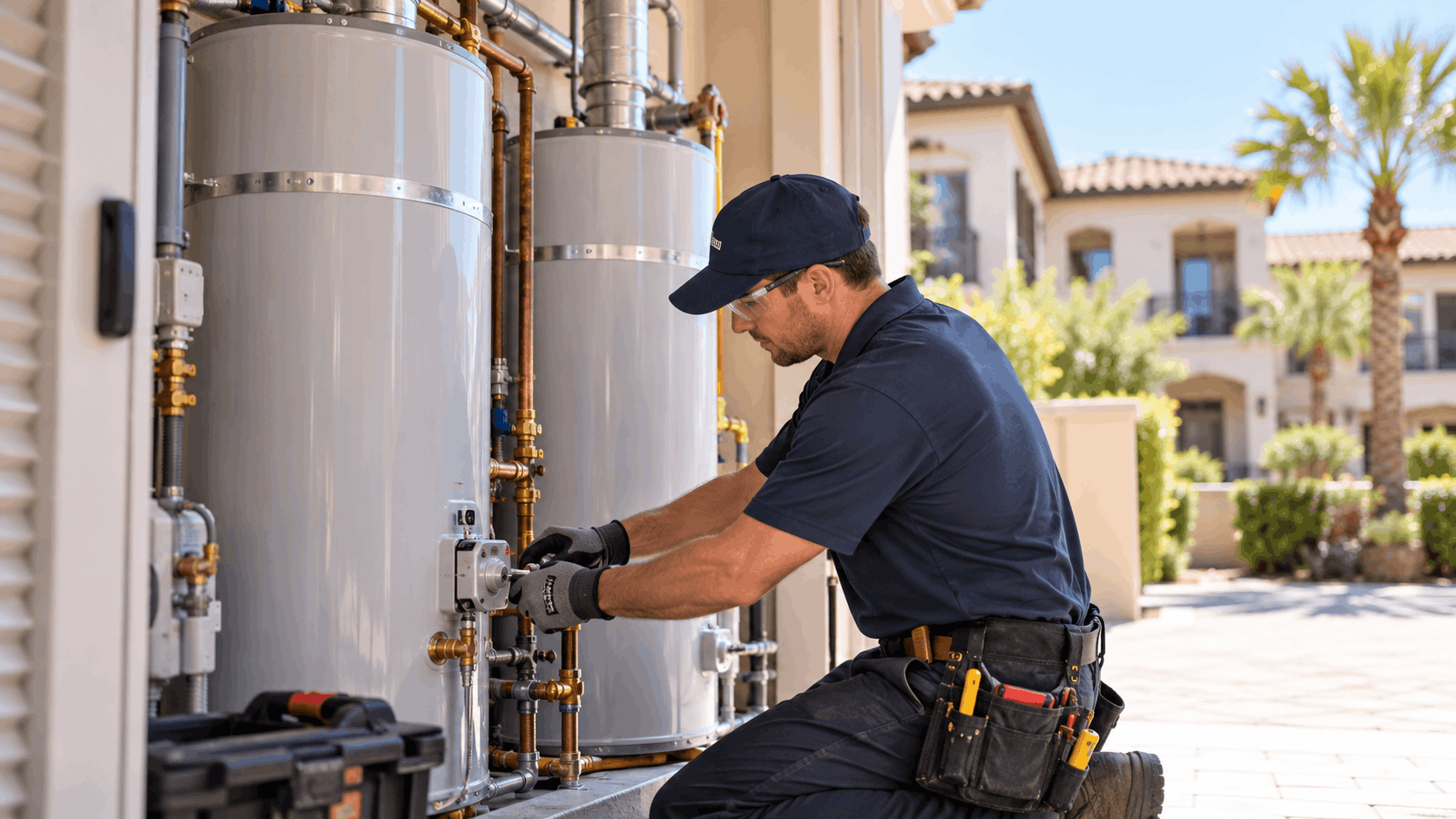
A commercial water heater installation runs $1,500 to $6,000+. A detached Spanish Trail custom home often carries an estate-scale system: two or three heaters, long recirculated hot water loops, pool and spa gas, and outdoor kitchen demand. When the job involves more than one heater, or a high-capacity commercial-grade unit for a large footprint, the total naturally lands higher than a single-tank swap.
Long hot water runs across a big home usually need a recirculation pump, and recirculation pump installation runs $400 to $900. The pump keeps hot water moving through the loop so a far bathroom gets hot water quickly instead of running cold for a minute. On an estate where the master wing sits a long way from the mechanical room, that pump is part of how the system actually performs.
The spread in this range comes down to how many heaters are replaced and how the system is piped. Replacing one of three heaters is a modest job. Replacing all of them, or upgrading to a larger capacity with new recirculation, is a full-day project with real material and labor behind it. The written price lists each unit and each component so the owner sees exactly what the total covers.
Why One Address Can Have Three Different Prices
Spanish Trail is unusual because three distinct property types live behind one gate. A detached custom home has an estate-scale system, so it lands in the commercial or multi-heater band more often than not. A single-heater condo or villa sits in the standard tank or tankless band. The system drives the price, not the neighborhood name.
That is why a quote over the phone without knowing the property type is close to guesswork. A villa owner expecting a $1,000 tank swap and a custom owner replacing three heaters are both correct about their own homes, but they are asking about different jobs. Establishing the property type first is the step that makes the price accurate.
There is a second reason the number can shift: who owns the equipment on attached and stacked product. On a villa or condo, the line between the owner's interest and association-maintained infrastructure can change who commissions the work. That is covered in detail further down, but it is worth flagging here because it affects the final number before a single part is ordered.
Get Your Quote
Tell us what's going on and we'll get back to you fast.
Three Property Types Inside the Gate, Three Different Jobs
The single biggest cost driver in Spanish Trail is not the heater brand or the time of year. It is which of the three property types the home is. Getting that straight at the first call decides the scope, the price, and sometimes who is even entitled to authorize the work. Here is how each type changes the job:
- Detached custom home: an estate-scale system with multiple heaters and recirculation
- Villa or attached home: shared walls and sometimes shared infrastructure
- Condominium: a unit stacked above or below a neighbor
Each of those carries a different system, a different ownership picture, and a different access situation. Below, each type connects to the price band that usually fits it.
Detached Custom Homes with Estate-Scale Systems
A Spanish Trail custom home is built like a small commercial property on the hot water side. It commonly runs multiple water heaters so that distant wings and casitas get hot water without a long wait. Long hot water runs mean a recirculation system is usually part of the design, keeping water moving so the far faucets deliver hot quickly.
These homes also carry pool and spa gas, outdoor kitchens, and extensive irrigation and yard lines, which means the plumbing system is larger and more interconnected than a tract home. When a heater fails on one of these properties, the question is whether to replace that one unit or address the whole system while the mechanical room is open.
Replacing one of several heaters is a targeted job that may sit in the tank band. Replacing all of them, or upgrading capacity and adding or correcting recirculation, moves the total into the commercial range of $1,500 to $6,000+ plus $400 to $900 for a recirculation pump. Owners of estate homes generally want the written price to lay out each piece so they can decide one heater versus the full set.
Villas and Attached Homes with Shared Infrastructure
A villa or attached home shares walls with a neighbor and often shares infrastructure. That changes the first question from "which heater do you want" to "what part of this is yours to replace." On attached product, plumbing inside a wall or beneath a slab can belong to the owner or to the association depending on the governing documents.
This matters before anything is ordered. If the heater and its connections fall within the owner's separate interest, the owner commissions the replacement directly. If a shared line or a common element is involved, the association may be the party that must authorize or perform the work. Sorting that out first avoids a halfway-done job and a dispute over who pays.
A single-heater villa itself usually sits in the standard tank or tankless band once ownership is clear. The complication is never the heater, it is the shared infrastructure around it. We settle the ownership question at the first call for attached homes in Spring Valley so the owner knows the path before the appointment is set.
Condominium Units Stacked Above or Below a Neighbor
A condominium unit can sit above or below another household, and that single fact changes a water heater job. A heater failure or a leak in a stacked unit is a two-property problem, not a one-property problem. Water from an upper unit heater finds the ceiling of the unit below, so timing, access, and authorization all involve more than one home.
That two-property reality affects the schedule because access to the neighboring unit may be needed to inspect for damage or to shut water down safely. It also affects who authorizes the work, since a leak that crosses into another unit can bring the association and a second owner into the conversation.
On the equipment itself, a single-heater condo usually lands in the tank band of $800 to $1,500 or the tankless band of $1,500 to $3,500. The cost pressure comes from the stacked layout and the need to protect the unit below, not from the heater size. A fast, clean shut-off and a tidy swap matter more here than anywhere else in the community.
How Property Type Changes the Final Number
Placing a home in the right band is straightforward once the type is known. A detached custom home with multiple heaters and recirculation leans toward the commercial range of $1,500 to $6,000+, often with a $400 to $900 recirculation pump. A villa or a condo with one heater sits in the tank band of $800 to $1,500 or the tankless band of $1,500 to $3,500.
The property type is the cost driver because the system is the cost driver. More heaters, longer runs, and recirculation add material and labor. A single unit in a tight closet is a contained job. The gate address is the same for all three, but the work is not.
That is why the first call on a Spanish Trail job starts with the property type rather than the heater model. Once that is settled, the right price band is clear, and the written price fills in the specifics for that exact home.
Need Help in Las Vegas?
Active Plumbing serves Las Vegas and all of Las Vegas Valley.
Who Owns the Water Heater: Owner or Association
On attached and stacked homes, the owner cannot always commission the replacement without checking who owns the equipment. In a common-interest community the line between a unit, a common element, and a limited common element decides who is responsible. That line needs to be settled before a heater is ordered, because ordering the wrong party's equipment is a wasted trip.
Nevada Revised Statutes Chapter 116 and the Governing Documents
Common-interest communities in Nevada are governed by Nevada Revised Statutes Chapter 116. Under that framework, the association's governing documents define what counts as a unit, what counts as a common element, and what counts as a limited common element. Those definitions are not the same from one community to the next.
On attached product, plumbing inside a wall or beneath a slab can sit on either side of that line depending on the document. A water heater that seems obviously the owner's can be tied to shared infrastructure that the association maintains. The CC&Rs or the management company hold the answer.
For a detached custom home, the owner generally controls the interior system and commissions the work directly. For villas and condos, confirming the ownership line with the association or management company comes first. It is worth reading the governing documents or making one phone call before scheduling, because it decides who even has the authority to approve the job.
When Architectural Review Applies to an Exterior Unit
Spanish Trail maintains architectural standards that cover exterior appearance. An exterior tankless unit, a visible softener, a treatment system, or anything mounted on a visible elevation can need architectural approval before it goes up. Interior work, by contrast, usually does not trigger that review because nothing changes on the outside of the home.
This matters for timing. A tankless unit that mounts on an exterior wall, or a softener that would sit where it is visible, may need the association to sign off first. That review can add time to the project, so it should be confirmed with the association early rather than discovered after the equipment arrives.
The practical move is simple. If the replacement keeps everything inside and out of sight, architectural review is usually not a factor. If the plan puts a unit on a visible elevation, confirm the approval path with the association before the install date is locked in.
Association Approval and County Permit Are Separate Tracks
Association approval and a county permit are two different things, and where both apply they run on separate tracks. The association reviews appearance and ownership. Clark County reviews the permit and the code. One does not stand in for the other, and both can affect timing and therefore cost.
Because they are separate, they should be lined up together at the start. An owner who clears the HOA but forgets the permit, or pulls the permit but misses an architectural review for an exterior unit, ends up waiting twice. The fix is to confirm both with the management company and the county at the same time.
For a straightforward interior tank or tankless swap in a detached home, the HOA track is often a non-issue and the permit track is the main item. For attached product with an exterior unit, both tracks are live. Confirming the position for the exact home keeps the schedule honest.
Guard-Gate Access and How It Affects the Job
Spanish Trail is guard-gated with private streets and villa courts inside. Those features do not change the plumbing, but they do shape the logistics, and logistics touch timing and the practical side of carrying equipment in. Getting the access right before the van rolls keeps the job on schedule.
Access Is Authorized Through the Homeowner in Advance
Contractor access in Spanish Trail is authorized ahead of time through the homeowner, not arranged at the gate on the day. The guard works from the owner's authorization, so the appointment has to include that step. Showing up without it means waiting at the gate while calls get made.
Associations of this type frequently maintain approved vendor records or require insurance documentation on file. That is common for guard-gated country club communities, and it is worth confirming how the community handles it when the appointment is booked. A licensed contractor with documentation in order clears that step cleanly.
The practical takeaway is to arrange access at booking rather than on arrival. When the owner authorizes the visit in advance and any vendor paperwork is squared away, the crew gets to the door on time and the heater work starts without delay.
Private Streets, Villa Courts, and Parking
Inside the gate, private streets and villa courts mean the working position can be well inside the property. A heater swap involves carrying a tank or a tankless unit, tools, and the old heater back out, so where the van can park affects how the work goes.
Parking a vehicle in a villa court affects more than one household, because those courts are shared. A crew that blocks a court inconveniences several neighbors, so planning the parking and the carry path is part of a considerate job in this community. It is a small thing that matters on a shared private street.
For a detached custom home with a long driveway, this is rarely an issue. For a villa in a shared court, confirming the parking and access route at booking keeps the equipment move smooth and keeps the neighbors clear. The physical layout, not the heater, is what makes this step worth planning.
Who Calls: Owners, Tenants, and Property Managers
Spanish Trail holds a significant share of second homes, seasonal residents, and rental or managed property alongside full-time owners. That means calls come from owners who are elsewhere, from tenants, and from property managers, not only from residents standing in the house.
Spring Valley overall is about half renter-occupied, with an owner-occupied rate near 50.5 percent, so the decision maker on a large share of jobs is not the person in the home. A tenant reports the problem, but the owner or the manager authorizes the work and handles payment. Sorting out who approves the job belongs in the first call.
Establishing who authorizes the work and who pays upfront avoids a stalled job later. When a manager calls for a seasonal owner, or a tenant reports a failing heater, the chain of approval needs to be clear before the crew is dispatched. That is a routine first step on managed property in this community.
Empty and Seasonally Occupied Homes
A seasonally empty home raises the value of a shut-off check. A failing or leaking heater in an occupied house gets noticed fast. In a home that sits empty for weeks, a slow leak can run undetected and cause real damage before anyone sees it.
That is why a shut-off and a quick system check matter so much for second homes here. Knowing where the main shut-off is, and confirming it works, gives an owner or manager a way to limit damage if a heater lets go while the home is empty. It is cheap insurance against a long-running leak.
For owners who split time elsewhere, pairing a heater replacement with a review of the shut-off and a whole-home leak detection system is worth considering. A leak detection system can catch a problem in an empty home before it spreads, which is exactly the risk a seasonal property carries.
Very Hard Water and the Hidden Cost It Adds
Hard water is the reason many Spanish Trail heaters reach the end early, and it is a cost that keeps running after the install. The valley's water is very hard, and that scale works against every heater in the home. On an estate with multiple units, that cost multiplies across the system.
| Issue from very hard water | Effect on the system | Response |
|---|---|---|
| Scale on elements and tank bottoms | Heater works harder, fails earlier than its rated life | Regular flushing |
| Scale in a tankless heat exchanger | Narrow passages clog, speeding up failure | Pre-filter plus descaling |
| Scale across multiple heaters and recirculation | Whole estate system affected at once | Softening or scale reduction |
280 PPM, About 16 Grains Per Gallon, Categorized Very Hard
The Southern Nevada Water Authority states the valley's water is 280 parts per million, or 16 grains per gallon, categorized as very hard. Most valley homes are served Colorado River water from Lake Mead, treated by SNWA, so this is the water running through every Spanish Trail heater.
Very hard water deposits calcium and magnesium scale as it heats. Inside a tank heater, that scale builds on the heating elements and settles on the tank bottom. The heater then has to work harder to push heat through a layer of mineral, which wastes energy and stresses the unit.
The result is a tank that works harder and fails earlier than its rated life when it is left unflushed. That is why scale is a leading reason heaters get replaced here. The hardness number is the published figure, not a guess, and it explains more heater failures in this valley than anything else.
Why Tankless Heaters Need a Pre-Filter Here
A tankless heater sends water through a heat exchanger, which is a narrow passage. Scale from very hard water collects fastest exactly in those narrow passages, so a tankless unit here is more sensitive to hard water than a storage tank. Left unaddressed, scale clogs the exchanger and speeds up failure.
That is why a tankless install in this valley almost always includes a pre-filter, which adds $150 to $300. The pre-filter reduces the mineral load reaching the exchanger, which protects the most expensive part of the unit. Skipping it on valley water is a short-term saving that costs more later.
Ongoing care matters too. Tankless maintenance and descaling runs $150 to $250, and it clears the mineral buildup before it chokes the exchanger. Scheduling tankless maintenance and descaling on a regular cycle is how a tankless unit reaches its full life in hard water instead of failing early.
Softening and Scale Reduction Across a Large System
On a custom home with multiple heaters and long recirculation loops, the hard water hits the whole system at once. Whole-house softening or scale reduction protects every heater and the recirculation across a long footprint, rather than treating one unit at a time. That is a better return on an estate-scale system than letting scale work through all of it.
Water softener installation runs $800 to $2,500, and salt-free water conditioning runs $800 to $2,500 installed. A softener removes the hardness minerals, while a salt-free conditioner changes how the minerals behave so they scale less. Either one eases the load on multiple heaters, fixtures, and recirculation at the same time.
In villas and condos where space is tighter, the treatment unit may need to sit somewhere the association will accept, which can touch the architectural standards covered earlier. That is one more reason to confirm placement before installing. A water softener installation protects the heater investment across the whole system.
Flushing Is Maintenance, Not an Upsell
Flushing a water heater clears the sediment and scale that settle in the tank. In this valley, with water at 280 ppm, that flushing extends heater life rather than being optional. A tank left unflushed carries a growing layer of mineral that makes the heater work harder every year.
Catching a problem early also keeps the bill down. Water heater repair runs $150 to $500, which is far below the cost of a full replacement. A failing element, a bad valve, or a thermostat issue caught in time can be fixed rather than replaced, especially on a newer unit.
Regular flushing and a quick response to early warning signs are how a heater reaches its rated life here. On a Spanish Trail custom home with several heaters, a maintenance routine protects a large investment and spreads the replacements out instead of facing them all at once.
Need Help in Las Vegas?
Active Plumbing serves Las Vegas and all of Las Vegas Valley.
What Actually Drives the Price on Your Install
Within every range there is a low end and a high end, and specific factors decide where a job lands. Understanding those factors lets an owner see what their own number depends on before the written price arrives.
Tank vs Tankless and Gas vs Electric
The clearest price gap is tank versus tankless. A tank install runs $800 to $1,500, while a tankless install runs $1,500 to $3,500 plus the $150 to $300 pre-filter for hard water. The tankless unit costs more upfront but saves space and gives continuous hot water, so the choice is about priorities, not just price.
Fuel type matters too. Gas work in the valley relates to Southwest Gas, which supplies natural gas here, while electric or heat pump water heater running costs relate to NV Energy for electricity. Gas sizing, pressure testing, and any gas line coordination fall under Southwest Gas, not the power company.
One note on heat pump water heaters: the federal Energy Efficient Home Improvement Credit under Section 25C applied only to equipment placed in service by December 31, 2025. It ended after that date, so it should not be counted on for a 2026 install. Any utility or manufacturer rebate changes often and should be checked against the current program before it factors into a decision.
Number of Heaters and Length of Hot Water Runs
A custom home with two or three heaters and long recirculated runs costs more than a single-heater condo. That is the simplest reason one address runs high and another runs low. Every additional heater is additional equipment and additional labor.
Long hot water runs add the recirculation factor. A recirculation pump install adds $400 to $900, and on a large footprint it is often not optional because the far bathrooms would otherwise run cold for too long. The pump is part of making the estate system actually deliver hot water on demand.
When a job replaces all the heaters on an estate at once, the material and labor stack up, which is why it lands in the commercial range. Replacing a single failed unit on the same home is a far smaller job. The written price breaks each unit and component out so the owner sees what drives the total.
Code Upgrades Required at Replacement
Southern Nevada adopted the 2024 Uniform Plumbing Code with Southern Nevada Amendments, and Clark County codified it. A replacement has to meet the current code, which can add to the job if the old install predated the current requirements. On a 1980s-era Spanish Trail home, that gap is common.
One requirement that often applies is the water heater drain pan. The amendments require a drain pan where a leak would cause damage, such as an attic or a floor-ceiling assembly, with a drain not less than 3/4 inch to a visible approved location and a pan at least 1-1/2 inches deep. Readily accessible tankless and point-of-use heaters are treated differently.
Bringing an older install up to these requirements, adding a pan and a proper drain, or correcting venting and connections, adds to the job. It is money well spent, because a pan and drain protect the home if the heater ever leaks. Confirm the exact requirements for the specific home with the county, since code details are updated.
Access, Location, and the Guard-Gate Reality
Where the heater sits affects labor. A heater in an attic or a tight villa closet takes more time and care to swap than one sitting in an open garage. Attic installs in particular add labor, and they are exactly where a drain pan requirement tends to apply.
The guard-gate logistics from earlier feed into this too. Controlled gate access and private-court parking shape the timing of the install, which is why arranging access in advance keeps the labor efficient. A crew held at the gate or hunting for parking in a court loses working time.
None of these change the heater itself, but they change the hours on the job. A clear access path, confirmed authorization, and an open working position keep a replacement on the efficient end of its range. The written price reflects the real location and access for the home.

Replacement, Repair, or Treatment: Making the Call
Not every failing heater needs replacing, and not every new heater is protected without treatment. The honest call depends on the unit's age, its condition, and the water it runs on. Here is the cost logic behind each path in a high-value home.
When Repair Makes More Sense Than Replacement
Water heater repair runs $150 to $500, and on a newer unit with a single fault it is often the right call. A failed thermostat, a bad element, a leaking valve, or a faulty gas control can be replaced without touching the rest of the heater. If the tank itself is sound, repair keeps a good unit in service.
The math shifts with age. Spending $400 on a repair for a heater near the end of its life risks another failure soon after. On a unit that is holding up well otherwise, that same repair buys years. The test is whether the tank and the core of the unit are still in good shape.
A quick diagnostic sorts this out. Checking the age, the condition of the tank, and the amount of scale buildup tells whether a repair is a smart fix or a short reprieve. On a newer heater, repair is usually the economical path.
Age and Scale: When a Tank Has Reached the End
Scale buildup and age together push a heater past its rated life. In this valley, scale from 280 ppm water collects on elements and the tank bottom, and an older tank carries years of that buildup. At some point the heater is working so hard against the scale that replacement beats another repair.
Spanish Trail homes developed from the mid-1980s are roughly forty years old, so their original heaters are long past replacement age, and any that have been swapped once may be due again. A heater that is well into its second or third decade, scaled up and struggling, is usually in replacement territory rather than repair territory.
Signs the end has arrived include rusty water, popping or rumbling from sediment, slow recovery, and leaks at the tank body. A leaking tank is not repairable. When those signs show up on an older, scaled unit, replacing it is the sound financial call, and it is the moment to bring the install up to current code.
Protecting the New Heater with Treatment
Pairing a new heater with softening or scale reduction protects the investment across a large system. There is little point installing a fresh heater, or several, only to let the same hard water scale them up at the same rate. Treatment addresses the cause rather than just the symptom.
The treatment ranges were covered earlier: water softener installation at $800 to $2,500 and salt-free water conditioning at $800 to $2,500 installed, with placement in villas and condos subject to where the association will accept the unit. On a custom home with multiple heaters, treatment protects all of them at once.
For a reader replacing a heater because scale shortened its life, treatment is the step that keeps the next one from going the same way. It turns a recurring replacement cycle into a longer-lived system, which is the better return on a high-value home.
Permits, Licensing, and Local Jurisdiction in Spanish Trail
The regulatory side bears directly on a permitted replacement here, and Spanish Trail sits in a specific jurisdiction that decides how it runs. Getting the authority right is a routine first step on a permitted job.
Spanish Trail Is Unincorporated Clark County
Despite the Las Vegas mailing address, Spanish Trail sits in the unincorporated town of Spring Valley, which is Clark County rather than the City of Las Vegas. That means permits and inspections run through the Clark County Department of Building and Fire Prevention, not a city counter.
This catches people out because residents describe the area as Las Vegas. The community is west of the Strip on the south side of Tropicana Avenue near Rainbow Boulevard, and it is county jurisdiction. The Southern Nevada Amendments to the Uniform Plumbing Code apply as codified by the county.
Knowing the correct department before quoting permitted work is the first step. A permit position confirmed for the exact Spanish Trail address through Clark County is the one that applies, since the valley is not a single permitting authority. You can read more about the area on our Spring Valley page.
Who May Perform Permitted Work
Permitted plumbing work in Nevada must be performed by a contractor licensed through the Nevada State Contractors Board. There is no statewide plumbing code, but the licensing is statewide, and the board holds the license classifications, status, bond, and workers compensation as public record.
An owner is entitled to ask for a license number and to verify it free at nvcontractorsboard.com. That matters in a market with a real unlicensed trade problem, and checking the license is a simple way to confirm the work will meet code and pass inspection.
Confirm the permit position for the exact address before work begins, since the requirement depends on the specific job. A replacement that triggers a permit runs through Clark County with a licensed contractor doing the work. That keeps the install documented and the inspection on record.
How Permit and HOA Timing Affect the Schedule
The permit track and the association approval track can each add time, and they run independently. A permit through Clark County takes its own course, and an architectural review for an exterior unit takes another. Both should be lined up early when the appointment is booked so neither one stalls the job.
For a straightforward interior swap in a detached home, the HOA track is often a non-issue and the permit is the main item. For attached product with an exterior tankless unit, both are live. Confirming each with the management company and the county at the same time keeps the schedule honest.
Planning both tracks at booking is how a replacement stays on schedule. Our water heater services team handles the permit and the access arrangements together so the owner is not caught waiting on one while the other is ready.

Need Help in Las Vegas?
Active Plumbing serves Las Vegas and all of Las Vegas Valley.
How Active Plumbing Handles a Spanish Trail Water Heater Replacement
Working behind the gate takes a different first call than a tract home. The scope, the authorization, and the access all get settled before the van arrives, so the price and the plan are clear upfront.
Confirming Property Type and Access at the First Call
The first call establishes the property type, because that decides the scope and the price band. Whether the home is a detached custom property, an attached villa, or a stacked condo changes the job and sometimes who can authorize it. That gets sorted before anything else.
We also confirm who authorizes the work. On managed or seasonal property, that is the owner or the property manager rather than the person in the house, so we settle the chain of approval early. For attached product, we check the ownership line so the right party commissions the work.
Gate access is arranged ahead of time through the homeowner, not at the gate on the day, so we coordinate authorization and any vendor documentation at booking. By the time the crew arrives, the scope, the approval, and the access are all in place.
A Written Price Before Work Starts
We give the customer a written price before work starts. On a Spanish Trail job that price reflects the property type, the number of heaters, the equipment location, and any code work the replacement triggers. The owner sees the number before committing to the job.
Technicians arrive in 30 to 60 minutes anywhere in the Las Vegas Valley. That window matters for a failing or leaking heater, and it matters more for a stacked condo or a seasonal home where a leak can spread. A quick arrival plus a clear written price keeps the job predictable.
A diagnostic comes first on a repair-versus-replace question, so the recommendation matches the actual condition of the unit. The written price then lays out whether the path is a repair at $150 to $500, a tank or tankless replacement, or a multi-heater estate job.
Licensed, Local, and Verifiable Since 1991
Active Plumbing is a fourth-generation family plumbing business that has served the Las Vegas Valley since 1991. We hold Nevada plumbing license NSCB #0047021, verifiable free at nvcontractorsboard.com, along with the certifications required for the work we perform. Some of our owners are US military veterans.
More than thirty years working this valley means we know the difference between a Spanish Trail custom estate and a stacked villa before we arrive. We have completed hundreds of repipes and heater jobs across the valley, and that experience shows in how we scope a guard-gated, multi-property community like this one.
An owner is entitled to verify the license, and we encourage it. The board's site shows the classification, status, bond, and workers compensation as public record, so a homeowner can confirm the credentials before scheduling the work.
Ready to Replace a Water Heater in Spanish Trail?
Call Active Plumbing at (702) 438-3357 and we will confirm your property type, arrange gate access through you in advance, and give you a written price before any work starts. Whether it is a single villa tank or a multi-heater estate system behind the gate off Tropicana, the first call settles the scope so the number is clear up front.
Frequently Asked Questions
- How much does a water heater replacement cost in Spanish Trail?
- Typical Las Vegas Valley ranges are tank installation at $800 to $1,500, tankless at $1,500 to $3,500 plus $150 to $300 for a pre-filter in hard water, and commercial-scale or multi-heater estates at $1,500 to $6,000+. These are typical area ranges, not a quote. The number for a specific Spanish Trail home depends on the property type, the number of heaters, and the equipment location, and it is given in writing before work starts.
- Why is a custom home water heater replacement more expensive than a condo?
- A detached custom home often runs two or three heaters with long recirculated hot water loops across a large footprint, which is an estate-scale system. That lands in the commercial range of $1,500 to $6,000+, often with a $400 to $900 recirculation pump. A single-heater condo sits in the tank band of $800 to $1,500 or the tankless band. More heaters and longer runs mean more equipment and labor, so the total is higher.
- Do I need HOA approval to replace my water heater in Spanish Trail?
- An interior swap usually does not need architectural review because nothing changes on the outside. An exterior tankless unit or any visible unit on a visible elevation can need approval under the community's architectural standards. On attached villas and condos there may also be ownership questions about what is the owner's interest versus association-maintained. Confirm both the appearance and ownership position with the association or management company before ordering.
- Tank or tankless for a Spanish Trail custom home?
- A tank install runs $800 to $1,500 and stores hot water; a tankless install runs $1,500 to $3,500 and heats on demand with continuous hot water and space savings. In this valley a tankless unit needs a pre-filter, adding $150 to $300, because very hard water scales the narrow heat exchanger. A custom home with long runs may use several units with recirculation. The right choice depends on demand, space, and the system layout.
- Does Spanish Trail's hard water affect my water heater?
- Yes. The Southern Nevada Water Authority reports valley water at 280 parts per million, or about 16 grains per gallon, categorized very hard. Scale builds on tank heating elements and tank bottoms, so the heater works harder and fails earlier than its rated life when left unflushed. In tankless units scale clogs the narrow heat exchanger. Regular flushing, a pre-filter on tankless units, and whole-house softening protect the equipment.
- Who do I call if I rent or manage a Spanish Trail property?
- A tenant reports the problem to the landlord or property manager, who authorizes the work and handles payment. Spring Valley is roughly half renter-occupied, so the decision maker is often not the person in the home. Spanish Trail also holds many second homes and seasonal residents, so managers and absentee owners call frequently. We settle who authorizes the work and who pays at the first call before dispatching a crew.
- Is a permit required to replace a water heater in Spanish Trail?
- Spanish Trail is in unincorporated Clark County, not the City of Las Vegas, so permitted work runs through the Clark County Department of Building and Fire Prevention under the Southern Nevada Amendments to the Uniform Plumbing Code. Permitted work must be performed by a contractor licensed through the Nevada State Contractors Board, verifiable at nvcontractorsboard.com. Confirm the exact permit position for your specific address, since requirements depend on the job.
- Is there a tax credit for a heat pump water heater in 2026?
- No. The federal Energy Efficient Home Improvement Credit under Section 25C applied only to heat pump water heater equipment placed in service by December 31, 2025. It ended after that date, so it should not be counted on for a 2026 install. Utility or manufacturer rebates may still exist but change often, so check the current program before factoring one into your decision.
- Should I repair or replace my water heater?
- Repair runs $150 to $500 and is often the right call on a newer unit with a single fault, such as a bad element, thermostat, or valve, when the tank itself is sound. An older tank heavily scaled from very hard water, or a leaking tank, is usually a replacement. Pairing a new heater with softening or scale reduction protects the investment. A diagnostic sorts out which path fits the unit's age and condition.
- How soon can a plumber reach a Spanish Trail home?
- Technicians arrive in 30 to 60 minutes anywhere in the Las Vegas Valley. For a guard-gated community like Spanish Trail, gate access is arranged in advance through the homeowner rather than at the gate on the day, so the authorization and any vendor documentation are coordinated at booking. That keeps the crew moving through the gate on time instead of waiting while calls are made.
Licensed plumbing professionals serving Las Vegas and Las Vegas Valley.
Licensed in Nevada · License #0047021
Last updated on
Why trust Active Plumbing?
Founded in 1991, Active Plumbing is a licensed and insured plumber serving Las Vegas and Las Vegas Valley. All content is reviewed by our licensed technicians.

Need Help in Las Vegas?
Active Plumbing serves Las Vegas and all of Las Vegas Valley.
Related Articles
Water Heater Replacement in Aliante and North Las Vegas - Builder-Grade Unit Failures at Year 10
Builder-grade water heaters across Aliante fail right around year 10. Learn the warning signs, replacement costs, tank vs tankless choices, and how to make a new unit last in North Las Vegas hard water.
How Much Does Water Heater Replacement Cost in Las Vegas?
Water heater replacement cost in Las Vegas depends on tank vs tankless, size, and permits. Vegas hard water shortens tank life. Here's what to expect and how to get a fair quote.

Water Heater Replacement Cost in Sun City Summerlin for Late 1980s and 1990s Homes
What water heater replacement really costs in Sun City Summerlin homes from 1989 to the 1990s, shaped by unit type, the 2024 code, hard water, and City of Las Vegas permits.