Polybutylene Pipe in Late 1970s and 1980s Spring Valley Homes: Finding It Before It Fails
Key Takeaways
- Central Spring Valley tract homes built roughly 1978 to 1995 are the polybutylene window, where the gray plastic supply pipe fails at its fittings.
- Spot polybutylene by its dull gray color and crimped fittings at the water heater, under sinks and the main shutoff, but confirm the material on site rather than from the build year alone.
- Fittings are the weak point, so a slow seep at a joint is the common first sign; the valley's very hard water at about 280 ppm adds scale and stress to an aging system.
- Watch for damp spots, stains, a musty smell, pressure drops, recurring joint repairs, and a climbing water bill as early warning signs of a hidden leak.
- Polybutylene is a standard repipe candidate because the fittings keep failing; copper and PEX are the common replacement materials in newer valley construction.
- Typical Las Vegas Valley ranges: whole-house repipe $4,000 to $15,000, burst pipe repair $200 to $800, electronic leak detection $150 to $350, slab leak repair $500 to $3,000.
- Spring Valley is unincorporated Clark County, so permits, plan check and inspections run through the county, confirmed from the parcel; work must be done by a Nevada State Contractors Board licensed contractor.
- Active Plumbing, a fourth-generation family business serving the valley since 1991 under NSCB #0047021, confirms the pipe on site, gives a written price before work starts, and arrives in 30 to 60 minutes valley-wide.
In This Article
A homeowner in central Spring Valley spots a damp patch on the drywall near the water heater, then notices the gray plastic pipe running out of the wall behind it. The question comes fast: is that pipe the problem, and is it about to flood the house? If the home was built roughly 1978 to 1995, the answer is often yes. That gray plastic is likely polybutylene, a supply pipe that fails at its fittings, and catching it before it bursts is far cheaper and cleaner than mopping up after it lets go.
Central Spring Valley, the big body of tract housing between Rainbow, Jones, Flamingo and Tropicana, sits squarely in that build window. Production builders ran these phases through the late 1970s, 1980s and early 1990s, and polybutylene was a common supply material in those years. The material itself rarely splits down the middle. The weak point is where the pipe meets a fitting, and that is where a slow seep usually starts.
What Polybutylene Pipe Is and Why Spring Valley Has So Much of It?
Polybutylene is a flexible plastic supply pipe that builders used widely from the late 1970s into the 1990s. It was cheap, easy to run, and fast to install, which is exactly why production builders reached for it when they were delivering valley tracts in phases. In Spring Valley, where whole neighborhoods went up in a short span, that meant one material went into hundreds of homes at once.
The pipe carries potable water to fixtures, so it runs through walls, under sinks, and across the attic to feed every faucet, shower and toilet in the house. When it was new, it looked like a modern upgrade over copper. The trouble showed up later, at the joints, after years of service in real-world water and temperature conditions.
Understanding the material and the era it belongs to tells a Spring Valley owner most of what they need to know before a plumber even arrives. The build year points to the likely supply pipe, and the supply pipe points to the likely failure. From there it is a matter of confirming what is actually behind the walls.
The gray or blue plastic supply pipe explained
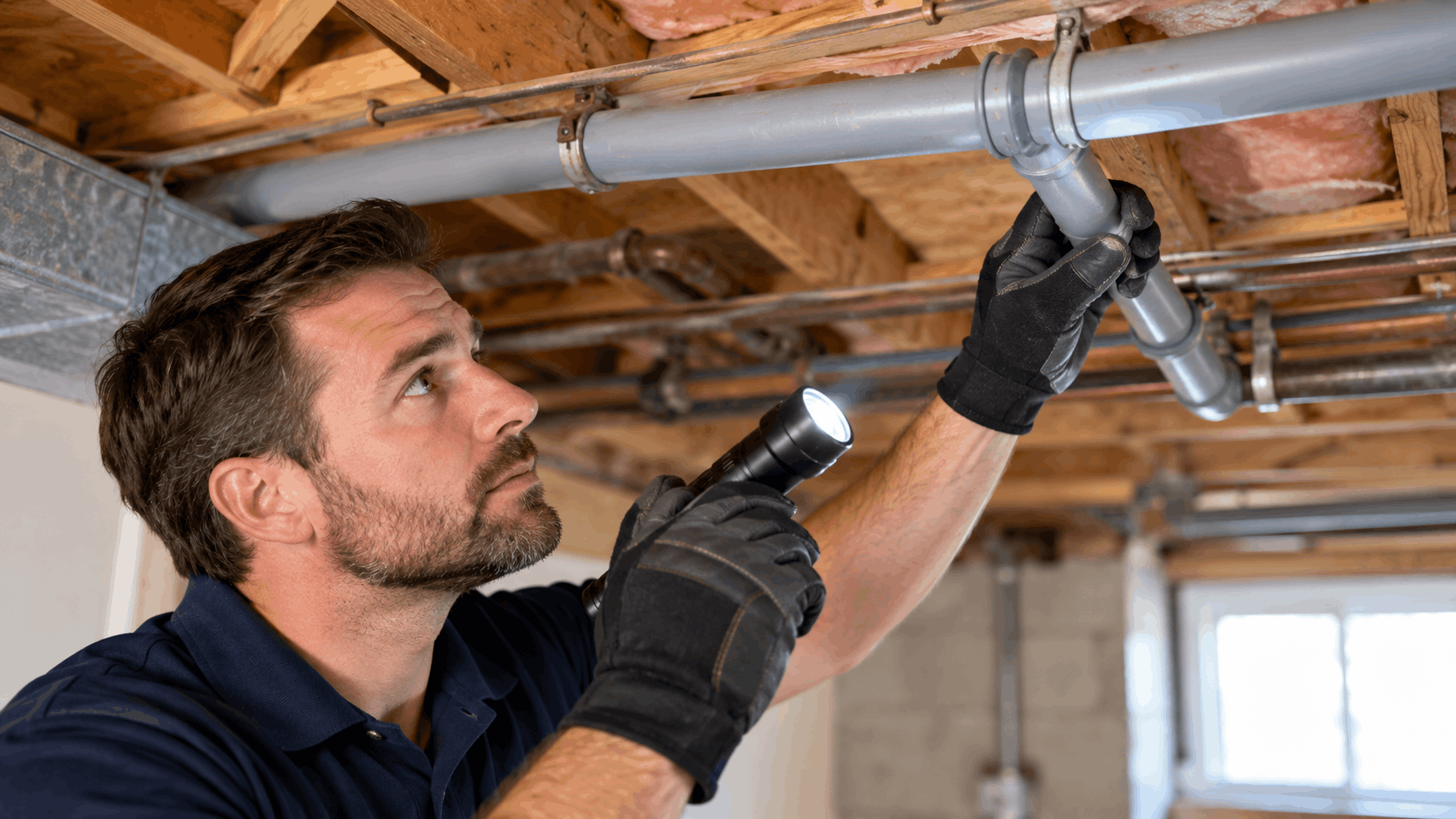
Polybutylene is usually gray, though blue versions exist and show up on exterior or underground runs. It is a soft, flexible plastic with a slightly waxy, matte surface, and it bends in gentle curves rather than running in rigid straight lines. A homeowner who sees a dull gray plastic pipe feeding the water heater or poking out under a sink is looking at the prime suspect.
Copper is easy to tell apart. It is a hard metal pipe, orange-brown when new and often darkened or greenish with age, and it holds a straight line with soldered joints. Polybutylene never looks metallic and never holds a crisp angle the way copper does. If the pipe is plastic, copper is ruled out.
PEX is the other plastic that causes confusion, because it is also flexible. The difference is in the color and the finish. PEX is the newer material in valley construction and commonly comes in red, blue or white with a glossier surface, while polybutylene is that distinctive dull gray. PEX also tends to appear in homes built well after the polybutylene window closed.
Because look-alikes exist, a visual guess is a starting point and not a verdict. The color and feel narrow it down, but the fittings and markings settle it, and those are best read by someone who handles this pipe regularly.
The 1978 to 1995 window and central Spring Valley tracts
The polybutylene window runs roughly 1978 to 1995, and that lines up almost perfectly with central Spring Valley. The area bounded by Rainbow, Jones, Flamingo and Tropicana is the large body of tract housing from the late 1970s, 1980s and early 1990s. Production builders delivered these homes in phases, which is why a single subdivision can share the same plumbing across dozens of houses.
When builders work in phases, they standardize materials to keep the job moving. If a builder was running polybutylene in 1985, every home in that phase got polybutylene. That is why, in this part of Spring Valley, the pipe behind the wall usually tracks the year on the title rather than varying house to house.
This clustering is a practical advantage for owners. If a neighbor down the street already repiped out of polybutylene, there is a strong chance the same material is in the house next door. The build era is a reliable first clue to what the original builder installed.
It is still only a clue. Homes in this window change hands, get remodeled, and sometimes get repiped along the way. The year tells us where to look and what to expect, but the pipe itself has the final word.
Where south Spring Valley and other eras sit
South Spring Valley is a different story. The 1990s and 2000s housing toward the Rhodes Ranch corridor and the Enterprise boundary is a decade or more newer than central Spring Valley. That stock largely postdates polybutylene, so owners there are usually not checking for gray plastic at all.
What they may find instead is Kitec, a different fitting system that appears in some later 1990s and 2000s construction. The Kitec window runs roughly 1995 to 2007, which overlaps the newer south Spring Valley tracts. So an owner near Rhodes Ranch worried about their plumbing is checking for a different material than an owner in the central box.
This matters because the fix and the inspection differ by material. A plumber walking a 1983 central Spring Valley home expects polybutylene. One walking a 2004 home near the Enterprise line is looking at copper, PEX or Kitec instead. Matching the material to the era saves time and points the inspection in the right direction.
The takeaway for any Spring Valley owner is to start with the build year, then confirm. The year narrows the field of likely materials, and from there a hands-on look tells the rest of the story.
Get Your Quote
Tell us what's going on and we'll get back to you. We're open 24/7.
Why Polybutylene Fails, and Why It Fails Faster in This Valley
Polybutylene earned its reputation the hard way. Across the country, these systems developed a pattern of leaks that showed up years after installation, usually not in the middle of a pipe run but right at the connections. The material held water fine for a while, then the joints started to give.
Here in the Las Vegas Valley, the water chemistry adds a layer of stress that an already weak system does not need. Very hard water deposits scale throughout the plumbing, and that scale works on fittings, fixtures and the narrow passages inside valves. None of this creates a precise countdown, but it does mean a polybutylene system here is fighting a harder battle than one in a soft-water region.
| Factor | What it does to polybutylene |
|---|---|
| Fitting design | Connections give way before the pipe body, so leaks start at joints |
| Very hard water (280 ppm) | Scale narrows bores, clogs small passages, and stresses fixtures and valves |
| Summer heat | Raises incoming water temperature and stresses garage and outdoor equipment |
| Slab-on-grade runs | Under-slab supply lines become a distinct, harder category of repair |
Fittings are the weak point
The core problem with polybutylene is where it connects, not what it is made of. The fittings are the weak point, and they tend to fail before the pipe body does. A connection that looked solid on install day slowly loosens its grip on the pipe over years of pressure cycling and water exposure.
That is why the first sign is almost always a slow seep at a joint rather than a dramatic blowout. Water finds its way out of a failing fitting a drop at a time, wicking into drywall or dripping into a cabinet long before anything bursts. By the time a homeowner notices, the joint may have been weeping for weeks.
These joints hide in the places plumbing runs: inside walls, in the attic, under sinks, and behind the water heater. A seep at a hidden fitting can soak framing and insulation without ever reaching a visible surface right away. That delay is what turns a small leak into real water damage that needs leak detection to pin down.
Once an owner understands the fittings are the problem, the logic of replacement becomes clear. The pipe body being intact does not help when the connections are the part that keeps failing, and every joint in the house shares the same vulnerability.
What 280 ppm hard water does inside the lines
The Southern Nevada Water Authority reports the valley's water hardness at about 280 parts per million, or roughly 16 grains per gallon, which is categorized as very hard. That is not a vague descriptor. It is a measured figure, and it explains more plumbing wear in Spring Valley than almost anything else.
Very hard water deposits calcium and magnesium scale throughout a system. Over years, that scale narrows the bore of supply lines, clogs aerators and shower heads, and builds up in the small passages inside mixing valves and cartridges. It leaves the white crusting on fixtures that owners describe as hard water stains.
On a polybutylene system, this scale piles stress onto a structure that was already prone to trouble at its joints. The buildup does not cause the fitting design flaw, but it adds wear inside lines and fixtures that are tied to the same aging plumbing. A home with hard-water scale and aging polybutylene is dealing with two problems at once.
This is why water treatment comes up so often alongside repipe talk. A whole-house water treatment approach addresses the scale that keeps punishing fixtures and heaters, and it protects whatever new pipe goes in when the old polybutylene comes out.
Heat, slab-on-grade, and where the pipe runs
Southern Nevada summers are brutal, and the heat reaches the plumbing. High temperatures raise the incoming water temperature and stress equipment located in garages and outdoors, where water heaters and exposed lines sit without the protection of conditioned space. Warmer water moving through a system adds another load the fittings have to handle.
Most of the valley is built slab-on-grade, meaning the home sits on a concrete slab poured on the ground with supply lines running beneath it. That construction style makes under-slab supply line failures a distinct category of problem. When a polybutylene line under the slab starts leaking, the water has nowhere easy to go, and the repair is far more involved than one in an accessible wall.
An under-slab leak can show up as a warm spot on the floor, unexplained moisture, or a water meter that keeps ticking when everything is off. Finding it takes slab leak detection and repair rather than a quick look under a sink. The slab both hides the leak and complicates the fix.
Knowing where the pipe runs shapes the whole conversation. A polybutylene leak in an attic line is a different job than one buried under the slab, and the location drives both the detection method and the cost. In Spring Valley's slab homes, the under-slab runs are the ones owners least want to ignore.

Need Help in Las Vegas?
Active Plumbing serves Las Vegas and all of Las Vegas Valley.
How to Tell if Your Spring Valley Home Has Polybutylene
A homeowner does not need to open walls to get a strong read on whether polybutylene is present. The pipe shows itself in several accessible spots, and a careful look at those spots tells most of the story. The goal is to spot the material, note its color and fittings, and then have a plumber confirm before anyone makes a decision.
The reason confirmation matters is simple. The build year points to the likely pipe, but homes change over decades. Some have been repiped, fully or in part, and some mix materials from different eras of work. What is behind one wall is not always what is behind the next.
So the right approach is to look where the pipe is visible, read the clues, and treat the result as a well-informed suspicion rather than a final answer. A hands-on inspection settles it, and in Spring Valley that inspection is the step that turns a guess into a plan.
Where it shows itself in the house
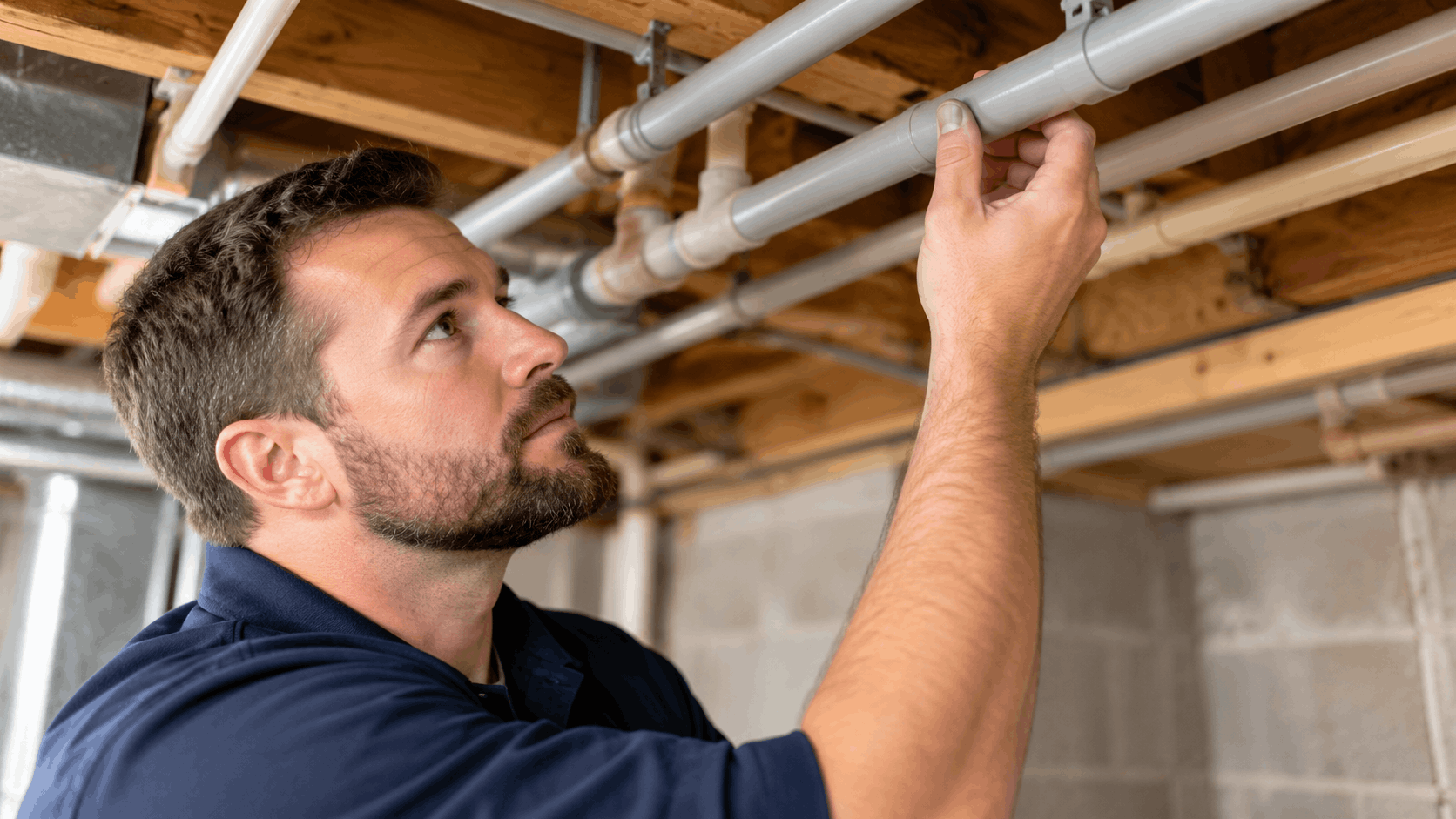
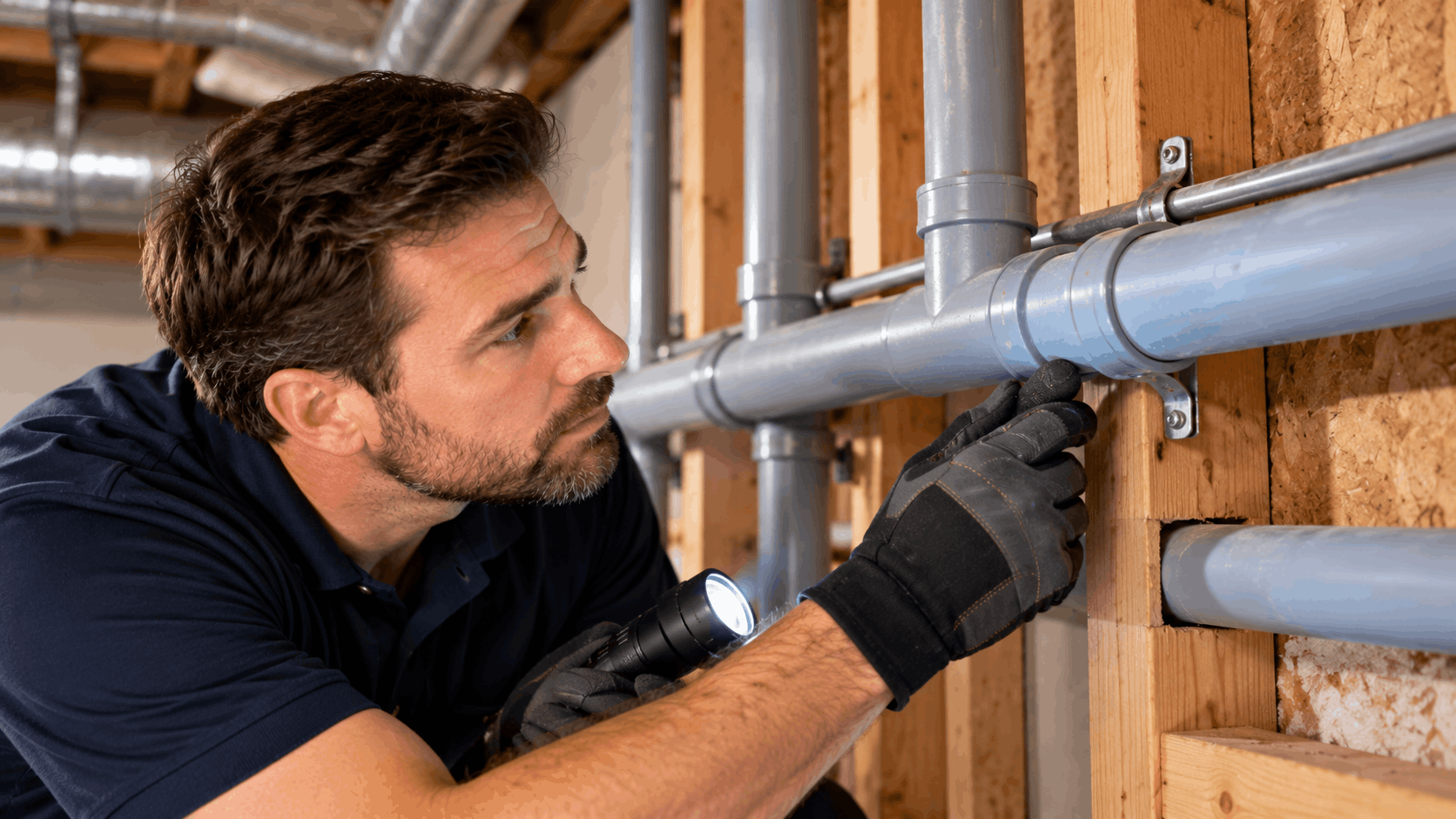
The water heater is the best place to start. Supply lines run right to the heater, and in a garage or utility closet they are usually exposed. A dull gray plastic pipe feeding the heater is a strong signal that polybutylene is in the system.
Under the kitchen and bathroom sinks is the next spot. Open the cabinet and look at the lines coming out of the wall to the shutoff valves. In many homes the original supply material is visible here, and gray plastic at the stub-outs points straight to polybutylene.
The main shutoff is another place the pipe often reveals itself, along with anywhere lines enter the house from the wall. Near the water heater, in the garage, or where the main comes in, the pipe is frequently out in the open. A walk through these spots with a flashlight gives a homeowner a real read without cutting into anything.
If gray plastic turns up at several of these points, the case for polybutylene is strong. If the lines are copper or a glossy flexible plastic in red, blue or white, the home likely has copper or PEX instead. Either way, the visible spots are where the answer starts.
Color, stamps, and fitting type
Color is the first tell. Polybutylene is that distinctive dull gray, with blue versions showing up mostly on exterior and underground runs. The matte, slightly waxy plastic surface looks nothing like metal and nothing like the shinier PEX used in newer homes.
Surface markings help too. Polybutylene pipe often carries stamped text along its length, printed into the plastic when it was made. Those markings are not always easy to read after years in a wall or cabinet, but when they are legible they add confidence to the identification.
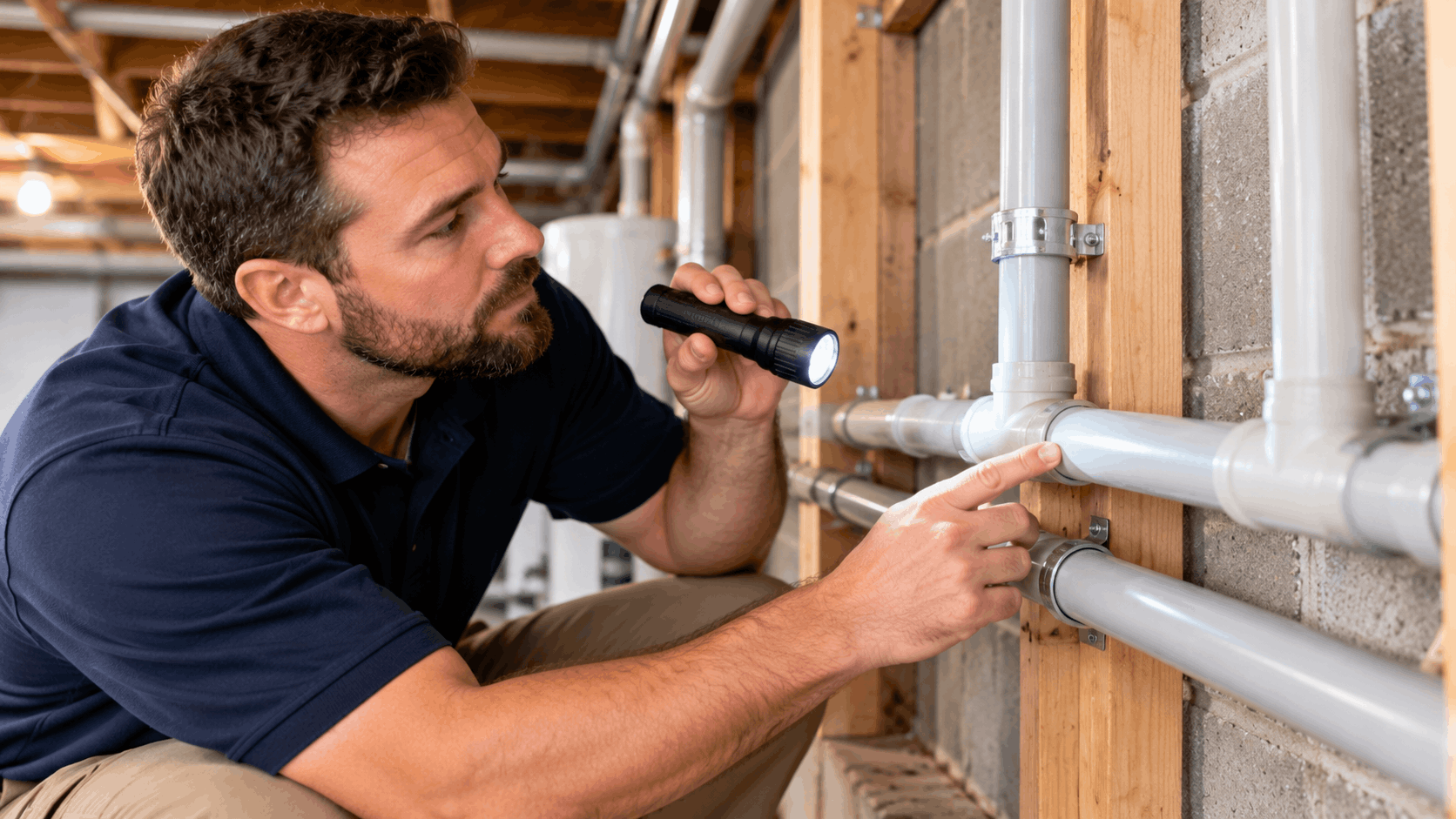
The fittings are the clincher. Polybutylene connections are typically crimped or clamped, with a metal or plastic ring squeezing the pipe onto the fitting. That crimped joint look, combined with the gray color, is the signature a plumber recognizes on sight.
Because flexible plastics can look similar at a glance, a look-alike is a reason to bring in a plumber rather than to assume. The combination of color, markings and fitting type is what distinguishes polybutylene from PEX and other materials, and getting that call right is worth a professional eye.
Why the build year alone is not enough
A home built in the polybutylene window is a strong candidate, but the year alone does not decide the matter. Many homes in this range have already been repiped, either fully or in part, during a remodel or after a leak. The original builder's choice is not always what is in the walls today.
A partial repipe is especially tricky. An owner might have had the accessible lines replaced after a failure while polybutylene remains buried under the slab or hidden in the attic. That mix means a home can be both repiped and still carrying the old material in the hardest-to-reach runs.
This is why the pipe must be confirmed on site before any decision gets made. A plumber checks the visible spots, traces the runs, and determines what is actually present rather than relying on the build year. The year sets the expectation, and the inspection proves it out.
For the record on jurisdiction, owners can confirm their parcel is in unincorporated Clark County rather than a city, since Spring Valley is a township. That detail affects permits later, and it is worth checking from the parcel rather than the mailing address. The material question, though, always comes down to what the inspection finds behind the walls.
Early Warning Signs Before a Line Bursts
The best outcome with polybutylene is catching it before a full failure. The system usually gives warning, and an owner who knows the signs can act while the fix is still a planned job instead of an emergency cleanup. Each sign ties to something a homeowner actually notices day to day.
None of these symptoms require special tools. They show up as stains, smells, pressure changes and bills that do not add up. Taken together, they often point to a slow seep at a hidden fitting, which is exactly how polybutylene tends to start failing.
Paying attention early changes the whole experience. A seep caught at the stain stage is a repair. The same seep ignored until the wall is soaked and the framing is wet becomes a much bigger problem, so the signs below are worth watching for in any home from the polybutylene era.
Damp spots, stains, and the smell of mold
Wall and ceiling stains are the classic early sign. A faint brown ring or a spreading discoloration on drywall usually means water is reaching a surface from somewhere it should not. When the stain sits near a plumbing run, a leaking fitting is a likely source.
Soft or spongy drywall is a step past the stain. Press gently near a suspected spot, and if the wall gives or feels damp, water has been sitting there long enough to weaken the material. That softness means the seep is not new.
A musty, moldy smell is the nose catching what the eye has not yet seen. Hidden moisture feeds mold growth inside walls and cabinets, and that earthy, damp odor often shows up before a visible stain does. In a closed cabinet under a sink, the smell can be the first clue.
Any one of these on its own is worth checking. All three together near a polybutylene run strongly suggest a slow seep at a hidden fitting, and that is the moment to get a plumber in before the leak grows.
Pressure drops and a water bill that climbs
A noticeable drop in water pressure can signal a leak somewhere in the system. When water escapes through a failing fitting, less reaches the faucet, and showers or taps may feel weaker than they used to. Scale buildup can also narrow lines, so pressure changes deserve a look either way.
A water bill that climbs without a change in household use is one of the clearest warning signs. Water leaving the system through a hidden leak still runs through the meter, so the usage goes up even though nobody is using more. An unexplained jump on the bill is the meter telling the owner something is leaking.
There is an electric angle too. If a hidden hot-water leak is forcing an electric or heat pump water heater to keep reheating, the electricity bill can spike as well. NV Energy supplies the electricity in the valley, so that kind of bill increase relates to NV Energy, while a plumber finds and fixes the leak driving it.
When pressure and billing clues line up with stains or smells, the picture gets clear. These are the symptoms of water going where it should not, and in a polybutylene home the fittings are the first place to suspect.
Recurring repairs at the same joints
One failed fitting is rarely the end of the story. Every joint in a polybutylene system shares the same age, the same material, and the same water. Once one connection gives way, others installed at the same time are usually close behind.
That is why a pattern of spot repairs is a message in itself. An owner who has fixed one leak, then another a few months later, then a third, is not having bad luck. The home is telling them the whole system is reaching the end of its service life.
Chasing leaks one at a time gets expensive and frustrating. Each repair addresses a single joint while the rest keep aging, and the plumber ends up back at the house for the next failure. The cost of repeated visits adds up toward the price of simply replacing the system.
When the same type of joint keeps failing across a house, that is the signal to stop patching and plan a full replacement. The recurring repairs are not separate problems. They are one aging system failing in sequence.
Spot Repair Versus a Whole-House Repipe
When polybutylene starts leaking, owners face a real decision: patch the spot that failed, or replace the whole system. The answer depends on the situation, but the nature of this material pushes hard toward replacement. Fittings that keep failing do not reward a patch-forever approach.
A spot repair has its place in narrow cases, and it can be the right first move when a leak needs stopping right now. The question is whether that patch is a bridge to a planned replacement or a false economy that leaves the owner chasing the next leak. Understanding both options makes the choice clearer.
Polybutylene is a standard repipe candidate for a reason. The copper and PEX that replace it are the common supply materials in newer valley construction, and they do not carry the fitting-failure history. For most Spring Valley homes with aging gray plastic, the repipe is the fix that actually ends the problem.
When a patch buys time
A single repair makes sense in narrow situations. If one accessible fitting fails and the rest of the system is otherwise holding, a targeted fix can stop the leak and restore service quickly. An isolated joint in an open wall or under a sink is the kind of spot a patch handles well.
A burst pipe repair is also the right call in an emergency. When a line lets go and water is running, the first job is to stop it, not to plan a whole-house project on the spot. A patch buys time and control in that moment.
The honest limit is that a patch fixes the symptom, not the cause. It repairs one joint while leaving every other same-age fitting in place, each carrying the same risk. The system is still aging, and the next leak is still coming.
So a spot repair is best understood as a bridge. It stops today's leak and lets the owner plan the real solution on their own timeline instead of in a crisis. On an aging polybutylene system, that is usually all a patch should be asked to do.
Why polybutylene is a standard repipe candidate
The case for a full replacement comes straight from how polybutylene fails. The fittings keep giving way, and no single repair changes that about the rest of the system. Replacing the whole run of supply pipe is what actually removes the problem rather than deferring it.
A whole-house repipe takes out the old gray plastic and runs new lines throughout the home. Copper and PEX are the common replacement materials in newer valley construction, and both avoid the fitting-failure pattern that defines polybutylene. Once the new system is in, the recurring-leak cycle ends.
Copper is a durable metal pipe with a long track record, while PEX is the flexible plastic that dominates newer construction for its ease of installation and resistance to scale. The right choice depends on the home, the layout, and the owner's preferences, and a plumber can lay out the tradeoffs on site. Both are a clear step up from aging polybutylene.
Thinking of polybutylene as a repipe candidate rather than a repair-forever material saves money over time. Every dollar spent patching a system that keeps failing is a dollar not spent on the fix that ends the failures. For most owners, the repipe is the decision that stops the bleeding.
What a repipe actually involves
A repipe is a real project, and knowing what it involves helps an owner plan. The core of the job is running new supply lines throughout the home to replace every length of old polybutylene. That means new pipe to each fixture, each bathroom, the kitchen, and the water heater.
Getting to the old lines requires access points. Plumbers open sections of drywall where the pipe runs inside walls and ceilings, enough to pull the old material and route the new. The number of access points depends on the home's layout and where the lines travel.
After the new lines are in and tested, the drywall gets patched where it was opened. The job also includes inspection, since permitted work has to be signed off by the jurisdiction. That sequence - run, test, patch, inspect - is the backbone of a clean repipe.
None of this is quick or invisible, and an owner should expect some disruption while the work is underway. The payoff is a complete supply system that does not share polybutylene's fitting problem. For a Spring Valley home from the polybutylene window, that is the outcome that lets an owner stop worrying about the gray plastic behind the walls.
Need Help in Las Vegas?
Active Plumbing serves Las Vegas and all of Las Vegas Valley.
What Finding and Replacing Polybutylene Costs in Spring Valley
Cost is usually the next question once an owner knows they have polybutylene. The figures below are typical ranges for plumbing work in the Las Vegas Valley, meant to give a sense of what to expect. They are not a quote, and the actual price for a specific job comes in writing before any work begins.
Two stages drive the cost: finding the problem, and fixing it. Locating a hidden leak or confirming the pipe is one set of ranges. Repairing a burst line or replacing the whole system is another. Where a home falls within a range depends on the house itself.
| Job | Typical Las Vegas Valley range |
|---|---|
| Electronic leak detection | $150 to $350 |
| Slab leak detection | $150 to $300 |
| Whole-home leak detection system | $300 to $800 |
| Burst pipe repair | $200 to $800 |
| Slab leak repair | $500 to $3,000 |
| Whole-house repipe | $4,000 to $15,000 |
Finding the leak and the pipe
Before anything gets fixed, the problem has to be located. Electronic leak detection runs $150 to $350 as a typical area range, and it uses acoustic and sensing equipment to pinpoint a hidden leak without tearing open every wall. That precision keeps the eventual repair focused and smaller.
Slab leak detection is a typical $150 to $300 in the valley. When a polybutylene line under the concrete slab is leaking, specialized tools find it through the slab rather than by guessing. Given how common slab-on-grade construction is across Spring Valley, this is a frequent starting point.
For owners who want ongoing protection, a whole-home leak detection system runs a typical $300 to $800. This kind of system monitors the plumbing and can alert an owner to a leak early, which matters a great deal on an aging polybutylene system prone to slow seeps.
Spending on detection first is money well placed. Knowing exactly where the problem is, and confirming the material, means the repair work is targeted rather than exploratory. That precision often saves more than the detection cost itself.
Repairs and the full repipe
Once the problem is located, the repair ranges apply. Burst pipe repair runs a typical $200 to $800 in the valley, covering the kind of emergency patch that stops an active leak at a single failure point. That is the figure for handling one joint or one section that let go.
A whole-house repipe is a typical $4,000 to $15,000. That range covers running new supply lines throughout the home to replace the old polybutylene entirely, along with the access, patching and inspection that go with it. It is the complete fix that ends the fitting-failure cycle for good.
Slab leak repair is a typical $500 to $3,000, reflecting the extra work of reaching a line beneath the concrete. An under-slab polybutylene failure sits at the harder, more expensive end of repair work precisely because of where it is. The slab both hides the leak and complicates the access.
Each of these is a typical range, not a fixed price. The final figure depends on the specific job - the home, the location of the problem, and what the inspection finds. That is why the written price comes after a look at the actual house.
What changes the number on a given home
Several things move the cost within a range. Home size is a big one: a larger house has more lines, more fixtures, and more wall to open, which raises a repipe toward the upper end. A compact home with simple plumbing sits lower.
The number of fixtures matters too. Every bathroom, the kitchen, the laundry and the water heater all need new lines in a repipe, so a home with more fixtures is a bigger job. Access is another factor - lines that are easy to reach cost less to replace than ones buried behind finished surfaces.
Under-slab runs are the biggest cost driver of all. Reaching a line beneath the concrete is far more involved than one in an open wall, and caliche makes it harder still. Caliche is a cemented calcium-carbonate hardpan common across the valley, and it makes excavation slower and more expensive wherever a line runs underground.
None of this is a mystery once a plumber sees the home. The size, the fixture count, the access, and whether the work goes under the slab together explain where a job lands in its range. That is the information that turns a typical range into a specific written price.
Permits, Code, and Who Does the Work in Spring Valley
A repipe is permitted work, so the jurisdiction and licensing facts matter in Spring Valley. Getting these right from the start keeps the project legal and inspected, and it protects the owner. The first step is knowing which authority governs the address.
Spring Valley is not a city, and that changes where the paperwork goes. It is an unincorporated township, which means the county runs the permitting. An owner planning a repipe should establish this before the work is quoted.
The code and the license questions follow from there. The valley follows a specific plumbing code with local amendments, and the work has to be done by a contractor licensed through the state. Each piece is worth understanding before hiring anyone.
Spring Valley permits run through Clark County
Spring Valley is an unincorporated Clark County township, so permits, plan check and inspections run through Clark County rather than any city. Even though residents and mail call it Las Vegas, the permitting authority for a Spring Valley address is the county. That distinction decides which building department handles the job.
The right way to confirm it is from the parcel, not the postal address. Mailing addresses often say Las Vegas even when the parcel sits in unincorporated county land. Checking the parcel removes the guesswork and points to the correct department.
This matters because the authority differs across the valley. The City of Las Vegas, Henderson and North Las Vegas each run their own permit counters, while unincorporated areas like Spring Valley, Enterprise and Paradise go through Clark County. A repipe permit for a Spring Valley home belongs to the county.
Establishing the jurisdiction up front keeps the project on track. The permit, the inspection, and the sign-off all flow through Clark County for a Spring Valley repipe, and knowing that before work starts avoids confusion later. For more on the area we serve, see our Spring Valley service page.
The code that applies and the Building Official
The valley follows the Uniform Plumbing Code together with the Southern Nevada Amendments, now in the 2024 cycle that replaced the 2018 editions. Clark County and the valley's cities adopted the 2024 code with local amendments, and Clark County's effective date fell in January 2026. A repipe is held to that current code.
Nevada has no statewide plumbing code, so the applicable rules are decided jurisdiction by jurisdiction. In Southern Nevada, that means the Uniform Plumbing Code with the amendments developed by the Southern Nevada Building Officials. The amendments are only code once a jurisdiction adopts and codifies them, which Clark County has done.
The Building Official is the authority on an alternate method. The amendments are not meant to prevent the use of any material or method not specifically prescribed, provided the alternate is approved and authorized by the Building Official. On an unusual repipe detail, that official has the final say.
For an owner, the practical point is that the code is real and current, and a licensed plumber works to it. The permit and inspection process exists to confirm the new system meets that code. A proper repipe is done to the Southern Nevada Amendments and signed off by the county.
Licensing and verifying who you hire
Plumbing work in Nevada is licensed statewide by the Nevada State Contractors Board. Permitted work must be performed by an appropriately licensed contractor, and a repipe is permitted work. The license is not optional, and the valley has a real unlicensed trade problem, which makes verification worth the effort.
A license can be verified free at nvcontractorsboard.com. The board's records are public, showing a contractor's classification, status, bond and workers compensation. An owner is entitled to ask for a license number and to check it before hiring.
Verifying first protects the homeowner on a sizable job. A repipe is a significant investment, and confirming the contractor is properly licensed and in good standing guards against the unlicensed operators who leave owners with uninspected, non-compliant work. The check takes minutes and the record is free.
For any Spring Valley repipe, the licensing question is settled before work begins. A licensed contractor pulls the county permit, works to the code, and stands behind inspected work. That chain - license, permit, inspection - is what separates a legitimate repipe from a risky one.
Spring Valley Neighborhoods and What Is Likely Behind the Walls
Spring Valley is not one uniform tract. It grew in waves, and the pipe in the ground reflects when each pocket went up. Knowing the era of a neighborhood gives a reliable first read on the likely supply material, from the polybutylene heart to the newer stock near the Enterprise line.
This map of eras helps an owner understand their own home in context. A house near Flamingo and Jones is a different vintage than one near Rhodes Ranch, and the plumbing follows the build date. The year the tract went up points to what the original builder installed.
As always, the era points the inspection but the on-site check confirms the material. These pockets are strong indicators, not guarantees, since homes get remodeled and repiped over decades. Still, matching the neighborhood to the likely pipe is exactly the local knowledge that makes a plumber's first visit efficient.
Central Spring Valley: the polybutylene heart
The box bounded by Rainbow, Jones, Flamingo and Tropicana is the main polybutylene zone in Spring Valley. This is the large body of late 1970s, 1980s and early 1990s tract housing from production builders, which puts it squarely in the polybutylene window of roughly 1978 to 1995. Owners here are the most likely in the township to find gray plastic.
There is a second material to watch in this area. Copper was also widely used across these middle decades, and in central Spring Valley it has reached pinhole age. That means some homes here face either polybutylene fitting failures or copper pinhole leaks, and sometimes a mix depending on what was installed and what was repaired.
So owners in the central box are often checking two materials at once. An inspection sorts out whether a home has aging polybutylene, aging copper, or a combination from past repairs. Both are reasons to take a slow seep seriously and get a professional look.
This concentration is why central Spring Valley sees so much repipe activity. The era produced the pipe, and the water and decades of service have brought it due. For these homes, a pipe and fixture evaluation is a sensible first step.
Section 10, Spanish Trail, and the custom-home runs
Section 10 is the custom-home pocket near The Lakes, named for its legal survey section and bounded by Desert Inn, Sahara, Rainbow and Buffalo. These are custom homes on lots of half an acre or more, some well over an acre, with long private runs for yard and irrigation lines. On a property that size, a leak can run for weeks before anyone notices.
Those long private runs change the risk. A leak on a buried irrigation or yard line at a Section 10 property is out of sight and far from the house, so there is no damp drywall to catch it early. The water meter and a climbing bill are often the first clue, which makes monitoring and detection especially useful here.
Spanish Trail is the guard-gated country club community in west Las Vegas from the mid-1980s, roughly forty years old now. It holds custom and semi-custom homes, villas and condominiums under association governance, and its build era sits within the polybutylene window. Owners there are checking the same gray plastic as the central tracts, and our Spanish Trail service area reflects that work.
Both Section 10 and Spanish Trail fall roughly in the polybutylene era, but the large lots and long runs make the detection step matter more. A hidden leak on a big property is a slow, expensive drip if left alone. Catching it early is the whole game on these homes.
Newer pockets: south Spring Valley, Rhodes Ranch, Sovana
Rhodes Ranch is the guard-gated master-planned golf community from the late 1990s through the 2000s. It is slab-on-grade construction with copper or PEX, which largely postdates polybutylene. Owners there are generally not finding gray plastic, though the slab construction still makes under-slab lines a distinct repair category.
Sovana is a Spring Valley name, not a Henderson one. It is a subdivision from about 2003 with homes of roughly 1,750 to 2,860 square feet, and portals use the name for a wider part of southwest Spring Valley around 89113. That 2003 vintage sits past the polybutylene window and inside the Kitec era instead.
West Sahara, around Sahara near Buffalo and Durango in 89117, is mostly 1970 to 1999 with some later construction. It mixes gated communities, custom homes, townhomes and apartments, so the material varies by the specific build year within the area. Some of that older stock overlaps the polybutylene window while newer parts do not.
The pattern across these newer pockets is that they largely postdate polybutylene. Owners near Rhodes Ranch, in Sovana, or in the newer parts of West Sahara are more likely checking for copper, PEX or Kitec than gray plastic. The build year within each area is what settles it, confirmed on site.
Need Help in Las Vegas?
Active Plumbing serves Las Vegas and all of Las Vegas Valley.
How Active Plumbing Handles a Polybutylene Job
Finding and replacing polybutylene is work we do across Spring Valley, and the process starts with confirming what is actually in the home. We draw on the same era-and-material knowledge covered above to point the inspection, then verify the pipe on site before talking cost or scope. The homeowner gets a clear picture before any commitment.
Our approach keeps the owner informed at each stage, from locating the problem to pricing the fix. The goal is a plan that matches the specific home rather than a one-size answer. That starts with a hands-on look.
Confirming the pipe and locating the problem
The first step is an on-site inspection to confirm the material. We check the visible spots - the water heater, under sinks, the main shutoff and where lines enter from the wall - to verify whether the home has polybutylene, copper, PEX or a mix. The build era points us, and the inspection proves it.
If there is an active leak, we locate it before quoting a repair. That may mean electronic leak detection in a wall or slab leak detection under the concrete, depending on where the water is going. Pinpointing the leak keeps the repair focused and the cost contained.
Our technicians arrive in 30 to 60 minutes anywhere in the Las Vegas Valley. For a Spring Valley home with a seeping fitting or a damp spot by the water heater, that response window means a problem gets looked at quickly rather than left to grow. Finding it early is always the cheaper path.
Once we know the material and the location of any leak, we can lay out the options honestly - whether a patch buys time or a repipe is the right call. That conversation rests on what the inspection actually found, not on the build year alone.
A written price before any work starts
We give the customer a written price before work begins. That is a standard business practice on our jobs, so an owner knows the figure before committing rather than after. On a project the size of a repipe, that clarity matters.
The written price reflects the specific home - its size, fixture count, access, and whether the work goes under the slab. The typical area ranges in this guide set expectations, but the actual figure depends on the job in front of us. The written number is built on what we find on site.
This approach lets an owner plan with real information. There is no guessing at the final cost once the work starts, because the price is set down before it does. For a Spring Valley owner deciding between a patch and a full repipe, that written figure is what makes the decision concrete.
A fourth-generation local team
Active Plumbing is a fourth-generation family plumbing business that has served the Las Vegas Valley since 1991. We have worked these Spring Valley tracts through the decades, so the pipe behind the walls and the era it belongs to are familiar ground. Some of our owners are US military veterans.
We hold Nevada plumbing license NSCB #0047021, verifiable free at nvcontractorsboard.com along with the certifications required for the work we perform. An owner can check our status, bond and classification on the state board's public record. We say so plainly because the valley has a real unlicensed trade problem.
That local history shows up in how we read a home. A 1985 central Spring Valley tract house, a Section 10 custom property with long private runs, a newer Rhodes Ranch home - each tells us something about what to expect before we even open a cabinet. Thirty-plus years in this valley is how we built that read.
Protect Your Spring Valley Home Before the Gray Plastic Gives Way
If you have found gray plastic behind the walls of a central Spring Valley home, the next move is an on-site check to confirm the material and locate any leak, followed by a written price before any work starts. Call Active Plumbing at (702) 438-3357 to get a technician out and know exactly what you are dealing with.
Frequently Asked Questions
- What does polybutylene pipe look like?
- Polybutylene is a flexible plastic supply pipe, usually a dull gray, though blue versions appear on exterior and underground runs. It has a matte, slightly waxy surface and bends in gentle curves rather than holding straight rigid lines like copper. The connections are typically crimped or clamped with a ring squeezing the pipe onto the fitting. Because other flexible plastics can look similar, a plumber should confirm it on site rather than relying on a visual guess alone.
- Which Spring Valley homes are most likely to have it?
- Central Spring Valley tract homes, in the box bounded by Rainbow, Jones, Flamingo and Tropicana, are the most likely. That area is the large body of late 1970s, 1980s and early 1990s production housing, which sits in the polybutylene window of roughly 1978 to 1995. Newer south Spring Valley stock toward the Rhodes Ranch corridor, built in the 1990s and 2000s, largely postdates polybutylene, so owners there usually check for copper, PEX or Kitec instead.
- Why does polybutylene fail?
- Polybutylene is associated with failure at the fittings, where the connections give way before the pipe body does. A joint that looked solid on install day slowly loses its grip over years of pressure and water exposure, which is why a slow seep at a connection is the common first sign. The valley's very hard water adds scale and stress inside the lines and fixtures, piling extra wear onto a system already prone to trouble at its joints.
- How much does a whole-house repipe cost here?
- A whole-house repipe is a typical $4,000 to $15,000 in the Las Vegas Valley. That is a typical area range, not a quote, and it covers running new supply lines throughout the home along with access, drywall patching and inspection. Where a specific home lands depends on its size, the number of fixtures, how accessible the lines are, and whether any runs go under the slab. The actual figure comes in a written price after an on-site look.
- Can I just repair the leaking section?
- A patch can buy time in narrow cases, such as an isolated accessible fitting or an emergency where a line has burst and needs stopping now. Burst pipe repair runs a typical $200 to $800 in the valley. The catch is that a patch fixes one joint while every other same-age fitting keeps aging and failing. Because the fittings are the recurring problem, polybutylene is a standard repipe candidate rather than a repair-forever material.
- Do I need a permit to repipe in Spring Valley?
- Yes. A repipe is permitted work, and Spring Valley is an unincorporated Clark County township, so permits, plan check and inspections run through Clark County rather than a city. Confirm the jurisdiction from the parcel, not the mailing address, since mail often says Las Vegas even when the parcel sits in unincorporated county land. The work must be done by a contractor licensed through the Nevada State Contractors Board, who pulls the county permit and works to the current code.
- What is the water hardness in Spring Valley?
- The Southern Nevada Water Authority reports the valley's water hardness at about 280 parts per million, or roughly 16 grains per gallon, which is categorized as very hard. That hardness deposits calcium and magnesium scale throughout a plumbing system. The scale narrows the bore of supply lines, clogs aerators and shower heads, builds up in mixing valves, and leaves the white crusting owners call hard water stains. On an aging polybutylene system, that scale adds stress to pipe and fixtures already due for attention.
- Does caliche affect a repipe cost?
- Caliche can raise the cost where a line runs underground. It is a cemented calcium-carbonate hardpan common across the valley, and it is hard to trench through and hard to bed a pipe into evenly. That makes excavation slower and more expensive for under-slab or buried runs. Caliche does not make pipe fail faster - it is abrasive to buried pipe and it simply makes the digging harder. For an all-indoor repipe with no underground work, caliche is not a factor.
- How do I verify a plumber's license?
- Nevada contractors are licensed statewide by the Nevada State Contractors Board, and a license is verified free at nvcontractorsboard.com. The board's records are public, showing a contractor's classification, status, bond and workers compensation. An owner is entitled to ask for a license number and check it before hiring, which is worth doing on a sizable job like a repipe. Active Plumbing holds NSCB #0047021, which anyone can confirm on that site.
- What are the early signs my polybutylene is about to fail?
- Watch for damp spots and wall or ceiling stains, soft or spongy drywall, and a musty, moldy smell, all of which point to a slow seep at a hidden fitting. A noticeable drop in water pressure or an unexplained rise in the water bill signals water escaping through a leak. A pattern of recurring repairs at the same type of joint is the system telling you the whole thing is near the end. Any of these in a polybutylene-era home is worth a professional look.
Licensed plumbing professionals serving Las Vegas and Las Vegas Valley.
Licensed in Nevada · License #0047021
Last updated on
Why trust Active Plumbing?
Founded in 1991, Active Plumbing is a licensed and insured plumber serving Las Vegas and Las Vegas Valley. All content is reviewed by our licensed technicians.

Need Help in Las Vegas?
Active Plumbing serves Las Vegas and all of Las Vegas Valley.
Related Articles

How Spring Valley Homeowners Deal with Aging Galvanized Pipes
Aging galvanized pipes cause brown water and weak pressure in older Spring Valley homes. Learn the warning signs, safety concerns, and repair or repipe options near Las Vegas.

The Spring Valley Town Advisory Board and County Rules: What Governs Plumbing Work on Your Home
Plumbing work on a Spring Valley home runs through Clark County, not the City of Las Vegas, and the Town Advisory Board does not issue permits or write code.
Water Damage Claims in Spring Valley and What Insurance Covers on a Burst Pipe
Most Spring Valley homeowner policies cover sudden water damage from a burst pipe but not the pipe repair itself. Here is what is covered, why pipes fail here, and how to file.