How Much Does a Repipe Cost in The Hills or The Trails, Summerlin?

Looking for a Plumber? Contact Us Now
Open 24/7. Written price before work starts.

Key Takeaways
- A whole-house repipe in the Las Vegas Valley typically runs $4,000 to $15,000, with the final figure given in writing after an on-site look.
- Price is driven by home size, bathroom and fixture count, under-slab line access, material choice between PEX and copper, and drywall patching.
- A repipe replaces pressurized supply lines only; drain lines and fixture swaps are separate scopes of work.
- Summerlin village age predicts the pipe: polybutylene before about 1995, Kitec from 1995 to 2007, copper and PEX in later villages, confirmed on site.
- Early Summerlin copper develops pinhole leaks on hot lines and under-slab runs because valley water is very hard at about 280 ppm or 16 grains per gallon.
- One isolated leak is usually a repair ($200 to $800, or $500 to $3,000 for a slab leak), while repeated leaks point toward a full repipe.
- The permit authority depends on the exact address: Summerlin North and West are City of Las Vegas, Summerlin South is unincorporated Clark County.
- Active Plumbing holds Nevada license NSCB #0047021, has served the valley since 1991, and arrives in 30 to 60 minutes anywhere in the Las Vegas Valley.
In This Article
Picture a homeowner in The Hills, finishing coffee on a quiet morning, who spots a small damp patch on the ceiling under an upstairs bathroom. A week later, the water pressure in the shower drops off, and a tiny pinhole leak shows up on a hot line in the garage. That is usually the moment the repipe question starts. In the Las Vegas Valley, a whole-house repipe typically runs between $4,000 and $15,000, presented as a typical area range rather than a quote for any one home.
The spread is wide for a reason. A single-story home in The Trails with two bathrooms is a very different job from a two-story estate up near Bear's Best in The Ridges. Pipe material, wall access, fixture count and layout all move the number, and the only way to land on a real figure is to look at the specific home.
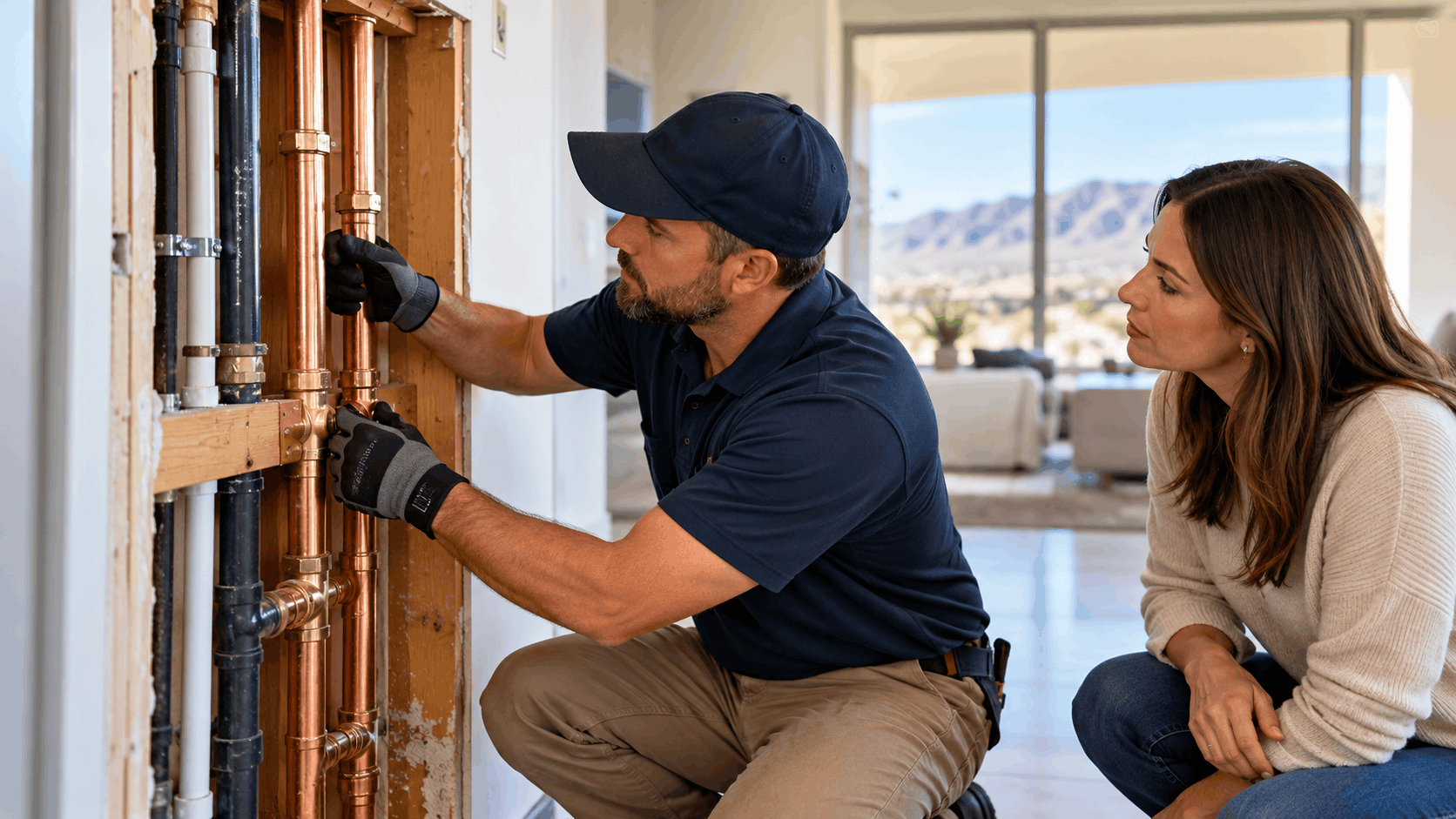
What a Repipe Costs in Summerlin?
A repipe is not a patch. It is the planned replacement of the fresh water supply lines running through a home, from where the main enters the structure out to every fixture that uses water. When a homeowner asks about repipe cost, the honest answer starts with the typical area range and then explains the scope behind it.
Here is how the most relevant jobs compare, using typical Las Vegas Valley ranges. These are market ranges for the area, not a fixed price from us, and the actual figure for any home is given in writing before work begins.
| Job | Typical Las Vegas Valley Range |
|---|---|
| Whole-house repipe | $4,000 to $15,000 |
| Burst pipe repair | $200 to $800 |
| Slab leak detection | $150 to $300 |
| Slab leak repair | $500 to $3,000 |
| Electronic leak detection | $150 to $350 |
| Water softener installation | $800 to $2,500 |
The Typical Price Range for a Whole-House Repipe
A whole-house repipe in the Las Vegas Valley typically falls between $4,000 and $15,000. That is a wide band, and the width is not an accident. No two homes in Summerlin share the same floor plan, the same number of fixtures, or the same way the original builder routed the pipe through the structure.
A compact single-story home with one or two bathrooms sits at the lower end of that range. The pipe runs are shorter, the fixture count is smaller, and the crew has fewer walls to open. The job uses less material and fewer labor hours, which keeps the total down.
A larger two-story home, or a custom estate with multiple full bathrooms, a wet bar, outdoor kitchen plumbing and long runs between fixtures, lands much higher. Every extra bathroom adds supply lines, connections and wall access points. The same job in two different Summerlin homes can land hundreds or thousands of dollars apart, which is exactly why a single phone figure is never reliable.
Treat the range as a starting point for planning, not a bill. It tells a homeowner what to budget for while they decide whether a full repipe or a targeted repair makes more sense for their situation.
What a Repipe Replaces and What It Does Not
A repipe replaces the pressurized supply lines that carry hot and cold water to every fixture: the kitchen sink, the bathrooms, the laundry, the water heater connections and the exterior hose bibbs. These are the lines that develop pinhole leaks, restrict flow when scale narrows the bore, or fail at fittings depending on the material. Replacing them end to end is what solves a pattern of leaks for good.
What a repipe does not automatically include is the drain, waste and vent system. Drain lines carry waste away by gravity, not under pressure, and they fail by a different mechanism. Cast iron drains in older housing corrode and scale from the inside, but that is a separate scope of work handled under drain and sewer services, not folded into a supply repipe.
Fixtures themselves are a separate line item too. A repipe reconnects the existing faucets, valves and the water heater, but swapping a dated faucet for a new one or installing a new toilet is fixture installation work priced on its own. Many homeowners choose to replace tired fixtures while the walls are open, which is a smart time to do it, but it is an add-on rather than part of the base repipe number.
Knowing this boundary helps a reader understand the quote. When someone sees $8,000 on a written scope, they can see it covers the supply system, the wall access, and the patching, and they can decide separately about fixtures or drain work.
Why a Written Price Beats a Phone Estimate
The final number on a repipe depends on things that cannot be judged over the phone. Home square footage, the number of bathrooms, how the supply lines are routed, whether they run under the slab or through the attic, and the replacement material all feed into the total. A guess made from a phone call is a guess, and it rarely survives contact with the actual home.
We give the customer a written price before any work starts. That means a crew member looks at the home, confirms the pipe material, maps the runs, and counts the access points needed. Only then does a real figure get put on paper.
This approach protects the homeowner. The written scope shows exactly what is being replaced and what it costs, so there is no mid-job surprise and no vague verbal number that creeps upward. For a job the size of a repipe, seeing the full scope and figure in writing before committing is how it should work.
Get Your Quote
Tell us what's going on and we'll get back to you. We're open 24/7.
What Drives the Price Up or Down?
Two homes on the same Summerlin street can land at different points in the repipe range, and the reasons are predictable once you know what to look at. Understanding the repipe cost factors lets a homeowner estimate whether theirs is a lower or higher job before anyone picks up a tool.
The main drivers are home size and fixture count, how the lines are accessed under a slab-on-grade foundation, the replacement material and the wall repair that follows, and whether add-ons like a water softener get installed to protect the new system. Each one matters in Summerlin plumbing pricing, so we will take them in order.
Home Size, Bathrooms and Fixture Count
More bathrooms mean more supply lines, more connections and more labor. Each full bathroom brings a shower or tub, a toilet and one or two sinks, and every one of those needs hot and cold lines run to it. A home with four bathrooms simply has more plumbing to replace than a home with two, and the price reflects that directly.
Fixture count beyond the bathrooms adds up too. A kitchen sink, a dishwasher line, a laundry hookup, a wet bar, a pot filler and exterior hose bibbs all extend the network. The longer the total run of pipe and the more endpoints it serves, the more material and hours the job takes.
Layout plays a quiet but real role. A single-story home in The Trails lets a crew run new lines through the attic and drop down to fixtures with relatively direct paths. A two-story estate means running lines up through walls between floors, which is slower and takes more access points to do cleanly.
So the rough rule of thumb is straightforward. Smaller, single-level homes with fewer fixtures sit lower in the range, while larger multi-level homes with many bathrooms sit higher. Neither is better or worse, it just reflects how much pipe the home actually holds.
Slab-on-Grade and Under-Slab Line Access
Most of the Las Vegas Valley, Summerlin included, is built slab-on-grade. That means the home sits on a concrete slab poured directly on the ground, and in many homes some of the original supply lines were routed through or under that slab. Those under-slab lines are the hardest to reach, and they are a big reason repipe access shapes cost.
Breaking out concrete to replace a failing under-slab line is disruptive and expensive. It means cutting the floor, removing flooring finishes, excavating, and then patching everything back. For that reason, the standard approach on most repipes is to abandon the old under-slab runs in place and reroute fresh supply lines overhead through the attic and down inside the walls.
Rerouting avoids the slab almost entirely. New lines travel through the attic space and drop down to each fixture, which keeps the concrete intact and cuts both cost and mess compared with trenching the floor. It is cleaner, faster and far less invasive for the household.
The trade-off is that overhead rerouting still needs access holes in walls and ceilings at each drop and connection point. The number of those access points is one of the quiet levers on the final price, which leads straight into the next factor: the walls themselves.
Pipe Material and Wall Repair
The replacement material is a choice with cost implications. PEX is a flexible plastic tubing that is quick to run through walls and attics with fewer fittings, which often makes it the practical choice on a reroute. Copper is a rigid, time-tested metal that costs more in both material and labor because every joint is soldered. Both are proven supply materials, and the right pick depends on the home and the homeowner's preference.
What people underestimate most is the wall repair. A repipe is not finished when the new pipe is in. The crew opens access holes in drywall to reach lines and connections, and those holes have to be patched, textured and prepared for paint afterward.
Drywall repair and texture matching are real work, especially in homes with knockdown or orange-peel texture that has to blend with the surrounding wall. The more access points a job needs, the more patching feeds into the total. On a large two-story home, that patch-and-texture phase can be a meaningful share of the cost.
This is why the material and the access strategy go hand in hand. A routing plan that minimizes access holes keeps the wall repair down, and a material that runs with fewer openings supports that goal. A good written scope accounts for both the pipe and the finish work behind it.
Hard Water and Add-Ons That Protect the New Pipe
The Southern Nevada Water Authority reports valley water at about 280 parts per million, which is roughly 16 grains per gallon. That is categorized as very hard, and it is the single biggest reason plumbing fails early here. Very hard water deposits calcium and magnesium scale throughout a system, narrowing supply lines over years, clogging aerators and shower heads, and fouling the small passages inside mixing valves and cartridges.
That scale does not stop just because the pipe is new. Install fresh supply lines and feed them the same hard water, and the same deposits begin again on fixtures, cartridges and the water heater. Protecting the investment is why many homeowners pair a repipe with a water treatment system.
A water softener installation runs $800 to $2,500 in the typical area range. A softener removes the hardness minerals before they reach the new pipe and fixtures, which slows scaling on everything downstream. In this valley, that is not a luxury; it extends equipment life rather than being optional.
It is a logical time to make the decision. The walls are already open, the crew is already on site, and adding whole-house water treatment during the same visit is efficient. The softener cost is a separate line item, but tying it to the repipe is how homeowners here keep a new system performing longer.

Need Help in Las Vegas?
Active Plumbing serves Las Vegas and all of Las Vegas Valley.
How Summerlin's Village Ages Change the Job
Summerlin is a 22,500-acre master-planned community on the western edge of the valley, built out in distinct waves against the Spring Mountains and Red Rock Canyon. The village a home sits in tells you a great deal about what is likely behind its walls, and that often decides whether a repipe is even the right call. Reading the pipe material through the lens of home age is where local knowledge earns its keep.
We work these villages constantly, from Sun City Summerlin down to the newest tracts in Summerlin, and the pattern runs oldest to newest. Here is what each era usually means for a repipe decision.
Sun City Summerlin and the Earliest Phases
Sun City Summerlin is the oldest village by a clear margin. The age-restricted Del Webb community was developed from 1989, with roughly 7,700 homes, its own community association, golf courses and recreation centers. Its earliest phases are now over thirty-five years old, which puts a lot of original plumbing well past its service life.
At that age, water heaters are on a second or third replacement, and the original angle stops under sinks and toilets, the small shutoff valves, are often seized or weeping. Original supply lines have had decades of very hard water running through them, scaling the bore and stressing every joint. These are the homes where a pattern of small failures starts to add up.
Sun City also carries a wrinkle many homeowners miss: there can be dual responsibility between the association and the homeowner when something backs up. Depending on where the problem sits, the fix may fall partly to the community association rather than entirely on the individual.
For these homeowners, the smart first step is identifying what is original and what has already been replaced. A home that has had piecemeal repairs over the years may be a candidate for a full repipe, or it may just need targeted work, and confirming the actual condition on site settles it.
The Hills and Summerlin North: The Polybutylene Question
The Hills is the second oldest village, an original community from the early 1990s on the eastern side around the golf corridors. The Summerlin North villages also date from the early 1990s. In this era, copper supply is typical, and copper from that period is now reaching the age where it starts to leak.
But there is a second material that makes this era important: polybutylene. Polybutylene supply systems went into many valley tracts from the 1970s through the early 1990s, and the material is now associated with failure at its fittings. It is a standard repipe candidate wherever it is found.
As a rule of thumb, homes built before about 1995 may have polybutylene. That does not mean every home of that age has it, which is exactly why the material has to be confirmed on site rather than assumed from the build year. A quick look at an exposed run in the garage or under a sink usually tells the story.
If a home in The Hills or Summerlin North has polybutylene, a full repipe is the usual recommendation because the fittings fail unpredictably. If it has copper, the decision shifts to how much of that copper is already leaking, which is a different conversation covered further down.
The Arbors, The Vistas and the Kitec Window
The Arbors holds Belvedere, 78 homes by William Lyon Homes in 2000 and 2001 at Anasazi and Town Center Drive in 89144, and Cottonwood Terrace, Pulte townhomes with build-out completed in 2001 in 89145. Santa Barbara, in The Hills South, dates to about 1997. The Vistas began development in 2000, with Talaverde, about 83 single-story homes by Woodside, built in 2003 and 2004 in 89138.
These dates put several of these neighborhoods squarely inside the Kitec window. Homes built from 1995 to 2007 may have Kitec, a brass-fitting pipe system that behaves differently from polybutylene. Kitec does not always announce itself with a dramatic leak first.
The giveaway with Kitec is flow. Its brass fittings corrode internally and restrict flow before they ever leak, so a homeowner may notice weak pressure at a faucet or shower long before any water shows up. That slow strangling of flow is a signal worth taking seriously in a Belvedere or Talaverde home of this vintage.
Because Kitec and copper of the same era look different once exposed, confirming which one a home has is the first move. A Kitec system is a strong repipe candidate, while copper may only need spot attention. Either way, the build date in these Vistas and Arbors neighborhoods is a flag to check the material carefully.
Summerlin South, The Ridges and Summerlin West
Summerlin South was developed later than the north, and it shows in the plumbing. These homes carry copper and PEX, with no polybutylene question to worry about. Summerlin South is unincorporated Clark County, bounded by Charleston Boulevard, Russell Road, Hualapai Way and the conservation area.
The Ridges is the guard-gated luxury village from the early 2000s, custom estates on elevated lots around Bear's Best. These are the highest-value homes in the northwest valley, often with extensive plumbing, multiple water heaters and long runs, so when they do need work the scope can be large even if the pipe itself is relatively modern.
Summerlin West is the newest area, built from the late 2010s against the Spring Mountains and still building out. Homes this new are almost always on modern PEX and are nowhere near the age where a repipe makes sense.
For newer homes across Summerlin South and Summerlin West, the usual answer is repair, not a full repipe. A leak in a newer home is typically a single failure at a connection or a fixture, handled as a targeted fix rather than replacing a system that has decades of life left. The repipe conversation belongs to the older villages.
Early Copper and When Pinhole Leaks Mean Repipe Time
Copper is widespread across Summerlin's middle decades, and early Summerlin copper is now at the age where pinhole leaks begin. These tiny perforations in the pipe wall are the most common trigger for the repipe cost conversation in the northwest valley, so it helps to understand why they start and when a spot fix stops making sense.
A pinhole leak is exactly what it sounds like: a pin-sized hole that lets water weep out, often behind a wall or above a ceiling where it is not seen until the damage shows. One is a repair. Several across a home is a pattern, and a pattern changes the math.
Why Early Summerlin Copper Develops Pinholes
Copper fails from the inside out. Over years, very hard water running through the pipe deposits scale and, in spots, erodes the thin interior wall until a microscopic hole opens. In Summerlin's early copper homes, enough years have now passed for that process to reach the tipping point.
The pattern is not random. Pinholes tend to show up first on hot water lines, because heat accelerates the chemistry that attacks the copper, and on under-slab runs where flow and conditions concentrate the wear. A homeowner who gets a pinhole on a hot line often sees another one not long after on a nearby run of similar age.
The valley's water chemistry is the engine behind it. At roughly 16 grains per gallon, the water is very hard, and that hardness drives the scaling and internal wear inside the narrow passages of a copper supply line. The same minerals that crust a shower head are at work inside the pipe you cannot see.
That is why pinhole leaks cluster in certain Summerlin homes and show up around the same time. The pipe all went in together, it has all seen the same hard water, and it all reaches the vulnerable age at once. When that happens, a single repair is rarely the end of it.
Spot Repair vs Full Repipe
One isolated leak does not mean a home needs a repipe. A single failure is often a burst pipe repair at $200 to $800, or if it is under the concrete, a slab leak repair at $500 to $3,000. For a one-off, fixing just that spot is the sensible, economical move.
The decision changes with repetition. When a home has had two, three or more leaks across different areas in a short span, that is the system telling you the rest of the pipe is close behind. Paying for repair after repair, plus the water damage cleanup each time, quickly outpaces the cost of replacing the whole supply system once.
That is the tipping point. If a homeowner finds themselves calling for the same kind of leak every few months, the money spent chasing individual failures is better put toward a whole-house repipe that ends the cycle. The range of $4,000 to $15,000 starts to look reasonable against a string of $500 to $3,000 slab repairs.
Age and material factor in too. Repeated pinholes in decades-old copper, or any failure in polybutylene or Kitec, point firmly toward repipe rather than repair, because the underlying material is the problem. A single leak in modern PEX is almost always just a repair.
Finding the Leak Before You Decide
Before anyone decides between repair and repipe, the leak has to be found, and that is not always obvious when water is moving behind a wall or under a slab. Electronic leak detection runs $150 to $350 and uses specialized equipment to pinpoint a leak without tearing open walls on a guess.
For water escaping below the concrete, slab leak detection at $150 to $300 locates the exact spot under the floor. This matters because a slab leak can masquerade as a high water bill, a warm spot on the floor, or the faint sound of running water with no fixture on.
Finding the leak precisely does two things. It allows a targeted repair when there is genuinely only one problem, saving the homeowner the cost and disruption of a full repipe they do not need. And it reveals a pattern when there is one, giving a clear basis for the repipe decision.
In an older Summerlin home, detection often turns up more than the homeowner expected, showing that the visible leak was one of several forming. That information is what makes the repair-or-repipe choice an informed one rather than a gamble, and it is where the cost conversation should really begin.

Need Help in Las Vegas?
Active Plumbing serves Las Vegas and all of Las Vegas Valley.
Permits, Inspection and the Jurisdiction Question
The permit position for a Summerlin repipe depends on the exact address, and getting it right affects both timing and sometimes cost. Summerlin spans more than one permitting authority, so the first step on any permitted job here is confirming which department governs the specific home.
This is not a formality. Filing with the wrong department causes delays, and a repipe is a job where the material and installation can be subject to inspection. Establishing the correct jurisdiction before quoting permitted work is a routine first step in this market.
Summerlin Spans Two Permitting Authorities
Summerlin North and Summerlin West lie within the City of Las Vegas. Summerlin South is unincorporated Clark County. That means two different building departments can govern homes that all carry the Summerlin name, and the permitting authority is confirmed from the address, not from the word Summerlin.
This trips people up because residents think of the whole area as one place. But the City of Las Vegas and Clark County each run their own building department and their own permit counter. A permit filed with the wrong one is a permit that goes nowhere.
The boundary runs along real lines on the map. Summerlin South, the unincorporated Clark County portion, is bounded by Charleston Boulevard, Russell Road, Hualapai Way and the conservation area. A home a few streets one way or the other can sit under a different authority.
Because of that, we confirm the governing department from the specific address before any permitted work is quoted. Telling a homeowner which department governs their home upfront avoids the delay of a misfiled application and keeps the project on schedule.
What a Permit and Inspection Add to the Job
Permitted plumbing work in Nevada must be performed by an appropriately licensed contractor, and a repipe generally falls into that category. The permit and the inspection that goes with it are there to confirm the work meets the local code, which protects the homeowner and the next owner down the line.
Inspection is part of the process, not an obstacle. A code inspector verifies the materials and installation, and a passing inspection is what certifies the job was done to standard. That step adds some time to the overall schedule, which is worth planning for.
Permit fees are set by the jurisdiction and are subject to change, so the exact cost is confirmed with the building department for the specific address rather than quoted from memory. We handle the permit position as part of the written scope so the homeowner knows what applies to their home.
The takeaway for a Summerlin homeowner is simple. A legitimate repipe is done by a licensed contractor, under a permit pulled from the correct department, and signed off by inspection. That is the process that stands up when the home is later sold or refinanced.
HOA and Association Review in the Villages
Summerlin villages have active homeowners associations, and that can add a review step on top of the city or county permit. For most interior repipe work the association has little to say, but anything touching an exterior wall, a shared structure or a visible element can trigger association review.
Age-restricted communities like Sun City Summerlin add another layer. There, the association and the homeowner can share responsibility when something backs up, which means the path for approval and even the question of who pays may run partly through the community association rather than entirely through the homeowner.
Because association rules, review timelines and any applicable fees vary by village and change over time, the right move is to confirm any requirements with the association that governs the specific community before exterior or shared work begins. We can work within those requirements once they are known.
For a standard interior reroute that stays inside the walls, association involvement is usually minimal. The time to check is when the work affects anything the association considers common or exterior, which is best settled early rather than discovered mid-project.
Code Rules That Touch a Repipe in Southern Nevada
A repipe does not happen in a vacuum. It touches the local plumbing code at several points, from the materials allowed to the fixtures that get reconnected afterward. In Southern Nevada, that code is the Uniform Plumbing Code with the Southern Nevada Amendments, not any statewide rule.
Here are the code points that most often bear on a Summerlin repipe, kept tight to what actually affects the job.
| Code Point | What It Means for a Repipe |
|---|---|
| Governing code | Uniform Plumbing Code with the Southern Nevada Amendments; no statewide code |
| Current edition | 2024 edition, adopted by valley jurisdictions in July 2025 |
| Private lavatory faucets | Max 1.5 gpm at 60 psi |
| Showerheads and body sprays | Max 2.0 gpm at 80 psi |
| Water closets | Max 1.28 gallons per flush |
| Alternate materials | Allowed if approved and authorized by the Building Official |
The Local Code That Applies
Nevada has no statewide plumbing code. Las Vegas and Clark County adopt the Uniform Plumbing Code, published by IAPMO, together with the Southern Nevada Amendments. So the rules for a repipe in Summerlin come from the local code, not a single state standard.
The amendments are developed by the Southern Nevada Building Officials, but they are only enforceable once each individual jurisdiction adopts and codifies them. That is part of why the governing department for a home matters: the applicable rule is decided jurisdiction by jurisdiction.
The valley is current on its code edition. Southern Nevada's jurisdictions adopted the 2024 Uniform Plumbing Code with Southern Nevada Amendments in July 2025, replacing the 2018 editions. A repipe permitted now is reviewed against that 2024 code.
For a homeowner, the practical point is that the code applied to their job is the local code for their specific address, under the current 2024 edition. A licensed contractor working the valley every day builds that into the plan from the start.
Fixture and Flow Rules That Come Into Play
A repipe reconnects fixtures, and when fixtures are reconnected or replaced during the work, flow rules come into play. WaterSense certification is required for lavatory faucets, urinals, water closets and showerheads in structures built, expanded or renovated on or after January 1, 2020, under NRS 278.582.
The specific limits are set. Private lavatory faucets are capped at 1.5 gpm at 60 psi, and public lavatory faucets at 0.5 gpm at 60 psi. Showerheads and body sprays are limited to 2.0 gpm at 80 psi, and water closets to 1.28 gallons per flush.
These matter at the point where a new or existing fixture gets tied back into the fresh supply lines. If a homeowner is taking the chance to swap fixtures while the walls are open, the replacements need to meet these flow standards to pass inspection.
Conservation requirements in Southern Nevada are enforceable through code and water authority rules, reflecting a desert valley dependent on the Colorado River. So these flow limits are requirements, not suggestions, and they are part of planning the fixture side of a repipe.
Approved Materials and the Building Official
The Southern Nevada Amendments specify approved materials, but they also leave room for alternates. The published amendments state they are not intended to prevent the use of any material or method not specifically prescribed, provided the alternate is approved and authorized by the Building Official.
That gives the Building Official real authority over material choice. On a repipe, the replacement material is confirmed against the local code for the address, and where an alternate method is proposed, the Building Official is the one who approves it. This is another reason the governing jurisdiction matters.
In practice, the common supply materials used on valley repipes are well within what the code accepts, so this rarely becomes a sticking point. The value of knowing the rule is that an experienced local contractor plans the material to the code from the outset rather than discovering a conflict at inspection.
For the homeowner, the reassurance is that the material going into their walls is confirmed acceptable for their specific address before the job proceeds. That is part of doing the work under a proper permit with the correct authority.

Need Help in Las Vegas?
Active Plumbing serves Las Vegas and all of Las Vegas Valley.
How Active Plumbing Handles a Summerlin Repipe
A repipe is a big decision, so the process should remove the guesswork rather than add to it. From confirming the pipe material to handing over a written price, here is how we approach a Summerlin repipe.
We are a fourth-generation family plumbing business that has served the Las Vegas Valley since 1991, and we work these northwest villages regularly, from The Hills to Summerlin West.
Confirming the Pipe Before Any Repipe Talk
Identifying the material comes before any repipe conversation. The build year gives a strong hint, but it is only a hint. A home from the early 1990s might have copper, might have polybutylene, and the only way to know is to look.
So the team confirms the actual pipe material on site. An exposed run in the garage, under a sink, or at the water heater usually reveals whether a home has copper, polybutylene or Kitec. That single fact reshapes the entire plan.
It changes the plan because each material behaves differently. Polybutylene and Kitec are strong repipe candidates on their own merits, while copper's story depends on how much of it is already leaking. Confirming the material first means the recommendation fits the home rather than a generalization about its age.
This step also protects the homeowner from doing a full repipe they may not need. If the pipe is modern PEX and the problem is a single failed connection, the answer is a repair, not a repipe, and an honest on-site look is what separates the two.
A Written Price Before Work Starts
We give the customer a written price before work starts. For a job the size of a repipe, that means the homeowner sees the full scope and the full figure for their specific home before they commit to anything.
The written scope lays out what is being replaced, how the lines will be routed, how many access points are involved, and the patching that follows. There is no vague verbal estimate that drifts upward as the work proceeds. What is on paper is what the job covers.
This matters most on a repipe because the range is so wide. A $4,000 job and a $15,000 job are both repipes, and the only way a homeowner knows which theirs is comes from a real look at the home followed by a figure in writing.
Seeing it in writing lets the homeowner plan, compare and decide with confidence. It is a business practice we hold to, and it is how a project this size should start.
Licensing and Response Across the Valley
Active Plumbing holds Nevada license NSCB #0047021, verifiable free at nvcontractorsboard.com, where classification, status, bond and workers compensation are all public record. In a market with a real unlicensed trade problem, a homeowner is entitled to ask for a license number and verify it, and we encourage it.
We have worked the valley since 1991 as a fourth-generation family business, and some of our owners are U.S. military veterans. Three decades of work across these neighborhoods means we know what the original builders put in the walls of each Summerlin village and what tends to fail.
Our technicians arrive in 30 to 60 minutes anywhere in the Las Vegas Valley. Whether a home is in The Trails, up in The Ridges, or over in Mountain Trails, the response window holds across the valley.
Plumbing work requiring a permit must be done by an appropriately licensed contractor, and holding the Nevada license and the certifications required for the work is the baseline for doing a repipe the right way. That license, plus the local experience behind it, is what a homeowner is actually hiring.
Ready to Find Out What Your Repipe Will Cost
The first step is confirming the pipe material in your home on site, then mapping the job and putting a written price in your hands before any work begins. Our technicians reach anywhere in the Las Vegas Valley in 30 to 60 minutes, whether you are in The Hills, The Trails or anywhere across Summerlin.
Call Active Plumbing at (702) 438-3357 to schedule a look at your home, or reach us through our contact page, and we will tell you which permitting department governs your address along with the written price for your specific repipe.
Frequently Asked Questions
- How much does a whole-house repipe cost in Summerlin?
- A whole-house repipe typically runs $4,000 to $15,000 in the Las Vegas Valley. That is a typical area range for planning, not a quote. Where a home lands depends on its size, bathroom count, pipe access and material, so the final figure is given in writing after a crew looks at the specific home. A compact single-story home sits lower in the range, while a large two-story estate sits higher.
- What makes one repipe cost more than another?
- Home size and the number of bathrooms drive it most, since more fixtures mean more supply lines and labor. How the lines are accessed matters too, because rerouting overhead to avoid breaking the slab changes both cost and disruption. Material choice between PEX and copper affects the total, and so does wall repair, the drywall patching and texture work that follows the access holes, which homeowners often underestimate.
- Does my Summerlin home have polybutylene or Kitec?
- It depends on the build era. Homes built before about 1995 may have polybutylene, which fails at its fittings, and homes from 1995 to 2007 may have Kitec, whose brass fittings restrict flow before they leak. But age only flags the possibility. The material must be confirmed on site rather than assumed from the build year, usually by checking an exposed run in the garage or under a sink.
- Do I need a permit to repipe in Summerlin?
- Permitted plumbing work must be performed by an appropriately licensed contractor, and a repipe generally needs a permit. The authority depends on the exact address. Summerlin North and Summerlin West lie in the City of Las Vegas, while Summerlin South is unincorporated Clark County, each with its own permit counter. The governing department is confirmed from the address so the application is filed correctly and the job stays on schedule.
- Should I repair or repipe if I have one leak?
- One isolated leak is usually a repair, not a repipe. A single burst line is often a burst pipe repair at $200 to $800 , or a slab leak repair at $500 to $3,000 if it is under the concrete. The decision shifts when leaks repeat across the home. Several failures in a short span point toward a whole-house repipe, because the rest of the pipe is close behind.
- Why do pipes in older Summerlin homes start leaking now?
- Early Summerlin copper has reached the age where pinhole leaks begin, and they show up first on hot water lines and under-slab runs. The valley's very hard water, about 280 ppm or roughly 16 grains per gallon, scales and wears the narrow interior of a copper line over the years until a pin-sized hole opens. The pipe all went in together and reaches that vulnerable age at once, so leaks cluster.
- Should I add a water softener during a repipe?
- Many homeowners do. Valley water is very hard at roughly 16 grains per gallon, and that hardness scales fixtures, cartridges and water heaters, the same way it narrows pipe. A water softener installation runs $800 to $2,500 and removes the hardness before it reaches the new system. In this valley it extends equipment life rather than being optional, and installing it during a repipe, while the walls are open, is efficient.
- How long does a repipe take and how disruptive is it?
- The general process is to open access holes in walls and ceilings, run new supply lines overhead through the attic and down inside the walls to avoid breaking the slab, then connect every fixture and patch the openings afterward. That patch, texture and paint-prep phase is part of the work. The specific timeline for a home is confirmed with the written scope, since it depends on size, layout and access.
- Does caliche soil affect the cost of a repipe?
- It can, but only on jobs that go underground. Caliche is a cemented calcium-carbonate hardpan common across the valley. It is abrasive and hard to trench through, which makes any digging slower and more expensive where a line must go underground. Most repipes, though, are routed overhead through the attic and walls to avoid the slab entirely, so caliche often does not factor into the cost at all.
- Is Active Plumbing licensed to do repipes in Summerlin?
- Yes. Active Plumbing holds Nevada license NSCB #0047021 , which anyone can verify free at nvcontractorsboard.com , where the classification, status, bond and workers compensation are all public record. We are a fourth-generation family business that has served the Las Vegas Valley since 1991, and we hold the certifications required for the work we perform.
Licensed plumbing professionals serving Las Vegas and Las Vegas Valley.
Licensed in Nevada · License #0047021
Last updated on
Why trust Active Plumbing?
Founded in 1991, Active Plumbing is a licensed and insured plumber serving Las Vegas and Las Vegas Valley. All content is reviewed by our licensed technicians.
Need Help in Las Vegas?
Active Plumbing serves Las Vegas and all of Las Vegas Valley.
Related Articles
How Much Does a Repipe Cost in Southern Highlands?
A whole-house repipe in Southern Highlands typically runs $4,000 to $15,000. Here is how property type, pipe material, and this hillside community's conditions set the price.

Whole-House Repipe Cost in Las Vegas by Home Size - 1,500 to 4,000+ Sq Ft Real Ranges
Real whole-house repipe cost ranges in Las Vegas by home size from 1,500 to 4,000+ sq ft, plus pipe materials, permits, timelines, and local factors.
Whole House Repipe Cost in Las Vegas by Square Footage
A local guide to whole house repipe cost in Las Vegas by square footage, plus how pipe material, home age, and permits shape the final price.