Summerlin North, South or West: Which Master Association Governs Your Plumbing Work

Key Takeaways
- No single master association issues plumbing permits in Summerlin; the City of Las Vegas or unincorporated Clark County does, decided by the exact address.
- Summerlin North is a City of Las Vegas planning area, but the broader community spans both jurisdictions, so the address has to be confirmed before permitted work.
- A master association design review of visible work is separate from the government plumbing permit, and both can apply to one job.
- Permitted work follows the 2024 Uniform Plumbing Code with Southern Nevada Amendments, effective in early 2026, with no statewide Nevada plumbing code.
- Many 1990s Summerlin North homes have copper supply, with polybutylene present in some, plus original angle stops and water heaters on a second or third replacement.
- Valley water hardness is about 280 ppm, roughly 16 grains per gallon, which drives scale in heaters, fixtures and cartridges; caliche makes digging slower but does not crack pipes.
- Plumbing contractors are licensed statewide by the Nevada State Contractors Board and verified free at nvcontractorsboard.com; Active Plumbing holds NSCB #0047021.
- Active Plumbing confirms jurisdiction and pipe on site, gives a written price before work starts, and reaches valley homes in 30 to 60 minutes on emergencies.
In This Article
A homeowner in Summerlin looks at their mail and sees Las Vegas, Nevada. That seems simple enough. The surprise comes when they call about a permit for a water heater swap or a repipe and learn that their address may not sit inside the City of Las Vegas at all.
Here is the short version. Summerlin spans the City of Las Vegas and unincorporated Clark County, so the authority over permitted plumbing work follows the exact address, not the Summerlin name. Two homes a few streets apart can answer to two different building departments, even though both sit under the same master-planned community.

The Short Answer: Your Address Decides, Not the Summerlin Name
No single master association issues plumbing permits across Summerlin. A homeowners or master association can review certain work, but it does not act as a permit authority. The permit itself comes from a government building department, and which department that is depends entirely on the property address.
That is the core of Summerlin jurisdiction. The community name on the entry monument does not tell a plumber or a homeowner which permit counter handles the job. Only the address does. Confirming that address with the right building department is the first move on any permitted job here.
Why Summerlin Is Split Across Two Jurisdictions
The Summerlin master plan did not stop at a single city line. It grew across the City of Las Vegas and into unincorporated Clark County, which is why two separate building departments can govern homes that share the same community name.
For an owner, this means the Summerlin label on a street sign carries no information about who issues the permit. A home in one village may fall inside the City of Las Vegas, while a home in another part of the broader plan may be a Clark County address. Each of those two authorities runs its own building department and its own permit process.
Nevada makes this split matter more than it would in many states. There is no statewide plumbing code, so the rules that apply are the local code adopted by whichever jurisdiction holds the address. The code base is shared, but the office that enforces it is tied to the property.
Because the line runs through the community rather than around it, nobody should assume the city by habit. The honest answer is that the address has to be checked against the jurisdiction map, not guessed from the neighborhood name.
Association Review vs the Permit: Two Different Approvals
There are two different approvals that can apply to one plumbing job, and they come from two different places. A master or homeowners association runs a design review that looks at exterior or visible work. A building department issues the plumbing permit that confirms the work meets code.
These are not substitutes for each other. An association review does not replace a government permit, and a permit does not satisfy an association. For work that changes something visible from the street or a shared area, both the association review and the building department permit can apply to the same project.
Most interior plumbing repairs do not touch the exterior, so they are usually a permit question rather than an association question. Work that adds an outdoor fixture, reroutes an exposed line, or changes something an association cares about on the exterior can trigger that separate review.
Because association rules, review timelines and fees change and differ by community, an owner should confirm those details directly with their association rather than treating the permit and the review as one step. The two run on separate tracks.
Why This Matters Before You Quote a Job
Establishing the correct jurisdiction is a routine first step for a reason. An owner needs to know which department confirms the permit position for their address before anyone talks about scope, schedule or cost on permitted work.
Treating the valley as one rule invites trouble. The permit position, the inspection process and the forms differ between the City of Las Vegas and Clark County, so a job quoted against the wrong department can stall at the counter. Getting the jurisdiction right first keeps the paperwork and the inspection moving.
It also tells a homeowner they are dealing with someone who knows the ground here. Naming the department that governs an address is a small signal of real local knowledge in a market where that knowledge is not universal.
For any permitted work in the area, the permit position should be confirmed for the specific address rather than assumed from a valley-wide habit. That single step shapes everything that follows.
Get Your Quote
Tell us what's going on and we'll get back to you. We're open 24/7.
Summerlin North and Its Villages
Summerlin North is the northern portion of the Summerlin master plan, the earlier villages developed from the early 1990s onward. It is a distinct area from Summerlin South and from the newer Summerlin West development farther over the beltway.
As a City of Las Vegas planning area, Summerlin North covers the ground north of West Charleston Boulevard and east of the 215 Beltway. Even within this planning area, the jurisdiction question still follows the address, because the broader Summerlin community spans both the City of Las Vegas and unincorporated Clark County.
Knowing the planning area and the named villages helps a homeowner place their home and start the jurisdiction check from the right point. It is also how we confirm which building department and which pipe era we are likely dealing with before a truck rolls.
Where Summerlin North Sits on the Map
Summerlin North sits north of West Charleston Boulevard and east of the 215 Beltway. Those two lines frame the area and are the easiest reference points for anyone trying to work out whether their home falls inside this planning area.
Summerlin Parkway is the spine. It runs from US 95 on the east all the way west to Town Center Drive, carrying most of the through traffic for the northern villages. If a home sits off the Parkway, it is almost certainly within reach of this area.
The cross arterials fill in the rest of the grid. Lake Mead Boulevard runs across the north, and Rampart Boulevard, Hualapai Way, Alta Drive and Buffalo Drive run as the main cross streets that connect the villages to the Parkway and the beltway.
These routes are how our crews navigate to a call here, and they are how a homeowner can describe their location when confirming jurisdiction. The nearest arterial plus the village name usually pins a property down quickly.
The Villages Here
Summerlin North is made up of named villages, and placing a home in the right one is the first step in knowing what to expect behind the walls. The villages here are Sun City Summerlin, The Pueblo, The Trails, The Crossing, The Hills, The Hills South, The Arbors, The Canyons and The Gardens.
Each village carries its own character and, often, its own slice of the build timeline. Sun City Summerlin is the well-known active-adult community in the northern reach of the plan. The Trails, The Hills and The Hills South sit among the earlier developed areas that give Summerlin North its 1990s housing stock.
The Pueblo, The Crossing, The Arbors, The Canyons and The Gardens round out the set. For a homeowner, the village name is more than an address detail. It helps narrow the likely construction era and, with it, the supply pipe and fixtures that came with the home.
None of these village names decides the permit authority on their own. That still comes back to the address. But knowing the village gives both the owner and the plumber a useful starting point for everything from pipe material to the age of the water heater.
Landmarks People Use to Place a Home
People in Summerlin North navigate by landmarks more than by village boundaries, and those same landmarks help confirm an area. Summerlin Hospital Medical Center on North Town Center Drive is the big one, anchoring the western side of the planning area near Town Center Drive.
The Summerlin Library and Performing Arts Center on Inner Circle Drive is another reference point locals use to orient themselves. Between the hospital, the library and the Parkway, most homeowners can describe roughly where they sit without needing a map.
Angel Park Golf Club on South Rampart Boulevard marks the eastern edge of the area for many residents, and the Summerlin Council parks are scattered through the villages. Those include The Hills Park on Hillpointe Road, The Pueblo Park on Lake Mead Boulevard, The Crossing Park on Crestdale Lane and The Trails Park on Trails Center Drive.
When a homeowner tells us they are near the hospital or just off Rampart by the golf club, that is often enough for us to work out the village and begin the jurisdiction check. Downtown Summerlin lies south across Charleston, and Summerlin West lies over the beltway, which helps rule out areas that fall outside this planning zone.

Need Help in Las Vegas?
Active Plumbing serves Las Vegas and all of Las Vegas Valley.
How to Find the Building Department for Your Exact Address
Since the Summerlin name alone does not decide who issues the plumbing permit, a homeowner needs a reliable way to confirm the government body that governs their address. The method is straightforward once you know the two possibilities.
One of two offices handles the permit: the City of Las Vegas building department or the unincorporated Clark County building department. The address lookup matters because mailing habits do not match permit boundaries. A quick check at the correct permit counter settles it.
Here is how to work through it without a wasted trip or a wrong assumption.
City of Las Vegas vs Clark County
The City of Las Vegas runs its own building department and its own permit counter. Unincorporated Clark County runs a separate building department and permit counter. For a Summerlin North address, one of these two applies, and they do not share a process.
That separation is why a valley-wide answer does not work. The forms, the fees and the inspection scheduling differ between the two offices. A permit application that belongs at the county counter will not move at the city counter, and the reverse is just as true.
For most of the Summerlin North planning area, the City of Las Vegas is the likely authority, since this is a City of Las Vegas planning area. But the broader Summerlin community spans both, so the address still has to be checked rather than assumed from the planning-area label alone.
When we take a call in Summerlin, confirming which of these two departments holds the address is part of the setup. It decides where the permit comes from and which inspector signs off the finished work.
Why a Las Vegas Mailing Address Can Still Be County
A Las Vegas mailing address does not prove a home is inside the City of Las Vegas. Large unincorporated areas across the valley carry Las Vegas mailing addresses while being governed by Clark County. The post office and the permit counter are two different systems.
Summerlin South is a clear example. It is unincorporated area, so a Summerlin South home reads Las Vegas by mail but answers to Clark County for permits. Residents who assume the city by mail alone can end up at the wrong counter.
This is not a Summerlin quirk. Places like Spring Valley, Enterprise, Paradise and Sunrise Manor all carry Las Vegas mailing addresses while sitting in unincorporated Clark County. The mailing city is simply not the jurisdiction.
For a homeowner, the takeaway is simple. Do not read the envelope and decide the permit authority. Check the address against the jurisdiction so the permit goes to the department that actually governs the property.
Confirming the Permit Position Before Work Starts
The reliable move is to confirm the permit position with the department that governs the address before any permitted work begins. That means identifying whether the home sits inside the City of Las Vegas or unincorporated Clark County, then checking the requirements with that office.
Permit fees, requirements and the details of the process change, so an owner should verify the current position with the building department that holds their address rather than relying on an older memory of how a job went. A quick confirmation up front avoids a stall at inspection later.
A licensed plumber can carry much of this for the homeowner. We confirm the jurisdiction, pull the right permit path and schedule the inspection with the correct office as part of handling a job. The owner still benefits from knowing which department is involved.
Once the permit position is confirmed for the address, the rest of the job runs against a known set of rules. That is the point of doing it first rather than discovering a mismatch mid-project.
The Code Behind the Permit: Southern Nevada Amendments to the UPC
Whichever department governs the address, the rules behind the permit are the same code base: the Uniform Plumbing Code published by IAPMO together with the Southern Nevada Amendments. Nevada has no statewide plumbing code, so there is no single state rulebook that overrides the local adoption.
That is why the authority follows the address even though the code is shared. Each jurisdiction adopts the Uniform Plumbing Code with the Southern Nevada Amendments and codifies it as its own ordinance. The content is common across the valley, but the enforcing office is tied to the property.
Understanding this helps a homeowner see why a plumber talks about the Southern Nevada Amendments rather than a statewide code, and why the Building Official for the address carries real weight on a job.
One Shared Amendment Set, Adopted Jurisdiction by Jurisdiction
The Southern Nevada Building Officials' Uniform Plumbing Code Committee writes a shared set of amendments. Each jurisdiction then adopts the Uniform Plumbing Code with those amendments and codifies it. The committee writes once, the jurisdictions adopt separately.
Voting on amendment proposals is limited to one vote each for the Southern Nevada municipalities, which include Clark County, Henderson, Las Vegas, North Las Vegas, Boulder City and Mesquite, along with the Clark County School District and three industry representatives. That shared process is what keeps the code base consistent across the valley.
The practical result for a Summerlin owner is that the code requirements are largely the same whether the home is a City of Las Vegas address or a Clark County address. The difference is which office enforces them and signs off the inspection.
So the authority follows the address while the rulebook stays shared. That is the structure to keep in mind when a job touches the permit process.
The 2024 Code Cycle Now in Effect
Southern Nevada's jurisdictions adopted the 2024 Uniform Plumbing Code with Southern Nevada Amendments in July 2025, replacing the 2018 editions. The effective dates landed in early 2026 across the valley, so plumbing work in Summerlin now follows the current cycle.
The City of Las Vegas effective date was January 5, 2026, which covers the bulk of the Summerlin North planning area. Clark County's effective date was January 11, 2026, with the county accepting projects under the 2018 codes only if the permit application was submitted on or before January 10, 2026.
Other valley jurisdictions phased in around the same window. North Las Vegas and Mesquite took effect January 1, 2026, and Henderson January 2, 2026. The point for a homeowner is that new permitted work here is reviewed against the 2024 cycle, not the older one.
The 2024 cycle also adopted Appendix M, the Peak Water Demand Calculator, a statistically based method for sizing water pipe. That kind of update is why confirming the current code edition with the department matters on larger jobs.
The Building Official Is the Authority on Alternates
The published amendments state plainly that they are not code unless adopted and codified by the individual governmental jurisdiction. That is the legal basis for the address deciding which rules apply. Until a jurisdiction adopts and codifies them, the amendments do not carry force there.
The amendments are also not intended to prevent the use of any material or method that is not specifically prescribed, provided the alternate is approved and authorized by the Building Official. In other words, the code lists approved methods but leaves room for alternates with sign-off.
This makes the Building Official for the address the authority on any alternate material or method. If a job calls for something the code does not specifically name, the path forward runs through that official for approval rather than around them.
For a homeowner, this is reassurance that unusual situations have a route. A good plumber knows when a standard method covers the work and when an alternate needs the Building Official's authorization before it can proceed.

What the Current Code Changes for Plumbing Work in Summerlin?
The code is not abstract once a permit is involved. Several points in the 2024 Southern Nevada Amendments touch the everyday plumbing jobs a Summerlin homeowner runs into, from a fixture swap to a water heater replacement to an irrigation backflow test.
Here are the ones that come up most on our calls in the northern villages. Each ties a code requirement to real work a homeowner can picture.
Fixture Flow Rates and WaterSense Fixtures
Water conservation is enforceable here, not optional, and the fixture rules show it. WaterSense certification is required for lavatory faucets, urinals, water closets and showerheads in structures built, expanded or renovated on or after January 1, 2020. A renovation that touches these fixtures falls under that requirement.
The specific limits matter when choosing fixtures. Showerheads and body sprays are capped at 2.0 gpm at 80 psi, and water closets are limited to 1.28 gallons per flush. Those numbers decide which models can go in on a permitted job.
Faucet limits split by setting. Private lavatory faucets are capped at 1.5 gpm at 60 psi, public lavatory faucets at 0.5 gpm at 60 psi, and public restroom lavatories must use self-closing or metering faucets. For a home bathroom remodel, the private faucet limit is the one that applies.
For a Summerlin owner planning a bathroom or kitchen remodel or a simple fixture replacement, these flow rates shape the shopping list. Picking a compliant fixture up front keeps the job on track at inspection.
Water Heater Drain Pans and Relief Valve Drains
Water heater rules in the 2024 cycle focus on containing a leak. A drain pan is required where a leak would cause damage, such as an attic install or a floor-ceiling assembly. The pan must be at least 1-1/2 inches deep, with a drain not less than 3/4 inch running to a visible approved location.
There is a limit on what goes into that pan. The relief valve discharge cannot drain into the pan, which keeps the two systems separate. Readily accessible tankless and point-of-use heaters are treated as exceptions to the pan requirement.
The relief valve drain inside a building has specified materials. Permitted options include galvanized steel, hard-drawn copper, CPVC, PP, flexible corrugated connectors or a listed drain tube run to the exterior, unless the listing prevents it. An air gap to a secondary washer port, floor sink, mop sink or funneled floor drain is also allowed.
These rules come up on nearly every water heater replacement in Summerlin North, where many tanks sit in a garage or an interior closet. Getting the pan, the drain and the relief line right is part of passing inspection.
Backflow Testing on Irrigation and Multifamily Properties
Backflow prevention protects the drinking water supply from cross-connections, and the rules apply to irrigation systems that are common on Summerlin lots. Backflow assemblies must be tested by a certified tester at installation, repair or relocation and at least annually after that, with the tester leaving certification on site.
The program itself is run by the water provider rather than the building department. For most of Summerlin North, that is the Las Vegas Valley Water District, which operates a backflow prevention program covering commercial buildings, multifamily properties and irrigation systems.
Nevada has required builders to install backflow assemblies on new commercial properties since the 1990s, and the Water District also retrofits older buildings. For a homeowner with an irrigation backflow device, the annual test is the recurring obligation to keep track of.
Hard water adds a wrinkle here. Scale works on valve internals over time, so a device that has sat for years can need service as well as a test. Keeping up with the annual certification catches problems before they become a failed assembly.
Under-Slab Gas and Drainage Rules
Summerlin North is slab-on-grade construction across most of the area, which makes the under-slab rules relevant. Gas piping under a slab must be removable without disturbing the slab, achieved with conduit or a listed system. That protects the slab and makes future service possible without breaking concrete.
Drainage rules reflect the desert. Rain, surface and subsurface water are prohibited from the sewer, and combined storm and sewer systems are prohibited in Southern Nevada. Stormwater and sewage stay on separate paths here, which matters when late-summer monsoon storms overwhelm drainage.
Southern Nevada is also treated as a dry gas condition in the code, which shapes how gas piping is handled. For any gas line work that runs beneath a slab, the removable requirement is the detail that keeps the job compliant.
Slab construction is also why under-slab supply line failures are their own category of work as these 1990s homes age. The same slab that houses the gas conduit carries the water lines, and reaching a leak means working through concrete.
Need Help in Las Vegas?
Active Plumbing serves Las Vegas and all of Las Vegas Valley.
What Is Likely Behind the Walls in Summerlin North Homes?
Build era tells a plumber a lot before the first wall is opened. Summerlin North developed from the early 1990s onward, so the pipe materials, the fixtures and the aging issues tend to follow that timeline. The honest caveat is that pipe is confirmed on site, never assumed from the year alone.
Still, knowing the era points us toward what is likely and what to check first. Here is what three decades of use tends to produce in these homes.
1990s Housing and the Pipe That Came With It
Summerlin North villages developed from the early 1990s onward, which sets the expectation for supply pipe. Copper supply is typical for the era, and it holds up well, though decades of hard water leave their mark inside the lines.
Polybutylene is the one to watch. It appeared in some homes of that era and is a material now associated with failure at fittings, which makes it a standard repipe candidate. Not every 1990s Summerlin home has it, so it is worth confirming rather than assuming.
Original angle stops are another common find. The small shutoff valves under sinks and behind toilets are often the ones the builder installed, and hard water works on their internals over thirty years. They can seize or weep when a homeowner finally needs to shut off a fixture.
Because the pipe behind the wall cannot be read from the build year alone, we confirm it on site. If polybutylene turns up, a whole-house repipe is the usual long-term answer, since fitting failures tend to repeat across a system rather than stop at one leak.
Three Decades of Hard Water on Heaters and Fixtures
Water hardness is the single biggest technical fact in this market, and it has been working on Summerlin North homes for three decades. The Southern Nevada Water Authority reports valley hardness at about 280 parts per million, roughly 16 grains per gallon, which is categorized as very hard.
That hardness has specific, predictable effects. Scale builds on water heater elements and tank bottoms, narrows the bore of supply lines over years, and clogs aerators, shower heads and the small passages inside mixing valves and cartridges. The white crusting on fixtures that customers call hard water stains is the same mineral deposit.
In a home that has run since the 1990s, that scale has had a long time to accumulate. A water heater left unflushed works harder and fails earlier than its rated life, and a fixture cartridge that has collected scale starts to drip or stick. These are not random failures; they are the result of mineral content doing what it does.
The standard responses are whole-house water treatment such as a softener or scale-reduction system, plus regular water heater flushing. In this valley those steps extend equipment life rather than being luxuries. SNWA publishes one hardness figure for the valley and does not publish per-neighborhood tables, so anyone claiming a special Summerlin number is inventing it.
Slab Leaks and Aging Water Heaters
Slab-on-grade construction across Summerlin North makes under-slab supply line failures a distinct category as the homes age. When a copper line beneath the concrete develops a pinhole or a fitting lets go, the leak sits under the slab where it is hard to see and harder to reach.
The signs a homeowner notices are often indirect: a warm spot on the floor, a jump in the water bill, or the sound of running water with every fixture off. Slab leak detection uses electronic equipment to pinpoint the line before anyone opens concrete, which keeps the repair targeted.
Water heaters in these homes are frequently on a second or third replacement by now. A tank has a finite life, and very hard water shortens it by loading the bottom and the elements with scale. A thirty-year-old home has usually outlived at least one or two heaters already.
When a heater reaches the end, the replacement is also a chance to meet current code on the drain pan and relief valve drain. For homes that want endless hot water and less scale buildup in a tank, a tankless water heater is an option, though hard water makes descaling maintenance part of owning one.
Caliche and the Cost of Trenching
Caliche shapes the cost of any job that goes in the ground here. It is a cemented calcium-carbonate hardpan common across the valley, and it is abrasive. Caliche makes excavation slower and more expensive, and it abrades buried copper where a line runs through it.
What caliche does not do is move. It does not shift, swell or crack pipes, and it is not an expansive soil. Confusing it with expansive clay leads to the wrong diagnosis on a buried-line problem.
The real soil mechanism for a buried line pulled out of grade is different. Seasonal expansive-soil movement as the ground wets and dries, plus poorly compacted backfill settling under a pipe, is what creates bellies and pulls lines off their slope. That is the honest cause to point to, not caliche.
For a homeowner facing a sewer or supply line repair, the caliche factor shows up in the dig. Trenching through hardpan takes longer and costs more than digging through softer ground, which belongs in any straight discussion of repair cost in Summerlin.
Who May Legally Do the Permitted Work?
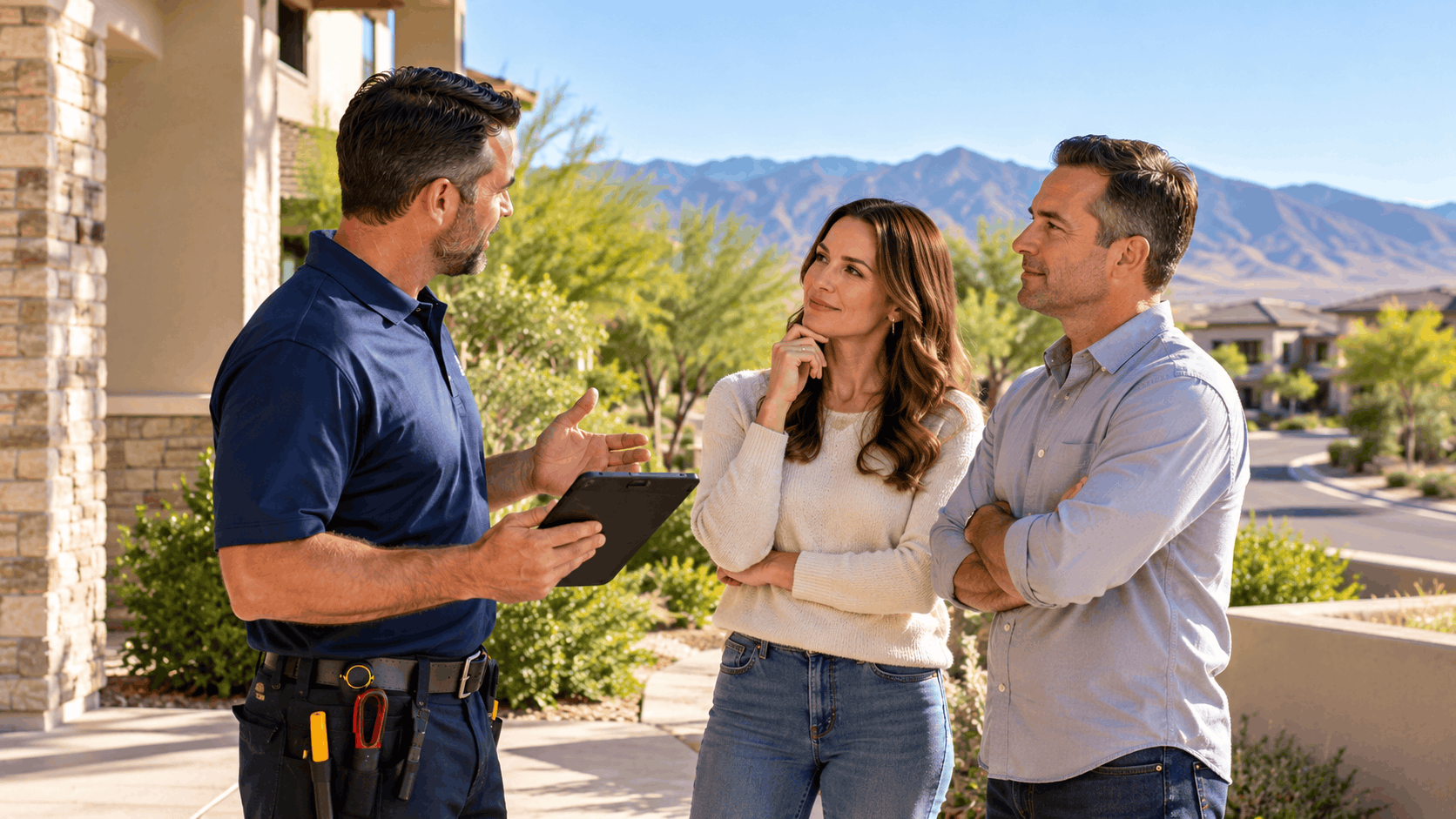
Permitted plumbing work in Summerlin must be done by an appropriately licensed contractor. That is not a formality. Licensing in Nevada is handled at the state level, and a homeowner has a clear right to check it before anyone starts.
Here is how the licensing works and how an owner verifies it, which matters in a market with a real unlicensed trade problem.
Statewide Licensing Through the Nevada State Contractors Board
Plumbing contractors in Nevada are licensed statewide through the Nevada State Contractors Board, not by a city or county. There is no such thing as a Clark County plumbing license or a City of Las Vegas license; the credential comes from the state board.
The Southern Nevada Amendments carry a plumbing license provision governing who may lead or direct installation on a job site. Combined with the state licensing requirement, this means permitted work must be performed by an appropriately licensed contractor regardless of which valley jurisdiction holds the address.
That separation is worth understanding. The building department for the address issues the permit and inspects the work, but it does not license the plumber. The license sits with the state board, and the permit sits with the local office.
For a homeowner, the two checks are different. Confirming the jurisdiction answers who permits the job, and confirming the license answers who is allowed to do it. Both are part of hiring well here.
How to Verify a License for Free
A license is verified free at nvcontractorsboard.com. The site shows classification, status, bond and workers compensation as public record, so an owner can see whether a contractor is current and properly covered before signing anything.
A customer is entitled to ask for a license number and to verify it with the board. A legitimate contractor will give the number without hesitation. Reluctance to share it is a signal worth paying attention to in this market.
Checking classification matters too, not just status. A license has to cover the type of work being done. A quick look confirms the contractor is licensed for plumbing rather than holding a different classification that does not fit the job.
This is a two-minute step that protects the homeowner. The information is free and public, and it is the single clearest way to separate a licensed contractor from the unlicensed work that circulates in the valley.
The Permit and Inspection Protect the Buyer Too
A permitted, inspected job creates a record the correct building department holds. That record is more than a formality during the work. It becomes useful later, especially at resale.
When a home changes hands, permitted work with a passed inspection shows the plumbing was done to code and signed off by the jurisdiction. Unpermitted work can raise questions during a sale and sometimes has to be corrected before a deal closes.
The inspection also protects the current owner. An inspector checking the work is a second set of eyes confirming the drain pan, the venting, the materials and the connections meet the adopted code. That is value for the homeowner living with the result.
Because the record lives with the department that governs the address, the permit position should be confirmed for the specific property. A permit filed with the wrong office does not create the record a future buyer or appraiser expects to find.
What Permitted Plumbing Work Typically Costs in the Valley?
Cost is usually the next question once jurisdiction and scope are settled. The figures below are typical market ranges for plumbing work in the Las Vegas Valley, the kind of permitted jobs a Summerlin homeowner commonly needs. They are typical ranges for the area, never a quote or a fixed price from us.
The actual price for a specific job depends on that job and is given in writing before work begins. Use these to get a sense of the territory.
| Job | Typical Las Vegas Valley range |
|---|---|
| Whole-house repipe | $4,000 to $15,000 |
| Burst pipe repair | $200 to $800 |
| Slab leak detection | $150 to $300 |
| Slab leak repair | $500 to $3,000 |
| Tank water heater installation | $800 to $1,500 |
| Tankless water heater installation | $1,500 to $3,500 |
| Tankless pre-filter (where hard water calls for one) | $150 to $300 |
| Water softener installation | $800 to $2,500 |
| Backflow preventer testing | $50 to $100 |
| Backflow device installation | $300 to $600 |
| Sewer line repair | $1,500 to $5,000 |
| Full sewer line replacement | $4,000 to $12,000 |
Repipes and Supply Line Work
For supply line work, the whole-house repipe is the big-ticket item, with a typical range of $4,000 to $15,000. The spread reflects home size, pipe routing and how much drywall has to be opened and patched. In a Summerlin North home that turns out to have polybutylene, this is the long-term fix.
Smaller leaks fall well below that. Burst pipe repair typically runs $200 to $800, depending on where the break sits and how accessible it is. A line in an open wall is a quicker job than one buried behind cabinetry.
Slab leaks split into two steps. Slab leak detection typically runs $150 to $300 to pinpoint the line without guessing, and slab leak repair typically runs $500 to $3,000 once the location is known. The repair range is wide because reaching a line under concrete varies a lot by access.
These ranges cover the supply side of what ages into failure in 1990s Summerlin homes. The detection step keeps the repair targeted, which is what holds the cost toward the lower end of its range when the leak is reachable.
Water Heaters and Water Treatment
Water heaters are among the most common planned replacements here. Tank water heater installation typically runs $800 to $1,500, while tankless water heater installation typically runs $1,500 to $3,500. The tankless range is higher because of the gas, venting and sometimes electrical work a conversion involves.
Hard water adds one line item on the tankless side. A pre-filter adds $150 to $300 where hard water calls for one, which in this valley it often does. The pre-filter helps protect the narrow heat exchanger passages from scale that would otherwise shorten the unit's life.
Water treatment is where many Summerlin owners address the hardness directly. Water softener installation typically runs $800 to $2,500. A softener reduces the scale that loads heaters, clogs aerators and fouls fixture cartridges, which is why it tends to extend equipment life here.
For homes weighing a treatment system, the math often ties back to the heater and fixtures. Reducing hardness slows the wear that drives repeat repairs, so the softener cost is best read alongside the equipment it protects.
Backflow, Sewer and Why Caliche Affects the Number
Backflow work is the small end of the scale. Backflow preventer testing typically runs $50 to $100, the annual certification that keeps an irrigation assembly compliant. Backflow device installation typically runs $300 to $600 when an assembly needs replacing.
Sewer work is the opposite end. Sewer line repair typically runs $1,500 to $5,000, and full sewer line replacement typically runs $4,000 to $12,000. The range depends on length, depth and how much of the line has failed.
Caliche is part of why a sewer number lands where it does. Trenching through cemented hardpan is slower and more expensive than digging through softer ground, so the dig itself drives cost on any buried-line job in Summerlin. That belongs in an honest cost discussion rather than being a surprise on the invoice.
Because so much of the sewer price is the excavation, a camera inspection first is money well spent. Seeing the actual condition of the line narrows the work to what is needed rather than replacing more than the problem requires.
Need Help in Las Vegas?
Active Plumbing serves Las Vegas and all of Las Vegas Valley.
How Active Plumbing Handles a Summerlin Job
Knowing the jurisdiction, the code and the likely pipe is the groundwork. Here is how we put it together on an actual Summerlin job, drawing on how our team works rather than on general claims.
Confirming the Jurisdiction and Pipe First
Our first step on permitted work is confirming which building department governs the address. Because Summerlin spans the City of Las Vegas and unincorporated Clark County, we check the address against the jurisdiction before anything else, so the permit goes to the right counter.
Getting that right up front keeps the inspection on track later. It also means we are quoting against the correct process rather than a valley-wide guess that could stall at the permit stage.
We inspect the actual pipe on site rather than assuming it from the build year. A 1990s Summerlin home might have copper throughout, or it might turn up polybutylene that changes the recommendation. Confirming the material is how we know whether a repair or a repipe is the honest call.
That on-site look also catches the related issues: original angle stops, scale in the lines, a heater past its prime. Seeing the system tells us what the home actually needs, not what the era suggests it might.
A Written Price Before Work Starts
The customer gets a written price before work begins. That is how we operate on every job, so an owner knows the number ahead of the work rather than after it.
The actual price for a specific job is given in writing, tied to what the inspection and the scope show. A repipe in a larger home and a single fixture swap are different jobs with different numbers, and the written price reflects the job in front of us.
This keeps the conversation straight. An owner can review the price, ask questions and decide before any work starts, with no moving target once the job is underway.
It is a business practice, not a guarantee, and it is simply how we think a plumbing job should be handled from the first visit.
Licensed, Local and Fast to Respond
Active Plumbing is a fourth-generation family business that has served the Las Vegas Valley since 1991. Some of our owners are US military veterans, and we have worked these Summerlin villages through their aging from new construction into thirty-year-old homes.
We hold Nevada plumbing license NSCB #0047021, verifiable free at nvcontractorsboard.com, along with the certifications required for the work we perform. An owner can check that license and see classification, status, bond and workers compensation for themselves.
Technicians arrive in 30 to 60 minutes anywhere in the Las Vegas Valley for emergency plumbing, and scheduled work is same-day or booked. For a Summerlin North home with a slab leak or a failed heater, that response window matters.
Because we work Summerlin regularly, we can tell an owner which department likely governs their address and what their village's build era tends to produce. That local knowledge is part of what we bring to the job.
Confirm Your Address and Get a Written Price
If you have permitted plumbing work coming up in Summerlin North, start by having the jurisdiction and the pipe confirmed, then get the number in writing before anyone begins. Call Active Plumbing at (702) 438-3357 to set that up.
Our team will identify which building department governs your address, inspect the actual system on site, and give you a written price before work starts, with technicians reaching Summerlin homes in 30 to 60 minutes on emergencies.
Frequently Asked Questions
- Which master association governs plumbing work in Summerlin?
- No single master association issues plumbing permits in Summerlin. The government permit authority is the City of Las Vegas or unincorporated Clark County, decided by the exact address. A master or homeowners association runs a separate design review that may apply to exterior or visible work, but that review does not replace the government permit. Both can apply to one job, so confirm the permit with the building department and any review with the association.
- Is Summerlin North part of the City of Las Vegas or Clark County?
- Summerlin spans both the City of Las Vegas and unincorporated Clark County, so the authority follows the specific address rather than the community name. Summerlin North is a City of Las Vegas planning area, which makes the city the likely authority for much of it, but the broader community crosses the line. An owner should confirm with the department that governs their property rather than assuming the city from the Summerlin name.
- Do I need a permit for plumbing work in Summerlin?
- Work requiring a permit must be performed by an appropriately licensed contractor and permitted through the correct building department for the address. Which office that is depends on whether the home sits inside the City of Las Vegas or unincorporated Clark County. The permit position should be confirmed for the specific address before work starts, since the two jurisdictions run separate permit counters and processes. A licensed plumber can handle that confirmation and the permit path for the owner.
- How do I know if my Summerlin home has polybutylene pipe?
- Some 1990s-era Summerlin homes have polybutylene supply, which is a material now associated with failure at fittings and a standard repipe candidate. It is not in every home of that era, so it cannot be read from the build year alone. The reliable way to know is to confirm the pipe on site, where a plumber can identify the material and check the fittings. If polybutylene turns up, a whole-house repipe is the usual long-term answer.
- How hard is the water in Summerlin?
- The Southern Nevada Water Authority reports valley hardness at about 280 parts per million, roughly 16 grains per gallon, which is categorized as very hard. That is the single published figure, and SNWA does not publish per-ZIP or per-neighborhood hardness tables, so anyone presenting a special Summerlin number is inventing it. This hardness is what drives scale in water heaters, tankless heat exchangers, fixture cartridges and valve seats across the valley, Summerlin included.
- Does caliche cause my pipes to crack?
- No. Caliche is a cemented calcium-carbonate hardpan that does not shift, swell or crack pipes, and it is not an expansive soil. What it does is make digging slower and more expensive, and it abrades buried copper where a line runs through it. The movement that stresses buried lines and pulls them out of grade comes from expansive soil wetting and drying, plus poorly compacted backfill settling under the pipe, not from caliche.
- Who handles gas line work in Summerlin?
- Natural gas in the Las Vegas Valley is supplied by Southwest Gas. If you suspect a gas leak, leave the building, avoid light switches and open flames, and call the gas utility from outside before calling a plumber. Once the situation is safe, a licensed plumber handles gas line installation, rerouting and repair under permit. Gas piping under a slab must be removable without disturbing the slab, so slab-on-grade Summerlin homes need conduit or a listed system for buried gas runs.
- Who runs the backflow program for Summerlin irrigation systems?
- Backflow prevention and cross-connection control are run by the water provider, not the building department. For most of Summerlin North, that is the Las Vegas Valley Water District, whose backflow prevention program covers commercial buildings, multifamily properties and irrigation systems. The LVVWD backflow staff line is 702-258-3156. Backflow assemblies must be tested by a certified tester at installation, repair or relocation and at least annually, with the tester leaving certification on site.
- How do I verify a plumber's license in Nevada?
- Plumbing contractor licensing is statewide through the Nevada State Contractors Board, not through a city or county. A license is verified free at nvcontractorsboard.com, where classification, status, bond and workers compensation are public record. A customer is entitled to ask for a license number and check it against that site. Confirming the classification covers plumbing, not just that the license is active, is a quick step that protects an owner before hiring.
- How fast can a plumber reach a Summerlin North home?
- Emergency dispatch is 30 to 60 minutes across the Las Vegas Valley, and scheduled work is same-day or booked. For a Summerlin North call, our team confirms the permit position for the address first on any permitted job, then handles the work. A failed water heater or a suspected slab leak is the kind of situation that fits the emergency window, while a planned repipe or treatment install is usually scheduled.
Licensed plumbing professionals serving Las Vegas and Las Vegas Valley.
Licensed in Nevada · License #0047021
Last updated on
Why trust Active Plumbing?
Founded in 1991, Active Plumbing is a licensed and insured plumber serving Las Vegas and Las Vegas Valley. All content is reviewed by our licensed technicians.

Need Help in Las Vegas?
Active Plumbing serves Las Vegas and all of Las Vegas Valley.
Related Articles
Clark County Plumbing Permit Requirements: Which Repairs Need One
A clear guide to Clark County plumbing permit requirements, covering which repairs need a permit, which do not, gray areas, and how the local process works.
Which Plumbing Work Needs HOA and Design Review Approval in Southern Highlands
Interior plumbing in Southern Highlands rarely needs HOA approval, but visible or street-facing changes usually do. Here is the full breakdown, plus county permits and costs.

The Spring Valley Town Advisory Board and County Rules: What Governs Plumbing Work on Your Home
Plumbing work on a Spring Valley home runs through Clark County, not the City of Las Vegas, and the Town Advisory Board does not issue permits or write code.