Thirty-Five Years Across Thirty Villages: A Summerlin Plumbing Guide by Build Era

Key Takeaways
- Summerlin was built village by village from 1989 forward, so the build era of a home is the best early clue to its pipe material.
- Homes before about 1995 may have polybutylene, 1995 to 2007 may have Kitec, copper runs through the middle decades, and PEX dominates newer villages like Summerlin South and West.
- Summerlin spans two permitting authorities: Summerlin North and West are City of Las Vegas, while Summerlin South is unincorporated Clark County, so the jurisdiction is confirmed from the address.
- The valley's very hard water at about 280 ppm, roughly 16 grains per gallon, scales water heaters and fixtures, so softeners and regular flushing extend equipment life here.
- Early Summerlin copper is now at the age where pinhole leaks begin, particularly on hot lines and under-slab runs in slab-on-grade homes.
- Caliche abrades buried pipe and makes trenching slower and more expensive, but it does not move pipe; expansive clay and settling backfill do that.
- Downtown Summerlin is commercial, so the work is grease interceptors, commercial water heating, backflow testing and Legionella management rather than repipes.
- Active Plumbing confirms the jurisdiction and the pipe on site, provides a written price before work starts, holds Nevada license NSCB #0047021, and responds in 30 to 60 minutes valley-wide.
In This Article
Summerlin is not one house on repeat. It is a community built across more than three decades, and the pipe behind the walls changes with every wave of construction. A 1989 Sun City home does not have the same plumbing as a 2003 house in The Vistas, which does not match a home still being framed in Summerlin West against the Spring Mountains.
That matters because the build era of a village is the single best early clue about what a plumber will find inside. The age points to copper, polybutylene, Kitec or PEX before anyone opens a wall. It also tells you which department holds the permit, because Summerlin is split between two separate permitting authorities.

Why the Village Decides the Plumbing in Summerlin?
Summerlin grew in waves from the late 1980s to today, and each wave carried the pipe material that was standard at the time. Knowing the village and its development year narrows down what a home likely has before anyone opens a wall. The Summerlin build era is a strong first filter, not a final answer.
The table below lines up the villages by age against the pipe material most likely for that era. Village age is the honest starting point, but the material has to be confirmed on site every time.
| Village or Era | Approx. Development | Likely Pipe Material |
|---|---|---|
| Sun City Summerlin | From 1989 | Copper, some early fittings aged out |
| The Hills / Summerlin North | Early 1990s | Copper typical, polybutylene in some homes |
| Santa Barbara (The Hills South) | About 1997 | Inside the Kitec window |
| The Arbors (Belvedere, Cottonwood Terrace) | 1999 to 2001 | Kitec-era possible, copper |
| The Vistas / The Paseos | 2000s | Kitec-era possible, copper |
| The Ridges | Early 2000s | Copper and PEX |
| Summerlin South | Later than north | Copper and PEX, no polybutylene |
| Summerlin West | Late 2010s onward | PEX dominant |
A 22,500-Acre Community Built Over Three Decades
Summerlin is a master-planned community covering about 22,500 acres on the western edge of the Las Vegas Valley. It sits against the Spring Mountains and the Red Rock Canyon National Conservation Area, which gives the newest villages their dramatic backdrop and their elevation.
The community did not go up all at once. It was developed village by village from 1989 forward, with each new section reflecting the construction practices of its day. That staged growth is why a short drive across Summerlin crosses several decades of plumbing standards.
Summerlin North and Summerlin West lie within the City of Las Vegas. Summerlin South is unincorporated Clark County, bounded by Charleston Boulevard, Russell Road, Hualapai Way and the conservation area. The name on the sign does not tell you the age or the jurisdiction, which is exactly why both have to be checked.
For a plumber who works these streets, the village name is shorthand for a whole set of likely conditions. It hints at the pipe, the age of the water heater, the condition of the angle stops and the department that issues the permit. None of that replaces the inspection, but it shapes the first questions worth asking.
What the Build Year Tells You About the Pipe
Las Vegas grew in distinct waves, and the pipe in the ground reflects that timeline. Homes built before about 1995 may carry polybutylene supply lines, a material now associated with failure at fittings and a standard repipe candidate. When those tracts went in, polybutylene was a common and accepted choice.
Homes from roughly 1995 to 2007 fall inside the window where Kitec fittings appear. Kitec combined a plastic pipe with brass fittings, and those brass fittings tend to restrict flow before they ever leak. Copper runs through the middle decades on both supply and some branch lines, and it is widespread across many Summerlin homes.
PEX dominates newer construction, which covers the later Summerlin South work and the ongoing building in Summerlin West. PEX is flexible, resists scale buildup better than narrow metal passages, and has become the standard for new residential supply across the valley.
The build year is a strong hint, not proof. Tracts were built over several seasons, builders changed suppliers, and later owners repiped sections. The year narrows the field, and the on-site inspection settles it.
Confirm the Material Before Any Repipe Talk
Identifying the actual pipe comes first, before anyone talks about a repipe or a repair budget. The reason is that different materials fail in different ways, and the fix depends entirely on what is there. A patch that makes sense on copper can be the wrong move on a failing system.
Polybutylene fails at its fittings, often without much warning, which is why finding it changes the conversation from a single repair to planning a whole-house replacement. Kitec behaves differently. Its brass fittings corrode and narrow the passage, so a homeowner notices weak flow at the fixtures before a leak ever appears.
Early Summerlin copper is now old enough that pinhole leaks begin, particularly on hot lines and under-slab runs. Each of these patterns points to a different plan, and guessing from the build year alone can send the work in the wrong direction.
Our team inspects accessible runs, checks fittings and identifies the material before quoting anything. Once the pipe is confirmed, the choice between a targeted repair and a whole-house repipe rests on evidence rather than assumption.
Get Your Quote
Tell us what's going on and we'll get back to you. We're open 24/7.
The Jurisdiction Question Comes First in Summerlin
Summerlin spans two permitting authorities, so the city or county is confirmed from the address, not the name. Getting this wrong means a permit filed with the wrong department, which stalls the job before it starts.
This is not a technicality. Establishing the correct jurisdiction before quoting permitted work is a routine first step in this market, and it protects the homeowner from delays and rework.
City of Las Vegas vs Unincorporated Clark County
Summerlin North and Summerlin West lie in the City of Las Vegas. That covers the older north villages and the newest construction pushing west toward the mountains. For those addresses, the City of Las Vegas building department is the authority.
Summerlin South is unincorporated Clark County. It is bounded by Charleston Boulevard, Russell Road, Hualapai Way and the conservation area. Residents there often describe their home as Las Vegas, but for permits it is a Clark County address.
Because the community straddles the line, two homes a few minutes apart can answer to different departments. The village name does not decide it. The specific street address does, and that is what we confirm before any permitted work.
Getting this right also matters for sewer. The Clark County Water Reclamation District serves unincorporated areas, while the City of Las Vegas runs its own sewer system. Matching the authority to the address keeps the whole job on solid ground.
Why Two Departments Means Two Permit Counters
Each authority runs its own permit counter with its own process. The City of Las Vegas and Clark County both review plans and issue permits, but they are separate offices. A permit filed with the wrong one does not transfer, it simply sits.
For a homeowner, this means the permit position has to be confirmed for the exact address rather than assumed from the Summerlin name. We handle that confirmation as part of the work so the paperwork lands at the right counter the first time.
Licensing works differently from permitting. Plumbing contractors are licensed statewide through the Nevada State Contractors Board, not by any individual city or county. A license is not a Clark County license or a Las Vegas license, it is a Nevada license.
A customer is entitled to ask for a license number and verify it free at nvcontractorsboard.com, where classification, status, bond and workers compensation are all public record. In a market with a real unlicensed trade problem, that check is worth making.
Which Code Applies in Summerlin
Nevada has no statewide plumbing code. Both the City of Las Vegas and Clark County adopt the Uniform Plumbing Code published by IAPMO together with the Southern Nevada Amendments. So the rules that apply to a Summerlin job come from the local plumbing code for that address.
The Southern Nevada Amendments are developed by the Southern Nevada Building Officials and then adopted by each jurisdiction. In July 2025 the valley's jurisdictions adopted the 2024 edition of the code with those amendments, replacing the 2018 editions, with effective dates rolling out in early 2026.
The amendments set specific rules that affect residential work, such as water heater drain pans where a leak would cause damage, approved materials for relief valve drains inside a building, and fixture flow limits. Those details shape how a repipe or a water heater swap is done here.
The amendments also state they are not intended to prevent a material or method not specifically prescribed, provided an alternate is approved by the Building Official. The Building Official is the authority on alternate methods, so unusual situations get resolved through that office rather than guesswork.

Need Help in Las Vegas?
Active Plumbing serves Las Vegas and all of Las Vegas Valley.
The Oldest Villages: Sun City Summerlin and The Hills
The earliest villages are now thirty-plus years old, which changes what fails and who is responsible. Water heaters, angle stops and original fittings have reached or passed their service life in these homes.
Aging plumbing in the oldest Summerlin villages is a predictable category of work. The parts that wear out on a clock rather than from abuse are the ones calling for attention first.
Sun City Summerlin, the Oldest by a Clear Margin
Sun City Summerlin is the oldest village by a clear margin. The age-restricted Del Webb community was developed from 1989 and holds roughly 7,700 homes, with its own community association, golf courses and recreation centers.
Its earliest phases are now about thirty-five years old. That age puts the original plumbing hardware well into the window where routine components reach the end of their useful life, even in a home that has been well maintained.
Because the community is age-restricted and tightly managed, the homes have often had careful owners. Careful ownership slows wear but does not stop a clock. A thirty-five-year-old angle stop is a thirty-five-year-old angle stop regardless of how gentle the household has been.
For residents here, the practical takeaway is to expect original parts to be at or past their life and to plan replacements before a failure rather than after a flood. Knowing the home's phase within Sun City helps gauge how far along that timeline a specific house sits.
Water Heaters, Angle Stops and Second or Third Replacements
The earliest Sun City phases put water heaters on a second or third replacement by now. A tank water heater is a wear item, and across thirty-five years a home will have cycled through more than one. Original angle stops, the small shutoff valves under sinks and behind toilets, are well past their life too.
Very hard valley water accelerates heater wear. The Southern Nevada Water Authority reports water hardness of about 280 parts per million, or roughly 16 grains per gallon, which is categorized as very hard. That mineral load leaves calcium and magnesium scale on heater elements and tank bottoms.
Scale makes a water heater work harder to move heat through the deposits, so an unflushed tank fails earlier than its rated life. Regular flushing is the straightforward response, and it genuinely extends equipment life rather than being an optional extra in this valley.
Angle stops are worth attention during any plumbing visit. An old stop that will not fully close turns a simple faucet swap into a bigger job, so replacing them proactively saves trouble later. Our water heater services cover both the heater and the valves that feed it.
The Hills and Summerlin North Copper Plus Polybutylene
The Hills is the second oldest village, an original section from the early 1990s on the eastern side around the golf corridors. The Summerlin North villages also date from the early 1990s and share the same construction era.
In these villages, copper supply is typical. Copper was the mainstream choice through the middle decades, and much of The Hills and Summerlin North was plumbed with it. That copper is now reaching the age where early pinhole leaks can begin on the hot side and on buried runs.
Polybutylene is also present in some homes of that era and is worth confirming rather than assuming. A home in an early-1990s tract could carry copper, could carry polybutylene, or could have had one replaced with another by a prior owner.
The only way to know is to look. An inspection of accessible supply lines and fittings settles the question quickly. If polybutylene turns up, the plan shifts toward a planned repipe because that material fails at its fittings over time.
Shared Responsibility in Association Communities
Sun City Summerlin is a managed association community, and that creates dual responsibility between the association and the homeowner when something backs up. The line between what the association maintains and what the homeowner owns is not always obvious from inside the house.
When a drain backs up or a shared line is involved, the first question is where the responsibility sits. Common elements and certain shared systems may fall to the association, while the plumbing inside the unit and up to a defined point is typically the homeowner's.
The sensible move is to confirm where the line of responsibility sits with the association rather than assuming. That one call can decide who pays and who schedules the repair, and it avoids a homeowner footing a bill that belonged to the association, or the reverse.
We are used to working in association communities and can help document what we find so a homeowner has a clear record to share with their association. Clear facts make the responsibility conversation faster and fairer for everyone involved.
The Kitec and Polybutylene Window: Mid-1990s to Mid-2000s Villages
Several Summerlin villages fall inside the eras where Kitec and polybutylene were installed. These materials restrict flow or fail at fittings, so identifying them matters before any repair plan is drawn up.
The window spans homes built before about 1995 for polybutylene and roughly 1995 to 2007 for Kitec. A number of Summerlin villages sit squarely inside that range, which makes material identification the first real step.
Santa Barbara and The Hills South Inside the Kitec Window
Santa Barbara, in The Hills South, dates to about 1997. That places it inside the Kitec window, where the combination of plastic pipe and brass fittings was used in residential construction across the valley.
Kitec's weak point is its brass fittings. Over time those fittings corrode on the inside and narrow the passage water flows through. The result is restricted flow that shows up as weak pressure at faucets and showers before any leak appears.
That flow restriction is actually a useful warning sign. A homeowner who notices gradual pressure loss across multiple fixtures in a late-1990s Hills South home has a reason to have the material checked. Catching it at the flow stage is better than waiting for a fitting to let go.
Because Santa Barbara sits right in the middle of the Kitec era, we treat a flow complaint there as a prompt to confirm the pipe type. If it is Kitec, the conversation turns toward planning rather than patching a single point.
The Arbors: Belvedere and Cottonwood Terrace
The Arbors holds Belvedere, 78 homes built by William Lyon Homes in 2000 and 2001 at Anasazi and Town Center Drive in the 89144 zip code. These homes sit at the edge of the window where Kitec appears, so the material is worth confirming on any plumbing visit there.
The Arbors also holds Cottonwood Terrace, Pulte townhomes with models that opened in 1999 and build-out completed in 2001, in the 89145 zip code. Townhomes add a layer because shared walls and stacked units can complicate access to supply lines.
For both neighborhoods, the 1999 to 2001 build dates land inside the broad Kitec era. That does not guarantee Kitec is present, but it makes the material a question worth answering before any repair plan. An inspection of accessible fittings gives the answer.
In a townhome like Cottonwood Terrace, confirming the pipe also helps map how a repipe would actually be sequenced through shared construction. Knowing the material and the layout together is what turns a quote into a realistic plan.
The Vistas and The Paseos in the 2000s
The Vistas began development in 2000. Within it, Capri was built early to mid 2000s, and Talaverde is about 83 single-story homes built by Woodside in 2003 and 2004 in the 89138 zip code. These dates place The Vistas across the heart of the Kitec window.
The Talaverde neighborhood is a good example of how specific a village can get. Single-story homes from 2003 and 2004 share a tight construction window, which makes the likely material and age of components fairly consistent across the tract.
The Paseos is a 2000s village as well, falling in the same general era. Homes from this period may carry Kitec, may carry copper, and the newer end of the decade starts to shade toward PEX in some construction.
Across The Vistas and The Paseos, the pattern holds: the build date flags Kitec as a real possibility, and the inspection confirms it. A home in The Paseos gets the same material check as any other 2000s Summerlin address.
What Identifying These Materials Prevents
Spotting polybutylene or Kitec early changes the repair conversation from patching to planning. With these materials, a single-point repair often buys limited time because the problem is systemic to the fittings, not isolated to one spot.
Confirming the material on site comes before quoting for a reason. A quote built on the wrong assumption either overspends on a doomed patch or underspends and misses the real scope. The inspection turns the guess into a plan.
When polybutylene turns up, the honest path is usually a planned repipe because the fittings will keep failing. When Kitec turns up with restricted flow, the same logic applies, since replacing the corroding fittings one at a time is a losing game.
Identifying the material early also lets a homeowner budget and schedule on their own terms instead of reacting to a burst line. Planning a repipe beats cleaning up after a failure, and that is the real value of getting the material right first.
The Newer Villages: Summerlin South, The Ridges and Summerlin West
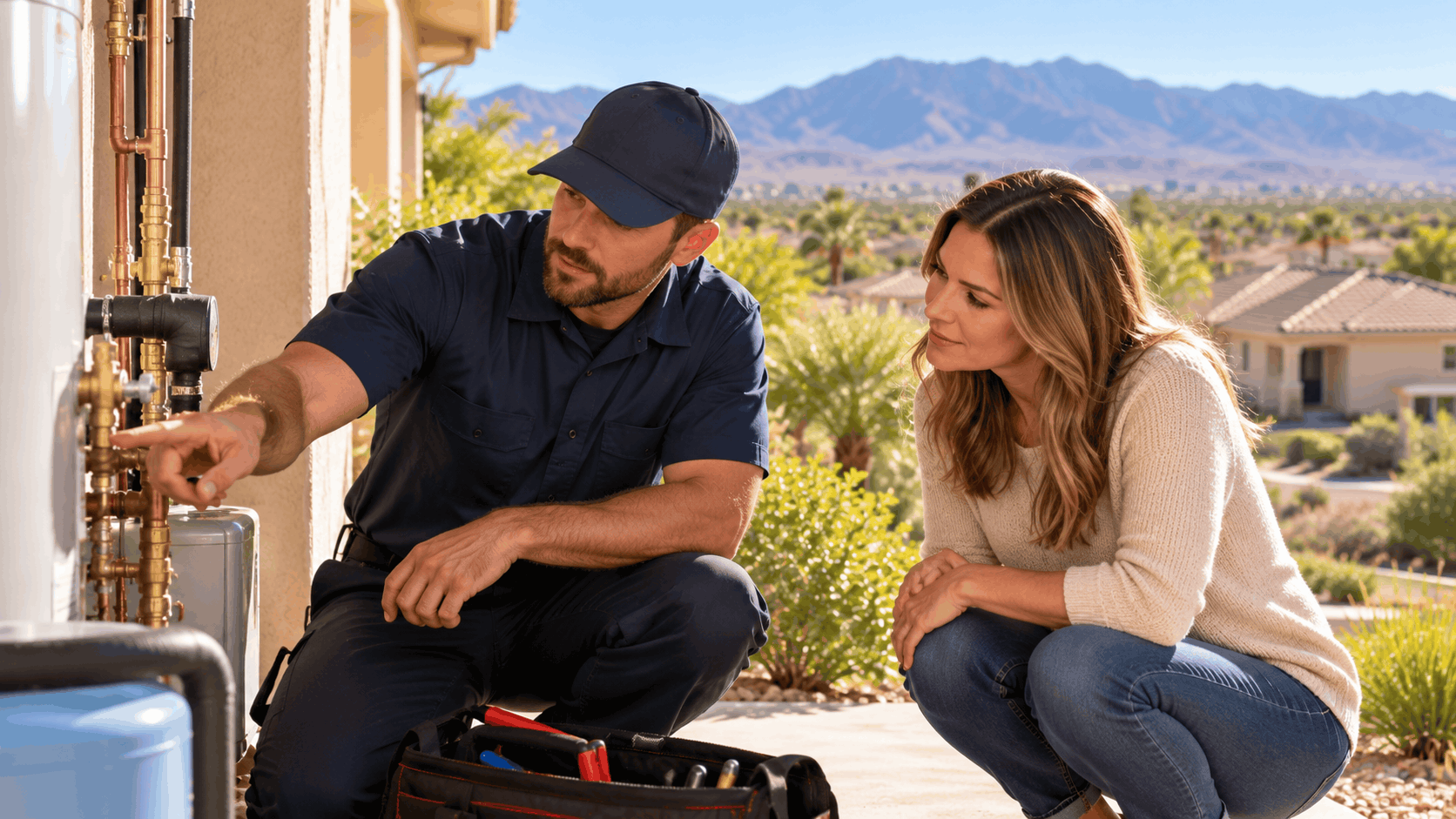
The south and west villages are later builds with copper and PEX and no polybutylene question. The issues shift from material failure toward higher-value custom work and newer-system service.
In these villages the conversation is rarely about an obsolete material. It is about maintaining newer systems, servicing larger custom homes, and getting the jurisdiction right at the permit counter.
Summerlin South: Copper and PEX, No Polybutylene
Summerlin South is later than the north villages. It was built with copper and PEX supply, which means there is no polybutylene question to settle. That alone simplifies the material conversation compared with the older eastern villages.
Copper and PEX are both durable choices. PEX in particular resists scale buildup better than narrow metal passages, which is a real advantage in a valley with very hard water. Copper remains solid, though even newer copper will eventually face the same hard-water scale on the inside over many years.
Summerlin South sits in unincorporated Clark County for permitting. That is a key difference from the north villages, which fall under the City of Las Vegas. For any permitted work in Summerlin South, the paperwork goes to Clark County.
Because the material is modern and the jurisdiction is clear, work here tends to be straightforward service and upgrades rather than emergency repipes. That said, the hard-water story still applies, so water heater flushing and treatment remain worthwhile for these homes.
The Ridges, Guard-Gated Luxury From the Early 2000s
The Ridges is the guard-gated luxury village from the early 2000s. It features custom estates on elevated lots around Bear's Best, and it represents the highest-value plumbing work in the northwest valley.
Custom estates mean custom plumbing. Larger homes carry more fixtures, multiple water heaters, recirculation systems and specialized equipment, all of which add scope to any job. A service call in The Ridges often touches systems a standard tract home does not have.
Guard-gated access also shapes the logistics. Scheduling, access coordination and the expectations that come with high-value homes are part of the work here. Precision and clean workmanship matter as much as the repair itself.
The pipe is modern copper and PEX, so material failure is not the driving concern. The focus is maintaining complex systems well, from recirculation pumps that keep hot water moving to larger-capacity water heating, and doing it to the standard these estates expect.
Summerlin West, the Newest Against the Spring Mountains
Summerlin West is the newest village, built from the late 2010s against the Spring Mountains and still building today. These are the freshest homes in the community, plumbed to current standards with PEX dominant.
New construction does not mean no plumbing needs. New homes still need fixture work, water treatment to handle the valley's very hard water, and service as systems bed in. The very hard water that scales older systems also works on brand-new ones, just more slowly.
Summerlin West lies in the City of Las Vegas for permits. Like the rest of Summerlin North, any permitted work here files with the city building department, not Clark County. Confirming that early keeps the job moving.
For owners of the newest homes, the smart play is early water treatment and a flushing routine to protect new equipment from scale. Starting that habit when the home is new extends the life of everything from the water heater to the fixtures.
Need Help in Las Vegas?
Active Plumbing serves Las Vegas and all of Las Vegas Valley.
Early Summerlin Copper and the Pinhole Leak Problem
Copper that went in across the middle decades is now at the age where pinhole leaks begin. The valley's very hard water and the way homes here are built shape where those leaks show up.
A pinhole leak is exactly what it sounds like, a tiny perforation in a copper line that weeps or sprays. By the time it is visible, it has often been working for a while, which is why detection matters.
Where Pinhole Leaks Start on Older Copper
Early Summerlin copper is now at the age where pinhole leaks begin. This is a function of the pipe's age, not any invented failure rate. Copper does not last forever, and the oldest copper in the community has simply reached that stage of life.
The leaks tend to start on hot lines and under-slab runs. Hot water lines face more stress from temperature, and buried runs are both harder to inspect and harder to reach once a problem develops. Those are the places to watch first in an older copper home.
A pinhole leak often announces itself quietly, through a jump in the water bill, a warm spot on a floor, or the sound of running water when nothing is on. Catching those signs early keeps a small weep from becoming a major water loss.
For an owner of an early 1990s Summerlin home with copper, the age of the pipe is the reason to take these signs seriously. Our electronic leak detection pinpoints the source without tearing a house apart to find it.
Why Slab-on-Grade Homes Face Under-Slab Failures
Slab-on-grade construction covers most of the valley, including Summerlin. That construction style runs supply lines under the concrete slab the home sits on, which makes under-slab supply line failures a distinct category of work.
When a line fails under the slab, the water has nowhere obvious to go. It can travel, surface through flooring, or show up as a warm patch on a tile floor. A slab leak is harder to find and harder to reach than a leak in an accessible wall.
Detection uses electronic equipment to locate the leak precisely before any concrete is opened. Pinpointing the spot first limits how much of the slab has to be disturbed, which controls both cost and disruption to the home.
The repair then depends on the situation. Options range from accessing and repairing the single spot to rerouting the line, and the right choice depends on the pipe's overall condition. If the under-slab copper is failing in more than one place, a reroute or repipe can make more sense than chasing individual leaks.
How Very Hard Water Shortens Fixture and Heater Life
The Southern Nevada Water Authority reports valley water hardness at about 280 parts per million as calcium carbonate, which is roughly 16 grains per gallon and categorized as very hard. That single figure explains more plumbing wear in Las Vegas than almost anything else.
Very hard water deposits calcium and magnesium scale throughout a system. Scale builds on water heater elements and tank bottoms, narrows the bore of supply lines over years, and clogs aerators, shower heads and the small passages inside mixing valves and cartridges. It also fouls inlet screens on dishwashers and washing machines.
In tankless units the stakes are higher because the heat exchanger is a narrow passage that scale blocks quickly. That is why descaling is standard maintenance for tankless systems in this valley, not an optional step.
Whole-house softeners, scale-reduction systems and regular water heater flushing are the standard responses. In this valley they extend equipment life rather than being luxuries. Our water treatment options address the hardness at the source so every fixture downstream lasts longer.
Caliche and Why Trenching Costs More Here
Caliche is a cemented calcium-carbonate hardpan common across the valley. It is abrasive, which makes excavation slower and more expensive, and it abrades buried pipe where a line runs through it. Any honest discussion of a buried repair cost in Summerlin has to account for it.
Caliche does not shift, swell or crack pipes, and it is not an expansive soil. That distinction matters. What actually moves pipe out of grade is expansive clay that swells and shrinks with moisture, along with poorly compacted backfill settling under a line over time.
Seasonal wetting and drying plus that settling fill are what pull lines out of grade and create bellies in sewer runs. Caliche's role is different. It slows the dig and wears on pipe through contact, which is why trenching through it takes longer and costs more.
For a homeowner, the practical point is that a buried repair in caliche involves more labor to reach the line and proper bedding to protect the new pipe. That is why the same repair can cost more here than in softer ground elsewhere.

Downtown Summerlin: A Different Set of Plumbing Needs
Downtown Summerlin is the commercial core, not a residential village. The work there is tenant improvement and large-system service rather than slab leaks and repipes.
It is the retail, dining, office and entertainment heart of the community, with a ballpark and arena nearby. The plumbing needs follow the commercial use, which is a different world from the surrounding homes.
Grease Interceptors and Commercial Water Heating
The core of Downtown Summerlin plumbing is grease interceptors, commercial water heating and tenant improvement work. Retail, dining, office and entertainment tenants near the ballpark and arena all bring commercial-scale systems.
Restaurants and food establishments need grease interceptors to keep fats, oils and grease out of the sewer. Under the Southern Nevada Amendments, pot, scullery and dishwashing sinks and commercial dishwashers drain indirectly through an air gap with an adjacent floor drain, which ties into health district requirements for food service.
Grease traps and interceptors need regular pumping to keep working, and the interval and rules come from the sewer authority for the address. Our grease trap pumping keeps a kitchen compliant and draining properly.
Commercial water heating is its own category, often involving larger-capacity or multiple units to meet demand. A busy restaurant or a multi-tenant building needs reliable hot water at volume, and our commercial water heater installation handles that scale.
Backflow and Cross-Connection Control on Commercial Sites
Backflow prevention and cross-connection control are run by the water provider, not the health district or the building department. In Las Vegas Valley Water District territory, the backflow program requires backflow prevention assemblies on commercial buildings, multifamily properties and irrigation systems.
Nevada has required builders to install these assemblies on new commercial properties since the 1990s, and the water provider retrofits older buildings. The assembly keeps contaminated water from flowing backward into the potable supply, which protects everyone on the system.
Under the Southern Nevada Amendments, backflow assemblies are tested by a certified tester at installation, repair or relocation, and at least annually thereafter. The tester leaves certification on site. That annual test is a standing obligation for a commercial property, not a one-time step.
For a Downtown Summerlin tenant or owner, staying current on backflow testing is part of running the building. We coordinate testing and any needed repair so the assembly stays compliant with the water provider's program.
Legionella Risk in Large Building Systems
Legionella can proliferate in large plumbing systems such as offices, hotels and high rises. SNWA notes that while it is found in low concentrations in source water, it can grow in biofilm along the interior of water pipes under the right conditions.
That makes temperature management, dead legs and stagnation legitimate commercial plumbing concerns rather than abstractions. A dead leg is a section of pipe with no flow, and low-use lines where water sits are exactly where biofilm and bacteria can establish.
Recirculation design matters here too. Keeping hot water moving and maintained at proper temperature through a building limits the conditions bacteria need. In a large commercial building, these are real design and maintenance considerations.
For a multi-tenant building in Downtown Summerlin, addressing dead legs, stagnation in low-use lines and recirculation is part of responsible system management. It is one more reason commercial plumbing here is a different discipline from residential service.
What Common Summerlin Plumbing Work Typically Costs?
Cost depends on the village, the material and the access, but typical market ranges for the valley give a reader a sense of scale. These are typical ranges for the area, not a quote, and the actual price for a specific job is given in writing before work begins.
| Job | Typical Range |
|---|---|
| Whole-house repipe | $4,000 to $15,000 |
| Burst pipe repair | $200 to $800 |
| Slab leak detection | $150 to $300 |
| Slab leak repair | $500 to $3,000 |
| Electronic leak detection | $150 to $350 |
| Tank water heater installation | $800 to $1,500 |
| Tankless water heater installation | $1,500 to $3,500 |
| Tankless pre-filter (where hard water calls for one) | adds $150 to $300 |
| Water heater repair | $150 to $500 |
| Water softener installation | $800 to $2,500 |
Repipe and Leak Repair Ranges
A whole-house repipe typically runs $4,000 to $15,000 in the valley. That wide range reflects home size, the number of fixtures, the material being installed and how accessible the existing runs are. A single-story Talaverde home and a custom Ridges estate sit at different ends of that spread.
Burst pipe repair typically runs $200 to $800. A burst line is usually a single-point failure, so the repair is more contained than a full repipe, though access can push it within the range.
Slab leak detection typically runs $150 to $300, and slab leak repair typically runs $500 to $3,000. The detection step locates the leak precisely, and the repair cost depends on how the line is reached and whether a reroute makes more sense than a spot fix.
Electronic leak detection typically runs $150 to $350. This is the non-invasive step that finds a hidden leak before any demolition, and it is money well spent because it limits how much gets opened up. Our emergency plumbing team handles these finds when a leak cannot wait.
Water Heater and Water Treatment Ranges
Tank water heater installation typically runs $800 to $1,500. For an older Sun City home on its second or third heater, this is a familiar line item, and the range covers the unit, the install and bringing the connections up to current code.
Tankless water heater installation typically runs $1,500 to $3,500, with a pre-filter adding $150 to $300 where hard water calls for one. Given the valley's very hard water, a pre-filter and a descaling routine protect the tankless heat exchanger, which is why that add-on shows up here.
Water heater repair typically runs $150 to $500. Many heater problems, from a bad element to a failing valve, are repairs rather than full replacements, and the range reflects the variety of fixes.
Water softener installation typically runs $800 to $2,500. For a home anywhere in Summerlin, a softener addresses the 280 ppm hardness at its source and extends the life of the heater and every fixture downstream.
What Pushes a Summerlin Job Toward the Higher End
Several factors move a job within its range. Caliche excavation is a real one. Trenching through cemented hardpan is slower and more labor-intensive, so a buried repair in caliche sits higher in its range than the same job in soft ground.
Under-slab access pushes cost up as well. Reaching a line beneath a concrete slab takes more work than reaching one in an open wall, which is why slab leak repair spans such a wide range.
The pipe material found and the village age both matter. A home that turns out to have failing polybutylene or Kitec may need a planned repipe rather than a patch, which changes the scope entirely. The build era points toward which conversation is likely.
Custom estates in The Ridges can mean larger scope simply because the homes are bigger and carry more systems. More fixtures, multiple water heaters and recirculation all add to a job. None of this involves a multiplier, it is just more work in a larger, more complex home.
Need Help in Las Vegas?
Active Plumbing serves Las Vegas and all of Las Vegas Valley.
How Active Plumbing Handles a Summerlin Job
The work starts with confirming the address jurisdiction and the actual pipe, then a written price before anything begins. Here is how a Summerlin job moves from the first visit to a finished repair.
Confirming the Jurisdiction and the Pipe On Site
The first step is confirming whether the address is City of Las Vegas or unincorporated Clark County. Because Summerlin straddles both, that determines which permit counter the work files with, and we settle it from the specific address rather than the village name.
Next comes inspecting the plumbing to identify the actual material. Our team checks accessible runs and fittings to determine whether the home has copper, PEX, polybutylene or Kitec before any repair plan is drawn up.
That pipe inspection is what turns a build-era guess into a confirmed fact. A 1997 Santa Barbara home might be Kitec, an early-1990s Hills home might be polybutylene, and only the inspection tells us for certain.
Confirming both the jurisdiction and the material up front keeps everything downstream accurate, from the permit to the quote. It is the groundwork that makes the rest of the job go smoothly.
A Written Price Before Work Starts
The customer gets a written price before work begins. This is a business practice, and it means a homeowner knows the scope and the cost before anyone starts cutting or digging.
The written price is built on the inspection, not on assumptions. Once we have confirmed the material, the access and the scope, the price reflects the actual job in front of us rather than a generic estimate.
For bigger jobs like a repipe, that written scope matters even more. It lays out what is being replaced, how the work is sequenced and what the homeowner is agreeing to, which removes surprises partway through.
The actual price for a specific job is given in writing before work starts. A homeowner always has the figure in hand before committing, which is how the process is meant to work.
Licensing, Experience and Response Window
Active Plumbing is a fourth-generation family business that has served the Las Vegas Valley since 1991. That history means our team has worked these villages across their full build-out, from the earliest Sun City phases to the newest Summerlin West construction.
We hold Nevada plumbing license NSCB #0047021, verifiable free at nvcontractorsboard.com, along with the certifications required for the work we perform. A homeowner can check our classification, status, bond and workers compensation there, all public record.
Technicians arrive in 30 to 60 minutes anywhere in the Las Vegas Valley. For a slab leak or a burst line, that response window gets a problem contained quickly before water does more damage.
Decades of local work, proper licensing and a fast response are what we bring to a Summerlin job. The combination means the person at the door knows the villages, holds the right credentials and can get there when it counts.
Get the Right Answer for Your Summerlin Address
The pipe, the permit and the fix all come down to where your home sits and when it was built. Our team confirms the jurisdiction, identifies the actual material on site, and puts a written price in your hands before any work begins.
Call Active Plumbing at (702) 438-3357 to schedule a visit, and a licensed technician will come out across the valley in 30 to 60 minutes.
Frequently Asked Questions
- Which Summerlin villages are most likely to have polybutylene?
- Homes built before about 1995 may have polybutylene, which includes some Summerlin North villages from the early 1990s and parts of The Hills. Polybutylene fails at its fittings over time, so finding it usually points toward a planned repipe. The build year is only a hint, though. The material must be confirmed on site through an inspection of accessible supply lines rather than assumed from the age of the tract.
- Does my Summerlin home have Kitec plumbing?
- Homes built roughly 1995 to 2007 may have Kitec. That window includes Santa Barbara in The Hills South around 1997 and several 2000s villages such as The Vistas and The Paseos. Kitec's brass fittings corrode and restrict flow before they ever leak, so weak pressure across multiple fixtures is a common early sign. The only way to be certain is to confirm the material by inspecting the fittings on site.
- Is my Summerlin address in the City of Las Vegas or Clark County?
- Summerlin North and Summerlin West lie in the City of Las Vegas, while Summerlin South is unincorporated Clark County, bounded by Charleston Boulevard, Russell Road, Hualapai Way and the conservation area. Because the community spans both, the permit position is confirmed from the specific street address, not the village name. Filing with the wrong department stalls a job, so we verify the jurisdiction before any permitted work begins.
- Why do older Sun City Summerlin homes need new water heaters so often?
- The earliest Sun City Summerlin phases date from 1989, which puts water heaters on a second or third replacement by now. On top of that age, the valley's very hard water at about 280 ppm leaves calcium and magnesium scale on the tank bottom and elements. An unflushed tank works harder to push heat through that scale and fails earlier than its rated life. Regular flushing slows that wear considerably.
- How much does a whole-house repipe cost in Summerlin?
- A whole-house repipe typically runs $4,000 to $15,000 in the valley, presented as a typical area range rather than a quote. Where a home falls in that range depends on its size, the number of fixtures, the material being installed and how accessible the runs are. A single-story home and a custom estate sit at opposite ends. The final price for your specific home is given in writing before work starts.
- Why are pinhole leaks showing up in Summerlin copper now?
- Copper installed across the middle decades, including the early-1990s villages, is now at the age where pinhole leaks begin. This reflects the age of the pipe, not any fixed failure rate. The leaks tend to start on hot lines and on under-slab runs, where stress and reduced access make them harder to spot and reach. A jump in the water bill or a warm floor spot is often the first clue worth investigating.
- Does caliche make Summerlin pipe fail faster?
- Caliche is a cemented calcium-carbonate hardpan that abrades buried pipe and makes trenching slower and more expensive. It does not swell, shift or crack pipe, and it is not an expansive soil. What actually moves lines out of grade is expansive clay that swells and shrinks with moisture, along with poorly compacted backfill settling under a pipe over time. Caliche raises the cost and effort of a buried repair, not the failure rate of the pipe itself.
- Do I need a water softener in Summerlin?
- Valley water is very hard at about 280 parts per million, roughly 16 grains per gallon, which SNWA categorizes as very hard. That mineral load scales water heaters, narrows supply lines over years and clogs aerators, shower heads and valve cartridges. Softeners, scale-reduction systems and regular flushing extend equipment life here rather than being optional luxuries. For any Summerlin home, treating the hardness protects the heater and every fixture downstream.
- Who handles backflow testing for commercial Summerlin properties?
- Backflow prevention is run by the water provider, such as the Las Vegas Valley Water District, not the health district or the building department. Assemblies are required on commercial buildings, multifamily properties and irrigation systems. Under the Southern Nevada Amendments, they must be tested by a certified tester at installation, repair or relocation and at least annually after that, with certification left on site. We coordinate that testing so a commercial property stays compliant.
- How do I verify a plumber's license in Nevada?
- Plumbing contractors in Nevada are licensed statewide by the Nevada State Contractors Board, not by any individual city or county. A license is verified free at nvcontractorsboard.com, where the classification, status, bond and workers compensation are all public record. In a market with a real unlicensed trade problem, that quick check protects a homeowner. Active Plumbing holds Nevada license NSCB #0047021, which anyone can confirm on that site.
Licensed plumbing professionals serving Las Vegas and Las Vegas Valley.
Licensed in Nevada · License #0047021
Last updated on
Why trust Active Plumbing?
Founded in 1991, Active Plumbing is a licensed and insured plumber serving Las Vegas and Las Vegas Valley. All content is reviewed by our licensed technicians.

Need Help in Las Vegas?
Active Plumbing serves Las Vegas and all of Las Vegas Valley.
Related Articles

Hard Water at Thirty Years in Summerlin North, From Scale to Failed Valves
After thirty years on 16-grain water, Summerlin North heaters, valves and cartridges fail from scale. Here is the mechanism, the fixes, and how the work is done.
Plumbing Service for Summerlin HOA Boards and Property Managers
A guide for Summerlin HOA boards and property managers on confirming permit jurisdiction, pipe material by village, shared-line responsibility, hard water, backflow and typical plumbing costs.

What Our Summerlin Plumbing Calls Show About Which Villages Break Most
Summerlin's plumbing calls follow build era, not luck. See which villages break most, from Sun City to Summerlin West, and what repairs and repipes typically cost.