Tips & Advice
Hard Water at Thirty Years in Summerlin North, From Scale to Failed Valves
Key Takeaways
- Summerlin North's early-1990s villages have run on very hard water at about 280 ppm, roughly 16 grains per gallon, for three decades, which is why heaters, valves and cartridges are failing now.
- Scale builds on heater elements and tank bottoms and inside the narrow passages of mixing valves, cartridges, aerators and tankless heat exchangers, so a tank left unflushed works harder and fails earlier than its rated life.
- Valley water comes mostly from Lake Mead and the Colorado River and is treated with ozone then chlorine, not chloramine, and SNWA publishes only one valley-wide hardness figure, never per-neighborhood tables.
- Original 1990s angle stops seize with scale and should be replaced during planned work rather than left to fail during a leak; copper is typical but polybutylene is present in some homes and must be confirmed on site.
- Caliche is an abrasive cemented hardpan that makes trenching slower and abrades buried copper, but it does not shift, swell or crack pipe; expansive clay and poorly compacted backfill cause the real underground movement.
- Softeners, scale-reduction systems and regular flushing extend equipment life in this valley, and the 2024 Southern Nevada Amendments to the UPC set current WaterSense fixture and flow requirements.
- Summerlin spans the City of Las Vegas and unincorporated Clark County, so the permitting authority follows the specific address, and contractor licensing is statewide through the Nevada State Contractors Board.
- Active Plumbing confirms pipe material and scale damage on site, provides a written price before work starts, and dispatches emergencies within 30 to 60 minutes across the valley, license #0047021 since 1991.
In This Article
Drive the quiet streets of The Trails or The Pueblo on any given morning and you will pass hundreds of homes that have been standing since the early 1990s. The stucco looks fine from the curb. What you cannot see is the plumbing behind the walls, which has been running on some of the hardest water in the country for three decades straight.
Those original water heaters are long gone, most now on their second or third replacement. The angle stops under the sinks are the same brass parts the builder installed. And the shower cartridges that used to glide now grind, because calcium and magnesium have been building up inside them the whole time the family has lived there.
Why Summerlin North Homes Reached a Turning Point on Water Quality?
The earlier Summerlin villages were developed from the early 1990s onward, which sets them apart from Summerlin South and the newer Summerlin West development over the beltway. That build era matters more than most owners realize. A home built in 1993 has now carried very hard water through its pipes, valves and heaters for about thirty years.
The fixtures and heaters failing right now in Summerlin North are not failing because the work was bad. They are failing because scale is a slow, patient process. It takes years to narrow a supply line, foul a cartridge or bury a heater element in sediment, and these homes have given it all the time it needs.
Tie the build era to the hardware and the pattern becomes obvious. The original heaters wore out and got replaced once or twice. The original angle stops are still in place. The shower valves are original in many houses. Every one of those parts has been soaking in hard water since the Clinton administration, and the calendar has finally caught up with them.
The 1990s Build and What the Original Plumber Installed
Copper supply was typical for homes of this era across the valley, and most Summerlin North houses were plumbed that way. Copper holds up well, but the inside of the pipe still collects scale over decades, and the fittings and valves attached to it are where trouble usually starts.
Some homes from this period were plumbed with polybutylene supply instead. Polybutylene shows up in a share of 1990s valley tracts, and it is a standard repipe candidate because it tends to fail at the fittings. The honest position is that it is worth confirming rather than assuming, since two houses on the same street can have different pipe behind the walls.
The original angle stops, those little shutoff valves under every sink and behind every toilet, are almost always the builder's parts. They were never meant to run thirty years in 16-grain water. Add heaters that are now on their second or third replacement, and you have a house where the newest plumbing is the heater and the oldest is the valve you need most in an emergency.
When our team runs an electronic leak detection call in these villages, the pipe material and the age of the shutoffs are the first things we confirm, because they tell us what the rest of the system is likely doing.
Villages That Make Up Summerlin North
Summerlin North covers a run of established villages, each with its own age and character. Sun City Summerlin, The Pueblo, The Trails, The Crossing, The Hills, The Hills South, The Arbors, The Canyons and The Gardens all sit within this planning area north of West Charleston Boulevard and east of the 215 Beltway.
The age varies across them. Some of the earliest sections went in during the first years of the 1990s, while others filled in later that decade and into the 2000s. That spread means the plumbing story is not identical from one village to the next, even though they all draw the same hard water.
Sun City Summerlin, as an active-adult community, tends toward original owners who have lived with the same fixtures for a long time. The Trails and The Hills include a wide mix of homes built across the decade. When we work a house in Summerlin, we treat the specific village and build year as a starting point, then confirm what is actually there on site.
People navigate these villages by landmarks like Summerlin Hospital Medical Center on North Town Center Drive and Angel Park Golf Club on South Rampart Boulevard, and knowing the layout helps us reach a call quickly and read a neighborhood's likely plumbing before we arrive.
Thirty Years of 16-Grain Water Adds Up
The Southern Nevada Water Authority reports valley hardness at about 280 parts per million, which works out to roughly 16 grains per gallon. That figure lands squarely in the category of very hard water, and it is the single most important technical fact for any home in this market.
Very hard water does not announce itself. It works quietly, leaving calcium and magnesium behind every time water sits in a line, passes through a valve or heats in a tank. A single glass of it looks clean. Thirty years of it, running through the same house every day, is a different matter entirely.
That is the core reason Summerlin North reached a turning point. These homes have stood long enough for the arithmetic of scale to become visible. The heaters, the cartridges, the aerators and the angle stops have all been accumulating deposits since the day the water was turned on, and the results are now the calls we take every week.
Get Your Quote
Tell us what's going on and we'll get back to you fast.
Where the Valley's Water Comes From and Why It Is So Hard
Before we get into what scale does, it helps to set the water chemistry straight. A lot of what homeowners believe about Las Vegas water is wrong, and the wrong facts lead to the wrong fixes. Two myths in particular need correcting: that the valley runs on groundwater, and that it uses chloramine.
Neither is true for most homes. Understanding where the water comes from and how it is treated tells you exactly why it is so hard and what the right responses actually are. Here is the short version in one place.
| Question | The Facts for the Valley |
|---|---|
| Main water source | About 90 percent Lake Mead and the Colorado River, the rest groundwater |
| Hardness | About 280 ppm, roughly 16 grains per gallon, categorized as very hard |
| Disinfection | Ozone at the treatment plants, then chlorine entering distribution |
| Chloramine used? | No, the valley is chlorinated, not chloraminated |
| Per-neighborhood hardness table? | None, SNWA publishes one figure for the whole valley |
Lake Mead and the Colorado River
About 90 percent of valley water comes from Lake Mead and the Colorado River, with the remainder drawn from groundwater. So when a Summerlin North homeowner turns on a tap, they are almost certainly getting treated surface water from Lake Mead, not well water from beneath their yard.
That distinction matters because the mineral content and treatment path are different for surface water. The Colorado River carries dissolved minerals picked up along its course, and those minerals are a big part of why the finished water is so hard by the time it reaches a home.
SNWA treats this Lake Mead water at two facilities, the Alfred Merritt Smith Water Treatment Facility and the River Mountains Water Treatment Facility, which has been delivering water since 2002. Summerlin North homes are served by this system, so the scale story in these villages traces straight back to the river.
Ozone Then Chlorine, Not Chloramine
The primary disinfection step is ozonation, added at the Alfred Merritt Smith facility in 2003, followed by filtration. Chlorine is then added as the water leaves the plants, and SNWA states chlorination is used throughout Southern Nevada's distribution systems.
This is where a common myth needs killing. Valley water is chlorinated, not chloraminated. You will sometimes hear that chloramine attacks rubber seals and pipe fittings, but that concern does not apply here because the valley does not use chloramine.
The practical takeaway for a Summerlin North owner is that any advice built around chloramine, whether it is a special filter or a claim about pipe damage, is aimed at the wrong water. The problem in these homes is hardness and scale, not chloramine.
What Very Hard Water Leaves Behind
Very hard water deposits calcium and magnesium scale throughout a system, and the consequences are specific and predictable. This is not a vague water-quality complaint. It is a set of results you can point to in nearly any thirty-year-old home in these villages.
The visible signs come first. White crusting builds on faucets and shower heads, the stuff customers call hard water stains. Aerators on the ends of faucets clog with grit, and shower heads lose their even spray as the small holes fill in.
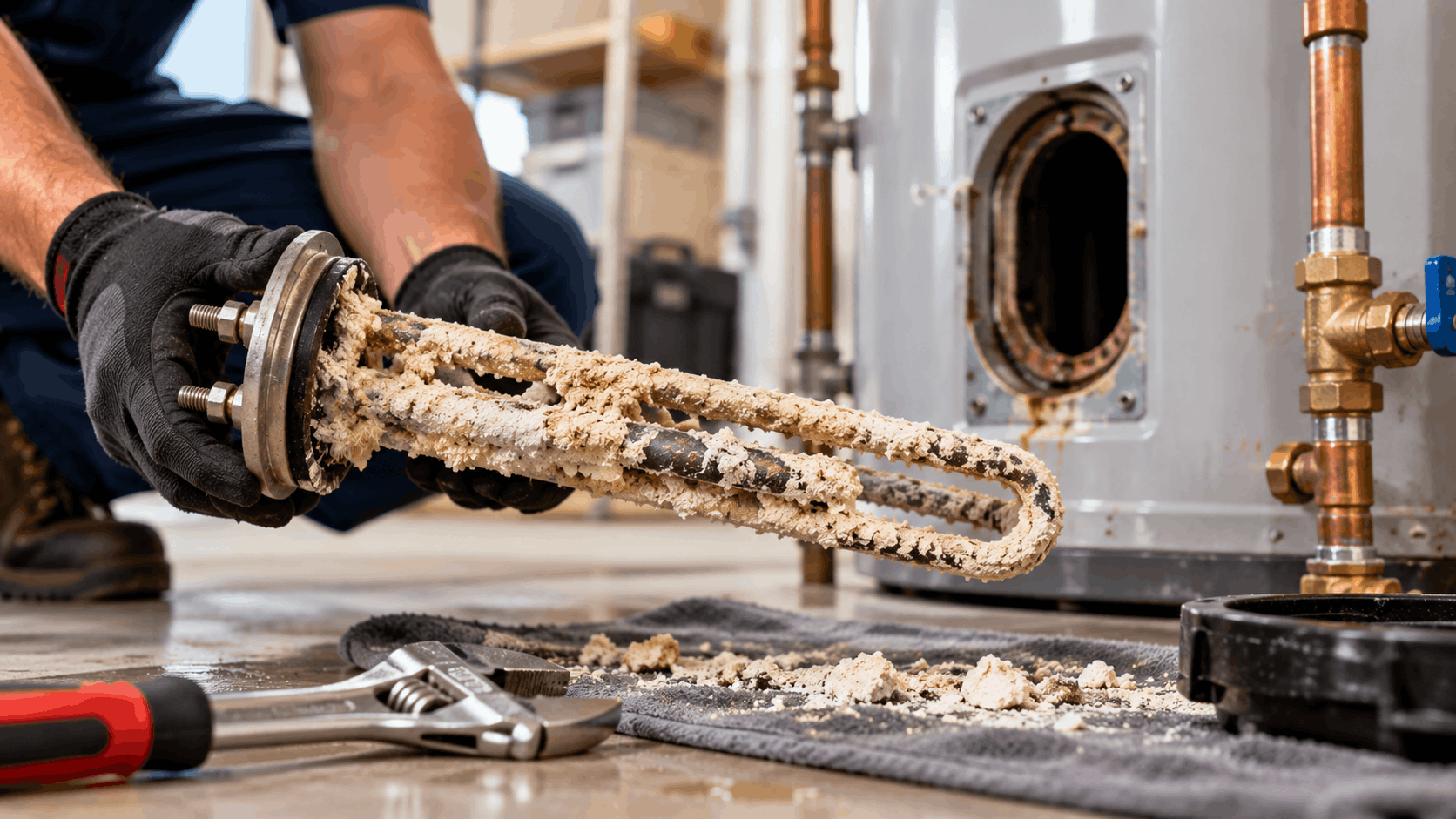
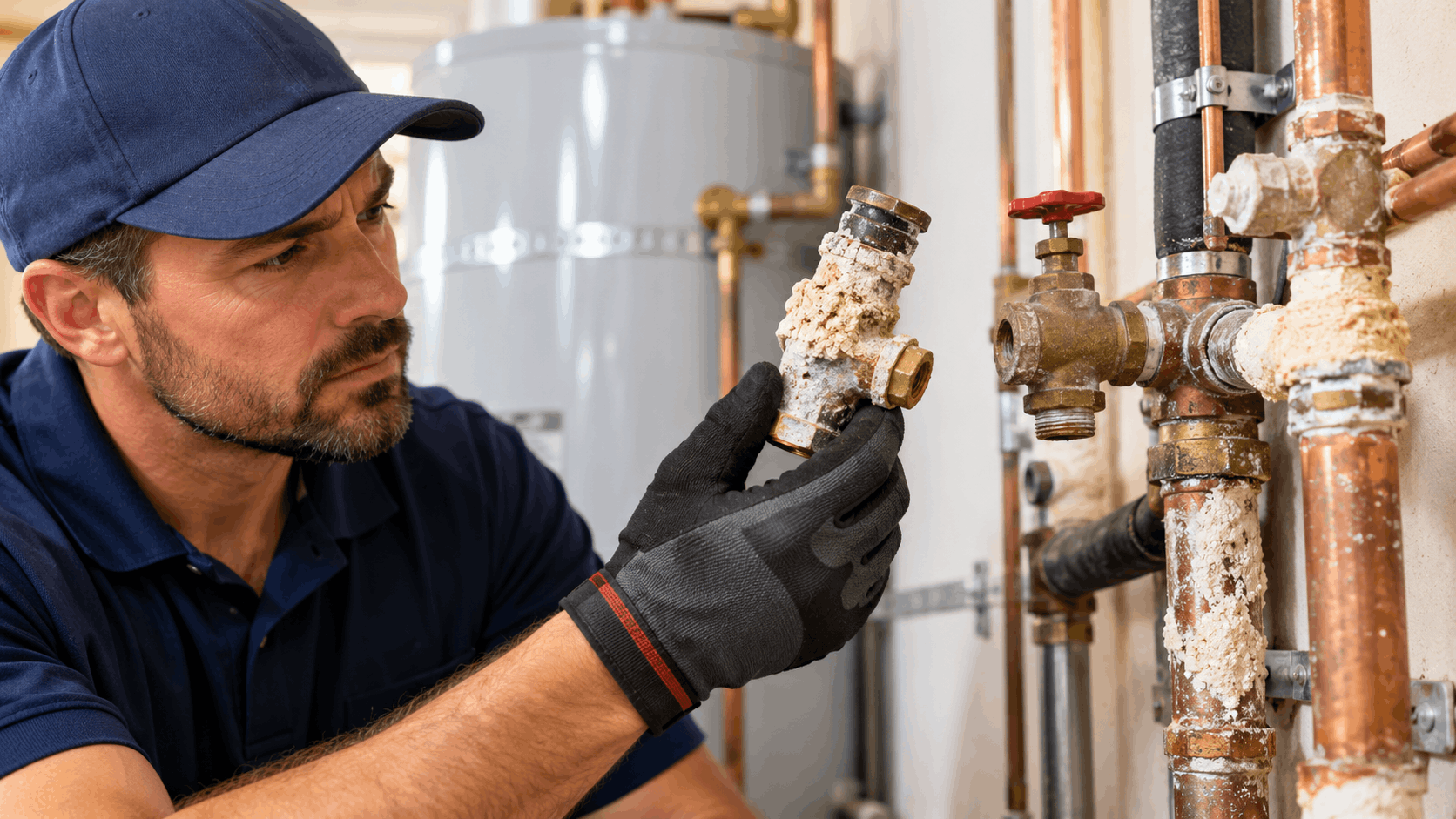
The hidden damage is worse. Scale narrows the bore of supply lines over years, builds on water heater elements and tank bottoms, and clogs the small passages inside mixing valves and cartridges. It also fouls the inlet screens on dishwashers and washing machines, which is why an appliance that seems broken is often just choked with mineral buildup. A water treatment setup is the direct answer to most of this.
No Per-Neighborhood Hardness Tables Exist
SNWA publishes one hardness figure for the entire valley, about 280 ppm or roughly 16 grains per gallon. It does not publish per-ZIP or per-neighborhood hardness tables. There is no official number for The Hills that differs from the official number for The Gardens.
So if someone shows you a hardness reading specific to your village and presents it as official data, that number is invented. The published figure is a valley-wide figure, full stop, and any per-neighborhood table is not coming from the water authority.
A home test kit is a different thing entirely. If a homeowner runs a test and gets a higher number, that is their own reading of their own water at their own tap, and it should not be restated as the municipal figure. The official number stays at about 280 ppm.
Need Help in Las Vegas?
Active Plumbing serves Las Vegas and all of Las Vegas Valley.
How Scale Attacks a Water Heater Over Three Decades
The water heater is the piece of equipment most Summerlin North homes have already replaced once or twice, and hard water is the main reason. Heat drives minerals out of solution faster, so the tank is where scale does its heaviest work.
Understanding what happens inside the tank connects the symptom to the fix. A heater that rumbles, runs out of hot water early or leaks from the bottom is usually telling you a scale story, and that story has a mechanism worth knowing.
Scale on Elements and Tank Bottoms
Scale builds on water heater elements and settles as sediment on the tank bottom. On an electric heater, a scaled element has to fight through an insulating crust to heat the water, so it works harder and runs hotter. On a gas heater, sediment on the bottom traps heat against the steel and can make the tank rumble or pop.
A tank left unflushed works harder and fails earlier than its rated life. That is the honest way to put it, without any invented multiplier. The heater still heats, but it is fighting a layer of mineral the whole time, and that constant extra work shows up as a shorter service life.
By the time a Summerlin North home is on its second or third heater, the owner has usually seen this pattern without naming it. The new heater works great, then over years it slows down, the hot water runs out sooner, and eventually the bottom gives way. Scale is the thread running through all of it. A new tank water heater installation paired with a softener is how we break that cycle.
Tankless Units and the Narrow Heat Exchanger
Tankless heaters face a sharper version of the same problem. The heat exchanger is a narrow passage, and scale accelerates failure in that tight geometry. Where a tank has room to collect sediment on the bottom, a tankless exchanger has almost none, so mineral buildup restricts flow and hurts performance much faster.
That is why tankless owners in these villages need descaling and flushing on a schedule, not just when something goes wrong. Running very hard water through an unmaintained tankless unit is the fastest route to a fouled exchanger and a service call.
The good news is that a tankless unit responds well to regular maintenance. A scheduled tankless maintenance and descaling service flushes the mineral out of the exchanger before it can build to a damaging level, which is exactly the routine hard water demands here.
For owners weighing a switch, a tankless water heater installation can make good sense in a Summerlin North home, as long as the plan includes both softening and a descaling schedule from day one.
Why Regular Flushing Extends Equipment Life Here
Flushing a water heater and reducing scale are not optional extras in this valley. They are life-extenders. The honest framing is that softeners, scale-reduction systems and regular flushing extend equipment life rather than being luxuries, because the water here is genuinely very hard.
Summer heat piles on. Extreme summer temperatures raise the incoming water temperature and stress outdoor and garage-located equipment, and a great many Summerlin North heaters live in the garage. A heater already fighting scale, now fed warmer water and baking in a hot garage, has a harder job than the same unit would have in a milder climate.
Flushing on a regular basis clears the sediment before it bakes into a hard layer. It is a small, routine service that pays for itself in years of added heater life, which is why we treat it as standard care in these villages rather than an upsell.
From Scale to Failed Valves and Cartridges
This is the heart of the matter. The same scale that fouls a heater eventually seizes the valves and cartridges throughout the house. These are the small-passage failures that generate most of the calls we take from thirty-year-old Summerlin North homes.
The pattern is consistent because the mechanism is the same everywhere in the system. Wherever water passes through a narrow opening or a moving seal, mineral has a place to collect, and over three decades it does.
Clogged Passages in Mixing Valves and Cartridges
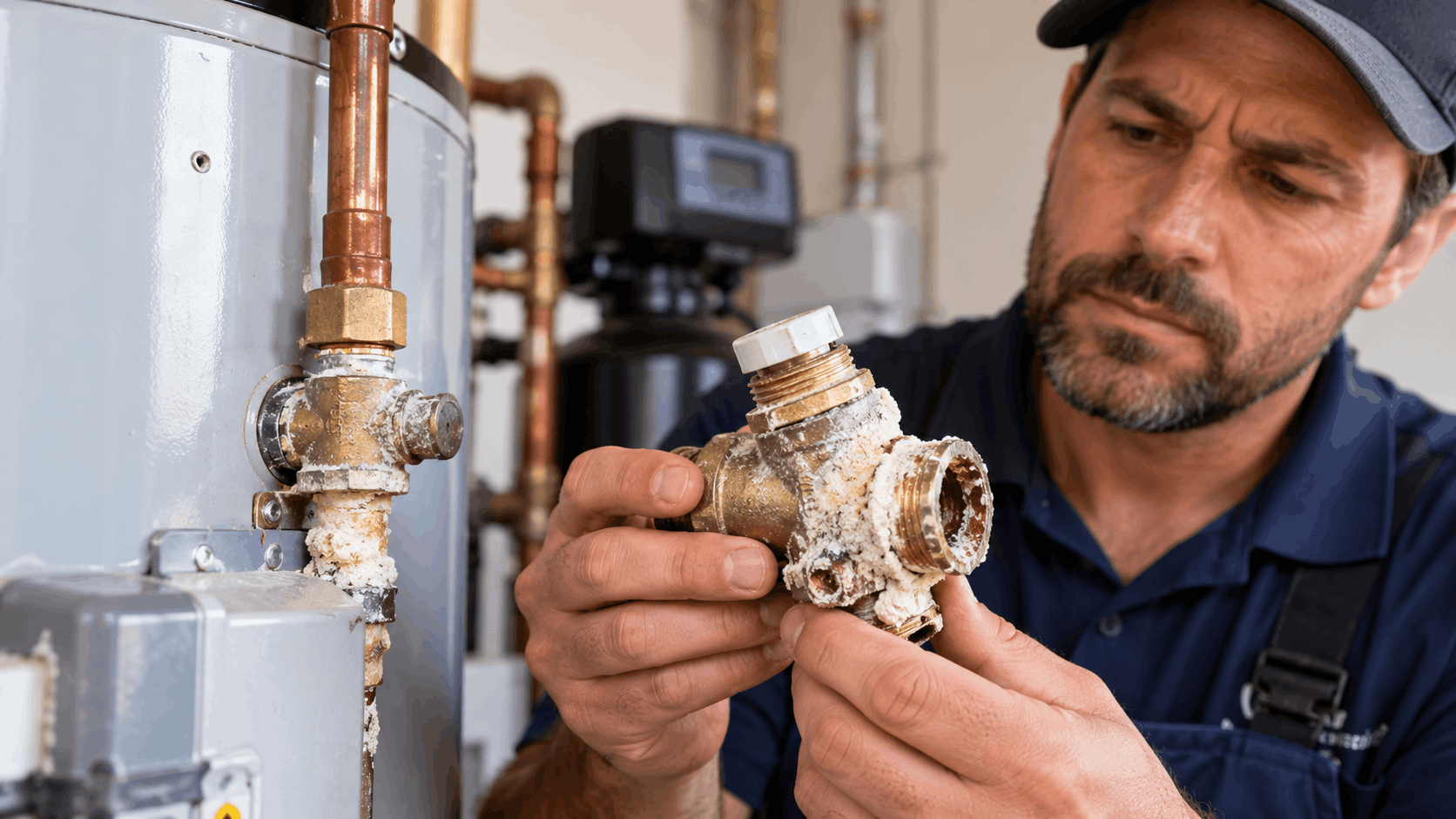
Scale clogs the small passages inside mixing valves and cartridges, along with aerators and shower heads. The cartridge inside a single-handle faucet or shower valve has tiny ports that blend hot and cold, and when mineral narrows those ports, the valve stops working the way it should.
The symptoms are the ones customers describe every day. Weak flow from a faucet that used to run strong. A shower temperature that will not hold steady and drifts hot or cold on its own. A handle that grinds or stiffens because the moving parts are packed with grit.
Aerators show it first because they are easy to reach. Unscrew one from a bathroom faucet in an older Summerlin North home and you will often find the screen half-full of white and tan mineral flakes. The cartridge behind the wall is dealing with the same buildup, just out of sight.
Replacing a scaled cartridge or a fouled mixing valve restores the flow and the temperature control, and our fixture installation and repair work handles exactly this kind of hard-water valve trouble.
Original Angle Stops That No Longer Turn
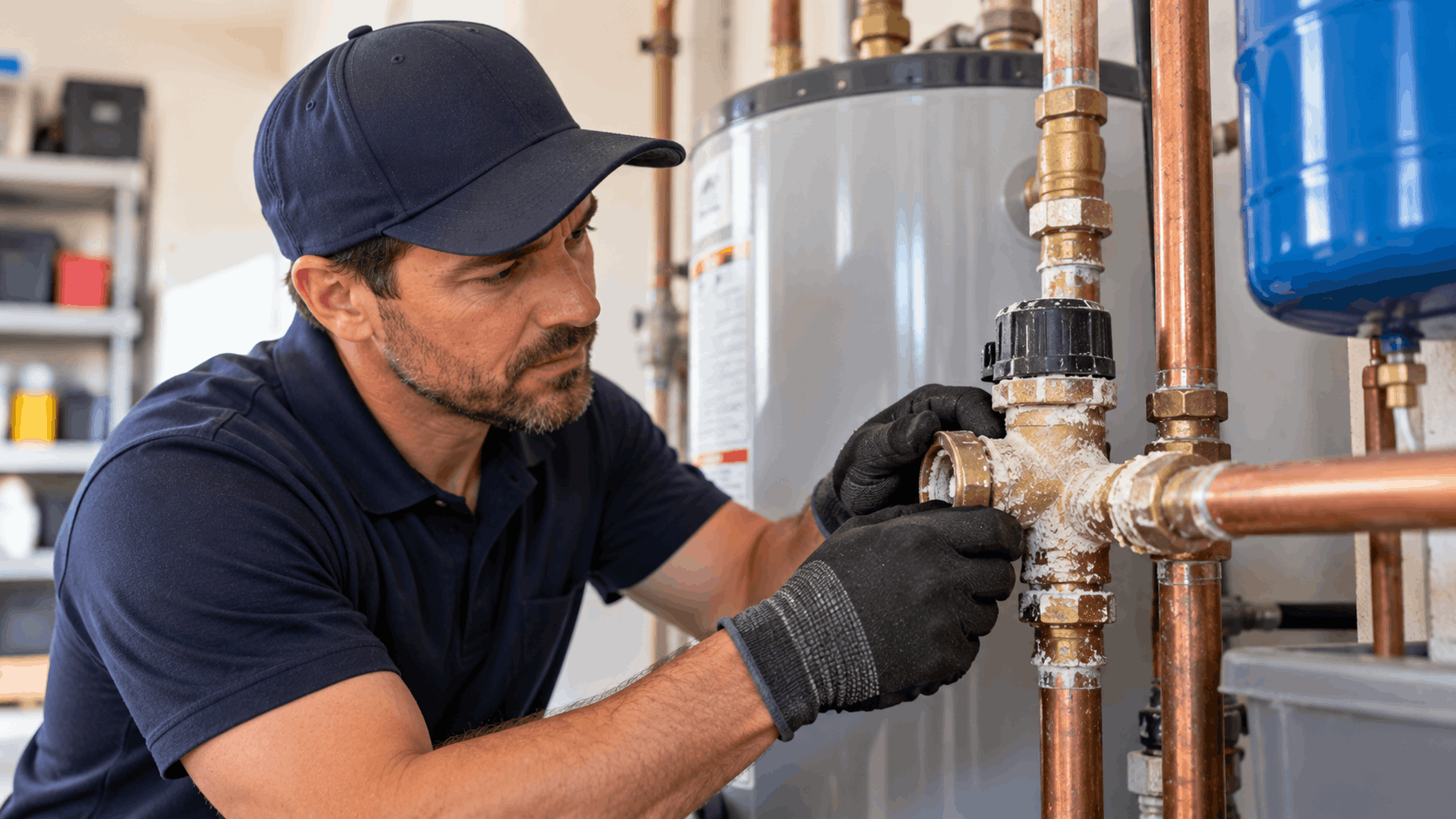
The original 1990s angle stops are a specific hazard in these homes. These are the shutoff valves under the sink and behind the toilet, the ones you reach for when a supply line starts leaking. After thirty years in 16-grain water, many of them seize with scale and will no longer turn.
That is a problem exactly when you need them most. A supply line bursts, water is running, and the homeowner reaches for the angle stop only to find it frozen solid or, worse, snapping off in their hand when they force it. Now a small leak is an uncontrolled one.
This is why we recommend replacing original angle stops during other planned work rather than leaving them to fail during an emergency. Swapping them out while we are already under the sink for a faucet or a fixture is cheap insurance against a much larger problem later.
When a stop does fail suddenly, that becomes an emergency plumbing call, and the whole point of preventive replacement is to keep a minor part from turning a quiet evening into a flooded bathroom.
Inlet Screens on Dishwashers and Washing Machines
Scale fouls the inlet screens on dishwashers and washing machines, and this catches a lot of homeowners off guard. When a dishwasher fills slowly or a washing machine throws an error code, the first assumption is a broken appliance. Often the real cause is the same water chemistry filling the rest of the house with mineral.
Both appliances have small screens at the water inlet to catch debris. In very hard water, those screens slowly pack with mineral flakes, choking the fill and triggering the machine's low-water or slow-fill warnings. The appliance is fine. Its screen is clogged.
Before anyone replaces a dishwasher over a slow fill, it is worth checking whether scale is the culprit. Cleaning or replacing the inlet screen, and addressing the hard water feeding it, often solves what looked like an expensive appliance failure for a fraction of the cost.
Barrier Trap Seals Instead of Trap Primers
Floor drains rely on a water seal in the trap to keep sewer gas out. Traditionally a trap primer feeds a little water to that seal, but trap primers have small passages that hard water corrodes and clogs over time, which is a real weakness in a valley with water this hard.
The 2024 Southern Nevada Amendments allow ASSE 1072 barrier trap seals in floor drains as an alternative to trap primers. A barrier trap seal is a mechanical membrane that holds the seal without needing a steady water feed, so it sidesteps the corrosion problem the hard water creates.
The practical benefit in a Summerlin North home is fewer dried-out or clogged floor drain seals and one less small passage for scale to ruin. Where a floor drain seal keeps failing, moving to a barrier trap seal is a sensible, code-recognized fix in this valley.
Slab Leaks and Buried Lines in These Aging Villages
Not every hard-water home problem is above the slab. As Summerlin North homes age, under-slab supply line failures become a distinct category of work, and the desert soil these homes sit on shapes what a repair actually costs.
Two soil facts get mixed up constantly around here, and getting them straight matters for both diagnosis and cost. Caliche and expansive clay are different things that do different damage, and only one of them moves.
Slab-on-Grade Construction and Hidden Hot-Water Leaks
Most of the valley, including Summerlin North, is built slab-on-grade, meaning the house sits on a concrete slab with the supply lines running beneath it. That construction makes under-slab supply line failures their own category of work, because a leak below the slab is not something you can see by opening a wall.
A hidden hot-water leak under the slab often shows up on the utility bill before anywhere else. NV Energy supplies electricity in the valley, and an electric or heat pump water heater working overtime to reheat water lost to a hidden leak can push the electric bill up without an obvious cause.
Another telltale sign is a warm spot on the floor, since a hot-water line leaking under the slab heats the concrete above it. When an owner reports an unexplained warm area or a jump in the bill, that is when our electronic leak detection pinpoints the leak without tearing up the whole floor.
Caliche and Why Trenching Costs More
Caliche is a cemented calcium-carbonate hardpan common across the valley. It is abrasive and it makes excavation slower and more expensive, which belongs in any honest discussion of what a buried-line repair costs in these villages.
Because caliche is abrasive, it also abrades buried copper where a line runs through it, wearing on the pipe over the years. That is a real mechanism worth knowing about when a copper line fails in a caliche layer.
Here is what caliche does not do. It does not shift, swell or crack pipe, and it is not an expansive soil. Anyone who tells you caliche moved and broke your line has the mechanism wrong. Caliche is hard, abrasive and expensive to dig, but it sits still.
Expansive Soil and Settling Backfill Pull Lines Out of Grade
The soil that actually moves is expansive clay, which swells when it takes on moisture and shrinks as it dries. That seasonal movement puts stress on buried lines and slabs, and it is the real cause of the ground shifting under a pipe, not caliche.
Poorly compacted backfill is the other half of the story. When a pipe was bedded in fill that was not compacted well, that fill settles over the years, and the pipe settles with it. As sections sag, the line develops a belly, a low spot where water and waste collect instead of flowing through.
A belly in a drain line causes slow drainage and recurring clogs that snaking never fully fixes, because the problem is the shape of the line, not a single blockage. A sewer camera inspection shows a belly clearly and tells us whether the fix is a spot repair or a re-grade.
Need Help in Las Vegas?
Active Plumbing serves Las Vegas and all of Las Vegas Valley.
The Standard Responses to Hard Water in Summerlin North
Knowing the problem is half the battle. The documented responses to very hard water are well established, and each one targets a specific part of the damage. Softeners, scale-reduction systems, flushing and the right fixtures each solve a real piece of the puzzle.
The goal across all of them is the same. In this valley these measures extend equipment life. They are not luxuries bolted onto a home, they are the reasonable response to water that is genuinely very hard.
Whole-House Softeners and Scale-Reduction Systems
Whole-house softeners and scale-reduction systems are the standard responses to hard water here. A softener uses ion exchange to pull the calcium and magnesium out of the water before it reaches the heater, the valves and the fixtures, which is why it protects the whole system at once.
The honest framing is that these systems extend equipment life rather than being optional. A softened-water home puts far less scale into its heater and cartridges, so the hardware it protects lasts closer to its rated life instead of fighting mineral the whole time.
Each approach has honest limits. A softener adds a small maintenance routine and uses salt, while scale-reduction systems work differently and suit different homes. A water softener installation sized to the household and the water is the version that actually delivers, and we match the system to the home rather than selling one box for every house.
Filtration for Taste and Odor
For taste and odor, the answer is simpler than some sellers suggest. Ordinary activated carbon handles chlorine taste and odor in valley water. Because the valley is chlorinated rather than chloraminated, there is no need for special catalytic carbon to deal with the water here.
It helps to set expectations on what filtration does and does not do. A carbon filter improves how the water tastes and smells by removing chlorine, but it does not soften the water. Scale is a hardness problem, and carbon filtration is not a softener.
Owners who want both better-tasting water and scale protection generally pair a softener with filtration, and for drinking water at the tap a reverse osmosis system installation takes it further. The point is matching the equipment to the goal rather than overbuying for a problem the valley water does not have.
WaterSense Fixtures and Current Flow Rates
Water conservation in Southern Nevada is enforced through code, not left to preference. The 2024 Southern Nevada Amendments require WaterSense certification for lavatory faucets, urinals, water closets and showerheads in structures built, expanded or renovated on or after January 1, 2020, under NRS 278.582.
The flow limits are specific. Private lavatory faucets are capped at 1.5 gpm at 60 psi and public ones at 0.5 gpm at 60 psi, showerheads and body sprays at 2.0 gpm at 80 psi, water closets at 1.28 gallons per flush, and urinals at 0.5 gallon per flush.
Because flow rates, restrictions and rebate figures are updated over time, the current numbers should be confirmed with the jurisdiction or the water authority before a project. What stays constant is that these are requirements in this valley, not suggestions, and a renovation has to meet them.
Replacing Angle Stops and Cartridges Before They Fail
The smartest hard-water move in a thirty-year-old home is swapping original angle stops and scaled cartridges during planned work rather than waiting for a flood. These parts are already living on borrowed time in 16-grain water, and replacing them on your schedule beats replacing them at 2 a.m. during a leak.
What the repair solves is control and reliability. A fresh angle stop turns smoothly and shuts the water off cleanly when you need it, and a new cartridge restores steady flow and temperature. Doing both while a plumber is already on site for other work is efficient and cheap compared to emergency repair.
We treat this as routine preventive work in Summerlin North because the pattern is so predictable. When we are in a home for one thing, we point out the original stops and scaled cartridges so the owner can decide whether to handle them now or wait for them to fail.

Permits, Licensing and Which Department Governs Your Address
Summerlin is not a single permitting authority, which surprises some owners. Before any permitted work in Summerlin North, the correct jurisdiction and the licensing need to be confirmed, and knowing how that works up front saves time and trouble.
These are not complicated facts once laid out, but they are specific to this community, and getting them right is part of doing the job correctly here.
Summerlin's Split Jurisdiction
The Summerlin master plan spans the City of Las Vegas and unincorporated Clark County, so the permitting authority follows the address. Two homes in Summerlin can answer to different building departments depending on exactly where they sit.
That is why we confirm the permit position for a specific address rather than stating one blanket rule for all of Summerlin. A Summerlin North home governed by the City of Las Vegas goes through the city's building department and permit counter, while a home in unincorporated Clark County goes through the county's.
For the homeowner, the practical step is simple: the department that governs the work is the one that governs the address, and we establish that before quoting any permitted job. Telling an owner which department covers their home is a small thing that reflects how this community is actually organized.
The Code That Applies Here
Nevada has no statewide plumbing code. Instead, the Southern Nevada Building Officials write a shared set of amendments to the Uniform Plumbing Code published by IAPMO, and each jurisdiction adopts the Uniform Plumbing Code with those amendments.
The current edition is the 2024 Uniform Plumbing Code with Southern Nevada Amendments, which the valley's jurisdictions adopted in July 2025, replacing the 2018 editions. The effective dates fell in early 2026, with the City of Las Vegas at January 5, 2026 and Clark County at January 11, 2026.
What this means on the ground is that the rules applying to a Summerlin North job come from the 2024 UPC as amended for Southern Nevada, adopted by whichever jurisdiction governs the address. The Building Official is the authority on any alternate material or method.
Licensed, Bonded and Verifiable
Plumbing contractors in Nevada are licensed through the Nevada State Contractors Board, and the licensing is statewide rather than city by city. Active Plumbing holds Nevada license #0047021 and has been licensed since 1991, working the valley for over three decades.
A license is public record and free to verify. At nvcontractorsboard.com, a homeowner can look up a contractor's classification, status, bond and workers compensation, all in one place. A customer is entitled to ask for a license number and to check it themselves.
In a market with a real unlicensed-trade problem, that verification matters. We put the number out plainly so any Summerlin North owner or property manager can confirm exactly who is doing their work before it starts.
What Is Likely Behind the Walls of a 1990s Summerlin North Home
Owners want a practical read on their own plumbing, and the valley's build eras give a reasonable starting point. The caveat always applies: the pipe should be confirmed on site rather than assumed from the build year alone.
Who makes the repair decision is its own question here, because a large share of homes in the city are rented, and that changes who picks up the phone.
Copper, Polybutylene and What to Confirm
For a 1990s Summerlin North home, copper supply is the typical expectation and covers many houses in these villages. Copper is durable, though its fittings and the valves attached to it still collect scale over three decades of hard water.
Polybutylene is present in some homes of this era and is a standard repipe candidate because it fails at the fittings. If a house has polybutylene, a planned repipe is usually the right call before a fitting lets go, and a whole house repipe replaces the whole run at once rather than chasing one failure after another.
The honest rule is to confirm on site rather than assume from the build year. Two homes in The Trails built the same year can have different pipe behind the walls, so we verify the material before recommending anything, whether that turns out to be copper, polybutylene or something else.
Who Calls the Plumber and Who Authorizes the Repair
In the City of Las Vegas, the owner-occupied rate is about 56.6 percent, which means roughly 43.4 percent of homes are rented. That share decides who calls about a leak and who approves the repair, and it shapes a lot of jobs in these villages.
A renter usually calls the landlord or the property manager, not the plumber directly. So the person standing in the house watching the leak is often not the person who authorizes the fix, and the approval has to come from whoever holds the property.
We work with that reality every day. When a tenant reports a problem in a Summerlin North rental, we coordinate the diagnostic and the written price with the owner or property manager, since they are the ones who sign off on the repair.
Seasonal Stress on Exposed Lines
The desert is hard on anything exposed. Hose bibbs, irrigation backflow assemblies and exposed lines on the exterior face intense UV and heat degradation, so the parts outside the wall wear differently than the ones inside it.
Winter still matters here, even though residents assume the desert never freezes. Winter nights can freeze exposed or poorly insulated lines, and an unprotected hose bibb or exterior line can split when a cold snap arrives. A little insulation on the vulnerable spots prevents most of that.
Late-summer monsoon storms bring the opposite problem. Short, intense rainfall overwhelms drainage and backs up floor drains and yard drains, so a home that never had a drainage issue can suddenly see water where it does not belong. Keeping those drains clear ahead of monsoon season is worth the effort.
Need Help in Las Vegas?
Active Plumbing serves Las Vegas and all of Las Vegas Valley.
How Active Plumbing Handles Hard-Water Work in Summerlin North
How a job actually runs matters as much as the diagnosis. Our approach in these villages is straightforward: confirm the real condition on site, put the price in writing before work starts, and respond within a known window.
Every step is grounded in the neighborhood, because we work these streets and know how the homes here are built and how they fail.
The On-Site Diagnostic
The first step is always confirming the pipe material, since a 1990s Summerlin North home might be copper or polybutylene and the right plan depends on which. From there we check the water heater, the valves and the fixtures for the scale damage that hard water leaves.
That means looking at the tank or tankless unit, testing the angle stops, checking cartridges and aerators, and identifying where mineral has done its work. We do this across the full range of villages, from Sun City Summerlin to The Gardens, because the same hard-water patterns show up in all of them.
Only after we have confirmed what is actually there do we talk about the work. A diagnostic built on the real condition of the home beats a guess made from the curb, and it keeps the recommendation honest.
A Written Price Before Work Starts
Once we know what the job involves, we put the price in writing before the work begins. The owner or the property manager sees and approves the number first, so there is no question about cost after the fact.
This matters especially in a community with a lot of rentals, where the person approving the repair is often not the person in the house. A written price gives the property manager or landlord a clear figure to sign off on before anyone turns a wrench.
The written estimate also keeps the scope clear. Both sides know what is being done and what it costs, which is the fairest way to handle a repair in someone's home.
Response Times Across the Valley
For emergencies, our dispatch window is 30 to 60 minutes across the valley. Scheduled work is same-day or booked to a time that suits the household. That window covers Summerlin North the same as the rest of the valley.
Reaching these villages quickly is a matter of knowing the routes. Summerlin Parkway runs from US 95 west to Town Center Drive as the spine, with Rampart Boulevard as a main cross arterial, so we navigate straight to a call in The Hills, The Crossing or The Arbors without wasting time.
When a seized angle stop or a burst line turns into a 24/7 emergency plumbing call, that response window is what keeps a small failure from becoming a major one.
Getting Ahead of the Scale in Your Summerlin North Home
Thirty years of very hard water leaves a clear trail in the early Summerlin villages. Scale buries heater elements, narrows lines, clogs aerators and shower heads, seizes original angle stops and chokes the cartridges inside your shower valves. The mechanism is the same everywhere water passes through a narrow opening, and these homes have simply stood long enough for it to show.
The fixes are well established and worth doing before a failure, not after. A softener sized to your home slows new scale, regular flushing and descaling extend heater life, and swapping tired angle stops and cartridges during planned work keeps a small part from flooding a bathroom at midnight. For under-slab leaks, the right read on the soil and precise leak detection keep the repair honest and the cost fair.
Here is how we work it. We confirm your pipe material and check the heater, valves and fixtures on site, put the full price in writing before anyone starts, and stand behind the repair. Emergency dispatch runs 30 to 60 minutes across the valley and scheduled work is same-day or booked. If the hard water in your Summerlin North home is showing up as weak flow, a wandering shower temperature or a heater on its last legs, call Active Plumbing or reach out through our contact page to set up a diagnostic. Verify our Nevada license #0047021 free at nvcontractorsboard.com, and check the water facts yourself at snwa.com.
Frequently Asked Questions
- How hard is the water in Summerlin North?
- The Southern Nevada Water Authority reports valley hardness at about 280 parts per million, which is roughly 16 grains per gallon and categorized as very hard. That figure applies across the whole valley, including every Summerlin North village. SNWA does not publish a per-neighborhood or per-ZIP hardness table, so any number presented as specific to your village is not official data, and a home test kit reflects only your own tap reading.
- Why do my shower cartridges and valves keep failing?
- Scale is the cause. Very hard water deposits calcium and magnesium inside the small passages of mixing valves and cartridges, slowly clogging the ports that blend hot and cold. The result is weak flow, a temperature that will not hold steady and drifts on its own, and a handle that grinds or stiffens. Replacing the scaled cartridge restores the flow and the temperature control, and softening the water slows the buildup from returning.
- Does Las Vegas water use chloramine that damages pipes?
- No. Valley water is disinfected with ozone at the treatment plants and then chlorine as it enters the distribution system, not chloramine. Any advice built around chloramine attacking rubber seals or pipe fittings is aimed at a different water supply and does not apply here. The real issue in Summerlin North homes is hardness and scale. Ordinary activated carbon handles the chlorine taste and odor with no special catalytic carbon required.
- Should I flush my water heater, and how often?
- Yes, flushing matters here. A tank left unflushed works harder and fails earlier than its rated life, because scale builds on the elements and settles as sediment on the tank bottom. Regular flushing clears that sediment before it bakes into a hard layer, extending heater life in this valley. The right interval depends on your heater and your water, so ask a technician to set a schedule for your specific unit rather than guessing.
- Do 1990s Summerlin North homes have polybutylene?
- Some do. Copper supply is typical for homes of this era, but polybutylene is present in a share of 1990s valley homes and is a standard repipe candidate because it fails at the fittings. The honest answer is that it must be confirmed on site rather than assumed from the build year, since two homes on the same street can have different pipe. We verify the material before recommending anything.
- Will a water softener stop scale in my heater and fixtures?
- A whole-house softener removes the calcium and magnesium before the water reaches your heater, valves and fixtures, so it greatly reduces new scale and extends equipment life. Softeners and scale-reduction systems are the standard responses to hard water here. They protect the whole system rather than one fixture, though each approach has its own maintenance and limits. Sizing the system to the household and the water is what makes it actually work.
- Does caliche damage my buried pipes?
- Caliche is a cemented calcium-carbonate hardpan that is abrasive, so it makes trenching slower and more expensive and it abrades buried copper where a line runs through it. What it does not do is shift, swell or crack pipe, and it is not an expansive soil. The real cause of pipe stress underground is expansive clay swelling and shrinking with moisture, plus poorly compacted backfill settling under a line and pulling it out of grade.
- Who issues the permit for plumbing work at my Summerlin North address?
- It depends on your exact address. Summerlin spans the City of Las Vegas and unincorporated Clark County, so the permitting authority follows the address. A home governed by the City of Las Vegas goes through the city's building department, while one in unincorporated Clark County goes through the county's. We confirm the correct department for your specific property before quoting any permitted work rather than applying one blanket rule to all of Summerlin.
- Is there still a federal tax credit for a heat pump water heater?
- No. The federal Section 25C Energy Efficient Home Improvement Credit applied only to equipment placed in service by December 31, 2025, and the One Big Beautiful Bill Act ended it, so it is not available for 2026 installs. Utility and manufacturer rebates may still exist, but these programs change often, so check the current program directly before counting on any rebate for a new install.
- How fast can a plumber reach my home in Summerlin North?
- Our emergency dispatch window is 30 to 60 minutes across the valley, and scheduled work is same-day or booked to a convenient time. We reach the Summerlin North villages by way of Summerlin Parkway and Rampart Boulevard, which lets us get to homes in The Hills, The Trails, The Crossing and the rest quickly when a seized valve or a leak needs attention right away.
A
Licensed plumbing professionals serving Las Vegas and Las Vegas Valley.
Licensed in Nevada · License #0047021
Last updated on
Why trust Active Plumbing?
Founded in 1991, Active Plumbing is a licensed and insured plumber serving Las Vegas and Las Vegas Valley. All content is reviewed by our licensed technicians.

Need Help in Las Vegas?
Active Plumbing serves Las Vegas and all of Las Vegas Valley.
Related Articles
Tips & Advice
Las Vegas Hard Water by ZIP Code: What SNWA Data Actually Shows
See actual SNWA water hardness data by Las Vegas ZIP code. Learn your neighborhood's GPG level and what it means for your plumbing, appliances, and home.

Maintenance
Tankless Water Heater Scale Buildup: Why Vegas Units Fail at 5 Years Without Descaling
Las Vegas hard water causes scale buildup that fails tankless units at five years. Learn the warning signs, descaling schedule, and treatment options to protect yours.
Cost Guides
Water Heater Repair vs Replace in Las Vegas: The Price Math at Years 6, 8, and 10 in Our Hard Water
Repair or replace your water heater in Las Vegas? See the real price math at years 6, 8, and 10, plus how hard water shortens tank life across the valley.