Water Heater Replacement on the Maryland Parkway Side of Huntridge

Looking for a Plumber? Contact Us Now
Open 24/7. Written price before work starts.
Get Your Quote
Tell us what's going on and we'll get back to you. We're open 24/7.
Key Takeaways
- Water heaters in Huntridge's 1940s cottages fail early because very hard water at 280 ppm, about 16 grains per gallon, scales the tank bottom and elements.
- Typical valley ranges are tank installation $800 to $1,500 and tankless $1,500 to $3,500, with a pre-filter adding $150 to $300; the written price comes before work starts.
- Huntridge sits inside the City of Las Vegas, so permits and inspections run through the city, not Clark County, and current code requires a drain pan where a leak would cause damage.
- Unlike John S. Park next door, Huntridge is not a designated historic district, so a water heater swap is generally a normal city permit.
- Many cottages sit on crawl spaces rather than slab, which makes leak tracing and heater connections easier and means slab leak work does not apply here.
- Old galvanized supply and mixed pipe materials create pressure loss and galvanic corrosion, so connections get checked and corrected during replacement.
- A softener, scale-reduction system or regular flushing protects a new heater from the hard water that wore out the old one.
- Active Plumbing is a fourth-generation family business licensed since 1991 as NSCB #0047021, verifiable at nvcontractorsboard.com, arriving in 30 to 60 minutes valley-wide.
In This Article
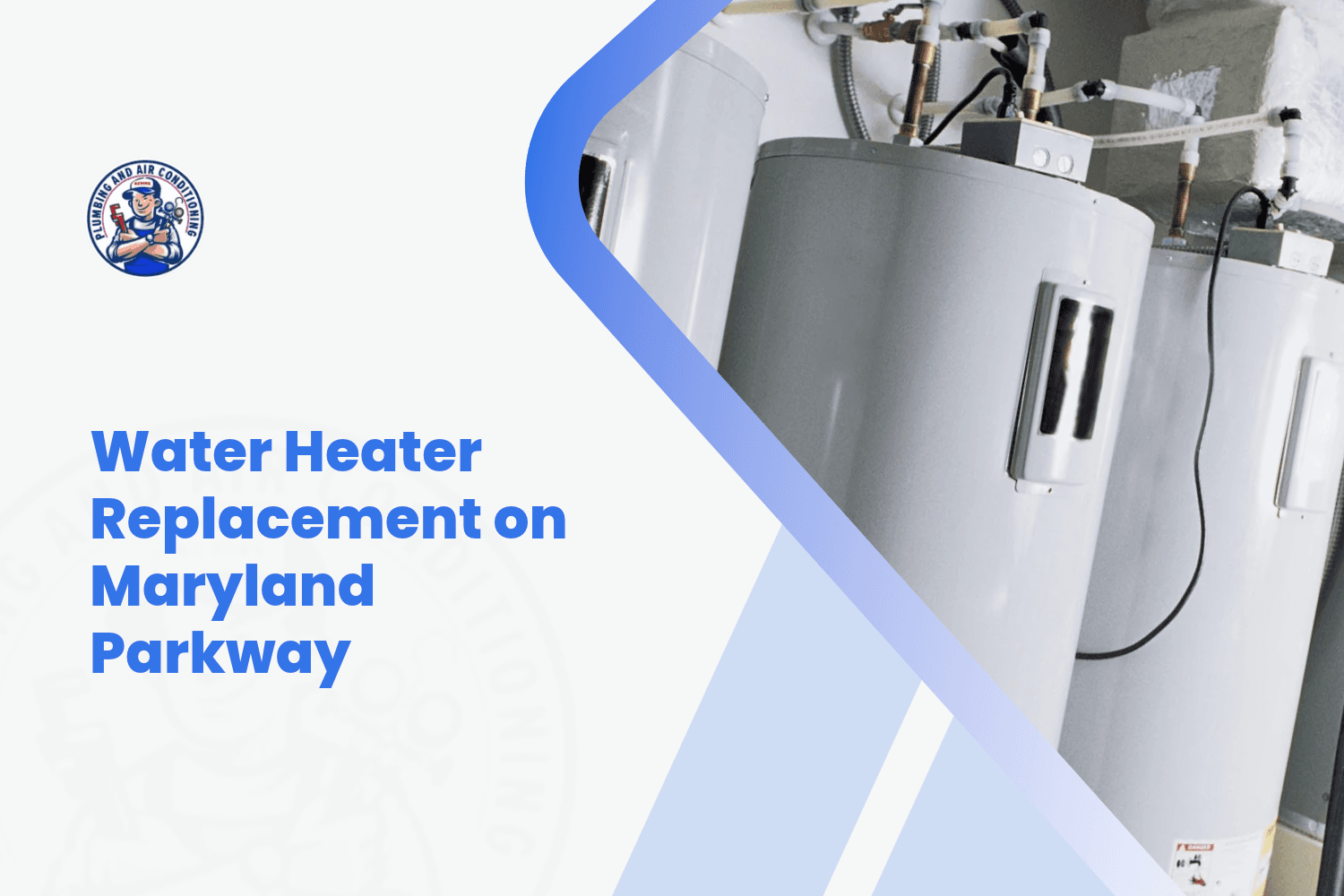
Water heater replacement on the Maryland Parkway side of Huntridge usually means swapping an old scaled-up tank in a 1940s cottage, with City of Las Vegas permits and very hard water in play. These modest homes east and west of Maryland between Oakey Boulevard and Charleston have been heating water for decades, and the tanks inside them take a beating from some of the hardest water in the country.
Picture a cottage a few blocks off Huntridge Circle Park. The morning shower runs lukewarm, there is a popping sound from the garage or closet where the tank sits, and rusty water shows up at the kitchen faucet. That is the start of most replacement calls here, and it rarely means the heater just quit. It means years of scale finally caught up with it.

Why Water Heaters Fail Early on This Side of Huntridge?
Water heaters in Huntridge cottages wear out faster than their rated life because of two things working together: very hard water and old galvanized supply pipe. The neighborhood holds numerous pre-war and wartime houses, with development starting in the 1940s, and the plumbing inside many of them still reflects that era. When you combine mineral-heavy water with narrowing steel lines, the heater carries more strain than the manufacturer ever planned for.
Hard water scale coats the inside of the tank and the heating surfaces. Old supply pipe restricts flow and drops pressure. The heater runs longer and hotter to do the same work, and parts that would last in another market give out sooner here. Understanding that pairing is the difference between replacing a tank once and replacing the same tank again in a few years.
| Factor | What It Does | Effect on the Heater |
|---|---|---|
| Very hard water (280 ppm) | Deposits calcium and magnesium scale on elements and tank bottom | Heater works harder, fails earlier than rated life |
| Galvanized steel supply | Narrows from the inside as corrosion compounds with hardness | Pressure loss and strain feeding the tank |
| 1940s build era | Original pipe and mixed later repairs | Galvanic corrosion at dissimilar metal joints |
Very Hard Water and Scale on the Tank Bottom
The Southern Nevada Water Authority states the valley's water is 280 parts per million, or 16 grains per gallon, which is categorized as very hard. That is not a small detail in Huntridge. It is the single biggest reason water heaters here give out ahead of schedule, and it explains the rumbling and popping owners hear before the tank finally fails.
As water heats, the dissolved calcium and magnesium drop out of solution and settle. On a tank heater, that scale builds on the burner-heated bottom of the tank and on electric elements. The layer acts like insulation, so the heater has to run longer to warm the water above it, and the sediment that collects hardens into a crusty bed at the base.
A tank left unflushed works harder and fails earlier than its rated life. The scale traps heat against the steel, stresses the tank, and makes the popping noise owners describe, which is water trying to boil under the sediment. In a market with water this hard, that process starts the day the heater goes in and never stops.
This is why replacement in Huntridge is so often a scale story rather than a defect story. The heater did its job in conditions that are tough on any tank, and when it reaches the end, the scale on the bottom is usually the reason.
Old Galvanized Supply Lines Feeding the Heater
Housing of this era in Las Vegas typically means galvanized steel supply lines. That is the standard find in 1940s Huntridge cottages, and it matters directly to the heater because that pipe carries the cold water in and the hot water out.
Galvanized steel fails by internal corrosion. The inside of the pipe rusts and scales, and the effective bore shrinks over the years until flow and pressure drop. In eighty-year-old pipe, the hardness of the water compounds that corrosion, so the bore closes faster than it would in modern materials. That is why a Huntridge owner typically reports weak pressure at one fixture long before anything leaks.
Restricted supply lines mean the heater is fed through narrowed pipe, and the whole system runs under strain. When flow is choked, hot water delivery suffers even if the tank itself is sound, and owners often blame the heater for what is really a pipe problem upstream. A good replacement starts by checking the lines feeding the unit, not just the unit itself.
For many of these cottages, weak pressure is the first warning. If the galvanized supply has narrowed that far, a whole-house repipe often belongs in the same conversation as the new heater, because a fresh tank on tired pipe only solves half the problem.
Signs It Is Time to Replace Rather Than Repair
Some water heater problems are minor fixes, and water heater repair runs in a known range. But certain symptoms point to replacement rather than another repair, and knowing the difference saves money on a tank that is already near the end.
Rusty or discolored water at the hot tap is a strong signal. In Huntridge, that color can come from the galvanized supply narrowing and shedding rust, or from the inside of an aging tank. Either way, it tells you the metal is breaking down. Popping or rumbling from the tank is the sound of scale on the bottom, and a heater that produces only lukewarm water despite running has usually lost capacity to sediment.
Water pooling at the base of the heater is the clearest sign. A leaking tank cannot be repaired, and once the steel has corroded through, replacement is the only answer. At that point, continuing to repair an old unit stops making sense, and a new heater sized for the home is the better spend.
The rule of thumb our team uses is simple: if the fix is a valve, a thermostat or an element and the tank is sound, repair is fine. If the tank is leaking, heavily scaled or producing rusty water on an old unit, replacement is the honest call. You can read more about the full range of work on our water heater services page.
Get Your Quote
Tell us what's going on and we'll get back to you. We're open 24/7.
Cost of Water Heater Replacement in Huntridge
Water heater replacement cost on the Maryland Parkway side of Huntridge depends on the type of unit, the condition of the existing connections, and what the job needs to meet current code. The figures below are typical ranges for plumbing work in the Las Vegas Valley, not a quote or a fixed price. The actual price for a specific cottage is given in writing before work begins.
These ranges give an owner a realistic picture of what a replacement involves. A straightforward tank swap in a well-set-up home sits at the lower end, while an older cottage with mixed pipe and added code work moves higher.
| Job | Typical Las Vegas Valley Range |
|---|---|
| Tank water heater installation | $800 to $1,500 |
| Water heater repair | $150 to $500 |
| Tankless water heater installation | $1,500 to $3,500 |
| Tankless pre-filter (where hard water calls for one) | $150 to $300 |
| Tankless maintenance and descaling | $150 to $250 |
| Recirculation pump installation | $400 to $900 |
Typical Tank Water Heater Pricing
For a standard tank unit, tank water heater installation runs $800 to $1,500 as a typical Las Vegas Valley range. That covers the common replacement most Huntridge owners need when an old tank gives out. Water heater repair runs $150 to $500 where the tank itself is sound and the fault is a part.
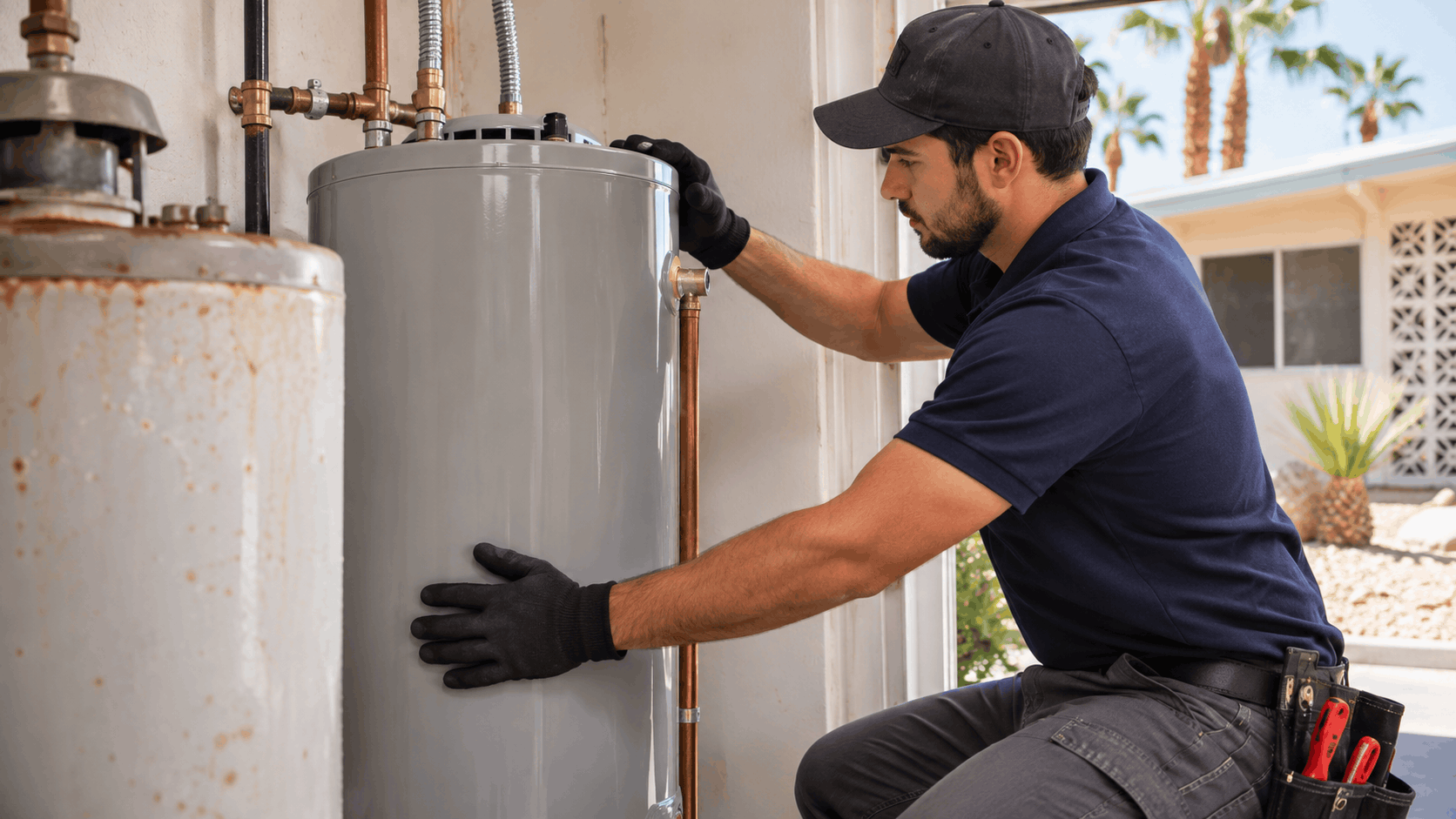
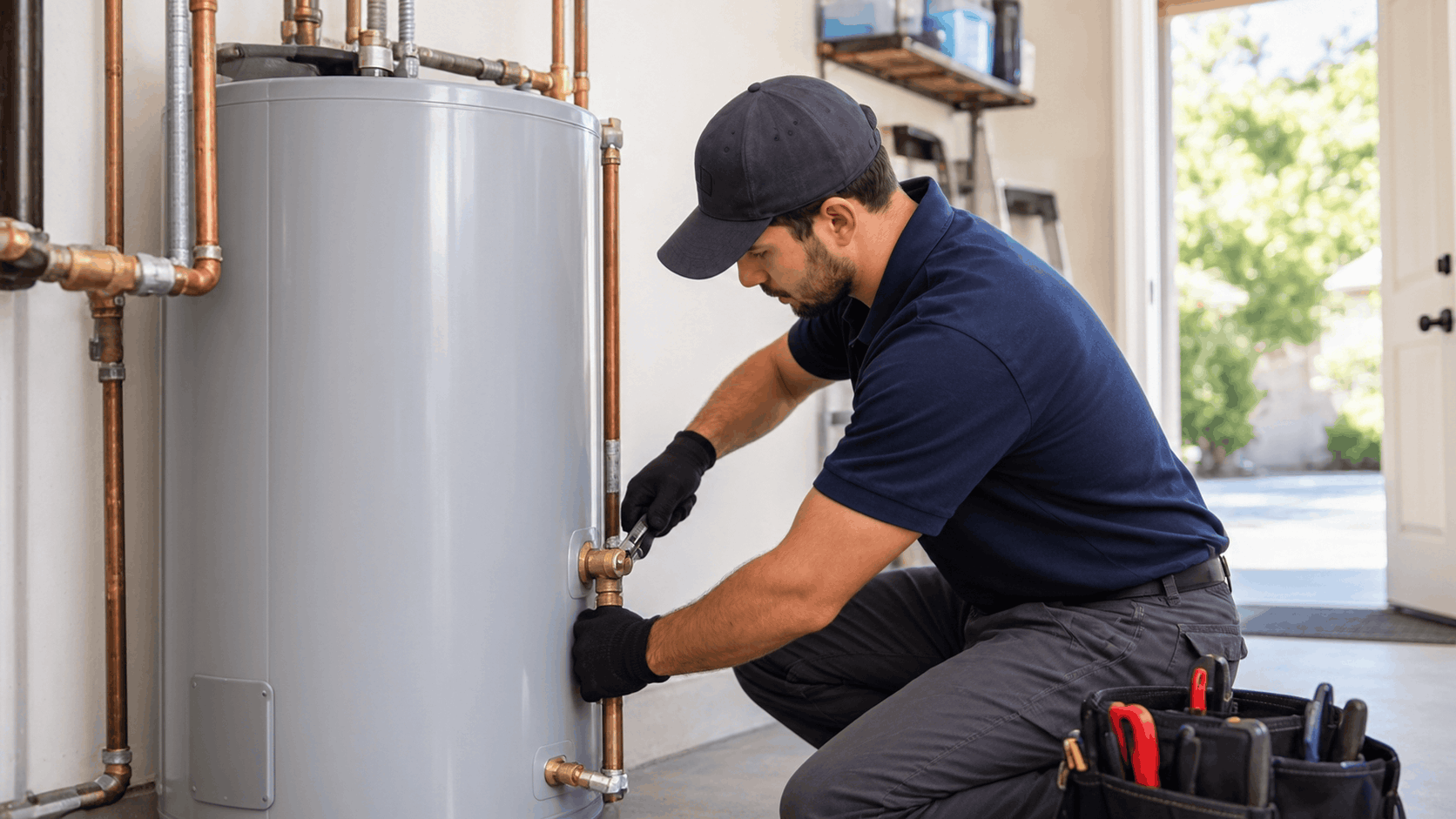
A basic tank swap includes removing the old unit, setting the new tank, connecting the water lines and the gas or electric supply, fitting the temperature and pressure relief valve, and testing the install. On a cottage with good access and connections that are in reasonable shape, that is a clean job.
The price moves within the range based on the heater size, the fuel type, and what shape the existing hookups are in. A 40 or 50 gallon tank is common for these homes, and the cost reflects the unit and the labor to tie it in correctly. The written price for a specific cottage lands once the existing setup has been checked.
Owners weighing repair against replacement should remember the scale point from earlier. Repairing an old, heavily scaled tank at the top of the repair range often costs most of the way to a new unit, so the math frequently favors replacement when the tank is near the end.
Tankless and Recirculation Options
Tankless water heater installation runs $1,500 to $3,500 as a typical range, with a pre-filter adding $150 to $300 where hard water calls for one. Tankless maintenance and descaling runs $150 to $250, and recirculation pump installation runs $400 to $900. These are copied directly as typical Las Vegas Valley figures.
A tankless unit heats water on demand instead of storing it, which appeals to owners of small cottages short on space. The catch in this market is the heat exchanger. It is a narrow passage, and hard water scale fouls it faster than it fouls a tank, which is exactly why a pre-filter and periodic descaling matter here.
A recirculation pump keeps hot water moving toward the fixtures so it arrives faster at the tap. In a small cottage the run is short, but some owners still want it for convenience, and the range above covers that add-on. Our recirculation pump installation and tankless water heater installation pages cover both in more detail.
Going tankless in Huntridge is a real option, but it is not a set-and-forget choice given the water here. The lower space and endless hot water come with the responsibility of keeping scale out of that narrow exchanger, which is why the pre-filter line item exists.
What Changes the Final Price on an Older Cottage
Several job-specific factors move the price on a decades-altered Huntridge cottage. These small 1940s houses have typically been remodeled repeatedly over eighty years, so a single home can hold original cast iron, a 1960s or 1970s copper patch, and modern PEX where a kitchen or bathroom was redone.
Mixed materials at the connections are the first factor. Where dissimilar metals meet, galvanic corrosion forms at the joint, and those connections often need correcting during a replacement rather than simply reusing them. Undersized original supply lines are a second factor, because a cottage that added a second bathroom or a laundry may be running on pipe that was never meant for the load.
Crawl-space access changes the labor too, as does code-required drain pan work. Current local code calls for a drain pan where a leak would cause damage, and if the old install predates that requirement, bringing it up to standard adds to the job. These are honest cost drivers, not surprises, and they get flagged before the price is set.
None of this means an owner should expect the top of the range by default. It means the final figure reflects the real condition of the specific cottage. A home with clean, matched connections and an existing pan sits lower, while one with mixed metals, undersized lines and missing code items sits higher.
Need Help in Las Vegas?
Active Plumbing serves Las Vegas and all of Las Vegas Valley.
Permits and the City of Las Vegas Rules for Huntridge
Water heater work in Huntridge runs through the City of Las Vegas, and the Southern Nevada Amendments to the Uniform Plumbing Code apply as the city has codified them. A replacement is permitted work, and the current code sets specific requirements for how a heater is installed and drained. The permit position should be confirmed for the specific address, which our team does as part of the job.
Knowing which department governs the address is a small thing that signals real local knowledge, because many nearby Las Vegas addresses are actually unincorporated Clark County. Huntridge is not one of them.
Which Department Governs a Huntridge Address
Huntridge is inside the City of Las Vegas, so permits and inspections run through the city rather than Clark County. The neighborhood sits along Maryland Parkway just south of Charleston Boulevard, immediately east of the John S. Park district, with the original tracts running from South 10th Street east to Maryland Parkway and from Charleston south to Franklin Avenue. Those addresses are city addresses.
This matters because the valley is not one permitting authority. Large populated areas like Paradise, Spring Valley and Enterprise are unincorporated Clark County, even though residents describe them as Las Vegas. A few blocks can be the difference between a city permit and a county permit, so establishing the correct jurisdiction before quoting permitted work is a routine first step.
For Huntridge, the answer is clear: the City of Las Vegas building department governs the work, and the Southern Nevada Amendments apply as codified by the city. You can find more about our work across the city on our Las Vegas page.
Telling an owner exactly which counter their permit runs through is part of how our team sets expectations. There is no guesswork about whether a Huntridge job is a city or county matter. It is the city.
Not a Designated Historic District
Huntridge, for all its age and its preservation-minded residents, is not a designated historic district. That is the distinction worth getting right, because it is the opposite of the John S. Park position next door. John S. Park is the only Las Vegas historic district designated both locally and nationally, so its permit applications go to the Historic Preservation Commission where work will impact a designated resource.
Because Huntridge is not a designated district, a water heater swap here generally does not face that review layer. Building permits run through the City of Las Vegas in the ordinary way. Two neighborhoods of similar vintage, a few blocks apart, with different processes, and the paperwork is simpler on the Huntridge side.
An owner should still confirm the status of an individually significant property with the city rather than assume, because some properties carry their own considerations. But the default answer here is that a water heater replacement is a normal city permit without a commission review.
This surprises some owners who expect the neighborhood's strong preservation ethic to mean extra steps. The Nevada Preservation Foundation runs tours here and the neighborhood association is active, but that cultural identity does not add a permit layer to a water heater swap the way a designated district would.
Drain Pan and Relief Valve Requirements
Under the 2024 Southern Nevada amendments, water heater drain pans are required where a leak would cause damage, such as an attic or a floor-ceiling assembly. The drain must be not less than 3/4 inch, run to a visible approved location, and the pan must be at least 1-1/2 inches deep. The relief valve must not discharge into the pan, with an exception for readily accessible tankless and point-of-use heaters.
The relief valve itself has specified drain materials. Inside a building, that drain can run via galvanized steel, hard-drawn copper, CPVC, PP, flexible corrugated connectors or a listed drain tube to the exterior, unless the listing prevents it. An air gap to a secondary washer port, floor sink, mop sink or funneled floor drain is also allowed.
These are the local code rules that apply to a Huntridge install, and they are a common reason an older setup needs upgrading during replacement. A tank put in decades ago may sit without a compliant pan or drain, and the replacement is the moment to bring it to standard.
Owners sometimes ask why the new install needs more than the old one had. The answer is that the code changed, and a permitted replacement is held to current requirements. The pan and the correct relief drain protect the home from water damage if the tank ever fails, which is worth having given how hard these tanks work here.
Licensed Work and Verifying a Contractor
Permitted plumbing work must be performed by an appropriately licensed contractor. Plumbing contractors in Nevada are licensed through the Nevada State Contractors Board, and the Southern Nevada Amendments carry a plumbing license provision governing who may lead or direct installation on a job site.
A customer is entitled to ask for a license number and to verify it free at nvcontractorsboard.com. On the board's site, classification, status, bond and workers compensation are all public record. That takes a minute and tells an owner exactly who they are dealing with before any work starts.
This market has a significant unlicensed trade problem, which makes verification worth doing. A tank set by someone unlicensed may skip the permit, miss the code-required pan, and leave the owner holding the problem if anything goes wrong or when the home sells.
Active Plumbing holds Nevada license NSCB #0047021, verifiable at the board's site. Asking for and checking a license number is a reasonable thing to do on any permitted job, and a legitimate contractor expects it.
Crawl-Space and Raised Foundation Access in Huntridge
Huntridge's foundation types change how a water heater job runs, because much of the valley is slab-on-grade and these cottages often are not. Many of the 1940s Minimal Traditional cottages here sit on crawl spaces or raised foundations, which is unusual in a valley built overwhelmingly on slab. That single difference affects leak tracing, how lines are run, and how the heater ties in.
For an owner, the good news is that accessible space under the house is an advantage, not a complication. It makes certain work easier here than it would be in a slab home a mile away.
Why These Cottages Sit Differently Than the Rest of the Valley
Huntridge is known for its 1940s Minimal Traditional cottages, modest in size and, where preserved, still carrying much of their original fabric. Many of them sit on crawl spaces or raised foundations rather than slab-on-grade. In a valley where slab construction dominates, that makes these cottages a different animal to work on.
Slab-on-grade means the supply lines run under a concrete slab, and reaching them involves cutting into that slab. A crawl space or raised foundation means the lines run in accessible space beneath the floor. For running a line to a heater, that accessibility shortens the work and opens options a slab home does not offer.
Because of this, slab leak work does not belong in this neighborhood the way it does across much of the valley. A leak under a crawl-space house is reachable, so the elaborate detection and slab-cutting involved in a slab leak is simply not the situation here. That is a genuine point of local knowledge that changes how a job is scoped.
When our team arrives at a Huntridge cottage, the first thing we confirm is the foundation type, because it shapes everything that follows. A raised floor with crawl access is handled very differently from the slab homes a few neighborhoods over.
Easier Leak Tracing, Different Connection Work
Access under the house is a genuine advantage when tracing a failure. Instead of relying solely on electronic detection through a concrete slab, a technician can get under the floor and follow the lines directly. That often makes finding the source of a leak faster and less invasive.
For a water heater specifically, reachable supply and drain connections change how the unit is tied in. In a slab home, the hookups come up through the floor and your options are limited. In a crawl-space cottage, there is room to work the connections, reroute if needed, and correct older tie-ins without destructive cutting.
That accessibility also helps when the supply feeding the heater needs attention. If the galvanized line is narrowed, reaching it to repair or replace a section is far simpler under an accessible floor than under a slab. The work the heater depends on gets easier because of how the house sits.
Our electronic leak detection service still has its place in these homes, but the crawl space means a technician often has a direct path to the problem that a slab home never offers.
Mixed Pipe Materials at the Heater Connections
A single Huntridge cottage can hold original cast iron, a 1960s or 1970s copper patch, and modern PEX where a kitchen or bathroom was redone. Eighty years of remodeling leaves a mix of materials in one house, and the heater connections often sit right at one of those transitions.
Where dissimilar metals meet, galvanic corrosion forms at the joint. Copper against galvanized steel is the classic example, and that electrochemical reaction eats the connection over time. Near a water heater, where temperature and flow are high, those joints are a known weak point that can leak or fail.
During a replacement, the connections at the heater get checked and corrected. If the old tie-in has copper meeting galvanized without proper separation, that gets fixed with the right fittings so the new install does not inherit the same corrosion. It is one of the reasons the final price on an older cottage can vary, as covered earlier.
PEX appears in the newer remodel work and is a good modern supply material, but it still has to be joined correctly to whatever it meets. Our team looks at the whole picture at the heater, not just the tank, so the new unit starts on sound connections rather than on a corroding joint.
Protecting a New Heater From Hard Water
A new water heater in Huntridge faces the same 280 ppm water that wore out the old one, so protecting the investment matters. The standard responses in this market are whole-house softeners, scale-reduction systems and regular water heater flushing. In this valley those are not optional luxuries. They extend equipment life.
For an owner who has just repiped or just dropped in a new tank, adding protection is how that spend lasts. Without it, the scale process starts fresh on the new unit the day it goes in.
Softeners and Scale-Reduction Systems
Whole-house softeners and scale-reduction systems are the standard responses to very hard water here, and the honest framing is that they extend equipment life rather than being optional luxuries. Water softener installation runs $800 to $2,500, and salt-free water conditioning runs $800 to $2,500 installed, both as typical Las Vegas Valley ranges.
A softener removes the calcium and magnesium that form scale, so the water reaching the heater carries far less of what builds up on the tank bottom and elements. That directly slows the process that shortens heater life in this market, and it protects fixtures, valves and the rest of the plumbing at the same time.
Salt-free conditioning takes a different approach, altering how the minerals behave so they are less likely to deposit as hard scale. Both options have their place, and the right choice depends on the home and the owner's preference. Our water treatment page covers the choices in full.
For a Huntridge owner who has just repiped an old cottage, a softener or scale-reduction system is the step that protects the new pipe and the new heater together. It turns a one-time repipe into a system that stays clear rather than one that starts scaling again right away.
Regular Flushing to Clear Scale
Regular water heater flushing is a standard response that keeps scale off the elements and the tank bottom. By draining the sediment that collects at the base, flushing removes the insulating layer that forces the heater to work harder and the crusty bed that causes popping and rumbling.
The point is simple: a tank that is flushed on a regular schedule does not accumulate the same heavy sediment as one that is left alone. A tank left unflushed works harder and fails earlier than its rated life, so flushing is maintenance that directly protects the tank you just paid to install.
How often to flush depends on the water and the use, but in a market this hard, it belongs on the calendar rather than being forgotten until the heater acts up. It is one of the lowest-cost things an owner can do to get full value from a new tank.
For owners who would rather not handle it themselves, flushing is a routine service call. It is far cheaper than the early replacement that skipping it tends to cause in Huntridge's hard water.
Pre-Filters on Tankless Units
Tankless heaters fail faster when the narrow heat exchanger fouls with scale, so a pre-filter and periodic descaling matter here more than almost anywhere. The exchanger is a tight passage, and hard water minerals coat it quickly, which is exactly why the pre-filter add-on exists in the pricing earlier.
A pre-filter catches minerals before they reach the exchanger, slowing the scale that would otherwise choke that narrow passage. Combined with periodic descaling, it keeps a tankless unit flowing freely and heating efficiently in water this hard. Without that protection, a tankless install in Huntridge is working against the water every day.
Descaling flushes a cleaning solution through the unit to dissolve the scale that builds up inside. On a tankless in this valley, it is routine maintenance, not an occasional repair, and the modest descaling range noted earlier reflects a service that keeps the unit healthy.
An owner considering tankless should budget for the pre-filter and the descaling as part of ownership, not as optional extras. That is the honest picture of running a tankless unit in a market with 16 grains per gallon of hardness.
Need Help in Las Vegas?
Active Plumbing serves Las Vegas and all of Las Vegas Valley.
Gas and Electric Water Heaters in Huntridge Homes
Replacing a water heater in these older homes means dealing with the fuel type, whether gas or electric, and keeping the utilities straight. Gas work relates to Southwest Gas, and electric running costs relate to NV Energy. In 1940s cottages, the original gas piping and meters warrant a look rather than an assumption.
Safety comes first with any gas appliance, and the rules below keep both the owner and the technician on solid ground.
Original Gas Piping and Meters of This Age
Original gas piping and meters in 1940s Huntridge cottages warrant inspection rather than assumption when a gas heater is replaced. Pipe and meters of that age have been in service for a long time, and a replacement is the right moment to confirm they are sound before connecting a new appliance.
Gas line work, gas pressure testing and gas coordination relate to Southwest Gas, which supplies natural gas across the Las Vegas Valley. If the piping serving the heater needs attention or the meter raises a question, that is the utility involved, not the electric provider.
Our team checks the gas connection as part of a gas-fired heater replacement rather than simply reusing whatever is there. In a cottage that has been altered over eighty years, the gas line feeding the heater may have been modified, and confirming it is correct protects the home. Our gas safety inspection and gas line installation services cover that work.
None of this means a gas heater is a problem in an old cottage. It means the piping and meter get the same attention the new tank does, so the whole setup is sound rather than just the appliance.
Electric and Heat Pump Options
For electric heaters, running costs relate to NV Energy, which supplies electricity in the valley. An electric tank or a heat pump water heater shows up on the electric bill, so a hidden hot-water leak that drives the bill up is an NV Energy matter, while the plumbing fix is ours.
Heat pump water heaters are an efficient electric option that pulls heat from the surrounding air to warm the water. They can cut running costs compared with a standard electric tank, though they need adequate space and air around them to work well, which a small cottage layout can affect.
One point owners should know: the federal Energy Efficient Home Improvement Credit under Section 25C, which offered 30 percent up to $2,000 a year for heat pump water heaters, applied only to equipment placed in service by December 31, 2025. That credit ended, so it is not available for 2026 installs and should not be counted on.
Utility and manufacturer rebates may still exist and change often, so an owner interested in a heat pump unit should check the current program directly rather than assume anything is in place. The right fuel and unit depend on the home, the space and the owner's priorities.
What To Do If You Smell Gas
If you smell gas near your water heater, leave the building first. Do not flip switches or light any flame, because an electrical spark or open flame near gas is a serious hazard. Get everyone out before doing anything else.
Once outside, call the gas utility. Southwest Gas handles gas emergencies in the valley, and they should be the first call from a safe distance away from the building. Report the smell and follow their instructions. Only after the gas situation is handled does a plumber come into the picture.
This is the standard safety procedure, and it is not something to work around. No one should try to cap, reconnect or repair a gas line themselves, and this guide does not walk through that work for good reason. The utility and a licensed professional handle it safely.
Our team responds to plumbing and gas line work through emergency plumbing, but the order is always the same with a suspected leak: people out, no sparks or flames, gas utility called from outside, then the plumber.
Who Authorizes the Work: Owners, Tenants and Property Managers
The Maryland Parkway side of Huntridge has a substantial rental and small multi-unit population, which decides who approves and pays for a water heater replacement. Calls come from tenants, absentee owners and property managers as often as from residents, so sorting out authorization early keeps the job moving.
Getting the decision maker straight at the first call avoids arriving to a job nobody actually approved, which is a real risk in a neighborhood with this ownership mix.
A Mixed Ownership Neighborhood
Huntridge holds a mix of long-tenured owner-occupiers, restoration-minded buyers and a substantial rental and small multi-unit population, including duplexes and converted properties. That variety shapes who makes the call when a tank fails.
In an owner-occupied cottage, the person in the house decides and pays. In a rental or a duplex, the tenant may be the one who notices the cold shower, but the landlord or property manager is the one who authorizes the repair and covers the cost. Those are different conversations, and knowing which one you are in matters from the first phone call.
City-level numbers back this up. Across the City of Las Vegas, the owner-occupied housing rate is 56.6 percent, so 43.4 percent of homes are rented. On this side of Huntridge, with its converted properties and small multi-unit buildings, the rental share shapes a large part of the work.
Because of that, our team treats the question of who owns and who authorizes as part of scoping the job, not an afterthought. It avoids confusion when the person calling is not the person who signs off.
Confirming Who Pays Before the Truck Rolls
Establishing who authorizes the work and who pays at the first call avoids arriving to a job nobody has approved. When a tenant calls about no hot water, the next step is confirming whether they have authority or whether the landlord or manager needs to approve the replacement.
This is a practical matter in a neighborhood where a large share of homes are rented and the decision maker often is not the person in the house. A tenant cannot authorize a tank replacement on a rental they do not own, so getting the owner or manager on board first prevents a wasted trip and a billing dispute.
For absentee owners, this often means a phone conversation to approve the scope and the written price before anyone is dispatched. It is straightforward once the right person is in the loop, and it protects everyone involved.
Our aim is to show up to a job that is genuinely approved, with the right person having signed off on the work and the price. That clarity at the start saves everyone time and keeps the replacement on track.
Standing Relationships for Multi-Property Landlords
Landlords with several properties in Huntridge are good candidates for a standing relationship rather than reactive call-outs. When someone owns multiple cottages or duplexes in the neighborhood, having a plumber who already knows their properties speeds up every call.
A standing relationship is useful when a tank fails in one of several units. The landlord does not have to vet a new contractor each time, the plumber already knows the building types and the common issues in these 1940s cottages, and the response is faster because the groundwork is done.
For a property manager handling a portfolio, that consistency matters. The same team handling water heater replacements, repipes and drain work across several Huntridge addresses means predictable quality and one point of contact rather than scrambling each time something fails.
Our team works with landlords and managers across the neighborhood on exactly this basis. It turns reactive emergencies into managed maintenance, which suits owners who have real exposure in a neighborhood of aging plumbing.
Access and Scheduling Along Maryland Parkway
Practical access along the Maryland Parkway side of Huntridge affects getting a heater in and out. Older narrow streets, on-street parking, mature canopy and the Maryland Parkway traffic through Huntridge Circle all mean access should be confirmed rather than assumed. A little planning before the day of the job saves time on site.
These are small details, but they are the kind of thing that separates a smooth replacement from one that runs long because nobody checked the parking.
Narrow Streets and Contested Parking
Huntridge has older narrow streets, on-street parking and a mature tree canopy, and Maryland Parkway traffic flows through Huntridge Circle Park, which acts as a roundabout. All of that means access should be confirmed rather than assumed before a truck arrives with a new tank.
Proximity to downtown makes daytime parking contested on the edges of the neighborhood. A service truck needs room to park close enough to move a heater, and on tighter blocks near the arterials that is not guaranteed without planning. Confirming where the truck can sit is a simple step that prevents delays.
The mature canopy that gives Huntridge its character also means low branches and tight clearances on some streets. None of this is a barrier, but it is worth sorting out so the crew arrives ready rather than circling for a spot.
Our team confirms access when scheduling a Huntridge job, so the day of the replacement is about the work, not about finding somewhere to park within reach of the house.
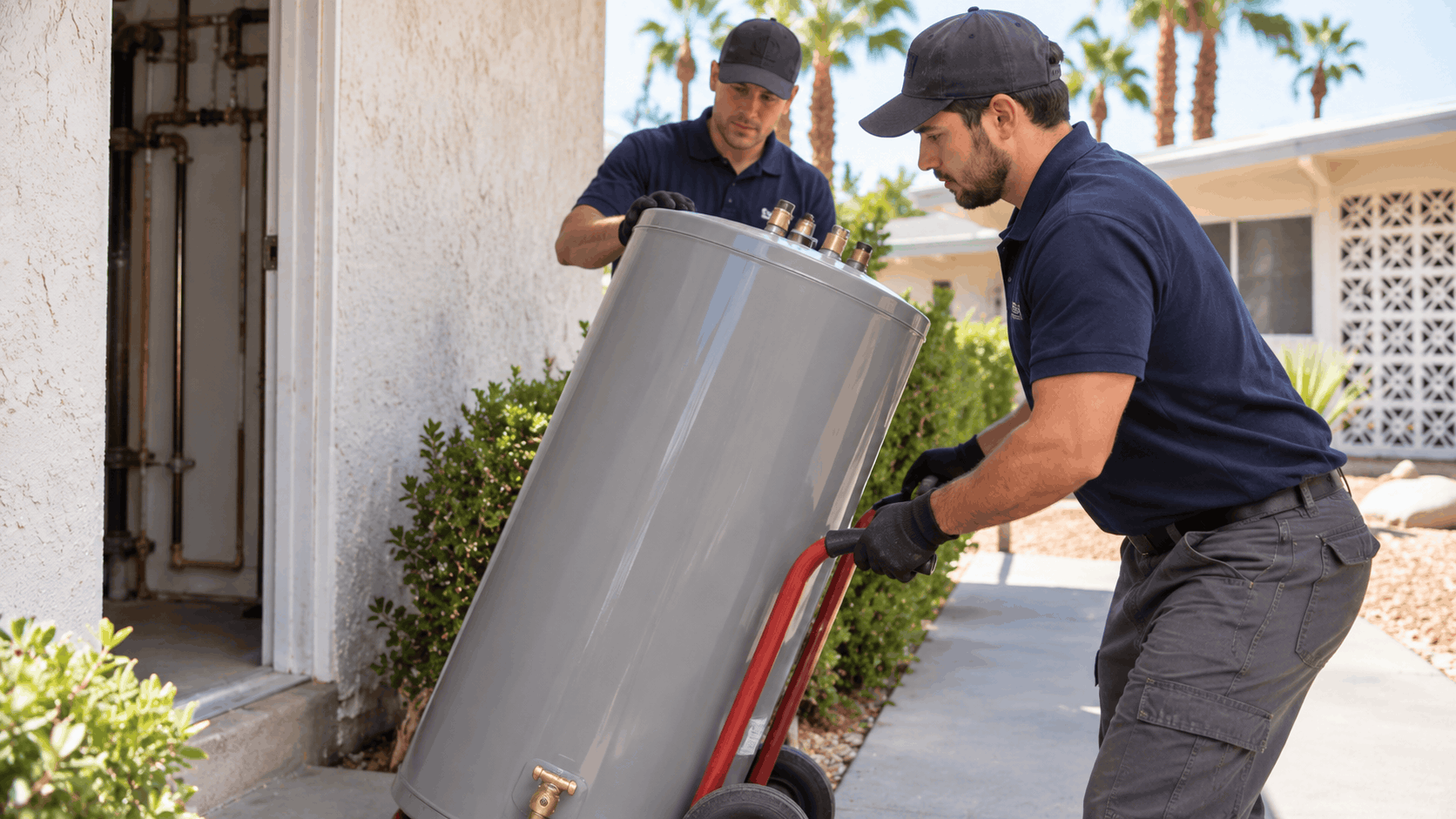
Getting an Old Tank Out of a Tight Cottage
Small 1940s cottages and crawl-space layouts affect maneuvering an old scaled tank out and a new one in. These are modest houses with modest rooms, and the heater often sits in a closet, a garage or a tight utility space that was sized for the original installation.
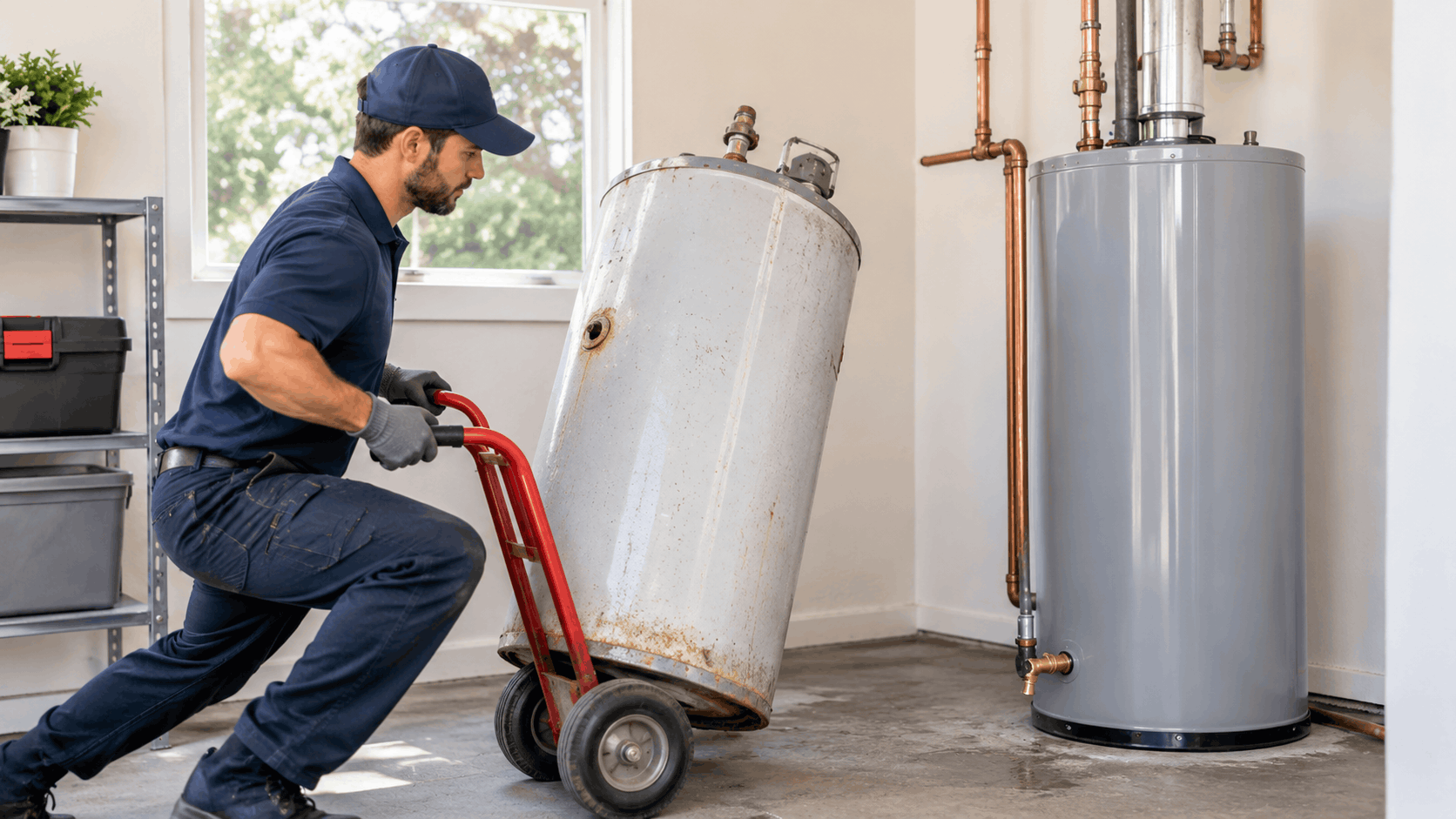
An old tank heavy with sediment is awkward to move, and the path from the heater's spot to the door may be narrow. Planning that route before the day of the job is part of the work, so the crew knows how the old unit comes out and the new one goes in without damaging the home.
Where the heater ties into crawl-space connections, the accessible space under the floor can actually help with the hookups even when the room above is tight. The layout of each cottage is a little different, and a walkthrough beforehand confirms how the swap will run.
This is why our team looks at the install location and the path to it as part of scoping, not as a surprise on the day. In a small cottage, getting the logistics right up front keeps the replacement clean and quick.
Early Appointments Beat the Arterials
Early appointments beat afternoon ones on the arterials around Maryland Parkway. Traffic through Huntridge Circle and along the corridor builds through the day, so scheduling earlier helps on jobs near Charleston Boulevard and Oakey Boulevard where the arterials are busiest.
An early slot means the crew arrives before the roads fill, has the truck parked and the work underway while access is easiest, and avoids the afternoon congestion that can slow a trip in and out. For an owner, that often means the job is done and tested earlier in the day.
Near the edges of Huntridge where it meets the main roads, the timing matters more. A morning appointment on a block close to Charleston is simply easier to reach and work than the same job at a busier hour.
When we schedule a Huntridge replacement, we factor the local traffic into the timing. It is a small piece of local knowledge that keeps the day running on schedule.
Need Help in Las Vegas?
Active Plumbing serves Las Vegas and all of Las Vegas Valley.
How Active Plumbing Handles a Water Heater Replacement
For a Huntridge owner, a water heater replacement with our team runs on confirmed steps rather than guesswork. We check the jurisdiction, assess the existing install and fuel type, size the right unit, and put the price in writing before any work starts. The goal is a clean swap that meets code and lasts as long as the hard water allows.
Confirming the Jurisdiction and the Install
The first step is confirming the permit position for the specific Huntridge address through the City of Las Vegas. Because the neighborhood sits inside the city, the permit and inspection run through the city building department, and we confirm that for the exact address rather than assuming one valley-wide rule.
From there, the team checks the existing connections and the fuel type. On a decades-altered cottage, that means looking at whether the supply lines are galvanized, copper or PEX, whether the connections carry galvanic corrosion, and whether the current setup has a compliant drain pan and relief valve drain.
We also size the replacement for the home. A cottage that added a bathroom or a laundry may need a different capacity than the original tank provided, and the right size depends on the household and the fixtures in use. Getting that right means the new heater actually keeps up with demand.
All of this happens before the price is set, so the owner knows what the job involves and why. It is how a replacement in an older home avoids surprises midway through.
A Written Price Before Work Starts
Active Plumbing gives the customer a written price before work starts. This is a business practice, not a guarantee, and it means the owner sees the figure for their specific job in writing before anyone begins the replacement.
The written price reflects the actual cottage: the fuel type, the condition of the connections, the code work needed, and the unit chosen. That is why the typical ranges earlier in this guide are a picture of what to expect rather than a quote. The real number lands in writing once the install has been assessed.
For an owner, that clarity removes the worry of an open-ended bill. The price is agreed up front, and the work proceeds against it. There is no mystery about the cost once the job is scoped and the figure is in hand.
This approach fits a neighborhood with absentee owners and property managers especially well, because a written price is something a landlord can approve from a distance before the work goes ahead.
Local, Licensed and On the Way
Active Plumbing is a fourth-generation family plumbing business that has served the Las Vegas Valley since 1991, and some of its owners are US military veterans. The business holds Nevada plumbing license NSCB #0047021, verifiable free at nvcontractorsboard.com, along with the certifications required for the work it performs.
Technicians arrive in 30 to 60 minutes anywhere in the Las Vegas Valley, which covers Huntridge and the surrounding neighborhoods. That response window matters when a tank fails and a household or a tenant is without hot water.
More than thirty years working the valley means our team knows these 1940s cottages, their mixed pipe, their crawl spaces and their hard-water heaters. That local experience shows up in how a replacement is scoped and handled on this side of Huntridge.
Licensed, local and reachable within the hour is the standard an owner should expect on a permitted job. We hold that standard on every Huntridge replacement.
Ready to Replace Your Water Heater in Huntridge?
When your tank gives out on a cottage near Maryland Parkway, our team confirms the City of Las Vegas permit position for your exact address, checks the connections and fuel type, sizes the right unit, and hands you a written price before any work starts. Technicians reach Huntridge in 30 to 60 minutes.
Call Active Plumbing at (702) 438-3357 to schedule your replacement, or reach us through our contact page.
Frequently Asked Questions
- How much does water heater replacement cost in Huntridge?
- Typical Las Vegas Valley ranges are tank water heater installation $800 to $1,500 and tankless water heater installation $1,500 to $3,500, with a pre-filter adding $150 to $300 where hard water calls for one. These are typical area ranges, not a quote. The actual price for a specific Huntridge cottage depends on the fuel type, the condition of the connections and any code work, and it is given in writing before the job starts.
- Do I need a permit to replace a water heater in Huntridge?
- Yes. Water heater replacement is permitted work, and permits for Huntridge addresses run through the City of Las Vegas, since the neighborhood sits inside the city rather than Clark County. The permit position should be confirmed for the specific address, which our team does as part of the job. Permitted work must be performed by an appropriately licensed contractor, so verify the license number before the work begins.
- Why does my water heater fail so fast in this part of Las Vegas?
- The valley's water is 280 parts per million, about 16 grains per gallon, which the Southern Nevada Water Authority categorizes as very hard. That hardness deposits calcium and magnesium scale on the heating elements and the tank bottom. The scale acts like insulation, so the heater works harder to warm the water. A tank left unflushed works harder and fails earlier than its rated life, which is why replacement here is so often a scale story.
- Should I switch to a tankless water heater in an older Huntridge cottage?
- Tankless is a real option and saves space in a small cottage, but the heat exchanger is a narrow passage that scale fouls faster than a tank in this hard water. A pre-filter and periodic descaling help keep it clear, which is why those items matter here. Tankless installation runs $1,500 to $3,500 with a pre-filter adding $150 to $300, and descaling runs $150 to $250, all as typical valley ranges.
- Does a Huntridge house need a drain pan under the water heater?
- Under the 2024 local code, a drain pan is required where a leak would cause damage, such as an attic or a floor-ceiling assembly. The pan must be at least 1-1/2 inches deep, with a drain not less than 3/4 inch running to a visible approved location, and the relief valve must not discharge into the pan. If an older install lacks a compliant pan, bringing it up to standard is part of a permitted replacement.
- Is Huntridge a historic district that complicates the paperwork?
- No. Unlike John S. Park next door, which is a designated historic district, Huntridge is not designated, so a water heater swap is generally a normal City of Las Vegas permit without a Historic Preservation Commission review layer. An owner should still confirm the status of an individually significant property with the city rather than assume, but the default answer here is an ordinary city permit.
- My cottage has a crawl space, not a slab. Does that change the job?
- Yes, in your favor. Many Huntridge cottages sit on crawl spaces or raised foundations rather than slab-on-grade, which is unusual for the valley. That means slab leak work does not apply here, and the accessible space under the house is an advantage when tracing a failure or running new connections to the heater. A leak under a crawl-space house is reachable, which makes several parts of the job easier.
- Who should I call if I smell gas near my water heater?
- Leave the building first, and do not flip switches or light any flame, because a spark near gas is dangerous. Once you are outside at a safe distance, call Southwest Gas, which handles gas emergencies in the valley, before calling a plumber. Let the utility handle the gas situation, and never try to cap or reconnect a gas line yourself. The plumber comes into it only after the gas is made safe.
- How do I verify a plumber is licensed before the work starts?
- Ask for the license number and verify it free at nvcontractorsboard.com through the Nevada State Contractors Board. On the board's site, the classification, status, bond and workers compensation are all public record. This takes a minute and is worth doing in a market with a significant unlicensed trade problem. Active Plumbing holds Nevada license NSCB #0047021, which you can check the same way.
- How fast can a plumber get to a Huntridge address?
- Active Plumbing technicians arrive in 30 to 60 minutes anywhere in the Las Vegas Valley, which includes Huntridge. Because the neighborhood has narrow streets, on-street parking and Maryland Parkway traffic through Huntridge Circle, access should be confirmed when scheduling so the crew can park within reach of the house. Early appointments beat afternoon ones on the arterials near Charleston and Oakey.
Licensed plumbing professionals serving Las Vegas and Las Vegas Valley.
Licensed in Nevada · License #0047021
Last updated on
Why trust Active Plumbing?
Founded in 1991, Active Plumbing is a licensed and insured plumber serving Las Vegas and Las Vegas Valley. All content is reviewed by our licensed technicians.
Need Help in Las Vegas?
Active Plumbing serves Las Vegas and all of Las Vegas Valley.
Related Articles

Water Heater Replacement Cost in East Henderson for 1960s to 1980s Homes
What a water heater replacement costs in East Henderson for 1960s to 1980s homes: typical price ranges, how build era and hard water drive cost, permits, and more.
Water Heater Replacement Cost in Southern Highlands for Tract Homes and Custom Estates
Water heater replacement cost in Southern Highlands ranges from $800 to $1,500 for a tank and $1,500 to $3,500 for tankless. See what moves the price across tract homes and custom estates.
Water Heater Replacement Cost in The Ridges for Custom Estates and Multiple Units
Water heater replacement cost in The Ridges for custom estates: typical Las Vegas Valley ranges, why multiple units stack, hard water, pressure and permits explained.