Water Heater Replacement Cost in The Ridges for Custom Estates and Multiple Units

Looking for a Plumber? Contact Us Now
Open 24/7. Written price before work starts.
Get Your Quote
Tell us what's going on and we'll get back to you. We're open 24/7.
Key Takeaways
- Typical Las Vegas Valley ranges are $800 to $1,500 per tank install, $1,500 to $3,500 per tankless install, and $1,500 to $6,000+ for commercial-style units, with figures stacking on estates that run several heaters.
- Recirculation pumps ($400 to $900), long-driveway access, guard-gate coordination and code work such as drain pans and relief valve routing push a custom home replacement above a tract swap.
- The valley's water is 280 ppm, or 16 grains per gallon, categorized very hard, so scale builds on elements, tank bottoms and narrow tankless heat exchangers, and an unflushed tank fails earlier than its rated life.
- Treatment protects the whole investment: softener installation and salt-free conditioning each run $800 to $2,500, and a pre-filter adds $150 to $300 on tankless.
- Elevated Ridges lots mean pressure varies with elevation, so the pressure regulator should be checked before replacing a heater, and a booster pump sometimes answers low upstairs pressure.
- In a second home that sits empty for a season, a whole-home leak detection system with automatic shut-off ($300 to $800) stops a failure that would otherwise run for weeks.
- The Ridges is Summerlin South in unincorporated Clark County, but the Summerlin boundary does not follow village names, so the permit jurisdiction must be confirmed per address, and exterior equipment may also need association design review under NRS 116.
- Active Plumbing walks the system before quoting, gives a written price before work starts, holds Nevada license NSCB #0047021, and arrives in 30 to 60 minutes valley-wide.
In This Article
An owner flies back to The Ridges after a few months away, opens the front door, and finds the entry tile holding a thin sheet of water. One of three water heaters serving the estate had let go weeks earlier, and with no one in the house, it ran until it emptied and kept running. By the time anyone noticed, the question was no longer about a single heater. It was about the damage underneath it and the system that let it happen.
Here is the short answer on cost. In the Las Vegas Valley, a tank water heater installation typically runs $800 to $1,500, a tankless installation $1,500 to $3,500, and a commercial-style water heater installation $1,500 to $6,000 or more, each as a per-unit range. A custom estate in The Ridges usually carries several units, long recirculation runs, and finished stone and hardwood that has to be protected, so the same job that is one line item in a tract house becomes several.

What Water Heater Replacement Costs in The Ridges?
Most owners want a number before they want a lecture, so here are the typical area ranges first. A custom estate lands at the higher end of each range because it rarely has just one heater, and because getting material to the working position inside a large guard-gated property takes more time than a driveway drop at a tract home.
The figures below are typical market ranges for the Las Vegas Valley, not a quote. They are meant to show what a reader should expect to see on a written estimate. The real number comes after the system is walked and the unit count, the layout and any code work are known.
| Water Heater Work | Typical Las Vegas Valley Range (per unit) |
|---|---|
| Tank water heater installation | $800 to $1,500 |
| Tankless water heater installation | $1,500 to $3,500 |
| Pre-filter where hard water calls for one | adds $150 to $300 |
| Commercial-style water heater installation | $1,500 to $6,000+ |
| Recirculation pump installation | $400 to $900 |
| Water heater repair | $150 to $500 |
| Tankless maintenance and descaling | $150 to $250 |
Typical Price Ranges for Tank and Tankless Units
A straight tank water heater installation in the valley typically runs $800 to $1,500 per unit. That range covers the heater itself, the fittings, the connections and the labor to set it, drain the old one out and bring the new one up to current code. On an estate, you may be looking at that range more than once because larger homes here are often set up with more than a single tank.
A tankless water heater installation typically runs $1,500 to $3,500 per unit. Tankless costs more up front because the install is more involved, the gas and venting demands are higher, and the unit is a more complex piece of hardware. Where the valley's hard water calls for it, a pre-filter adds $150 to $300, and on tankless it is money well spent because the heat exchanger is a narrow passage that scale loves.
For the largest multi-bathroom estates, a commercial-style water heater installation typically runs $1,500 to $6,000 or more per unit. These setups move far more hot water and are built for continuous demand across many fixtures. Our team handles that scale through our commercial water heater installation work, and the right arrangement depends on how the house actually uses hot water.
Why Multiple Units Multiply the Cost
A custom estate in The Ridges is not a large tract house, it is a different system. Many of these homes run multiple water heaters or a commercial-style heating arrangement to keep up with several bathrooms, a kitchen, outdoor features and sometimes a casita with its own services. Replacing one heater is a per-unit range, and replacing several stacks those ranges on top of each other.
That stacking is simple math, but it is not just the heaters. Long hot water runs on a big footprint usually depend on recirculation to keep hot water moving so no one waits a minute at a far bathroom. A recirculation pump installation typically runs $400 to $900 where a long run needs it, and that becomes its own line item when the pumps are replaced alongside the heaters.
So when an owner asks why replacing three heaters is not simply three times a single swap, the honest answer is that it is close to that on the units, plus shared labor for access, recirculation and any code work the job triggers. Our recirculation pump installation service is often part of the same visit, since it makes little sense to open the system twice.
Repair Versus Replace on an Estate System
Not every failing heater needs to be replaced. A water heater repair typically runs $150 to $500, and when one unit of several is the problem, repair can be the right call. A bad thermostat, a failed element, a stuck relief valve or a leaking fitting can often be fixed for far less than a full swap, and that keeps the rest of a working bank in service.
The decision turns on the age and condition of the tank and what the inside looks like. A relatively young heater with a repairable part is a repair. A heater near the end of its rated life, with a rusted tank bottom or heavy scale, is a replacement, because throwing money at a tank that is close to leaking is a short bet.
On tankless units, maintenance is a third path that often delays replacement entirely. Tankless maintenance and descaling typically runs $150 to $250, and clearing scale out of the heat exchanger restores flow and temperature without buying a new unit. Our water heater services team weighs repair against replacement on each unit rather than condemning a whole bank because one part failed.
Get Your Quote
Tell us what's going on and we'll get back to you. We're open 24/7.
What Drives the Price Up on a Custom Home?
A standard tract install and an estate install can use the same brand of heater and still land at very different prices. The difference is everything around the heater: the length of the hot water system, the type of arrangement, the access, and the code work the job triggers. Each of those is a real cost, not a markup.
Understanding where the money goes helps an owner read an estimate and know it is fair. Below are the specific factors that push a custom home replacement above a tract swap, each tied directly to labor and materials on the job.
Long Hot Water Runs and Recirculation
Estates in The Ridges have long hot water runs because the houses are large and spread out, with bathrooms, kitchens and outdoor features sometimes a long way from the heaters. To avoid a long wait for hot water at those far fixtures, these homes typically run recirculation continuously, pushing hot water in a loop so it is always close by.
That recirculation is part of the system, so when heaters are replaced the pumps and the loop have to be addressed too. A recirculation pump installation typically runs $400 to $900, and it shows up as a line item because it is real equipment and real labor, not a convenience add-on. Reconnecting a loop correctly after new heaters go in takes time that a simple single-tank tract swap never involves.
The length of the runs also adds labor on the connections, the insulation and the balancing of the system so each branch gets its share. A plumber who ignores the recirculation side and just bolts in new tanks leaves the owner with the same slow hot water they had before. Getting it right is why an estate job carries more labor hours than a house half the size.
Tank, Tankless or Commercial-Style Arrangement
These homes show up with one of three setups, and each affects price differently. A standard tank arrangement is the most familiar and the least costly per unit, but a single tank rarely serves a large estate on its own, so you often see two or more tied together.
A tankless bank is the second setup, where several tankless units work together to deliver endless hot water on demand. Tankless costs more per unit to install because of the gas and venting demands and the complexity of the hardware, and a bank of them serving many bathrooms adds up. The payoff is that tankless does not store and reheat water all day. Our tankless water heater installation work covers both single units and multi-unit banks.
The third setup is a commercial-style heating arrangement, found in the largest multi-bathroom estates that use hot water like a small hospitality property. A commercial-style water heater installation typically runs $1,500 to $6,000 or more per unit because it is built for continuous, high-volume demand. Which arrangement is right is a design question, not a catalog choice, and it depends on how the household actually draws hot water across a day.
Access, Long Driveways and Carrying Material
The working position on an estate is well inside the property. Long private driveways mean our crew carries old units out and new units in across a much greater distance than a tract job, where the truck parks a few steps from the garage. That carrying time is labor, and on a heavy commercial-style unit it adds up fast.
Guard-gate access is the other piece. Contractor access in The Ridges is authorized in advance through the homeowner or the property manager rather than arranged at the gate on the day, and communities at this level commonly keep approved vendor records or require insurance documentation on file. We confirm how access works when the appointment is booked so the crew is not stuck at the gate with a full truck.
None of this is dramatic, but it is honest cost. A job that would take a crew a set number of hours at a tract home takes longer here simply because of distance and coordination. Building that into the written price up front is far better than discovering it on the invoice. For a sudden failure, our emergency plumbing team coordinates access the same way.
Drain Pans, Relief Valve Routing and Code Work
The Southern Nevada Amendments to the Uniform Plumbing Code require a water heater drain pan where a leak would cause damage, such as an attic, a floor-ceiling assembly or a similar location. The pan must be at least 1-1/2 inches deep, with a drain not less than 3/4 inch running to a visible approved location, and no relief valve discharge into the pan. Readily accessible tankless and point-of-use heaters are the exception.
Relief valve routing adds work on some installs too. Under the amendments, a relief valve inside a building drains through galvanized steel, hard-drawn copper, CPVC, PP, a flexible corrugated connector or a listed drain tube to the exterior, unless the listing prevents it. There are also allowances for an air gap to a secondary washer port, a floor sink, a mop sink or a funneled floor drain.
When a heater sits in an attic or above finished living space, meeting these requirements means running a proper drain and routing the discharge correctly, which is labor the job may not have had before if the old install predated current rules. This is where bringing an older estate install up to code adds to the price, and it is the kind of detail that protects the house the next time a tank gives out.

Need Help in Las Vegas?
Active Plumbing serves Las Vegas and all of Las Vegas Valley.
Why Very Hard Water Shortens Heater Life Here?
The single biggest technical reason water heaters in The Ridges fail earlier than their rated life is the water itself. An estate with several heaters and a houseful of high-end fixtures has a lot riding on water quality, and treatment is the preventive side of the replacement cost conversation.
This is not a comfort argument. In a home with costly mixing valves, multiple tanks and tankless units, scale is the quiet force that shortens the life of all of it. Here is exactly what it does and why treatment protects the investment.
The 280 ppm Figure and What It Does to a Tank
The Southern Nevada Water Authority states the valley's water is 280 parts per million, or 16 grains per gallon, which is categorized as very hard. That is one published figure for the valley, and it is the number to work from, not a test reading an owner might get that runs higher.
Very hard water deposits calcium and magnesium scale throughout a system. In a tank water heater, that scale builds on the heating elements and settles across the tank bottom, where it forms an insulating layer. The heater then has to work harder to move the same heat through that layer, which stresses the tank and the elements.
A tank left unflushed works harder and fails earlier than its rated life. That is why regular flushing is a standard response out here, not an optional extra. On an estate running multiple tanks, a maintenance arrangement that flushes them on a schedule protects every unit at once and pushes back the day any of them needs replacing.
Tankless Heat Exchangers and Narrow Passages
Tankless units are especially sensitive to scale because the heat exchanger is a narrow passage. Water moves through tight channels where it is heated fast, and in very hard water those channels are exactly where calcium and magnesium deposit. As scale builds, flow drops and the unit struggles to reach temperature.
That is why a pre-filter matters on estate tankless banks. A pre-filter adds $150 to $300 and reduces the scale reaching the exchanger, which keeps the unit working the way it was designed to. On a bank of several tankless units, protecting each one from the front end is far cheaper than replacing exchangers or whole units later.
Regular descaling finishes the job. Tankless maintenance and descaling typically runs $150 to $250 and clears mineral out of the passages before it chokes them off. On a seasonally occupied estate, scheduling that descaling into a maintenance plan beats waiting for a cold shower to signal trouble. A pre-filter plus routine descaling is the honest way to get full life out of a tankless bank in this valley.
Protecting High-End Fixtures and Cartridges
Scale does not stop at the heaters. It fouls the narrow passages inside high-end mixing valves and cartridges, the parts that blend hot and cold at a shower or a faucet. Those components are expensive to replace and are sometimes on long lead times, which means a scaled-up cartridge can leave a luxury bathroom out of service while a part ships.
In a house with imported finishes and custom fixtures, that is a real cost, not an inconvenience. Very hard water also leaves visible mineral marking on stone, glass and polished surfaces, the kind of spotting owners at this level notice and do not want. Treatment is the thing that keeps all of it clean and working.
So the case for whole-house treatment on an estate is about protecting the entire plumbing investment, not just the water heaters. When an owner spends on the fixtures and the finishes, softening or conditioning the water that runs through them is the step that keeps that spend intact. Our water treatment team sizes a system to the house.
Treatment Ranges Worth Knowing
Treatment is best understood as the preventive side of water heater cost, because it extends the life of every unit and fixture downstream. A water softener installation typically runs $800 to $2,500, which removes the calcium and magnesium that cause scale and is the standard whole-house answer in this valley.
Salt-free water conditioning typically runs $800 to $2,500 installed. It does not remove minerals the way a softener does, but it changes how they behave so they are less likely to deposit as hard scale. It suits owners who want scale control without adding sodium or managing salt, and it is a reasonable fit on some estates.
Whole-house water filtration typically runs $800 to $2,500 and addresses taste, odor and sediment across the home rather than scale specifically. Many estates combine softening with point-of-use filtration where an owner wants it, and for drinking water a dedicated reverse osmosis system installation runs $300 to $600 including parts and labor. On a property with multiple heaters, treatment is one of the better dollars an owner can spend.
Elevated Lots, Pressure and Water Heater Stress
The Ridges sits on the western edge of the valley on elevated lots against the Spring Mountains. That position changes the water pressure a home sees, and pressure quietly shapes how long heaters and connectors last. It bears directly on replacement timing and cost.
Pressure is one of those things no one thinks about until a heater or a connector fails early. On an estate, getting it right before a new heater goes in is the difference between a heater that reaches its rated life and one that burns through it fast.
Pressure Varies With Elevation Across the Village
Homes in The Ridges enclaves like Azure, Sterling Ridge and Falcon Pointe sit high on the system against the mountains. Because incoming pressure varies with elevation across the village, two houses in different enclaves can see noticeably different pressure at the meter.
High incoming pressure is hard on everything downstream of the meter. It stresses water heater tanks, the flexible connectors at the heater, the valves and the seals throughout the house. The damage is gradual rather than sudden, which is why it so often goes unnoticed until a heater or a connector gives out earlier than it should.
On the highest lots, that elevated pressure is a standing condition the plumbing lives with every day. An estate that has worn through heaters faster than expected is worth checking for a pressure problem, because the water chemistry is not the only force at work out here. Pressure and scale together are why heater life gets cut short on these lots.
Checking the Regulator Before Replacing
The pressure regulator is the first thing to check, not an afterthought. If high pressure helped kill the old heater, it will shorten the life of the new one just as surely, so putting a fresh tank on an uncorrected pressure problem is throwing good money after bad.
A regulator is a small device compared to a water heater, and testing it is quick. It sets the pressure the house sees downstream, and when it fails or was never set correctly, the whole system runs at a pressure it was not meant to. Replacing or adjusting it is far cheaper than replacing another heater prematurely.
This is why our crew checks pressure as part of a water heater replacement on an estate rather than just swapping the unit. A new heater protected by a working regulator stands a real chance of reaching its rated life. A new heater running at high pressure is on the same path the old one was.
Low Pressure Upstairs and Boosting
The complaint owners actually notice is low pressure at upstairs fixtures in a large two-story estate. A shower on the second floor at the far end of the house can feel weak, especially when other fixtures are running, and that is the issue a homeowner calls about.
Low pressure upstairs has several possible causes, and the fix depends on which one is at work. Sometimes it is a worn regulator, sometimes it is scale narrowing supply lines over the years, and sometimes it is simply the elevation and the height of the fixtures working against the incoming pressure.
On the highest lots, a boosting arrangement is sometimes the honest answer rather than replacing fixtures that are working correctly. A booster pump raises pressure for the home so the upstairs fixtures get their share, which solves the real problem instead of masking it. Diagnosing which answer fits takes understanding the whole system, not just the fixture that feels weak.

Leaks in an Unoccupied Estate and Why They Cost More
The Ridges holds a significant share of second homes and seasonally occupied properties, and that changes the risk picture entirely. A water heater failure in an empty house runs until someone notices, and on a large property that can be weeks. The damage, and the smart prevention budget, are both bigger here.
This is the single most valuable preventive conversation available in this community, because the cost of a failure in an unoccupied estate is rarely just the heater. It is the heater plus everything the water touched while no one was home.
Second Homes and Seasonal Occupancy
A tank failure in an occupied house gets caught fast. Someone hears it, sees it, or loses hot water and calls. In an unoccupied estate, none of that happens, so a leaking tank or a failed connection can run for weeks before anyone discovers it.
On a large property, the scale of that is sobering. A tank that lets go in an attic or a mechanical room can empty, keep running on the supply, and soak through flooring, ceilings and finished walls over the days or weeks the owner is away. By the time it is found, the water heater is the small part of the bill.
This is why the second-home risk profile deserves its own plan. An estate that sits empty for part of the year needs more than a good water heater, it needs a way to stop a hidden leak from running unchecked. The build and the seasonal use together are what make this valley's empty estates such a specific concern.
Shut-Off Valves and Automatic Detection
A leak detection system with automatic shut-off is the direct answer to a leak that runs while no one is home. It watches for the signature of a leak and closes the water supply automatically, so a failure that would have run for weeks is stopped in its tracks. A whole-home leak detection system runs $300 to $800, which is small against the damage it prevents.
Alongside that, a documented main shut-off that operates easily is worth having. When something does go wrong, whoever is on site, an owner, a property manager or a plumber, needs to be able to close the water fast, and a main valve that is seized or hidden defeats the purpose. We make sure it works and that it is known.
For an estate that sits empty part of the year, these are proportionate recommendations rather than gadgets. Our whole-home leak detection system and electronic leak detection work are built for exactly this risk, and they turn a potential catastrophe into an alert.
A Check Before an Owner Leaves for a Season
A system check before an owner leaves for a season is one of the most useful things we do in The Ridges. It catches the heater that is weeping, the connector that is corroding and the valve that no longer seals, before the house is left alone for months.
The point is simple. A small problem found before an owner leaves is a quick repair. The same problem left to run in an empty house becomes a replacement bill plus damage repair later, and often an insurance claim on top. Catching it early is far cheaper on every count.
For properties managed by an estate manager or a property manager, this check fits naturally into the handoff before a season away. Whoever authorizes the work can schedule it as part of closing the house up. It is a proportionate preventive step for a property of this value, not an upsell.
Need Help in Las Vegas?
Active Plumbing serves Las Vegas and all of Las Vegas Valley.
Gas Sizing When You Add or Replace Heaters
When heaters are added or replaced on an estate, gas sizing is the mistake that bites. The common error is sizing gas for the one appliance in front of you rather than for the whole load the house runs, and it quietly undercuts water heater performance.
Getting gas sizing right is a genuine technical differentiator at this level, because the symptoms are subtle and easy to blame on the wrong thing. Here is how it goes wrong and what doing it right involves.
The Whole-House Gas Load, Not One Appliance
An estate in The Ridges draws gas for far more than its water heaters. Pool heaters, outdoor kitchens, fire features, patio heaters and generators all pull from the same gas system, and each one adds to the total demand the line has to supply.
The mistake is sizing for the appliance you are working on rather than for everything the house actually runs at once. A gas line that is fine for a single water heater on its own can fall short when that heater has to compete with a pool heater and an outdoor kitchen firing at the same time.
So when new water heaters go in, the right approach starts with the whole-house gas load. Our team looks at every appliance drawing from the system, not just the heaters being replaced, so the line can actually supply the house at peak demand. Our gas line services cover that sizing work.
Symptoms of an Undersized Line
An undersized gas line rarely fails dramatically. Instead, appliances underperform. A water heater or a pool heater never quite reaches temperature, or a cooktop flame drops when another appliance fires up and starts drawing gas.
Those symptoms are easy to misread. An owner might blame the water heater, call for a replacement, install a perfectly good new unit, and still have the same problem, because the real issue was never the heater. It was the gas line that could not feed it enough when the rest of the house was running.
That is why diagnosing an underperformance complaint on an estate means looking at the gas supply, not just the appliance. A pressure drop under load points to a sizing problem, and catching it saves an owner from replacing a heater that was fine. The honest fix is often upsizing or rerouting the gas, not buying new hardware.
Gas Work Ranges and Who Supplies the Gas
Gas work has its own typical ranges. A gas line installation runs $300 to $800 for a single appliance connection and $1,500 to $3,000 for a new main line run. Gas line rerouting runs $500 to $2,500, which is often what an undersized or badly routed line needs. Our gas line rerouting and upsizing service handles exactly that.
Natural gas in the Las Vegas Valley is supplied by Southwest Gas. Gas pressure testing, gas coordination and anything to do with the gas meter relate to Southwest Gas, so that is the utility involved when a new line run is added or a meter position changes.
On safety, the standard instruction on any suspected gas leak is to leave the building, avoid switches and flames, and call the gas utility from outside before calling a plumber. Never try to repair, cap or reconnect a gas line yourself. Once the utility has made the area safe, our team handles the plumbing side of the work.

Permits, Design Review and Jurisdiction in The Ridges
Two separate approval tracks can affect the timing and cost of an estate replacement, and both start with knowing exactly where the address sits. Confirming the jurisdiction and the association requirements before the work is quoted keeps the job on schedule.
These are not formalities to skip. On a visible exterior install they can be the difference between a smooth job and one that stalls, so they belong in the first conversation.
Confirming the Building Department Per Address
The Ridges is the guard-gated luxury village of Summerlin South, which sits in unincorporated Clark County. That makes Clark County the likely permitting authority for most addresses here, with its own building department running the permit counter.
The catch is that Summerlin spans both unincorporated Clark County and the City of Las Vegas, and the boundary does not follow village names. Because of that, the permit position has to be confirmed for the specific address rather than assumed from the village. Establishing which department governs the property is a routine first step before quoting permitted work.
Whichever jurisdiction governs the address, the Southern Nevada Amendments to the Uniform Plumbing Code apply as that jurisdiction has codified them. That is the code our team works to, and it is why the drain pan and relief valve requirements covered earlier shape a water heater install. Serving the broader Summerlin area, we confirm the correct authority before we price permitted work.
When Design Review Applies to Equipment
The Ridges sits under a master association with sub-associations, and design review here is active and detailed, operating under Nevada Revised Statutes Chapter 116. That matters the moment a water heater job puts anything on the outside of the house.
Anything visible on the exterior can require association approval. An exterior tankless unit, a water heater enclosure, a treatment system, exterior equipment on a visible elevation or a new gas meter position all fall into that category. Interior work does not trigger design review, so a tank swapped out in a mechanical room is a different matter from a tankless unit mounted on a visible wall.
The important thing to understand is that association approval and a building permit are separate tracks. Clearing one does not clear the other, and on a visible exterior install both may apply. In a village where architecture is closely controlled, confirming with the association before mounting equipment on an exterior wall is a necessary step, not an optional one.
How Approvals Affect Timing
Where exterior equipment is involved, association review can add time to the job. An interior replacement can usually move quickly, but an install that puts something on a visible elevation may have to wait on the design review track before the work can go ahead.
Because of that, an owner planning an exterior tankless unit, a visible enclosure or a new meter position should confirm requirements with the association, the city or the water provider before anything is mounted. Finding out after the fact that an install needs approval is how a job stalls and a removal gets ordered.
We build these two tracks into the conversation up front so the owner knows what each one requires and how long it may take. That way the timing is understood before work starts, and an exterior install is not held up by a step that could have been handled in advance.
Need Help in Las Vegas?
Active Plumbing serves Las Vegas and all of Las Vegas Valley.
How Active Plumbing Handles a Water Heater Replacement Here
Working on an estate in The Ridges is a different job from a tract swap, and our process reflects that. Here is what an owner or property manager can expect, from the first walk of the system to a written price before any work begins.
Walking the System Before Quoting
Diagnosing a problem on a system this size starts with understanding the layout, not with the symptom. An estate with multiple heaters, long recirculation runs, pool and spa gas, outdoor features and sometimes a casita is a complex system, and reacting to a single complaint without seeing the whole picture leads to the wrong fix.
So our team asks for the plans or walks the system before quoting. We trace where the heaters sit, how the recirculation runs, where the gas feeds and what the pressure situation looks like on the lot. That walk is what tells us whether a problem is a single repair, a unit replacement or a sign of something larger.
On a property of this value, that first look pays for itself. It is the difference between a quote built on the actual system and a guess that misses something expensive. A plumber who walks the system before pricing is doing the job the way it should be done.
A Written Price Before Work Starts
We give the customer a written price before work starts. The actual price for a specific job depends on that job, which is why the walk comes first, but once we understand the system the owner gets the number in writing before anyone picks up a tool.
Licensing applies to permitted work, and an owner is entitled to verify it. Active Plumbing holds Nevada plumbing license NSCB #0047021 and has been licensed since 1991. You can verify it free at nvcontractorsboard.com, where the classification, status, bond and workers compensation are all public record.
That verification matters in a market with a significant unlicensed trade problem, and on an estate where permitted work and association approvals are both in play, licensed work is the only kind that holds up. Asking for the license number and checking it is a reasonable thing for any owner or property manager to do.
Access, Protected Finishes and Response
We confirm guard-gate access through the owner or the property manager when the appointment is booked, so the crew arrives with what it needs and is not held up at the gate. In a house with stone and hardwood floors and finished interiors, we protect those finishes as we move units in and out and carry material across the property.
Where an under-slab line has failed, a reroute is frequently better value than breaking through a finished slab, and detection is what makes that call possible without tearing up the house. Our slab leak detection and repair work exists so finished floors stay intact wherever a reroute does the job.
For response, our technicians arrive in 30 to 60 minutes anywhere in the Las Vegas Valley, which matters when a heater has failed in an occupied house or a leak has been found in one that was empty. Access coordination, protected finishes and that response window are how an estate job stays discreet and tidy from start to finish.
Planning a Water Heater Replacement in The Ridges
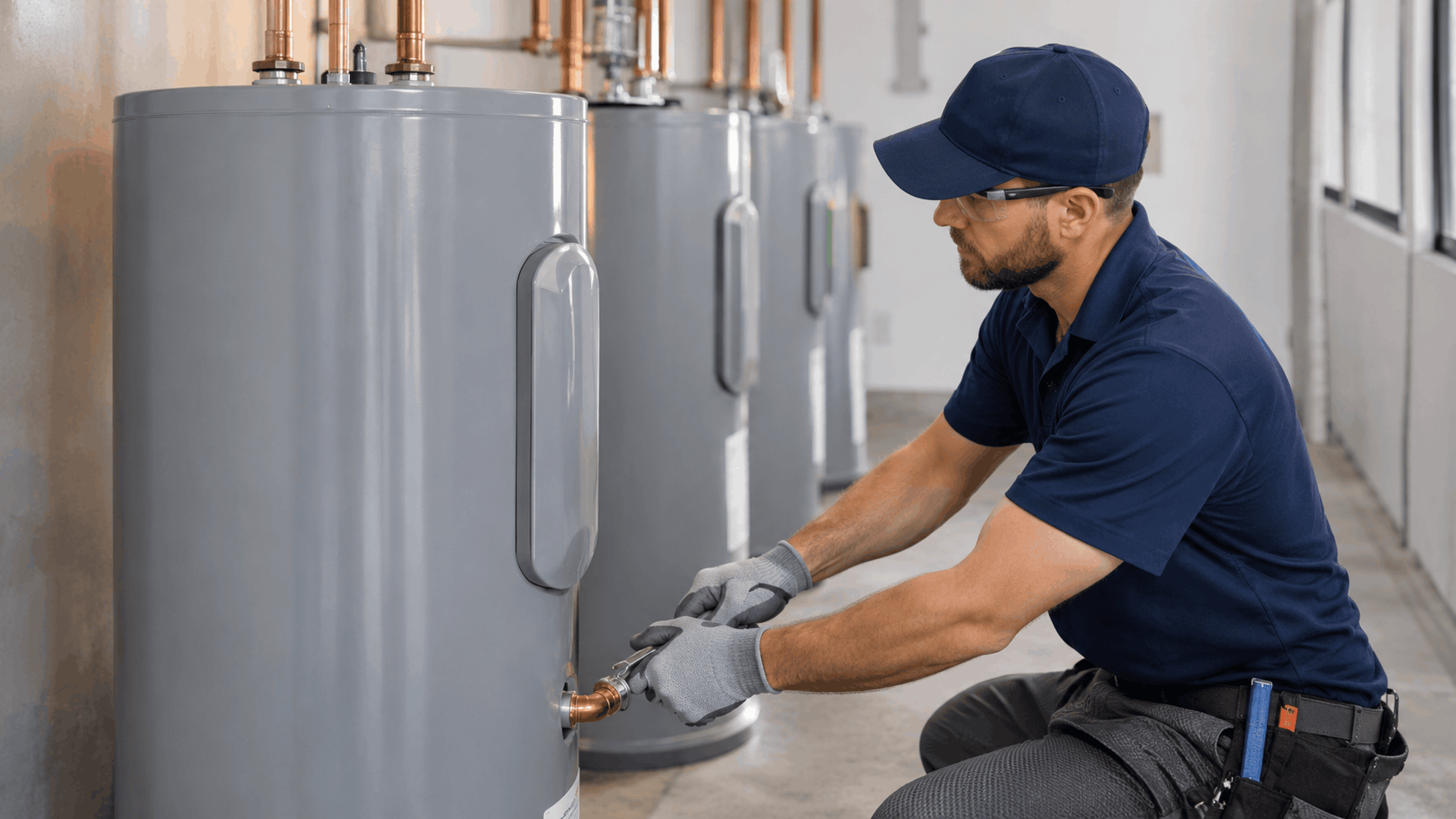
An estate replacement starts with walking the system, since the number of units, the recirculation runs and any code work all shape the job, and it ends with a written price before any work begins. Active Plumbing is a fourth-generation family business that has served the valley since 1991, holds Nevada license NSCB #0047021, and arrives in 30 to 60 minutes anywhere in the Las Vegas Valley.
To schedule a system walk or get a written price for your estate, call our team at (702) 438-3357.
Frequently Asked Questions
- How much does water heater replacement cost in The Ridges?
- As a typical area range, a tank water heater installation runs $800 to $1,500 per unit and a tankless installation runs $1,500 to $3,500 per unit in the Las Vegas Valley. Estates here often run several units, so those per-unit ranges stack rather than counting once. A commercial-style installation runs $1,500 to $6,000 or more per unit. These are typical ranges, not a quote, and the written price depends on the specific job after the system is walked.
- Why does replacing multiple units cost more than one?
- Custom estates in The Ridges typically run several water heaters or a commercial-style arrangement to serve many bathrooms and outdoor features. Each unit carries its own per-unit range, so replacing several stacks those figures. On top of that, you pay shared labor for guard-gate access, carrying material across long driveways, reconnecting continuous recirculation loops, and any code work the job triggers, such as drain pans and relief valve routing. That combination is why an estate job runs well above a single tract swap.
- Should an estate use tank or tankless water heaters?
- It depends on the home's layout and hot water demand. Estates have long hot water runs with recirculation running continuously, and both tank and tankless setups can serve that with the right design. Tankless costs more per unit but does not store and reheat all day. In the valley's hard water, a pre-filter adds $150 to $300 where it is called for on tankless, which protects the heat exchanger. Walking the system is how we recommend the right arrangement for a specific house.
- How does hard water affect my new water heater?
- The valley's water is 280 parts per million, or 16 grains per gallon, which the Southern Nevada Water Authority categorizes as very hard. Scale from that water builds on heating elements and across the tank bottom, forming an insulating layer the heater has to push heat through. A tank left unflushed works harder and fails earlier than its rated life. Regular flushing, and whole-house softening or conditioning, are the standard responses that protect a new heater and the fixtures downstream of it.
- Do I need a permit to replace a water heater in The Ridges?
- Permits are decided by the jurisdiction over the specific address. The Ridges is part of Summerlin South in unincorporated Clark County, so Clark County is the likely authority, but Summerlin spans both the county and the City of Las Vegas and the boundary does not follow village names, so the permit position has to be confirmed per address. Separately, exterior equipment such as a tankless unit or a new meter position may need association design review, which is a different track from the building permit.
- Does a new water heater need a drain pan?
- Under the Southern Nevada Amendments, a drain pan is required where a leak would cause damage, such as an attic, a floor-ceiling assembly or a similar location. The pan must be at least 1-1/2 inches deep, with a drain not less than 3/4 inch running to a visible approved location, and no relief valve discharge into the pan. Readily accessible tankless and point-of-use heaters are the exception. When a heater sits above finished living space, meeting this adds work to the install.
- What about a water heater failing while the house is empty?
- The Ridges holds a significant share of second homes and seasonally occupied properties, so a tank failure can run for weeks before anyone notices on a large property, soaking floors, ceilings and finished walls. A whole-home leak detection system with automatic shut-off runs $300 to $800 and closes the water supply when it senses a leak, stopping a failure that would otherwise run unchecked. A system check before the owner leaves for a season is the other proportionate step for an empty estate.
- Can I get a price over the phone?
- For an estate job, we walk the system before quoting, because the real number depends on the layout, the number of units, the recirculation setup and any code work the install triggers. A commercial-style arrangement serving many bathrooms prices very differently from a single tank swap, and only seeing the system tells us which it is. Once we understand the house, we give a written price before work starts, so the owner has the number in hand before any tool comes out.
- Who supplies the gas and what if I smell a leak?
- Natural gas in the Las Vegas Valley is supplied by Southwest Gas, so gas pressure testing, meter work and gas coordination all relate to that utility. If you smell a suspected gas leak, the standard instruction is to leave the building, avoid switches and flames, and call the gas utility from outside before calling a plumber. Do not try to repair, cap or reconnect a gas line yourself. Once Southwest Gas has made the area safe, we handle the plumbing side of the work.
- How do I verify the plumber's license?
- Plumbing work in Nevada is licensed by the Nevada State Contractors Board, which is statewide. Active Plumbing holds Nevada license NSCB #0047021 and has been licensed since 1991. You can verify it free at nvcontractorsboard.com, where the classification, status, bond and workers compensation are all public record. In a market with a significant unlicensed trade problem, checking the license number before work begins is a reasonable step for any owner or property manager, especially on permitted estate work.
Licensed plumbing professionals serving Las Vegas and Las Vegas Valley.
Licensed in Nevada · License #0047021
Last updated on
Why trust Active Plumbing?
Founded in 1991, Active Plumbing is a licensed and insured plumber serving Las Vegas and Las Vegas Valley. All content is reviewed by our licensed technicians.
Need Help in Las Vegas?
Active Plumbing serves Las Vegas and all of Las Vegas Valley.
Related Articles
Water Heater Replacement Cost in Southern Highlands for Tract Homes and Custom Estates
Water heater replacement cost in Southern Highlands ranges from $800 to $1,500 for a tank and $1,500 to $3,500 for tankless. See what moves the price across tract homes and custom estates.
Water Heater Replacement Cost in Spanish Trail for Multi-Unit and Custom Homes
Water heater replacement cost in Spanish Trail depends on property type, number of heaters, gate access, and very hard water. Get the typical valley ranges and what drives your price.

Water Heater Replacement Cost in Sun City Summerlin for Late 1980s and 1990s Homes
What water heater replacement really costs in Sun City Summerlin homes from 1989 to the 1990s, shaped by unit type, the 2024 code, hard water, and City of Las Vegas permits.