How-To Guides
Water Heater Venting Types in Las Vegas Homes: Atmospheric, Power Vent, and Direct Vent
Key Takeaways
- Gas water heaters need venting to carry combustion gases like carbon monoxide out of the home, while electric units need none.
- Atmospheric venting is the cheapest and common in older Las Vegas homes but can backdraft in tight or sealed spaces.
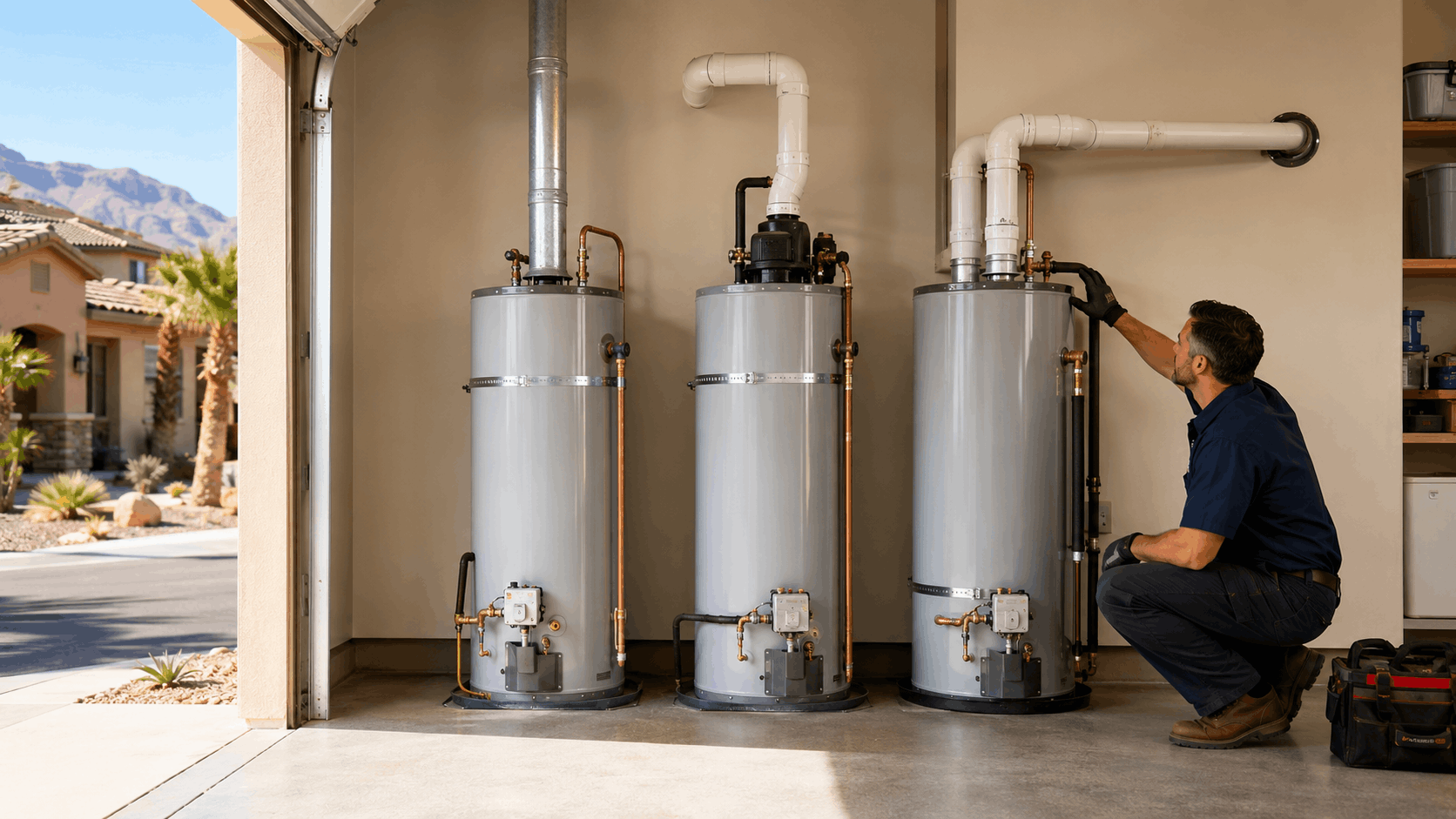
- Power vent units use a fan and PVC piping to vent horizontally, ideal for interior closets far from a roof.
- Direct vent units use sealed combustion with outside air, making them the safest choice for newer tightly sealed homes.
- Clark County requires a plumbing permit and inspection for venting changes, and some HOAs restrict vent placement.
- Installed costs run roughly $1,200-$2,000 atmospheric, $1,800-$3,000 power vent, and $2,200-$3,800 direct vent.
- Annual vent checks and clearing dust from side wall vents prevent backdrafting and keep the system safe in the desert climate.
- Active Plumbing services and converts all three venting types across Las Vegas, Summerlin, Henderson, and surrounding areas.
In This Article
A homeowner in Summerlin recently called us in the middle of a water heater replacement. The old tank had rusted through, water was pooling in the garage, and the contractor at the store kept throwing around terms like "atmospheric," "power vent," and "direct vent." She had no idea which one her house needed, and nobody had explained why it mattered.
That confusion is common, and honestly, it is fair. Venting is one of those parts of a water heater that stays hidden until something goes wrong. But the way your unit gets rid of hot exhaust affects your family's safety, your energy bill, and whether your install passes a Clark County inspection.
Why Water Heater Venting Matters in Las Vegas Homes?
Every gas water heater burns fuel to heat your water, and burning fuel creates exhaust. Venting is the path that exhaust takes to get out of your house safely. When that path works right, you never think about it. When it fails, the results range from a cold shower to a life-threatening carbon monoxide problem.
Water heater venting matters for three big reasons in our valley:
- Safety - it keeps combustion gases out of your living space
- Efficiency - a good vent design wastes less heat
- Code compliance - the county will not sign off on an unsafe or wrong vent setup
Local conditions shape the right choice too. Tight new builds, dusty desert air, and garage installs all change what works best. Let us break each factor down.
What Venting Actually Does
When a gas water heater fires up, the burner produces heat along with combustion byproducts. These include water vapor, carbon dioxide, and small amounts of carbon monoxide. Venting carries that mix out of your home before it can build up indoors.
The flue or vent pipe acts like a chimney for your tank. Hot gases move up and out through the roof or a side wall, depending on the system. A well-designed vent pulls fresh air toward the burner at the same time, which keeps the flame burning clean.
Electric water heaters change the picture completely. They use heating elements instead of a burner, so they produce no combustion gases and need no venting at all. This is why a gas water heater always demands more planning than an electric swap, and why homeowners switching fuel types should call us before buying anything.
Because the exhaust from a gas unit is invisible and can be odorless, you cannot rely on your senses to know it is working. That is the whole reason venting design and inspection carry so much weight.
Safety Risks of Improper Venting
The biggest danger is backdrafting. This happens when exhaust that should go up the flue instead spills back into the room. A cracked flue, a blocked pipe, or negative air pressure inside the home can all cause it.
A carbon monoxide leak is the worst-case outcome of backdrafting. Carbon monoxide is colorless and odorless, and it can make a family sick or worse before anyone notices. This is why we always recommend a working carbon monoxide alarm near any gas appliance.
Newer sealed homes make this trickier. Tightly built houses in places like Mountain's Edge keep conditioned air in, which is great for cooling bills but bad for atmospheric venting. When a bathroom fan or kitchen hood runs, it can pull air backward down the flue and cause draft failure.
Poor venting also creates moisture damage. Exhaust carries a lot of water vapor, and when it lingers in a closet or garage, it rusts the tank, stains drywall, and rots framing over time. We see this constantly during inspections in older closet installs.
How Clark County Code Affects Your Options
The Clark County Building Department sets specific rules for water heater venting. Pipe sizing, clearances, materials, and termination points all have to meet code. A wrong vent length or a missing air gap can fail an inspection on the spot.
Any water heater replacement that changes venting usually needs a plumbing permit. The permit protects you, because a licensed inspection confirms the install is safe before you rely on it every day. Skipping the permit can also cause headaches when you sell the home.
HOA rules add another layer in many valley communities. Some neighborhoods restrict where a side wall vent can terminate so it does not face a neighbor's yard or the street. Master-planned areas like Summerlin and Inspirada often have architectural guidelines that affect vent placement.
Our team handles the permit and inspection process as part of any install, so homeowners never have to sort through county paperwork on their own. You can learn more about our water heater services and how we manage code compliance.
Desert Climate and Venting Performance
The desert climate here is hard on vent systems in ways that surprise people. Dry heat is easy on some parts but rough on others, and dust gets into everything. Over years, that grit can build up inside a side wall vent and choke airflow.
Garage installs are extremely common across the valley, from Henderson to North Las Vegas. A garage water heater faces wide temperature swings, more dust, and sometimes road debris blown in through the garage door. All of that shortens the life of a vent connector.
Monsoon season brings its own problems. Blowing debris and heavy wind can disturb a rooftop flue or push exhaust back down an atmospheric vent. We get calls every summer about pilot lights going out during storms because of draft problems.
Because of these local factors, the best venting choice is not always the cheapest one. A system that handles dust and wind well often pays off over the years it stays in service.
Get Your Quote
Tell us what's going on and we'll get back to you fast.
Atmospheric Vent Water Heaters Explained
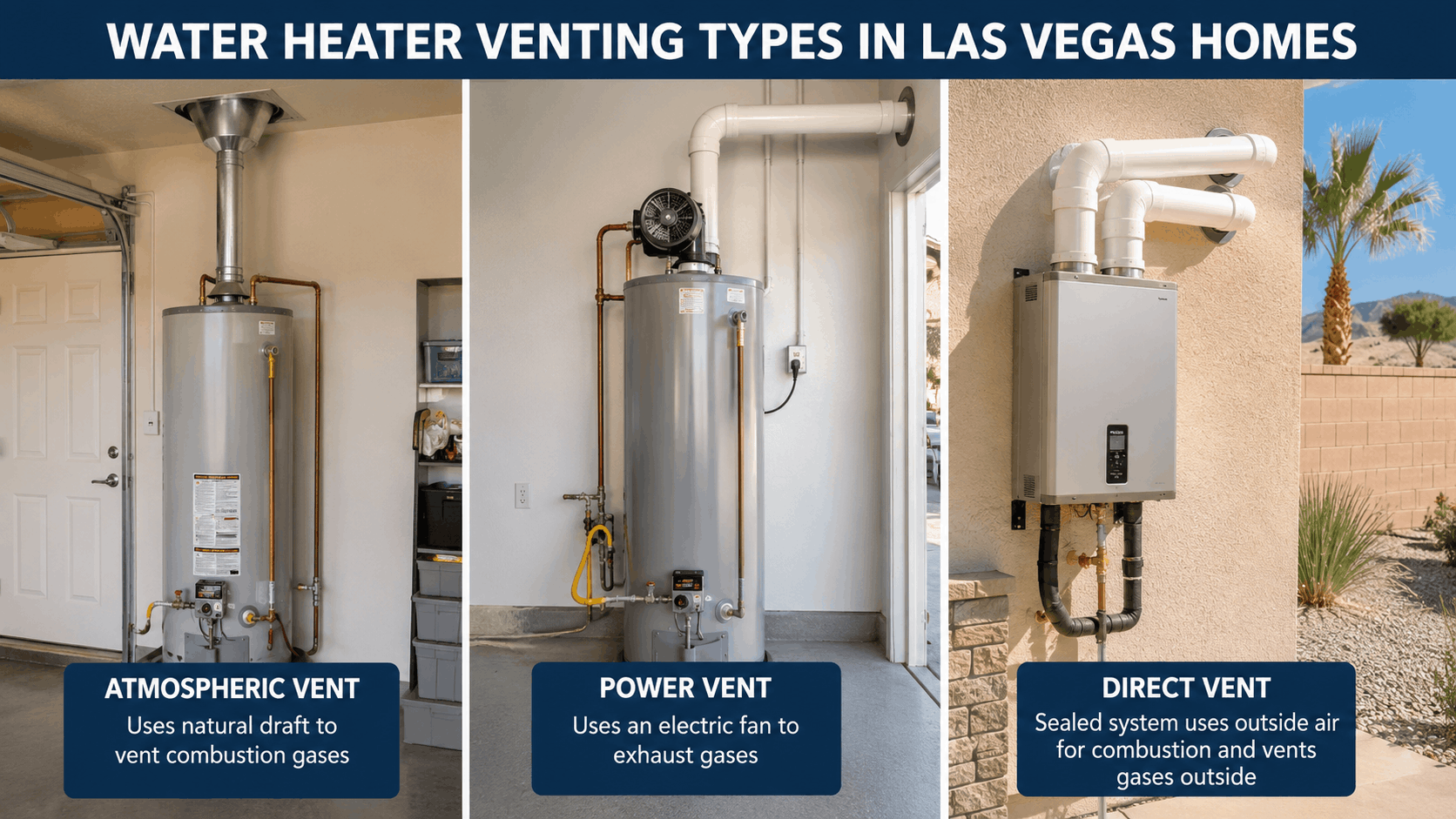
Atmospheric venting is the old standby. If your home was built before the 2000s and still has its original setup, there is a strong chance it uses an atmospheric vent. These units are simple, cheap, and everywhere in older parts of town.
They rely on natural draft, meaning hot air rises on its own with no help from a fan. That simplicity is both their strength and their weakness. Here is a quick overview before we get into the details.
| Feature | Atmospheric Vent |
|---|---|
| Draft method | Natural draft (gravity) |
| Vent material | Metal flue |
| Electricity needed | No |
| Vent direction | Vertical through roof |
| Upfront cost | Lowest |
How Atmospheric Venting Works
Atmospheric venting uses one basic rule of physics: hot air rises. When the burner heats the water, the hot combustion gases float up naturally through a metal flue pipe. That flue runs up through the attic and out the roof.
There is no fan and no electricity involved in the venting itself. The draft is created entirely by the temperature difference between the hot exhaust and the cooler air outside. As long as the flue is clear and the room has enough fresh air, natural draft venting pulls the gases out steadily.
A draft hood sits on top of the tank to help the flow start and to protect against gusts. Fresh air for combustion comes from the room around the unit, usually through vents or gaps near the floor. This is why closet doors on these units often have louvers built in.
Because the system depends on gravity and open air, anything that blocks the flue or steals room air can stop it from working. That vulnerability is where most problems begin.
Where We See Them in Older Neighborhoods
Older homes near Charleston Boulevard and throughout the Historic Westside almost always have atmospheric units. These neighborhoods were built when this style was the only real option, and many still run the original vent design.
For decades, atmospheric venting was the standard because it was cheap and required no electrical connection. Builders installed them by the thousands across central Las Vegas and older Sunrise Manor tracts. We still service plenty of them today.
Ranch-style homes from the 1960s through the 1990s tend to have generous mechanical closets or garage spots that suited natural draft venting well. The open layouts of that era gave these units the room air they needed to breathe.
When we work on homes in the Las Vegas core, we often find atmospheric setups that have run reliably for 15 years or more. The trade-off is that they need regular checks to stay safe as they age.
Common Problems With Atmospheric Units
The most common issue we find is backdrafting in tight closets. When a home has been remodeled and sealed up, or a powerful exhaust fan gets added, the flue can lose its draft. Exhaust then spills into the room instead of going up and out.
Corroded flues are another frequent problem. Moisture and heat cycling over the years eat away at the metal, and we sometimes find rust holes or disconnected sections during inspections. A corroded flue can leak combustion gases into the attic long before anyone notices.
Wind is a real enemy of these units in our valley. During monsoon gusts, a downdraft can blow into the flue and cause draft failure, snuffing out the pilot or pushing exhaust back inside. Homes with rooftop vents exposed to open desert wind see this most.
Our technicians also check for undersized or crushed vent connectors, which restrict flow. When we spot chronic draft problems, we often recommend looking at a power vent or direct vent replacement instead of patching the same closet setup again.
Costs and Lifespan
Atmospheric units remain the least expensive option upfront. A standard installation typically runs between $1,200 and $2,000 in the Las Vegas market, depending on tank size and any code updates needed. The simple venting keeps the labor cost down.
Lifespan for the tank itself usually lands around 8 to 12 years here. Our hard water shortens that range if the tank is not flushed regularly, which is common across the valley. The metal flue can last longer but should be inspected as the unit ages.
The low installation cost is why these still get chosen for straightforward swaps in older homes. If the existing flue is in good shape and the closet has proper airflow, replacing like-for-like is often the budget-friendly path.
That said, the upfront savings can fade if the unit backdrafts or wastes heat. We walk homeowners through the real numbers so the cheapest choice today does not become the costly one in a few years.
Need Help in Las Vegas?
Active Plumbing serves Las Vegas and all of Las Vegas Valley.
Power Vent Water Heaters Explained
Power vent units solve one big problem: what do you do when hot gas cannot rise naturally to the roof? Instead of relying on gravity, these use an exhaust fan to push the gases out. That fan opens up installation options that atmospheric units cannot match.
They have become popular in homes where a roof flue is hard or impossible to run. Here is a snapshot before the details.
| Feature | Power Vent |
|---|---|
| Draft method | Built-in blower fan |
| Vent material | PVC pipe |
| Electricity needed | Yes (standard outlet) |
| Vent direction | Horizontal through side wall |
| Upfront cost | Moderate |
How Power Venting Works
A power vent water heater has a blower fan built right into the top of the unit. When the burner fires, the blower switches on and pushes the exhaust out under pressure. Because the fan does the work, the gases do not need to rise on their own.
This forced airflow lets the exhaust travel through PVC piping instead of a metal flue. PVC is cheaper, easier to route, and can bend around corners. That flexibility is the whole appeal of the design.
Best of all, the vent can run horizontally and exit through a side wall rather than the roof. This opens up spots where a vertical flue would be a nightmare to install. The blower can push exhaust much farther than gravity ever could.
The tank still pulls combustion air from the room around it, so it is not a fully sealed system. That distinction matters when we talk about the best fit for very tight homes later on.
Best Uses in Las Vegas Homes
Power vent units shine in homes where routing a roof flue is a headache. Interior closets in the middle of a house, far from any exterior wall, are a classic example. The horizontal venting can snake through walls to reach the outside.
Many Henderson-area builds place the water heater in an interior closet install where the roof is hard to reach. In these homes, a power vent lets us run PVC to the nearest side wall without tearing into the ceiling. We handle plenty of these across Henderson neighborhoods.
They also work well when a homeowner wants to relocate the tank during a remodel. Since the exhaust can travel horizontally, the unit does not have to sit directly under a roof penetration. That freedom simplifies many upgrade projects.
For two-story homes where the water heater is on the ground floor, power venting avoids running a flue up through living space. It is often the practical middle-ground choice between the old atmospheric style and a full sealed system.
Electrical and Noise Considerations
Because the blower needs power, a power vent unit requires a nearby electrical outlet. If the current spot does not have one, an electrician has to add it, which adds cost. We always check for a dedicated outlet before quoting this option.
Fan noise is the trade-off most homeowners notice. The blower makes a low hum or whir whenever the unit heats water. In a garage this is usually no bother, but in a closet near a bedroom, some people find it noticeable.
Power outages create another wrinkle. Because the fan is required to vent safely, the unit will not fire during an outage. During summer storms that knock out power in parts of the valley, that means no hot water until the electricity returns.
None of these are dealbreakers, but they are worth knowing up front. We point them out so homeowners are not surprised by a humming fan or a cold morning after a monsoon knocks the power out.
Costs and Efficiency Gains
Installation cost for a power vent unit usually falls between $1,800 and $3,000 in our market. The higher price reflects the unit itself, the PVC venting, and any electrical work needed. Longer horizontal runs push the number up.
The energy efficiency gain over atmospheric models is modest but real. Because the blower controls airflow, less heated air escapes up an open flue when the burner is off. That tighter control trims a bit off your gas usage over the year.
Homeowners should not expect huge savings from efficiency alone, though. The main value of a power vent is the installation flexibility, not a dramatic drop in bills. The efficiency edge is a nice bonus rather than the reason to choose it.
When we compare options for a customer, we weigh the flexibility against the ongoing fan noise and the outlet requirement. For many interior closet homes, the trade is worth it.
Direct Vent Water Heaters Explained
Direct vent units take safety a step further. Instead of borrowing air from inside the house, they pull combustion air straight from outdoors and exhaust straight back out. The whole burn happens in a sealed loop with the outside.
This design fits the tightly sealed homes going up across the valley. Here is the quick view.
| Feature | Direct Vent |
|---|---|
| Draft method | Sealed combustion, two-pipe or concentric |
| Air source | Outside air only |
| Electricity needed | Sometimes (varies by model) |
| Vent direction | Side wall, sealed |
| Upfront cost | Higher |
How Direct Venting Works
A direct vent water heater uses a two-pipe system, or a single concentric pipe with one tube inside another. One path brings fresh outside combustion air in, and the other carries exhaust out. Both connect directly to the outdoors.
Because the burner draws only outside air, it never uses the air inside your home. This sealed combustion design keeps indoor air completely separate from the burn. That is the core safety advantage over both atmospheric and power vent units.
The pipes usually run a short distance to a nearby exterior wall. A concentric setup keeps everything in one neat penetration, which many homeowners prefer for a cleaner look. Either way, the system stays closed off from your living space.
Since no indoor air feeds the flame, backdrafting into the room is essentially off the table. Even if the house is under negative pressure from fans or HVAC, the sealed loop keeps working the same way.
Where Direct Vent Makes Sense
Direct vent is the smart pick for tightly sealed newer homes. Communities like Summerlin and Inspirada are full of energy-efficient builds where indoor air is limited and controlled. An atmospheric unit in one of these homes can struggle to draft properly.
When a water heater sits in a small mechanical closet inside a sealed home, pulling combustion air from the room is a real problem. A direct vent unit sidesteps that entirely by getting its air from outside. This is why we recommend it so often in newer Summerlin homes.
The safety benefit is the headline. In a sealed home with kids or anyone sensitive to air quality, keeping combustion completely separate from indoor air offers strong protection against carbon monoxide problems. That reassurance is a big draw.
These units also work well in tight utility rooms where there simply is not enough open air for natural draft. When space is limited, sealed combustion removes the airflow guesswork.
Installation Requirements
Direct vent systems come with specific wall clearance rules. The vent termination has to sit a set distance from windows, doors, and property lines so exhaust does not re-enter the home. Getting these clearances right is where many DIY attempts go wrong.
Pipe routing has to be planned carefully. The intake and exhaust must terminate in the correct spots and maintain proper slope and support along the run. Concentric setups need precise sizing to work as designed.
This is why professional installation really matters for these units. A small mistake in clearance or slope can cause exhaust recirculation or condensation problems that are hard to trace later. Our team follows the manufacturer specs and county code on every install.
We also verify the HOA rules on vent placement before we cut into a wall, since master-planned communities often restrict where terminations can face. Handling that up front saves homeowners from a redo.
Costs and Long-Term Value
Direct vent units carry the highest installation cost of the three, typically $2,200 to $3,800 in the Las Vegas market. The sealed pipe system and careful clearances take more time and materials. Concentric venting adds to the price as well.
The long-term value shows up in safety and steady performance. For homeowners who plan to stay in their home for years, the sealed design offers peace against carbon monoxide worries and stable operation regardless of indoor air pressure. That is hard to put a price on.
Efficiency runs slightly better than atmospheric too, since no conditioned indoor air gets pulled into the burn and lost. Over a decade of use, those small gains add up alongside the safety benefits.
For families in sealed new builds, we usually see direct vent as the best long-term fit. The higher upfront cost buys years of safer, more predictable operation in exactly the kind of home where it matters most.
Comparing the Three Venting Types Side by Side
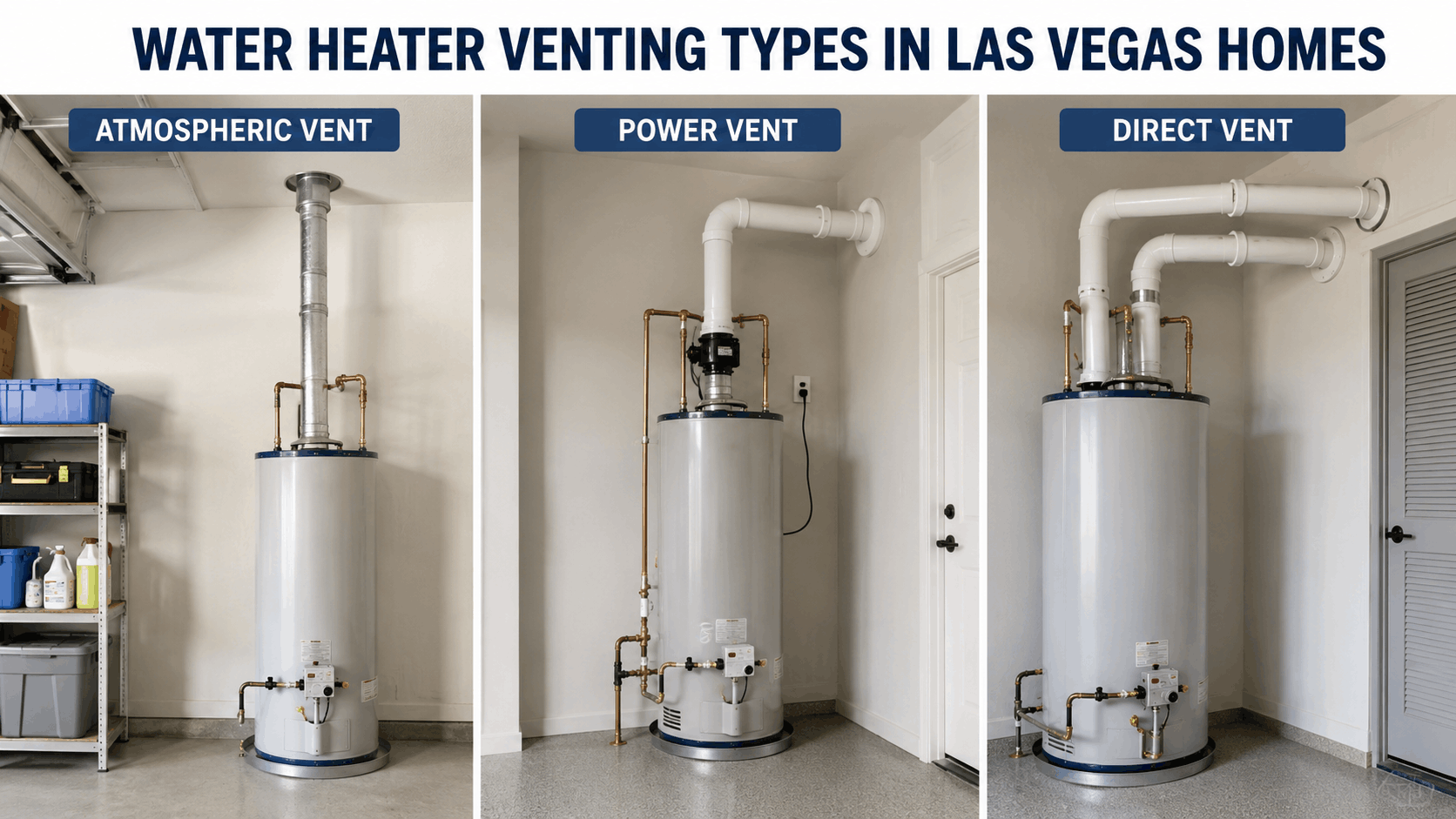
Now that we have covered each type, let us put them next to each other. Most homeowners want a simple way to weigh cost, safety, efficiency, and how hard the install is. This venting comparison should make the choice clearer.
No single water heater type wins on every measure. The right pick depends on your home, your budget, and how long you plan to stay.
| Factor | Atmospheric | Power Vent | Direct Vent |
|---|---|---|---|
| Upfront cost | $1,200-$2,000 | $1,800-$3,000 | $2,200-$3,800 |
| Combustion safety | Good with airflow | Better | Best |
| Efficiency | Baseline | Slightly higher | Slightly higher |
| Install complexity | Low | Moderate | High |
| Needs electricity | No | Yes | Sometimes |
Cost Comparison
On upfront cost, atmospheric wins clearly, usually landing between $1,200 and $2,000 installed. Power vent sits in the middle at roughly $1,800 to $3,000, while direct vent runs highest at $2,200 to $3,800. These ranges reflect the Las Vegas market and shift with tank size and any needed upgrades.
Long-term costs tell a slightly different story. Atmospheric units can cost more over time if they backdraft, waste heat, or need repeated flue repairs. The efficiency edge of the other two trims a little off gas bills each year.
Electrical work also affects the total. A power vent may need a new outlet, and both power and direct vent involve more labor. When we quote a job, we lay out both the day-one price and the likely cost over the unit's life.
For a straightforward like-for-like swap in an older home, atmospheric keeps the upfront cost lowest. For a tricky location or a sealed home, spending more on venting up front often prevents bigger costs later.
Safety and Air Quality
On combustion safety, direct vent ranks first, hands down. Its sealed system keeps the burn entirely separate from indoor air, so backdrafting into your living space is not a concern. That makes it the safest air quality choice for tight homes.
Power vent comes in second. The blower actively controls the exhaust path, which greatly reduces backdrafting risk compared to natural draft. It still uses room air for combustion, so it is not fully sealed, but the fan gives it a strong edge.
Atmospheric ranks third, not because it is unsafe, but because it depends on conditions staying right. Good airflow and a clear flue make it safe, but a sealed room or blocked vent can cause trouble. This is why we stress annual checks on these units.
For any home, a working carbon monoxide alarm near the unit is non-negotiable regardless of venting type. It is the last line of defense that catches a problem the moment it starts.
Efficiency and Energy Bills
Energy efficiency between the three is closer than many expect. Atmospheric units lose the most heat because warm air drifts up the open flue even when the burner is off. That constant loss is the baseline everything else improves on.
Power vent and direct vent both reduce that standby loss by controlling airflow more tightly. The savings on your NV Energy gas charges are modest, often a small monthly difference rather than a dramatic drop. Still, it adds up across a decade of use.
Summer is when gas bills for water heating are already lowest, since incoming water is warmer. The efficiency gap between venting types matters a bit more in cooler months when the burner runs harder. Either way, do not expect venting alone to slash your bill.
If cutting energy use is a top goal, we often point homeowners toward a tankless water heater installation, which uses a different approach to venting and efficiency altogether.
Which Type Fits Which Home
Older ranch homes near Charleston or in central Las Vegas usually fit atmospheric best, especially with an existing good flue and open closet. A like-for-like swap keeps things simple and affordable in those layouts.
Homes with interior closets far from an exterior wall, common in many Henderson and Spring Valley builds, often call for power vent. The horizontal PVC routing reaches the nearest side wall without a roof penetration.
Newer sealed builds in Summerlin, Inspirada, and Mountain's Edge point toward direct vent. When indoor air is tight and controlled, sealed combustion is the safest and most reliable water heater selection.
Of course, every home has quirks, and the layout on paper does not always match reality. That is why a quick assessment from our team beats guessing based on the neighborhood alone.
Need Help in Las Vegas?
Active Plumbing serves Las Vegas and all of Las Vegas Valley.
How to Know Which Venting Type Your Home Has
Before you shop for a new unit, it helps to know what you already have. You can identify your venting type with a few simple checks, no tools required. Here is how to read the setup on your own water heater.
A quick water heater inspection of your own can save confusion at the store. Look at the pipes, the power connection, and the label.
Checking the Flue and Pipes
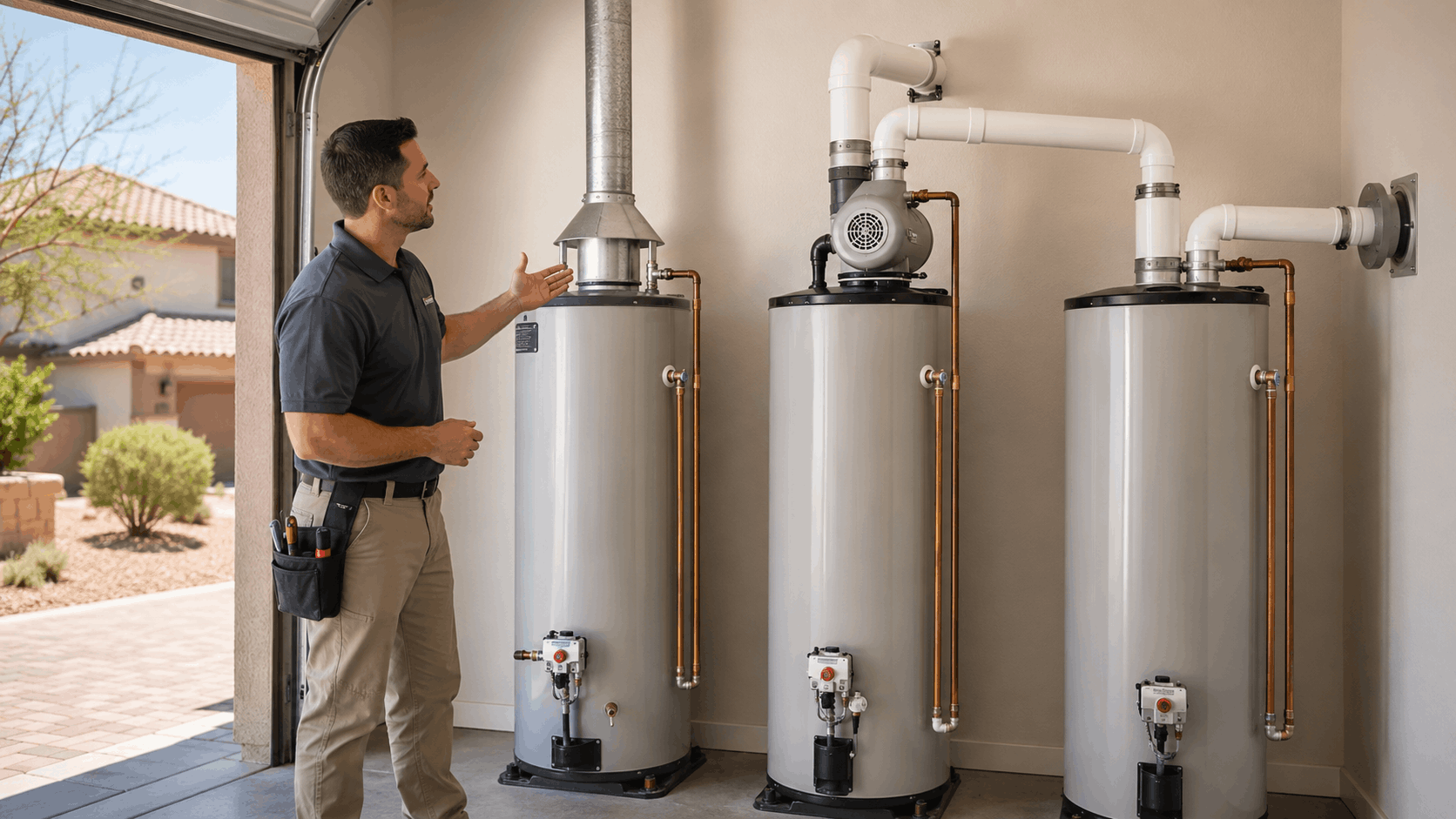
Start by looking at the pipe coming off the top of the tank. If it is a round metal flue pipe, usually galvanized steel, and it heads straight up toward the ceiling or roof, you likely have an atmospheric unit. That vertical metal run is the tell.
If instead you see white or gray PVC pipe running off the unit, you are looking at a power vent or direct vent system. PVC cannot handle the heat of an atmospheric flue, so its presence means a fan-assisted or sealed design.
Follow where the pipe goes. A metal flue routing up and out the roof points to atmospheric. PVC that turns and heads toward a side wall points to power vent or direct vent instead.
Taking a photo of the top of the tank and the piping is smart. It gives us something concrete to look at if you call with questions before a replacement.
Looking for a Fan or Power Connection
Check whether the unit is plugged into an electrical outlet. Atmospheric water heaters need no power connection at all, so a cord running to a wall outlet is a strong sign of a power vent. You may also hear the fan hum when the burner is running.
Listen for that blower sound during a heating cycle. A steady whir that starts when the burner lights confirms a power vent. Atmospheric units are silent because they have no moving parts in the venting.
Look at the pipe count too. A single PVC exhaust with a plug usually means power vent. Two PVC pipes, or one pipe inside another, with sealed connections point toward direct vent using outside air.
If you see sealed pipes but are not sure whether it is power or direct vent, the intake air pipe is the giveaway. Direct vent has a second pipe pulling air from outside, while power vent pulls air from the room.
Reading the Unit Label and Specs
Every water heater has a manufacturer label, sometimes called the rating plate, on the side of the tank. This label lists the model, capacity, and often the vent type or vent category. It is the most reliable way to confirm what you have.
Look for words like "atmospheric," "power vent," "power direct vent," or "direct vent" printed on the plate or in the model name. Manufacturers usually spell it out clearly once you know where to look.
The label also lists the required vent size and category, which matters for any replacement. Snapping a clear photo of this plate before you shop makes the whole process smoother.
If the label is faded or missing, the model number can be searched to pull up the specs. When in doubt, send us the photo and we can identify the venting type quickly.
When to Call for a Professional Inspection
If you cannot tell from the pipes and label, that is a good time to call for a professional inspection. Guessing wrong before a water heater replacement can lead to buying the wrong unit or a failed install. A quick look by our team clears it up.
You should also call if you notice any warning signs, like soot near the vent, a rusty flue, or condensation around the unit. These can point to a venting problem that needs attention before you replace anything.
Any time you are switching fuel types or moving the tank, an inspection first is smart. The venting requirements change, and it is better to plan for that up front than to discover it mid-project.
Our team offers straightforward assessments across the valley. You can reach us through our contact page to set one up before you buy a new unit.
Upgrading or Switching Venting Types in Las Vegas
Sometimes a homeowner wants to change venting types entirely, not just replace like-for-like. Maybe the old closet keeps backdrafting, or a remodel is moving the tank. A venting conversion is a bigger project, so here is what it involves.
A water heater upgrade that changes venting touches code, cost, and layout. Knowing the pieces up front helps you plan.
When a Switch Makes Sense
The most common reason to switch is chronic backdrafting. If an atmospheric unit in a tight closet keeps spilling exhaust no matter what, moving to a power vent or direct vent solves the root problem. A backdrafting fix like this is worth the investment for safety.
Relocation is another driver. When a remodel moves the water heater to a spot with no easy roof access, converting to a power vent with horizontal PVC often makes the new location workable. The venting follows the tank rather than the other way around.
Sealed home upgrades also prompt switches. Homeowners who add insulation, new windows, or tight air sealing may find their old atmospheric unit no longer drafts well. Direct vent restores safe operation in a home that has been tightened up.
We also see switches during fuel or efficiency upgrades. Anyone rethinking their whole hot water setup should look at venting as part of the plan, not an afterthought.
Permits and Inspections
A venting conversion almost always needs a plumbing permit through the Clark County Building Department. The permit ensures the new vent meets code for materials, clearances, and termination. It is not just paperwork, it is your safety check.
The inspection that follows confirms the work was done right. An inspector verifies pipe sizing, slope, clearances from windows and property lines, and proper connections. Passing that inspection protects you and your home's value.
Skipping the permit is a bad idea. Unpermitted venting work can cause problems when you sell, and worse, it can hide a safety flaw that no one catches. We pull the permits and schedule inspections as part of every conversion.
Because HOA rules in many communities restrict vent placement, we confirm those requirements before starting. Handling both the county and the HOA up front keeps the project on track.
What Active Plumbing Handles During a Conversion
Our conversion process starts with a full assessment of the current setup and the desired new location. We check airflow, wall access, clearances, and electrical availability before recommending a path. That planning prevents surprises later.
From there, Active Plumbing handles the unit selection, permit, and the venting install itself. We route the new PVC or sealed piping, set proper clearances, and connect everything to code. We work across the valley, from Green Valley in Henderson to Centennial Hills in the northwest.
After install, we test the system to confirm it drafts correctly and vents safely. This includes checking for proper exhaust flow and verifying there is no spillage back into the home. We do not leave until it passes.
Throughout, our team keeps the homeowner informed about what is happening and why. Clear communication is part of how we work on every job across local neighborhoods.
Budgeting for the Change
A venting conversion costs more than a simple swap because of the extra labor and materials. In our market, a conversion often runs $2,000 to $4,500 depending on the new venting type and the distance to an exterior wall. Longer runs and electrical work push the number up.
Several factors drive the conversion cost. Wall access, the length of the new vent run, whether an outlet needs adding, and any drywall repair all affect the budget. A straightforward side wall exit costs less than a complex routing job.
We give homeowners a clear estimate up front so there are no surprises. The quote spells out the unit, the venting, the permit, and any electrical or patch work needed.
While a conversion is a bigger spend than a like-for-like replacement, it often pays back in safety and reliability. For a home that keeps having draft problems, that is money well spent.
Maintaining Your Water Heater Venting System
Whatever venting type you have, a little maintenance keeps it safe and working. The desert climate here throws dust and wind at your vents year round. A few simple habits go a long way toward avoiding trouble.
Good venting maintenance is part of overall water heater care. It protects your family and extends the life of the system.
Annual Vent and Flue Checks
An annual inspection of the vent and flue catches problems early. Once a year, take a look at the flue connections to make sure they are tight and free of rust or gaps. Loose or corroded joints can leak exhaust.
A proper flue check also looks for blockages. Dust, debris, or even a bird nest can restrict airflow and cause backdrafting. Clearing these keeps the draft strong and the exhaust moving out where it belongs.
For power vent and direct vent units, check that the PVC terminations outside are clear and undamaged. Screens and caps can collect grit over time and need a wipe.
Pairing this with a yearly tank flush is smart, since our hard water builds sediment fast. Our team can handle both during a single visit to keep the whole system in shape.
Watching for Warning Signs
Certain warning signs point straight to a venting problem. Soot marks near the draft hood or vent, rust streaks running down the tank, or moisture and condensation around the top of the unit all deserve attention. These often mean exhaust is not leaving cleanly.
A carbon monoxide alarm going off near the water heater is a serious signal. If that happens, get everyone out, ventilate the space, and call us right away. Never ignore a CO alarm around any gas appliance.
Other clues include a pilot light that keeps going out or a burning or odd smell when the unit runs. Both can indicate draft trouble or spillage.
Catching these signs early prevents a small issue from becoming a dangerous one. When something looks off, it is better to have it checked than to wait and hope.
Keeping Vents Clear in Dusty Conditions
Our valley's blowing dust is tough on side wall vents. Fine grit can build up around a PVC termination and slowly restrict airflow. A quick check and wipe a few times a year keeps the opening clear.
Monsoon debris makes this worse. Summer storms whip leaves, dirt, and trash around, and some of it can lodge in or near a vent opening. After a big storm, glance at your exterior vent to make sure nothing is blocking it.
Garage installs face extra dust buildup from the door opening and closing. If your water heater lives in the garage, keep the area around it swept and the vent path clear.
These small habits protect the draft and keep the unit burning clean. Clogged vents are one of the more preventable problems we see in the valley.
When to Schedule Professional Service
We recommend professional service on your venting system at least once a year. A yearly check by our team catches corrosion, blockages, and draft issues before they become hazards. It is a small step that keeps the whole system safe.
Schedule sooner if you notice any warning signs, or if your unit is more than eight years old. Older tanks and their vents deserve closer attention as they near the end of their life.
Active Plumbing supports homeowners across the valley with venting inspections, repairs, and full replacements. Whether you are in Summerlin, Henderson, or central Las Vegas, our team knows the local homes and the code.
You can pair a venting check with other water heater repair needs in one visit. Reaching out before a problem grows is always the easier path.
Need Help in Las Vegas?
Active Plumbing serves Las Vegas and all of Las Vegas Valley.
Final Thoughts
Choosing the right venting type comes down to your home's age, layout, and how tightly it is sealed. Atmospheric works well in older, open homes, power vent solves tricky closet locations, and direct vent is the safest fit for newer sealed builds.
Whatever you have now, safe venting keeps combustion gases out of your living space and your family protected. Regular checks and the right choice at replacement time make all the difference.
Our team has worked on water heaters in nearly every corner of the valley, and we are glad to help you sort out the best option for your home. Reach out to Active Plumbing for a straightforward assessment before your next replacement.
Frequently Asked Questions
What is the difference between atmospheric, power vent, and direct vent water heaters?
Atmospheric units let hot exhaust rise naturally through a metal flue and out the roof, pulling combustion air from the room. Power vent units use a built-in fan to push exhaust through PVC out a side wall, still using room air. Direct vent units seal the whole process, pulling combustion air from outside and venting it back out through a sealed pipe system.
Which venting type is safest for a Las Vegas home?
Direct vent ranks highest for safety, especially in tightly sealed newer homes in areas like Summerlin and Inspirada. Because it uses sealed combustion, it draws air from outside and never touches indoor air, which removes the risk of backdrafting exhaust into your living space. For homes prone to negative air pressure from fans or HVAC, that sealed design offers the strongest protection against carbon monoxide problems.
How much does it cost to replace a water heater with a different vent type?
A straight replacement runs about $1,200 to $2,000 for atmospheric, $1,800 to $3,000 for power vent, and $2,200 to $3,800 for direct vent in the Las Vegas market. Converting from one type to another usually costs $2,000 to $4,500, since it adds new venting, possible electrical work, and permit fees. The final price depends on tank size, vent routing distance, and wall access.
Do I need a permit to change my water heater venting in Clark County?
Yes. Any water heater replacement that changes the venting requires a plumbing permit through the Clark County Building Department. The permit and follow-up inspection confirm the vent meets code for materials, clearances, and termination points. This protects your safety and keeps things clean when you sell your home. Our team pulls the permits and schedules inspections as part of every install and conversion.
Can I install a power vent water heater in an interior closet?
Yes, and that is one of the best uses for a power vent unit. Its blower pushes exhaust through PVC piping that can run horizontally to the nearest exterior wall, so you do not need roof access. This makes power vent ideal for interior closets common in many Henderson and Spring Valley builds where a vertical flue would be difficult to route.
Why does my atmospheric water heater keep backdrafting?
Backdrafting usually comes from three causes. A tight or remodeled space that lacks enough fresh air, powerful exhaust fans like a kitchen hood pulling air backward down the flue, or a blocked or corroded flue restricting the draft. Monsoon winds can also cause downdrafts. If it keeps happening, we often recommend switching to a power vent or direct vent unit to fix the root problem.
How long do water heater venting systems last?
A metal flue on an atmospheric unit can last 15 years or more but should be inspected as it ages, since heat and moisture cause corrosion. PVC venting on power and direct vent units also lasts many years when kept clear of dust and debris. Vent pipes typically get replaced when the water heater itself is swapped out, which is usually every 8 to 12 years here.
Does venting type affect my energy bill?
It has a modest effect. Atmospheric units lose the most heat because warm air drifts up the open flue even when the burner is idle. Power vent and direct vent units control airflow more tightly, trimming a small amount off your NV Energy gas charges over the year. The difference is real but not dramatic, so venting alone will not slash your bill.
How do I know if my water heater has a venting problem?
Watch for soot marks near the vent, rust streaks on the tank, condensation around the top of the unit, or a pilot light that keeps going out. A carbon monoxide alarm sounding near the unit is a serious signal to act on immediately. Any burning or odd smell when the unit runs also points to trouble. If you spot these signs, call a professional to inspect it.
Does Active Plumbing service all venting types in Las Vegas?
Yes. Our team works on atmospheric, power vent, and direct vent water heaters across the valley. We handle inspections, repairs, replacements, and full venting conversions in neighborhoods from Summerlin and Henderson to central Las Vegas and North Las Vegas. Whether you need a quick vent check or a complete switch to a safer sealed system, we can help. Reach out to schedule an assessment.
Frequently Asked Questions
- What is the difference between atmospheric, power vent, and direct vent water heaters?
- Atmospheric units let hot exhaust rise naturally through a metal flue and out the roof, pulling combustion air from the room. Power vent units use a built-in fan to push exhaust through PVC out a side wall, still using room air. Direct vent units seal the whole process, pulling combustion air from outside and venting it back out through a sealed pipe system.
- Which venting type is safest for a Las Vegas home?
- Direct vent ranks highest for safety, especially in tightly sealed newer homes in areas like Summerlin and Inspirada. Because it uses sealed combustion, it draws air from outside and never touches indoor air, which removes the risk of backdrafting exhaust into your living space. For homes prone to negative air pressure from fans or HVAC, that sealed design offers the strongest protection against carbon monoxide problems.
- How much does it cost to replace a water heater with a different vent type?
- A straight replacement runs about $1,200 to $2,000 for atmospheric, $1,800 to $3,000 for power vent, and $2,200 to $3,800 for direct vent in the Las Vegas market. Converting from one type to another usually costs $2,000 to $4,500, since it adds new venting, possible electrical work, and permit fees. The final price depends on tank size, vent routing distance, and wall access.
- Do I need a permit to change my water heater venting in Clark County?
- Yes. Any water heater replacement that changes the venting requires a plumbing permit through the Clark County Building Department. The permit and follow-up inspection confirm the vent meets code for materials, clearances, and termination points. This protects your safety and keeps things clean when you sell your home. Our team pulls the permits and schedules inspections as part of every install and conversion.
- Can I install a power vent water heater in an interior closet?
- Yes, and that is one of the best uses for a power vent unit. Its blower pushes exhaust through PVC piping that can run horizontally to the nearest exterior wall, so you do not need roof access. This makes power vent ideal for interior closets common in many Henderson and Spring Valley builds where a vertical flue would be difficult to route.
- Why does my atmospheric water heater keep backdrafting?
- Backdrafting usually comes from three causes. A tight or remodeled space that lacks enough fresh air, powerful exhaust fans like a kitchen hood pulling air backward down the flue, or a blocked or corroded flue restricting the draft. Monsoon winds can also cause downdrafts. If it keeps happening, we often recommend switching to a power vent or direct vent unit to fix the root problem.
- How long do water heater venting systems last?
- A metal flue on an atmospheric unit can last 15 years or more but should be inspected as it ages, since heat and moisture cause corrosion. PVC venting on power and direct vent units also lasts many years when kept clear of dust and debris. Vent pipes typically get replaced when the water heater itself is swapped out, which is usually every 8 to 12 years here.
- Does venting type affect my energy bill?
- It has a modest effect. Atmospheric units lose the most heat because warm air drifts up the open flue even when the burner is idle. Power vent and direct vent units control airflow more tightly, trimming a small amount off your NV Energy gas charges over the year. The difference is real but not dramatic, so venting alone will not slash your bill.
- How do I know if my water heater has a venting problem?
- Watch for soot marks near the vent, rust streaks on the tank, condensation around the top of the unit, or a pilot light that keeps going out. A carbon monoxide alarm sounding near the unit is a serious signal to act on immediately. Any burning or odd smell when the unit runs also points to trouble. If you spot these signs, call a professional to inspect it.
- Does Active Plumbing service all venting types in Las Vegas?
- Yes. Our team works on atmospheric, power vent, and direct vent water heaters across the valley. We handle inspections, repairs, replacements, and full venting conversions in neighborhoods from Summerlin and Henderson to central Las Vegas and North Las Vegas. Whether you need a quick vent check or a complete switch to a safer sealed system, we can help. Reach out to schedule an assessment.
A
Licensed plumbing professionals serving Las Vegas and Las Vegas Valley.
Licensed in Nevada · License #0047021
Last updated on
Why trust Active Plumbing?
Founded in 1991, Active Plumbing is a licensed and insured plumber serving Las Vegas and Las Vegas Valley. All content is reviewed by our licensed technicians.

Need Help in Las Vegas?
Active Plumbing serves Las Vegas and all of Las Vegas Valley.
Related Articles
Cost Guides
Best Water Heater Option for Las Vegas Homes: Tank vs Tankless
Compare tank vs tankless water heaters for Las Vegas homes. Costs, hard water effects, lifespan, permits, and which option fits your neighborhood best.
Cost Guides
Condensing vs Non-Condensing Tankless for Las Vegas Homes: Venting, Cost, Hard-Water Scaling
Compare condensing vs non-condensing tankless water heaters for Las Vegas homes, covering venting, real install costs, and how hard water scaling affects each type.
Cost Guides
Tankless Water Heater Installation Cost in Las Vegas: Gas Line Upsizing, Venting, and Permit Line Items
A clear breakdown of tankless water heater installation cost in Las Vegas, including gas line upsizing, venting, permits, and hard water factors for valley homes.