Tips & Advice
Best Plumber in Las Vegas: How to Compare Companies Without Just Reading Reviews
Key Takeaways
- Online reviews are one data point and can be faked or filtered, so verify companies with harder criteria before hiring.
- Always confirm a plumber holds an active Nevada State Contractors Board license and is bonded and insured before work starts.
- Get a written estimate that lists parts, labor, warranty, and total cost, and ask about trip charges and diagnostic fees up front.
- Response time matters during emergencies, so confirm real 24 hour availability and how fast a technician can reach your neighborhood.
- Local experience with valley hard water, older versus new homes, and HOA rules leads to faster, more accurate repairs.
- Compare parts and labor warranties, get callback terms in writing, and match a company's specialties to your specific plumbing problem.
- Build a simple scoring checklist and watch for red flags like cash-only demands, no license, and vague pricing answers.
In This Article
A homeowner in Summerlin recently told us how she picked a plumber. She searched for a company, saw a shiny 5-star average, and booked the first name at the top of the list. Two weeks later her repaired water line was leaking again, the company stopped answering, and she had no written warranty to fall back on.
Her story is common across the valley. Star ratings feel like a shortcut, but they leave out the things that actually protect a home and a wallet. A high rating tells you nothing about a company's license, its pricing model, or how it handles a repair that fails.
Why Online Reviews Alone Can Mislead You
Reviews are useful, but they are one small piece of a much bigger picture. Smart homeowners in the valley treat online reviews as a starting point, not the final word. A company can look great online and still show up unlicensed, overpriced, or unable to back its own work.
Here is what star ratings often hide:
- Whether the company holds a current Nevada plumbing license
- How the company prices its work and whether hidden fees show up later
- What happens when a repair fails and a callback is needed
- Whether the plumber who arrives actually did the work described in the reviews
When plumber ratings become the only measure, homeowners lose sight of the practical details that decide whether a repair lasts. The sections below break down why that happens and how to read past the numbers.
How Fake and Filtered Reviews Happen
Not every review a homeowner reads was written by a real customer. Some companies buy fake reviews in bulk, and others quietly push friends and family to post glowing ratings before a single job is done. A brand new company with dozens of perfect reviews and no local history should raise an eyebrow right away.
Review filtering is another trick. Some businesses funnel happy customers to public review sites while steering unhappy ones to a private feedback form that never sees daylight. That practice inflates the public score while burying the complaints that would actually help you decide.
There are patterns that give fake reviews away. Watch for clusters of five-star ratings posted within a day or two of each other, reviews that repeat the same phrases, and profiles with no photos and no other review history. Vague praise like "great service" with no mention of the actual plumbing problem is another warning sign.
We tell homeowners to read the middle. The three- and four-star reviews often carry the most honest detail, because those customers had a real experience and took the time to explain both the good and the bad.
Why a 5-Star Average Does Not Tell the Whole Story
A perfect star rating can be misleading when it sits on top of very few reviews. A company with five reviews and a 5.0 average has far less proof than one with 400 reviews and a 4.7. Review volume gives a rating weight, because a large number of ratings is much harder to fake or manipulate.
Recency matters just as much as volume. A company that earned strong reviews three years ago may have changed owners, lost its best technicians, or slipped on quality since then. Reading the most recent 10 to 15 reviews shows how the company operates today, not how it performed in the past.
Detail is the third factor. A useful review names the specific job, like a water heater swap in Peccole Ranch or a sewer backup near Sunset Park, and describes how the crew handled it. Those specifics prove a real person hired the company for a real problem similar to yours.
So a single star rating number is a weak signal on its own. Volume, recency, and detail together paint a far more accurate picture of what a homeowner can expect.
The Difference Between a Happy Customer and a Skilled Plumber
A friendly technician who shows up on time can earn a five-star review even if the repair does not hold up. Customer service and quality repair work are two different things, and reviews tend to reward the first far more than the second. A homeowner leaving a review often has no way to know if the pipe was joined correctly or if the fittings meet code.
We have been called to re-do jobs that came with glowing reviews for the original company. The customer loved how polite the first crew was, but the drain kept backing up because the real problem was never diagnosed. Kindness at the door does not replace skill under the sink.
The best way to judge quality is to look for reviews that describe long-term results. Comments like "no problems a year later" or "the same repair is still holding" say more about workmanship than any comment about a friendly attitude.
Great plumbers usually offer both, but never assume good manners equal good work. Pair the tone of the reviews with the harder proof covered in the rest of this guide.
Get Your Quote
Tell us what's going on and we'll get back to you fast.
Check the License, Bond, and Insurance First
Before comparing prices or reading a single review, a homeowner should confirm the company is licensed, bonded, and insured. This paperwork protects the home and the wallet if something goes wrong. In Nevada, plumbing work is regulated, and skipping this step is one of the most expensive mistakes a homeowner can make.
A legitimate company will share its Nevada plumbing license number without hesitation. If a business dodges the question or claims it does not need a license, that is reason enough to move on. Being bonded and insured is not optional for serious plumbing work in the valley.
How to Verify a Nevada State Contractors Board License
Nevada requires plumbing contractors to be licensed through the Nevada State Contractors Board, often shortened to NSCB. A homeowner can verify any contractor license in a couple of minutes online. Just visit the Nevada State Contractors Board website and search by license number or company name.
Plumbing work generally falls under a C-1 classification, which covers plumbing and heating. When you look up a company, the record shows whether the license is active, the classification, the bond amount, and any disciplinary history. An expired or suspended license is a clear signal to keep looking.
The search also confirms the legal business name matches the company you are talking to. Some outfits advertise under one name while holding a license under another, or use a license that belongs to someone else entirely. Matching the name, number, and classification protects you from that shell game.
We encourage every homeowner to run this check even on companies with strong reputations. It takes two minutes and confirms the contractor license is real and current before any work begins.
Why Bonding and Liability Insurance Protect Your Home
A surety bond and liability insurance are two separate protections, and both matter. A surety bond gives homeowners a way to recover money if the contractor fails to finish the job or does not follow the terms of the agreement. It acts as a financial backstop when a company walks away from a mess.
Liability insurance covers damage that happens during the work itself. If a plumber cracks a tile floor, floods a finished basement, or damages a neighbor's wall during a repair, the insurance pays for it. Without that coverage, the homeowner can be stuck paying to fix the damage out of pocket.
Uninsured work is a gamble that rarely pays off. A cut-rate crew might quote a lower price, but one accident during a repipe or water heater install can cost thousands more than the savings. That is a trade no homeowner should accept.
A bonded and insured company will provide proof on request. Ask for a certificate of insurance and confirm the coverage is current before scheduling any major job.
Permits and Clark County Building Inspections
Many plumbing jobs in the valley require permits pulled through Clark County or the local municipality. Water heater replacements, repipes, gas line work, and sewer line repairs typically need a permit and an inspection to confirm the work meets code. A real plumber handles this process instead of hiding from it.
Permits exist to protect the homeowner, not to slow the job down. A Clark County building inspection catches mistakes that could cause leaks, gas hazards, or failed sales inspections down the road. Skipping the permit to save time can create bigger headaches when it is time to sell the home.
You can review permit requirements through the Clark County Building Department. A licensed contractor knows which jobs need a permit and pulls it as part of the project. If a company suggests skipping the permit "to keep it cheap," that is a red flag worth taking seriously.
Our team pulls permits and coordinates inspections as a normal part of the work. That way the finished job is documented, code-compliant, and ready for any future inspection.
Need Help in Las Vegas?
Active Plumbing serves Las Vegas and all of Las Vegas Valley.
Compare How Companies Handle Pricing and Estimates
Pricing is where many homeowners feel lost, and where surprise charges do the most damage. A clear plumbing estimate should tell you exactly what you are paying for before the work starts. Comparing how two companies structure their pricing is often more revealing than comparing the final number.
The goal is to avoid hidden fees and understand what drives the cost. Some companies use flat rate pricing, others charge by the hour, and each model fits different situations. The table below breaks down the trade-offs.
| Pricing Model | Best For | Watch Out For |
|---|---|---|
| Flat rate | Standard jobs like water heater swaps or faucet installs | Padded pricing on quick jobs |
| Hourly rate | Diagnostic work or unpredictable repairs | Slow work that runs up the clock |
| Free estimate | Larger projects like repipes or sewer repair | Estimates that change once work starts |
Flat Rate vs Hourly Pricing Explained
Flat rate pricing means the homeowner is quoted one price for the whole job before it starts. A water heater install might be quoted at a set price regardless of how long it takes. This model gives predictability, since the cost does not change if the technician runs into a slow bolt or a tight crawlspace.
Hourly rate pricing charges for the time spent plus parts. This can work in the homeowner's favor on quick, simple jobs where the flat rate might feel padded. The downside is uncertainty, because a job that takes longer than expected costs more.
Most reputable companies in the valley lean on flat rate pricing for common jobs because it removes surprises. For diagnostic work where the problem is unknown, an hourly rate or a set diagnostic fee often makes more sense. The right model depends on the job.
The important thing is knowing which model a company uses before you book. Ask directly so there are no surprises when the invoice arrives.
What a Written Estimate Should Include
A written estimate is the homeowner's best protection against a surprise bill. It should list the parts being installed, the labor cost, and the total price in plain language. If an estimate is just one number scribbled on a card, that is not enough to protect anyone.
A good estimate also names the warranty terms on both parts and labor. It should describe the scope of work so there is no confusion about what is and is not included. For a larger job, it may note whether a permit is required and who pulls it.
We recommend getting the estimate in writing before the work begins, even for smaller repairs. A clear written estimate lets a homeowner compare two companies line by line instead of guessing. It also gives you something to point to if the final bill does not match.
When browsing our pipe and fixture services, homeowners can ask for an itemized quote up front. Transparency at the estimate stage tells you a lot about how a company operates.
Watch for Trip Charges and Diagnostic Fees
Add-on fees catch a lot of homeowners off guard. A trip charge is a fee just for the truck to show up, and a diagnostic fee covers the time spent figuring out the problem. Neither is automatically bad, but both should be disclosed before the technician is dispatched.
Some companies apply the diagnostic fee toward the repair if the homeowner moves forward. Others keep it separate no matter what. Knowing which applies helps you compare the true cost between two companies.
The problem is not the existence of these fees, it is the surprise. A company that hides a trip charge until the invoice arrives is not being upfront. Ask about every possible fee during the first phone call so nothing sneaks up on you.
A fair company explains its fees clearly and answers the question without dodging. If a dispatcher gets vague about charges, treat that as a warning.
Typical Cost Ranges for Common Las Vegas Repairs
Homeowners often ask what common repairs should cost in the valley. Prices vary by home, brand, and complexity, but ranges help set expectations. A standard water heater replacement often runs from around 1,200 to 2,500 dollars depending on the unit and whether the connections need updating.
Basic drain clearing usually falls in the 150 to 400 dollar range, while a stubborn main line that needs hydro jetting costs more. A visible leak repair under a sink might run 200 to 500 dollars, while a slab leak that requires detection and access costs considerably more. These are ballpark figures, not fixed quotes.
Hard water in the valley pushes some of these costs up over time. Mineral buildup shortens water heater life, so replacement comes sooner here than in areas with softer water. That is worth factoring in when weighing repair versus replacement.
Our team gives specific numbers after seeing the job, not vague promises. A quote that seems far below every other company usually means something is missing from the scope.
Look at Response Time and Availability
When a pipe bursts or a sewer backs up, how fast a company answers and arrives matters more than almost anything else. An emergency plumber who shows up in an hour saves a home from damage that a next-day appointment cannot. Response time is a real part of comparing companies, not an afterthought.
Water spreads fast. A supply line failure in a Summerlin two-story can soak floors, drywall, and cabinets in minutes. That is why availability and true 24 hour service belong on your comparison list.
Emergency Service Hours and Real Availability
Plenty of companies advertise 24/7 service, but not all of them actually send a technician at 2 a.m. Some route after hours calls to a voicemail or an answering service that books you for the next business day. That is not real emergency coverage.
The difference matters most during a true emergency. A backed-up sewer or a burst pipe at night needs a crew on the way, not a callback in the morning. Ask directly whether a live technician responds after hours and how quickly one can be dispatched.
Our emergency plumbing team handles after hours calls with real availability, because a night leak cannot wait until morning. Confirm this before you need it, not during the flood.
A company that answers the phone live at midnight and gives a straight arrival window is one worth keeping on your short list.
How Location Affects Arrival Times Across the Valley
The valley is large, and travel distance shapes how fast help arrives. A crew coming from Henderson to the far northwest near Skye Canyon fights across town, and a team based on the east side takes time to reach Summerlin. Arrival time depends heavily on where the company sits relative to your neighborhood.
A centrally located team, or one with crews spread across the valley, reaches more neighborhoods quickly. That is why service area coverage matters when you compare companies. A local plumber that already works your part of town regularly can usually arrive sooner.
We serve neighborhoods from Summerlin to Henderson and across the north valley near Aliante and Elkhorn. Knowing the routes and traffic patterns helps a crew reach homes faster during a crisis.
When you call, ask where the nearest available technician is coming from. That answer tells you a lot about your real wait time.
Questions to Ask a Dispatcher Before Booking
A short list of questions on the first call reveals how a company operates. Ask when a technician can arrive and whether the window is a firm estimate or a rough guess. A company that gives a two-hour window and calls before arrival respects your time.
Ask who will be doing the work and whether that person is a licensed plumber or a helper. Confirm whether you will get a text or call before the technician shows up. These booking questions weed out companies that overpromise and underdeliver.
It also helps to ask about fees during this call. Find out about any trip charge or diagnostic fee before the truck rolls, so the invoice holds no surprises. A dispatcher who answers all of this clearly is a good sign.
If the person on the phone gets defensive or vague about timing and cost, that tone usually carries over to the job. Trust how a company handles the first conversation.
Judge Their Local Experience and Neighborhood Knowledge
A plumber who knows Las Vegas homes and water conditions works faster and gets the fix right the first time. Local experience is not just a talking point, it changes how a job goes. A crew that understands valley construction and water chemistry avoids the trial-and-error that runs up a bill.
Neighborhood knowledge shows up in small ways. Knowing that older central homes have different pipe than new builds in Skye Canyon lets a plumber diagnose faster. That local edge is hard to fake.
Why Las Vegas Hard Water Changes Everything
Las Vegas has some of the hardest water in the country, drawn largely from the Colorado River through Lake Mead. That water is loaded with calcium and magnesium, which leave mineral buildup inside pipes, water heaters, and fixtures. Over time that scale narrows pipes and wears out equipment early.
The effects are everywhere in the valley. Water heaters fail sooner, faucet aerators clog, and glass shower doors spot no matter how often they are cleaned. Homeowners here replace fixtures and appliances more often than people in softer-water regions.
A local plumber factors hard water into every recommendation. When we install a water heater, we know it will face heavy scale, so maintenance and treatment become part of the conversation. Our water treatment services address the root cause instead of just the symptoms.
Ignoring hard water shortens the life of everything it touches. A plumber who understands local water gives advice that actually extends the life of a home's plumbing.
Older Homes Downtown vs New Builds in Summerlin and Skye Canyon
Older homes near downtown and the Arts District often have aging galvanized or cast iron pipe. That older material corrodes from the inside, restricting flow and causing rusty water or slow drains. Repairs in these homes sometimes reveal deeper issues that call for partial repiping.
Newer construction in Summerlin, Skye Canyon, and Mountains Edge brings different problems. These homes use modern materials, but builder-grade fittings and quick installs can lead to early failures. Hard water still attacks new plumbing, just on a different timeline.
A plumber who works both ends of the valley knows what to expect before opening a wall. In a 1960s home near the Arts District, we plan for old pipe. In a five-year-old house, we look for install shortcuts instead.
That neighborhood knowledge means fewer surprises and a faster, more accurate repair. Age and construction type change the whole approach to a job.
HOA Rules in Communities Like Green Valley and Aliante
Planned communities like Green Valley and Aliante come with HOA rules that affect plumbing work. Outdoor projects, visible equipment, and water softener installs sometimes need approval or must meet placement standards. A plumber familiar with these communities plans around those requirements.
Water softener installs are a common example. Some HOAs restrict where equipment can sit or require it to be screened from view. A crew that has worked in Aliante already knows how to handle these details without delaying the job.
Getting this wrong can mean a fine or a forced re-do. We help homeowners choose install locations that satisfy both the plumbing needs and the HOA guidelines. Our water softener installation work accounts for these community rules.
Local experience turns a potential HOA headache into a smooth install. Knowing the rules ahead of time saves everyone trouble.
How Las Vegas Valley Water District Rules Come Into Play
The Las Vegas Valley Water District sets rules that affect water lines and backflow prevention. Homes with irrigation systems or certain plumbing setups may need backflow testing to keep the public water supply safe. A local plumber already knows when this applies and how to handle it.
Backflow devices protect drinking water from contamination, and they require periodic testing by a certified tester. Missing a required test can lead to notices or service issues. A plumber who works the valley daily keeps these requirements straight.
Water line rules also govern how service lines connect and where meters sit. A company that regularly deals with the local water district navigates these details without slowing the job. That familiarity keeps projects on schedule and compliant.
Homeowners rarely think about these rules until a problem arises. Hiring a plumber who already understands them removes that risk entirely.
Need Help in Las Vegas?
Active Plumbing serves Las Vegas and all of Las Vegas Valley.
Compare Warranties and What Happens If Something Goes Wrong
A warranty tells you what a company stands behind after the truck drives away. Comparing guarantees on parts and labor separates companies that back their work from those that vanish. Real accountability shows up in the callback policy, not the sales pitch.
When comparing warranties, look for these details:
- Length of the parts warranty and who honors it
- Length of the labor guarantee on the company's own work
- Whether a failed repair earns a free return visit
- Whether all of it is written down, not just promised out loud
Parts Warranty vs Labor Warranty
A parts warranty and a labor warranty cover two different things, and a lasting repair needs both. The parts warranty comes from the manufacturer and covers the equipment itself, like a water heater or a valve. If the part fails on its own, the manufacturer replaces it.
The labor warranty comes from the plumbing company and covers the work of installing or repairing. If a joint leaks because of how it was installed, the labor warranty means the company fixes it at no charge. A part can be perfect and still fail if the installation was poor.
Some companies offer a strong parts warranty but a weak labor guarantee, which leaves the homeowner exposed. Others cover both for a year or longer. Ask about each separately so you know exactly what is protected.
The best coverage protects the equipment and the workmanship together. That combination is what keeps a repair from becoming a repeat expense.
How a Company Handles a Repair That Fails
Even good repairs occasionally fail, and how a company responds is the real test. A fair callback policy means the company returns to fix its own work without charging you again. That no-charge return visit is a sign of a company that stands behind what it does.
Some companies fight callbacks, blame the homeowner, or charge a new service fee for a problem they created. That approach tells you everything about how they treat customers after the sale. A quality company treats a callback as a chance to make it right.
We ask homeowners to clarify the callback process before booking. Find out how quickly the company responds to a failed repair and whether the return visit is truly free. A clear, generous policy is worth paying a little more for.
Accountability after the job is where cheap companies fall apart. A solid callback policy protects your investment long after the work is done.
Getting Warranty Terms in Writing
A verbal promise means little once a dispute starts. Warranty terms belong in writing, on the invoice or a separate document, where both sides can point to them. A written warranty removes any argument about what was covered and for how long.
Ask for documentation that lists the parts warranty length, the labor warranty length, and the callback terms. It should also name what voids the warranty, such as damage from unrelated work. Reading these terms before the job starts prevents surprises later.
Companies that hesitate to put warranty terms in writing usually do not intend to honor them. A confident company hands over the documentation without being pushed. That paperwork is your proof if you ever need it.
Keep every warranty document with your home records. If a repair fails months later, that paper is what gets a company back to your door.
Evaluate the Range of Services and Specialties
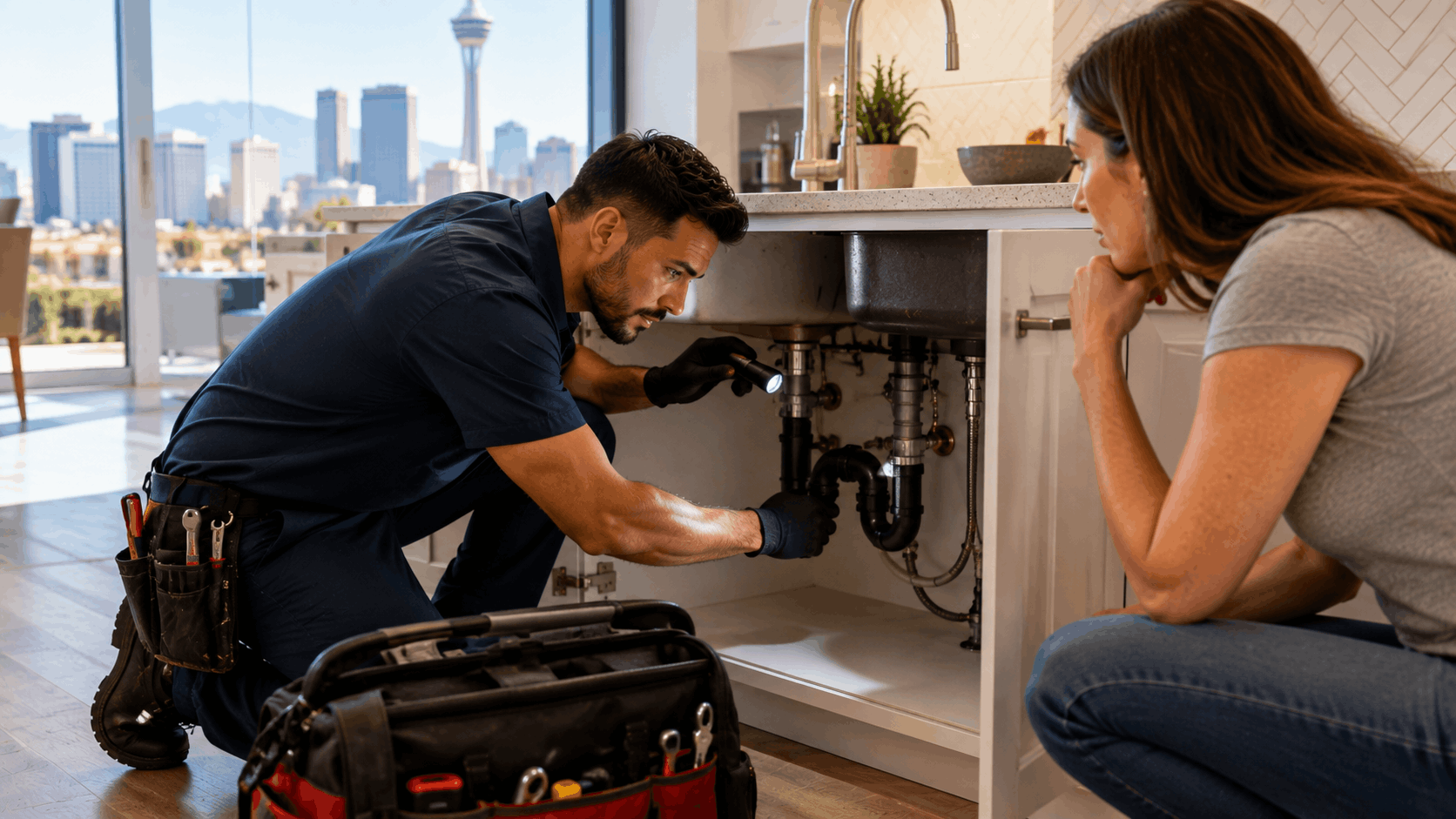
Matching a company's skills to your specific problem leads to a better fix. A plumber who handles the exact issue every week works faster and misses less than a generalist doing it once a year. Comparing the range of plumbing services helps you find the right match.
The table below shows common valley needs and the specialties that address them.
| Problem | Service Needed | Common Valley Cause |
|---|---|---|
| Slow or clogged drains | Drain cleaning | Grease, roots, mineral scale |
| No hot water | Water heater repair or replacement | Hard water sediment |
| Hidden leak or high bill | Leak detection | Slab leaks, aging pipe |
| Spotting and buildup | Water treatment | Extreme hard water |
Drain Cleaning and Sewer Line Repair
Slow drains and backups are among the most common calls we get across the valley. Grease, hair, and mineral scale collect inside pipes and choke the flow over time. In older neighborhoods, tree roots invade sewer lines through small cracks and cause repeat backups.
Simple clogs clear with a cabling tool, but heavy buildup often needs hydro jetting to scour the pipe walls clean. For recurring problems, a camera inspection finds the real cause instead of guessing. That combination solves the problem instead of just delaying the next backup.
When a sewer line is cracked or collapsed, repair or replacement is the only real fix. Our sewer line repair and replacement work addresses the damage at the source. A sewer camera inspection confirms what is happening underground before any digging starts.
The right tool matters. A company that only cables drains may keep charging for the same clog that a jetter would clear for good.
Water Heater Install and Tankless Upgrades
Water heaters take a beating in the valley because of hard water. Sediment builds at the bottom of the tank, reduces efficiency, and shortens the unit's life. When a heater is old and struggling, replacement usually costs less over time than repeated repairs.
Deciding between repair and replacement comes down to age and condition. A newer unit with a bad element is worth repairing, while a corroded ten-year-old tank is better replaced. Our water heater repair team helps homeowners weigh the choice honestly.
Hard water pushes many homeowners toward tankless units, which avoid the sediment problems of a tank. A tankless water heater installation heats water on demand and lasts longer when maintained. Tankless units do need periodic descaling here because of the mineral content.
The right choice depends on the household's hot water use and budget. A local plumber factors in valley water when making the recommendation.
Leak Detection and Repiping
Slab leaks are a quiet threat in valley homes, especially where pipe runs under a concrete foundation. A leak under the slab can raise a water bill, warm a spot on the floor, or trigger the sound of running water when no fixture is on. Catching it early prevents major damage.
Modern leak detection uses electronic and acoustic tools to pinpoint the leak without tearing up the whole floor. Our electronic leak detection finds the source with minimal digging. Finding it precisely keeps the repair smaller and cheaper.
Older homes with corroded pipe sometimes need repiping rather than another patch. When the same line fails again and again, replacing the pipe solves the problem for good. A whole home leak detection system adds ongoing protection against future leaks.
Repiping is a bigger project, but it ends the cycle of repeat repairs. For aging homes near downtown, it often makes the most sense.
Water Treatment and Softener Installation
Water treatment tackles the hard water at the root instead of chasing its damage. A water softener removes the calcium and magnesium that cause scale, protecting pipes, fixtures, and appliances. Softer water also cuts down on spotting and makes soap work better.
Some homeowners prefer salt-free conditioning, which reduces scale without adding sodium. Our salt-free water conditioning is a good fit for households that want an alternative to traditional salt systems. Both approaches extend the life of a home's plumbing.
Installing a softener correctly matters, especially in HOA communities with placement rules. A proper install ties into the main line and sits where the equipment is allowed and accessible. That is where local knowledge pays off again.
Given how aggressive valley water is, treatment often pays for itself through longer-lasting fixtures and appliances. It is one of the smarter investments a valley homeowner can make.
Build Your Own Short List and Compare Side by Side
Once a homeowner understands what to look for, the final step is comparing two or three companies side by side. A simple scoring method removes the guesswork and makes the choice clear. This turns a pile of research into a confident decision.
Use the checklist below to score each company on the same criteria.
| Criteria | What to Check | Score 1 to 5 |
|---|---|---|
| License | Active NSCB license verified online | ___ |
| Pricing | Clear written estimate, no hidden fees | ___ |
| Warranty | Parts and labor coverage in writing | ___ |
| Response time | Real availability and fast arrival | ___ |
| Local experience | Knows valley water and neighborhoods | ___ |
A Simple Comparison Checklist
Score each company from one to five on license, pricing, warranty, response time, and local experience. Add up the totals and the strongest choice usually stands out. This comparison method keeps you focused on what matters instead of a single star rating.
License and warranty are non-negotiable, so a low score in either is a deal breaker no matter how the rest looks. Pricing and response time help break a tie between two solid companies. Local experience is the tiebreaker that often decides the winner in the valley.
Fill out the checklist while the details are fresh from each phone call. Memory fades fast when comparing several companies. A written comparison makes the choice obvious.
This same checklist works whether you are hiring for a small repair or a major project. The criteria hold up across every kind of plumbing job.
Questions to Ask on the First Phone Call
The first phone call reveals a lot about how a company operates. Ask for the license number so you can verify it, and ask how pricing works and whether the estimate will be written. These screening questions filter out weak options before a technician ever arrives.
Ask about warranty terms on both parts and labor, and whether they come in writing. Find out about any trip charge or diagnostic fee up front. Ask when a technician can arrive and who will actually do the work.
Pay attention to how the questions are answered, not just the answers themselves. A company that responds clearly and patiently is easier to work with than one that gets annoyed. Tone during the first call often predicts the whole experience.
Keep the same list of questions for every company you call. Asking each the same thing makes the comparison fair and honest.
Red Flags That Should End the Conversation
Certain warning signs should end the conversation on the spot. A demand for cash only, no verifiable license, or a refusal to put anything in writing are all serious red flags. These signs point to a company that cannot be held accountable.
Vague answers about pricing and warranty are another warning. If a company will not explain fees or dodges the license question, that pattern rarely improves once work begins. Pressure to decide immediately or pay a large deposit up front is also a bad sign.
An unusually low quote can hide a problem too. A price far below every competitor often means missing permits, unlicensed work, or a scope that leaves out major costs. Cheap up front can turn expensive fast.
Trust these warning signs. Walking away from a questionable company is always cheaper than cleaning up after a bad one.
Need Help in Las Vegas?
Active Plumbing serves Las Vegas and all of Las Vegas Valley.
Final Thoughts
Choosing the best plumber in Las Vegas takes more than scrolling star ratings. The homeowners who avoid regret check the license, compare pricing, confirm the warranty, and weigh real local experience. Reviews are one data point among many, not the whole story.
A licensed, bonded, and insured company that knows valley water and stands behind its work will serve a home far better than the flashiest online profile. Use the checklist, ask the hard questions, and trust the warning signs when they appear.
When you are ready to compare or need help now, our team is here across Summerlin, Henderson, North Las Vegas, and the whole valley. Contact Active Plumbing for a straight answer, a written estimate, and work that is backed in writing. Call us today and put this guide to work on your next plumbing project.
Frequently Asked Questions
How do I check if a Las Vegas plumber is licensed?
Ask the company for its license number, then search it on the Nevada State Contractors Board website. The NSCB record shows whether the license is active, what class it holds, the bond amount, and any disciplinary history. Plumbing work usually falls under a C-1 classification. A license check takes about two minutes and confirms the contractor is legitimate before any work starts.
How much does a plumber charge per hour in Las Vegas?
Hourly rates in the valley often run from roughly 90 to 200 dollars per hour depending on the company and the job. Many reputable plumbers use flat rate pricing instead, quoting one price for the whole job before starting. Flat rate removes the uncertainty of a running clock. Always ask which model a company uses so the final plumber cost holds no surprises when the invoice arrives.
Are online reviews reliable for picking a plumber?
Reviews are one data point, not the full picture. Fake and filtered reviews can inflate a rating, and a happy customer does not always mean a lasting repair. Pair reviews with a license check, a written estimate, and a clear warranty policy. Reading recent, detailed reviews adds reliability, but never let a star rating alone decide who works on your home.
Why does Las Vegas water damage plumbing so fast?
Valley water is extremely hard, loaded with calcium and magnesium from the Colorado River. Those minerals build up inside pipes, water heaters, and fixtures, causing scale that narrows pipes and shortens equipment life. Water heaters here often fail sooner than in softer-water regions. A water softener or conditioning system fights this mineral damage and protects a home's plumbing over the long run.
Do I need a permit for plumbing work in Clark County?
Many jobs require a permit, including water heater replacements, repipes, gas line work, and sewer line repairs. The Clark County Building Department sets these requirements to protect homeowners and confirm work meets code. A licensed plumber pulls the permit and schedules the inspection as part of the job. If a company suggests skipping the permit to save money, treat that as a red flag.
What should a plumbing estimate include?
A clear estimate should list the parts, the labor cost, the total price, and the warranty terms on both parts and workmanship. It should describe the scope of work so nothing is left vague. For larger jobs, it may note whether a permit is required and who pulls it. Getting this quote in writing before work begins lets you compare companies line by line.
How fast can a plumber reach my neighborhood?
Arrival time depends on where the nearest technician is coming from and current demand. A crew based across the valley may take longer to reach Summerlin or the far northwest than one already working nearby. During emergencies, a centrally located team with wide service area coverage usually responds faster. Ask the dispatcher where the closest available technician is and for a firm arrival window.
What warranty should a plumber offer on repairs?
Look for both a parts warranty from the manufacturer and a labor guarantee from the company on its own work. Labor coverage of a year or more is common for quality companies, and a fair callback policy provides a free return visit if a repair fails. Always get the warranty terms in writing on the invoice or a separate document, since verbal promises are hard to enforce.
Is a tankless water heater worth it in Las Vegas?
Tankless units avoid the sediment buildup that shortens tank life in hard water, and they heat water on demand. For many valley households they last longer and save space, though the upfront cost is higher. They do need periodic descaling here because of the mineral content. For homes with steady hot water use, a tankless water heater is often worth the investment.
How do I avoid getting overcharged by a plumber?
Get a written estimate before work begins, and compare two or three companies on the same criteria. Ask about trip charges and diagnostic fees up front so nothing is hidden. Verify the license and confirm the warranty in writing. Be cautious of quotes far below every competitor, since a cheap price often hides missing permits or an incomplete scope that leads to fair-pricing problems later.
Frequently Asked Questions
- How do I check if a Las Vegas plumber is licensed?
- Ask the company for its license number, then search it on the Nevada State Contractors Board website. The NSCB record shows whether the license is active, what class it holds, the bond amount, and any disciplinary history. Plumbing work usually falls under a C-1 classification. A license check takes about two minutes and confirms the contractor is legitimate before any work starts.
- How much does a plumber charge per hour in Las Vegas?
- Hourly rates in the valley often run from roughly 90 to 200 dollars per hour depending on the company and the job. Many reputable plumbers use flat rate pricing instead, quoting one price for the whole job before starting. Flat rate removes the uncertainty of a running clock. Always ask which model a company uses so the final plumber cost holds no surprises when the invoice arrives.
- Are online reviews reliable for picking a plumber?
- Reviews are one data point, not the full picture. Fake and filtered reviews can inflate a rating, and a happy customer does not always mean a lasting repair. Pair reviews with a license check, a written estimate, and a clear warranty policy. Reading recent, detailed reviews adds reliability, but never let a star rating alone decide who works on your home.
- Why does Las Vegas water damage plumbing so fast?
- Valley water is extremely hard, loaded with calcium and magnesium from the Colorado River. Those minerals build up inside pipes, water heaters, and fixtures, causing scale that narrows pipes and shortens equipment life. Water heaters here often fail sooner than in softer-water regions. A water softener or conditioning system fights this mineral damage and protects a home's plumbing over the long run.
- Do I need a permit for plumbing work in Clark County?
- Many jobs require a permit, including water heater replacements, repipes, gas line work, and sewer line repairs. The Clark County Building Department sets these requirements to protect homeowners and confirm work meets code. A licensed plumber pulls the permit and schedules the inspection as part of the job. If a company suggests skipping the permit to save money, treat that as a red flag.
- What should a plumbing estimate include?
- A clear estimate should list the parts, the labor cost, the total price, and the warranty terms on both parts and workmanship. It should describe the scope of work so nothing is left vague. For larger jobs, it may note whether a permit is required and who pulls it. Getting this quote in writing before work begins lets you compare companies line by line.
- How fast can a plumber reach my neighborhood?
- Arrival time depends on where the nearest technician is coming from and current demand. A crew based across the valley may take longer to reach Summerlin or the far northwest than one already working nearby. During emergencies, a centrally located team with wide service area coverage usually responds faster. Ask the dispatcher where the closest available technician is and for a firm arrival window.
- What warranty should a plumber offer on repairs?
- Look for both a parts warranty from the manufacturer and a labor guarantee from the company on its own work. Labor coverage of a year or more is common for quality companies, and a fair callback policy provides a free return visit if a repair fails. Always get the warranty terms in writing on the invoice or a separate document, since verbal promises are hard to enforce.
- Is a tankless water heater worth it in Las Vegas?
- Tankless units avoid the sediment buildup that shortens tank life in hard water, and they heat water on demand. For many valley households they last longer and save space, though the upfront cost is higher. They do need periodic descaling here because of the mineral content. For homes with steady hot water use, a tankless water heater is often worth the investment.
- How do I avoid getting overcharged by a plumber?
- Get a written estimate before work begins, and compare two or three companies on the same criteria. Ask about trip charges and diagnostic fees up front so nothing is hidden. Verify the license and confirm the warranty in writing. Be cautious of quotes far below every competitor, since a cheap price often hides missing permits or an incomplete scope that leads to fair-pricing problems later.
A
Licensed plumbing professionals serving Las Vegas and Las Vegas Valley.
Licensed in Nevada · License #0047021
Last updated on
Why trust Active Plumbing?
Founded in 1991, Active Plumbing is a licensed and insured plumber serving Las Vegas and Las Vegas Valley. All content is reviewed by our licensed technicians.

Need Help in Las Vegas?
Active Plumbing serves Las Vegas and all of Las Vegas Valley.
Related Articles
Tips & Advice
Active Plumbing vs Big Brand Plumbers: Why Local Vegas Companies Win on Service
See how local Vegas plumbers like Active Plumbing beat big brand franchises on response time, honest pricing, hard water know-how, permits, and warranties.

Tips & Advice
Best Leak Detection Method in Las Vegas (Slab, Yard, Wall, and Ceiling Leaks)
Discover the most effective leak detection methods for Las Vegas homes including slab, yard, wall, and ceiling leaks. Professional techniques that save money and prevent damage.

Cost Guides
Best Time to Call a Plumber in Vegas to Avoid Emergency Rates
Learn the best time to call a plumber in Las Vegas to avoid emergency rates, plus seasonal tips, neighborhood factors, and how to tell a real emergency from a job that can wait.