Seasonal
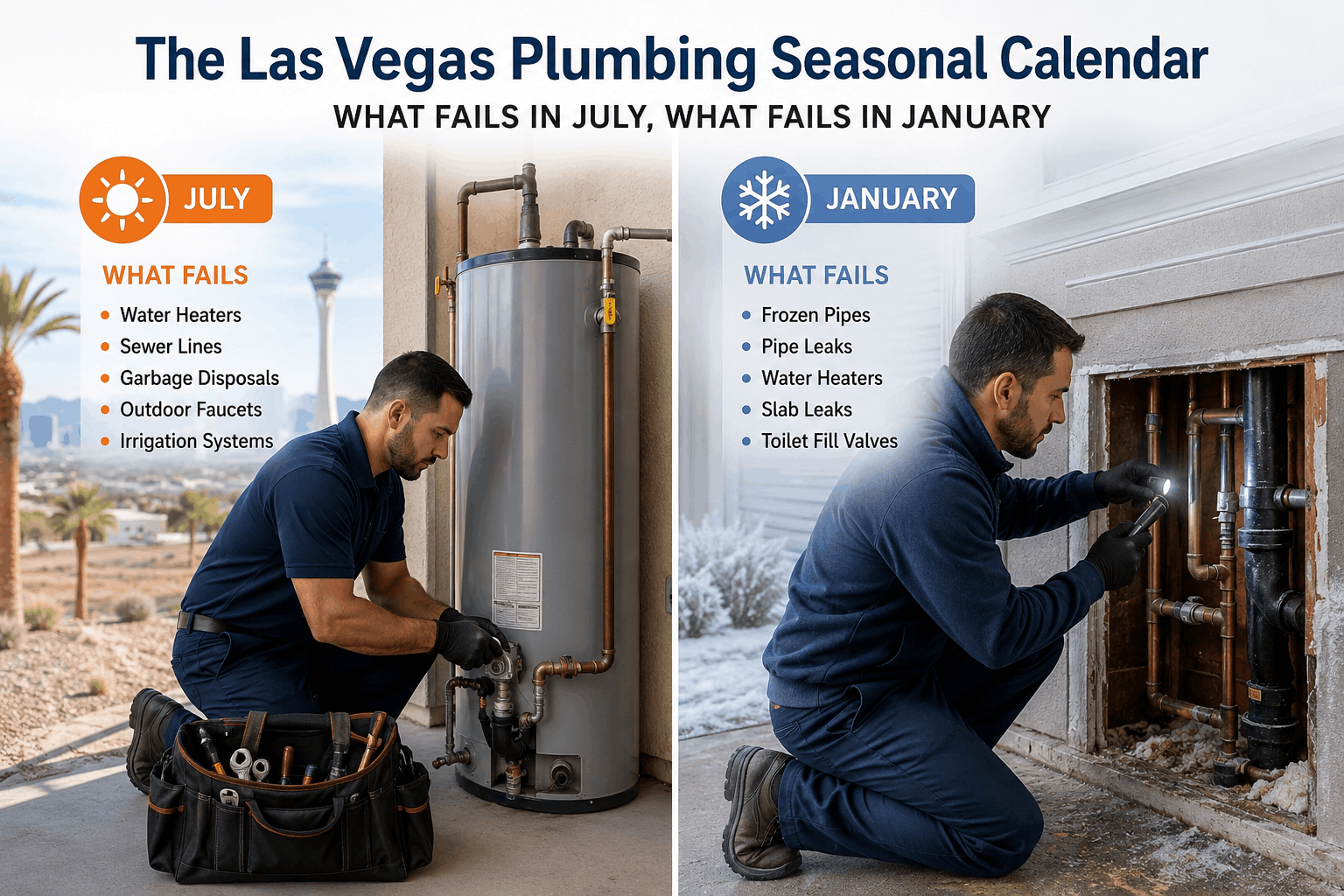
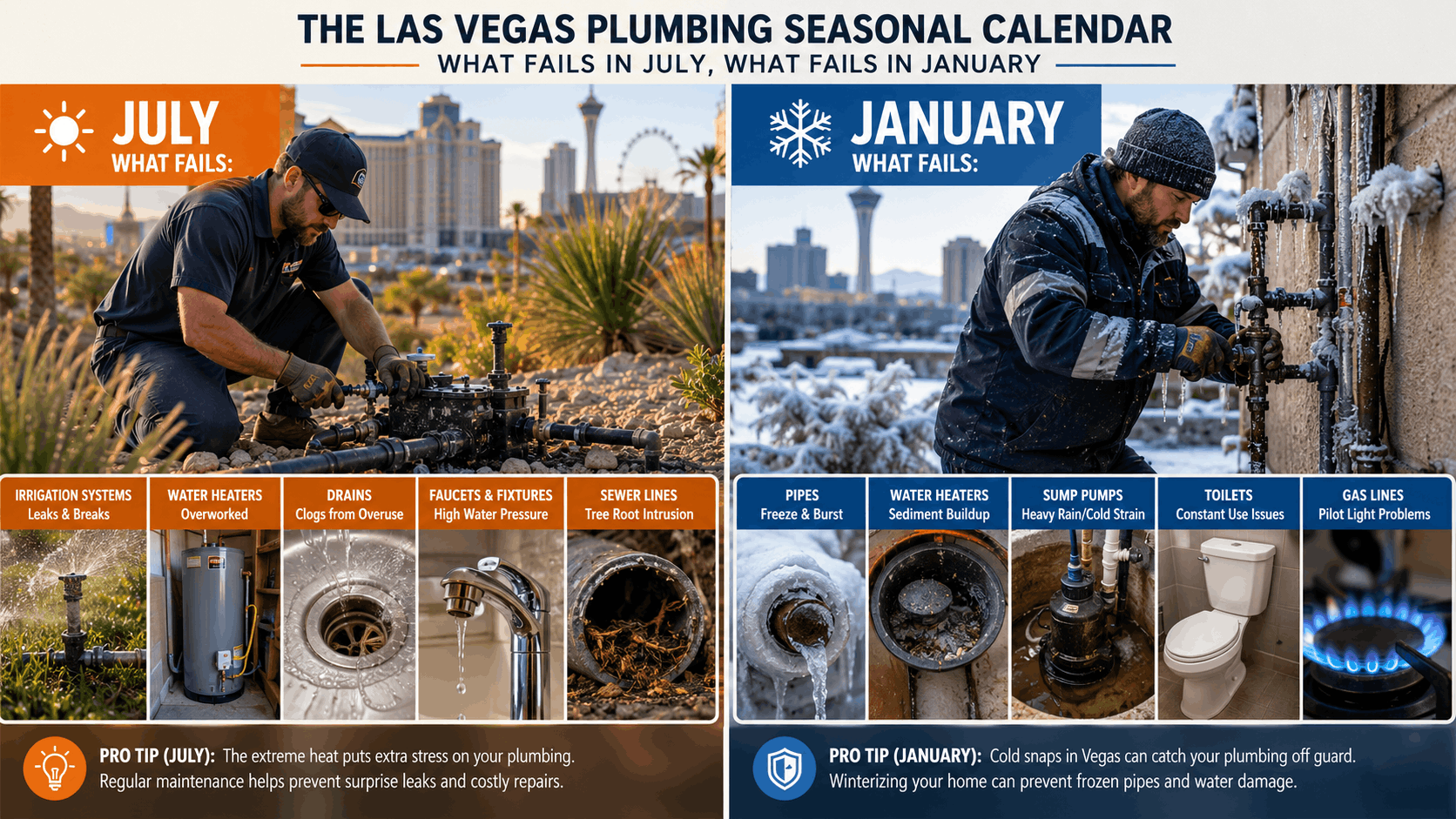
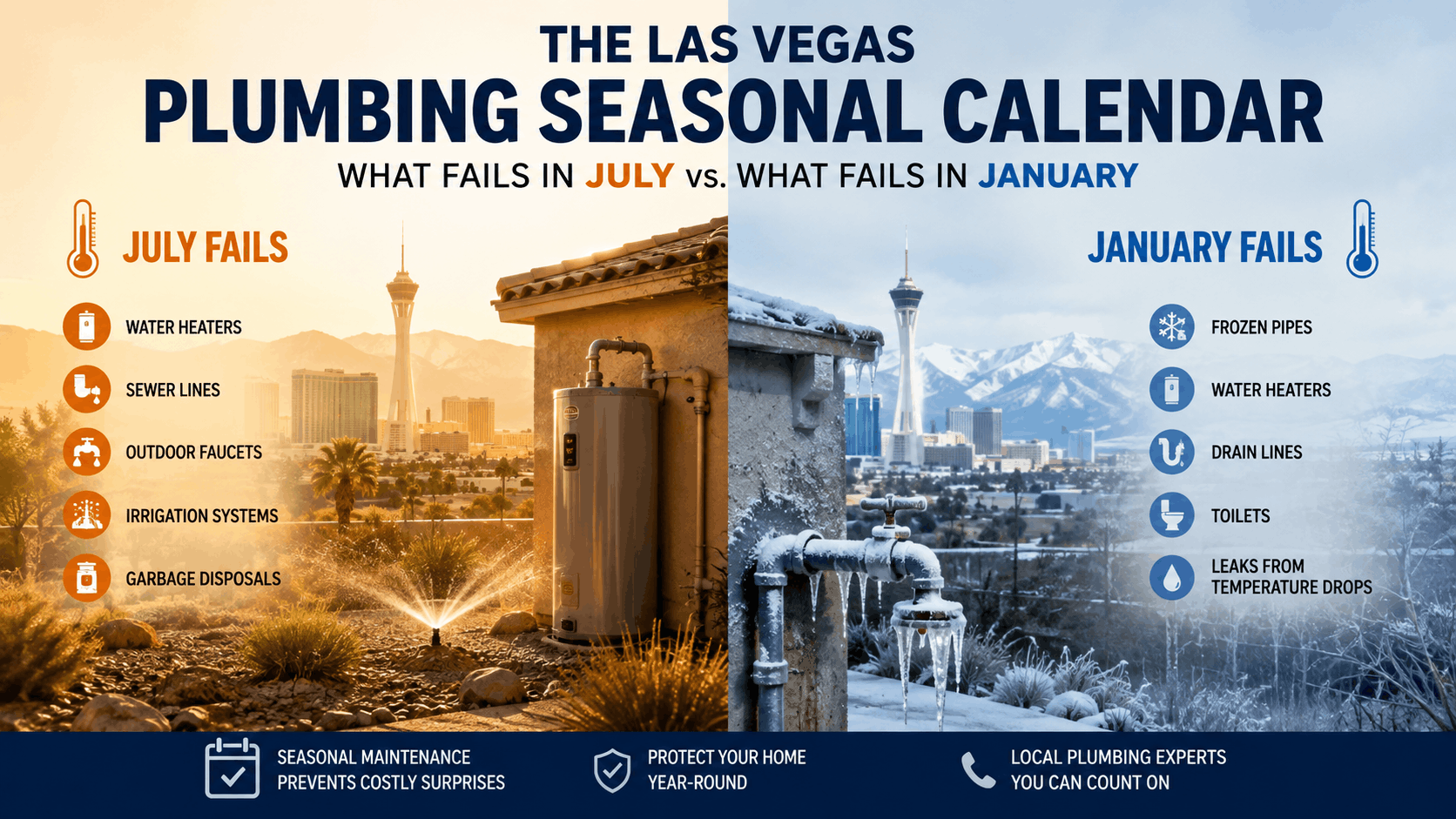
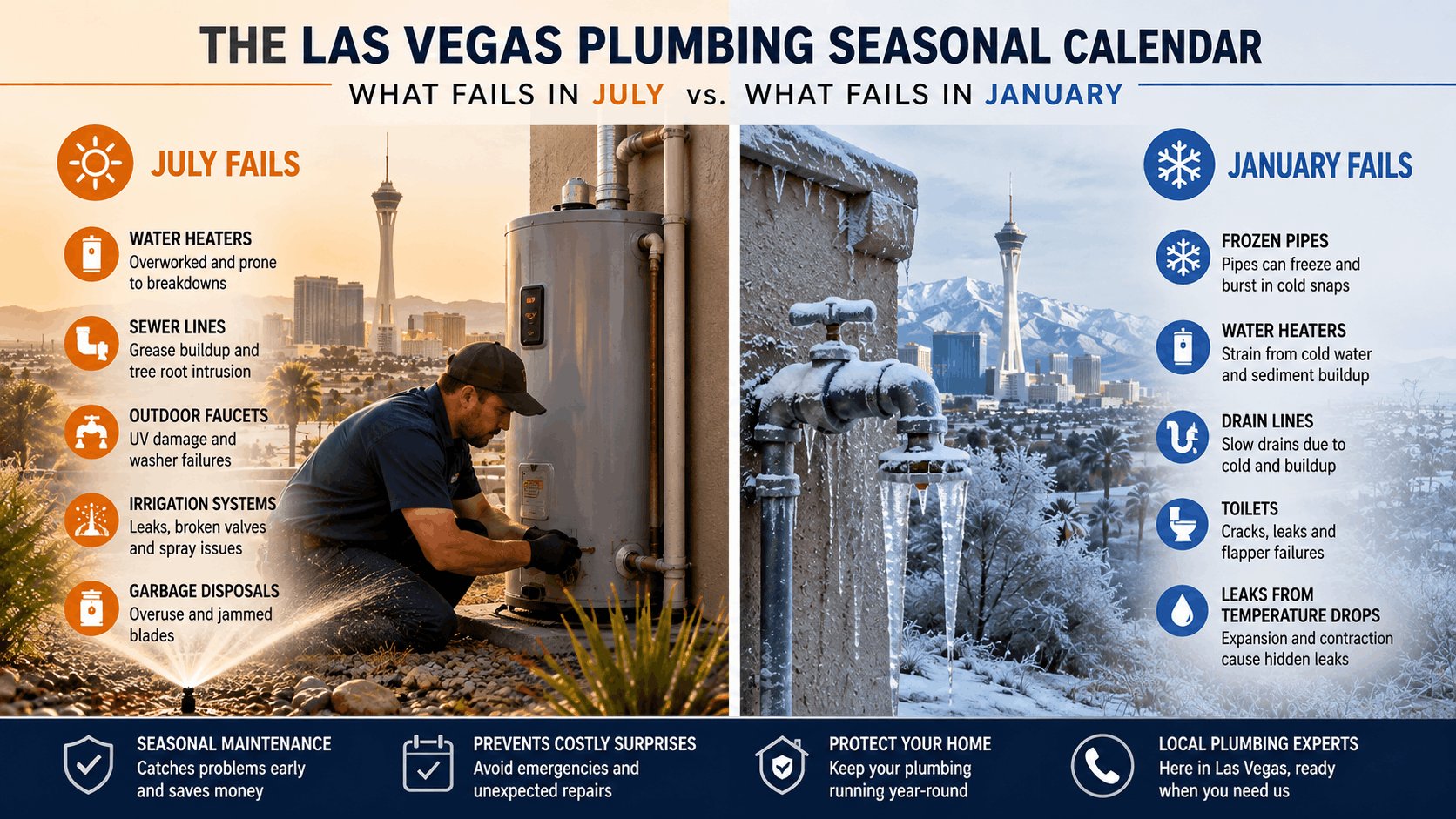
The Las Vegas Plumbing Seasonal Calendar: What Fails in July, What Fails in January
Key Takeaways
- Las Vegas plumbing fails in two distinct seasons: summer heat stress in July and winter freeze damage in January.
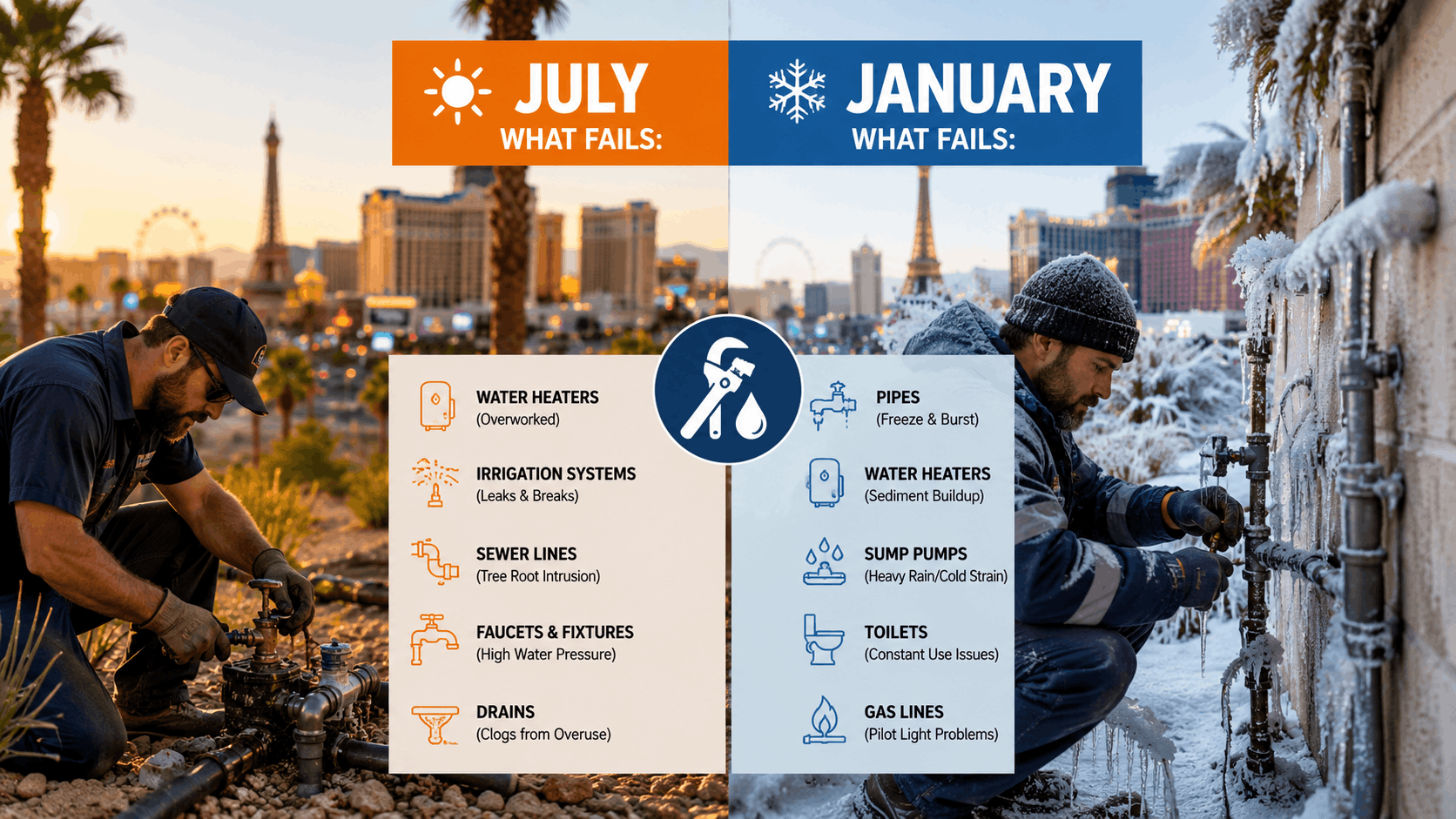
- July failures include water heaters with sediment buildup, cracked hose bibs, slab leaks from shifting soil, and dried-out P-traps.
- January failures include burst frozen pipes, cracked outdoor spigots and pool lines, overworked water heaters, and holiday drain clogs.
- The valley's very hard water builds scale that shortens the life of every pipe, fixture, and appliance in both seasons.
- Home age and elevation matter - older downtown homes deal with galvanized pipes and sewer roots, while newer builds face slab leaks.
- Spring and fall are the best times to hunt leaks, winterize pipes, and schedule off-peak repairs at lower cost.
- A simple quarter-by-quarter maintenance calendar keeps homeowners ahead of both failure seasons.
- Warm floor spots, sudden pressure loss, and spiking water bills signal a slab leak that needs a plumber right away.
In This Article
Last July, a family off Far Hills Avenue near Summerlin called us in a panic. Their AC was straining against a 112-degree afternoon, and while everyone crowded around the vents, the water heater in the garage quietly gave out. Warm brown water spread across the floor, and a summer that was already hard on the house got a lot harder.
Six months later, a homeowner in Henderson watched the thermometer drop below freezing overnight. A pipe running through an exterior wall split, and by morning a soaked drywall stain told the whole story. Two very different disasters, two very different seasons, one desert valley that swings between extremes.
Las Vegas plumbing does not fail the way it does in milder cities. The desert climate creates two separate breakdown seasons - a brutal summer heat cycle and a short but sharp winter freeze. This guide walks through what tends to fail in July, what tends to fail in January, and what homeowners across the valley can do to stay ahead of both.
Why Las Vegas Plumbing Follows a Two-Season Pattern
Most cities deal with plumbing problems that build slowly across the year. The valley is different. Our desert climate plumbing splits the calendar into two hard-hitting windows, and each one attacks a home in its own way.
When people think about seasonal plumbing failures, they usually picture frozen pipes in a cold Midwest winter. Here, the story runs in two directions. Summer heat cooks outdoor lines and pushes water heaters past their limits, while winter cold snaps catch homeowners who assume freezing never happens in the desert.
The two seasons share one common troublemaker: Las Vegas water. It carries a heavy mineral load that quietly damages pipes and fixtures all year, which makes both the July heat and the January cold worse. Here is how the pattern breaks down:
- Summer stresses water heaters, hose bibs, and outdoor irrigation.
- Winter freezes exposed pipes, backyard spigots, and pool equipment.
- Hard water speeds up every failure in both seasons.
- Home age and pipe materials decide which problems hit hardest.
The Summer Heat Load on Pipes and Fixtures
When the valley hits 110 degrees for days on end, plumbing takes a beating that most homeowners never think about. Heat stress on pipes is real, especially on lines that run through attics, garages, and along sun-baked exterior walls. Plastic supply lines soften, expand, and slowly weaken at their joints.
Outdoor fixtures get the worst of it. A hose bib sitting in direct afternoon sun can reach surface temperatures far above the air temperature, and the rubber washers inside dry out and crack. That is why so many summer plumbing calls involve dripping spigots that worked fine in the spring.
Water heaters face a double hit in summer. Incoming water arrives already warm from underground lines that have soaked up desert heat, and demand climbs as families take more showers to cool off. The tank works overtime, and any weak spot tends to reveal itself during the hottest stretch of the year.
Irrigation systems round out the summer load. Drip lines run daily to keep desert landscaping alive, and the constant pressure cycling wears out fittings and valves faster than most people expect.
Winter Cold Snaps That Catch Homeowners Off Guard
Plenty of newcomers assume frozen pipes in Las Vegas are impossible. They are wrong. Overnight lows dip below freezing several nights each winter, and that is more than enough to crack an exposed line.
Higher-elevation neighborhoods feel it most. Areas like Anthem and the western foothills near Summerlin can run several degrees colder overnight than the valley floor. A pipe in an uninsulated garage or an exterior wall can freeze, split, and then flood the home once the ice thaws in the morning sun.
The trouble with winter plumbing here is the surprise factor. Because freezes are short, many homeowners never winterize anything. A single hard cold snap in January can produce a wave of burst pipe calls across the valley within a day or two.
Outdoor fixtures and pool equipment sit right in the danger zone. Water trapped in a backyard spigot or an exposed pool line freezes, expands, and cracks the housing, often without any warning until the thaw arrives.
How Hard Water Makes Both Seasons Worse
The valley's water comes largely from Lake Mead through the Las Vegas Valley Water District, and it is some of the hardest water in the country. That means a heavy load of calcium and magnesium in every gallon that flows through a home.
Those minerals do not just sit in the water. They build up as scale inside pipes, water heaters, and fixtures, narrowing the paths water travels through. Over months and years, that mineral scale chokes flow and forces appliances to work harder.
In summer, scale inside a water heater traps heat at the bottom of the tank and speeds up failure. In winter, mineral-clogged fixtures and valves are more likely to stick or crack under the stress of cold. According to the U.S. Geological Survey, water this hard is considered very hard on the standard scale.
A water treatment setup is one of the few things that helps in both seasons at once, since it slows the scale that damages plumbing year round.
Neighborhood Age and Pipe Materials Matter
Not every home in the valley fails the same way, and a big reason is the age of the plumbing. Older homes near downtown and the Historic Westside often still carry galvanized steel or early copper piping that has decades of corrosion and scale inside.
Those older pipe materials tend to fail from the inside out. Galvanized lines rust and clog, water pressure drops, and eventually a pinhole leak shows up in a wall or under a slab. Sewer lines in these areas are older too, which invites root intrusion and backups.
Newer builds tell a different story. Homes in Mountain's Edge and Aliante usually have modern PEX or copper, but they sit on soil that is still settling. That movement is a common trigger for slab leaks in the first ten to fifteen years.
Knowing your neighborhood's typical failure points helps you watch for the right warning signs. A 1950s house downtown and a 2015 build in Enterprise need very different attention.
Get Your Quote
Tell us what's going on and we'll get back to you fast.
What Fails in July: The Summer Breakdown List
July is the peak of summer plumbing failures across the valley. The heat does not just make life uncomfortable - it actively breaks plumbing parts that were already near the end of their life.
When the Las Vegas heat settles in, our July plumbing calls follow a predictable pattern. Here is the short list of what tends to give out, and where it shows up most.
| Component | What Goes Wrong | Where It Shows Up |
|---|---|---|
| Water heater | Sediment buildup, tank failure | Valley-wide, garages |
| Hose bibs | Cracked spigots, dried washers | Summerlin, Green Valley |
| Irrigation lines | Fitting and valve leaks | Desert landscaping yards |
| Slab lines | Slab leaks from soil movement | Aliante, newer builds |
| P-traps | Dried out, sewer odor | Guest baths, empty homes |
Water Heaters Working Overtime
Summer is the hardest season on a water heater in the valley. Incoming water arrives warm from underground lines, so the tank never gets a real break, and demand climbs as everyone showers more to cool down.
Sediment buildup is the quiet killer here. Our hard water drops calcium and mineral sediment to the bottom of the tank, and that layer bakes against the heating element or burner. You may hear popping or rumbling sounds as the heater fights through that crust.
Once a tank is loaded with sediment, efficiency drops and the metal wears thin. That is when we see summer water heater failure - a leak at the base, a tripped element, or a full tank rupture during the hottest week of the year.
Flushing the tank each year and considering a tankless water heater can both cut down on these summer surprises. Our water heater team handles both repairs and upgrades across the valley.
Hose Bibs and Irrigation Lines Under Pressure
Outdoor plumbing carries the summer load in yards all over the valley. A hose bib leak often starts small - a slow drip at the handle - and grows worse as the rubber inside cracks from heat exposure.
Irrigation lines run hard through the summer to keep desert landscaping alive. Drip fittings, valves, and manifolds cycle daily, and the constant pressure plus sun exposure wears them out. A hidden drip leak can waste hundreds of gallons before anyone notices.
We see this constantly in Summerlin and Green Valley, where homes have larger yards and more elaborate drip systems. A cracked spigot or a leaking backflow valve is one of the most common July calls we get.
Checking each hose bib and walking the irrigation zones once a month in summer catches most of these before they turn into a soaked flower bed and a high water bill.
Slab Leaks From Ground Movement
The desert soil under valley homes is not stable. In summer, the ground dries out and shifts, and that movement puts stress on the water lines buried in a home's slab foundation.
A slab leak happens when a pressurized line under the concrete cracks or wears through. The water has nowhere to go but into the slab and up through the floor. In areas like Aliante, where newer homes sit on settling soil, this is a familiar summer problem.
The warning signs are easy to miss at first. A warm spot on the floor, a sudden jump in the water bill, or the faint sound of running water with every tap off all point toward a slab leak.
Because these leaks hide under concrete, they need real detection tools. Our electronic leak detection pinpoints the exact spot so the repair is targeted instead of tearing up a whole floor.
Sewer Line Odors and Dried-Out Traps
A strange sewer smell in a spare bathroom is a classic summer complaint. The cause is usually simpler than people fear - a dried out P-trap.
Every drain has a P-trap, a curved section that holds a little water to block sewer gas from rising into the home. In summer heat, the water in a rarely used trap evaporates faster, and once it is gone, sewer odors flow right in.
This hits guest bathrooms, laundry sinks, and floor drains in homes that sit empty during summer travel. Snowbirds and vacationing families come home to a house that smells like a sewer, and the fix is often just running water down each drain.
If the smell sticks around after refilling the traps, the problem may run deeper into the sewer line, and a camera inspection can find the real source.
Need Help in Las Vegas?
Active Plumbing serves Las Vegas and all of Las Vegas Valley.
What Fails in January: The Winter Freeze List
January brings a shorter but sharper list of winter plumbing failures. The freeze does not last long here, but it does not need to. One cold night can crack a pipe and flood a home by morning.
When the January freeze arrives, our burst pipe calls spike overnight. Here is what tends to fail when the temperature drops, and which parts of a home are most at risk.
| Component | What Goes Wrong | Highest Risk Areas |
|---|---|---|
| Exposed pipes | Freeze and burst | Garages, exterior walls |
| Hose bibs | Frozen, cracked housing | Anthem, foothills |
| Pool plumbing | Frozen equipment lines | Higher elevations |
| Water heater | Overworked by cold inlet | Aging tanks valley-wide |
| Kitchen drains | Grease clogs, backups | Holiday-heavy homes |
Exposed and Uninsulated Pipes Bursting
The number one winter failure in the valley is a burst pipe from freezing. Water expands when it turns to ice, and that expansion puts enough pressure inside a pipe to split the metal or crack the plastic.
The pipes at risk are the ones with the least protection. Lines running through an unheated garage, along an exterior wall, or through a crawl space have nothing to shield them when the temperature drops overnight.
Most bursts happen in the early morning hours when temperatures bottom out. The homeowner does not find out until the ice thaws and water starts pouring from a wall or ceiling, often while they are at work.
Frozen pipe repair is one of our most common January jobs, and fast response limits the damage. Our burst pipe repair team works across the valley when a freeze hits.
Backyard Hose Bibs and Pool Equipment
Outdoor plumbing that survived the summer heat now faces the winter cold. A frozen hose bib is a common January failure, especially when a garden hose is left attached and traps water inside the spigot.
Pool plumbing is another weak spot. The pumps, filters, and exposed lines around pool equipment hold water that can freeze if the equipment is not running. A cracked pump housing or split PVC line is an expensive surprise.
Colder pockets like Anthem and the foothills see more of this than the valley floor. Those few extra degrees of overnight chill push borderline situations into real freeze damage.
Draining outdoor lines and covering hose bibs before the first freeze prevents most of these failures. It takes ten minutes in the fall and saves a repair bill in January.
Water Heaters Struggling With Cold Inlet Water
Winter is hard on water heaters for the opposite reason summer is. Now the incoming water is genuinely cold, sometimes 30 to 40 degrees colder than in July, and the tank has to work much harder to reach the same temperature.
That extra workload is what exposes an aging unit. A tank already weakened by years of sediment and hard water may fail when it suddenly has to heat much colder inlet water for longer cycles.
Homeowners often notice they run out of hot water faster in winter, or that the heater runs almost constantly. Those are signs the unit is straining, and a failure may not be far off.
A winter checkup and a tank flush help older heaters make it through the cold season. If a unit is past its prime, a repair or replacement before it quits saves the cold-shower emergency.
Holiday Kitchen Clogs and Drain Backups
January drain problems have less to do with cold and more to do with holiday cooking. Big meals, lots of guests, and heavy kitchen use pile stress onto drains that normally handle a quiet household.
Grease is the main culprit. Poured down the drain as a warm liquid, it cools and hardens inside the pipe, catching food scraps and building a clog. Garbage disposals get overloaded with peels, bones, and fibrous scraps they were never meant to handle.
By early January, we get a run of kitchen clog and drain backup calls from homes that hosted through the holidays. A sink that drains slowly on New Year's Day is a warning the pipe is nearly blocked.
For stubborn clogs, our hydro jetting service clears grease and buildup that a plunger cannot touch. Keeping grease out of the drain is the best prevention.
Spring and Fall: The Quiet Months That Set Up Failures
The mild months between the extremes are the valley's secret weapon. Spring and fall are calm, comfortable, and the best time to catch problems before July or January forces the issue.
Smart homeowners treat these shoulder seasons as prep windows. A little seasonal maintenance now prevents an emergency later, and it costs far less to fix a small issue than a burst pipe or a flooded floor.
| Season | Focus | Best Months |
|---|---|---|
| Spring | Leak hunting before summer | March, April |
| Fall | Winterizing before freeze | October, November |
| Both | Off-peak repairs | Shoulder seasons |
Spring Leak Hunting Before Summer Demand
Spring is the time to find leaks before the summer heat magnifies them. In March and April, the weather is mild and the plumbing is not yet under peak stress, so problems are easier to spot and fix.
Start with the irrigation system. Turn on each zone and walk the yard looking for wet spots, geysers, or drip emitters that have popped off. An irrigation inspection now saves gallons of water once the daily summer watering begins.
Check every hose bib for drips and test the water heater while you are at it. A spring leak check that includes flushing the tank clears out the sediment that would otherwise cook all summer.
Catching a small leak in April is a minor repair. Catching it in July, when everyone needs a plumber at once, is a much bigger headache.
Fall Winterizing Before the First Freeze
Fall is the window to winterize pipes before the first freeze catches anyone off guard. October and November bring cooler nights that hint at the cold to come.
Insulating exposed pipes is the main job. Foam sleeves on lines in the garage, along exterior walls, and in crawl spaces add a layer of protection that can keep water from freezing overnight.
Outdoor lines need attention too. Draining hose bibs, disconnecting garden hoses, and shutting off outdoor supply valves removes the water that would otherwise freeze and split the fixture.
Fall plumbing prep is quick and cheap compared to a January burst pipe. Higher-elevation neighborhoods like Summerlin especially benefit from getting this done early.
Off-Peak Repairs Cost Less and Move Faster
There is a real money reason to schedule work in the shoulder seasons. When July and January hit, plumbers across the valley are slammed with emergencies, and that demand affects both wait times and rates.
Off-peak plumbing means you get a plumber sooner and often at a calmer, planned pace. A water heater replaced in April is a scheduled appointment, not a frantic emergency call during a heat wave.
Repair scheduling in spring or fall also lets you plan bigger projects properly. Repiping, sewer work, or a water treatment install all go smoother when they are not competing with a flood of urgent calls.
The homeowners who stay ahead of the seasons rarely pay emergency rates. That is the quiet advantage of using the calm months well.
How Las Vegas Water Quality Speeds Up Every Failure
Every failure in this article gets worse because of one thing: the water itself. The valley's mineral-heavy supply shortens the life of every fixture and appliance in the home.
Understanding hard water damage helps homeowners fight back instead of just replacing parts over and over. The mineral scale never stops building, so the best defense is treating the water before it wrecks the plumbing.
Scale Buildup Inside Water Heaters and Pipes
Hard water carries dissolved calcium and magnesium, and those minerals do not stay dissolved forever. As water heats or sits, they drop out and form scale on the inside of pipes and tanks.
Inside a water heater, scale buildup collects at the bottom and around the heating elements. It insulates the water from the heat source, so the unit burns more energy and wears out years early.
Inside supply pipes, scale slowly narrows the opening water flows through. Over time that means reduced water flow at the tap, and in older galvanized lines the buildup can nearly close the pipe.
This is why two identical water heaters can have very different lifespans. The one fighting untreated valley water gives out long before one protected by treatment.
Faucets, Valves, and Fixtures Clogging Early
Look at any faucet aerator in the valley and you will find the proof of hard water. That white, crusty buildup is mineral deposits, and it forms on every fixture in the home.
A clogged faucet aerator cuts flow and sprays water sideways. Shower heads clog the same way, with mineral crust blocking the little holes until the spray turns weak and uneven.
Shutoff valves suffer quietly. Scale builds up inside them, and a valve that has not been turned in years can seize or crack when you finally need it during an emergency.
Cleaning aerators and shower heads with vinegar helps, but it only treats the symptom. The minerals keep coming with every gallon until the water itself is treated.
Water Softeners and Filtration Options
The real fix for hard water is treatment at the source. A water softener removes the calcium and magnesium before they reach the pipes, which slows scale across the entire home.
Whole-home filtration adds another layer, catching sediment and improving water quality at every tap. Together, these systems can extend the life of water heaters, fixtures, and appliances by years.
We install these systems across neighborhoods like Spring Valley, where residents feel the hard water on their skin and see it on their glassware. Our water softener installation and salt-free conditioning options fit different needs and budgets.
Homeowners in Spring Valley and beyond often tell us their fixtures last noticeably longer after adding treatment. It is one of the few upgrades that pays off in both summer and winter.
Need Help in Las Vegas?
Active Plumbing serves Las Vegas and all of Las Vegas Valley.
Neighborhood-by-Neighborhood: Where Certain Failures Show Up Most
The valley is not one uniform place when it comes to plumbing. Home age, elevation, and soil all shape what problems a neighborhood faces most.
Mapping local plumbing issues to specific areas helps homeowners know what their own zip code deals with. Here is what we see across the different corners of the valley:
- Downtown and Historic Westside: aging pipes and sewer roots.
- Anthem and Summerlin: freeze risk from higher elevation.
- Mountain's Edge and Aliante: slab leaks and builder-grade fixtures.
- Green Valley: HOA rules and shared-wall leaks.
Older Homes Near Downtown and the Historic Westside
The older housing stock near downtown and the Historic Westside carries decades of plumbing history in its walls. Many of these homes still have galvanized steel pipes that have been corroding from the inside for fifty years or more.
Galvanized pipes rust internally, which drops water pressure and turns the water a rusty color. Eventually they leak, and a full repipe is often the only lasting fix once corrosion sets in.
Sewer lines in these older areas invite trouble too. Aging clay or cast iron lines crack over time, and tree roots find their way in, causing sewer line root intrusion and repeat backups.
A sewer line repair or camera inspection is often the right first step for these homes. Owners near the Arts District deal with these older-line issues regularly.
Higher-Elevation Areas Like Anthem and Summerlin
Elevation changes the winter risk more than most people realize. Neighborhoods that sit higher, like Anthem and parts of Summerlin, run colder overnight than the valley floor.
Those extra degrees of cold matter. A pipe that would survive freezing near the Strip might split in Anthem on the same night because the low there dropped further below freezing.
Freeze-prone areas need more winter prep, not less. Insulating exposed pipes and draining outdoor lines is more important here, since the margin for error is smaller.
We see the January freeze pattern clearly in these higher spots. Residents in Summerlin West benefit from getting ahead of the cold each fall.
Newer Builds in Mountain's Edge and Aliante
Newer neighborhoods have modern pipe materials, but they come with their own weak points. In Mountain's Edge and Aliante, the soil is still settling under homes built in the last couple of decades.
That settling is a leading cause of slab leaks in newer homes. As the ground shifts, it stresses the water lines in the foundation until one cracks and starts leaking under the concrete.
Builder-grade fixtures are another issue. The valves, faucets, and shutoffs installed to keep construction costs down often fail earlier than higher-quality replacements would.
Homeowners in Mountain's Edge and Aliante should watch for early slab leak signs and plan to upgrade cheap fixtures over time.
HOA and High-Density Communities in Green Valley
High-density communities and HOA neighborhoods in Green Valley add a layer of coordination to any plumbing job. Shared walls and close spacing mean one home's leak can affect a neighbor.
Shared-wall leaks are a common headache. A pipe in a party wall can damage two units at once, and figuring out responsibility takes cooperation between owners and the HOA.
HOA rules also affect permits and approved work. Many communities require certain steps before repairs or upgrades, and skipping them creates problems down the road.
We work with HOA requirements regularly across Henderson and Green Valley, coordinating repairs so they meet community rules the first time.
A Year-Round Maintenance Calendar Homeowners Can Follow
The best way to beat both failure seasons is a simple, repeatable plumbing maintenance calendar. Break the year into four blocks, and each one has a clear job.
This home maintenance schedule keeps residents ahead of July and January without much effort. A few tasks each quarter prevent most emergencies.
January Through March: Post-Freeze Checkups
The first quarter is about recovering from winter and finding any hidden damage. After a freeze, some cracks do not leak right away, so a post-freeze inspection matters.
Walk the garage, exterior walls, and outdoor fixtures looking for drips, stains, or warped spots. A pipe that froze but did not fully burst may be weakened and ready to leak later.
This is also the ideal time for a water heater flush. Clearing out the sediment before the summer stress season gives the tank a fresh start and better efficiency.
Catching freeze damage early in the year prevents a small crack from becoming a wall-soaking leak in spring.
April Through June: Summer Readiness
The second quarter is all about summer prep before the heat arrives. This is the window to get outdoor plumbing ready for months of hard use.
Test the irrigation system zone by zone, checking for leaks and broken emitters. Inspect every hose bib for drips, since the summer sun will only make a small leak worse.
A water pressure test is worth doing now too. Pressure that is too high stresses pipes and fixtures, and correcting it before summer protects the whole system.
Getting this done in spring means the plumbing is ready when the first 100-degree day hits.
July Through September: Heat-Season Monitoring
The third quarter is about watching the plumbing through peak heat. Heat-season monitoring catches problems while they are still small.
Stay alert for slab leak signs - warm floor spots, a spiking water bill, or the sound of running water when everything is off. Summer soil movement makes these more likely.
Run water in unused faucets and bathrooms to keep P-traps full and block sewer odors. This simple habit prevents the summer sewer smell that catches so many travelers off guard.
Keep an eye on outdoor lines and irrigation, since the heat is hardest on them right now.
October Through December: Winterizing and Holiday Prep
The final quarter covers winterizing and holiday drain prep. Cooler nights and big gatherings both arrive in this stretch.
Insulate exposed pipes and drain outdoor lines before the first freeze. Cover hose bibs and shut off outdoor supply valves so nothing freezes overnight.
Prep the kitchen drains for holiday cooking. Keep grease out of the sink, run plenty of cold water when using the disposal, and avoid overloading it with tough scraps.
A little prep here prevents both the January burst pipe and the New Year's Day drain backup.
When to Call a Plumber Versus Handle It Yourself
Not every plumbing problem needs a pro, but some absolutely do. Knowing the difference saves money on the small stuff and prevents disaster on the big stuff.
Here is how to judge when to call a plumber, where DIY plumbing limits kick in, and which situations count as emergency plumbing.
Simple Fixes Most Homeowners Can Manage
Plenty of minor issues are safe to handle yourself with basic tools. Cleaning a clogged aerator or shower head just takes unscrewing it and soaking it in vinegar to dissolve the mineral crust.
A plunger clears most simple drain clogs. Keeping a good cup plunger for sinks and a flange plunger for toilets handles the common backups without any special skill.
Every homeowner should know how to shut off the water at the main. When something goes wrong, a fast water shutoff limits the damage while you decide the next step.
These small DIY plumbing tasks keep a home running smoothly between professional visits.
Warning Signs That Mean Call Right Away
Some symptoms are red flags that need a plumber now. A sudden loss of water pressure can point to a hidden burst or a major line problem.
Warm spots on the floor are a classic slab leak sign, especially paired with a water bill that jumped for no reason. So is the sound of running water when every tap is off.
Any sewage backup, gas smell, or water pouring from a wall is an emergency. These situations get worse fast and can threaten the home and the people in it.
When these signs show up, shutting off the water and calling right away is the smart move. Our emergency plumbing team responds quickly across the valley.
How Active Plumbing Handles Seasonal Emergencies in Las Vegas
When a burst pipe or water heater failure hits, speed matters. Our team responds to seasonal emergencies across the valley, from a July tank rupture to a January frozen line.
We come equipped for the real problems each season brings. That means leak detection tools for summer slab leaks and fast burst pipe repair when a January freeze splits a line.
Because we work these neighborhoods every day, we know the common failure points street by street. A call from Summerlin, Henderson, or North Las Vegas gets a crew that already understands the local plumbing.
Whether it is an emergency or planned maintenance, homeowners across Las Vegas can reach our team when the seasons turn hard on their plumbing.
Need Help in Las Vegas?
Active Plumbing serves Las Vegas and all of Las Vegas Valley.
Final Thoughts
Las Vegas plumbing lives on a two-season calendar. July heat attacks water heaters, hose bibs, and slab lines, while January cold cracks exposed pipes and overworks aging tanks.
Hard water makes both seasons worse, and neighborhood age and elevation decide which failures hit hardest. The homeowners who use the calm spring and fall months to prep rarely face the worst emergencies.
Our team knows this valley street by street and season by season. Reach out to Active Plumbing for a consultation or seasonal checkup, and stay ahead of whatever July and January throw at your home. According to the EPA WaterSense program, catching leaks early also saves thousands of gallons a year.
Frequently Asked Questions
Do pipes really freeze in Las Vegas?
Yes, they do. While the desert is famous for heat, overnight lows dip below freezing several nights each winter. Exposed pipes in garages, exterior walls, and crawl spaces can freeze and burst, especially in higher-elevation areas like Anthem and the foothills. Because freezes are short and unexpected, many homeowners skip winterizing, which is exactly why a single January cold snap produces a wave of burst pipe calls across the valley.
Why does my water heater fail more often in summer?
Summer stacks three problems on a water heater at once. Incoming water arrives already warm from underground lines soaking up desert heat, demand climbs as everyone showers more, and hard water sediment bakes at the bottom of the tank. That constant stress on an aging unit often reveals a weak spot during the hottest stretch. Flushing the tank yearly and replacing older units before peak heat helps prevent a July failure.
What are the signs of a slab leak?
The most common signs are a warm spot on the floor, an unexplained jump in the water bill, and the sound of running water when every tap is off. You might also notice low water pressure or cracks in the flooring. Because slab leaks hide under concrete, they need electronic leak detection to pinpoint the exact spot. Catching one early prevents major foundation and flooring damage, so call quickly if you notice these signs.
How do I keep my outdoor faucets from freezing?
Start in the fall before the first freeze. Disconnect and drain all garden hoses, since a connected hose traps water inside the spigot. Install foam faucet covers on each hose bib, and if your home has a separate outdoor shutoff valve, close it and drain the line. In colder areas like Anthem, these simple steps take ten minutes and prevent a cracked spigot and flooded yard come January.
Is hard water really that bad in Las Vegas?
It is genuinely some of the hardest water in the country. The supply comes largely from Lake Mead and carries a heavy load of calcium and magnesium. Those minerals build scale inside pipes, water heaters, and fixtures, cutting water flow and shortening appliance life. You see it as white crust on faucets and glassware. A water softener or whole-home filtration slows this damage and extends the life of your plumbing throughout the home.
How often should I flush my water heater?
At least once a year, and twice a year is not a bad idea given the valley's hard water. Flushing clears the calcium and mineral sediment that collects at the bottom of the tank. Left alone, that sediment insulates the heating element, wastes energy, and shortens the tank's life. The best time to flush is early in the year, before the summer heat and demand put extra strain on the unit.
Why do my drains back up during the holidays?
Holiday cooking overwhelms kitchen drains. Grease poured down the sink cools and hardens inside the pipe, catching food scraps and building a clog. Garbage disposals get overloaded with peels, bones, and fibrous scraps, and heavy guest use adds to the strain. By early January, slow-draining sinks and full backups are common. Keeping grease out of the drain and running cold water with the disposal prevents most of these holiday clogs.
When is the best time to schedule plumbing maintenance?
Spring and fall are ideal. During these mild shoulder seasons, plumbers are not slammed with July heat or January freeze emergencies, so you get faster scheduling and calmer, planned appointments. It is also the perfect timing - spring lets you catch leaks before summer demand, and fall lets you winterize before the first freeze. Booking maintenance in these windows usually costs less than emergency work during peak season.
Does Active Plumbing offer emergency service across the valley?
Yes. Our team responds to plumbing emergencies across the Las Vegas Valley, including Summerlin, Henderson, North Las Vegas, and the surrounding communities. We handle burst pipes, water heater failures, slab leaks, and sewage backups, and we come equipped for the specific problems each season brings. Because we work these neighborhoods every day, we know the common failure points and can respond quickly when a summer or winter emergency hits your home.
Should I install a water softener?
For most valley homes, it is a worthwhile upgrade. The local water is very hard, and a softener removes the calcium and magnesium that build scale inside pipes, water heaters, and fixtures. That protection extends the life of your plumbing and appliances and improves water quality at every tap. If you prefer not to use salt, salt-free conditioning is an option too. Our team can recommend the right system for your home and budget.
Frequently Asked Questions
- Do pipes really freeze in Las Vegas?
- Yes, they do. While the desert is famous for heat, overnight lows dip below freezing several nights each winter. Exposed pipes in garages, exterior walls, and crawl spaces can freeze and burst, especially in higher-elevation areas like Anthem and the foothills. Because freezes are short and unexpected, many homeowners skip winterizing, which is exactly why a single January cold snap produces a wave of burst pipe calls across the valley.
- Why does my water heater fail more often in summer?
- Summer stacks three problems on a water heater at once. Incoming water arrives already warm from underground lines soaking up desert heat, demand climbs as everyone showers more, and hard water sediment bakes at the bottom of the tank. That constant stress on an aging unit often reveals a weak spot during the hottest stretch. Flushing the tank yearly and replacing older units before peak heat helps prevent a July failure.
- What are the signs of a slab leak?
- The most common signs are a warm spot on the floor, an unexplained jump in the water bill, and the sound of running water when every tap is off. You might also notice low water pressure or cracks in the flooring. Because slab leaks hide under concrete, they need electronic leak detection to pinpoint the exact spot. Catching one early prevents major foundation and flooring damage, so call quickly if you notice these signs.
- How do I keep my outdoor faucets from freezing?
- Start in the fall before the first freeze. Disconnect and drain all garden hoses, since a connected hose traps water inside the spigot. Install foam faucet covers on each hose bib, and if your home has a separate outdoor shutoff valve, close it and drain the line. In colder areas like Anthem, these simple steps take ten minutes and prevent a cracked spigot and flooded yard come January.
- Is hard water really that bad in Las Vegas?
- It is genuinely some of the hardest water in the country. The supply comes largely from Lake Mead and carries a heavy load of calcium and magnesium. Those minerals build scale inside pipes, water heaters, and fixtures, cutting water flow and shortening appliance life. You see it as white crust on faucets and glassware. A water softener or whole-home filtration slows this damage and extends the life of your plumbing throughout the home.
- How often should I flush my water heater?
- At least once a year, and twice a year is not a bad idea given the valley's hard water. Flushing clears the calcium and mineral sediment that collects at the bottom of the tank. Left alone, that sediment insulates the heating element, wastes energy, and shortens the tank's life. The best time to flush is early in the year, before the summer heat and demand put extra strain on the unit.
- Why do my drains back up during the holidays?
- Holiday cooking overwhelms kitchen drains. Grease poured down the sink cools and hardens inside the pipe, catching food scraps and building a clog. Garbage disposals get overloaded with peels, bones, and fibrous scraps, and heavy guest use adds to the strain. By early January, slow-draining sinks and full backups are common. Keeping grease out of the drain and running cold water with the disposal prevents most of these holiday clogs.
- When is the best time to schedule plumbing maintenance?
- Spring and fall are ideal. During these mild shoulder seasons, plumbers are not slammed with July heat or January freeze emergencies, so you get faster scheduling and calmer, planned appointments. It is also the perfect timing - spring lets you catch leaks before summer demand, and fall lets you winterize before the first freeze. Booking maintenance in these windows usually costs less than emergency work during peak season.
- Does Active Plumbing offer emergency service across the valley?
- Yes. Our team responds to plumbing emergencies across the Las Vegas Valley, including Summerlin, Henderson, North Las Vegas, and the surrounding communities. We handle burst pipes, water heater failures, slab leaks, and sewage backups, and we come equipped for the specific problems each season brings. Because we work these neighborhoods every day, we know the common failure points and can respond quickly when a summer or winter emergency hits your home.
- Should I install a water softener?
- For most valley homes, it is a worthwhile upgrade. The local water is very hard, and a softener removes the calcium and magnesium that build scale inside pipes, water heaters, and fixtures. That protection extends the life of your plumbing and appliances and improves water quality at every tap. If you prefer not to use salt, salt-free conditioning is an option too. Our team can recommend the right system for your home and budget.
A
Licensed plumbing professionals serving Las Vegas and Las Vegas Valley.
Licensed in Nevada · License #0047021
Last updated on
Why trust Active Plumbing?
Founded in 1991, Active Plumbing is a licensed and insured plumber serving Las Vegas and Las Vegas Valley. All content is reviewed by our licensed technicians.

Need Help in Las Vegas?
Active Plumbing serves Las Vegas and all of Las Vegas Valley.
Related Articles
Cost Guides
Kitec Plumbing Replacement Cost in Las Vegas - and Why Insurers and Buyers Force the Issue
Kitec plumbing replacement cost in Las Vegas explained, plus why insurers and buyers force the issue. Real price ranges, the repipe process, and how to pick a plumber.
Safety & Prevention
Why Las Vegas Homes Built Before 1990 Need a Full Plumbing Inspection
Las Vegas homes built before 1990 face unique plumbing challenges from aging materials, desert conditions, and outdated construction practices that can lead to catastrophic failures.
Seasonal
Why Las Vegas Water Heaters Fail in July: 115° Garages, Thermal Stress, and Demand Spikes
Learn why Las Vegas water heaters fail in July as 115 degree garages, thermal stress, hard water, and summer demand spikes all pile on your unit at once.