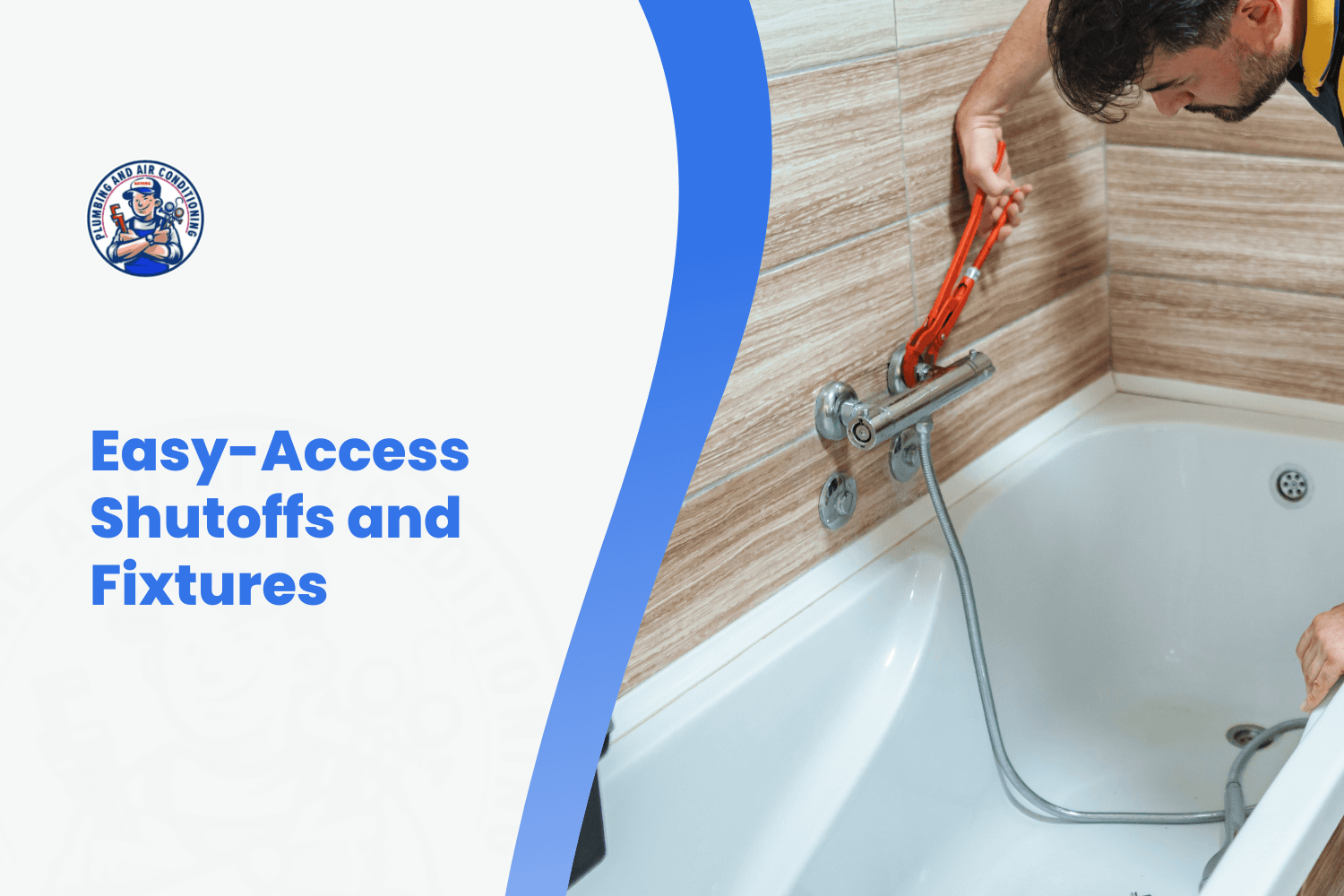
Easy-Access Shutoffs and Fixtures for Sun City Summerlin Residents
Key Takeaways
- Sun City Summerlin homes date from Del Webb's 1989 build onward, so original shut-off valves, angle stops and fixtures have aged out and often seize when finally needed.
- The valley's very hard water at 280 ppm or 16 grains per gallon deposits scale that seizes valves and clogs aerators, shower heads and mixing cartridges.
- Swapping a seized main shut-off for a quarter-turn ball valve is a small job with outsized value for arthritic hands or limited strength.
- Lever handles, comfort-height toilets, walk-in shower conversions and thermostatic mixing valves make daily use safer and easier for residents 55 and over.
- A dripping water heater relief valve is frequently a failed thermal expansion tank, and a two-minute incoming pressure check catches a worn regulator.
- Ask any plumber for a Nevada State Contractors Board license number and verify it free at nvcontractorsboard.com, and never make a decision on the doorstep.
- Sun City Summerlin sits within City of Las Vegas limits, but confirm the permit counter for the exact address, and remember association review and city permits are separate tracks.
- Active Plumbing is a fourth-generation local business licensed since 1991, NSCB #0047021, with technicians arriving in 30 to 60 minutes anywhere in the valley.
In This Article
A pipe lets go under the kitchen sink on a quiet morning in Sun City Summerlin, and the water starts to spread. The homeowner, who has lived off Del Webb Boulevard for twenty years, heads for the garage to shut the water off at the main. The valve will not budge. It has not been turned since the house was built, and now it is the one moment it needs to work.
This is the situation we find most often in an age-restricted community where many homes are thirty-five years old. The original valves have fused in place, the fixtures were never built for hands that no longer grip the way they used to, and the water chemistry here has been working against every fitting the whole time. A seized main shut-off is not a minor annoyance in a one or two person household. It is the difference between a small leak and a flooded floor.

Why Shutoffs and Fixtures Age Out in Sun City Summerlin?
Sun City Summerlin is the age-restricted active adult community that Del Webb began building in 1989 in the northwest valley. It holds roughly 7,700 homes across its phases, and it is the oldest part of Summerlin by a clear margin. While the newer Summerlin villages date from the 2000s and 2010s, the earliest phases here are thirty-five years old. That makes this the Summerlin address where original equipment and fittings have genuinely aged out.
Age alone does not tell the whole story. The valley's very hard water has been depositing scale inside every valve, cartridge and supply line since the day these homes were plumbed. A shut-off valve that never moves is the perfect place for mineral buildup to harden undisturbed. Combine three and a half decades with 16 grains per gallon of hardness and you get the failures residents actually see: valves that will not turn, aerators that barely trickle, and relief valves that drip for reasons that have nothing to do with the valve itself.
The build era sets the stage, and the water chemistry finishes the job. Here is how the two line up in these homes.
| Component | Original era in these homes | How it fails here |
|---|---|---|
| Main shut-off valve | 1989 onward, often never turned | Seizes and will not close when needed |
| Angle stops under sinks and toilets | Original builder fittings | Freeze in place or weep when turned |
| Copper supply lines | Earlier phases | Pinhole leaks on hot and under-slab runs |
| Water heater | Often second or third unit now | Scale shortens life, especially if never flushed |
| Thermal expansion tank | Frequently overlooked | Fails silently, shows up as a dripping relief valve |
| Washing machine hoses | Often still original | Well past sensible service life, burst risk |
What 35 Years Does to a Shut-Off Valve
Most older shut-off valves are a gate or globe design with a round handle and a rubber or metal seat inside. When the handle turns, a stem screws down to close off the flow. That design works fine for the first few years, but it depends on the stem and seat staying clean and free. A valve that sits in one position for decades does not stay clean here.
Very hard water leaves calcium and magnesium scale on the stem threads and around the seat. Over thirty-five years that scale hardens into a cement-like grip. When the day comes to close the valve, the handle either refuses to move or snaps off the stem. Some valves will turn partway and then weep from the packing nut because the rubber inside has gone brittle with age.
In a household of one or two older people, a seized main shut-off turns a manageable leak into an emergency. A resident who cannot generate the force to break a stuck valve free is left watching water spread while they wait for help. That is why we treat the main shut-off as the single most important valve in the house, not an afterthought.
Angle stops under sinks and toilets suffer the same fate on a smaller scale. They are turned even less often than the main, so they are just as likely to seize or weep the first time someone tries to use them during a repair.
How Very Hard Water Clogs and Seizes Fittings
The Southern Nevada Water Authority reports the valley's water hardness at 280 parts per million, or about 16 grains per gallon, which is categorized as very hard. That figure explains more plumbing failures here than anything else. It is not a vague complaint about the water. It is a measured mineral load that every fitting in the house deals with day and night.
As hard water moves through the system, it deposits calcium and magnesium scale wherever it slows down or evaporates. That means the small passages take the worst of it. Aerators clog and drop the flow at the faucet. Shower heads scale over until half the holes are blocked. The tiny internal passages inside mixing valves and cartridges narrow and bind, which makes a single-lever faucet stiff or jumpy.
The same scale builds up inside shut-off stops and valves, which is exactly why they seize. A valve that would turn freely in soft water becomes a solid lump of mineral and brass here. This is the mechanism behind almost every aged fitting in a Sun City Summerlin home, and it is why treatment and regular maintenance extend equipment life rather than being optional.
The white crusting residents wipe off their fixtures is the visible version of what is happening inside the plumbing they cannot see. Where the crust forms on the outside, scale is forming on the inside too.
Original Copper, Angle Stops and Supply Lines in the Earliest Phases
Homes from 1989 onward in Sun City Summerlin are slab-on-grade with copper supply in the earlier phases and later materials in the newer ones. Copper of this age reaches the point where pinhole leaks begin, particularly on hot lines and under-slab runs. When a leak shows up under the slab, the choice between breaking the slab to repair the line or rerouting it overhead becomes a real decision rather than a theoretical one. You can read more about how we approach slab leak detection and repair when a line fails below the concrete.
The small fittings age out alongside the pipe. Angle stops, toilet fill valves, supply connectors and washing machine hoses that are still original at thirty-plus years are well past sensible service life. A braided supply connector has a rubber core that hardens and cracks with age and heat. A thirty-year-old plastic fill valve inside a toilet tank becomes brittle enough to split. These are the quiet failures that flood a bathroom overnight.
We always confirm the pipe on site rather than assuming from the build year alone. Phases vary, and some homes have already been repiped or had fixtures replaced by a previous owner. Our pipe and fixture work starts with checking what is actually behind the wall and under the cabinet before any quote goes out.
Replacing original stops, connectors and hoses during any service visit is cheap insurance in these homes. It is the difference between a controlled repair and a water damage claim.
Get Your Quote
Tell us what's going on and we'll get back to you. We're open 24/7.
The Main Shut-Off: Your First Line of Defense
Knowing where the main water shut-off is and whether it actually closes matters more in Sun City Summerlin than almost anywhere. In a household of one or two older people, a water heater failure or a sewer backup is not an inconvenience, it is a situation. The ability to stop the water fast is the first thing that decides how bad it gets.
A thirty-five-year-old valve that has never been turned frequently will not close when it is needed, and a resident may not be able to force it. That combination is the real risk. The valve was there the whole time, but it does not work the one day it has to.
Getting ahead of this is simple and low cost. Find the valve, test it gently, and if it fights back, replace it before an emergency ever arrives. Everything about handling a leak well starts here.
Finding and Testing the Valve Before an Emergency
The main shut-off in these slab-on-grade homes is usually in the garage, near where the water line enters, or in an exterior wall box. There is also a curb stop at the water meter near the street, though that one typically needs a key and is harder for a resident to reach in a hurry. The valve inside or on the house is the one to know.
Testing it is worth doing on a calm day, not during a flood. Turn the handle slowly to see whether it moves and whether it closes fully. If it turns but water keeps running from a faucet you left open, the valve is passing and not sealing. If it will not turn at all, stop before you force it, because an old brittle valve can snap and make the problem worse.
The reason this matters so much here is simple. When water is spreading across a floor, a resident with limited grip strength may not be able to break a stuck valve free, and the clock is running. Finding out the valve works ahead of time removes that panic entirely.
We tell every Sun City Summerlin customer to locate and test the main before they ever need it. It is the single most useful thing a resident can do to protect their home.
Replacing a Seized Valve With One That Turns Easily
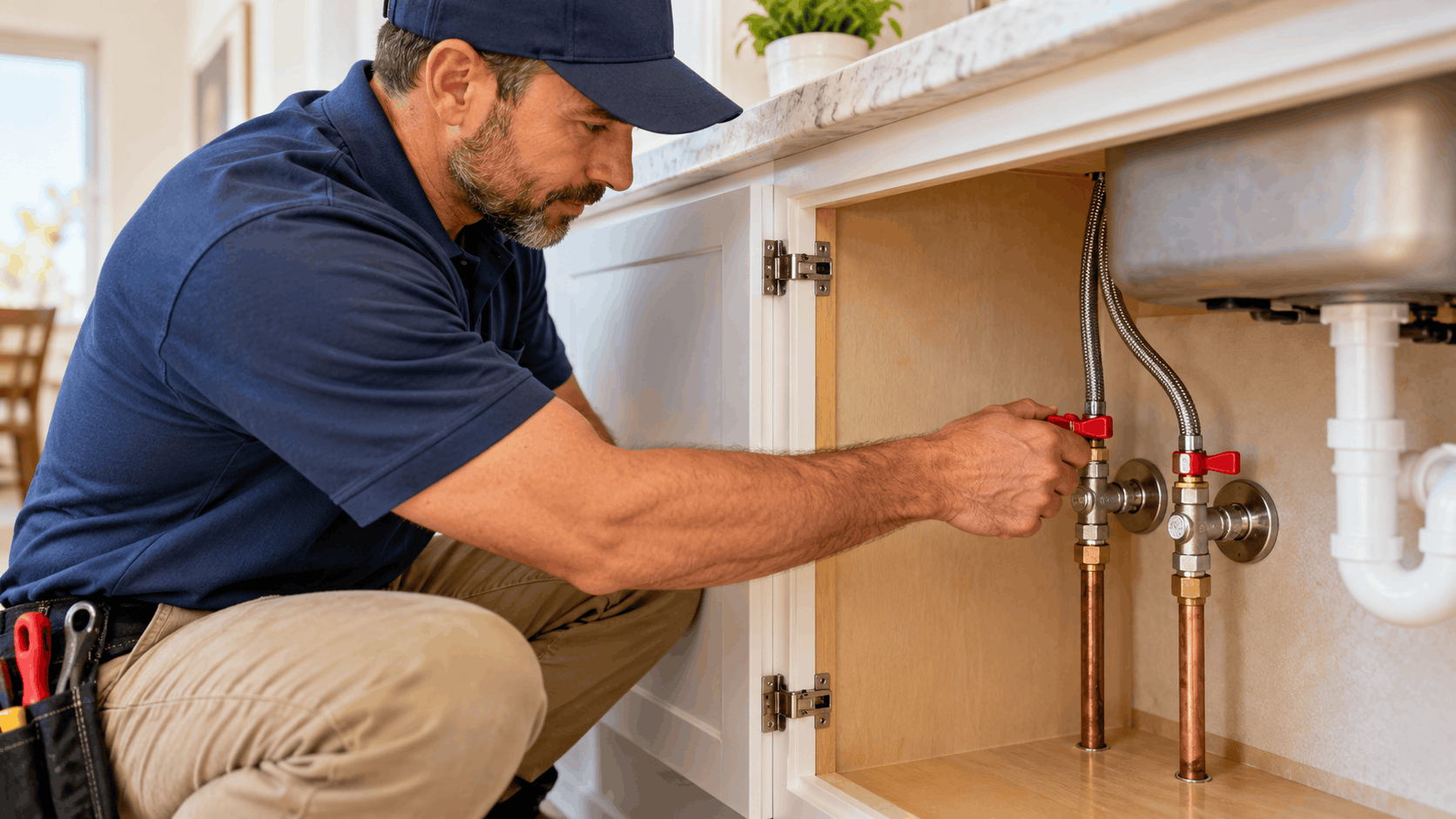
When a main shut-off has seized, the fix is to swap it for a quarter-turn ball valve. Instead of a round handle that screws a stem down, a ball valve has a lever that rotates ninety degrees to go from fully open to fully closed. There is no fine thread to scale over and no rubber seat to harden, so it stays easy to operate for decades.
For arthritic hands or limited strength, this change is a small job with disproportionate value. A quarter turn of a lever closes the water. There is no straining against a stuck handle and no risk of snapping a brittle stem. A resident who could not budge the old valve can work the new one with one hand.
The work itself is straightforward for a licensed plumber. We isolate the line, cut out the old valve, and install the new quarter-turn valve, often adding a short section of fresh pipe if the existing stub is corroded. The house is back on water quickly, and the resident has real control over it again.
This is exactly the kind of practical, protective upgrade that suits this community. It costs little, it is done in one visit, and it changes how safe the whole house is when something goes wrong.
Fixture Shutoffs Under Every Sink and Toilet
Individual angle stops under each sink and toilet let a resident isolate one fixture without cutting water to the whole house. If a toilet fill valve sticks on or a faucet connector weeps, a working stop at that fixture stops the water right there. The rest of the house keeps running while the repair happens.
The problem is that thirty-plus-year-old stops often freeze or weep the first time anyone turns them. The same scale that seizes the main valve seizes these smaller ones, and they get turned even less often. A homeowner reaching under the sink in a hurry may find the stop will not move, or that turning it starts a new drip from the packing.
Replacing old multi-turn stops with quarter-turn stops gives every fixture the same easy control as the new main valve. A quarter-turn lever under the sink is simple to reach and simple to close, which matters for anyone who finds bending and twisting difficult. We often replace the supply connector at the same time, since a thirty-year-old braided line is a burst waiting to happen.
Doing this at each fixture builds a layer of protection into the whole house. A leak at any single point can be stopped at that point, without a trip to the garage and without shutting down the entire home.

Need Help in Las Vegas?
Active Plumbing serves Las Vegas and all of Las Vegas Valley.
Fixtures Built for Aging in Place
Accessibility work is a genuine service line in Sun City Summerlin, not a niche. Residents are 55 and over, many considerably older, and the hardware that makes daily use safer and easier is something they actively want. Family members researching on a parent's behalf are a real audience for this too.
The goal with aging in place work is to make everyday fixtures easier and safer to use without making the home feel like a hospital. Lever handles, comfort-height toilets, walk-in showers and anti-scald protection all do that. They replace the original builder fittings these homes came with, which were never designed for changing abilities.
We discuss these options plainly and without condescension. A resident deciding what to change in their own bathroom deserves straight information about what each fixture does and what the work involves.
Lever Handles and Single-Lever Mixers
Round faucet knobs require a firm grip and a twisting motion, which is exactly what arthritic hands struggle with. Lever handles and single-lever mixers solve that. A lever can be pushed with a wrist, an elbow or the back of a hand, and a single-lever mixer controls both temperature and flow with one easy motion.
These replace the original two-handle builder fittings that came with most Sun City Summerlin homes. Swapping them is usually a direct fixture change at the sink or tub, though in very hard water the old valve bodies underneath may be scaled enough to warrant replacing more than just the handles. We check the condition of the valve, not only the handle, before quoting the work.
The daily difference is real. A resident who had started avoiding a stiff faucet because it hurt to turn can use a lever version without a second thought. It is a small change that restores independence at the sink.
Our fixture installation and repair covers lever faucets, single-lever mixers and the connections behind them, so the whole fitting works easily, not just the handle you see.
Comfort-Height Toilets and Walk-In Shower Conversions
Comfort-height toilets sit higher than a standard toilet, which makes sitting down and standing back up far easier on the knees and hips. The install is a plumbing job that reconnects to the existing flange and supply, and in these homes it is a common and welcome upgrade. It is one of the simplest accessibility changes with one of the biggest daily payoffs.
Walk-in shower conversions replace a step-over tub with a low or zero-threshold shower. This is real plumbing work, not just a surface change. The drain is relocated and reset, the valve is replaced, and the supply is reworked to suit the new layout. For a resident who finds climbing into a tub risky, removing that step removes a genuine fall hazard.
Grab bars often tie into this work. Where a grab bar lands near plumbing, or where a wall is already open for a shower conversion, coordinating the bar placement with the plumbing makes for a cleaner, stronger result. We handle the plumbing side and make sure the layout supports safe bar placement.
Larger conversions like these fall under bathroom remodel plumbing, where several fixtures and lines change at once. We scope the whole job up front so a resident knows exactly what the conversion involves.
Anti-Scald and Thermostatic Mixing Protection
Anti-scald protection and thermostatic mixing valves control hot water temperature so it cannot spike to a dangerous level at the tap or shower. A thermostatic mixing valve blends hot and cold to hold a steady, safe temperature even if someone flushes a toilet or runs another fixture. For a resident at risk of burns, this is protection that works automatically.
This matters more here because of a documented local condition. Southern Nevada summer heat raises the incoming water temperature, which stresses outdoor and garage-located equipment and can push delivered hot water higher than expected. A mixing valve keeps the output in a safe range regardless of what the heat is doing to the supply.
Older residents are more vulnerable to scald injuries because reaction time and skin sensitivity change with age. A couple of seconds of very hot water that a younger person would pull away from can cause a real burn. Setting a safe maximum temperature at the valve removes that risk without the resident having to manage it.
We can add thermostatic mixing at the water heater to protect the whole house, or at a specific shower or tub where the concern is greatest. The right placement depends on the home and how the resident uses it.
Easy-Reach Valves and Reach-Free Laundry Arrangements
Easy-reach shut-off valves put the control where a resident can actually get to it without crawling into a cabinet or behind an appliance. A valve mounted at a sensible height and position means a resident can shut water off without bending, kneeling or straining. That is the whole point of designing the arrangement around the person, not the plumbing.
The laundry is a common trouble spot. Original washing machine hoses in these homes are frequently still the ones installed decades ago, and a rubber hose that old is a burst risk. A failed hose can dump water fast while no one is home. Replacing old hoses with braided steel versions and adding an easy-reach laundry shutoff removes both the burst risk and the struggle of reaching behind the machine.
Utility arrangements can be reworked so nothing requires an awkward reach. A single-lever laundry valve box, accessible connections and well-placed stops all reduce the bending and twisting that make these chores harder with age. These are small changes that add up to a home a resident can manage comfortably.
We look at the laundry and utility areas as part of any accessibility visit, since they are easy to overlook and quick to improve.
The Quiet Problems a Service Visit Catches
Some of the most important problems in these homes are the ones a resident cannot see. A thermal expansion tank, a pressure regulator and the inside of a water heater all fail quietly, and they routinely get missed. Knowing what to ask about means a resident can make sure a service visit actually checks them.
These are the items we inspect on every visit to a Sun City Summerlin home, because the housing stock and the water chemistry make them predictable. Catching a worn regulator or a failed expansion tank early prevents the larger failures they cause downstream.
None of this requires a resident to be technical. It just helps to know the names of the parts so the right questions get asked.
Thermal Expansion Tanks That Fail Silently
A thermal expansion tank absorbs the pressure increase that happens when water heats up and expands. Inside it is an air bladder that gives the expanding water somewhere to go. When the bladder fails, the tank stops doing its job, and the extra pressure has to escape somewhere else.
That somewhere is usually the water heater's relief valve, which starts to drip. The dripping relief valve is frequently mistaken for a faulty valve and replaced, when the real culprit is the dead expansion tank. Swapping the relief valve does not fix it, and the drip comes back, because the pressure problem is still there.
These tanks are routinely missed because they fail with no obvious sign until the relief valve starts weeping. A resident may not know the tank exists, and a quick visit that only looks at the heater can overlook it entirely. We check the expansion tank whenever we see a dripping relief valve, since that is so often the actual cause.
In a home that has been through two or three water heaters, the expansion tank may be original or may have been skipped during a past swap. Confirming it is present and working is part of a proper water heater inspection.
Pressure Regulators That Creep High or Drop
A pressure regulator sits on the main line and holds incoming water pressure at a safe level for the house. Over time these wear out, and they fail in one of two directions. Some creep high and let pressure climb until it stresses fixtures, supply lines and the water heater. Others drop and leave the house with weak flow at every faucet.
High pressure is the more damaging failure. It accelerates leaks at connectors, strains valves and can trigger the relief valve on the water heater. A resident who notices banging pipes, a running relief valve or supply lines failing more often may have a regulator that has crept high without anyone checking.
Because of this, a two-minute incoming pressure check belongs on every visit. We put a gauge on a hose bibb or laundry connection and read the pressure directly. If it is too high or too low, the regulator is the likely cause, and replacing it is a contained job that protects everything downstream.
In thirty-five-year-old homes, many regulators are original or well past their service life. Checking pressure is quick, and it catches a problem that quietly shortens the life of every fixture in the house.
Original Water Heaters and Flushing in Hard Water
Most Sun City Summerlin homes are on their second or third water heater by now, because original units are long gone. The ones that fail early and repeatedly are almost always the ones that were never flushed in this water. Very hard water is the reason.
Scale from the valley's 16-grain water settles on the heating elements and the bottom of the tank. That layer of mineral insulates the water from the heat source, so the unit has to work harder to reach temperature. A tank left unflushed in very hard water works harder and fails earlier than its rated life. The scale also promotes corrosion and can cause the popping and rumbling sounds residents hear from an aging heater.
Regular flushing removes that sediment before it hardens into a thick crust. On a tank heater it means draining the sediment out on a schedule. On a tankless unit, descaling clears the narrow heat exchanger that scale fouls fastest. Either way, flushing is standard practice here, not an upsell. You can see the full scope of our water heater services, including flushing and replacement.
When a heater has already failed early once, that is the signal to address the water chemistry so the replacement lasts closer to its rated life. Protecting the new unit is cheaper than replacing it again on the same schedule.
Treating the Hard Water That Shortens Fixture Life
For a household on a fixed income, the honest framing on hard water is cheap before expensive. Handle the small maintenance first, then consider treatment once the simple steps have been done. There is no reason to jump to a large purchase when inexpensive actions reduce the scale burden right away.
Treatment matters because it protects the shutoffs, valves and fixtures this whole guide is about. A softener or scale reduction system slows the mineral buildup that seizes valves and clogs fixtures in the first place. But it is the second step, not the first.
The water here is genuinely very hard at 280 ppm, so scale is real and ongoing. The question is only how much to spend and when, and the answer depends on the home and the budget.
Cheap Steps First: Flush, Clean, Check
The low-cost actions come first because they reduce scale burden for little or no money. Flushing the water heater clears the sediment that makes it work harder. On a fixed income, a flush is far cheaper than a new heater, and it buys real years of service.
Cleaning aerators and shower heads restores flow that scale has slowly choked off. Many residents assume their water pressure is failing when the real problem is a clogged aerator that unscrews and soaks clean in vinegar. This is something a resident can often do themselves, and it makes an immediate difference at the tap.
Checking the incoming pressure rounds out the cheap steps. A quick gauge reading tells whether the regulator is holding pressure in a safe range, which protects every fixture downstream. These three steps, flush the heater, clean the aerators, and check the pressure, are the sensible starting point before any larger spend.
Doing these first also makes it clear whether treatment is really needed yet. If the simple maintenance keeps things working well, a big purchase can wait.
Softeners and Scale-Reduction Systems
A whole-house water softener removes the calcium and magnesium that cause scale, using a resin that exchanges those minerals for sodium. A salt-free conditioner takes a different approach, altering the minerals so they are less likely to stick, without removing them. Both reduce the maintenance burden and protect shutoffs, valves and fixtures from the scale that seizes and clogs them.
In this valley, treatment extends equipment life rather than being a luxury. Softer water means valves stay easier to turn, aerators stay clear, cartridges stay smooth, and the water heater builds scale far more slowly. For an older household, that means fewer repairs and less fuss over the years.
The honest timing is cheap before expensive. Flush, clean and check first, then consider a system when a heater has already failed early once or when the maintenance burden is wearing the resident down. That is when treatment stops being optional and starts paying for itself. Our water treatment options cover both softeners and salt-free conditioning so a resident can match the system to their needs and budget.
We size and recommend based on the actual home, not a one-size pitch. The right system for a two-person household is often simpler than a resident expects.
Association Approval for Visible Treatment Systems
The Sun City Summerlin community association governs under Nevada Revised Statutes Chapter 116, with architectural standards covering exterior appearance. A treatment system installed on a street-facing elevation, or anything visible from the street, can require association approval. Interior work generally does not.
That distinction matters when placing a softener or conditioner. A system tucked in the garage or an interior utility space is usually an internal matter, while a unit mounted on a visible exterior wall may fall under the architectural standards. The same applies to an exterior tankless unit or a visible filtration setup on a street-facing side of the home.
Association approval and a building permit are separate tracks. One is the association reviewing exterior appearance, and the other is the city reviewing the plumbing work. Where both apply, both have to be satisfied, and clearing one does not clear the other. We help residents understand which track their project touches.
Because standards and review timelines can change, confirm the current requirements with the community association office before installing anything on a visible elevation. That one call avoids a system that has to be moved later.
Need Help in Las Vegas?
Active Plumbing serves Las Vegas and all of Las Vegas Valley.
Protecting Yourself From Scams and Pressure Selling
Older homeowners are disproportionately targeted by unlicensed operators and by high-pressure upselling, and Sun City Summerlin is exactly the kind of community these operators look for. The honest counter to that is concrete and protective, and every resident is entitled to use it.
The three defenses are simple. Ask for a license number and verify it, get a written price before any work starts, and never let anyone pressure a decision on the doorstep. A legitimate plumber welcomes all three.
Las Vegas has a significant unlicensed trade problem, which makes these steps genuinely protective here rather than abstract advice. They separate a real business from the operators residents have learned to fear.
Ask for the License Number and Verify It
A customer is entitled to ask any plumber for their Nevada State Contractors Board license number. A licensed contractor will give it without hesitation. An operator who dodges the question, gives a vague answer or gets defensive has told you what you need to know.
Verification is free and takes a minute at nvcontractorsboard.com. There you can confirm the license is current and see the classification, status, bond and workers compensation, all of which are public record. Classification tells you the contractor is licensed for plumbing specifically, not something unrelated.
Contractor licensing in Nevada is statewide through the Nevada State Contractors Board, not through the county or the city. So the same verification works for any address in the valley. If someone claims to be "county licensed" for plumbing, that is a sign they do not understand how licensing works here.
Doing this before work starts, not after a problem, is the point. The license check is the first filter, and it screens out the operators who target this community.
A Written Price Before Any Work Starts
A written price should be given before work starts, and no legitimate plumber needs a decision made on the doorstep. A written, itemized quote lets a resident read it at leisure and discuss it with family before committing. That alone defeats most high-pressure tactics.
Pressure selling relies on rushing the decision. "This price is only good today" and "I can start right now if you decide now" are the lines to walk away from. A real repair will still be there tomorrow, and a real quote holds up when a family member reads it over the phone.
For an age-restricted community where a resident may want a son or daughter to weigh in, a written price is more than a formality. It is a document that can be shared, questioned and understood without anyone standing over the homeowner. That is exactly why it protects this audience.
We give a written price before work starts as a matter of practice, so a resident always knows the number before anything begins. It is there to be read, not rushed.
How a Well-Networked Community Spots Bad Actors
Sun City Summerlin is unusually well networked. Residents talk to each other constantly through clubs and the recreation centers, and that word-of-mouth is a real defense against bad actors. A contractor who does right by one household gets referred across the neighborhood, and one who does not gets talked about just as fast.
The association centers are the hubs for this. Mountain Shadows at 9107 Del Webb Boulevard holds the association office, Desert Vista sits at 10360 Sun City Boulevard, and Sun Shadows and Pinnacle round out the four. Residents cross paths at these centers constantly, and a bad experience with a plumber travels through those conversations quickly.
That network works for residents who use it. Asking a neighbor who they trust, and checking that recommendation against a license verification, is a strong combination. A referral tells you someone had a good experience, and the license check confirms the basics are in order.
Operators who rely on a quick sale and a fast exit do not survive in a community that talks this much. That is one more reason the honest steps work especially well here.

Knowing Your Jurisdiction and Permits
Summerlin spans both unincorporated Clark County and the City of Las Vegas, and the boundary is not obvious from the street. Sun City Summerlin itself sits within City of Las Vegas limits. Still, because Summerlin as a whole crosses jurisdictions, the right answer is always to confirm the permit counter for the specific address before quoting permitted work.
This matters for easy-access and fixture work because some of it needs a permit and some of it does not. Knowing which applies, and which department handles it, saves time and keeps the job clean.
Going to the wrong counter costs time, which is why establishing the correct jurisdiction is a routine first step on any permitted job here.
Where Sun City Summerlin Sits
Sun City Summerlin is the Del Webb active adult village inside City of Las Vegas limits. The community association map shows it bounded by the 215 Beltway on the north, Lake Mead Boulevard on the south, North Rampart Boulevard on the east and Summerlin Parkway on the west. Those four roads frame the whole community.
Del Webb Boulevard is the main loop, with Sun City Boulevard and Thomas W. Ryan Boulevard carrying the rest of the internal traffic. Residents orient by these roads and by the golf courses and recreation centers along them, from Palm Valley at 9201 Del Webb Boulevard to the association centers scattered across the village.
Knowing the community sits within City of Las Vegas limits points to the likely permit authority. But because Summerlin as a whole straddles the city and unincorporated county, we confirm the exact address rather than assume. The Pueblo and The Trails lie south across Lake Mead Boulevard, which is a reminder of how quickly the surrounding context changes.
For broader context on the area we serve, our Summerlin service page and the Las Vegas location page cover the wider jurisdiction.
Which Work Needs a Permit and the Code That Applies
The Southern Nevada Amendments to the Uniform Plumbing Code apply as codified by whichever jurisdiction governs the property. For Sun City Summerlin, that is the City of Las Vegas, confirmed for the specific address. The code is the local framework for how plumbing work has to be done and inspected.
Not every job needs a permit. A straightforward like-for-like fixture swap or a shut-off valve replacement is often minor work, while larger jobs such as moving drain lines for a shower conversion or reworking supply are more likely to require one. Because the line between the two depends on the scope and the jurisdiction, the permit position should be confirmed for the specific address rather than assumed from a general rule.
Southern Nevada adopted the 2024 Uniform Plumbing Code with Southern Nevada Amendments, which took effect in the City of Las Vegas on January 5, 2026. Those amendments carry fixture flow rules and other requirements that bear on fixture and treatment work. A licensed contractor works to the current adopted code for the address.
We confirm the permit position and handle the code side so a resident does not have to track which edition and which amendments apply to their home.
Separating Association Review From a City Permit
Association architectural review and a city building permit are two separate tracks where both apply. The association reviews exterior appearance under its architectural standards. The city reviews the plumbing work itself under the adopted code. One does not substitute for the other.
This distinction decides which of your projects touch which track. Interior shutoff and fixture work, such as replacing a main valve, swapping angle stops or installing lever faucets, is generally an internal matter that does not change the home's exterior appearance. Anything on a street-facing elevation, like a visible treatment system or an exterior unit, can trigger association review on top of any permit.
Where both apply, both have to be cleared. Getting a permit does not satisfy the association, and getting association approval does not satisfy the city. Treating them as separate from the start avoids a stalled project.
We help residents sort which track their specific job touches, so there are no surprises partway through. Confirming both up front keeps the work moving.
What Easy-Access Shutoffs and Fixtures Cost?
The figures below are typical market ranges for plumbing work in the Las Vegas Valley, presented as ranges for the area and never as a quote or a fixed price from us. The actual price for a specific job depends on that job, and we give a written price before work begins. Use these to know what to expect, not as a bill.
Several things move a job up or down in these thirty-five-year-old homes, from corroded access points to accessibility add-ons. Here are the ranges that apply to shutoff, fixture and treatment work.
| Work | Typical valley range |
|---|---|
| Fixture installation | $150 to $400 |
| Backflow preventer testing | $50 to $100 |
| Backflow device installation | $300 to $600 |
| Bathroom and kitchen remodel plumbing | $800 to $3,500 |
| Water softener installation | $800 to $2,500 |
| Salt-free water conditioning | $800 to $2,500 installed |
| Tank water heater installation | $800 to $1,500 |
| Water heater repair | $150 to $500 |
Typical Ranges for Fixtures and Shutoff Work
For fixture and shutoff work, fixture installation runs $150 to $400 as a typical valley range. That covers the kind of direct swaps common in this community, like a lever faucet or a comfort-height toilet, where the connection is straightforward. Replacing a seized shut-off or an angle stop falls into the same category of contained fixture-level work.
Backflow preventer testing is a typical $50 to $100, and backflow device installation runs $300 to $600. These apply where a property has an assembly that needs testing or replacement, which is more common on irrigation and certain setups than on a standard interior fixture job.
Larger conversions step up into bathroom and kitchen remodel plumbing at $800 to $3,500. A walk-in shower conversion that relocates a drain and replaces a valve sits in that range rather than the simple fixture range, because more lines and fixtures change at once.
These are typical area ranges. The written price for any specific job is given before work begins, because the real number depends on what the plumber finds at the home.
Ranges for Water Treatment and Heaters
For residents weighing the cheap-before-expensive path, the treatment and heater ranges help frame the decision. Water softener installation runs $800 to $2,500, and salt-free water conditioning runs $800 to $2,500 installed. Those are the larger steps to take once the simple maintenance has been done.
On the heater side, tank water heater installation is a typical $800 to $1,500, and water heater repair runs $150 to $500. A repair or a flush is the lower-cost route when a heater still has life in it, while a full replacement is the larger spend when the unit has reached the end.
Seeing these side by side makes the cheap-before-expensive logic clear. A flush or a repair is a fraction of a new heater, and a softener is a one-time investment that slows the scale shortening every fixture's life. A resident can sequence the spend to match the budget.
As with all of these, the figures are typical ranges for the valley. The written price for the specific home comes before any work starts.
What Changes the Final Price in These Homes
Several factors push a job toward one end of its range in thirty-five-year-old Sun City Summerlin homes. Aging access points are a common one. If the shutoff being replaced is itself seized, or the surrounding pipe is corroded, the plumber may need to work back to sound material, which adds to a simple swap.
Hidden corroded stops are another. A quote to replace one fixture can grow if the angle stop under it crumbles when touched, or if a supply connector has to be replaced alongside it. These are the small surprises that an old home produces, and they are why a firm number comes after a look, not before.
Accessibility add-ons shape the price too. A straight fixture swap sits at the lower end, while coordinating grab bars, relocating a drain for a walk-in shower or adding thermostatic mixing moves the job up. The more the layout changes, the more the price reflects that.
One more factor is timing. After-hours emergency calls carry a service fee of $150 to $300 plus repair costs. Knowing where the main shut-off is, and that it works, is part of avoiding an after-hours call in the first place.

Need Help in Las Vegas?
Active Plumbing serves Las Vegas and all of Las Vegas Valley.
How Active Plumbing Handles the Job in Sun City Summerlin
Working in an age-restricted community changes how a job is done, not just what gets fixed. Clear explanation, a schedule that is actually kept, identification at the door, tidiness and floor protection all matter here, and they are noticed. We approach every Sun City Summerlin home with that in mind.
The written price before work starts anchors the whole visit. A resident knows the number before anything begins, and it is explained plainly enough to read later and talk over with family. That suits a community where decisions are often shared across a household.
Everything below reflects how we actually work, drawn from what we can state plainly about the business.
A Clear Explanation and a Written Price First
We give a written price before work starts. It is explained in plain language, not technical shorthand, so a resident understands what the job involves and why. This is a business practice, there to make the decision clear, not a guarantee of anything beyond the number itself.
A written price that can be read at leisure and discussed with family is worth more than a verbal number in this community. A resident can set it aside, call a son or daughter, and come back to it without pressure. That is exactly what defeats the doorstep pressure older homeowners are warned about.
Clear explanation runs through the whole visit. We tell a resident what we found, what the options are, and what each one does, without talking down to anyone. The goal is a homeowner who understands their own plumbing well enough to make a confident choice.
When the scope is clear and the price is in writing, there are no surprises. That is how we want every Sun City Summerlin job to feel.
Scheduling, Identification and Protecting the Home
Scheduling that is actually kept matters here, because a resident may have arranged their whole day around the appointment. We treat the scheduled time as a commitment, since a missed window is a real disruption for someone who planned around it.
Identification, tidiness and floor protection are all noticed and talked about in this community. We arrive identifiable, keep the work area clean, and protect floors so the home is left the way we found it. These are small things that signal respect for the resident and their house.
For urgent problems, our technicians arrive in 30 to 60 minutes anywhere in the Las Vegas Valley. That response window matters most in a one or two person household where a leak or a backup is a situation, not an inconvenience. Our emergency plumbing team covers the valley for exactly these moments.
Doing right by a resident gets noticed across a networked community, and that is the standard we hold every visit to.
A Fourth-Generation Local Team
Active Plumbing is a fourth-generation family plumbing business that has served the Las Vegas Valley since 1991. Some of our owners are US military veterans. That long local history means we have worked across the valley's build eras, including communities like Sun City Summerlin where original equipment has aged out.
We hold Nevada plumbing license NSCB #0047021, verifiable free at nvcontractorsboard.com, along with the certifications required for the work we perform. Any resident can check that license and see the classification, status, bond and workers compensation for themselves, which is exactly the verification we encourage people to do with any contractor.
Being local and long established means we know how this valley's water chemistry and build history shape the work. The 16-grain water, the slab-on-grade construction and the thirty-five-year-old fittings in Sun City Summerlin are familiar ground, not a learning curve.
You can read more about our history on the about page, and the license is public record for anyone who wants to confirm it.
Protect Your Home Before the Next Leak
Finding the main shut-off and swapping a seized valve for a quarter-turn is the single best step a Sun City Summerlin resident can take, and our team gives a written price before any work starts. Call Active Plumbing at (702) 438-3357 to schedule a visit, and we will check the valve, the pressure and the fittings while we are there.
Frequently Asked Questions
- Why won't my main water shut-off turn?
- A main shut-off that is thirty-plus years old and has never been turned frequently seizes. Very hard water deposits scale on the valve stem and seat over the decades, and that scale hardens into a grip that locks the handle. Forcing it can snap the stem and make things worse. Replacing the seized valve with a quarter-turn ball valve restores easy control, since a lever has no fine thread to scale over and stays easy to close.
- How much does it cost to replace a shut-off valve or fixture?
- Fixture installation runs a typical $150 to $400 in the Las Vegas Valley, which covers the kind of direct swaps common in Sun City Summerlin, including replacing a seized shut-off or an angle stop. That is a typical area range, not a quote. The actual price for your specific job depends on what we find, such as corroded pipe behind the valve, and we give a written price before work begins so you know the number up front.
- Can you install lever handles for arthritic hands?
- Yes. Lever handles and single-lever mixers replace the round knobs that are hard to grip and twist, which is exactly what arthritic hands struggle with. A lever can be pushed with a wrist, elbow or the back of a hand. These are common accessibility upgrades in this community, replacing the original two-handle builder fittings. In very hard water we also check the valve body underneath, since scale can make the whole fitting stiff, not just the handle.
- Do I need an association approval or a permit for this work?
- Interior shutoff and fixture work usually differs from street-facing changes. Replacing a main valve, swapping angle stops or installing lever faucets is generally internal and does not change the home's exterior appearance. Anything visible from the street, like an exterior treatment system, can require association review under the community's architectural standards. Association review and a city building permit are separate tracks, and both can apply. Confirm the position for your specific address, since Summerlin spans the city and unincorporated county.
- Will anti-scald protection stop burns at the tap?
- A thermostatic mixing valve and anti-scald devices control the hot water temperature so it cannot spike to a dangerous level at the tap or shower. The valve blends hot and cold to hold a steady, safe temperature even when another fixture is used. This matters more here because Southern Nevada summer heat raises the incoming water temperature, which can push delivered hot water higher than expected. For an older resident at risk of burns, setting a safe maximum removes that risk automatically.
- What is the dripping valve on my water heater?
- A dripping relief valve is frequently a thermal expansion tank problem rather than a faulty valve. The expansion tank absorbs the pressure increase when water heats and expands. When its internal bladder fails, that extra pressure escapes through the relief valve as a drip. Replacing the relief valve alone does not fix it, because the real cause is the dead expansion tank. We check the expansion tank whenever we see a dripping relief valve, since that is so often the actual culprit.
- How do I check a plumber is licensed in Nevada?
- Plumbing licensing in Nevada is statewide through the Nevada State Contractors Board, not the county or city. You can verify any plumber free at nvcontractorsboard.com, where the license classification, status, bond and workers compensation are all public record. Ask for the license number before work starts, and verify it yourself. A licensed contractor gives it without hesitation. This is one of the strongest protections against the unlicensed operators who target older homeowners in this community.
- Which building department covers Sun City Summerlin?
- Sun City Summerlin sits within City of Las Vegas limits, so the City of Las Vegas is the likely permit authority. Because Summerlin as a whole spans both the City of Las Vegas and unincorporated Clark County, and the boundary is not obvious from the street, we confirm the permit counter for your exact address before quoting permitted work. Going to the wrong counter costs time, so establishing the correct jurisdiction is a routine first step on any permitted job here.
- Is a water softener worth it in Sun City Summerlin?
- The valley's water is 280 parts per million, or about 16 grains per gallon, categorized as very hard. A softener or scale-reduction system reduces the maintenance burden and protects shutoffs, valves and fixtures from the scale that seizes and clogs them, which extends equipment life. For a fixed-income household, the honest order is cheap steps first, flush the heater, clean the aerators, check the pressure, then consider a system once a heater has already failed early once.
- How fast can someone get to my home for a leak?
- Our technicians arrive in 30 to 60 minutes anywhere in the Las Vegas Valley. In a one or two person household, a leak or a backup is a situation, not an inconvenience, so a fast response matters here. Before any emergency arrives, find your main shut-off and test whether it actually closes. A valve that works, plus a quick response, is the combination that keeps a small leak from becoming a flooded floor.
Licensed plumbing professionals serving Las Vegas and Las Vegas Valley.
Licensed in Nevada · License #0047021
Last updated on
Why trust Active Plumbing?
Founded in 1991, Active Plumbing is a licensed and insured plumber serving Las Vegas and Las Vegas Valley. All content is reviewed by our licensed technicians.

Need Help in Las Vegas?
Active Plumbing serves Las Vegas and all of Las Vegas Valley.
Related Articles
Hard Water at Thirty Years in Summerlin North, From Scale to Failed Valves
After thirty years on 16-grain water, Summerlin North heaters, valves and cartridges fail from scale. Here is the mechanism, the fixes, and how the work is done.
What Our Summerlin Plumbing Calls Show About Which Villages Break Most
Summerlin's plumbing calls follow build era, not luck. See which villages break most, from Sun City to Summerlin West, and what repairs and repipes typically cost.
Thirty-Five Years Across Thirty Villages: A Summerlin Plumbing Guide by Build Era
A Summerlin plumbing guide by build era, from 1989 Sun City homes to Summerlin West, covering likely pipe material, jurisdiction and typical costs by village.