Slab Leak Detection in Sun City Summerlin Single-Story Homes

Key Takeaways
- Sun City Summerlin's earliest Del Webb phases are about 35 years old, built slab-on-grade with copper supply lines that now reach the point where pinhole leaks begin, especially on hot lines.
- The valley's very hard water at 280 ppm, about 16 grains per gallon, deposits scale that adds wear to aging buried copper lines over the decades.
- Common signs include water running with every fixture off, a warm spot on the floor, damp or lifting flooring, a water bill jump with no new use, and a drop in pressure.
- Acoustic and electronic detection plus line isolation pinpoint the leak before any concrete is opened, which keeps the repair opening small and the cost down.
- Typical valley ranges are slab leak detection $150 to $300, electronic leak detection $150 to $350, slab leak repair $500 to $3,000, and a whole-house repipe $4,000 to $15,000.
- Repair choices are a spot repair through the slab, rerouting the line above the slab on aging copper, or a whole-house repipe when a home has had repeated leaks.
- Permitted work for Sun City Summerlin goes through the City of Las Vegas, interior slab work rarely needs HOA review, and a license can be verified free at nvcontractorsboard.com.
- Active Plumbing holds Nevada license NSCB #0047021, arrives in 30 to 60 minutes valley-wide, detects the leak first, and gives a written price before work starts.
In This Article
A Sun City Summerlin homeowner turns off every faucet, closes every valve, and stands still in the kitchen. The house is quiet, but somewhere under the floor, water is still moving. That faint hiss or the warm patch that shows up on the tile near the hallway is often the first sign of a leak in a supply line running beneath the concrete slab.
In a community where the earliest homes are about thirty-five years old, that scene plays out more than residents expect. The original copper supply lines in these Del Webb homes have reached the age where small leaks start, and the very hard water here does not help. A slab leak is not a drip you can see and wipe up. It hides under the foundation, and finding it without tearing up a floor takes the right equipment and a careful approach.

Why Slab Leaks Show Up in Sun City Summerlin Homes?
Sun City Summerlin is the oldest part of Summerlin by a wide margin. Del Webb began building it in 1989, and the earliest phases are now about thirty-five years old. That age, combined with the way these homes are built and the water that runs through them, puts under-slab supply failures into their own category of plumbing work here.
A slab leak is a leak in a pressurized water line that runs under the concrete the house sits on. Because the pipe is buried, the signs are indirect and the fix is more involved than a leak you can reach. A copper pinhole leak under the slab of a Sun City Summerlin home brings together three things at once: the age of the pipe, the hardness of the water, and the heat the system carries in summer. The table below lays out how each factor adds to the risk.
| Factor | What It Does | Why It Matters Here |
|---|---|---|
| Build era (1989 onward) | Earliest phases are about 35 years old | Original copper and fittings have genuinely aged out |
| Slab-on-grade foundation | Supply lines run under the concrete | A leak there is a distinct repair category, not a simple patch |
| 280 ppm hard water | Deposits scale that narrows pipe bore | Adds wear to lines that are already decades old |
| Summer heat | Raises incoming water temperature | Hot-line runs under the slab carry extra stress |
Slab-On-Grade Construction From 1989 Onward
When Del Webb developed Sun City Summerlin starting in 1989, the homes went up as slab-on-grade construction, like most of the valley. That means the house sits directly on a concrete slab poured over graded ground, with no basement or crawl space underneath. The water supply lines for the house run inside or beneath that slab.
This building method is common and cost-effective, and it holds up well in a dry desert climate. The trade-off shows up decades later. When a supply line under the slab fails, there is no easy access panel to reach it. The pipe is encased in or buried below concrete, so getting to a leak means either breaking through the floor or routing around the problem.
The earliest phases of this community, along the Del Webb Boulevard loop and the streets off Sun City Boulevard, are now at the point where the original plumbing has aged out. A home built in the first phase has carried water through the same buried lines for over three decades. That is why slab leaks are a real, recurring category of work in Sun City Summerlin rather than a rare event.
Understanding the foundation type helps a homeowner grasp why the repair choices are what they are. You are not dealing with an exposed pipe in a wall. You are dealing with a line locked under concrete, and that shapes every decision that follows once a leak is confirmed.
Aging Copper and Under-Slab Hot Lines
Copper was the standard supply material in the earlier phases of Sun City Summerlin, and copper of that age reaches the point where pinhole leaks begin. These are tiny perforations that open in the pipe wall, often letting water escape slowly at first. A pinhole leak can run for weeks under a slab before the homeowner notices anything at all.
Hot lines are a frequent trouble spot. Water running hotter puts more stress on the pipe, and the under-slab hot run is a common place for a leak to start in a home this age. When a homeowner reports a warm patch on the floor, the buried hot line is usually the first suspect. That warmth is heated water escaping and spreading through the slab.
The reason copper develops these failures is partly about time and partly about what the water carries. Over decades, the inside of the pipe is exposed to constant flow, mineral content and temperature cycling. Small weak points eventually give way. On a slab-on-grade home, the leak then has nowhere to go but into or under the concrete.
This is why slab leak detection and the choice between breaking the slab or rerouting the line is a genuine category of work in these homes, not a theoretical one. Once copper starts producing pinhole leaks, a home can see more than one over time, and that pattern shapes the repair decision. Our team treats a confirmed copper pinhole leak as a sign to look at the condition of the whole run, not just the one spot.
How 280 PPM Hard Water Works on Buried Lines
The Southern Nevada Water Authority states the valley's water is 280 parts per million, or about 16 grains per gallon, which is categorized as very hard. Most valley homes, including those in Sun City Summerlin, are served with Colorado River water from Lake Mead treated by the SNWA. That hardness is a constant across every home in this community.
Very hard water deposits calcium and magnesium scale throughout a plumbing system. Over years, that scale narrows the bore of supply lines and builds up on the inside of pipes. On a buried copper line, this mineral build-up adds to the wear the system already carries from age. It does not create a leak on its own, but it is part of the overall stress an older line is under.
Residents see the same hardness at their fixtures. Scale clogs aerators and shower heads, reduces flow, and leaves the white crusting many describe as hard water stains. The same minerals that crust a faucet are working inside the supply lines the whole time. A home that has never had any treatment has carried that load through every pipe for its entire life.
For a homeowner weighing their options, a whole-house water treatment system reduces the maintenance burden and protects equipment going forward. It will not reverse wear already in place on a buried line, but it eases the load on everything downstream. The honest order for a household on a fixed income is cheap before expensive: flush the heater, clean the aerators, check the pressure, and consider treatment when a heater has already failed early once.
Summer Heat and Higher Incoming Water Temperature
Summer in the valley brings extreme heat, and that heat raises the temperature of the water coming into the home. Incoming water that starts out warmer stresses the system differently than cool water does. The supply lines, the water heater and the fixtures all feel that higher baseline temperature during the hottest months.
On an under-slab run, the hot line already carries the highest temperatures in the home. When the incoming supply is also warmer in summer, the thermal load across the system goes up. This is a documented effect of the desert climate here, and it is part of why the hot-line run under the slab is a known trouble spot in older homes.
The practical takeaway for residents is that summer is often when a hidden slab leak becomes noticeable. A warm floor can be harder to spot when the whole house is warm, but a steady patch of unexplained warmth near the hallway or a bedroom is worth checking. Outdoor and garage-located equipment also works harder in the heat, which is a separate but related stress.
None of this means a pipe is doomed or fails on any set schedule. Heat is one factor among several, and it adds to the wear an older copper system already carries. The sensible response is awareness: know the signs, check the floor, and have a hidden flow confirmed rather than guessed at.
Get Your Quote
Tell us what's going on and we'll get back to you. We're open 24/7.
Warning Signs a Single-Story Home Has a Slab Leak
Most slab leaks announce themselves in small ways before they become obvious. A homeowner who knows what to listen and look for can catch a leak early, which usually means a smaller repair and less water damage. These are the same signs residents describe when they call, and several are easy to check without any tools.
The table below groups the common slab leak signs a single-story home shows, what each one tends to mean, and the quick check a homeowner can do. None of these confirm a slab leak on their own, but together they build a strong case for having the line checked.
| Warning Sign | What It Often Means | Quick Check |
|---|---|---|
| Water running with everything off | Hidden flow somewhere in the system | Read the water meter with no fixtures in use |
| Warm spot on the floor | Leaking hot line under the slab | Walk the floor barefoot for a steady warm patch |
| Damp carpet, lifting tile, musty smell | Water spreading through the slab | Check for soft or discolored flooring |
| Water bill jumped with no new use | Water escaping continuously | Compare recent bills for an unexplained rise |
| Low water pressure | Pressure loss from a leak or worn regulator | Have the incoming pressure checked at the hose bibb |
Water Running With Every Fixture Off
One of the clearest signs is the sound of water moving when nothing is turned on. A homeowner stands in a quiet house, every faucet closed and no appliance running, and still hears a faint hiss or rush through the walls or under the floor. That sound is water escaping from a pressurized line that has no business flowing.
This is where a simple meter check helps. The water meter for the home has a small flow indicator, often a little dial or triangle that spins when water is moving. With every fixture off, a homeowner can look at the meter. If that indicator is still turning, water is flowing somewhere it should not be, and a hidden leak is the likely cause.
The meter check does not tell you where the leak is, only that one exists. On a slab-on-grade home, a hidden flow with everything off often points to a line under the concrete, especially if there are no visible drips at any fixture. It is a quick, free way to confirm something is wrong before calling for help.
We treat a positive meter check as a strong starting point. It tells the technician to look for a hidden source rather than an obvious one, and it justifies bringing out the electronic leak detection equipment needed to pinpoint a buried leak without opening the floor.
Warm Spots and Unexplained Damp Flooring
A warm patch on the floor is one of the most telling signs of a slab leak, and it points specifically to a hot line. Heated water escaping under the concrete warms the slab above it. A homeowner walking barefoot across a tile or laminate floor may notice a spot that is distinctly warmer than the area around it, with no heat source nearby to explain it.
Damp flooring is another signal. Carpet that feels wet or spongy in one area, tile that starts to lift at the edges, or a laminate floor that buckles can all mean water is spreading through or under the slab. The water has to go somewhere, and it often works its way up through the flooring over time.
A musty smell frequently comes along with the dampness. When water sits under flooring for a while, it can lead to mold and a damp, earthy odor that will not go away with cleaning. If a homeowner notices a persistent musty smell in one part of the house paired with damp flooring, a slab leak is a real possibility.
These signs together, a warm spot, damp or lifting flooring, and a musty smell, build a strong case for a hot line leaking under the slab. The sooner that is confirmed and pinpointed, the less water spreads and the smaller the eventual repair tends to be.
A Water Bill That Jumped With No New Use
A sudden rise in the water bill with no change in how the household uses water is a classic leak signal. If the same two people are living the same way and the bill climbs noticeably, that extra water is going somewhere. A slab leak that runs continuously can add a meaningful amount of water use month after month.
Comparing a few recent bills side by side makes the pattern clear. A jump that cannot be explained by new landscaping, guests, or a change in habits deserves a closer look. The water is being metered and billed whether it reaches a fixture or escapes under the slab, so the meter and the bill both reflect a hidden flow.
It helps to know which utility the bill comes from. The water provider bills for water use, so a water bill spike is the relevant one for a slab leak. NV Energy only enters the picture if an electric water heater is involved, such as an electric bill rising from a hidden hot-water leak forcing the heater to work more. For the leak itself, the water provider's bill is the signal to watch.
A homeowner who spots an unexplained bill increase should combine it with the meter check described above. A rising bill plus a spinning meter indicator with everything off is about as clear a sign of a hidden leak as a resident can gather on their own.
Low Pressure and a Pressure Check at the Hose Bibb
Low water pressure can accompany a slab leak, because water escaping from the line means less reaches the fixtures. A homeowner who notices weaker flow at the shower or the kitchen sink, with no clogged aerator to blame, may be seeing the effect of a leak drawing pressure off the system.
Pressure problems in Sun City Summerlin homes are not always a leak, though. Pressure regulators wear out on homes this age, and a worn regulator can either creep too high or drop too low. Because the homes are around thirty-five years old, the original regulator is often past its service life. A two-minute incoming pressure check belongs on every visit for exactly this reason.
That check is straightforward. A technician attaches a gauge to an outdoor hose bibb and reads the incoming pressure. A reading that is too high, too low, or unstable tells the technician a lot about the system before any other work begins. It separates a regulator problem from a possible leak and guides what to check next.
For a resident, the takeaway is that low pressure is worth reporting but not worth self-diagnosing. It could be a worn regulator, a slab leak, or scale narrowing the lines. The pressure check is quick, it costs nothing in time, and it keeps the diagnosis honest by ruling things in or out before anyone talks about opening a slab.

Need Help in Las Vegas?
Active Plumbing serves Las Vegas and all of Las Vegas Valley.
How Slab Leak Detection Actually Works?
The goal of detection is simple: find the exact spot of the leak before any concrete is opened. Getting that location right is what separates a small, targeted repair from a messy, expensive one. A homeowner who understands how detection works can see why it is worth doing carefully rather than rushing to break the floor.
Modern slab leak detection is largely non-destructive. The technician uses specialized equipment to listen for and trace the leak through the slab, narrowing it down to a small area before anyone picks up a tool. The result is a pinpointed location that turns a guessing game into a precise repair.
Electronic and Acoustic Listening Equipment
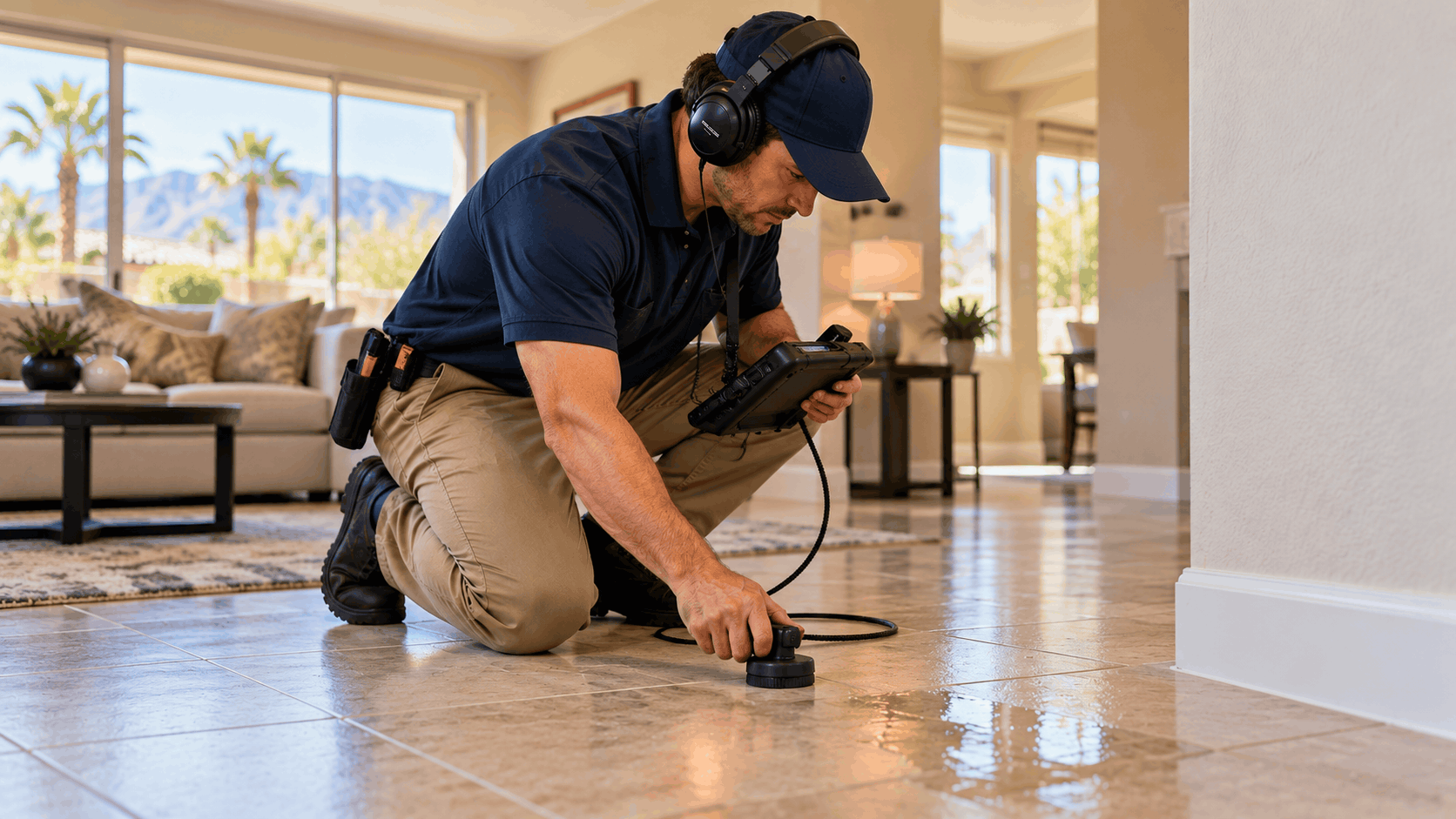
Acoustic listening gear is the core tool for finding a slab leak. Water escaping from a pressurized line under concrete makes a distinct sound, a hiss or a faint rush, that travels through the slab. Sensitive listening equipment picks up that sound where human ears cannot, letting the technician hear the leak through the floor.
The technician moves the listening device across the floor, tracking where the sound is loudest. As they work, the noise grows stronger near the leak and fades as they move away from it. This process steadily narrows the location from a general area down to a small, specific spot, often within a foot or so of the actual failure.
Electronic detection equipment complements the acoustic work. These tools help confirm the location and rule out false readings from background noise or other plumbing sounds. Together, the acoustic and electronic methods give a technician confidence about where the leak is before committing to any repair.
The whole point is accuracy. A precise leak location means the repair can be surgical rather than exploratory. Our team invests the time in listening and tracing because every bit of accuracy gained here saves floor and money later. A rushed detection that misses by a few feet turns into a much larger opening in the slab.
Isolating the Hot and Cold Lines
Beyond listening, a technician can isolate the hot and cold supply lines to confirm which one is leaking. By shutting off and pressure-testing each line separately, they can see whether the pressure holds or drops on the hot side, the cold side, or both. A line that loses pressure when isolated is the one with the leak.
This matters because knowing whether the leak is on a hot or cold run guides the repair choice. The hot line under the slab is a common failure point in these older homes, and confirming it is the hot side points the technician toward the right section of pipe. A pressure test turns a suspicion into a fact.
The process is methodical. The technician closes a valve to isolate one line, applies pressure, and watches the gauge. If the pressure holds steady, that line is sound. If it falls, that line is losing water somewhere, which confirms the leak is on that run. Repeating the test on the other line builds a complete picture.
Pairing line isolation with acoustic listening gives two independent confirmations. One tells the technician where the leak is, the other tells them which line it is on. That combination keeps the diagnosis solid and reduces the chance of opening the slab in the wrong place or on the wrong line.
Why Pinpointing Beats Opening the Whole Slab
The value of precise detection comes down to cost and damage. When the leak is pinpointed, the repair can be made through a small opening in the slab, right at the failure point. Without that precision, a plumber would have to chase the line across a room, opening far more concrete and flooring than necessary.
Every square foot of slab opened is concrete that has to be cut, removed, and later patched, plus flooring that has to be restored. A minimal opening keeps that work small. A home where the leak was found to within a foot might need only a modest patch, while a poorly located leak can mean tearing up a large section of floor.
Less floor damage also means less disruption for the household. In a single-story home where the resident lives on one level, keeping the opening small keeps more of the house usable during the repair. That matters to anyone, and it matters even more in a community of older residents who may have arranged their day around the work.
So detection accuracy connects directly to repair cost and to how livable the home stays during the work. Spending the time up front to pinpoint the leak is what keeps the repair contained. It is the difference between a targeted fix and a demolition project.
Confirming It Is the Slab and Not Something Else
Before anyone commits to slab work, a good technician rules out the things that are easy to mistake for a slab leak. Several common plumbing issues produce similar symptoms, and opening a slab to chase a problem that was never there is a costly mistake.
A dripping relief valve on the water heater is a frequent example. Residents often assume the valve itself is faulty, when the real cause is a thermal expansion tank that has failed silently. Expansion tanks fail quietly and are routinely missed, so a dripping relief valve is frequently an expansion tank problem rather than a bad valve. That has nothing to do with the slab.
A worn pressure regulator can also mimic other issues, as can a simple fixture leak that is harder to spot than it sounds. Each of these can produce a symptom, a sound, a pressure change, or a bit of moisture, that a worried homeowner reads as a slab leak. The job of the technician is to separate these out.
This is why the diagnosis comes before the repair plan. By checking the water heater, the expansion tank, the regulator, and the fixtures first, the team confirms the slab really is the source before recommending slab work. It protects the homeowner from paying for an expensive repair that would not have fixed the actual problem.
Repair Choices: Break the Slab or Reroute the Line
Once a slab leak is pinpointed and confirmed, the homeowner faces a choice between two main repair paths. One opens the slab at the leak and fixes the pipe in place. The other abandons the buried run and routes a new line around it. The right call depends on the condition of the pipe and how many leaks the home has had.
Both are legitimate repairs, and neither is automatically better. Giving residents enough to understand the trade-offs lets them discuss the choice with family, which matters in this community. Here is how each path works and when it tends to make sense.
Spot Repair Through the Concrete
A spot repair opens the slab directly at the pinpointed leak. The technician breaks through the concrete at that one location, exposes the failed section of pipe, and repairs or replaces it. Once the pipe is sound, the opening is filled and the flooring is restored over the patch.
This approach makes sense when the leak is a single, isolated failure on a line that is otherwise in good shape. If the detection work pinpointed the spot tightly, the opening stays small and the repair is contained. For a first leak on a run that still has life in it, a spot repair can be the most direct and least disruptive option.
Floor restoration is part of the job. After the pipe is fixed, the concrete is patched and the flooring, tile, laminate, or carpet, is put back. The quality of that restoration depends on keeping the opening small, which again ties back to accurate detection. A tight opening is far easier to restore cleanly than a large one.
The limitation of a spot repair is that it fixes one point on the line. If the rest of the buried run is aging copper that is starting to fail elsewhere, a spot repair solves today's leak but may not be the last one. That is where the next option comes in.
Rerouting the Line Above the Slab
Rerouting abandons the failed under-slab run entirely. Instead of repairing the buried pipe, the technician caps off the old line and installs a new run through the walls or the attic, above the slab. Water then travels the new overhead path, bypassing the problem line completely.
This is often the better call on aging copper. If the detection and diagnosis suggest the buried run is near the end of its service life, repairing one spot only delays the next failure. Rerouting replaces the whole troubled run with new pipe in an accessible location, so any future issue is far easier to reach than a line locked under concrete.
The trade-off is that rerouting involves work in the walls or attic rather than the floor. There is drywall to open and patch where the new line passes through, and the run has to be planned carefully. On a single-story slab-on-grade home, the attic often provides a practical path for the new overhead run.
For many Sun City Summerlin homes with original copper, rerouting a failing run is a way to stop chasing leaks on that line. It trades a floor opening for wall and attic work, and it leaves the home with a new, reachable line in place of a worn, buried one.
When Repeated Leaks Point to a Repipe
When a home has already had one or more copper pinhole leaks, the math starts to change. Each spot repair or reroute addresses one failure, but if the copper throughout the house is the same age and has started producing pinholes, more leaks are likely to follow. At some point, chasing each failure costs more than replacing the system.
That is when a whole-house repipe becomes the sensible choice. A repipe replaces the home's supply lines with new pipe, ending the cycle of recurring copper failures. Instead of paying for repeated detections and repairs, the homeowner invests once in a system that starts fresh.
The decision usually comes down to a pattern. One leak on an otherwise sound line may call for a spot repair or reroute. A second or third leak in a short span is a strong sign the copper as a whole is reaching the end of its life. At that point, a repipe often makes better financial sense than continuing to fix one spot at a time.
Our team is honest about where a home sits on that curve. For a first leak, we will often recommend the targeted fix. When a home has a history of copper pinhole leaks, we will lay out the repipe option alongside the cost of continued repairs so the homeowner and their family can weigh them clearly.
What Slab Leak Work Typically Costs in the Las Vegas Valley
Cost is one of the first questions a homeowner asks, and it is a fair one. The figures below are typical market ranges for plumbing work across the Las Vegas Valley, not a quote for any specific job. Every slab leak is different, and the actual price for a particular home is given in writing before work begins.
What pushes a job toward the high end of a range comes down to a few things: how deep the pipe is, how much slab has to be opened, the condition of the surrounding line, and the ground itself. Caliche, the valley's cemented hardpan, is a real factor in any dig. Here is how the numbers break down.
Detection and Repair Price Ranges
For locating the leak, slab leak detection runs $150 to $300 as a typical valley range. Electronic leak detection, which uses the specialized equipment described earlier, runs $150 to $350. These are the costs of pinpointing the problem accurately before any concrete is opened, and that accuracy is what keeps the repair itself contained.
For the repair, slab leak repair runs $500 to $3,000 as a typical range. The spread is wide because the work varies so much. A single spot repair on a shallow, easy-to-reach line sits toward the lower end, while a deeper leak, a larger opening, or more extensive line work moves it higher.
These figures are typical ranges for the area, not a fixed price. The actual cost for a specific job depends on that job, and our team gives the customer a written price before any work starts. That written price lets a homeowner see exactly what the repair involves before deciding anything.
For a resident weighing whether to call, the detection cost is modest relative to the damage a running slab leak can do over time. Finding the leak early and knowing its exact location is what keeps the repair side of the bill as low as the situation allows.
How Caliche Affects the Cost of Any Dig
Caliche is a cemented calcium-carbonate hardpan found across much of the valley, and it shapes the cost of any job that involves digging. It is a hard, compacted layer that is difficult to trench through and difficult to bed a pipe into evenly. Excavating through caliche is slower and more expensive than digging in softer ground.
Where a buried line runs through caliche, the abrasive nature of the hardpan can wear on the pipe over time. Caliche is abrasive and it abrades buried pipe where a line passes through it. This is a wear factor, not a cause of sudden failure, and it is part of why some buried runs in the valley show more wear than others.
For a slab leak repair that requires excavation around or beneath the foundation, caliche adds time and labor. Breaking through a cemented hardpan layer takes more effort than ordinary soil, and that effort shows up in the cost. It is an honest part of any discussion of repair price in the valley.
What caliche does not do is move, shift, or crack pipes. It is not an expansive soil. Seasonal ground movement and poorly compacted backfill settling under a pipe are what pull lines out of grade, and that is a separate issue from the abrasive hardpan. When caliche matters to the cost, it is because the dig is harder, not because the pipe is doomed.
When a Repipe Becomes the Cost Comparison
For a homeowner weighing repeated spot repairs against replacing the system, the comparison point is the cost of a whole-house repipe, which runs $4,000 to $15,000 as a typical valley range. That is a significant spread, reflecting home size, pipe routing, and the materials used, and it is presented here as a typical area range rather than a quote.
The comparison becomes relevant once a home has had more than one leak. If each detection and repair cycle costs money, and the copper is likely to keep failing, adding up several future repairs can approach or exceed the cost of a repipe. At that point, the repipe buys a fresh system instead of a series of patches.
A single leak on a sound line rarely justifies a repipe. The comparison makes sense when the pattern of failures suggests the copper as a whole is near the end of its life. Then the question becomes whether to keep paying for individual repairs or invest once in replacement.
We lay out both sides of that comparison plainly, with a written price for the repair in front of the homeowner, so a family can see what continued repairs might total against the cost of a repipe. The right answer depends on the specific home and its history, not a blanket rule.
Need Help in Las Vegas?
Active Plumbing serves Las Vegas and all of Las Vegas Valley.
The Age-Restricted Community Side of This Work
Sun City Summerlin is a 55-and-over active adult community of roughly 7,700 homes, and that shapes how slab leak work should be handled from start to finish. Residents are 55 and over, many considerably older, and the practical consequences of that go well beyond the technical repair. How the work is explained, scheduled, and priced matters as much as how it is done.
This community is also unusually well networked. Residents talk to each other constantly through clubs and the recreation centers, so a plumber who does right by one household gets referred across the neighborhood. The flip side is just as true, which is a strong reason to get every part of the job right.
Clear Explanations and a Written, Itemized Price
Clear explanation matters more than technical shorthand in this community. A homeowner deserves to understand what the leak is, where it was found, what the repair involves, and why one path was recommended over another. Talking through it plainly, without condescension, lets the resident make an informed decision.
A written, itemized price that can be read at leisure is worth more than a verbal number. A resident may want to sit with the quote, read it carefully, and discuss it with family before deciding. A written price makes that possible. It lays out the work and the cost in black and white, so there are no surprises and nothing to misremember from a conversation on the doorstep.
Active Plumbing gives the customer a written price before work starts. That practice fits this community especially well, because it respects the resident's need to review and discuss rather than decide on the spot. The written price is the document a family member can read over the phone or in person.
No legitimate plumber needs a decision made on the doorstep. A real business gives the homeowner the information and the time to consider it. Pressure to decide immediately is a warning sign, not a sign of urgency, and residents here are right to be wary of it.
Verifying a License and Avoiding Scams
Older homeowners are disproportionately targeted by unlicensed operators and by high-pressure upselling. It is a real issue in this demographic, and the honest counter is concrete rather than reassuring words. A resident has every right to check who they are dealing with before any work begins.
Plumbing contractors in Nevada are licensed through the Nevada State Contractors Board. A customer is entitled to ask for a license number and to verify it free at nvcontractorsboard.com, where the classification, status, bond, and workers compensation are all public record. That verification takes a few minutes and tells a homeowner whether the person at their door is a licensed contractor or not.
Active Plumbing holds Nevada license NSCB #0047021, verifiable at that same site. A resident can look it up before, during, or after the conversation. A legitimate business welcomes the check, because it confirms exactly what it claims to be.
Pairing the license check with a written price gives a resident two solid defenses against the operators this demographic has learned to fear. If someone cannot produce a license number to verify, or pushes for a doorstep decision without a written price, those are the signs to stop and call a business that will do both.
Why Finding the Main Shut-Off Matters in a One or Two Person Home
In a household of one or two older people, a water heater failure or a slab leak flooding a floor is not an inconvenience, it is a situation. The ability to stop the water quickly makes an enormous difference in how much damage occurs. That comes down to the main shut-off valve and whether it actually works.
A thirty-five-year-old main shut-off that has never been turned frequently will not close when it is needed. These valves seize over decades of sitting in one position. A resident facing a flooding floor may reach the valve only to find it will not budge, and an older person may not have the strength to force a stuck valve even if it would move.
Replacing a seized main shut-off with one that operates easily is a small job with disproportionate value in this community. For a modest piece of work, a resident gains the ability to stop the water in seconds when a leak or burst happens. That one upgrade can be the difference between a quick shut-off and a flooded home.
We treat the main shut-off as worth checking on any visit, especially in a home this age. Knowing where it is and confirming it actually closes is practical, protective advice that suits this audience. When a slab leak is already flooding a floor, a working shut-off is the first and most valuable tool a resident has.

Jurisdiction, Permits and HOA Approval for This Community
A slab leak repair in Sun City Summerlin can touch two separate approval tracks: the building permit from the governing jurisdiction and, in some cases, the community association. Knowing which applies and confirming the authority for the specific address comes first, before any permitted work is quoted.
Getting this right saves time. Going to the wrong counter or skipping a required approval causes delays, and an owner or contractor who establishes the correct authority up front avoids that. Here is how the permit and association tracks work for this community.
Which Building Department Governs the Address
Summerlin spans both unincorporated Clark County and the City of Las Vegas, and the boundary is not obvious from the street. Sun City Summerlin itself sits within City of Las Vegas limits, shown on the community association map as bounded by the 215 Beltway on the north, Lake Mead Boulevard on the south, North Rampart Boulevard on the east, and Summerlin Parkway on the west.
Because this community is within City of Las Vegas limits, permitted plumbing work here goes through the City of Las Vegas building department rather than Clark County. That distinction matters, because the two run separate permit counters, and an owner who goes to the wrong one loses time. Establishing the correct jurisdiction for the exact address is a routine first step.
The Southern Nevada Amendments to the Uniform Plumbing Code apply as codified by whichever jurisdiction governs the property. For Sun City Summerlin, that is the City of Las Vegas version of those amendments. The local code governs how the repair must be done, and the building department is the authority on any alternate method.
The practical rule is simple: confirm the permit position for the specific address before permitted work begins. For this community, that means the City of Las Vegas, but the address should always be confirmed rather than assumed, since Summerlin as a whole straddles two authorities.
Interior Slab Work Versus Street-Facing Changes
The community association governs under Nevada Revised Statutes Chapter 116, with architectural standards covering exterior appearance. Those standards apply to what the home looks like from the outside, which means they focus on street-facing elevations and visible changes rather than what happens inside the house.
Interior slab work usually does not need association review. Repairing a leak under the floor, patching the slab, and restoring the flooring are inside the home and not visible from the street. That kind of repair falls under the building permit track, not the architectural standards the association enforces.
Where the association does come in is anything visible on a street-facing elevation. If a repair or related work put something on the exterior, a visible run, an outdoor unit, or any change to the home's street-facing appearance, that could require association approval under the architectural standards. For a typical interior slab leak repair, this rarely applies.
So for most slab leak repairs in Sun City Summerlin, the association track is not triggered, and the work moves through the City of Las Vegas permit process alone. A homeowner should still confirm current requirements with the association office if any part of the job would change the home's exterior appearance.
Two Separate Tracks When Both Apply
Association approval and a building permit are separate tracks. They are run by different bodies, follow different rules, and move on their own timelines. Where both apply to a job, each has to be satisfied independently, and one does not substitute for the other.
For a slab leak repair that stays inside the home, typically only the building permit track applies. But if a repair involves an exterior element that falls under the architectural standards, the homeowner would need to clear both the association and the city. In that case, it helps to start both processes early, since they do not run on a shared clock.
The association office for Sun City Summerlin is at the Mountain Shadows center at 9107 Del Webb Boulevard. A homeowner with a question about whether a job needs architectural review can confirm current requirements there. For the permit side, the City of Las Vegas building department is the authority.
The sensible approach is to confirm both before work that might touch either track. Because these rules and timelines can change, a homeowner should check the current requirements with the association office and the city rather than relying on a general assumption. For a straightforward interior slab leak, the permit is the main consideration.
Need Help in Las Vegas?
Active Plumbing serves Las Vegas and all of Las Vegas Valley.
How Active Plumbing Handles a Slab Leak Call Here
When a Sun City Summerlin resident calls about water running under the floor or a warm spot on the tile, the response follows a clear order: a licensed technician arrives, pinpoints the leak before any concrete is opened, and provides a written price before work starts. That sequence protects the homeowner at every step.
The process is built around the realities of this community and this kind of work. Nothing gets opened on a guess, and nothing proceeds without the homeowner seeing the price in writing first. Here is how it works.
Licensed, Local and Reaching the Northwest Valley Fast
Active Plumbing holds Nevada license NSCB #0047021, verifiable at nvcontractorsboard.com, and is a fourth-generation family business that has worked the valley since 1991. Some of the owners are US military veterans, and the business is owned by Edward Schmitt. That history means the team knows the northwest valley and its older housing stock firsthand.
Technicians arrive in 30 to 60 minutes anywhere in the Las Vegas Valley, including the Del Webb Boulevard loop and the streets off Sun City Boulevard. For a resident in this community, that covers the internal roads like Sun City Boulevard and Thomas W. Ryan Boulevard, so help reaches the home quickly once a call is placed.
Being local matters for a job like this. A technician who knows the build era of these Del Webb homes, the copper in the earlier phases, and the way slab leaks present in single-story homes here can move efficiently from diagnosis to solution. That local knowledge is built from decades of work across the valley's neighborhoods.
For an emergency like a slab leak actively flooding a floor, our emergency plumbing team is the right call. The arrival window and the licensed, local crew mean a resident is not left waiting with water spreading under their floor.
Detection First, Then a Written Price
The team pinpoints the leak before opening any slab. Using the acoustic and electronic methods described earlier, the technician narrows the leak to a small area and confirms whether it is on the hot or cold line. No concrete comes up until the location is known, because opening the floor on a guess wastes money and damages the home.
Once the leak is located and the diagnosis is confirmed, the customer gets a written price before work starts. That written price lays out the repair and the cost so the homeowner can read it at leisure. In this community, that means a resident can review it carefully and discuss it with family before giving the go-ahead.
This order, detection first and written price second, keeps everything transparent. The homeowner knows what the problem is, where it is, and what the fix will cost before any irreversible work begins. There is no pressure to decide on the spot and no mystery about the bill.
The slab leak detection and repair service is built around this sequence. It respects the homeowner's need to understand and approve the work, which fits the expectations of residents in an age-restricted community particularly well.
Ruling Out the Cheap Fixes Before the Expensive Ones
On an older household, often on a fixed income, the honest order is cheap before expensive. Before recommending any slab work, the team confirms the slab really is the source and not something simpler and less costly to fix. That protects the homeowner from paying for a major repair that would not have solved the actual problem.
A dripping relief valve is a common example. It is frequently an expansion tank problem rather than a faulty valve, and an expansion tank is a far smaller fix than opening a slab. A worn pressure regulator can also produce symptoms that mimic a leak, and a two-minute pressure check at the hose bibb helps rule that in or out.
Only after these simpler causes are checked and ruled out does the conversation turn to slab repair. If the diagnosis points clearly to a buried line, the team recommends the repair that actually solves it, whether that is a spot repair, a reroute, or a repipe for a home with repeated failures.
This approach keeps the recommendation honest. The goal is to fix the real problem at the lowest sensible cost, not to sell the biggest job. For a resident weighing a repair, that order, confirm the cheap causes first, then the expensive ones, is exactly what protects their budget.

Getting a Slab Leak Diagnosed in Sun City Summerlin
If you hear water running with everything off, or you have found a warm patch on the floor, the next step is a licensed technician who pinpoints the leak before any concrete comes up and hands you a written price before work begins. Call Active Plumbing at (702) 438-3357 to have the leak located and the cause confirmed. A technician can reach homes along the Del Webb Boulevard loop and the streets off Sun City Boulevard within the valley-wide arrival window, so the water can be stopped and the problem diagnosed before it spreads further.
Frequently Asked Questions
- What is a slab leak in a single-story home?
- A slab leak is a leak in a water supply line that runs under the concrete slab the house sits on. Single-story homes in Sun City Summerlin are slab-on-grade, meaning they rest directly on a concrete foundation with the supply lines running inside or beneath it. When a buried line fails, the water has nowhere to go but into or under the slab, which is why this type of leak forms its own category of repair.
- How much does slab leak detection cost in the Las Vegas Valley?
- Slab leak detection typically runs $150 to $300 in the Las Vegas Valley, and electronic leak detection runs $150 to $350. The repair itself, slab leak repair, typically runs $500 to $3,000, depending on depth, access, and how much slab must be opened. These are typical area ranges, not a quote. Active Plumbing gives a written price before any work starts, so the homeowner sees the actual cost for their specific job first.
- What are the first signs I should watch for?
- Listen for water running when every fixture is off, which a quick meter check can confirm. Look for a warm spot on the floor, which usually points to a leaking hot line, along with damp carpet, lifting tile, or a musty smell. A water bill that jumped with no change in household use is another signal, and a noticeable drop in water pressure can accompany a slab leak as well.
- Why are copper slab leaks common in older Sun City Summerlin homes?
- Sun City Summerlin was built by Del Webb from 1989 onward, so the earliest phases are about thirty-five years old. These homes are slab-on-grade with copper supply lines in the earlier phases, and copper of that age reaches the point where pinhole leaks begin, especially on hot lines. The valley's very hard water at 280 ppm, about 16 grains per gallon, adds wear to those aging lines over the decades they have carried water.
- Should the line be repaired or rerouted?
- A spot repair opens the slab at the one pinpointed location and fixes the pipe there, which suits a single leak on an otherwise sound line. A reroute abandons the buried run and routes a new line through walls or the attic, which often makes more sense on aging copper. The right choice depends on the condition of the line and how many leaks the home has already had.
- Does caliche make slab leak repair more expensive?
- Yes, where a dig is required. Caliche is a cemented calcium-carbonate hardpan that is hard to trench through and hard to bed a pipe into evenly, so excavating through it is slower and more expensive than digging in softer ground. It is abrasive and can wear on buried pipe that passes through it. It does not cause pipes to fail faster or move anything, but it does add time and labor to any excavation.
- Do I need an HOA approval or a permit for a slab leak repair?
- Interior slab work usually does not need association review, since the community's architectural standards under NRS Chapter 116 cover exterior appearance. Permitted work for Sun City Summerlin goes through the City of Las Vegas, because this community sits within city limits. Both the permit requirement and any association question should be confirmed for the specific address, through the City of Las Vegas building department and the association office at the Mountain Shadows center.
- How fast can someone come out to a Sun City Summerlin home?
- Technicians arrive in 30 to 60 minutes anywhere in the Las Vegas Valley, which covers the Del Webb Boulevard loop and the streets off Sun City Boulevard. For a slab leak actively spreading under a floor, that quick arrival window limits how much water can escape before the source is located and the line is shut down. A resident who confirms a hidden flow with a meter check should call promptly.
- How do I know the plumber is licensed and not a scam?
- Ask for a Nevada State Contractors Board license number and verify it free at nvcontractorsboard.com, where the classification, status, bond, and workers compensation are all public record. Active Plumbing holds license NSCB #0047021. A legitimate plumber provides a written price before work starts and never needs a decision made on the doorstep. Pressure to decide immediately or an inability to produce a verifiable license are both warning signs.
- Could my warm floor or dripping valve be something other than a slab leak?
- Yes. A dripping relief valve on the water heater is frequently an expansion tank problem rather than a faulty valve, and an expansion tank fails silently and is easily missed. A worn pressure regulator can mimic other issues too. Because these simpler causes are easy to mistake for a slab leak, the team confirms the slab really is the source, checking the water heater, expansion tank, regulator, and fixtures, before opening any concrete.
Licensed plumbing professionals serving Las Vegas and Las Vegas Valley.
Licensed in Nevada · License #0047021
Last updated on
Why trust Active Plumbing?
Founded in 1991, Active Plumbing is a licensed and insured plumber serving Las Vegas and Las Vegas Valley. All content is reviewed by our licensed technicians.

Need Help in Las Vegas?
Active Plumbing serves Las Vegas and all of Las Vegas Valley.
Related Articles
Electronic Leak Detection on a Spanish Trail Estate Before Anyone Breaks Concrete
How electronic leak detection pinpoints a hidden slab leak in a Spanish Trail estate before anyone breaks concrete, plus costs, copper failures, HOA rules and permits.

Can You Fix a Slab Leak in a Summerlin Home Without Tearing Up the Floor?
Many Summerlin slab leaks can be fixed without tearing up the floor using rerouting, lining or a small access opening. Here is how detection, pipe material and cost decide the method.

Slab Leak Reroute in a Southern Highlands Home Off St Rose Parkway
How a slab leak reroute works in a Southern Highlands home off St. Rose Parkway: detection, reroute vs breaking the slab, county permits, HOA access, and typical cost ranges.