Emergency Plumber in North Las Vegas and Aliante - Builder-Grade Supply Line Failures
Key Takeaways
- Builder-grade supply lines use cheap plastic or low-grade braided material that fails fast in Las Vegas hard water and desert heat.
- Toilet lines, under-sink connections, and washing machine hoses are a common burst points in Aliante homes.
- Watch for white mineral crust, rust, bulging or cracked lines, musty smells, and warped cabinets as early warning signs.
- Replace any builder-grade supply line at the ten year mark, since most Aliante homes are already well past that window.
- In an emergency, close the fixture valve first, then the main shutoff near the garage or front hose bib, and call fast.
- Upgrading to braided steel lines and quarter-turn valves prevents repeat failures and future floods.
- Water softeners, pressure regulators, and leak detectors are affordable ways to prevent the next emergency.
- Bundling multiple line replacements into one visit lowers the cost per line and ends the cycle of surprise floods.
In This Article
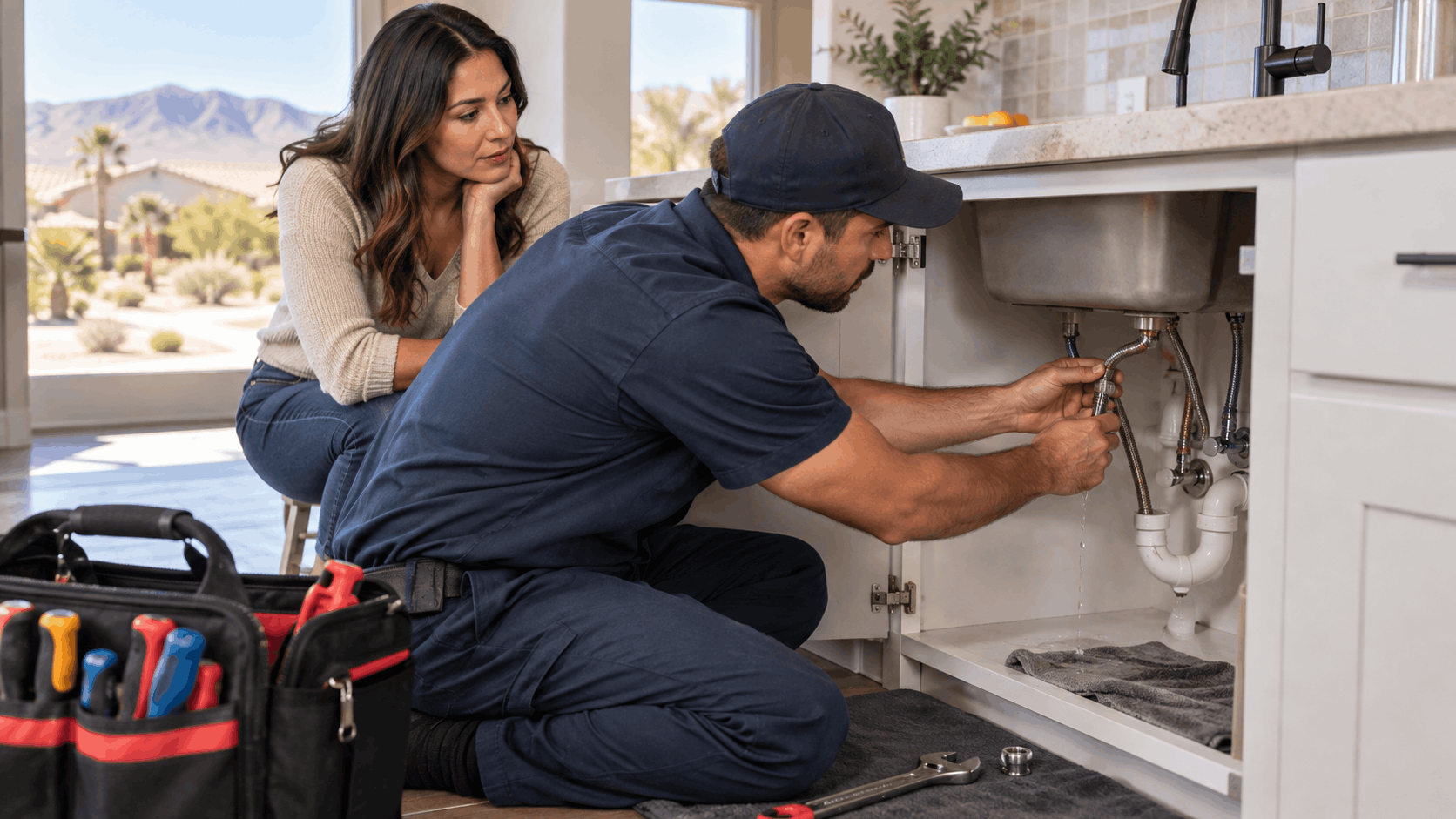
It usually starts the same way. An Aliante homeowner walks into the master bathroom on a quiet Sunday morning and finds two inches of water spreading across the tile, seeping under the vanity, and creeping toward the hallway carpet. The culprit is almost always the same: a thin, cheap supply line behind the toilet that finally gave out after years of quiet corrosion. By the time anyone notices, the water has already reached the baseboards.
We get these calls constantly across North Las Vegas, and the pattern rarely changes. The homes are not old. Many were built in the 2000s and 2010s. The problem is not age alone. It is the builder-grade parts that came with the house, combined with our hard water and brutal desert heat. Those two forces wear down supply lines more quickly than most people expect.
Why Builder-Grade Supply Lines Fail in North Las Vegas Homes?
Most homeowners never think about the small hoses connecting their fixtures to the water supply. They sit hidden under sinks and behind toilets, doing their job silently for years. Then one day a builder-grade supply line splits open and turns a normal afternoon into an emergency.
The reason these failures cluster in this valley comes down to three things: the parts builders install, the water that runs through them, and the climate they live in. Understanding those forces helps explain why North Las Vegas plumbing sees so much water damage from a part that costs only a few dollars to replace.
What Builder-Grade Supply Lines Actually Are
When a house goes up, builders buy plumbing parts by the pallet. To keep costs down, they often choose the cheapest supply lines available. That usually means thin plastic tubing or a low-grade braided supply line with flimsy inner cores and soft rubber washers.
A plastic supply line is the worst offender. The tubing gets brittle over time, and the compression fittings crack under normal water pressure. These parts pass inspection when the home is brand new, but they were never built to last a decade or more in a desert climate.
Higher-quality braided lines are a different animal entirely. They use woven stainless steel over a durable inner tube, with metal fittings that hold up to pressure and mineral exposure. The difference in cost between a cheap line and a quality one is a few dollars, but the difference in lifespan is measured in years.
When our team upgrades a home, we swap the builder-grade junk for real braided steel every time. Homeowners are often surprised the original parts lasted as long as they did, given how thin the material feels in hand.
How Las Vegas Valley Water District Hard Water Speeds Up Failure
The water here is hard. Very hard. The Las Vegas Valley Water District serves most of the metro area, and that supply carries heavy mineral content straight from the Colorado River and local wells.
All those minerals leave deposits inside fittings and around threaded connections. Over time, that mineral buildup causes corrosion on brass and plated fittings, especially where two metals meet. The white crust you see on a valve is a warning sign that the metal underneath is breaking down.
Hard water also attacks the rubber washers inside supply line couplings. Mineral scale builds on the sealing surface, which forces the washer to compress unevenly. Eventually the seal fails and a slow drip begins, or the fitting cracks outright under pressure.
This is why we often recommend pairing line upgrades with water treatment options. Softer water slows the corrosion cycle and protects everything downstream, from supply lines to water heaters to faucet cartridges.
Desert Heat, Attic Runs, and Rubber That Dries Out
Summers in North Las Vegas push past 110 degrees for weeks at a time. Attic spaces get far hotter than that, sometimes reaching 140 degrees or more. Any supply line routed through or near that heat takes a beating.
The desert heat dries out rubber components fast. A rubber washer that stays flexible in a mild climate turns hard and brittle here in just a few seasons. Once it loses its flex, it cannot hold a proper seal, and the connection starts to weep.
A plastic coupling reacts the same way. The heat makes the plastic rigid, and rigid plastic cracks under the constant pulse of water pressure. Lines feeding upstairs bathrooms and fixtures near hot walls fail earlier than lines in cool, shaded cabinets.
We see this pattern clearly across two-story homes near Aliante Parkway and the newer tracts off Deer Springs Way. The upstairs fixtures almost always show more wear on their supply lines than the ground floor ones in the same house.
Why Newer Aliante Homes Are Not Immune
Plenty of Aliante homeowners assume their newer house is safe. After all, the neighborhood filled in during the 2000s and 2010s, long after the old ranch homes near Historic North Las Vegas. Unfortunately, newer does not mean better parts.
Those builders used the same budget supply lines as everyone else. A home built in 2008 has parts that are now well over fifteen years old. That is deep into the failure window for cheap braided and plastic lines, regardless of how modern the house looks.
New construction plumbing gets a pass at inspection, but no one checks those hidden hoses again after move-in. So the countdown starts the day the family gets the keys, and it runs quietly for years.
We have replaced failed supply lines in Aliante homes that still look brand new from the street. The house being young offers no protection when the guts of the plumbing are builder-grade. Age plus cheap materials is the real recipe for a burst line.
Get Your Quote
Tell us what's going on and we'll get back to you. We're open 24/7.
Common Spots Where Supply Lines Burst in Aliante and Nearby Neighborhoods
Not every fixture fails at the same rate. Some spots blow far more often than others, and knowing which ones lets homeowners keep an eye on the trouble makers. Below is a quick reference of a common failure points we handle.
| Location | Failure Risk | Typical Damage |
|---|---|---|
| Toilet supply line | Very High | Fast bathroom flooding |
| Under-sink faucet lines | High | Cabinet rot, slow leaks |
| Washing machine hose | High | Major laundry room flood |
| Water heater line | Moderate | Slow garage leaks |
| Refrigerator ice maker line | Moderate | Hidden floor damage |
Toilet Supply Lines and Fill Valve Connections
The toilet supply line is the number one failure point we respond to. It runs constant pressure, sits in a hot bathroom, and connects to a fill valve that vibrates every flush. That combination wears the line down over time.
When a toilet supply line lets go, it can flood a bathroom in a short time. A full-size line under household pressure can dump hundreds of gallons an hour with nobody home. That is how a Sunday morning turns into ripped-out tile and soaked drywall.
Early cracking usually shows near the fill valve connection or where the line bends toward the wall. Look for hairline cracks in plastic lines or a stiff, discolored coupling. If the nut is crusted with white mineral scale, the seal underneath is already compromised.
We tell every homeowner to check behind their toilets twice a year. It takes two minutes and catches most failures before they become a flood.
Under-Sink Lines in Kitchens and Bathrooms
The faucet supply lines under sinks fail in a quieter, sneakier way. Instead of a dramatic burst, they often start with a slow under sink leak that drips onto the cabinet floor. By the time anyone opens the cabinet, the damage is done.
The particleboard cabinet bottoms in most tract homes soak up water like a sponge. The floor swells, warps, and then rots. We have pulled out entire vanity bases in Aliante homes that crumbled apart from a leak the owner never noticed.
The warning signs are easy to catch if you know them. A musty smell when you open the cabinet, a dark ring on the cabinet floor, or a soft spot under stored cleaning supplies all point to a leaking supply line.
Kitchen sinks are especially bad because families store bins and bottles under there, hiding the leak completely. Clear the cabinet out once in a while and run your hand along the lines and the floor to feel for moisture.
Washing Machine Hoses and Laundry Room Floods
A washing machine hose carries some of the highest pressure in the home, and it stays pressurized around the clock. When one of these hoses blows, it does not drip. It sprays, and a laundry room flood follows fast.
The rubber hoses that come standard with most machines are prone to bulging and cracking. Add our hard water and heat, and those hoses degrade even more quickly. A blown washer hose can push out several gallons a minute until someone shuts the valve.
The simplest habit is to turn off the hot and cold valves behind the machine when you leave for a trip. If reaching them is a pain, we can install a single-lever shutoff that closes both lines at once.
We also recommend swapping standard rubber hoses for braided steel washer lines. They resist bursting far better and give homeowners years of extra protection for a small cost.
Water Heater and Refrigerator Line Failures
The water heater supply line sits in the garage on most local homes, out of sight and out of mind. A slow leak there can run for months, quietly rusting the tank base and staining the garage floor before anyone notices.
Because garages get hot and dry in the summer, the connections at the top of the heater dry out and weep. If you spot rust streaks or a small puddle near the base, the line or a fitting is likely failing. Our water heater services team checks these connections during every visit.
The refrigerator ice maker line is another silent troublemaker. It is a small plastic or copper line tucked behind a heavy appliance that nobody moves. When it fails, water pools under and behind the fridge, warping the floor for weeks.
Both of these spots reward a quick check once or twice a year. Pull the fridge out, look behind it, and glance at the base of the water heater. A five-minute look can save thousands in repairs.
Need Help in Las Vegas?
Active Plumbing serves Las Vegas and all of Las Vegas Valley.
Warning Signs a Supply Line Is About to Fail
Most supply line failures give warning before they blow. The trick is knowing what to look for. A quick inspection habit catches the majority of problems while they are still cheap fixes. Here are the plumbing leak signs we tell every homeowner to watch.
- White crust or rust on any fitting
- Bulges or cracks in a braided line
- Damp spots or musty smells in cabinets
- Any line more than ten years old
Visible Corrosion, Rust, or White Crust on Fittings
A corroded fitting is one of the clearest supply line warning signs. That chalky white crust around a nut or valve is dried mineral deposit, and it means water has been seeping out and evaporating. The metal underneath is corroding while you watch.
Rust colored stains are just as telling. They show the fitting is breaking down from the inside, and once corrosion sets in, it only spreads. A rusty valve is a valve on borrowed time.
Look under every sink and behind every toilet for this mineral crust. Run a paper towel around the connections. If it comes away damp or picks up grit, that fitting needs attention.
In hard water areas like ours, corrosion is the leading reason older builder-grade lines fail. Catching it early lets us swap the part before it turns into a flood.
Bulging, Cracking, or Kinked Braided Lines
A bulging supply line is a red alert. When you see the braided outer sheath ballooning out at any point, the inner rubber tube has already failed and is pushing through the weave. That line can burst at any moment.
A cracked line on the plastic tubing type shows up as tiny fractures, usually near a bend or fitting. Those cracks widen with every pressure cycle until the line splits open. Never ignore a visible crack, even a small one.
Kinks are a slower killer. When a line gets bent sharply during installation or from crowding under a sink, the material weakens at the kink point. Over months and years, that weak spot becomes the failure point.
If you find a bulge, crack, or hard kink, shut off that fixture valve and call for a replacement. These are not problems that heal or hold. They only get worse.
Damp Spots, Musty Smells, and Warped Cabinets
A musty smell is often the first clue of a hidden leak. That damp, earthy odor means moisture is sitting somewhere it should not be, feeding mildew inside a cabinet or wall. Your nose catches these leaks before your eyes do.
A damp cabinet floor tells the same story. Feel the wood at the back of the cabinet where the lines connect. If it feels soft, cool, or spongy, water has been working on it for a while.
Warped or swollen cabinet bottoms confirm a long-running slow drip. Once particleboard swells, it does not go back. That warping is proof a supply line connection has been failing quietly for weeks or months.
When these signs show up together, treat them as a leak until proven otherwise. Our electronic leak detection can pinpoint the source when the leak is hidden behind walls or under floors.
The Age Rule: Ten Years and Counting
Even a line that looks fine has a limited supply line lifespan. As a rule of thumb, builder-grade supply lines should be replaced at ten years, no matter how they appear. The failure often starts inside where you cannot see it.
Plastic lines are the shortest lived. In our heat and hard water, many start failing around the eight to ten year mark. Cheap braided lines last a bit longer but still fall inside that window.
Because most Aliante homes were built fifteen to twenty years ago, the original lines are well past their safe life. If your house still has factory supply lines, they are running on luck at this point.
Proactive line replacement is far cheaper than emergency cleanup. Swapping a line during a scheduled visit costs a fraction of what water damage repair runs after a burst.
What To Do the Moment a Supply Line Bursts
A plumbing emergency is stressful, but a calm, quick response makes a huge difference. The sooner you stop the water, the less damage you deal with afterward. Here is the exact sequence to follow when a burst line hits.
Find and Close the Fixture Shutoff Valve First
The fastest fix is the fixture shutoff valve. For a toilet, it is the small oval or round handle on the wall behind the bowl. For a sink, look under the cabinet for two small valves on the water lines.
Turn the valve clockwise, or right, to stop water at that fixture. On a quarter-turn valve, a single 90-degree turn does it. On an older round handle, you may need several full turns.
Sometimes the valve is seized from mineral buildup and will not budge. Do not force it so hard that you snap it off, which makes the flood worse. If it will not turn, move straight to the main shutoff.
Once the fixture valve is closed, the immediate spray stops. That buys you time to deal with the water on the floor and get help on the way.
Locating Your Main Water Shutoff in North Las Vegas Homes
Every homeowner should know where the main water shutoff sits before an emergency, not during one. In most North Las Vegas homes, the home water valve is near the garage wall or by the front hose bib on the exterior.
In many Aliante builds, the shutoff hides in a small interior wall access panel in the garage. Some homes have it in a ground box near the sidewalk where the city meter lives. Take five minutes on a calm day to find yours.
Turn the main valve clockwise to cut water to the whole house. A lever-style valve turns a quarter turn. A round wheel valve needs several full rotations to close completely.
Label the valve so anyone in the family can find it fast. When water is pouring across the floor is not the time to go hunting for it.
Reducing Water Damage While You Wait
Once the water is off, focus on limiting the mess. Move rugs, boxes, electronics, and anything valuable out of the wet area first. Standing water spreads and soaks into whatever it touches.
Grab towels and mop up as much as you can to slow the water from reaching carpet, hallways, and adjoining rooms. Push it toward tile and away from wood flooring where possible.
If water is anywhere near outlets or a running appliance, cut power to that area at the breaker box before you wade in. Never stand in standing water near live electrical connections.
Open windows and run fans to start drying the space. Fast air movement slows mold growth while you wait for help to arrive.
When To Call an Emergency Plumber Right Away
Some situations cannot wait for business hours. If the water will not stop after closing the valves, if it is flooding fast, or if it is near electrical panels or outlets, call an emergency plumber immediately.
A burst line spraying at full pressure can ruin floors and ceilings in under an hour. The sooner a 24 hour plumber gets there, the less you spend on repairs and cleanup down the line.
Our team runs emergency calls across North Las Vegas and Aliante around the clock. When you call, we walk you through stopping the water while we head your way. You can reach our emergency plumbing team any hour, any day.
Do not try to live with an active leak overnight to save a service call. The damage from waiting almost always costs far more than the emergency visit.
Need Help in Las Vegas?
Active Plumbing serves Las Vegas and all of Las Vegas Valley.
How Active Plumbing Handles Emergency Supply Line Calls
When a supply line fails, homeowners want to know what happens next. Our emergency plumbing service follows a clear process from the first call to the final repair. Knowing what to expect takes some of the panic out of the moment.
Fast Response Across North Las Vegas and Aliante
Speed matters most with a burst line, so we route trucks to cover North Las Vegas efficiently. Our crews know the drive from Aliante Parkway to the tracts off Elkhorn Road and how to move quickly along the 215 Beltway during peak hours.
For most calls in Aliante and the surrounding North Las Vegas neighborhoods, we aim to arrive within 30 to 60 minutes of your call. We keep supply lines and quarter-turn valves stocked on the truck so we can fix the problem on the first visit.
Living and working here every day means we already know the layouts of these tract homes. That local knowledge shaves time off every job because we are not guessing where things are.
Whether you are near the Aliante Nature Discovery Park or over toward Tule Springs, our fast response covers the whole area. The quicker we arrive, the sooner the water stops and the drying begins.
Diagnosing the Failure and Checking Nearby Lines
When we arrive, the first step is leak diagnosis. We confirm the source, stop the water, and clear the area so we can see exactly what failed and why.
Then we do something many plumbers skip. We check the other builder-grade lines in the home, because if one cheap line failed, the rest are likely close behind. A quick plumbing inspection of your fixtures tells us what is next in line to go.
This full-home look often saves people a second emergency a few months later. We would rather point out three aging lines now than watch a customer flood again in the same year.
We explain what we find in plain language and let the homeowner decide how far to go. There is no pressure, just an honest picture of the plumbing's condition.
Replacing Cheap Lines With Quality Braided Steel
The repair is where the real upgrade happens. We remove the failed builder-grade part and install a proper braided steel line with a metal core built to hold pressure for years.
We also swap out old multi-turn valves for a modern quarter-turn valve wherever we can. These valves close with a single flick, which makes future shutoffs fast and easy in an emergency. They also resist the mineral seizing that plagues older valves.
Upgrading to a braided steel line and a fresh valve is what prevents repeat calls. The cost difference over cheap parts is small, but the reliability is night and day.
Homeowners often ask us to replace every line in the house once they see how the failed one looked inside. That batch approach ends the cycle of one-off emergencies for good.
Cleanup Guidance and Referral Support
After the repair, we help homeowners understand the water cleanup steps that come next. We point out where moisture may have spread and what needs to dry out to avoid mold.
For larger floods, we can connect you with trusted water damage and restoration contacts. A flood referral to a good remediation crew speeds up drying and helps with the insurance side of things.
We also advise on documenting the damage with photos before cleanup begins. Good records make any insurance claim smoother and clearer.
Our goal is to leave you with a fixed line and a clear plan, not just a repaired part and a mess. Helping neighbors get fully back to normal is part of the job.
Preventing Future Supply Line Failures Before They Start
The best emergency is the one that never happens. A little leak prevention and routine plumbing maintenance keeps supply lines from ever reaching the burst stage. These steps are affordable and pay for themselves the first time they save you from a flood.
Scheduling a Whole-Home Supply Line Inspection
A single home plumbing inspection catches aging lines before they fail. We check every fixture, valve, and connection and flag anything showing corrosion or wear.
For homes in the North Las Vegas area, we suggest a supply line check every one to two years. Given our hard water and heat, waiting longer than that leaves too much room for a hidden line to go.
The inspection itself is quick and low cost compared to what a burst line does to a home. Most homeowners are relieved to have a clear list of what needs attention and what is fine.
Think of it like a checkup. Catching a weak line early turns a potential emergency into a five-minute planned fix.
Upgrading All Lines and Angle Stops at Once
When lines are aging, replacing them one at a time is a slow, expensive way to go. Every separate visit means another service charge. Batch replacing all the builder-grade lines and every angle stop in a single visit costs far less per line.
A whole-home line upgrade also removes the guesswork. Instead of wondering which cheap line fails next, you know they are all fresh and rated to last.
We usually replace the angle stops at the same time, since those valves are the same age and just as likely to seize or leak. New quarter-turn stops make every future repair simpler.
The math almost always favors doing it all at once. One planned visit beats three separate emergencies every time.
Water Softeners and Pressure Regulators for Hard Water
Since hard water drives so many of these failures, treating it protects the whole system. A water softener removes the minerals that corrode fittings and stiffen washers over the years.
Softer water extends the life of your supply lines, water heater, and fixtures all at once. Our water softener installation is one of the best long-term defenses against corrosion in the valley.
High water pressure is the other silent killer. If your home runs above the safe range, a pressure regulator brings it down to a level that lines and fittings can handle safely.
Together, softening and pressure control take much of the strain off your plumbing. They slow the wear that leads to a burst line down the road.
Installing Leak Detectors and Auto Shutoff Devices
Technology can stop a flood even when nobody is home. A small leak detector placed under a sink or behind a toilet sounds an alarm the moment it senses water.
Go one step further with an automatic shutoff valve on the main line. When it detects an unusual flow or a leak, it closes the water automatically and stops the flood in its tracks. Our whole-home leak detection systems do exactly that.
For families who travel or leave the house empty during work hours, these devices are worth every penny. A line can burst at 10 a.m. on a workday and flood all afternoon without one.
The comfort of knowing your home shuts itself off during a leak is hard to overstate. It turns a potential disaster into a minor event.
Need Help in Las Vegas?
Active Plumbing serves Las Vegas and all of Las Vegas Valley.
What Supply Line Repairs Cost in the North Las Vegas Area
Nobody likes surprise bills, so here is a straight look at supply line repair cost in our area. Plumbing pricing varies with the job, but these ranges give homeowners a realistic picture to budget around.
Typical Cost of a Single Line Replacement
Replacing one supply line and its valve during a service call typically runs in the low hundreds of dollars. That price usually covers the parts, the labor, and the trip out to your home.
The line replacement cost depends on the fixture and how accessible it is. A toilet line in an open spot is quick, while a line jammed behind a garbage disposal takes more time.
The service call fee covers the plumber's time to diagnose and fix the issue on site. When we are already there, adding a second line often costs much less than the first.
Compared to the thousands a flood can cause, a single line swap is a small, smart expense. It is the cheapest insurance in plumbing.
Emergency and After-Hours Pricing
Emergency calls cost more than scheduled visits, and there is a fair reason for it. An after-hours rate covers a plumber leaving home at night or on a weekend to reach you fast.
Emergency plumbing cost reflects the urgency and the off-hours labor involved. When water is actively flooding your home, a quick response is worth the premium to most people.
We keep our emergency pricing transparent and explain the cost before we start any work. There are no mystery charges added at the end of the job.
If the problem can safely wait until normal hours, we will tell you honestly. We would rather save you money than push an unnecessary emergency call.
Hidden Costs of Ignoring a Slow Leak
A slow drip feels harmless, but the water damage cost adds up fast. That quiet leak under a sink rots the cabinet, warps the floor, and spreads into the subfloor over time.
Worse, standing moisture in our climate still grows mold inside walls and cabinets. Mold repair and remediation run into the thousands, far more than fixing the line ever would have.
Drywall, baseboards, and flooring all take damage from a leak left alone. What started as a five-dollar part becomes a full room repair.
This is why we push early repair so hard. Catching a leak this week instead of next month is the difference between a small fix and a big renovation.
How Bundling Repairs Saves Money
Bundling is where homeowners save real money. Replacing several lines during one visit spreads the service call fee across all of them instead of paying it over and over.
Say you replace six lines in your home. Doing them in one bundled repair visit costs far less than six separate trips over a few years. The labor efficiency alone brings the per-line price down.
You also gain plumbing savings by avoiding future emergencies, which always cost more than planned work. One tidy project replaces years of one-off scares.
When we inspect a home and find several aging lines, we lay out both options with clear pricing. Most families choose to bundle once they see the numbers side by side.
Final Thoughts
Builder-grade supply lines are the small, cheap parts that cause some of the biggest headaches in North Las Vegas and Aliante homes. Our hard water and desert heat wear them out more quickly than most owners expect, and even newer houses are running on parts well past their safe life.
The good news is that these failures are preventable. A quick inspection, a swap to braided steel lines, and a smart leak detector can end the cycle of floods for good. And when an emergency does hit, knowing where your shutoffs are and who to call makes all the difference.
If you have builder-grade lines or a home over ten years old, now is the time to act. Reach out to our team at Active Plumbing for an inspection or fast emergency help across North Las Vegas and Aliante. We are here around the clock to stop the water and protect your home.
Frequently Asked Questions
- How long do builder-grade supply lines last?
- Most builder-grade supply lines last around eight to ten years in our area, though many owners get lucky longer. Our hard water and desert heat shorten that lifespan by corroding fittings and drying out rubber washers. Plastic lines fail earliest, often before the ten year mark. If your home is over a decade old and still has factory lines, plan to replace them soon before one bursts.
- What does a burst supply line sound or look like?
- A burst line usually announces itself with a hissing or spraying sound, followed by the rush of water hitting the floor. You may see a fine mist near a fitting or a steady stream shooting from a cracked line. Pooling water under a sink or across a bathroom floor is the clearest sign. If you hear water running when no fixture is on, check your lines fast.
- Can I replace a supply line myself?
- A simple line swap is doable for a handy homeowner if the shutoff valve works and the connections come loose easily. Shut off the water, drain the line, and thread on a quality braided replacement. The trouble comes when the valve is seized from mineral buildup or the fittings are corroded stuck. In those cases, forcing it can cause a bigger leak, so call a plumber.
- How fast can an emergency plumber reach Aliante?
- For most emergency calls in Aliante and nearby North Las Vegas neighborhoods, we aim to arrive within 30 to 60 minutes of your call, often under an hour depending on time and traffic. Our crews know the routes along Aliante Parkway and the 215 Beltway well. When you call, we guide you through stopping the water while we drive over so damage stays as low as possible.
- Are braided steel lines really better than plastic ones?
- Yes, by a wide margin. Braided steel lines use a woven stainless sheath over a durable inner tube with metal fittings that resist pressure and corrosion. Plastic lines get brittle and crack, especially in our heat. The cost difference is only a few dollars per line, but braided steel resists bursting for years longer. It is the upgrade we install on every emergency call.
- Where is my main water shutoff usually located?
- In most North Las Vegas homes, the main shutoff sits near the garage wall, by the front hose bib, or in a small interior access panel in the garage. Some homes also have a curb valve in a ground box near the sidewalk by the city meter. Find yours on a calm day and label it. When water is flooding, you do not want to be hunting for it.
- Does homeowners insurance cover supply line water damage?
- Many policies cover sudden and accidental water damage from a burst supply line, but coverage varies by policy. Slow leaks that went unnoticed for a long time are often denied as neglect. Document everything with photos before cleanup and keep repair records. Reviewing your policy details ahead of time tells you what is covered, and good documentation gives any claim the best chance of approval.
- How much does an emergency supply line repair cost?
- An emergency supply line repair typically runs in the low to mid hundreds of dollars, depending on the fixture, access, and time of day. After-hours calls carry a premium for the off-hours response. The price includes parts, labor, and the trip out. It is a small cost next to the thousands a full flood can cause, which is why fast repair almost always pays off.
- Should I replace all my supply lines at once?
- If your home has aging builder-grade lines, replacing them together makes sense. All the lines are the same age and material, so if one fails, the rest are close behind. Bundling the work into one visit spreads the service fee across every line and lowers the cost per line. It also ends the cycle of surprise floods, giving you fresh, reliable connections throughout the home.
- Does hard water in North Las Vegas really cause line failures?
- It absolutely does. The Las Vegas Valley Water District supply carries heavy mineral content that leaves scale inside fittings and around connections. That buildup corrodes brass and plated metal and forces rubber washers to seal unevenly until they fail. Over years, this steady wear is a leading cause of supply line failures here. A water softener slows the process and protects your whole plumbing system.
Licensed plumbing professionals serving Las Vegas and Las Vegas Valley.
Licensed in Nevada · License #0047021
Last updated on
Why trust Active Plumbing?
Founded in 1991, Active Plumbing is a licensed and insured plumber serving Las Vegas and Las Vegas Valley. All content is reviewed by our licensed technicians.

Need Help in Las Vegas?
Active Plumbing serves Las Vegas and all of Las Vegas Valley.
Related Articles
Aliante North Las Vegas Plumber: Service Coverage and Pricing
A local guide to Aliante plumbing: where Active Plumbing works across North Las Vegas, common desert-home problems, core services, and honest pricing ranges.
Emergency Plumber in Downtown Las Vegas and Huntridge: Galvanized-Era Homes and What Fails at 2am
Older galvanized-era homes in Downtown Las Vegas and Huntridge fail at 2am for good reasons. Learn the warning signs, emergency steps, and repiping options.
Water Heater Replacement in Aliante and North Las Vegas - Builder-Grade Unit Failures at Year 10
Builder-grade water heaters across Aliante fail right around year 10. Learn the warning signs, replacement costs, tank vs tankless choices, and how to make a new unit last in North Las Vegas hard water.