How-To Guides
Trenchless Pipe Lining vs Pipe Bursting: When Each Works in Vegas Soil
Key Takeaways
- Pipe lining repairs a pipe from the inside, while pipe bursting replaces it entirely with new HDPE pipe.
- Hard caliche around Henderson and the northwest makes trenchless methods far cheaper than open-trench digging.
- Lining suits cracked pipes and root intrusion; bursting suits collapsed, crushed, or badly offset lines.
- Bursting can upsize a line for homes with chronic drainage problems, something lining cannot do.
- Trenchless repair in the valley typically runs $80 to $250 per foot, with most jobs finishing in one to two days.
- Both lined and burst pipes seal out roots and can last 50 years or more.
- Most Clark County sewer repairs need a plumbing permit and before-and-after camera inspections.
- A camera inspection of pipe condition, soil, and access is the only reliable way to pick the right method.
In This Article
A homeowner in Summerlin West walked out one morning to a sinkhole forming near the side yard and a foul smell drifting up from the sewer cleanout. By the time she called us, the old clay line had already collapsed under years of ground pressure. Her first fear was the one we hear most: a backhoe tearing a fifteen-foot trench straight through her fresh rock landscaping and paver walkway.
That trench is exactly what most people picture when a sewer line fails. The good news is that two trenchless repair methods can often fix the problem without that kind of destruction. The right one depends heavily on the ground under your specific property.
How Las Vegas Soil Affects Underground Pipe Repair?
The ground under a Las Vegas home behaves nothing like the soft soil you find in wetter parts of the country. Las Vegas soil is dense, dry, and packed with mineral deposits that fight back against a shovel. Those conditions change how pipes fail and which repair method holds up over the long haul.
Before recommending any fix, our crews study the dirt as much as the pipe itself. Pipe repair choices here often come down to what a shovel or bursting head has to move through. A method that works great in loose California topsoil can stall out fast in valley ground.
Caliche and Rocky Ground Around the Valley
Caliche is the cement-like layer of calcium carbonate that runs through much of the valley floor. It forms when minerals leach down and harden into a rock-solid crust, sometimes just a foot or two below the surface. Around Henderson and the northwest, crews often hit a thick caliche layer that resists a standard digging bar.
Henderson soil in particular can feel like digging through concrete once you break the topsoil. That hardness is one of the biggest reasons owners lean toward trenchless work. Digging a full trench through caliche takes more time, heavier equipment, and more money than most people expect.
When we quote a job in an area with heavy caliche, the reduced digging of trenchless methods often saves thousands. We only have to break through that hard layer at one or two spots instead of the whole run. That single fact steers a lot of local repairs away from open-trench work.
Expansive Clay and Ground Movement
Older parts of town sit on pockets of expansive clay that swell when they get wet and shrink as they dry out. Every irrigation cycle and rare desert rainstorm makes that clay move a little. Over years, that constant push and pull cracks rigid pipe and shoves joints out of line.
A pipe offset happens when one section of pipe shifts sideways from the next, leaving a lip that catches debris and slows flow. We see this a lot in homes built decades ago near the older cores of the valley. The clay does not care how well the pipe was installed; it moves the ground regardless.
This ground movement matters for method choice because a badly offset line may be too far out of shape to line. A liner needs a mostly intact host pipe to form against. When clay has cracked and shifted a line hard enough, full replacement often makes more sense.
Dry Heat and Aging Pipe Materials
Decades of dry heat and big temperature swings wear on older pipe materials from the inside out. In neighborhoods like the Historic Westside and downtown, many homes still run on original cast iron pipe or clay pipe. Both were common before PVC took over.
Cast iron pipe corrodes and scales up on the inside, narrowing the channel until flow crawls. Clay pipe aging shows up as cracks, brittle sections, and joints that separate as the ground shifts around them. The dry heat does not soften these materials the way moisture would; instead it makes them brittle and prone to fracture.
By the time a cast iron or clay line is fifty or sixty years old, it is usually near the end of its service life. That age is why so many downtown-area sewer calls end with a serious repair rather than a quick patch. Knowing the pipe material helps our team predict what we will find with a camera.
Why Soil Type Decides the Method
All of these ground factors add up to one point: soil conditions steer the choice between lining and bursting. Hard caliche pushes owners toward the trenchless method with the fewest access holes. Shifting clay that has wrecked a pipe's shape can rule lining out entirely.
A good trenchless method matches the damage, the pipe material, and the dirt around it. That is why we never quote a repair sight unseen. The same failure symptom can call for two different fixes on two different streets.
In the sections ahead, we break down exactly how each method works. Then we match them to real valley neighborhoods so the right fit becomes clear for your own home.
Get Your Quote
Tell us what's going on and we'll get back to you fast.
What Trenchless Pipe Lining Actually Involves
Trenchless pipe lining rebuilds a pipe from the inside without digging up the whole run. The industry term is cured-in-place pipe, often shortened to CIPP. Homeowners like it because most of the work happens underground through small access points.
The short version: we slide a resin-soaked liner into the old pipe and harden it into a new pipe-within-a-pipe. Our sewer line repair and replacement crews handle this process regularly across the valley. Here is what each step looks like on a real job.
How the Cured-In-Place Liner Works
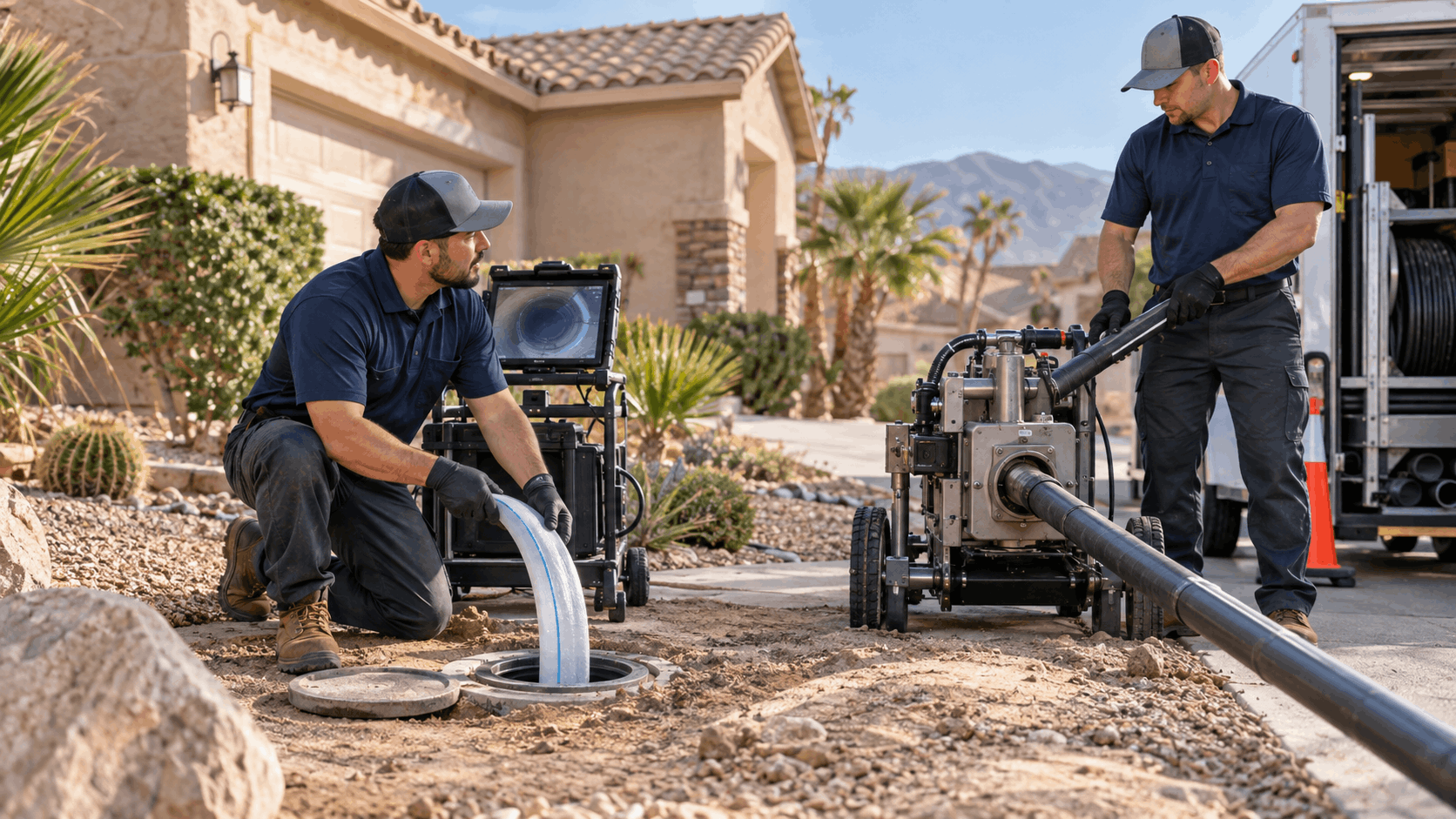
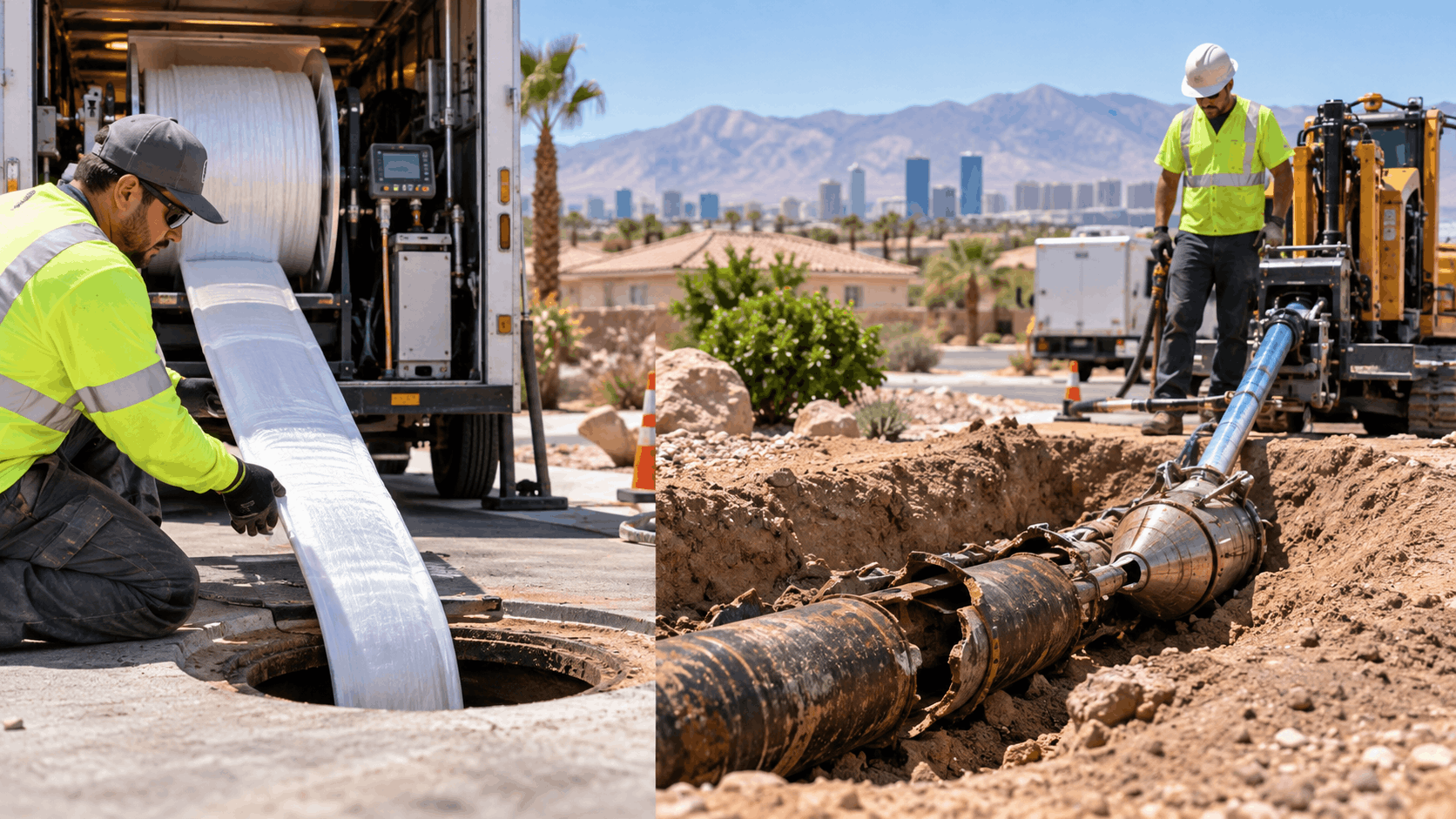
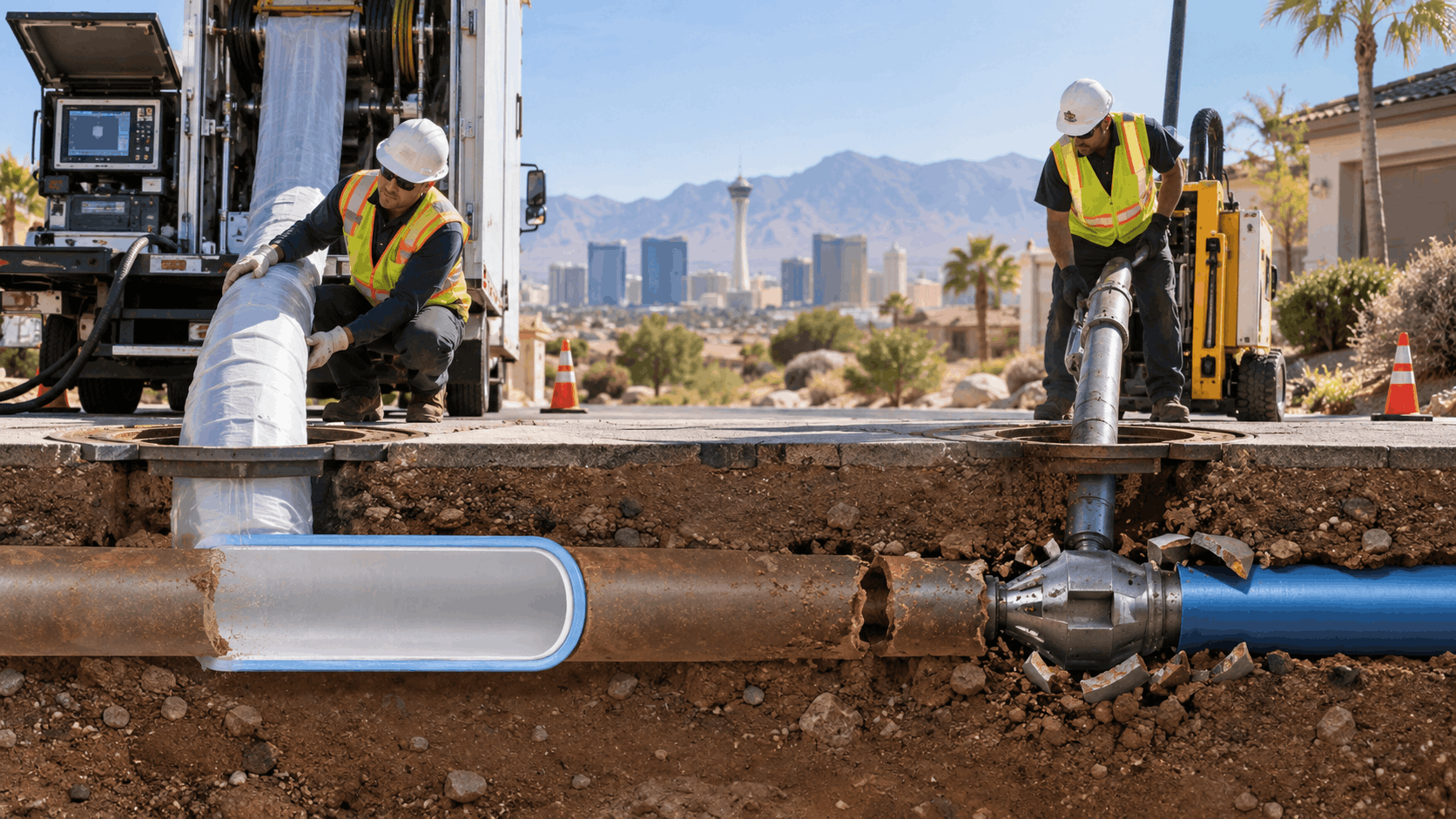
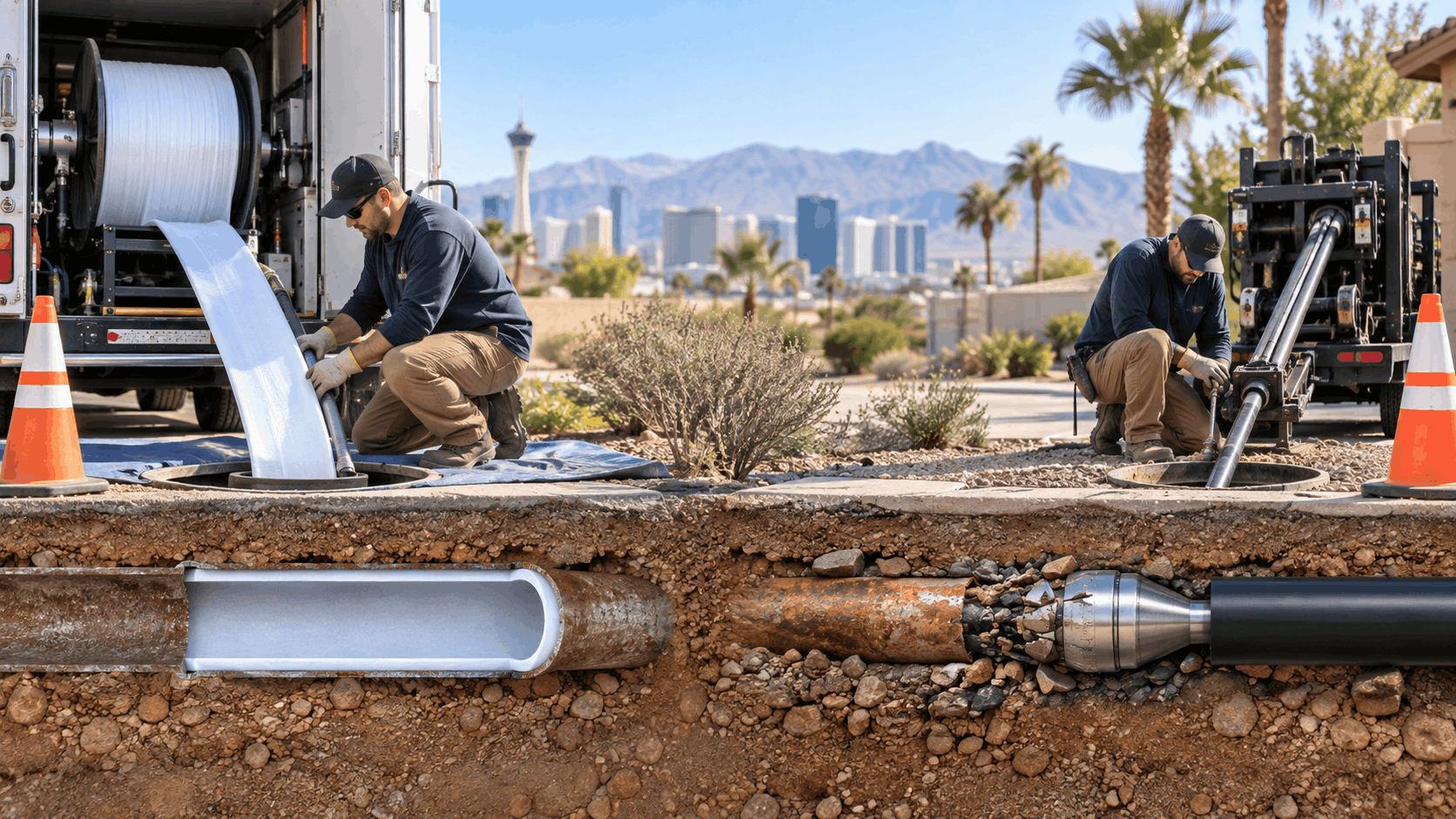
A CIPP liner is a flexible felt or fiberglass tube soaked in a two-part resin. We saturate the liner, then pull or invert it into the damaged line through an existing cleanout or a small pit. Once it is in position, we inflate it so it presses tightly against the old pipe walls.
Then comes the pipe curing stage, where the resin liner hardens into a solid new surface. We cure it using ambient heat, hot water, steam, or UV light depending on the job. As the resin sets, it forms a smooth, jointless pipe bonded to the inside of the old one.
The finished result is a seamless pipe with no joints for roots to sneak into. It also has a slick interior that actually improves flow compared to a scaled-up cast iron line. The old pipe becomes little more than a mold for the new one.
Access Points and Yard Impact
The biggest selling point of lining is how little digging it takes. Many jobs need only one or two access points, often an existing cleanout and one small pit. That means minimal digging across your yard.
For homes with rock landscaping, pavers, or a poured driveway, this matters a lot. We can often reline a full run without touching the decorative gravel or hardscape most desert homes have. A backhoe trench, by contrast, would tear all of that apart and leave a restoration bill behind.
On tight lots common in newer master-planned areas, there is barely room for a full trench anyway. Lining lets us work in that limited space without heavy equipment parked on delicate landscaping. Homeowners near HOA-controlled streets appreciate that their yard looks nearly the same when we leave.
Timeframe and Cure Time in Desert Heat
Most residential lining jobs wrap up in a single day once we start. Cleaning and prepping the old pipe takes a few hours, then the liner install and cure follow. A typical repair timeline runs from morning to late afternoon for a standard home run.
Cure time depends on the resin and the curing method used. Standard ambient cures can take several hours, while steam or UV curing speeds things up considerably. In the dry valley heat, warmer ground and air temperatures can shorten ambient cure windows compared to a cold, damp climate.
We plan the schedule so the line is back in service the same day whenever possible. You may need to limit water use for a few hours while the resin sets. Our team gives you a clear window so you know exactly when drains are ready again.
Pipe Conditions That Suit Lining
Lining shines when the old pipe is still mostly in one piece. A cracked pipe with hairline fractures, longitudinal splits, or minor corrosion is a strong candidate. The liner bridges those cracks and seals them from the inside.
It also handles root intrusion well, since the new jointless surface leaves roots nowhere to enter. Once a line is relined, the smooth wall blocks the tiny gaps that roots exploit. That makes it a lasting fix for tree-related backups.
The limit is structure. If the host pipe has collapsed, gone missing in spots, or shifted badly out of round, there may be nothing solid to line against. In those cases we look at bursting instead, which we cover next.
Need Help in Las Vegas?
Active Plumbing serves Las Vegas and all of Las Vegas Valley.
What Pipe Bursting Actually Involves
Pipe bursting is the full-replacement cousin of lining. Instead of rebuilding the old pipe, this trenchless method destroys it and pulls a brand-new pipe into place. It is the go-to when a line is too far gone to save.
Like lining, pipe bursting avoids a long open trench. Our crews still reach the line through two compact pits instead of digging the whole path. Here is how the pipe replacement process unfolds on local jobs.
How the Bursting Head Breaks the Old Pipe
The core tool is a cone-shaped bursting head attached to a steel cable or rod. We feed the cable through the old line from one pit to the other, then attach the head. A powerful hydraulic winch pulls the head back through the old pipe.
As the bursting head travels, its widening cone shape fractures the old pipe and shoves the pieces outward into the surrounding soil. Right behind the head, we tow in a new pipe, usually seamless HDPE pipe. HDPE is a tough, flexible plastic that resists corrosion and root intrusion for decades.
The result is a new full-length pipe sitting in the same path as the old one. Because the fragments get pushed into the dirt, there is no old pipe to dig out and haul away. The new line is stronger and often larger than what it replaced.
Entry and Exit Pits
Bursting needs two small excavations: an entry pit and an exit pit. One usually sits near the house cleanout and the other out near the city connection or property line. Each pit is a few feet across, not a continuous trench.
Planning those pits around caliche and hardscape is where local know-how pays off. We choose pit locations that avoid the thickest caliche and steer clear of driveways, patios, and mature planters where we can. On homes with heavy rock beds, we place pits in the least disruptive spots.
Even in tough Henderson caliche, digging two small pits beats trenching the entire run. We only fight that hard layer at two points instead of along thirty or forty feet. That keeps both labor and restoration costs down compared to open-trench replacement.
Upsizing a Damaged Line
One advantage bursting has over lining is pipe upsizing. Because the bursting head clears a wider path as it goes, we can pull in a larger diameter pipe than the original. A four-inch line can often become a six-inch line in the same trenchless pass.
That extra capacity helps homes with chronic drainage complaints or slow-flowing lines. Older properties that added bathrooms or a casita over the years sometimes outgrew their original pipe. Upsizing gives that home the flow it always needed.
Lining, by contrast, slightly reduces the inner diameter because it adds a layer inside the old pipe. For most homes that reduction is harmless, but where capacity is already tight, bursting and upsizing is the better path. We weigh this whenever drainage has been a repeated problem.
Pipe Conditions That Suit Bursting
Bursting is the answer when a pipe is beyond saving. A collapsed pipe, a section that has caved in, or a line with a severe offset joint all call for full replacement. Lining cannot rebuild a pipe that no longer holds its shape.
It also fits badly corroded cast iron and crumbling clay that would not support a liner. When the host pipe is more damage than pipe, replacing it outright is the durable choice. The new HDPE line resets the clock for decades.
The main requirement is a mostly continuous path for the cable to travel. If the old line has a hard bend or a spot where the burst head cannot follow, we adjust the plan. A camera pass tells us which method the pipe can actually accept.
Side-by-Side Comparison of Cost and Disruption
Both methods spare your yard compared to old-fashioned trenching, but they differ in price, mess, and best use. Homeowners want a clear head-to-head, so here is one. The table below sums up the trade-offs, and the sections that follow add detail.
| Factor | Pipe Lining (CIPP) | Pipe Bursting |
|---|---|---|
| What it does | Repairs pipe from inside | Replaces pipe entirely |
| Access holes | 1 to 2 small points | 2 small pits |
| Best for | Cracks, roots, minor corrosion | Collapsed, offset, crushed lines |
| Can upsize? | No (slightly smaller inside) | Yes |
| Typical lifespan | 50 years or more | 50 to 100 years |
| Yard impact | Very low | Low |
Typical Price Ranges in the Valley
Trenchless repair cost depends on length, depth, pipe size, and how hard the caliche is. Across Las Vegas, pipe lining often runs from about $80 to $250 per foot. Pipe bursting tends to land in a similar band, roughly $100 to $250 per foot depending on access.
For a typical home run, total projects commonly fall between $4,000 and $15,000. Price per foot climbs when crews have to break through thick caliche or work at greater depth. Shorter, shallower runs with easy access sit at the lower end.
Open-trench replacement can actually cost more once you add heavy digging and full landscape restoration. That hidden restoration bill is why trenchless often wins on total price. We give an itemized quote after inspecting the line so there are no surprises.
Damage to Landscaping and Driveways
Landscaping damage is where trenchless methods really pay off in desert homes. Both lining and bursting avoid a long trench through your rock beds, turf, or pavers. Lining edges out bursting slightly because it usually needs fewer holes.
Rock landscaping is common across the valley, and it is deceptively hard to restore once disturbed. Matching decorative gravel color and regrading a bed takes time and money most owners would rather skip. Keeping the excavation small protects that investment.
Driveway concern is another big one, especially where the sewer line runs under a slab or paver drive. Trenchless routing often lets us avoid cutting the driveway at all. When a pit must sit near hardscape, we plan its placement to minimize any patch work afterward.
Long-Term Pipe Life and Warranty
Both results are built to last decades. A quality CIPP liner has an expected pipe lifespan of fifty years or more. New HDPE from a bursting job can last fifty to one hundred years thanks to its corrosion resistance.
Warranty coverage varies by product and installer. Many liner and HDPE materials carry manufacturer warranties, and reputable installers back their labor as well. We walk through the specific warranty terms for your job before work begins.
Because both methods seal out roots and resist corrosion, repeat failures are rare when the right method is chosen. That long service life is a big part of the value. You are not just patching a problem; you are replacing the weak link for a generation.
Which Costs Less for Your Situation
The honest answer is that cost comparison depends on your pipe, not a sticker price. If the line is intact enough to line, lining is often the leaner option with less disruption. If the pipe is collapsed or you need more capacity, bursting delivers better value even at a similar price.
Access plays a role too. A property with easy cleanout access may favor lining, while a home needing upsizing points toward bursting. The wrong cheap method that fails in a few years is the most expensive choice of all.
We frame the decision around lasting results rather than the lowest bid. A camera inspection removes the guesswork and shows which method the pipe can accept. From there, value becomes clear.
When Each Method Works Best in Vegas Neighborhoods
Home age and street conditions change the math across the valley. Let us apply both methods to real Las Vegas neighborhoods so you can picture the fit for your own block. Sewer repair looks different in a 1950s bungalow than in a 2015 tract home.
Older Homes Near Downtown and the Historic Westside
Older homes near downtown Las Vegas and the Historic Westside often run on original clay or cast iron. Those lines are frequently cracked, scaled, or shifted after fifty-plus years in expansive clay. The Arts District and nearby older cores show this pattern constantly.
When a camera finds cracks and root intrusion but the pipe still holds its shape, lining is usually the right call. When it finds a collapsed or badly offset line, bursting replaces it with new HDPE. The pipe's actual condition, not just its age, drives the choice.
We handle a lot of these downtown-area jobs, and the decision hinges on that camera pass. Two homes on the same street can need different methods. That is why we never assume based on the neighborhood alone.
Newer Builds in Summerlin and the Northwest
Newer builds in Summerlin and the northwest usually have PVC sewer lines. PVC holds up better than clay, so failures here often come from ground shift, poor bedding, or a crushed spot rather than age. When PVC cracks but stays in shape, lining works well.
These areas also come with tight HOA landscaping and detailed yard rules. Homeowners along streets in Summerlin West want the fix that keeps their curated rock beds and pavers intact. Trenchless methods fit that need almost perfectly.
On tight modern lots there is often no room for a full trench anyway. The minimal footprint of lining or bursting matches the space and the HOA expectations. We tailor pit placement to the strict landscaping these communities enforce.
Established Areas Like Henderson and Green Valley
Established parts of Henderson and Green Valley bring two challenges together: heavy caliche and mature trees. That thick caliche layer makes open-trench digging slow and costly. Trenchless work with only a couple of access points saves real money here.
Mature trees along these streets send roots toward any sewer line they can find. Where roots have cracked an otherwise sound pipe, lining seals the gaps for good. Where roots and age have wrecked the line, bursting starts fresh.
Neighborhoods near Whitney Ranch and the Lake Las Vegas area often show this mix. We read the caliche depth and the pipe damage together before recommending a method. The combination decides the fit.
Homes With Mature Trees and Root Problems
Root intrusion is one of the most common reasons homeowners call us. Big trees along older tree-lined streets chase moisture straight into small pipe gaps. Once roots get in, they grow into a mat that snags waste and causes backups.
A sealed liner blocks future root intrusion because it has no joints for roots to enter. New HDPE from bursting does the same, since its fused joints leave no opening. Either way, the fix removes the pathway roots were using.
Clearing roots with a cable or hydro jetting gives short-term relief but the roots return. For a lasting cure, sealing the line with a liner or new pipe is what actually stops the cycle. We often pair a jetting clean-out with a trenchless repair for a permanent fix.
Need Help in Las Vegas?
Active Plumbing serves Las Vegas and all of Las Vegas Valley.
Permits, Water Authority Rules, and Inspections
Sewer work in the valley comes with paperwork, and skipping it causes headaches later. Knowing the permit and inspection steps up front keeps a job smooth. Here is how the local process works.
Clark County Building Permits
Most trenchless sewer repairs in unincorporated Clark County need a plumbing permit. The county building department wants sewer replacement and major repairs pulled and inspected. A Clark County permit protects you by confirming the work meets code.
Requirements vary a bit between the county, the City of Las Vegas, Henderson, and North Las Vegas. Each jurisdiction has its own building department and fee schedule. You can review general county guidance through Clark County before work starts.
Our team pulls the correct permit for your address as part of the job. We handle the filing so you do not have to chase the paperwork. That keeps the repair legal and the record clean for future home sales.
Sewer and Water Utility Coordination
Work near the sewer main often ties into the local utility. The Las Vegas Valley Water District and regional sewer agencies oversee where private lines meet public infrastructure. Utility coordination matters most at the property line connection.
The Southern Nevada Water Authority and its member agencies set rules that touch this kind of work. We coordinate with the right agency when a repair reaches the public side. That avoids conflicts with the main and any shared laterals.
Most homeowner repairs stop at the private lateral, which stays your responsibility. When the damage sits closer to the main, we confirm who owns which section first. Getting that boundary right prevents disputes over cost and access.
Camera Inspections Before and After
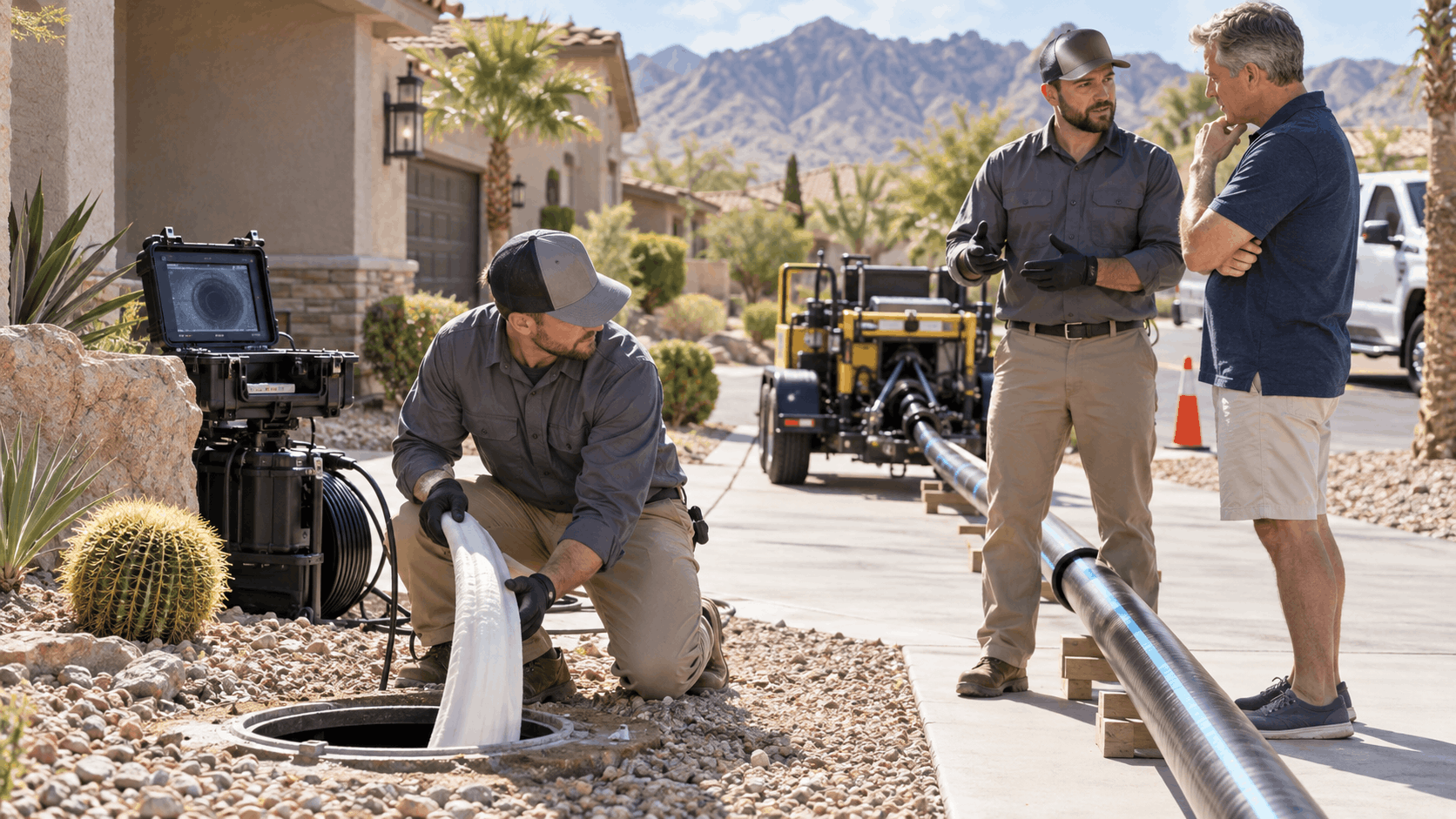
A sewer camera inspection is the foundation of any trenchless job. We run a video sewer camera through the line to see the exact damage, its location, and its depth. That footage tells us whether lining or bursting fits.
The camera inspection also measures how far the problem runs and flags any bends or bellies. Seeing the pipe firsthand removes guesswork from the quote. You get a clear picture of what is actually wrong underground.
After the repair, we run the camera again to verify the finished work. That before-and-after record proves the fix is solid and satisfies inspectors. It also gives you documentation for your own records.
HOA Approvals in Master-Planned Communities
Many valley homes sit inside master-planned communities with active HOAs. Communities across Summerlin, Green Valley, and parts of Henderson have landscaping and work rules. HOA approval can affect scheduling and yard restoration timing.
Some associations require notice before excavation or set standards for restoring gravel and plants. Because trenchless work leaves such a small footprint, it usually clears HOA review easily. Still, we plan around any community rules on our end.
We can provide the job scope your HOA needs for its records. Coordinating that paperwork ahead of time keeps the project on schedule. It also keeps you in good standing with your association.
What We Experienced at Active Plumbing
Over years of sewer work across the valley, our team has seen nearly every way a line can fail. We have dug through caliche near Henderson that dulled tooling within minutes. We have pulled root mats the size of a basketball out of older lines near downtown.
One pattern stands out: the homes where owners waited too long paid the most. A hairline crack that could have been lined became a collapse that needed full bursting. Catching the problem early with a camera almost always keeps the fix smaller and cheaper.
We have also learned how much local ground shapes the right answer. The same slow drain can mean roots in one neighborhood and a crushed pipe in another. That firsthand experience across specific streets is what lets us match the method to the home instead of guessing.
How Active Plumbing Decides Which Method to Use
Trust comes from a clear process, so here is exactly how our team chooses. There is no one-size answer, and we would not offer one. The decision follows the same steps on every job.
Starting With a Full Line Inspection
Every sewer diagnosis starts with a camera. Our line inspection maps the damage from the cleanout to the main. That footage shows cracks, roots, offsets, bellies, and any collapsed sections.
- We locate the exact spot and depth of the problem
- We identify the pipe material, whether clay, cast iron, or PVC
- We measure how much of the run is affected
This diagnosis removes guesswork before any recommendation. As a Las Vegas plumber who works these streets daily, we rely on what the camera shows, not assumptions. The video becomes the basis for the whole plan.
Checking Access Points and Soil on Site
Next we assess the property itself. We look at where cleanouts sit and where pits could go. We also test the caliche depth so we know how hard the digging will be.
- We scout the best access points to limit yard disruption
- We check caliche and soil conditions where pits are needed
- We note driveways, rock beds, and trees to protect
This on-site soil check shapes the labor and cost estimate. Hard caliche in one spot might change where we place a pit. Reading the ground firsthand keeps the plan realistic.
Matching the Method to Pipe Condition and Budget
With the camera and site data in hand, we match the method to reality. Pipe condition leads the decision, then access and budget follow. We aim for the fix that lasts, not just the cheapest today.
- Intact pipe with cracks or roots usually points to lining
- Collapsed or badly offset pipe points to bursting
- Homes needing more flow point to bursting with upsizing
We lay out the options with honest pricing so you can weigh them. If two methods both work, we explain the trade-offs plainly. The final call fits your pipe, your yard, and your budget.
What Homeowners Can Expect During the Job
We set clear expectations before we start the repair process. You get a schedule window, a scope, and a price with no hidden add-ons. Most residential jobs finish in one to two days.
- We protect landscaping and keep the work area contained
- We clean up pits and restore access spots when done
- We run a final camera pass and share the footage
After the job, cleanup and follow-up are part of the deal. If an emergency arises mid-project, our emergency plumbing team can respond fast. We want the finished repair to feel effortless from your side.
Need Help in Las Vegas?
Active Plumbing serves Las Vegas and all of Las Vegas Valley.
Final Thoughts
Trenchless pipe lining and pipe bursting both save your yard from a destructive trench, but they solve different problems. Lining rebuilds a pipe that still holds its shape, while bursting replaces one that is collapsed or beyond saving. Valley ground, with its caliche and shifting clay, often makes trenchless the smarter route either way.
The right choice comes down to a camera pass, the soil under your home, and the condition of your pipe. Once you know those three things, the decision is clear. Guessing is what leads to repeat failures and wasted money.
Frequently Asked Questions
What is the difference between pipe lining and pipe bursting?
Pipe lining repairs your existing pipe from the inside by curing a resin liner against the old walls, creating a new jointless surface. Pipe bursting replaces the pipe entirely by fracturing the old one and pulling in new HDPE pipe. In short, lining rebuilds and bursting replaces. Lining suits intact pipes with cracks or roots, while bursting suits collapsed or badly damaged lines.
How much does trenchless sewer repair cost in Las Vegas?
Trenchless repair in the valley usually runs between $80 and $250 per foot for both lining and bursting. Most complete home projects land between $4,000 and $15,000 depending on length, depth, and caliche hardness. Harder digging and deeper lines push costs higher. A camera inspection lets us give an itemized quote so you know the real number before any work starts.
Which method causes less damage to my yard?
Both methods spare your yard compared to open-trench digging since they need only small access points. Lining is usually the gentlest because it often uses just one or two holes. Bursting needs two small pits but still avoids a long trench. For homes with rock landscaping or pavers, either method protects most of your yard, with lining edging slightly ahead.
Can trenchless methods work with caliche soil?
Yes, and trenchless is often the better choice in caliche. That hard mineral layer makes open trenching slow and expensive, so limiting digging to one or two spots saves real money. Our crews break through caliche only at the access points, then plan pit placement to avoid the thickest sections. Areas like Henderson with heavy caliche benefit the most from this approach.
How long does a trenchless repair take?
Most residential trenchless repairs finish in one to two days. A standard lining job often wraps up in a single day, including cleaning, install, and cure. Bursting can also complete in a day for a typical run. Length, depth, caliche hardness, and access all affect the timeline. We give you a clear schedule window before we begin so there are no surprises.
How long do lined and burst pipes last?
A quality cured-in-place liner is built to last fifty years or more. New HDPE pipe installed through bursting can last fifty to one hundred years thanks to its corrosion resistance. Both results seal out roots and resist the ground movement that wrecks older pipes. When the right method matches the pipe, repeat failures are rare for decades.
Do I need a permit for sewer line work in Clark County?
Most trenchless sewer repairs and replacements require a plumbing permit in Clark County. Requirements differ slightly between the county and the cities of Las Vegas, Henderson, and North Las Vegas. Our team pulls the correct permit for your address and coordinates the inspection. Handling the paperwork keeps the work code-compliant and clean on record for future home sales.
Can pipe bursting make my sewer line bigger?
Yes, upsizing is one of the main advantages of pipe bursting. Because the bursting head clears a wider path as it moves, we can pull in a larger diameter pipe than the original. A four-inch line can often become six inches in the same pass. This helps older homes with chronic slow drainage or homes that added bathrooms over the years.
Will tree roots come back after a trenchless repair?
A properly installed liner or new HDPE pipe blocks future root intrusion. Roots enter through gaps at joints and cracks, and both trenchless methods eliminate those openings. A cured liner is jointless, and bursting installs pipe with fused, sealed joints. Once the line is sealed, roots have no pathway inside, which stops the backup cycle that cabling alone never fully fixes.
How do I know which method is right for my home?
The only reliable way is a camera inspection. Our team runs a video sewer camera to see the exact damage, pipe material, and how much of the line is affected. We then check access points and caliche depth at your property. From there we match the method to your pipe condition and budget, then explain the options in plain terms.
Whether your line needs a fresh liner or a full HDPE replacement, the right method starts with knowing what is really happening underground. Our team has worked sewer lines from the Historic Westside to Summerlin West, and we match each fix to the soil and pipe we actually find. That is how you get a repair that lasts instead of a guess that fails.
If you have a slow drain, a sewer smell, or a backup that keeps returning, call Active Plumbing for a camera inspection. Reach out through our contact page to schedule a consultation. We will show you exactly what is wrong and recommend the method that fits your home and budget.
Frequently Asked Questions
- What is the difference between pipe lining and pipe bursting?
- Pipe lining repairs your existing pipe from the inside by curing a resin liner against the old walls, creating a new jointless surface. Pipe bursting replaces the pipe entirely by fracturing the old one and pulling in new HDPE pipe. In short, lining rebuilds and bursting replaces. Lining suits intact pipes with cracks or roots, while bursting suits collapsed or badly damaged lines.
- How much does trenchless sewer repair cost in Las Vegas?
- Trenchless repair in the valley usually runs between $80 and $250 per foot for both lining and bursting. Most complete home projects land between $4,000 and $15,000 depending on length, depth, and caliche hardness. Harder digging and deeper lines push costs higher. A camera inspection lets us give an itemized quote so you know the real number before any work starts.
- Which method causes less damage to my yard?
- Both methods spare your yard compared to open-trench digging since they need only small access points. Lining is usually the gentlest because it often uses just one or two holes. Bursting needs two small pits but still avoids a long trench. For homes with rock landscaping or pavers, either method protects most of your yard, with lining edging slightly ahead.
- Can trenchless methods work with caliche soil?
- Yes, and trenchless is often the better choice in caliche. That hard mineral layer makes open trenching slow and expensive, so limiting digging to one or two spots saves real money. Our crews break through caliche only at the access points, then plan pit placement to avoid the thickest sections. Areas like Henderson with heavy caliche benefit the most from this approach.
- How long does a trenchless repair take?
- Most residential trenchless repairs finish in one to two days. A standard lining job often wraps up in a single day, including cleaning, install, and cure. Bursting can also complete in a day for a typical run. Length, depth, caliche hardness, and access all affect the timeline. We give you a clear schedule window before we begin so there are no surprises.
- How long do lined and burst pipes last?
- A quality cured-in-place liner is built to last fifty years or more. New HDPE pipe installed through bursting can last fifty to one hundred years thanks to its corrosion resistance. Both results seal out roots and resist the ground movement that wrecks older pipes. When the right method matches the pipe, repeat failures are rare for decades.
- Do I need a permit for sewer line work in Clark County?
- Most trenchless sewer repairs and replacements require a plumbing permit in Clark County. Requirements differ slightly between the county and the cities of Las Vegas, Henderson, and North Las Vegas. Our team pulls the correct permit for your address and coordinates the inspection. Handling the paperwork keeps the work code-compliant and clean on record for future home sales.
- Can pipe bursting make my sewer line bigger?
- Yes, upsizing is one of the main advantages of pipe bursting. Because the bursting head clears a wider path as it moves, we can pull in a larger diameter pipe than the original. A four-inch line can often become six inches in the same pass. This helps older homes with chronic slow drainage or homes that added bathrooms over the years.
- Will tree roots come back after a trenchless repair?
- A properly installed liner or new HDPE pipe blocks future root intrusion. Roots enter through gaps at joints and cracks, and both trenchless methods eliminate those openings. A cured liner is jointless, and bursting installs pipe with fused, sealed joints. Once the line is sealed, roots have no pathway inside, which stops the backup cycle that cabling alone never fully fixes.
- How do I know which method is right for my home?
- The only reliable way is a camera inspection. Our team runs a video sewer camera to see the exact damage, pipe material, and how much of the line is affected. We then check access points and caliche depth at your property. From there we match the method to your pipe condition and budget, then explain the options in plain terms. Whether your line needs a fresh liner or a full HDPE replacement, the right method starts with knowing what is really happening underground. Our team has worked sewer lines from the Historic Westside to Summerlin West, and we match each fix to the soil and pipe we
A
Licensed plumbing professionals serving Las Vegas and Las Vegas Valley.
Licensed in Nevada · License #0047021
Last updated on
Why trust Active Plumbing?
Founded in 1991, Active Plumbing is a licensed and insured plumber serving Las Vegas and Las Vegas Valley. All content is reviewed by our licensed technicians.

Need Help in Las Vegas?
Active Plumbing serves Las Vegas and all of Las Vegas Valley.
Related Articles
Tips & Advice
How Caliche Soil Shapes Every Underground Pipe Decision in the Las Vegas Valley
Caliche soil shapes every buried pipe decision in the Las Vegas Valley. Learn how this hardpan affects trenching, pipe materials, sewer and water lines, and cost.
How-To Guides
Polybutylene Pipe Identification: Which Vegas Neighborhoods Still Have It
Learn how to identify polybutylene pipe, which Las Vegas neighborhoods still have it, why local water makes it fail faster, and what a modern repipe costs.
Cost Guides
Trenchless Pipe Bursting vs Pipe Lining vs Open Trench in Las Vegas Caliche Soil
Compare trenchless pipe bursting, pipe lining, and open trench sewer repair in Las Vegas caliche soil, with costs, timelines, and how to pick the right method.