Plumber in Whitney Ranch, Henderson with Same-Day Service

Looking for a Plumber? Contact Us Now
Open 24/7. Written price before work starts.
Get Your Quote
Tell us what's going on and we'll get back to you. We're open 24/7.

Key Takeaways
- Whitney Ranch sits inside the City of Henderson, so permits run through the Henderson Development Services Center, not Clark County and not the separate Whitney township.
- Homes built across the late 1980s and 1990s may have polybutylene or Kitec pipe; both fail predictably and a PEX or copper repipe at $4,000 to $15,000 is the honest fix.
- Technicians arrive in 30 to 60 minutes anywhere in the Las Vegas Valley, with burst pipes, active slab leaks and no hot water in a rental warranting an immediate visit.
- Valley water is 280 ppm, about 16 grains per gallon and very hard, which scales thirty-year-old heaters and fixtures and makes softeners and flushing worth doing.
- Slab-on-grade homes make under-slab leaks a distinct job; electronic detection at $150 to $350 pinpoints the leak before any concrete is opened.
- In condos and rentals, NRS 116 and NRS 118A decide who owns the pipe and who authorizes the repair, which is settled on the first call.
- After-hours calls carry a $150 to $300 service fee plus repair costs, and a written price is given before work begins.
- Active Plumbing holds Nevada license NSCB #0047021, licensed since 1991, verifiable free at nvcontractorsboard.com.
In This Article
A homeowner near Galleria Drive walks across the living room one morning and notices a patch of tile that feels warm underfoot. There is no leak in sight, no dripping pipe, nothing obvious. That warm spot on a slab floor is one of the most telling early signs of an under-slab plumbing failure, and in Whitney Ranch it is a call we take often.
This guide covers same-day plumbing help in this west Henderson community. It walks through the pipe materials common in homes here, the hard water that wears out equipment, the slab-on-grade construction that makes under-floor leaks their own category of work, and the condominium and rental mix that decides who pays and who approves a repair. Whitney Ranch is a specific place with specific plumbing patterns, and knowing those patterns is how a fault gets fixed right the first time.
When a caller needs help fast, our technicians arrive in 30 to 60 minutes anywhere in the Las Vegas Valley. Below, we set out what a caller should expect, what genuinely needs a same-day visit, and how we confirm the jurisdiction, the ownership and the pipe behind the walls before quoting any permitted work.

Where Whitney Ranch Is and Why the Right Address Matters?
Whitney Ranch is a west Henderson community of detached tract housing, attached product and condominium developments built largely from the late 1980s through the 1990s. Because it sits inside the City of Henderson, permits, plan check and inspections run through the City of Henderson, not Clark County. That single fact shapes the first question on any permitted job.
The confusion comes from the name. There is a separate place called Whitney, an unincorporated Clark County township off Boulder Highway, and it is a different jurisdiction with different housing and a different service mix. Establishing which of the two a caller means is a genuine first-call question, because getting it wrong sends paperwork to the wrong agency and sets the wrong expectations about the property.
| Detail | Whitney Ranch | Whitney Township |
|---|---|---|
| Jurisdiction | City of Henderson | Unincorporated Clark County |
| Permit counter | City of Henderson Development Services Center | Clark County building department |
| Location | West Henderson wedge near Galleria Drive | Off Boulder Highway, northwest of the Ranch |
| Housing | Late 1980s-1990s tract, attached and condo | Different housing stock and mix |
The Henderson Wedge: Boulder Highway to Whitney Mesa
Whitney Ranch occupies a recognizable wedge of west Henderson. It is framed by Boulder Highway, State Route 582, Stephanie Street, Sunset Road and the Whitney Mesa escarpment. Anyone who has driven the area knows the local traffic rides along Galleria Drive and Patrick Lane, which link the housing to the retail edge at Galleria at Sunset.
The City of Henderson runs several anchors here that help place an address fast. Whitney Ranch Recreation Center sits at 1575 Galleria Drive, White School Park at 1661 Galleria Drive, and the Whitney Mesa Recreation Area and Nature Preserve at 1990 Patrick Lane. When a caller describes their street by one of these landmarks, it speeds up the first call.
School campuses reinforce the geography too. Jim Thorpe Elementary at 1650 Patrick Lane, Harriet Treem Elementary at 1698 Patrick Lane and Thurman White Academy of the Performing Arts at 1661 Galleria Drive all sit inside the community. Knowing these routes is part of why a quick arrival in Whitney Ranch is realistic rather than a sales line.
The Whitney Mesa escarpment also marks the community's edge, with Green Valley to the south and Pittman and downtown Henderson to the east. Those boundaries matter because the unincorporated Whitney township lies northwest along Boulder Highway, close enough to confuse but a separate place entirely.
Whitney Ranch Versus Whitney Township: Not the Same Place
Whitney Ranch sits inside the City of Henderson. Whitney township, off Boulder Highway to the northwest, is unincorporated Clark County. They share part of a name and nothing else that matters for a permit.
That distinction decides which building department governs the work. A Whitney Ranch address runs through the City of Henderson. A Whitney township address runs through Clark County, a separate permit counter with its own ordinance and its own inspection process.
Getting it wrong is not a small clerical slip. It sends paperwork to the wrong agency, stalls the job, and resets the expectations a homeowner had about timing and cost. We ask the question up front so the work starts on the right track.
If a caller is unsure which one they live in, the landmarks near Galleria Drive and Patrick Lane usually settle it quickly. Our Henderson service area and our Whitney township page cover both so there is no doubt about which team and which jurisdiction applies.
Who Handles Permits for Your Whitney Ranch Home
For a Whitney Ranch home, permits, plan check and inspections run through the City of Henderson Development Services Center. That is the authority for a repipe, a sewer line replacement, a gas line run or any other work that needs a permit in this community.
The code that applies is the Southern Nevada Amendments to the Uniform Plumbing Code as codified by the City of Henderson. Those amendments are not code unless the jurisdiction adopts them, and Henderson has. The Building Official is the authority on any alternate material or method.
Confirming the address up front avoids delays at the counter. We tell a homeowner the permit position is confirmed for their specific address rather than quoting one valley-wide rule, because the right answer depends on which city or county the property sits in.
If a job turns out not to need a permit, that is worth knowing too, since interior repair work often moves faster than permitted structural or exterior work. Either way, the first call is where we pin down the jurisdiction so nothing surprises the owner later.
Get Your Quote
Tell us what's going on and we'll get back to you. We're open 24/7.
What Same-Day Service Actually Means Here?
Same-day service is not a single promise that fits every job. It means we move fast on the faults that cannot wait and set honest expectations on the ones that can. In this part of west Henderson, quick response works because the community is compact and the routes are familiar.
A burst pipe, an active slab leak or a dead water heater in a rental are emergency plumbing situations. A slow drip under a sink or a fixture swap can usually be scheduled. Knowing the difference saves a homeowner money and keeps the emergency slots open for the people who truly need them.
Our emergency plumbing team handles the calls where water is actively causing damage. The sections below explain how arrival works here and which problems earn a same-day visit.
Arrival Window Across West Henderson
Technicians arrive in 30 to 60 minutes anywhere in the Las Vegas Valley, and Whitney Ranch is well inside that window. The community's compact footprint helps, since the housing clusters around a handful of connected roads rather than spreading across miles of terrain.
Galleria Drive and Patrick Lane carry the local traffic through the heart of the community, and Sunset Road frames the northern edge. Those roads tie directly into Boulder Highway and State Route 582, which gives a truck more than one way in depending on where the traffic is backed up.
Because the recreation center at 1575 Galleria Drive and the schools along Patrick Lane sit central to the housing, most addresses are only a short run from a main route. That geography is the quiet reason a 30 to 60 minute arrival holds up in practice rather than only on paper.
When a caller gives us a cross street or a nearby landmark, we can route the nearest technician without guesswork. The clearer the address on the first call, the tighter the arrival window.
Problems That Can't Wait: Burst Pipes, Slab Leaks, No Hot Water
Some faults need an immediate visit because every minute adds damage or hardship. A burst pipe is the clearest example, since water under pressure can flood a room and soak drywall, flooring and belongings before anyone can mop up.
An active slab leak is another. The warm spot on the floor near Galleria Drive that we opened this guide with is often the first sign, and an under-slab failure keeps feeding water into the foundation and the structure until it is found and stopped.
No hot water is urgent too, especially in a rental. A failed water heater in a tenant-occupied home is the landlord's responsibility to fix, and a bathroom that cannot supply hot water does not meet the habitability standard a landlord owes. Those calls move to the front of the line.
Sewage backing up into a tub or a floor drain is a health hazard that also warrants an immediate response. When any of these happen, the right move is to shut off the water if it is safe to do so and call for help rather than wait for business hours.
After-Hours and Weekend Calls
Plumbing does not fail on a schedule, and the worst leaks seem to arrive late at night or over a weekend. For calls outside normal business hours, an after-hours emergency service fee of $150 to $300 plus repair costs applies.
That fee is a typical range for the area, not a fixed quote. It covers the cost of dispatching a technician outside standard hours, and the repair itself is priced separately based on the actual fault once it is diagnosed on site.
The full price is given in writing before any work starts, so a homeowner knows the number before committing. That holds true whether the call comes in at two in the afternoon or two in the morning.
Weekend plumbing emergencies in Whitney Ranch tend to follow the same patterns as weekday ones here: a slab leak that finally surfaces, a water heater that quits, or a connector that lets go on an aging system. The response is the same whatever the clock says.

Need Help in Las Vegas?
Active Plumbing serves Las Vegas and all of Las Vegas Valley.
The Pipe Behind Your Walls: Polybutylene and Kitec
Whitney Ranch homes went up across the late 1980s and 1990s, and that build window straddles two problem pipe materials. Neither should be assumed from the build year alone, and both should be checked on site. Knowing which one is behind the walls changes the whole repair conversation.
Polybutylene and Kitec each fail in a predictable way, and each has a legal history that has already closed. Owners today carry the cost of replacement themselves. A planned repipe in PEX or copper is the honest recommendation for both, because with either material the whole installation ages together.
| Material | Install window | Appearance | Fittings | How it fails |
|---|---|---|---|---|
| Polybutylene | 1978 to 1995 | Gray, sometimes black inside; blue underground | Acetal, usually gray; aluminum or copper crimp rings | Reacts with oxidants such as chlorine and becomes brittle |
| Kitec | 1995 to 2007 | Orange for hot, blue for cold | Brass, marked Kitec, IPEX or PlumbBetter | Dezincification: zinc leaches from brass, restricts flow, then leaks |
Why the Build Era Puts Both Materials in Play
The earlier phases of Whitney Ranch fall inside the polybutylene window that ran from 1978 to 1995. The later phases fall inside the Kitec window that ran from 1995 to 2007. Because the community was built across both periods, a single tract can land in either camp.
That overlap is exactly why neither material should be assumed. A home built in 1989 is a strong polybutylene candidate, while one finished in the late 1990s could carry Kitec. The only way to know is to look.
This is also why a plumber who knows the valley's build eras can tell an owner what is most likely behind their walls based on the tract and the year. That local read saves time, but it is a starting point, not a verdict.
We confirm the pipe on site before recommending anything. The build year narrows the field, and a quick inspection at a few access points settles it.
Spotting Polybutylene and How It Fails
Polybutylene is usually gray and sometimes black inside the house, with a blue underground service line. It is joined by acetal fittings, usually gray and occasionally white, held with aluminum or copper crimp rings. Once you know the look, it is hard to mistake.
The material fails because it reacts with oxidants such as the chlorine in the water supply. Over years that reaction makes the pipe brittle from the inside, so it cracks and lets go, often at or near a fitting where stress concentrates.
The places to look are consistent from home to home: under sinks, behind toilets, at the washer hookups, at the water heater, and where pipe enters the wall from the slab. A homeowner can check these spots with a flashlight before calling.
If gray pipe turns up at even one of these points, it is worth a full assessment. Because the whole system was installed at once, finding it in one place usually means it is everywhere.
Spotting Kitec and Dezincification
Kitec is an IPEX composite pipe, aluminum sandwiched between plastic layers, orange for hot and blue for cold. It uses brass fittings, and the markings to look for include Kitec, IPEX or PlumbBetter printed on the pipe or stamped on the fittings.
Kitec fails by dezincification. Zinc leaches out of the brass fitting and builds up as a chalky deposit inside, which restricts flow long before the fitting actually leaks. Low pressure at a fixture on a Kitec system can be an early warning.
The same inspection points apply: under sinks, behind toilets, at the washer connections and at the water heater. Orange and blue pipe with brass fittings is the tell, and the brand markings confirm it.
Because the deposit forms gradually, a Kitec system can seem fine right up until a fitting gives way. That is why spotting the markings early matters more than waiting for a failure.
Why a PEX or Copper Repipe Is the Honest Fix
With both polybutylene and Kitec, the entire installation ages together. Patching one failure does not address the dozens of other fittings and runs that are the same age and heading the same way. Chasing individual leaks turns into a running expense.
The legal windows for both materials have passed. The polybutylene claim windows closed years ago, and a later action was dismissed with prejudice in 2018. The Kitec deadlines, extended to March 17, 2017 in Clark County and January 9, 2020 for the broader settlement, have also passed. Current owners carry the cost themselves.
Given that, a planned whole-house repipe in PEX or copper is the smarter spend. A whole-house repipe is typically $4,000 to $15,000, a figure that depends on the size of the home and the layout. That is a range for the area, not a quote.
Done once, a repipe clears the problem material out of the home entirely and resets the plumbing for decades. It turns an unpredictable series of emergency repairs into a single planned project.
Hard Water and Aging Equipment in Thirty-Year-Old Homes
Very hard water plus original equipment creates a predictable set of faults in homes of this age. The water chemistry is the same across the valley, but in a thirty-year-old Whitney Ranch home it has had three decades to do its work. The result is scaled heaters, tired fixtures and components long past their service life.
Connecting the water to what breaks makes the fix make sense. Scale does not strike at random. It settles where water heats and where water slows, and that tells us where to look and what a treatment system actually solves.
280 PPM: What Very Hard Water Does to Your System
The Southern Nevada Water Authority states the valley's water is 280 parts per million, or about 16 grains per gallon, categorized very hard. That is the single most important technical fact in this market, and it explains more plumbing failures here than anything else.
Very hard water deposits calcium and magnesium scale throughout a system. Scale builds on water heater elements and tank bottoms, it clogs aerators and shower heads, and it narrows the bore of supply lines over years. It also fouls the inlet screens on dishwashers and washing machines.
The white crusting customers call hard water stains is the visible end of the same process happening inside the pipes. Mixing valves and cartridges have small passages that scale clogs, which is why faucets start to stick or drip after years of service.
In a home that has been drinking this water since the 1990s, the buildup is advanced. Treatment slows it, but the existing scale is already there in the older equipment.
Water Heaters Past Rated Life
Homes of this age often have water heaters past rated life and scaled internally, and many Whitney Ranch properties are already on a second unit. A tank left unflushed works harder and fails earlier than its rated life, because the scale on the bottom forces the burner or element to heat through a layer of mineral.
Flushing a tank clears that sediment and is the standard response to very hard water here. It is maintenance that extends equipment life rather than an optional extra, and skipping it is why so many heaters in these homes die young.
When a heater can be saved, water heater repair runs $150 to $500, a typical range for the area. When it is beyond repair, tank water heater installation runs $800 to $1,500. The right call depends on the age and condition of the unit.
Our water heater team checks the tank's age, the sediment load and the connections before recommending repair or replacement, and the price comes in writing first.
Thermal Expansion Tanks, Regulators and Old Angle Stops
Thermal expansion tanks fail silently. When one goes, a water heater's relief valve starts to drip, and that drip is frequently misdiagnosed as a faulty valve when the real problem is the expansion tank behind it. Replacing the valve alone does not fix it.
Pressure regulators creep high or drop over time. High incoming pressure stresses an already aging system, and on a polybutylene or Kitec house that extra pressure pushes a compromised material closer to failure. A two-minute pressure test belongs on every call here.
The original angle stops, connectors, fill valves and washing machine hoses in a thirty-year-old home are long past sensible service life. These small parts are cheap, but when one lets go it can flood a room, so replacing them during other work is a sound move.
Checking pressure, the expansion tank and the shutoffs together gives a true picture of the home's condition. One failing part in this chain often points to others nearby that are just as tired.
Softeners and Scale Reduction That Extend Equipment Life
Whole-house softeners and scale-reduction systems extend equipment life in this valley rather than being luxuries. With water at 280 ppm, a treatment system is what keeps the next heater, the next set of fixtures and the supply lines from scaling as fast as the originals did.
A water treatment system installation, whether a softener or salt-free conditioning, runs $800 to $2,500, a typical range for the area. The right choice depends on the home and the owner's preference, and both approaches cut the scale that shortens equipment life.
One wrinkle in Whitney Ranch: where an association governs, architectural standards cover exterior appearance. A visible softener or treatment system on a street-facing elevation can require association approval even though interior work does not.
Association approval and a city permit are separate tracks. We flag the approval question early so a treatment system does not get installed and then run afoul of the architectural standards.

Slab Leaks and Caliche Under Whitney Ranch Homes
Homes in Whitney Ranch are slab-on-grade, which makes an under-slab supply line failure a distinct category of work. The pipe runs under a concrete slab, so when it leaks there is no crawlspace to crawl into and no easy access. The job becomes detection first, then a choice about how to fix it.
The signs are usually subtle at the start, and the ground conditions around here add their own complication. Caliche makes any exterior excavation slower and more expensive, which belongs in an honest discussion of what a repair costs.
Signs of a Slab Leak: Warm Floors and Rising Usage
The usual first sign is a recurring warm spot on a floor, which happens when a hot water line under the slab leaks and warms the concrete above it. A homeowner near Galleria Drive feeling a warm patch on cool tile is describing a textbook early symptom.
An unexplained rise in water usage is the other common tell. If the bill climbs with no change in habits, water is going somewhere it should not, and under the slab is a frequent culprit when nothing is visible above ground.
Other signs include the sound of running water with every fixture off, or a drop in hot water pressure. Because the leak is hidden, these indirect clues are often all a homeowner has to go on.
An under-slab failure is not accessible without detection, so guessing at the location risks breaking concrete in the wrong place. That is why the process starts with pinpointing, not demolition.
Electronic Detection Before Anyone Breaks Concrete
Electronic and acoustic methods locate a slab leak before anyone touches the concrete. The idea is simple: find the exact spot first, then open the slab in one place rather than chasing the leak across a room.
Our slab leak detection and repair team uses listening equipment and line tracing to narrow the leak to a small area. Electronic leak detection picks up the signature of water escaping under pressure through the slab.
Slab leak detection runs $150 to $300, and electronic leak detection runs $150 to $350, both typical ranges for the area. That detection cost buys precision, which more than pays for itself by limiting how much concrete has to come up.
Once the leak is pinpointed, the repair plan follows from there. Knowing the exact location also informs the bigger decision of whether to fix the one spot or reroute the line entirely.
Why Caliche Makes Exterior Digging Slower and Dearer
Caliche is a cemented calcium-carbonate hardpan common across the valley. It is hard to trench through and hard to bed a pipe into evenly, which makes exterior excavation slower and more expensive than digging in softer ground.
That extra effort is a real cost factor on any work that involves digging to a service line or lateral. Slab leak repair runs $500 to $3,000, a typical range for the area, and the ground conditions are part of why exterior work sits toward the higher end.
Caliche is abrasive, and over time it can abrade a buried pipe that runs through it. What it does not do is shift, swell or crack pipes, since it is not an expansive soil. The ground movement that pulls lines out of grade comes from poorly compacted backfill settling under a pipe, not from the caliche itself.
Understanding the mechanism keeps the diagnosis honest. We explain why the digging is harder and what that means for the timeline, rather than blaming the soil for the leak.
Break-and-Repair Versus Reroute in a Poly or Kitec House
Once a slab leak is located, there are two paths. One is to break the slab, repair the single failed spot and patch the concrete. The other is to reroute the line, often overhead or through walls, bypassing the slab run entirely.
In a home with sound pipe, breaking the slab for one repair can make sense. The failure is isolated, the rest of the system is fine, and fixing the one spot solves the problem.
In a polybutylene or Kitec house, the math changes. The pipe under the slab is the same aging material as the pipe everywhere else, so repairing one failure just means waiting for the next. Here a full repipe is usually the smarter spend than patching.
We lay out both options with the detection results in hand so the owner can weigh a one-time repair against a repipe that clears the problem material for good. The right answer depends on the pipe material and how much of it is already failing.
Need Help in Las Vegas?
Active Plumbing serves Las Vegas and all of Las Vegas Valley.
Condos, Attached Homes and Rentals: Who Pays and Who Approves
A significant share of Whitney Ranch is attached, condominium and rental housing. That mix changes who owns the pipe and who authorizes the work, and sorting it out before a job starts avoids wasted visits and wrong bills. The question of who pays is sometimes harder than the repair itself.
Nevada law and the governing documents of each community set the boundaries. Knowing where the unit ends and the common element begins, and knowing whether an owner or a tenant is on the line, is the groundwork for a clean job.
Unit Versus Common Element in Stacked and Attached Product
Under Nevada Revised Statutes Chapter 116, the governing documents define what is the unit, what is common element and what is limited common element. Pipe inside a wall, a shared stack or a shared riser is frequently not the owner's to repair, while the branch and fixtures serving a single unit usually are.
That line matters because it decides who pays. An owner who assumes they are responsible for a shared stack can end up footing a bill that belonged to the association. The reverse happens too, where an association declines a repair that was actually the owner's branch.
Never assume the owner controls the pipe until the CC&Rs or the management company confirm it. We help identify where the failure sits in the system, but the documents settle responsibility.
Getting this right up front saves everyone time and friction. It also means the repair gets authorized by the party who actually owns the pipe, which keeps the work moving.
One Leak, Multiple Units: Why Fast Diagnosis Matters
In stacked product, a single leak is rarely a single-unit problem. Water from a failure on an upper floor runs down into the units below, so one fault becomes a multi-party problem involving several owners and often the association.
That is why prompt, documented diagnosis is valuable to everyone involved. Finding the source quickly stops the spread, and a clear record of where the leak originated helps sort out responsibility among the affected parties.
Our emergency response treats a multi-unit leak as the urgent situation it is. The faster the source is pinned down, the fewer units take damage and the cleaner the accounting afterward.
Documentation also matters when an association and multiple owners are each looking at part of the bill. A clear diagnosis gives everyone the same facts to work from.
Rentals: Tenant Reports, Landlord Authorizes
Whitney Ranch carries a substantial rental and investor-owned share, and across Henderson 33.9 percent of homes are rented. So the person reporting a fault is often a tenant, while the landlord or property manager authorizes and pays for the work.
Under Nevada Revised Statutes Chapter 118A, a landlord must maintain habitable premises, including working plumbing and facilities to supply hot water. A failed heater or an unusable bathroom in a rental is the owner's responsibility rather than the tenant's.
Establishing ownership on the first call avoids a wasted visit. A technician who arrives to find the tenant cannot authorize the repair has lost a trip, so we confirm who is paying before we dispatch.
Tenants are welcome to report the problem, and we will coordinate with the landlord or property manager to get the work approved. The goal is a fast fix with the right person signing off.
Portfolio Landlords and Phased Repipe Programs
A landlord with several units in Whitney Ranch faces the same cycle across the portfolio: the same aging heaters, the same creeping regulators and the same tired connectors. What fails in one unit is lined up to fail in the next.
Where the pipe material is polybutylene or Kitec, a phased repipe program across the portfolio beats waiting for each unit to flood. Replacing the problem material on a planned schedule costs less in total than a string of emergency repairs and water damage claims.
A phased approach lets an owner spread the work over time, unit by unit, while clearing the known failure risk from each property. It turns an unpredictable liability into a managed project.
We work with investor-owners to map out which units carry which pipe and to sequence the work sensibly. The same logic applies to heaters and connectors that are all the same age across a portfolio.

What Same-Day Plumbing Costs in Whitney Ranch?
Honest cost ranges help a homeowner know what to expect before the truck arrives. The figures below are typical ranges for plumbing work in the Las Vegas Valley, not a quote and not a fixed price. The actual price for a specific job is given in writing before work begins.
| Job | Typical range |
|---|---|
| Burst pipe repair | $200 to $800 |
| Slab leak detection | $150 to $300 |
| Slab leak repair | $500 to $3,000 |
| Electronic leak detection | $150 to $350 |
| Whole-house repipe | $4,000 to $15,000 |
| Tank water heater installation | $800 to $1,500 |
| Drain cleaning | $150 to $350 |
| After-hours emergency fee | $150 to $300 plus repair costs |
Leak and Burst Pipe Pricing
Burst pipe repair runs $200 to $800, depending on where the break is and how much access it takes to reach. A clean break on an accessible line sits toward the lower end, while a hidden or awkward failure costs more to open up and repair.
Slab leak detection runs $150 to $300, and electronic leak detection runs $150 to $350. These are the costs of pinpointing a hidden leak before any concrete comes up, and they buy the precision that keeps the repair small.
Slab leak repair itself runs $500 to $3,000, with the range reflecting whether the fix is a single-spot repair or something larger, and whether the caliche makes the digging slow. A whole-home leak detection system runs $300 to $800 for owners who want ongoing monitoring.
All of these are typical ranges for the area. The specific number for a specific leak comes after diagnosis and arrives in writing.
Water Heater and Repipe Pricing
Tank water heater installation runs $800 to $1,500. A tankless water heater installation runs $1,500 to $3,500, with a pre-filter adding $150 to $300 where the hard water calls for one. In this valley a pre-filter protects the tankless heat exchanger from scale.
Water heater repair runs $150 to $500 for units that can be saved. For a thirty-year-old home on its original or second heater, the repair-versus-replace call depends on the age and the sediment load inside the tank.
A whole-house repipe runs $4,000 to $15,000, the largest of these jobs and the one that clears polybutylene or Kitec out of a home for good. The range reflects the size of the house and how the plumbing is routed.
These are typical area ranges. The written price for the specific home comes before any work starts.
Drain, Sewer and After-Hours Pricing
Drain cleaning runs $150 to $350 for a standard blockage. Hydro-jetting for residential lines runs $300 to $600, which clears heavier buildup and is the stronger option when a line has scaled or greased up over years.
For calls outside business hours, the after-hours emergency service fee is $150 to $300 plus repair costs. That fee covers dispatching a technician after hours, and the repair is priced separately once the fault is diagnosed.
Every one of these figures is a typical range for the area rather than a quote. The actual price for the job is given in writing before work begins, so the number is settled before anyone commits.
Our drain and sewer team handles the clogs, the backups and the line cleaning that drive many same-day calls in homes of this age.
Need Help in Las Vegas?
Active Plumbing serves Las Vegas and all of Las Vegas Valley.
How Our Team Handles a Whitney Ranch Call
From the first call to the finished repair, the process is built to avoid surprises. We confirm the basics up front, verify what we are licensed to do, diagnose the fault and put a price in writing before any work starts. Here is how a Whitney Ranch job actually runs.
The First Call: Confirming Address, Ownership and Jurisdiction
The first call establishes three things. First, whether the home is in Whitney Ranch inside the City of Henderson or in the separate Whitney township in unincorporated Clark County, because that decides which permit counter applies.
Second, who controls the repair. In attached and condominium product, that means sorting out whether the owner, a tenant or the association is responsible, so the right party authorizes the work. In a rental, it means reaching the landlord or property manager.
Third, the permit position, confirmed for the specific address rather than quoted as one valley-wide rule. For a permitted job, that confirmation keeps the paperwork on the right track from the start.
Getting these three settled on the first call is what prevents a wasted visit and a stalled permit. It is a small step that signals we work this community every day.
Licensing You Can Verify
Active Plumbing holds Nevada license NSCB #0047021 and has worked the valley since 1991 as a fourth-generation family business. Some of its owners are US military veterans. The owner is Edward Schmitt.
A license is verified free at nvcontractorsboard.com, where classification, status, bond and workers compensation are all public record. A customer is entitled to ask for a license number and to check it, and in a market with a significant unlicensed trade problem that verification is worth doing.
Contractor licensing in Nevada is statewide through the Nevada State Contractors Board. Work that requires a permit must be performed by an appropriately licensed contractor, which is another reason the jurisdiction and the license both get confirmed early.
You can read more about the company and its history on our about page. The license number and the start date are matters of public record anyone can check.
Diagnosis, a Written Price, Then the Work
Technicians arrive in 30 to 60 minutes anywhere in the Las Vegas Valley, Whitney Ranch included. On arrival, the technician diagnoses the fault, and on homes of this age that includes a quick pressure test, since high incoming pressure stresses aging polybutylene and Kitec.
Once the fault is clear, the customer gets a written price before any work starts. That is how the job runs here, so the number is settled and agreed before a wrench turns.
The diagnosis drives the plan, whether that is a single repair, a reroute or a full repipe. On a slab leak the detection step comes first so the concrete is opened in exactly one place.
From there the work proceeds against the price the customer already has in hand. No part of the job surprises the owner with a number they did not see first.
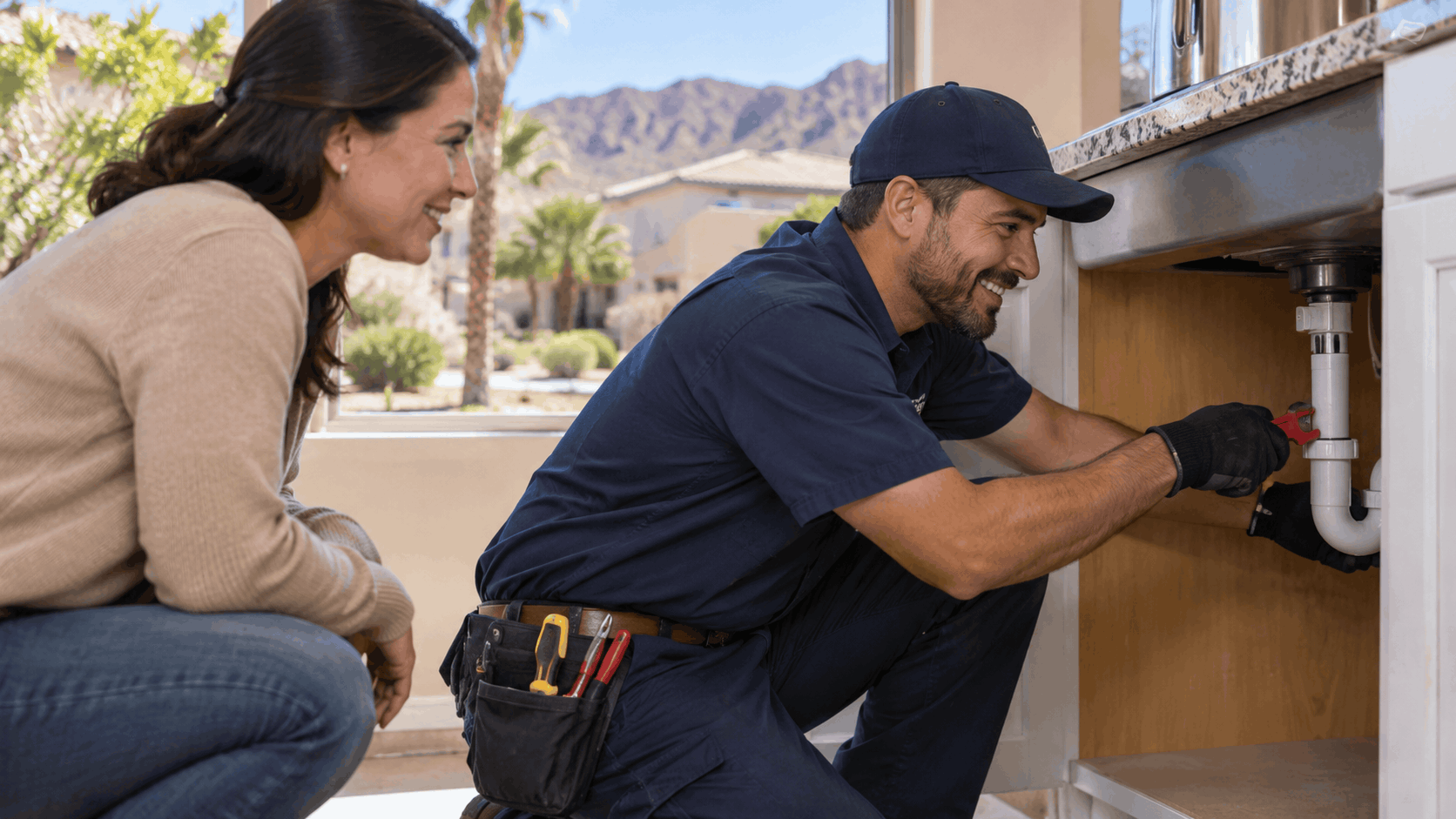
Ready When Your Whitney Ranch Home Needs Us
When a warm spot appears on the floor or a pipe lets go, our technicians arrive in 30 to 60 minutes across the Las Vegas Valley, confirm the jurisdiction and ownership for your address, diagnose the fault with a quick pressure test, and put a written price in your hands before any work starts.
Call Active Plumbing at (702) 438-3357 to get a technician on the way or to schedule a repipe assessment for your Whitney Ranch home.
Frequently Asked Questions
- How fast can a plumber reach my Whitney Ranch home?
- Technicians arrive in 30 to 60 minutes anywhere in the Las Vegas Valley, and Whitney Ranch is well inside that window. The community clusters around Galleria Drive and Patrick Lane, which tie directly into Boulder Highway, State Route 582 and Sunset Road. That compact layout and the main routes through it are why a quick arrival holds up here in practice. Giving a cross street or a nearby landmark on the call helps us route the nearest technician without guesswork.
- Is my home on polybutylene or Kitec pipe?
- Homes built in Whitney Ranch across the late 1980s and 1990s may have either, and neither should be assumed from the build year alone. Polybutylene is usually gray, while Kitec is orange for hot and blue for cold with brass fittings marked Kitec, IPEX or PlumbBetter. Look behind toilets, under sinks and at the water heater with a flashlight. We confirm the material on site before recommending anything, since the whole installation ages together.
- How much does a whole-house repipe cost?
- A whole-house repipe is typically $4,000 to $15,000, a typical range for the Las Vegas Valley rather than a quote. The actual figure depends on the size of the home and how the plumbing is routed, and it is given in writing before work begins. In a polybutylene or Kitec house, a repipe in PEX or copper clears the problem material for good, which beats patching one failure after another as the aging system lets go.
- How do I know if I have a slab leak?
- The usual first signs in slab-on-grade Whitney Ranch homes are a recurring warm spot on the floor and an unexplained rise in water usage. The warm spot comes from a hot water line leaking under the concrete. Because the failure is under the slab, it is not accessible without detection. We pinpoint the leak electronically before anyone breaks concrete, so the slab is opened in exactly one place rather than chased across a room.
- Who pays for a leak in my Whitney Ranch condo?
- Under Nevada Revised Statutes Chapter 116, the governing documents decide. A shared stack or riser is frequently the association's responsibility, while the branch and fixtures serving a single unit are usually the owner's. Never assume the owner controls the pipe until the CC&Rs or the management company confirm it, because an owner can otherwise pay for work the association owed. We help identify where the failure sits, and the documents settle who authorizes and pays for the repair.
- I rent in Whitney Ranch. Who do I call about plumbing?
- Under Nevada Revised Statutes Chapter 118A, a landlord must maintain habitable premises, including working plumbing and facilities to supply hot water. So a tenant reports the fault, and the landlord or property manager authorizes and pays for the repair. A failed heater or an unusable bathroom in a rental is the owner's responsibility rather than the tenant's. We confirm ownership on the first call and coordinate with the landlord or manager to get the work approved quickly.
- Which city handles permits for Whitney Ranch?
- Whitney Ranch sits inside the City of Henderson, so permits, plan check and inspections run through the City of Henderson Development Services Center, not Clark County. It should not be confused with the separate Whitney township off Boulder Highway, which is unincorporated Clark County with its own permit counter. Getting this wrong sends paperwork to the wrong agency and stalls the job. We confirm the permit position for your specific address on the first call.
- Why does hard water cause so many problems here?
- The Southern Nevada Water Authority states the valley's water is 280 parts per million, or about 16 grains per gallon, categorized very hard. That water deposits calcium and magnesium scale on heater elements and tank bottoms, clogs aerators and shower heads, and narrows supply lines over years. In a thirty-year-old Whitney Ranch home it has had decades to build up, which is why equipment of this age scales and fails. Softeners, scale reduction and regular heater flushing extend equipment life here.
- Do you charge extra for after-hours calls?
- For calls outside normal business hours, an after-hours emergency service fee of $150 to $300 plus repair costs applies. That fee covers dispatching a technician after hours, and the repair itself is priced separately once the fault is diagnosed on site. Both are typical ranges for the area rather than a fixed quote. The full price is given in writing before any work starts, so you know the number before committing, whatever time the call comes in.
- How can I verify your plumbing license?
- Active Plumbing holds Nevada license NSCB #0047021 and has been licensed since 1991. Anyone can verify it free at nvcontractorsboard.com, where classification, status, bond and workers compensation are all public record. A customer is entitled to ask for a license number and to check it, and in a market with a significant unlicensed trade problem, that verification is worth two minutes. Licensed work that requires a permit must be performed by an appropriately licensed contractor.
Licensed plumbing professionals serving Las Vegas and Las Vegas Valley.
Licensed in Nevada · License #0047021
Last updated on
Why trust Active Plumbing?
Founded in 1991, Active Plumbing is a licensed and insured plumber serving Las Vegas and Las Vegas Valley. All content is reviewed by our licensed technicians.
Need Help in Las Vegas?
Active Plumbing serves Las Vegas and all of Las Vegas Valley.
Related Articles

Emergency Plumber in Summerlin: Same-Day Service for The Trails, Summerlin South, and The Ridges
A local guide to emergency plumbing in Summerlin, covering same-day service for The Trails, Summerlin South, and The Ridges, plus prevention tips and FAQs.

Plumber at Lake Las Vegas with Same-Day Service
Same-day plumbing at Lake Las Vegas: gate access, response windows, Kitec repipes, empty-home leak risk, hard water and Henderson permits explained by a licensed local team.
Whitney Ranch Henderson Plumber: 2000s-Era Construction Issues
Whitney Ranch homes built in the early-2000s boom share predictable plumbing problems. Learn the warning signs and how Active Plumbing helps Henderson homeowners.