Sewer Camera Inspection in Charleston Heights Before You Buy or Renovate

Looking for a Plumber? Contact Us Now
Open 24/7. Written price before work starts.
Get Your Quote
Tell us what's going on and we'll get back to you. We're open 24/7.
Key Takeaways
- A sewer camera inspection shows the real condition of a buried drain line, something a standard home inspection almost never checks on an older home.
- Charleston Heights homes built between 1953 and 1968 carry cast iron and clay drains that scale, crack and separate at joints after six decades.
- Mature trees across these tracts push roots into clay and cast iron laterals, showing first as repeated slow drains before a full backup.
- Slab-on-grade over caliche means excavation is slower and more expensive, and settling backfill pulls lines out of grade to create bellies.
- Buyers can use documented camera footage of a defect to negotiate a repair credit or price reduction before closing.
- Typical valley ranges include drain cleaning $150 to $350, hydro-jetting $300 to $600, sewer line repair $1,500 to $5,000, and full replacement $4,000 to $12,000.
- Permitted sewer work in Charleston Heights runs through the City of Las Vegas, and under Nevada law a rental sewer repair is the landlord's cost.
- Active Plumbing holds Nevada license NSCB #0047021, has served the valley since 1991, and gives a written price before work starts.
In This Article
Picture a buyer under contract on a modest 1960s tract home off Upland Boulevard, a few blocks from Gary Dexter Park. The house shows well, the inspection came back fine, and the closing date is set. What nobody has looked at is the sewer line buried under the slab, which is the single biggest unknown on a house this old.
Charleston Heights is one of the valley's largest pockets of postwar housing, built mostly between 1953 and 1968 on small lots. The drain pipe in the ground reflects that era, and on a slab-on-grade house, you cannot see it without putting a camera down the line. The same question hangs over an owner planning a second bathroom: what shape is the drain in before the walls open?
What a Sewer Camera Inspection Actually Shows?
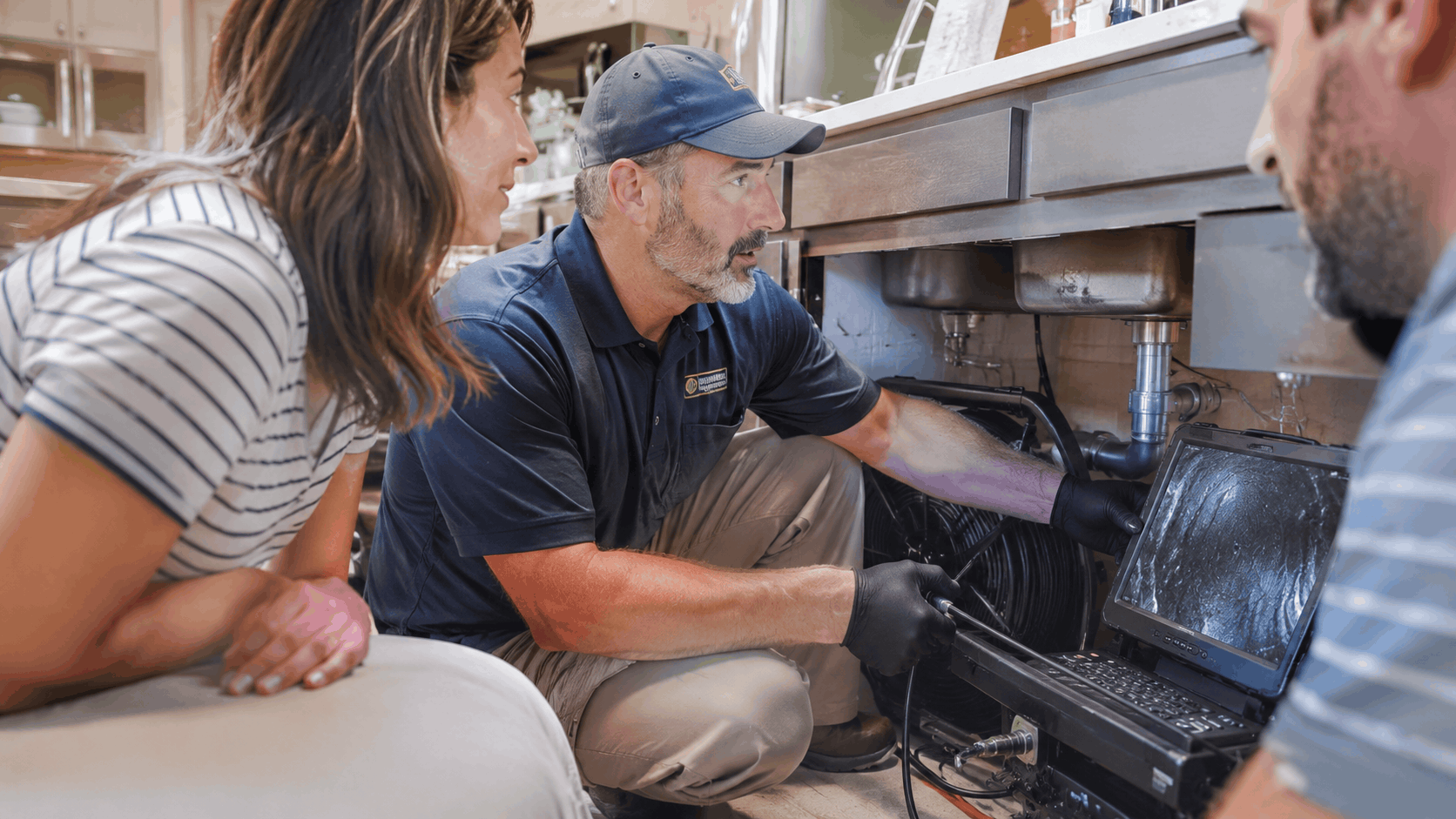
A sewer camera inspection is exactly what it sounds like. A plumber feeds a flexible waterproof camera into the drain line and watches a live screen while it travels through the pipe. On a home sale or a remodel, that footage answers the one question a buyer or renovator cannot answer any other way: is the buried drain sound, or is it about to cost money?
The point of a video pipe inspection is to turn a guess into a decision. A buyer learns whether to proceed, negotiate or walk. A renovator learns whether the line can handle more fixtures before the tile goes down. Both get to see the actual condition of the pipe instead of assuming it is fine because the toilets flush today.
Here is a quick look at what the inspection answers and why it matters to someone spending money on an older house.
| What the camera shows | Why it matters to a buyer or renovator |
|---|---|
| Overall pipe condition | Tells you if you are buying a sound line or a repair bill |
| Exact location of a problem | Decides whether a fix is a small dig or a full replacement |
| Pipe material in the ground | Cast iron and clay age differently than newer plastic |
| Root intrusion or blockages | Explains repeated slow drains before they become a backup |
| Grade of the line | Reveals a belly where waste pools and clogs form |
How the camera travels the line
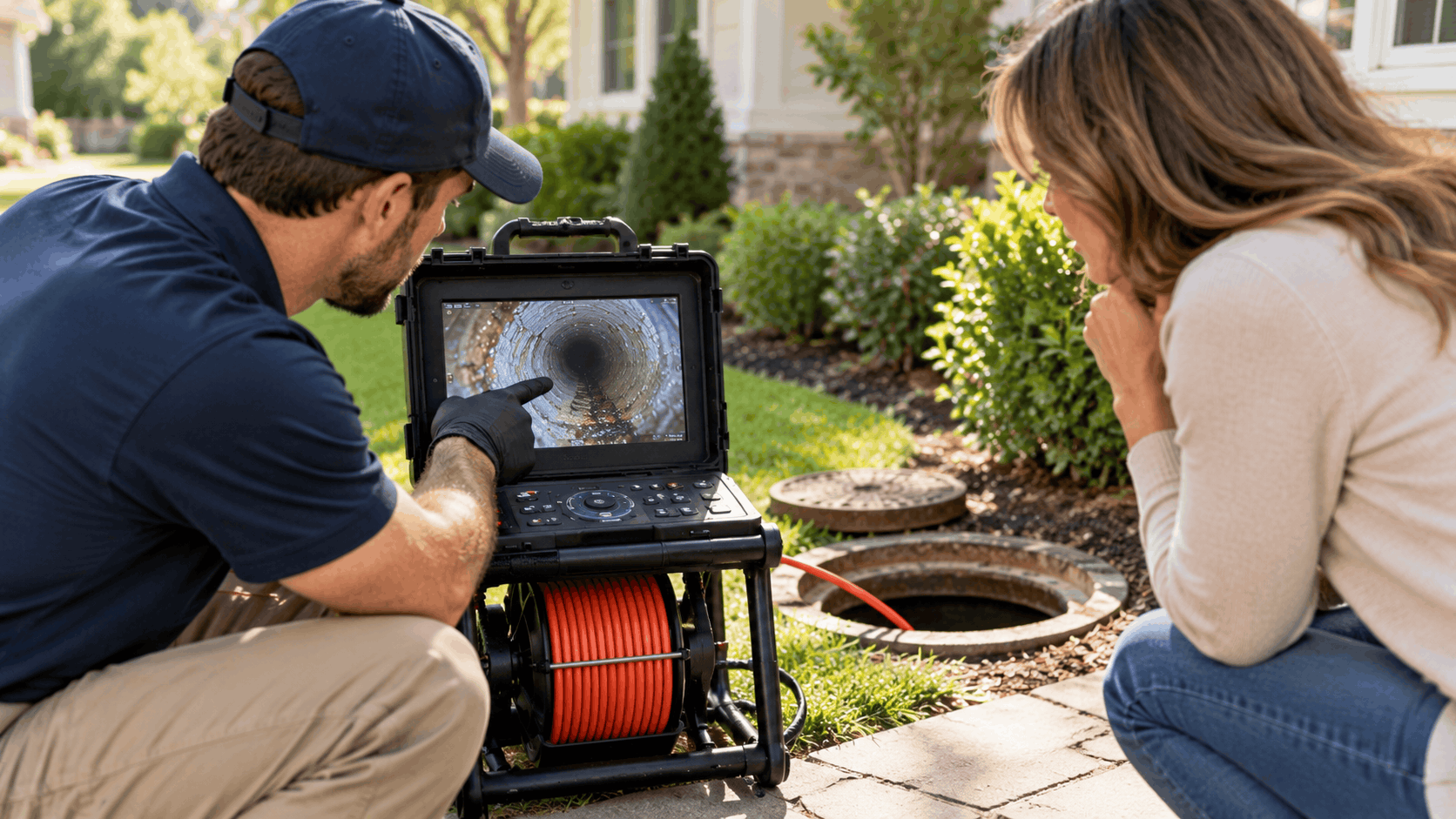
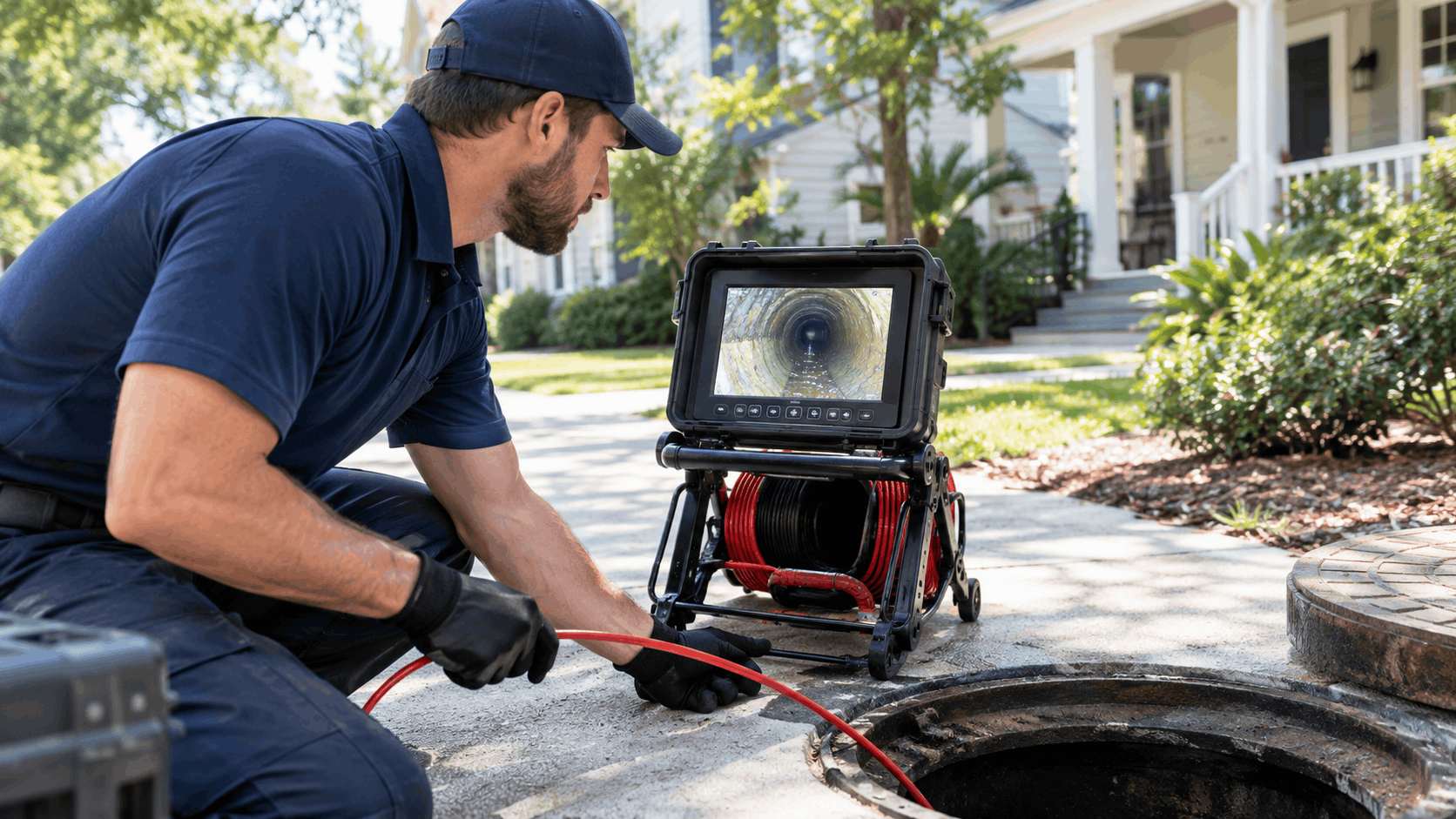
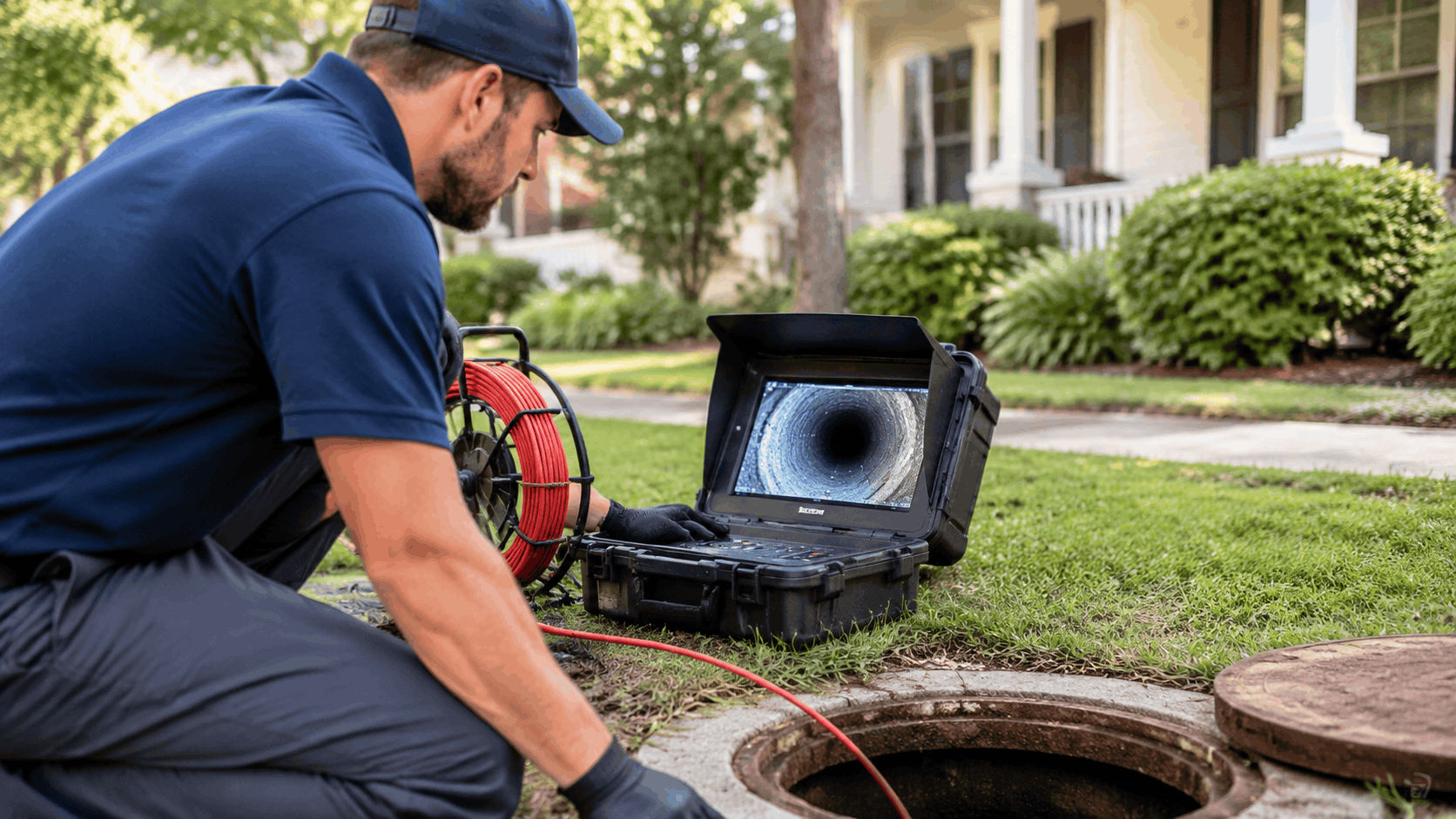
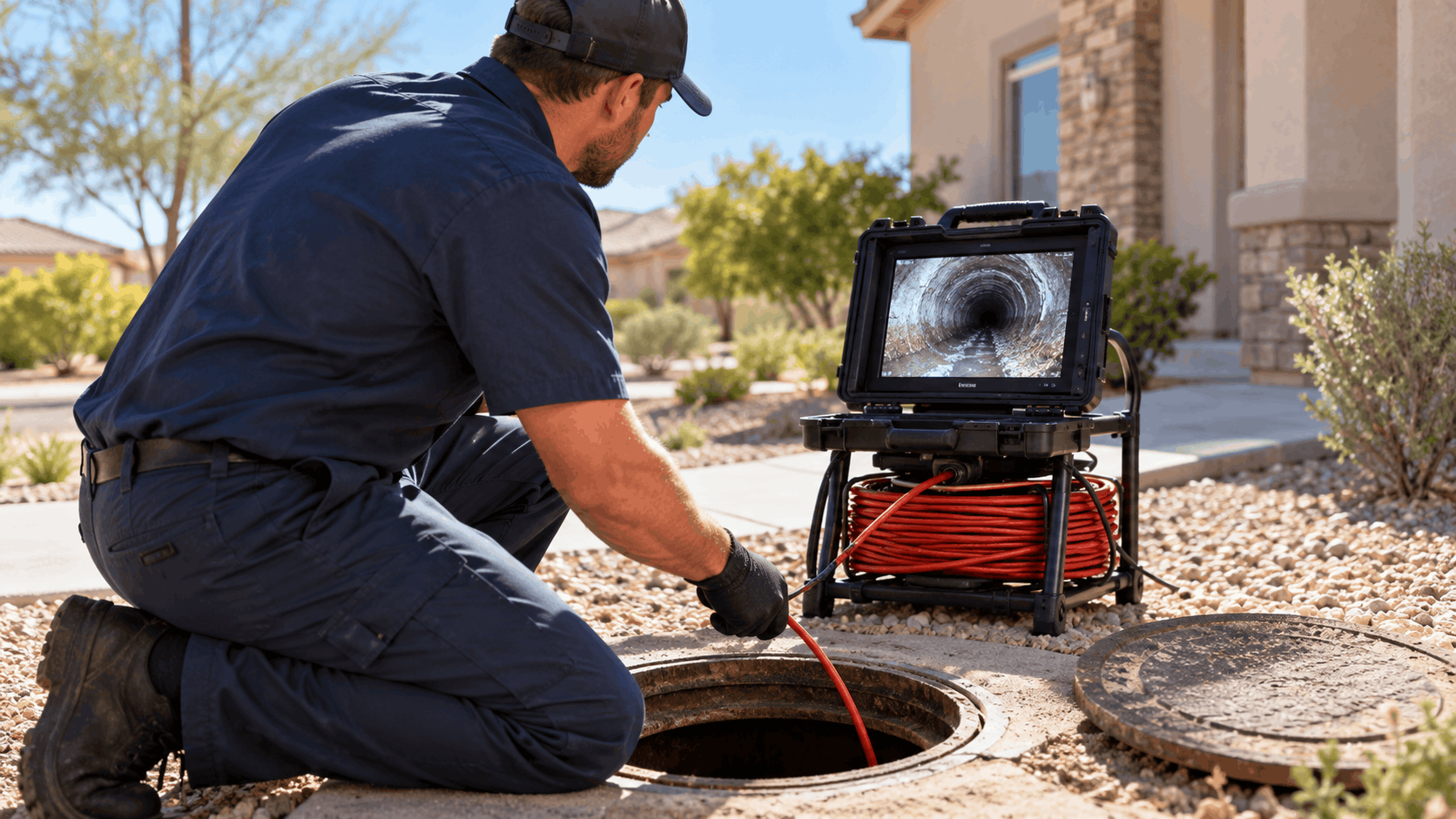
The technician starts at an access point, usually a cleanout if the house has one, or through a pulled fixture if it does not. The camera head is on a flexible cable that pushes through the drain and follows the sewer lateral out toward the city connection. It bends around the turns in the pipe the same way waste does.
As the cable feeds in, the plumber watches a live monitor showing the inside of the pipe in real time. Nothing is hidden behind a wall or under the slab anymore. The feed shows the pipe walls, the joints, any standing water, and anything growing or collapsing inside the line.
Many camera heads carry a locator that lets the technician mark the exact spot of a problem from above ground. That matters on a slab home, because knowing a defect sits twenty feet out under the front yard versus directly beneath the kitchen changes the repair completely. The footage is the record; the locate is the map.
On older Charleston Heights homes without a usable cleanout, part of the first visit is often figuring out the best access. A cleanout installation can make this and every future service far easier, which is worth knowing before the camera even goes in.
What problems the footage reveals
The camera shows the whole catalog of drain trouble. Root intrusion appears as fine hairs or thick masses pushing in through a joint or crack. Cracks and separated joints show as dark gaps or offset pipe where two sections no longer line up. Scale buildup narrows the bore and roughens the walls so waste catches instead of flowing.
A pipe belly shows as a section holding standing water where the line has lost its slope. That pooling is where solids settle and clogs start. Blockages, whether grease, debris or a collapsed section, show up as the point where the camera can go no further.
These problems track directly to the pipe this era used. Cast iron drain, waste and vent lines scale and crack from the inside after decades. Clay laterals are jointed every few feet, and every joint is an invitation for roots. Seeing which problem you have, and where, is the whole reason to run the camera before you sign or demolish.
Why footage beats a plunger or a snake guess
Clearing a slow drain with a snake or a plunger treats the symptom. The water moves again, so the problem feels solved. But if roots or a belly caused the slowdown, the clog comes back, because nothing about the pipe changed.
A camera gives a real diagnosis. It shows the cause, not just the blockage, and it shows exactly where the cause sits in the line. That is the difference between knowing a drain is slow and knowing a joint twelve feet out has separated and lets roots in every season.
For a buyer deciding whether to walk away or negotiate, that distinction is the whole deal. A one-time clog cleared with drain cleaning is a minor note. A root-packed, bellied cast iron lateral is a five-figure conversation. Only the footage tells you which one you are looking at.
Get Your Quote
Tell us what's going on and we'll get back to you. We're open 24/7.
Why Charleston Heights Homes Need This Check?
Charleston Heights covers a large swathe of west-central Las Vegas around Charleston Boulevard and Decatur Boulevard. The city survey bounds the neighborhood by Washington Avenue, Vegas Drive and Meadows Lane on the north, Decatur and Bedford Lane on the east, Charleston and Evergreen Avenue on the south, and Torrey Pines Drive and Rainbow Boulevard on the west. Builder Ernest Becker put up most of it between 1953 and 1968.
That build era is why the camera matters here. These postwar tract homes were built modestly on small lots, and the drain pipe underground is as old as the house. Sixty years is long enough for every common failure mode in the pipe of that period to come due.
The table below ties the local conditions to the drain problems they produce in these specific tracts.
| Local condition | What it does to the drain line |
|---|---|
| 1953-1968 build era | Cast iron and clay drains now at the age they fail |
| Mature trees across the tracts | Roots enter clay and cast iron joints |
| Slab-on-grade over caliche | Hard dig, and settling backfill pulls lines out of grade |
| Small, modest houses | Repair cost weighed against the home's own value |
Sixty-year-old cast iron and clay drains
Housing of this era in Las Vegas typically carries cast iron drain, waste and vent piping through much of it, with clay laterals running out to the street. Cast iron does not last forever. Over six decades it scales on the inside, cracks, and separates at the joints where sections were originally sealed.
A cast iron drain that has scaled loses its smooth bore. Waste catches on the rough interior, which is why an old line clogs more often than a new one even when nothing is broken. Eventually the scaling and corrosion thin the pipe wall until a section cracks or a joint lets go entirely.
Clay lateral pipe is strong but brittle and jointed every few feet. Each joint is a seam that can shift, crack or separate as the ground around it moves. For a buyer, this is precisely why you want eyes on the line first. A house that looks move-in ready can sit on a drain line at the end of its service life, and nothing above the slab will tell you.
Mature landscape and root intrusion
Decades of growth means mature trees across these tracts, and tree roots are relentless about finding water. A sewer lateral carries moisture, nutrients and warmth, so roots work their way toward it and push in through any joint or crack they can reach.
Clay and cast iron laterals are prime targets because both have joints or corrosion gaps that give roots an entry point. Once inside, roots form a mat that snags toilet paper and waste, slowing the drain long before it blocks completely.
The pattern is predictable. It shows as repeated slow drains, a tub or toilet that backs up a little and then clears, over and over across months. Homeowners often live with it, assuming it is normal for an old house. A camera catches the root mass while it is still a slow drain, which is far cheaper to deal with than the full backup it becomes.
Slab-on-grade over caliche
These tracts were built slab-on-grade, and the valley's caliche layer sits beneath much of this ground. Caliche is a cemented calcium-carbonate hardpan. It is hard to trench through and hard to bed a pipe into evenly, which makes any excavation here slower and more expensive than in softer ground.
Caliche does not move or crack pipe on its own. The real mechanism is the backfill. When the original trench was dug and refilled around the pipe, poorly compacted fill settles over the years. As it settles, it pulls a section of the line down out of its proper grade.
That loss of grade is what creates a pipe belly, the low spot where waste pools instead of flowing. The camera finds these bellies as standing water on the footage. On a slab home, correcting a belly means getting to the pipe through or under the slab, which is exactly why knowing it exists before you buy or remodel changes everything.
Why this matters more on a modest house
Because these are smaller houses, often weighed against their own value, a bad sewer line carries more weight in the math than it would on a larger property. A repair that would be a rounding error on an expensive home can be a real share of a modest one's value.
An owner here is frequently deciding whether the house is worth a major drain repair at all, or whether to scope the work differently. Honest footage lets that decision happen before money changes hands, not after. Discovering a failed lateral the week after closing is the worst version of this story.
For a renovator, the same logic applies to scope. Knowing the drain's condition shapes the whole plan and the budget. A clear look at the line up front is what separates a project that stays on budget from one that blows up mid-tear-out. It also lets an owner weigh a drain repair against other work the house needs with real numbers instead of hope.
Need Help in Las Vegas?
Active Plumbing serves Las Vegas and all of Las Vegas Valley.
Before You Buy: What the Inspection Tells a Buyer
A home buyer under contract on an older Charleston Heights house is making one of the largest purchases of their life, often on a few weeks of due diligence. The sewer lateral is the most expensive thing on the property that the standard process almost never checks.
Running a camera before closing is part of looking at the whole house, not just the parts you can see. On a home built when these were, the buried drain deserves the same scrutiny as the roof or the foundation. It is the one system where a problem stays completely hidden until it fails, and by then you own it.
Standard home inspections stop at the fixtures
A general home inspection is broad but shallow on the drain system. The inspector runs water, checks that fixtures drain, looks under sinks for leaks, and moves on. Almost none of them push a camera down the sewer lateral, because that is a specialty service outside a standard inspection's scope.
That leaves the buried lateral as the biggest unknown in the deal on a home of this age. Everything from the fixture trap outward to the city main is unverified. The drain can pass a fixture test while a joint fifteen feet out is separated or root-packed.
This is where hidden damage lives on a 1960s slab home. The pipe is old enough to fail, buried where no one can see it, and skipped by the one inspection most buyers rely on. A dedicated camera run closes that gap, and on a house this age, it is money well spent during the inspection period.
Using the findings to negotiate
Documented footage is leverage. When the camera shows root intrusion, a belly or a separated joint, the buyer has a recorded, time-stamped record of a real defect. That is far harder for a seller to wave off than a verbal concern.
With that footage, a buyer can ask for a repair credit, a price reduction, or that the seller fix the line before closing. The cost ranges are known enough that both sides can negotiate against a real number rather than a fear. A separated joint might be a modest repair; a collapsed lateral is a different conversation entirely.
The alternative is inheriting the problem with no recourse. Once you close, that drain is yours and so is the bill. A few hundred dollars for an inspection during the due diligence window can shift thousands of dollars of repair onto the right party, or at least into the price you pay.
Rentals and investor buyers in these tracts
Charleston Heights carries a high share of rental and investor-owned property. For an investor buying to rent, the sewer line check is not optional homework, it is protecting a future income stream from an expensive emergency.
Under Nevada law, a landlord is responsible for maintaining habitable premises. A sewer backup in a rental is the owner's cost to fix, not the tenant's. An investor who skips the camera is betting their own money that an old lateral will hold, and on a 1960s line that is a poor bet.
Checking the lateral before purchase lets an investor price the repair into the deal or schedule it before a tenant moves in. That beats a 2 a.m. call about a backed-up only bathroom in a one-bath rental, which is an emergency the owner is legally on the hook to resolve fast.
Before You Renovate: Checking the Line Before the Walls Open
An owner planning a remodel or an added bathroom has a different reason to film the drain, but the same logic applies. The line condition should be known before the project is scheduled, because it shapes what the project actually involves and costs.
Opening a finished remodel later to fix a drain is the outcome nobody wants. Running the camera first means the drain work, if any is needed, happens while the walls are already open and the floor is already up. That is the cheapest time to do it by far.
Adding a bathroom to a one-bath house
Many Charleston Heights homes started life with a single bathroom. Adding a second bath or a laundry asks more of a drain system that was sized for one, and the tired original pipe does not always cooperate.
A sixty-year-old cast iron drain that is already scaled and narrowed has less capacity than it did when new. Add fixtures to it and the existing restrictions get exposed as slow drains and backups that were not a problem under lighter use. The line that handled one bathroom may struggle with two.
Knowing the drain's real capacity shapes the remodel plan. The camera tells you whether the existing line can carry the new load or whether part of it needs upsizing or replacement as part of the job. That is far better learned in the planning stage than after the new bathroom is tiled and the drain cannot keep up.
Avoiding a tear-out surprise mid-project
The expensive version of a remodel is the one where a failing lateral gets discovered after the cabinets are in and the tile is set. Now the finished work has to come back out to reach the drain, and the budget takes a hit it never planned for.
Filming the line before demolition prevents that. If the camera shows a problem, the drain repair gets built into the project sequence, done while everything is already open. If the camera shows a sound line, the owner proceeds with confidence instead of crossing their fingers.
Coordinating the remodel plumbing around a known drain condition is simply smarter planning. The camera is a cheap insurance policy against the single most disruptive surprise a remodel can hit. A few hundred dollars up front can save a tear-out that costs many times that.
Permits and the City of Las Vegas
Charleston Heights sits firmly inside the City of Las Vegas, not unincorporated Clark County, even though residents describe the whole valley as Las Vegas. That means permits and inspections for a remodel or a sewer repair run through the City of Las Vegas building department, under the Southern Nevada Amendments to the Uniform Plumbing Code as the city has codified them.
Because jurisdiction is decided address by address across the valley, the permit position should be confirmed for the specific property with the city before work is scheduled. A plumber who works these streets will know to point you to the right counter, which is a small thing that signals real local knowledge.
Permitted work must be performed by a contractor licensed through the Nevada State Contractors Board. In a neighborhood with a significant unlicensed trade presence, that is worth stating plainly, and a homeowner is entitled to ask for and verify a license number.
Reading the Results and Choosing the Fix
Once the camera run is done, the footage drives the decision. A clean line means you proceed. A problem means choosing a repair that matches what the pipe actually needs, which on a slab home over caliche is a conversation worth having carefully.
The footage and the locate tell the plumber what is wrong and exactly where. That is what makes the sewer repair choice honest instead of a guess, because the fix is matched to the real defect and its location rather than to a worst-case assumption.
Root intrusion that keeps coming back
When the camera shows roots, the pattern usually matches what the homeowner already noticed: a drain that slows, gets cleared, and slows again. Clearing the roots with a cable buys time, but the roots grow back through the same joint or crack that let them in.
Hydro-jetting is a stronger option. A high-pressure water stream scours the pipe walls and cuts the root mass out far more completely than a cable, restoring close to the full bore. On a recurring root problem, hydro-jetting often gives much longer relief than cabling alone.
But jetting still treats a pipe that lets roots in. If the camera shows the roots are entering through a specific broken or separated section, the lasting fix is replacing that root-damaged section of lateral. The footage tells you whether you are managing an aging line or whether one bad section needs to go.
A belly or separated joint under the slab
A pipe belly is a section that has settled below grade, so waste pools there instead of flowing. A separated joint is where two pipe sections have pulled apart. Neither clears with cleaning, because the problem is the pipe's shape or position, not a blockage.
Fixing a belly or a separated joint almost always means excavation to reach the pipe and reset it to the correct grade or rejoin it properly. On a slab-on-grade home, that can mean breaking the slab for an under-slab run or digging the exterior lateral, depending on where the defect sits.
Here the caliche factor drives the cost. That cemented hardpan is slow and expensive to trench through, so a dig here costs more than the same repair would in softer ground. An honest estimate reflects that up front, because pretending caliche does not exist just means a surprise on the invoice later.
Spot repair versus full lateral replacement
The core decision after a bad result is whether to repair one bad section or replace the whole lateral. The right answer depends entirely on what the camera showed across the length of the line.
If the footage shows one failed joint or a single cracked section in otherwise sound pipe, a spot repair makes sense. You fix the bad part and leave the good pipe alone. If the footage shows scaling, cracking and root intrusion along the whole run, a sewer line repair or replacement of the entire lateral is the more honest long-term call.
Patching one section of a line that is failing everywhere just moves the next leak a few feet down. The camera is what lets a plumber tell the difference between a localized defect and a worn-out line, so the money goes where the pipe actually needs it. That is the whole value of filming before you dig.
Need Help in Las Vegas?
Active Plumbing serves Las Vegas and all of Las Vegas Valley.
What a Sewer Camera Inspection and Related Work Costs?
Knowing the typical ranges helps a buyer or renovator plan. These are typical market ranges for plumbing work in the Las Vegas Valley, not a quote, and the actual price for a specific job is given in writing before work begins. The figures below are copied from our service pricing.
| Service | Typical Las Vegas Valley range |
|---|---|
| Drain cleaning | $150 to $350 |
| Electronic leak detection | $150 to $350 |
| Hydro-jetting (residential lines) | $300 to $600 |
| Cleanout installation | $250 to $600 |
| Sewer line repair | $1,500 to $5,000 |
| Full sewer line replacement | $4,000 to $12,000 |
Inspection and diagnostic ranges
For the diagnostic side of the work, the closest listed ranges are drain cleaning at $150 to $350 and electronic leak detection at $150 to $350. These are typical area ranges, and the drain cleaning range covers the work when clearing a line is part of getting a clear look at it.
Electronic leak detection, at $150 to $350, is the pinpoint diagnostic range for finding where a leak sits, which pairs with camera work when a line shows both a blockage and a suspected leak. Both are diagnostic steps that cost a fraction of the repairs they help you avoid guessing at.
The value of spending on diagnosis first is that it keeps you from paying for the wrong repair. A few hundred dollars to know exactly what and where the problem is protects you from a dig in the wrong place. On a slab home, digging in the wrong spot is an expensive mistake.
What repairs run if the camera finds a problem
If the footage turns up a problem, the repair ranges tell you what you are looking at. Hydro-jetting for residential lines runs $300 to $600. Cleanout installation runs $250 to $600, which is worth it on a house that lacks easy drain access.
Larger repairs span a wider range. Sewer line repair runs $1,500 to $5,000, and a full sewer line replacement runs $4,000 to $12,000. The gap between those two is exactly why the camera matters. It tells you whether you are in the repair range or the replacement range before anyone starts digging.
These are typical ranges for the valley, not a fixed price for any one job. A spot repair of a single joint sits toward the low end of the repair range; replacing a full caliche-bound lateral under a slab sits toward the high end of replacement. The footage is what places your job on that scale.
Why the caliche factor belongs in the price talk
Any honest price for exterior line work in Charleston Heights has to account for caliche. That cemented hardpan makes trenching slower and more expensive than digging through softer soil, because the equipment and labor needed to cut through it simply cost more.
A plumber who explains the caliche factor up front is giving you the truth about a price rather than defending it afterward. It is the reason a sewer lateral replacement here can land higher than the same length of pipe would in ground without that layer.
This is not a reason to avoid the work, it is a reason to budget honestly for it. When you understand why the dig costs what it does, the estimate makes sense instead of feeling like a surprise. For urgent drain failures, our emergency plumbing team handles the dig and the repair with that reality built into the plan.
Protecting an Older Line After You Buy
Once you own or finish renovating a Charleston Heights slab home, a little attention keeps the drain line working and catches trouble early. These are practical steps for a new owner or a tenant, aimed at an old line in an old house.
None of this is complicated or expensive, and all of it helps a sixty-year-old drain system last longer. The goal is to spot the slow slide toward a backup while it is still a cheap fix, not after it floods the only bathroom.
Know where the main shut-off is
Every owner and tenant should know where the main water shut-off is and should test that it actually works. On a house this age, a shut-off valve that has never been turned often seizes and will not close when it is finally needed.
Finding out your shut-off is frozen during an active leak is the worst possible time to learn it. Turn the valve during calm conditions to confirm it moves and seals. If it will not budge or will not fully stop the water, that is a small repair worth doing before an emergency forces it.
For a tenant in one of these rentals, knowing the shut-off location is still worth it even though the landlord owns the repair. Being able to stop the water fast limits the damage while the owner arranges the fix. A few minutes locating and testing the valve now can save a flooded slab later.
Watch for repeat slow drains
The clearest early warning on an old line is a drain that slows, clears, and slows again. That returning pattern is almost never random. It usually means root intrusion or a failing section narrowing the pipe, and it builds toward a full backup.
A one-time clog is normal. A drain that keeps slowing in the same fixture, or across several fixtures, is the pipe telling you something structural is going on. That is the moment to film the line, while it is still a slow drain and not yet sewage on the floor.
Catching it early is the entire advantage. A root mass found as a slow drain can be jetted or the bad section replaced on your schedule. The same problem ignored becomes a backup on a holiday weekend. Paying attention to the pattern is free, and it is the single best habit for an old drain.
Monsoon season and yard drains
Late summer brings the valley's monsoon storms, short and intense bursts of rain that overwhelm drainage. That seasonal pattern can back up floor drains and yard drains across these older tracts when the system cannot shed water fast enough.
A yard or floor drain that is already partly blocked with debris or roots has even less capacity when a monsoon dumps water all at once. The storm does not cause the blockage, but it exposes one that was there all along. A line filmed and cleared before late summer handles the rain far better.
Keeping yard drains clear and knowing where water goes in a hard storm is worth doing ahead of the season. If a floor drain backs up during a monsoon, that is a signal the drainage needs attention, and the camera can show whether the problem is debris or something structural in the line.
Need Help in Las Vegas?
Active Plumbing serves Las Vegas and all of Las Vegas Valley.
How Active Plumbing Handles a Camera Inspection in Charleston Heights
We work the streets of Charleston Heights, the tracts between Washington Avenue and Charleston Boulevard, around the schools like Red Rock Elementary and Western High and the West Charleston Library on West Charleston Boulevard. We know the build era here and what the pipe under these slabs tends to be, which shapes how we run every camera job.
Our approach on an older Las Vegas slab home is to diagnose first and show you the evidence, so the repair decision is yours and it is informed. Here is how a camera inspection goes.
The camera run and the diagnosis
We feed the camera through the line and watch the footage with you, so you see what we see on the screen. There is no mystery about the condition of the pipe when you are looking at the inside of it in real time alongside the technician.
When the camera finds something, we locate it from above ground so you know exactly where the problem sits and how deep. On a slab home that locate is critical, because it decides whether a repair is a short exterior dig or an under-slab job. We get that answer before anyone talks about breaking concrete.
Only after we have seen the footage and located any defect do we recommend a fix. That way the recommendation matches what the pipe actually needs, whether that is a drain and sewer clearing, a spot repair, or a full lateral replacement. The diagnosis leads, not the other way around.
A written price before work starts
We give the customer a written price before any work begins. That is how we operate, so you know the number before we start, not after. It lets you weigh the repair against the house with a figure in hand.
Our technicians arrive in 30 to 60 minutes anywhere in the Las Vegas Valley, so a slow drain or a backup in Charleston Heights gets a fast look rather than a long wait. For a one-bathroom house, that response window matters when the only bathroom is the one backing up.
Seeing the price in writing before the work starts is especially useful on a modest house where the drain repair is being weighed against the home's value. You make the call with the number in front of you, not as a surprise on the invoice.
Licensed and verifiable in the City of Las Vegas
Active Plumbing is a fourth-generation family plumbing business that has served the Las Vegas Valley since 1991, and some of our owners are US military veterans. The owner is Edward Schmitt, and the company holds Nevada plumbing license NSCB #0047021.
That license is verifiable free at nvcontractorsboard.com, where classification, status, bond and workers compensation are all public record. You can ask for the license number and check it yourself, which is worth doing in a market with a real unlicensed trade problem.
Permitted drain and sewer work in Charleston Heights runs through the City of Las Vegas, and it has to be done by a contractor licensed through the Nevada State Contractors Board. A licensed plumber who knows the city permit counter and the pipe under these slabs is exactly who you want looking at a sixty-year-old lateral before you buy or build.
Schedule Your Charleston Heights Camera Inspection
If you are under contract or planning a remodel on an older Charleston Heights home, film the line before you commit the money. Our team runs the camera, shows you the footage, locates any problem, and gives you a written price before any work starts.
Call Active Plumbing at (702) 438-3357 to schedule a camera inspection, and you will know what is in the ground before you buy or open a wall.
Frequently Asked Questions
- What is a sewer camera inspection?
- It is a flexible waterproof camera fed through the sewer line on a cable. The camera sends a live picture to a screen the plumber watches as it travels the pipe, showing the inside of the line in real time. That lets the plumber see the condition of the pipe, spot root intrusion, cracks, scale or a belly, and locate exactly where any problem sits before recommending a fix.
- How much does a sewer camera inspection cost in Las Vegas?
- The closest typical area ranges from our pricing are drain cleaning at $150 to $350 and electronic leak detection at $150 to $350. These are typical ranges for the Las Vegas Valley, not a fixed quote. The actual price for a specific job depends on that job and is given to you in writing before any work begins, so you know the number up front rather than after.
- Should I get a sewer inspection before buying a Charleston Heights home?
- Yes. On a home built in the 1950s and 1960s with cast iron and clay drains, the buried lateral is the biggest unknown in the deal. A standard home inspection runs water and checks fixtures but rarely films the sewer line, so that pipe goes unverified. A camera run during due diligence gives you a recorded look at the one expensive system nobody else checked before you commit.
- What does the camera find in older homes here?
- In these tracts the camera commonly finds root intrusion, scale buildup, cracks, separated joints and bellies in the line. Those track directly to the build era and the setting. Cast iron scales and cracks after sixty years, clay laterals separate at their many joints, and mature trees across the neighborhood push roots into those joints. A pipe belly shows as standing water where settling backfill pulled the line out of grade.
- How long does a sewer camera inspection take?
- It is a short visit. The technician sets up at an access point, feeds the camera through the line, and reviews the footage with you on the screen. Reviewing what shows up and locating any defect from above ground is part of that same visit. The exact time depends on the length of the line and the access, but it is a quick diagnostic compared with any repair it helps you avoid.
- Do I need a permit to repair the sewer line?
- Charleston Heights sits inside the City of Las Vegas, so permitted sewer work runs through the City of Las Vegas building department under the Southern Nevada Amendments to the Uniform Plumbing Code. Because jurisdiction is set address by address across the valley, the permit position should be confirmed for your specific property with the city. Permitted work must be done by a contractor licensed through the Nevada State Contractors Board.
- Who pays for a sewer repair in a rental?
- Under Nevada law a landlord is responsible for maintaining habitable premises, so a sewer backup in a rental is the owner's cost to fix, not the tenant's. Because Charleston Heights has a high rental share, the person reporting the problem is often a tenant while the person who pays is a landlord or property manager. Establishing who owns the property at the first call keeps the right party authorizing and covering the work.
- Does caliche affect a sewer repair cost?
- Yes. Caliche is a cemented calcium-carbonate hardpan common under this ground, and it is harder and slower to trench through than softer soil. That makes any exterior line repair or replacement more labor-intensive, so an honest price here reflects the harder dig. Caliche does not crack or move the pipe itself; the cost impact comes from the excavation, which is why we explain the factor up front rather than after the invoice.
- Can roots really break into a sewer line?
- Yes. Roots from the mature trees across these tracts seek the water, warmth and nutrients inside a sewer line. They enter through joints and cracks in clay and cast iron laterals, then grow into a mat inside the pipe. The first sign is usually repeated slow drains that clear and come back, long before a full backup. A camera catches that root intrusion while it is still a slow drain and cheaper to deal with.
- Is Active Plumbing licensed to do this work?
- Yes. Active Plumbing holds Nevada plumbing license NSCB #0047021 and has been licensed since 1991. The license is verifiable free at nvcontractorsboard.com, where you can check classification, status, bond and workers compensation yourself. We are a fourth-generation family business serving the Las Vegas Valley, and you are welcome to ask for and verify the license number before any work begins.
Licensed plumbing professionals serving Las Vegas and Las Vegas Valley.
Licensed in Nevada · License #0047021
Last updated on
Why trust Active Plumbing?
Founded in 1991, Active Plumbing is a licensed and insured plumber serving Las Vegas and Las Vegas Valley. All content is reviewed by our licensed technicians.
Need Help in Las Vegas?
Active Plumbing serves Las Vegas and all of Las Vegas Valley.
Related Articles
Sewer Camera Inspection Cost in Las Vegas - and When It's Free With Service
Sewer camera inspection cost in Las Vegas runs $125-$400, and it is often free with a repair. See price factors, warning signs, and when the fee is waived.

Sewer Camera Inspection Cost Vegas: Pre-Purchase vs Maintenance Pricing
A local guide to sewer camera inspection cost in Las Vegas, comparing pre-purchase and maintenance pricing plus the factors that raise or lower your quote.

Sewer Inspection in Scotch 80s and Rancho Circle: Estate Lots, Long Laterals, and Mature Trees
A local guide to sewer inspection in Scotch 80s and Rancho Circle, covering estate lots, long laterals, mature tree roots, camera scopes, and repair options in Las Vegas.