Plumber in Rancho Bel Air, Las Vegas with Same-Day Service

Looking for a Plumber? Contact Us Now
Open 24/7. Written price before work starts.
Get Your Quote
Tell us what's going on and we'll get back to you. We're open 24/7.
Key Takeaways
- Technicians arrive in 30 to 60 minutes anywhere in the Las Vegas Valley, with guard-gate access and parking arranged on the first call.
- On large estate lots, a hidden yard or irrigation leak often shows up first as an unexplained water bill, so exterior leak detection is a real service here.
- Slab-on-grade homes from the 1960s through 1980s make under-slab leaks a distinct category; detection comes first, then the choice to break the slab or reroute the line.
- Decades of remodels mean one home can hold original copper, later repairs and PEX, so the pipe is always confirmed on site rather than assumed from the build year.
- The valley's water is 280 parts per million, about 16 grains per gallon, very hard, which scales multiple heaters, cartridges and tankless units in a large system.
- Estate gas work must be sized to the whole load, not one appliance, or a pool heater or outdoor kitchen will underperform; natural gas here is supplied by Southwest Gas.
- Rancho Bel Air is inside the City of Las Vegas, so permits run through the city in the ordinary way, and licenses can be verified free at nvcontractorsboard.com.
- Active Plumbing is a fourth-generation family business serving the valley since 1991, holds Nevada license NSCB #0047021, and gives a written price before work starts.
In This Article
An owner behind the gates off Rancho Drive often spots trouble not as a flood, but as a number. A water bill climbs for no reason anyone in the house can see, or the hot water that used to reach the far bathrooms starts running lukewarm across a long footprint. On a large estate lot, the first sign of a real problem is frequently quiet, and that quiet is exactly what makes same-day help worth having on call.
Rancho Bel Air sits on the west side of Rancho Drive between Alta Drive and US 95, a guard-gated community of custom and semi-custom homes built mostly from the 1960s through the 1980s. The plumbing on these parcels does not stop at the front door. It runs out to pools, outdoor kitchens, casitas and long irrigation lines, which means a leak or a backup can hide for a while before it shows.
What Same-Day Service Looks Like in a Guard-Gated Estate Community?
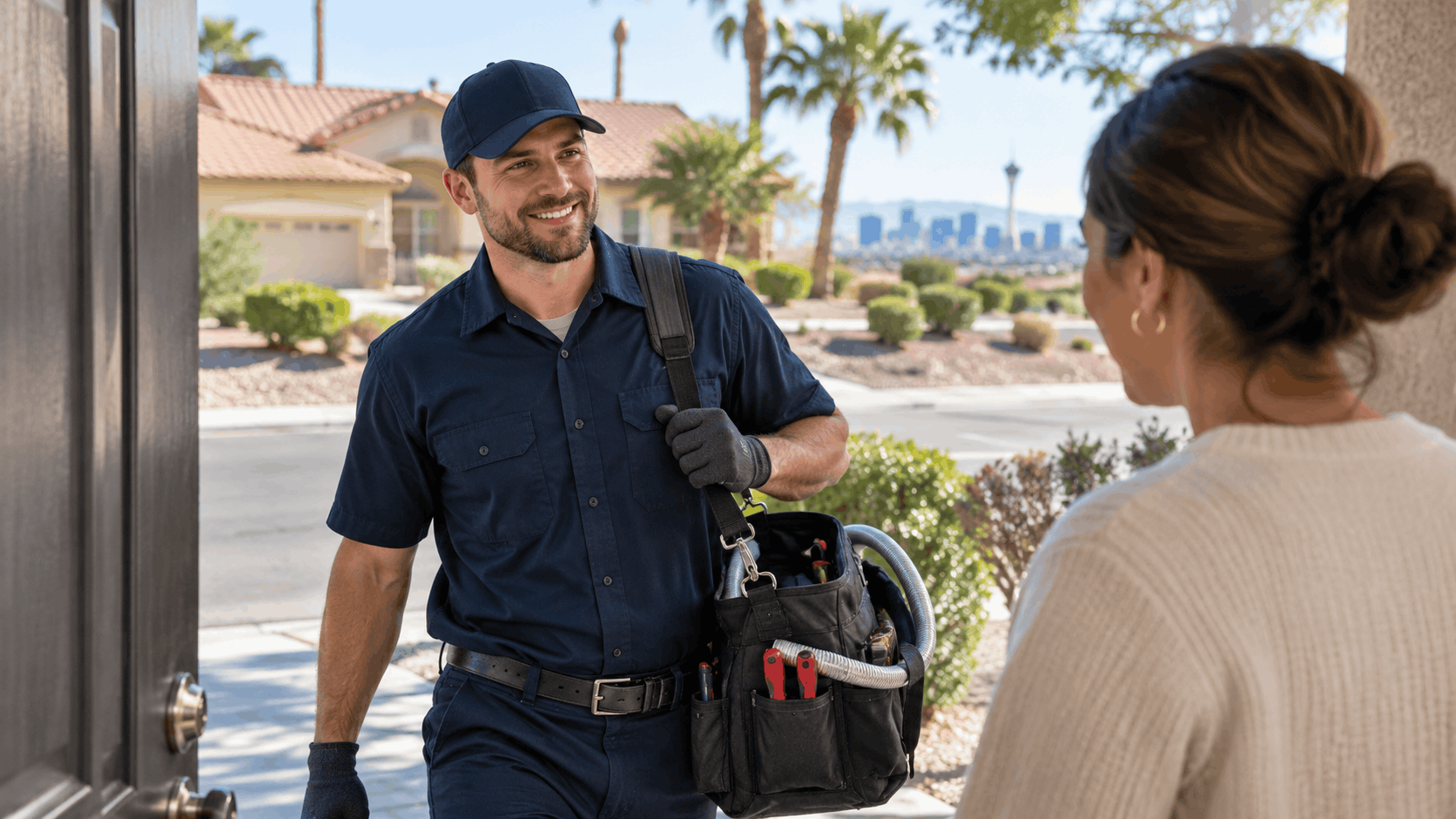
Same-day plumbing in a walled, gated neighborhood off Rancho Drive works a little differently than it does in an open tract subdivision. The plumbing itself is the same trade, but getting to the fixture, parking a loaded truck, and knowing who can approve the work all take an extra step. Handling those steps on the first call is what turns a same-day promise into an actual same-day repair.
Because Rancho Bel Air is entered through a guard gate off Rancho Drive and laid out around Rancho Bel Air Drive in ZIP code 89107, the fastest path to a fix starts with arranging access before a truck rolls. A same-day plumber who already knows the community is guard-gated asks the right questions at the start rather than losing time at the entrance. The table below shows how a typical same-day call moves from phone to finished work.
| Step | What Happens | Why It Matters on a Gated Estate |
|---|---|---|
| First call | Confirm the problem, the address and who can authorize work | Owner, tenant or manager may differ |
| Access setup | Arrange the guard gate and where the truck parks | Long driveways affect material carry |
| Arrival | Technician reaches the property in 30 to 60 minutes | Covers the whole valley, including near US 95 |
| Diagnosis | Find the real source before opening anything | Finished floors and walls stay intact |
| Written price | Price given in writing before work starts | Expected at this level of home |
Our 30 to 60 Minute Arrival Window
Our technicians arrive in 30 to 60 minutes anywhere in the Las Vegas Valley. For a home in Rancho Bel Air, close to the US 95 freeway and framed by Rancho Drive, Charleston Boulevard and Decatur Boulevard, that window covers the drive comfortably. The freeway access near the community is part of why reaching this corner of central Las Vegas is quick.
For a leak that is actively running or a drain backing up into a finished space, that arrival time is the difference between a contained problem and a larger one. Water left to run across stone or hardwood floors does damage by the hour, so a fast response limits what the repair has to fix later. The sooner a technician is on site, the sooner the water is shut off and the diagnosis begins.
Emergency response is not only about speed, it is about arriving ready. A technician who knows the community is gated and the lots are deep comes equipped to handle access and the distance from the curb to the work. For urgent situations, our emergency plumbing services are built around getting to the problem quickly and stopping the water.
Not every call is a true emergency, and part of the first conversation is sorting what cannot wait from what can be scheduled. A burst line or a sewage backup needs a same-day visit. A slow drain that has been getting worse for weeks can often be planned for the same day at a time that suits the household, rather than treated as a crisis.
Arranging Access Through the Gate or a Property Manager
Walled and gated properties mean access is set up with the owner or a property manager in advance rather than assumed. A guard at the entrance will not wave a service truck through without clearance, so the first call includes arranging that clearance. Giving the gate the technician's name and arrival window ahead of time keeps the 30 to 60 minute response from stalling at the entry.
On a lot this size, where the truck parks matters more than it would on a standard street. Long driveways and deep setbacks mean a technician may be carrying tools, pipe and equipment a fair distance from the vehicle to the work. Knowing in advance whether the truck can pull close to the house, the pool equipment or the far side of the property saves time and protects landscaping.
For second homes or properties handled by a management company, the property manager often coordinates gate access and points the technician to the right part of the estate. Establishing that contact early means no one is standing at a locked gate while the clock runs. A quick call to confirm the route in avoids the most common delay on gated jobs.
Discretion starts at the gate as well. Residents here value privacy, so arriving as scheduled, parking where asked and keeping the work area tidy is part of respecting the property. A technician who treats the access arrangement seriously signals the same care they will bring to the plumbing itself.
Who Authorizes and Pays for the Work
Some properties in Rancho Bel Air are second homes or are managed on an owner's behalf, so establishing who approves the work and who pays belongs in the first call. On an estate where the person in the house may be a caretaker, a family member or a guest, the technician needs to know who can sign off on a repair before the diagnosis turns into a scope of work. Sorting authorization up front prevents a finished diagnosis from sitting unapproved.
Across Las Vegas, a large share of homes are rented. City figures put owner-occupied housing at about 56.6 percent, which means roughly 43.4 percent of homes are rented. In those cases a renter calls the landlord or the property manager, not the plumber, and the decision maker is often not the person standing in the house.
That pattern shapes how we handle the first call. If the caller is a tenant or a manager, we confirm who authorizes the repair and who receives the written price before any work is scheduled. Clear lines on approval and payment keep the job moving and keep everyone informed.
For managed or absentee-owned estates, we are comfortable coordinating with a property management company and documenting the work for the owner's records. The goal is that whoever pays the bill sees the price and the scope before the work starts, no matter who happened to place the call.
Discretion and Kept Appointments
Households at this level expect kept appointments, tidy work and a written price before anything starts. When a time is set, the technician arrives in that window, and when the work is done the area is left clean. Those basics carry extra weight in a neighborhood where owners are accustomed to a certain standard of service.
Rancho Bel Air is known for long-standing residents and privacy, so discretion is part of the service rather than a nice-to-have. That means minimal disruption, respect for the household's schedule, and keeping the details of the property and the work to ourselves. A quiet, professional presence on site matters as much as the quality of the repair.
A written price before work begins is a fixed part of how we operate. The customer sees what the job will cost before a tool comes out, so there is no guessing and no surprise at the end. For high-end fixtures and finished interiors, that clarity is reassurance that the work will be handled with care.
Tidy work also protects the home. On stone, tile and hardwood floors, that means drop cloths, clean entry and exit, and leaving no trace beyond the repair. Treating the property with care is how trust is earned in a community where reputation travels by word of mouth.
Get Your Quote
Tell us what's going on and we'll get back to you. We're open 24/7.
Common Same-Day Calls on Estate Properties Here
On a large lot off Rancho Bel Air Drive, the plumbing system extends well beyond the house, so the urgent calls look different from those in a tract neighborhood. Yard and irrigation lines, pool and spa equipment, outdoor kitchens and multiple water heaters all add places where something can go wrong. Knowing which problems need attention now and which can wait helps an owner act without panic.
Estate plumbing brings two categories of emergency repair that barely exist on a small lot: exterior leaks that run unseen across a big parcel, and systems spread so far apart that a failure in one part does not show up where you would expect. The table below sorts the common same-day calls by urgency so an owner knows what to do first.
| Problem | How It Shows Up | Urgency |
|---|---|---|
| Hidden yard or irrigation leak | Unexplained high water bill, no visible water | Same-day detection |
| Burst pipe or sudden leak | Water appearing, drop in pressure | Shut off and same-day fix |
| Drain or sewer backup | Repeated slow drains, then backup | Same-day if backing up |
| No hot water | Lukewarm or cold at far fixtures | Same-day repair |
The Unexplained Water Bill From a Hidden Yard Leak
Yard and irrigation line leaks can run for weeks on a parcel this large and show up first as a water bill rather than anything visible. On an estate with long irrigation runs feeding mature landscape, a cracked line underground can lose water steadily without a single wet spot appearing where anyone walks. The lawn and beds absorb it, and the first real signal is a bill that does not match how the house was used.
That is why exterior leak detection is a genuine service here, not an add-on. Finding a buried leak on a deep lot takes equipment and method, not just a walk around the yard. Our team uses electronic and acoustic tools to narrow the location before any digging, which matters when a line could run anywhere across a large property.
The mechanism is simple once you see it. Irrigation lines and exterior supply runs sit buried across the parcel, and decades of pressure, ground movement and settling backfill eventually open a crack or a fitting. Because the water has an easy path into the soil, it never surfaces, so the meter is the only witness. A electronic leak detection service pins the spot so the repair stays small.
For an owner watching an unexplained bill climb, the fastest answer is to have the exterior lines checked rather than guessing. Catching a hidden yard leak early keeps the loss and the repair contained, and it stops water from quietly running week after week. A whole-home leak detection system can also flag these losses sooner by monitoring flow at the main.
Burst Pipes and Sudden Leaks
A burst pipe is the opposite of a hidden leak. It announces itself with water where water should not be, and often a noticeable drop in pressure at the fixtures. When that happens, the first move is shutting off the supply, and a same-day fix keeps the damage from spreading through finished rooms.
On a large footprint, even a sudden leak can hide for a while. A line that bursts inside a wall, under a slab or in a rarely used wing of the house may soak into materials before anyone notices. Long runs across an estate mean the water can travel from where the pipe failed to where it finally shows, which complicates the search.
The repair depends on where and why the pipe failed. A clean break on an accessible line is straightforward, while a failure inside a wall or under the slab calls for detection first. In every case, stopping the flow comes before anything else, which is why knowing the location of the main shutoff is worth checking before an emergency ever happens.
Our same-day response is built for exactly this. A technician arrives within the 30 to 60 minute window, isolates the leak, and gives a written price for the burst pipe repair before the work starts. Acting quickly on a burst line is the single best way to keep a plumbing problem from becoming a flooring and drywall problem.
Drain and Sewer Backups
Drain and sewer backups rarely arrive without warning. More often they build up as repeated slow drains over weeks or months before a full backup finally stops the house. A sink that empties slowly or a tub that gurgles is the system telling you something is narrowing the line.
On older estate lots, sewer laterals may be clay or cast iron, and decades of mature landscape make root intrusion a recognized issue. Tree and shrub roots seek out the moisture and nutrients in a sewer line, working into joints and small cracks until they form a mass that catches waste and slows flow. That root intrusion is the mechanism behind many of the slow drains that owners notice first.
Because the laterals run under a landscaped parcel that has had decades to mature, the roots have had just as long to find the pipe. A camera inspection shows exactly what is in the line and where, so the fix targets the actual blockage rather than guessing. Our sewer camera inspection turns a hidden problem into something you can see.
Clearing the line is sometimes enough, and sometimes the pipe itself needs repair. For heavy root intrusion, hydro-jetting cuts the roots and scours the pipe wall, while a damaged clay or cast iron lateral may need a section repaired or replaced. A drain and sewer service that starts with inspection keeps the work proportional to the problem.
No Hot Water Across a Long Footprint
In a large home, losing hot water does not always mean one failed heater. These estates often run more than one water heater and a recirculation system that runs continuously to deliver hot water across a long footprint. A drop in hot water at the far bathrooms may trace to one unit, a recirculation pump, or scale building inside the system.
Same-day water heater repair is a common urgent call because hot water is not something a household wants to go without. The diagnosis starts by identifying which heater or which part of the system is failing, since a large home may have several points where the problem could live. Pinning the cause down is faster than replacing parts on a guess.
Recirculation systems are a particular feature of big homes. They keep hot water moving through long runs so it is ready at the tap, but the constant flow also exposes the pump and lines to the valley's hard water day after day. When hot water stops reaching the far end of the house, the recirculation loop is often where the trouble sits. A recirculation pump installation or repair can restore delivery across the footprint.
For repairs, the question is whether a fix restores the unit or whether age and scale call for replacement. A heater that has worked for years under very hard water may be near the end regardless of the immediate fault. Our water heater services cover repair, replacement and the recirculation systems that keep a large home supplied.

Need Help in Las Vegas?
Active Plumbing serves Las Vegas and all of Las Vegas Valley.
Under-Slab Leaks: Detect, Then Decide Whether to Break or Reroute
Rancho Bel Air homes are predominantly slab-on-grade, built from the 1960s through the 1980s, which makes an under-slab supply failure a distinct category of work. Unlike a crawl-space leak in an older part of the valley, a line under the slab is not accessible without either opening the concrete or finding another route. That single fact shapes the entire conversation about how to fix it.
So the real discussion is not just finding the leak, it is deciding the repair method. Detection comes first, then the choice between breaking the slab for a spot repair or rerouting the line overhead or around the slab. On a finished estate home, that decision carries real cost and disruption weight, which is why it deserves an honest look.
Why Slab Leaks Happen in Homes of This Era
Original copper from the 1960s and 1970s is at the age where pinhole leaks begin, particularly on hot lines and under-slab runs. Copper has served these homes for decades, but no pipe lasts forever, and the oldest runs in the valley's original luxury housing are now reaching that stage. The hot-water side tends to go first because heat and water chemistry work on it harder than the cold.
A pinhole leak is exactly what it sounds like, a tiny perforation that lets water seep out slowly. Under a slab, that seepage has nowhere obvious to go, so it works into the ground and the concrete rather than appearing as a visible drip. By the time an owner notices warm spots on the floor, a higher bill, or the sound of running water with everything off, the leak has usually been active for a while.
Understanding this mechanism helps an owner see what the repair actually solves. The goal is not just to patch one hole, it is to address an aging copper run that may be developing more weak points. On a home with decades-old under-slab copper, the diagnosis looks at the condition of the line, not only the single failure in front of the technician.
This is also why detection matters so much on these homes. A pinhole leak under a slab gives few outward clues, so finding it precisely is the only way to keep the repair small. Guessing where to open a floor on a finished estate is not an option worth considering.
Finding the Leak Without Tearing Up the House
On a finished interior with stone, tile or hardwood floors, the first step is detection, not demolition. Electronic and slab leak detection equipment locates the leak by listening for the sound of escaping water and tracing the line, so the technician knows where the problem sits before touching a floor. That precision is what protects the finishes in a high-end home.
Electronic leak detection uses sensitive acoustic and pressure tools to narrow a leak to a small area. Rather than opening a wide section of floor hoping to find the pipe, the technician works from the data to pinpoint the spot. On an estate with expensive flooring, the difference between a targeted opening and exploratory demolition is enormous.
Detection also informs the repair decision. Once the leak's location is known, the technician can weigh whether a spot repair through the slab or a reroute makes more sense. Without that information, there is no honest way to recommend one method over the other, so detection always comes first. Our slab leak detection and repair service is built around finding the leak before opening anything.
For owners worried about their floors, this is the reassurance that matters. The house is not torn up to go hunting. The leak is found, the options are explained, and only then does any work on the slab or the piping begin.
Breaking the Slab vs Rerouting the Line
Once the leak is located, the choice comes down to breaking the slab for a spot repair or rerouting the line around it. In a house with stone, tile or hardwood floors and finished interiors, rerouting a line overhead or around the slab is frequently better value than breaking through. Cutting into a slab under expensive flooring means replacing that flooring afterward, which can cost more than the plumbing itself.
A spot repair through the slab makes sense when the leak is isolated and the floor above it is easy to restore. For a single failure under an unfinished or easily matched surface, opening the concrete, fixing the pipe and patching back can be the cleaner option. The method fits the situation rather than being applied to every case.
Rerouting abandons the failing under-slab section and runs a new line through walls, ceilings or around the slab to reconnect the fixture. On aging copper that is likely to develop more pinholes, a reroute also sidesteps the next leak on that same run. For finished estate homes, avoiding repeated floor demolition is often the honest, lower-cost path over time.
The right answer depends on the leak's location, the flooring, and the condition of the rest of the line. Our job is to lay out the tradeoff plainly, with a written price for each path, so the owner decides with the full picture. There is no single rule that fits every slab leak in these homes.
Why Exterior Excavation Costs More Here
When a repair reaches outside the house, the ground itself raises the cost. Caliche is a cemented calcium-carbonate hardpan common across much of the valley, and it is hard to trench through and hard to bed a pipe into evenly. Digging through it is slower and more labor-intensive than working in softer soil, and that time shows up in the price.
Caliche is also abrasive, so it wears against buried pipe where a line runs through it. What it does not do is move, shift, swell or crack pipe, because it is not an expansive soil. Seasonal ground movement and poorly compacted backfill settling under a pipe are what pull lines out of grade over time, not the caliche layer itself.
Honest cost discussion includes this. An exterior excavation on a Rancho Bel Air lot may take longer than the same job would in easier ground, purely because of what the shovel hits. We would rather an owner understand why a trench on their property costs what it does than be surprised by the labor hours.
Bedding a pipe properly in caliche matters for the long run. Poorly compacted backfill settles under a new line and can pull it out of grade, which is how bellies and future problems form. Doing the excavation and backfill correctly the first time is part of why the work is not quick, and it is what keeps the repair sound.
Decades of Alteration: What Is Actually Behind the Walls
Homes of this vintage have typically been renovated more than once, so one property can hold original copper, later repairs in other materials and modern PEX where bathrooms were redone. A house built in the 1960s and lived in for half a century has usually had kitchens and baths updated, additions built, and leaks patched along the way. Each of those projects may have added a different material.
That history is why diagnosis starts with confirming what is really in the ground and the walls rather than assuming from the build year. The construction date tells you where to start looking, not what you will find. On an estate that has changed hands and been remodeled repeatedly, only a hands-on look settles the question.
Mixed Materials From Multiple Remodels
A single estate home can hold original copper from its construction, later repairs in whatever was common when they were done, and modern PEX where bathrooms were redone in recent years. Each remodel left its own layer, and the result is a system that is not one material but several joined together. That mix is normal for a home of this age.
The build year is a starting guess, not an answer. A 1970s construction date suggests copper as the original material, but it says nothing about the three bathrooms that were redone in the 2000s or the repair someone made in the 1990s. Reading the year off a record is where diagnosis begins, never where it ends.
Copper remains common across the middle decades of the valley's growth, and PEX dominates newer work, including modern remodels. Between them sit whatever repairs were made over the years. Knowing which material is where changes how a repair or a repipe is planned, so confirming it on site is the only reliable method.
For an owner, the practical takeaway is simple. Do not assume the pipe behind the wall matches the age of the house. The only way to know is to look, and that look is the first thing a technician does before recommending anything.
Galvanic Corrosion at Dissimilar Metal Joints
Where dissimilar metals meet at a repair joint, galvanic corrosion sets in. When two different metals are joined in the presence of water, an electrochemical reaction causes one of them to corrode faster than it would alone. In a home with original copper and later repairs in another metal, those junctions become weak points.
The corrosion concentrates right at the joint, which is why failures tend to appear there rather than along a clean run of pipe. A joint that was made to fix one problem can become the source of the next one years later. On a home with decades of mixed repairs, these dissimilar-metal connections are worth checking.
A proper repair addresses the cause, not just the symptom. That means using the correct materials and fittings to join dissimilar metals safely, or replacing the problem section so the mismatch is gone. Simply patching the leak without correcting the metal pairing invites the same failure to return.
This is another reason the on-site look matters so much on these estates. Finding where incompatible metals were joined over the years tells a technician where future leaks are likely to start. Addressing those junctions during a repair prevents the slow drip that a mismatched joint produces over time.
When a Whole-House Repipe Makes Sense
A whole-house repipe becomes a candidate when original lines are failing in multiple places rather than at a single point. One pinhole leak is a repair. A pattern of leaks across aging copper, on top of mixed materials and corroding joints, is a sign the system as a whole is near the end of its service life.
Repiping replaces the supply lines throughout the home with new material, usually PEX or copper, so the mix of old pipe and old repairs is gone. For an estate where the plumbing has been patched repeatedly, a repipe trades a string of future repair calls for one planned project. It is a larger job, but it ends the cycle of chasing leaks.
The decision is never made from the build year alone. The pipe is always confirmed on site before any recommendation, because the actual condition of the lines is what matters. A home that looks like a repipe candidate on paper may have had its worst runs already replaced, and only an inspection reveals that.
When a repipe is the right call, planning it around a finished estate is its own skill. Routing new lines with minimal disruption to stone and hardwood takes thought, and a written price covers the full scope before work begins. Our whole-house repipe service is built for exactly these older homes.
Aging Sewer Laterals and Root Intrusion
Below ground, the sewer laterals on these older estates may be clay or cast iron, materials that were standard when the homes were built. Both age, and both develop the small cracks and open joints that invite trouble from outside the pipe. Decades of use leave them vulnerable in ways newer materials are not.
Mature landscape drives root intrusion into those aging laterals. As covered earlier, roots work into joints and cracks seeking moisture, forming masses that catch waste and show up as repeated slow drains before a full backup. On a parcel with decades of established trees and shrubs, the roots have had plenty of time to reach the line.
Clay pipe is particularly prone to this because its jointed sections give roots an easy entry point. Cast iron corrodes internally over the years, narrowing and roughening the bore until flow slows and debris catches. Either way, a camera inspection of the lateral shows the real condition rather than leaving the owner to guess from the drains.
The fix ranges from clearing the roots to repairing or replacing a damaged section of lateral. For a line that is cracked or heavily intruded, a sewer line repair or replacement restores proper flow. Matching the work to what the camera shows keeps the job sized to the actual problem.

Very Hard Water in a Large, Expensive System
The valley's water is very hard, and on an estate home that runs multiple water heaters and continuous recirculation, that hardness has a lot of system to work on. Scale builds everywhere water sits and flows, and in a large home there is simply more of everything for it to affect. Protecting that system is a straightforward argument once you see how scale behaves.
Hard water deposits calcium and magnesium throughout the plumbing, and the consequences are specific and predictable. On a big property with high-end fixtures, multiple baths and long hot-water runs, the case for treatment is not a pitch, it is basic protection of expensive equipment.
The Verified Hardness Figure for the Valley
The Southern Nevada Water Authority reports the valley's water hardness at 280 parts per million as calcium carbonate, which is about 16 grains per gallon, categorized as very hard. That is the published municipal figure, and it is the number that explains more plumbing problems in Las Vegas than anything else. It applies across the valley, including Rancho Bel Air.
Very hard is not a vague label. At 16 grains per gallon, the water carries enough dissolved mineral to leave scale on everything it touches over time. That is why fixtures crust, heaters struggle and cartridges clog in homes across the area, regardless of neighborhood.
Sometimes an owner runs their own water test and gets a different number. That reading is their own measurement of their own water at that moment, and it is not the municipal figure. The published hardness for the valley stays at the SNWA number of 280 parts per million, and that is the figure to plan around.
For an estate owner, the takeaway is that the water feeding a large, expensive system is hard by any standard. Knowing the verified figure helps frame why treatment and flushing are maintenance rather than extras. The mineral load is real and consistent, and it works on the system every day.
What Scale Does to Heaters, Cartridges and Tankless Units
Scale builds on water heater elements and tank bottoms, where it insulates the heat from the water and forces the unit to work harder. A tank left unflushed in this water works harder and fails earlier than its rated life. In an estate home with more than one heater, that is multiple units all accumulating scale at once.
Across several bathrooms, scale fouls the small passages inside mixing valves and cartridges. The white crusting owners see on fixtures is the same mineral narrowing the parts they cannot see. On a home with high-end fixtures in many baths, that means more cartridges clogging and more valves losing their smooth action over time.
Tankless units are especially exposed because the heat exchanger is a narrow passage. Scale accelerates failure there, since even a thin mineral layer in a tight channel chokes flow and strains the unit. A tankless heater in this water needs regular descaling to keep that exchanger clear, which is why maintenance is part of owning one here.
The pattern across a large system is consistent. Scale on heaters, scale in recirculation lines that run continuously, fouled cartridges across the baths, and stressed tankless exchangers all trace to the same hard water. Addressing it at the source protects every one of those components at once.
Softening, Scale Reduction and Heater Flushing
Whole-house softening or scale reduction protects a large system by treating the water before it reaches the heaters, fixtures and recirculation lines. On an estate, that single point of treatment guards every component downstream, which is far more practical than fighting scale fixture by fixture. The protection argument is simple when the system is this big and this expensive.
A water softener removes the calcium and magnesium that form scale, while salt-free conditioning alters the minerals so they are less likely to deposit. Both approaches cut the scale load on the system, and which one fits depends on the home and the owner's preference. Our water treatment options cover both softening and scale reduction.
Heater flushing is maintenance, not an option, in this water. Flushing a tank clears the sediment and scale from the bottom before it builds into a layer that shortens the unit's life. For a home running multiple heaters, keeping each one flushed on schedule is how they reach their rated service life instead of failing early.
For an owner with high-end fixtures, the protection argument is straightforward and true. Treating the water extends the life of expensive valves, cartridges, heaters and tankless units rather than leaving them to scale up. On a large system, that protection pays back across every fixture and appliance it touches.
What the Valley Water Is and Is Not
Most valley homes are served Colorado River water from Lake Mead, treated by SNWA, with about 90 percent of the supply coming from the lake and the rest from groundwater. This is not groundwater coming out of the tap in most homes, it is treated surface water. That matters when choosing treatment for the water a home actually receives.
The water is chlorinated, not chloraminated. SNWA uses ozone as the primary disinfection and adds chlorine as the water leaves the treatment plants, and chlorination is used throughout Southern Nevada's distribution systems. There is no chloramine in the valley's water, so treatment plans do not need to account for it.
Because the disinfectant is chlorine, ordinary activated carbon handles the chlorine taste and odor. There is no need for special catalytic carbon for the valley's water, which keeps point-of-use filtration simple. For drinking water, an under-sink reverse osmosis system or a carbon filter addresses taste cleanly.
Knowing what the water is keeps treatment choices honest. The hardness is the main concern for the plumbing system, and chlorine taste is the main concern at the tap. Matching the treatment to those two realities, rather than to problems the water does not have, is how we keep recommendations true to the supply.
Need Help in Las Vegas?
Active Plumbing serves Las Vegas and all of Las Vegas Valley.
Gas Work for Pools, Outdoor Kitchens and Fire Features
On a large lot, the gas system feeds far more than a furnace and a stove. Pool heaters, outdoor kitchens and fire features all draw gas, and the system has to be sized to carry the whole load. That is where estate gas work diverges most sharply from a standard home.
The most common mistake on these properties is sizing gas to one appliance rather than to everything the system serves. When that happens, the fault is rarely dramatic. It shows up as equipment that underperforms, which sends owners chasing the wrong problem.
Sizing Gas to the Whole Load, Not Just One Appliance
Sizing gas to the appliance in front of you is the common mistake on estate properties. A new pool heater or outdoor kitchen gets connected to a line that looks adequate, without accounting for everything else the system already feeds. When multiple appliances run at once, the line cannot deliver enough gas to all of them.
The result is not an obvious failure but an appliance that underperforms. A pool heater that struggles to reach temperature, a burner that runs weak, a fire feature with a low flame, all can trace back to a gas line that is undersized for the total load. Owners often blame the appliance when the real issue is supply.
Proper sizing starts with a load calculation that adds up every appliance the line serves. The furnace, water heaters, range, pool heater, outdoor kitchen and fire features all draw gas, and the piping has to carry their combined demand. Getting that calculation right is the difference between equipment that works and equipment that disappoints.
Natural gas in the Las Vegas Valley is supplied by Southwest Gas. On an estate with several gas appliances spread across a deep lot, the system has to be planned as a whole, which is why our gas line services start with the total load rather than the single appliance in front of us.
Gas Line Installation and Rerouting Outdoors
Adding a fire feature, an outdoor kitchen or a new pool heater usually means running gas across the yard to reach it. On a deep lot, that outdoor gas line installation covers more distance than it would on a small property, and the run has to be sized and routed correctly for the appliance it serves. The line also faces the valley's intense heat and UV where it is exposed.
Rerouting existing gas lines comes up when a landscape is redesigned or an appliance is moved. An outdoor kitchen relocated during a remodel, or a fire feature added to a patio, may need the gas rerouted or upsized to carry the new load. Our gas line rerouting and upsizing handles those changes while keeping the whole system sized correctly.
Exposed exterior gas lines on an estate face real conditions. Summer heat, large day-to-night temperature swings and strong UV all work on anything above ground, so outdoor runs need appropriate materials and protection. Planning for those conditions keeps the line sound over years of desert exposure.
For new construction or major additions on the property, the gas work ties into the whole plan. A gas line installation for a single appliance connection is one job, while a new main line run to serve several appliances is another. Matching the installation to what the property needs keeps every appliance supplied properly.
If You Smell Gas, Here Is What to Do
If you smell gas anywhere on the property, the response is the same. Leave the building, avoid light switches and open flames, and call the gas utility, Southwest Gas, from outside before calling a plumber. Getting people out and away from any ignition source comes first, always.
Do not try to find or fix the source yourself. Do not flip switches, light anything or use anything that could create a spark, because gas and an ignition source are a dangerous combination. Moving outside and making the call from a safe distance is the correct and only first step.
Southwest Gas handles the gas emergency response. Once the utility has made the situation safe, a licensed plumber can diagnose and repair the line properly. The order matters: safety and the utility first, then the repair.
This is the one area where self-help has no place. A suspected gas leak is not a problem to investigate on your own, no matter how handy you are. Leave, call from outside, and let the professionals handle it from there.
Gas Leak Detection and Safety Inspection
Gas leak detection finds a leak that is suspected but not located. If an owner smells gas intermittently, sees a gas bill climbing without explanation, or wants a line checked after work on the property, detection identifies whether and where a leak exists. On an estate with gas running to several outdoor features, that coverage matters.
A gas safety inspection checks the whole system for integrity and correct operation. It is worth scheduling after buying an estate home, after adding or moving gas appliances, or simply on a regular basis for a property with an extensive gas system. The inspection catches small problems before they become hazards.
Both services are available same-day when the situation calls for it. A suspected leak is urgent, and a safety inspection can be scheduled at a convenient time. Our gas safety inspection gives an owner a clear picture of the system's condition.
For a large property with pool heaters, outdoor kitchens and fire features, periodic gas checks are sound ownership. The more appliances and the more line, the more value there is in confirming everything is tight and operating as it should. An inspection is a small step that protects a complex system.

What Plumbing Work Costs in the Rancho Bel Air Area?
Knowing what plumbing work typically costs helps an owner plan before a problem turns urgent. The figures below are typical ranges for plumbing work in the Las Vegas Valley, presented as area ranges rather than a quote for any specific job. The actual price for a given job depends on that job and is given in writing before work begins.
On an estate, two factors can push a job toward the higher end of its range. Caliche excavation is slower and more labor-intensive, and long material runs on a deep lot add time. The table and sections below lay out the ranges so an owner knows what to expect.
| Service | Typical Range |
|---|---|
| Slab leak detection | $150 to $300 |
| Slab leak repair | $500 to $3,000 |
| Whole-house repipe | $4,000 to $15,000 |
| Tankless water heater installation | $1,500 to $3,500 |
| Water softener installation | $800 to $2,500 |
| Sewer line repair | $1,500 to $5,000 |
| Outdoor gas line installation | $500 to $2,500 |
Leak Detection and Repair Ranges
For finding and fixing leaks, the typical ranges run as follows. Slab leak detection is $150 to $300, and slab leak repair is $500 to $3,000. Electronic leak detection is $150 to $350, and a whole-home leak detection system is $300 to $800.
Burst pipe repair typically runs $200 to $800, depending on where the pipe failed and how accessible it is. A clean break on an exposed line sits at the lower end, while a failure inside a wall or under a slab, which requires detection and more work to reach, moves toward the higher end.
A whole-house repipe is the larger project at $4,000 to $15,000. The range is wide because it depends on the size of the home, the number of fixtures and the routing required. On an estate with many bathrooms and a large footprint, a repipe sits higher in the range than it would in a small home.
These are typical area ranges, not a quote. The specific price for any leak detection or repair depends on the particulars of the job, which is why the figure is given in writing after the diagnosis and before work starts.
Water Heater and Water Treatment Ranges
Water heater work covers a spread of jobs. Tank water heater installation runs $800 to $1,500, while tankless water heater installation is $1,500 to $3,500, with a pre-filter adding $150 to $300 where hard water calls for one. Water heater repair runs $150 to $500, and tankless maintenance and descaling is $150 to $250.
On a large home with recirculation, a recirculation pump installation runs $400 to $900. That system keeps hot water moving across a long footprint, and when it fails, restoring it falls in that range. For estates running multiple heaters, these figures apply per unit.
Water treatment ranges reflect the options for handling hard water. Water softener installation is $800 to $2,500, salt-free conditioning is $800 to $2,500 installed, and whole-house filtration is $800 to $2,500. Which approach fits depends on the home and what the owner wants to address.
For a large system with high-end fixtures, treatment is protection rather than an extra, and these ranges show what that protection costs up front. Against the cost of replacing scaled heaters and fouled fixtures over time, the treatment range is modest.
Drain, Sewer and Gas Ranges
For drains and sewers, drain cleaning typically runs $150 to $350, and hydro-jetting for residential lines is $300 to $600. Sewer line repair is $1,500 to $5,000, and full sewer line replacement is $4,000 to $12,000. On older estates with clay or cast iron laterals and root intrusion, these figures cover the range from clearing a blockage to replacing a damaged line.
Hydro-jetting sits at the higher end of routine drain work because it scours the pipe wall and cuts roots rather than just clearing a path. For a lateral under mature landscape, jetting often does more lasting good than a simple cleaning, which is reflected in its range.
Gas work ranges as follows. Gas leak detection is $150 to $300, and gas leak repairs are $200 to $600. Outdoor gas line installation is $500 to $2,500, and a gas safety inspection is $75 to $150.
Outdoor gas line installation covers the wide span between a short run to a single feature and a longer run across a deep lot to multiple appliances. The distance and the number of connections on an estate push the figure within that range.
After-Hours and What Changes the Final Price
After-hours emergency calls carry a service fee of $150 to $300 plus repair costs. That fee covers the off-hours response, and the repair itself is priced separately within its own range. For a true emergency that cannot wait until morning, that is the cost of same-day, after-hours help.
On an estate lot, a few factors move a job within its range. Caliche excavation is slower and dearer because the hardpan is tough to trench through, so any job requiring outdoor digging carries more labor. Long material runs on a deep lot also add time, since tools and pipe travel farther from the truck to the work.
The flooring and finishes matter too. A slab leak under stone or hardwood may favor a reroute, which changes the method and the price compared with breaking through. These property-specific factors are why a range is a starting point rather than a final number.
The actual price for a specific job is given in writing before work begins. After the diagnosis, the owner sees exactly what the job will cost, with no surprises at the end. That written price is how the ranges above become a firm number for the home in question.
Permits, Licensing and the City of Las Vegas
Rancho Bel Air sits inside the City of Las Vegas, so permits and inspections run through the city, and the Southern Nevada Amendments to the Uniform Plumbing Code apply as the city codifies them. Getting the authority right matters on work at this value, because the rules and the permit counter depend on which jurisdiction the address falls in. For this community, that jurisdiction is the city.
Knowing the correct authority before quoting permitted work is a routine first step. Telling an owner which department governs their address is a small thing that signals genuine local knowledge, and on an estate it keeps the project on the right track from the start.
Why Your Address Decides the Permit Counter
The Las Vegas Valley is not one permitting authority. Clark County, the City of Las Vegas, the City of Henderson, the City of North Las Vegas and Boulder City each run their own building departments. An address determines which counter issues the permit, and getting that wrong delays the work.
Rancho Bel Air is inside the City of Las Vegas, not unincorporated Clark County. Many areas residents call Las Vegas, like Spring Valley or Enterprise, are actually county addresses, but this community is within the city limits. That means permits and inspections for a Rancho Bel Air home run through the City of Las Vegas building department.
We confirm the permit position for the specific address rather than applying one valley-wide rule. The city governs this community, and we tell owners that plainly so they know which department stands behind the work. For plumbing elsewhere in the city, our Las Vegas service area page covers the broader coverage.
For permitted work, this matters because the permit, the inspection and the applicable amendments all come from the city. An owner planning a larger project can expect the process to run through the City of Las Vegas, and we handle the correct counter as part of the job.
Not a Historic District, So Permits Run the Ordinary Way
Rancho Bel Air is historically significant, part of the valley's original luxury housing alongside the Scotch 80s and the Las Vegas Country Club area. It was built long before the master-planned communities to the west and south existed. That history gives the community standing without changing how permits work.
Importantly, it is not a designated historic district. Historic Preservation Commission review applies to designated resources, and this community is not one of them. That distinction matters for anyone planning work that needs a permit.
Because it is not a designated district, permits run through the City of Las Vegas in the ordinary way rather than through Historic Preservation Commission review. An owner does not face an extra preservation approval layer on top of the standard city process. The permit path is the normal one.
For a plumbing project on a Rancho Bel Air home, that keeps things straightforward. The work follows the city's standard permitting and inspection process, the same as any other home within the city limits. No special historic review stands between an owner and the permit for their plumbing work.
Verifying a Plumbing License
Plumbing work in Nevada is licensed by the Nevada State Contractors Board. Contractor licensing is statewide, so a plumber working anywhere in the valley holds a license through the board. An owner is entitled to ask for a license number and to verify it.
Verification is free and easy. At nvcontractorsboard.com, an owner can check a license number and see the classification, status, bond and workers compensation, all of which are public record. Taking that step confirms the contractor is properly licensed before any work begins.
This matters in a market with a significant unlicensed trade problem. On work at the value of an estate home, confirming the license is a basic protection worth the minute it takes. A legitimate contractor welcomes the check and provides the number without hesitation.
Active Plumbing holds Nevada license NSCB #0047021, verifiable free at nvcontractorsboard.com. An owner can look it up and confirm the classification and status for themselves. Stating it plainly is part of how we build trust on high-value work.
A Few Current Code Points That Touch Fixture Work
When fixtures are replaced during a remodel, current code points come into play under the Southern Nevada Amendments. WaterSense certification is required for lavatory faucets, urinals, water closets and showerheads in structures built, expanded or renovated on or after January 1, 2020. For a bathroom or kitchen remodel on an estate home, that applies to the new fixtures.
Flow limits are part of the current amendments as well. These figures touch fixture selection on a remodel, and the right specifics are confirmed for the project rather than assumed, since code editions and requirements are updated over time. Confirming them for the particular job keeps the work compliant.
Southern Nevada adopted the 2024 Uniform Plumbing Code with amendments, which took effect in the City of Las Vegas in early 2026. For a project today, the current edition and its fixture requirements are what apply. We confirm the applicable points for the specific work.
For a fixture installation or a larger remodel, these code points shape what fixtures can be installed. Matching the fixtures to current requirements is part of planning the work, and we handle that as part of the job rather than leaving an owner to sort it out.

Need Help in Las Vegas?
Active Plumbing serves Las Vegas and all of Las Vegas Valley.
How Our Team Handles a Same-Day Call in Rancho Bel Air
Bringing it together, here is how a same-day call actually runs on a Rancho Bel Air estate. The process accounts for the gated access, the large lot and the finished interiors, and it ends with a written price before any work starts. Each step is built around getting the problem solved with minimal disruption to the home.
The goal throughout is to diagnose accurately, confirm what is really behind the walls and in the ground, and give the owner a clear picture before anything is opened. That approach fits the estate setting, where guessing is expensive and discretion matters.
The First Call and Setting Up Access
The first call confirms the problem, the address and who authorizes the work. On a managed or second-home property, that means identifying the owner or property manager who can approve the repair and receive the written price. Sorting that out before a truck rolls keeps the job moving.
Access is arranged during that same call. We coordinate the guard gate and confirm where the truck can park on a deep lot, so the technician reaches the work without delay at the entrance. Giving the gate the details ahead of time is what keeps the response quick.
Our technicians arrive within the 30 to 60 minute window anywhere in the valley, including Rancho Bel Air near US 95. For an urgent leak or backup, that speed limits the damage, and for a scheduled job, it means a kept appointment. The window holds across the whole service area.
By the time the technician reaches the gate, the access and the authorization are already set. That preparation is what makes same-day service work behind a guarded entrance, where an unprepared truck would simply wait. We handle those details so the owner does not have to.
Diagnosis Before Any Floor or Wall Is Opened
On an estate home, the team establishes what is actually in the ground and the walls rather than assuming from the build year. A 1960s or 1970s construction date is a starting point, not an answer, given decades of remodels and mixed materials. Confirming the real condition comes first.
Detection equipment does the work that avoids unnecessary demolition. Electronic and acoustic tools locate a leak precisely, and a camera shows what is inside a sewer lateral, so a problem is found before a floor or wall is touched. On finished stone and hardwood, that precision protects the home.
Diagnosing before opening anything is how a repair stays proportional. The technician knows where the problem sits and what caused it, which informs whether a spot repair, a reroute or a larger project makes sense. Guessing is replaced by information, and the owner sees the basis for the recommendation.
This step also shapes the honest conversation about method. For a slab leak on finished floors, for instance, detection reveals whether a reroute or breaking through is the better path, and that choice is explained with its tradeoffs. The diagnosis is where the real plan takes shape.
A Written Price Before Work Starts
The customer gets a written price before work begins. After the diagnosis, the owner sees exactly what the job will cost, in writing, before a tool comes out. There is no verbal estimate that shifts later and no surprise at the end.
This is a business practice, consistent on every job. Whether the work is a burst pipe repair or a whole-house repipe, the written price comes first. For a managed or absentee-owned property, that document also gives the owner a clear record of the scope and cost.
On an estate, where finishes are expensive and projects can be substantial, that clarity carries weight. An owner approves the work knowing the figure, and the technician proceeds against an agreed scope. Both sides work from the same written understanding.
The written price turns the typical ranges into a firm number for the specific home. The ranges set expectations, and the written price settles the actual cost for the job in front of the owner. That is how pricing moves from general to specific on a real repair.
A Licensed, Fourth-Generation Local Team
Active Plumbing is a fourth-generation family plumbing business that has served the Las Vegas Valley since 1991. That history means decades of working on homes across the valley, including the older estates that make up its original luxury housing. Some of the owners are US military veterans, and the owner is Edward Schmitt.
The company holds Nevada plumbing license NSCB #0047021, verifiable free at nvcontractorsboard.com, along with the certifications required for the work it performs. An owner can check the license and confirm the status for themselves. Licensing is stated plainly rather than hedged.
Working the valley since 1991 means familiarity with the build eras, the water conditions and the jurisdictions that shape every job here. For a Rancho Bel Air home inside the City of Las Vegas, that local knowledge covers the permit path, the pipe likely behind the walls and the very hard water working on the system.
From water treatment to drain and sewer work, the team covers the full range of estate plumbing. For a same-day need, that depth means one call handles whatever the diagnosis reveals.
Same-Day Help for Your Rancho Bel Air Estate
Our diagnosis establishes what is actually behind the walls and in the ground before anything is opened, and the customer gets a written price before work begins. Technicians arrive in 30 to 60 minutes anywhere in the valley, with gate access arranged on the first call.
To schedule same-day service for your Rancho Bel Air home, call Active Plumbing at (702) 438-3357.
Frequently Asked Questions
- How fast can a plumber reach Rancho Bel Air?
- Our technicians arrive in 30 to 60 minutes anywhere in the Las Vegas Valley, and Rancho Bel Air sits in central Las Vegas near the US 95 freeway, so the drive fits comfortably within that window. The one thing we set up first is gate access, which we arrange on the first call so the guard clears the technician ahead of arrival. That way the response time is not lost waiting at the entrance.
- How do you get through a guard-gated community for same-day service?
- Access to a walled, gated property is arranged with the owner or property manager in advance rather than assumed. On the first call we confirm who authorizes the work and coordinate the guard gate, giving the entrance the technician's name and arrival window. For a second home or a managed estate, the property manager often handles the gate clearance and points us to the right part of the property, so the technician reaches the work without delay.
- My water bill jumped but I see no leak. What now?
- On a large lot, a yard or irrigation line leak can run for weeks without surfacing, because the water soaks into the soil instead of appearing anywhere visible. The first real sign is often the bill. Exterior leak detection uses electronic and acoustic equipment to locate a buried leak across a deep parcel before any digging, so the repair stays small. Having the exterior lines checked is the fastest way to find a hidden yard leak.
- Do you have to break my floors to fix a slab leak?
- Not necessarily. We locate the leak first with slab leak detection, which pinpoints the spot without opening a floor. Then the choice is between a spot repair through the slab and rerouting the line overhead or around the slab. On stone, tile or hardwood floors, rerouting is frequently better value than breaking through, since cutting finished flooring often costs more than the plumbing. We lay out the tradeoff with a written price for each option.
- How hard is the water in Rancho Bel Air?
- The Southern Nevada Water Authority reports the valley's water at 280 parts per million, about 16 grains per gallon, categorized as very hard. That applies across the valley, including Rancho Bel Air. In an estate home, that hardness means scale on multiple water heater elements and tank bottoms, fouled cartridges across several bathrooms, and shortened life in tankless heat exchangers. A tank left unflushed in this water works harder and fails earlier than its rated life.
- What does same-day plumbing cost here?
- These are typical Las Vegas Valley ranges, not a quote. Slab leak detection runs $150 to $300 and slab leak repair $500 to $3,000, burst pipe repair $200 to $800, and water heater repair $150 to $500. After-hours emergency calls carry a service fee of $150 to $300 plus repair costs. The actual price for a specific job is given in writing before work begins, after the diagnosis.
- Do I need a permit for plumbing work in Rancho Bel Air?
- Rancho Bel Air is inside the City of Las Vegas, not unincorporated Clark County, so permits and inspections for permitted work run through the city building department. The community is historically significant but not a designated historic district, so permits run the ordinary way rather than through Historic Preservation Commission review. We confirm the permit position for your specific address rather than applying one valley-wide rule.
- What should I do if I smell gas at my pool heater or outdoor kitchen?
- Leave the building, avoid light switches and open flames, and call the gas utility, Southwest Gas, from outside before calling a plumber. Do not try to find or fix the source yourself, since any spark near gas is dangerous. Once Southwest Gas has made the situation safe, a licensed plumber can diagnose and repair the line. Safety and the utility come first, then the repair.
- How do I check that a plumber is licensed?
- Plumbing work in Nevada is licensed by the Nevada State Contractors Board, and you can verify any license free at nvcontractorsboard.com. There you can see the classification, status, bond and workers compensation, all of which are public record. Active Plumbing holds Nevada license NSCB #0047021, which you can look up and confirm. On high-value work, that minute of verification is a basic protection worth taking.
- What kind of pipe is probably behind my walls?
- Homes built from the 1960s through the 1980s often hold original copper, which is at the age where pinhole leaks begin on hot and under-slab lines. Because these estates have usually been renovated more than once, a single home can also hold later repairs in other materials and modern PEX where bathrooms were redone. The build year is a starting guess, not an answer, so the pipe is always confirmed on site before any recommendation.
Licensed plumbing professionals serving Las Vegas and Las Vegas Valley.
Licensed in Nevada · License #0047021
Last updated on
Why trust Active Plumbing?
Founded in 1991, Active Plumbing is a licensed and insured plumber serving Las Vegas and Las Vegas Valley. All content is reviewed by our licensed technicians.
Need Help in Las Vegas?
Active Plumbing serves Las Vegas and all of Las Vegas Valley.
Related Articles
Plumber in John S. Park, Las Vegas with Same-Day Service Near Charleston and Ninth
A local guide to same-day plumbing in the John S. Park Historic District near Charleston and Ninth: old galvanized and cast iron pipe, hard water, crawl spaces and city review.

Plumber at Lake Las Vegas with Same-Day Service
Same-day plumbing at Lake Las Vegas: gate access, response windows, Kitec repipes, empty-home leak risk, hard water and Henderson permits explained by a licensed local team.
Sewer Line Clog Vegas: When You Need Same-Day vs Scheduled Service
Learn when a Las Vegas sewer line clog needs same-day emergency service versus a scheduled visit, plus local causes, costs, and prevention tips from Active Plumbing.