Water Heater Replacement Cost in The Lakes for 1980s and 1990s Homes
Key Takeaways
- Tank water heater installation in The Lakes typically runs $800 to $1,500, and tankless runs $1,500 to $3,500, with a pre-filter adding $150 to $300 in hard water.
- The Lakes was built from the mid-1980s to mid-1990s around Lake Sahara, so original water heaters are well past rated life and the heater usually fails before the pipe.
- Valley water is 280 parts per million, or 16 grains per gallon, very hard, so scale on tank bottoms and narrow tankless heat exchangers shortens equipment life here.
- The Lakes sits inside the City of Las Vegas, so permits run through the city building department, not Clark County, even though neighboring Spring Valley is unincorporated.
- The 2024 Uniform Plumbing Code with Southern Nevada Amendments requires a drain pan at least 1-1/2 inches deep with a 3/4 inch drain where a leak would cause damage.
- Water softening or salt-free conditioning at $800 to $2,500 installed, plus flushing or tankless descaling, protects a new heater and the whole plumbing run.
- Gas work ties to Southwest Gas and electric running costs to NV Energy; the federal 25C heat pump credit ended after December 31, 2025.
- Active Plumbing holds Nevada license NSCB #0047021, gives a written price before work starts, and verifies licensing free at nvcontractorsboard.com.
In This Article
Walk the streets around Lake Sahara and you are looking at homes built from the mid-1980s to the mid-1990s, most of them on their original water heater or the first replacement someone put in years ago. Forty years on slab, in some of the hardest water in the country, that tank in the garage is well past the age where it should be trusted. When the drip starts or the hot water runs out mid-shower, the first question every owner asks is what it costs to fix.
Here is the short answer for The Lakes and the wider 89117 area. A tank water heater installation typically runs $800 to $1,500, and a tankless water heater installation typically runs $1,500 to $3,500, with a pre-filter adding $150 to $300 where the valley's hard water calls for one. Those are typical ranges for this market, not a quote for a specific home. The actual price depends on the unit, the location and whether the install needs code updates.
What Water Heater Replacement Costs in The Lakes?
Homeowners near Lake Sahara deserve to know the numbers before a truck pulls into the driveway. The ranges below are typical for the Las Vegas Valley and apply to homes across The Lakes and the rest of the 89117 area. They cover the common jobs we see on forty-year-old houses, from a straight tank swap to a full tankless conversion.
Price lands where it does for real reasons: tank versus tankless, the condition of the parts around the heater, whether the install needs to meet current code, and where the unit sits. A simple replacement with good surrounding components sits near the bottom of the range. A tankless conversion with gas sizing, a pre-filter and a code update climbs toward the top.
| Service | Typical Price Range |
|---|---|
| Tank water heater installation | $800 to $1,500 |
| Tankless water heater installation | $1,500 to $3,500 |
| Tankless pre-filter (hard water) | $150 to $300 |
| Water heater repair | $150 to $500 |
| Tankless maintenance and descaling | $150 to $250 |
| Recirculation pump installation | $400 to $900 |
| After-hours emergency service fee | $150 to $300 plus repair costs |
These are typical ranges, never a fixed price from us. We give a written price before any work starts, based on what we find at your specific home. You can read more about the full range of water heater services we handle across the valley.
Tank Water Heater Installation Price Range
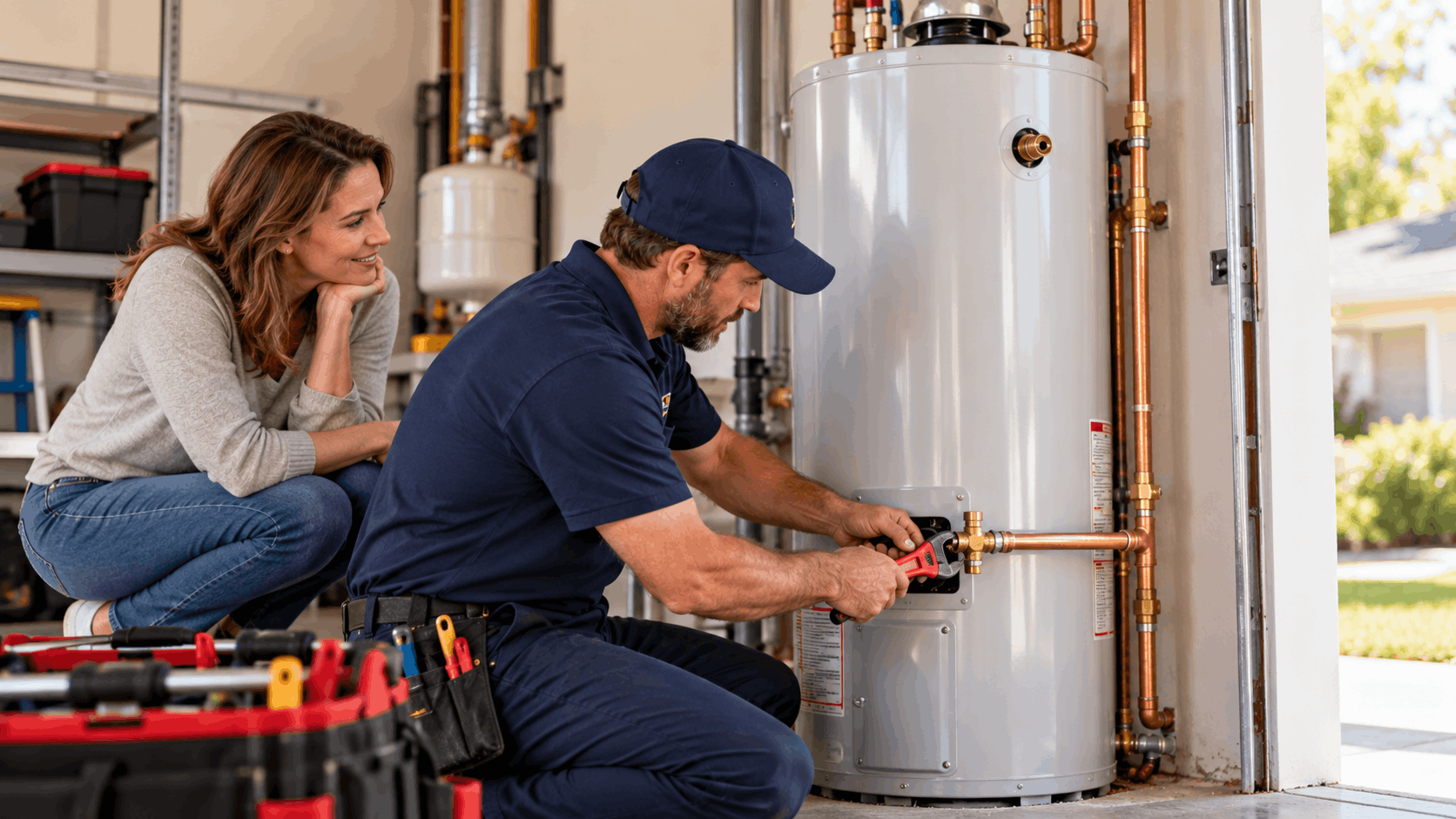
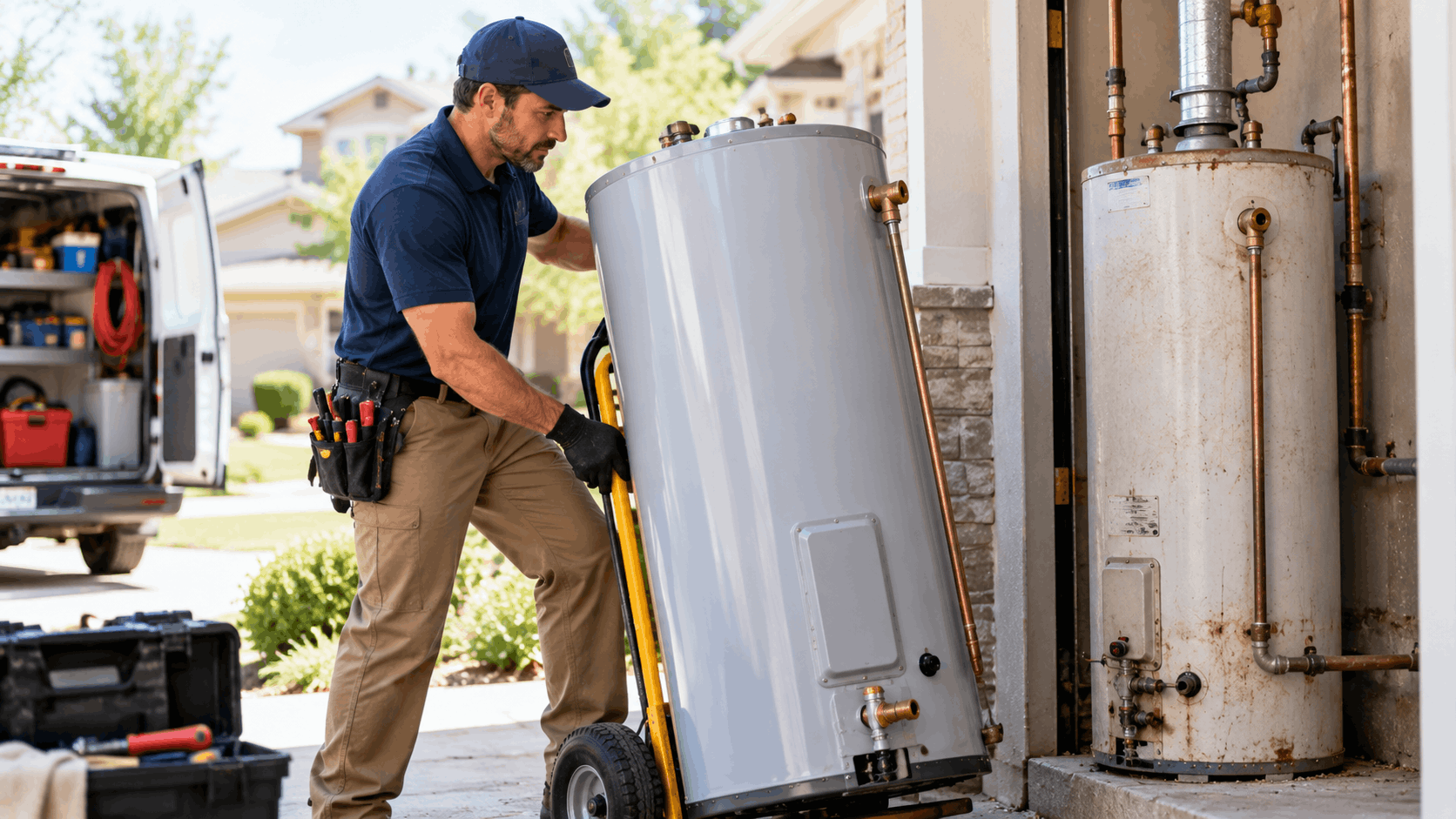
A tank water heater installation in The Lakes typically falls between $800 and $1,500. On a 1980s or 1990s home, a straight swap means pulling the old tank, setting the new one in the same spot, and reconnecting the water, the gas or electric feed, the venting and the temperature and pressure relief line. When the surrounding parts are in good shape, the job is clean and sits near the lower end.
The catch on houses this age is that the surrounding parts are rarely in good shape. Original angle stops, flexible supply connectors and the gas flex may all be as old as the house. A quality install replaces those at the same time rather than reconnecting worn hardware to a brand-new tank, which is part of why one swap costs more than another.
Venting matters too. A gas tank needs a correct draft, and an old flue or a crowded garage install can need attention before the new unit goes in. We confirm the condition of every connection point so the new heater is not sitting on borrowed time from the first day.
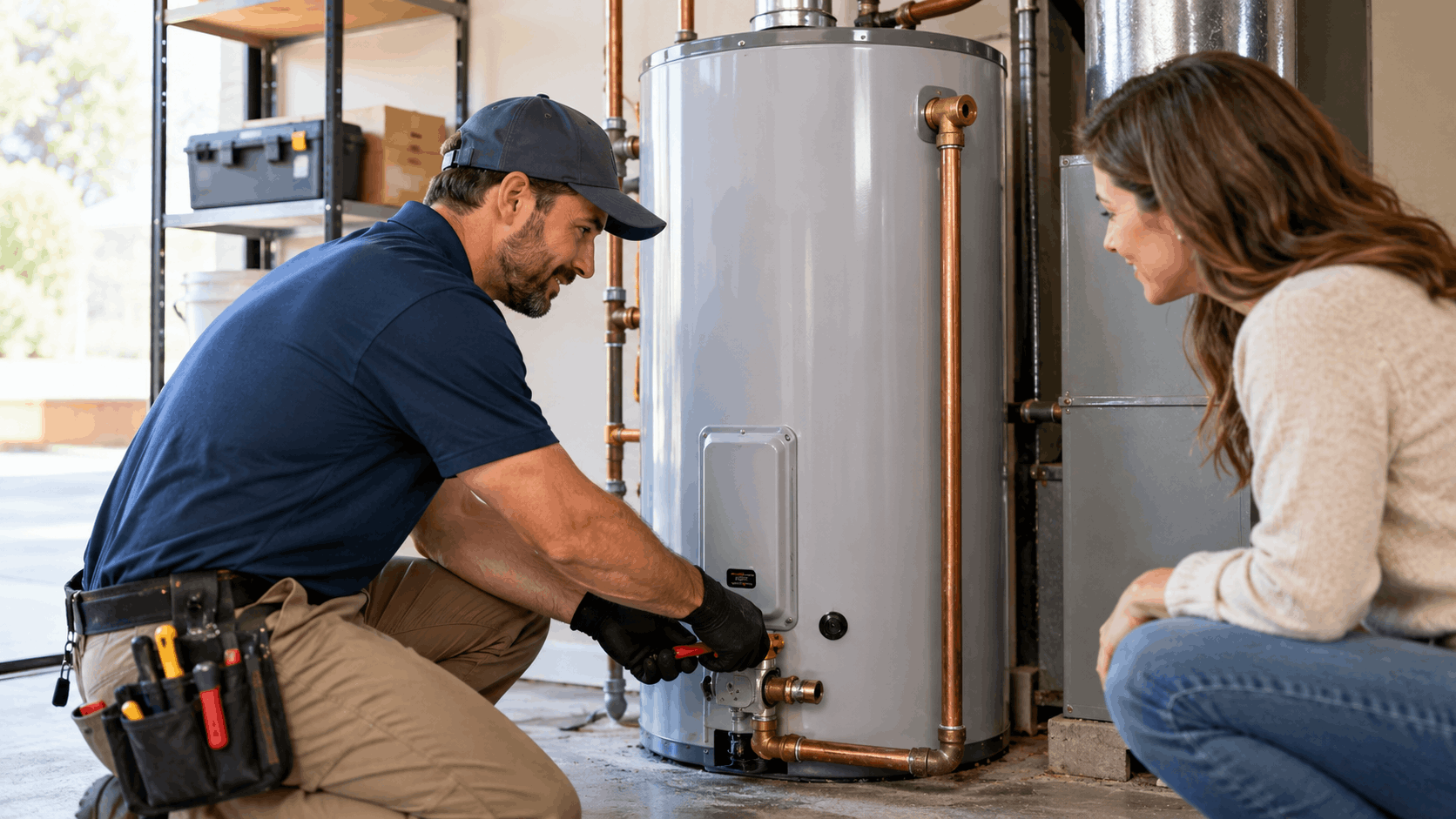
Finally, access plays a role. A tank in an open garage bay is fast. A tank crammed into a closet or set in an attic takes longer to remove and set, which affects labor. We note the location on the diagnostic so the written price reflects the real work.
Tankless Water Heater Installation Price Range
A tankless water heater installation typically runs $1,500 to $3,500. The spread is wider than a tank because the conversion involves more. A gas tankless unit usually needs a larger gas supply, different venting and in some homes an electrical connection for the controls, all of which add parts and labor to the base number.
In the valley's water, a tankless install almost always includes a pre-filter, which adds $150 to $300. The heat exchanger inside a tankless unit is a narrow passage, and scale collects there fast. A pre-filter and a plan for regular descaling protect that exchanger and keep the unit performing the way it should.
Gas sizing is the step people skip and regret. If a home has a pool heater, a spa, a cooktop and a dryer already on the gas line, a tankless water heater has to be sized to the whole load, not just to itself. Undersized gas shows up as a unit that underperforms rather than as an obvious fault, so we check the full appliance load before quoting a tankless water heater installation.
Because the work is more involved, the quote on a tankless conversion depends heavily on the existing home. A house already plumbed and vented for a tankless sits lower. A full conversion from an old tank, with new gas and venting, lands higher.
Repair, Descaling and Recirculation Pump Costs
Not every call ends in replacement. A water heater repair typically runs $150 to $500, covering parts like a thermocouple, a gas control valve, a heating element or a relief valve. On a unit still within its rated life with no tank corrosion, a repair can be the right call.
Tankless maintenance and descaling typically costs $150 to $250. This is the service that keeps a tankless unit healthy in hard water. Flushing a descaling solution through the heat exchanger pulls out the scale that collects in those narrow passages, protecting both performance and the life of the unit.
Recirculation pump installation typically runs $400 to $900. Several of the larger plans in The Lakes were built with a hot water loop so distant bathrooms get hot water faster. Those pumps reach the end of their life like any other component, and a failing pump is sometimes mistaken for a water heater problem.
When a recirculation system is part of the home, replacing the heater is a good moment to check the pump. We can handle a recirculation pump installation at the same visit so the whole hot water system is sound rather than just the tank.
After-Hours and Emergency Service Fees
A scheduled replacement and a Saturday-night flood are two different jobs. After-hours emergency calls carry a service fee of $150 to $300 plus repair costs. That fee covers the off-hours response, and the repair itself is priced on top.
A leaking tank that is actively flooding a garage or running into the house is an emergency, and waiting until Monday can turn a water heater problem into a water damage problem. When water is spreading, shutting the supply off at the heater and calling for help is the right move.
Most replacements, though, are not emergencies. A heater that is slow to recover, runs lukewarm, or shows a little rust at a fitting can usually be scheduled during normal hours, which keeps the cost in the standard ranges. Catching the warning signs early is what keeps a planned job from becoming an after-hours one.
When it truly cannot wait, our emergency plumbing team responds across the valley. For a failing tank that is leaking now, the 24/7 emergency plumbing line is the fastest route to getting the water stopped.
Get Your Quote
Tell us what's going on and we'll get back to you. We're open 24/7.
Why 1980s and 1990s Homes in The Lakes Need Replacement Now?
The Lakes was built from the mid-1980s to the mid-1990s around Lake Sahara, which makes the neighborhood roughly forty years old. That single fact shapes the whole conversation. In housing of this age, the heater is usually what fails rather than the pipe, because the equipment wears out faster than copper supply lines do.
Here is what that age produces in these homes:
- Original water heaters well past their rated life and scaled internally from decades of hard water.
- Thermal expansion tanks that quietly fail and announce themselves through a dripping relief valve.
- Pressure regulators that creep high and stress fixtures, or drop and leave an owner complaining about weak pressure.
- Original angle stops and supply connectors that have never once been replaced.
- Recirculation pumps on the larger plans reaching the end of their service life.
None of this is a defect in how the homes were built. It is simply equipment doing its time in a demanding environment. The useful thing is knowing what to look at, because a replacement that addresses the whole picture lasts longer than one that swaps the tank and ignores everything around it.
Equipment Past Rated Life in a Forty-Year-Old Neighborhood
A water heater has a rated life, and most original units in The Lakes passed it a long time ago. Even a replacement installed ten or fifteen years back is now in the zone where failure becomes likely rather than possible. Age alone is reason enough to plan ahead instead of waiting for a leak.
Inside an older tank, scale is the quiet enemy. Calcium and magnesium settle on the bottom and coat the heating surfaces, forcing the heater to work harder to deliver the same hot water. An unflushed tank works harder and fails earlier than its rated life because that layer of scale never leaves on its own.
The telltale signs of a tank near the end are worth watching. Rusty hot water, popping or rumbling sounds as the burner fights through sediment, longer recovery times, and any sign of moisture at the base all point to a unit on borrowed time. A rumble is often scale shifting on the tank floor.
Because the pipe in these homes is usually copper and still serviceable, the heater is the part that reaches end of life first. That is why water heater replacement is such a common job in The Lakes specifically, where the build era put a generation of tanks into service all at once.
Thermal Expansion Tanks and Pressure Regulators
Many homes in The Lakes have a small thermal expansion tank mounted near the water heater. Its job is to absorb the pressure that builds as water heats and expands in a closed system. When that tank fails, it does so silently, and the first sign an owner notices is water dripping from the temperature and pressure relief valve.
People often assume a dripping relief valve means the heater itself is bad. Frequently the real culprit is a dead expansion tank that can no longer absorb the pressure swings. Checking the expansion tank at replacement time prevents a brand-new heater from inheriting the same symptom.
The pressure regulator is the other component that quietly causes trouble. Over years, a regulator can creep high, pushing system pressure up and stressing fixtures, supply connectors and the heater itself. High pressure shortens the life of everything downstream of it.
A regulator can also drift the other way and drop, which produces the weak-pressure complaint an owner notices at the shower or the kitchen faucet. Either direction is a problem, so a regulator check belongs in any honest water heater replacement on a home this age.
Original Angle Stops and Supply Connectors
The angle stops and supply connectors near a water heater are easy to overlook, but on a forty-year-old home they are often original. Four decades of use, mineral deposits and the simple aging of rubber and brass leave these small parts stiff, corroded or ready to seep.
At replacement time these components matter more than their size suggests. A shutoff valve that will not turn, or a supply connector that weeps when disturbed, can turn a clean swap into a longer job. Replacing them along with the heater removes the weakest links in the hot water system.
Hard water is especially unkind to these small passages. Scale narrows the openings inside valves and connectors and seizes the moving parts, which is exactly why an original angle stop so often refuses to close when it is finally needed. A valve that cannot shut off is useless in an emergency.
Changing these parts during a planned replacement is inexpensive compared to dealing with them after a failure. It is the difference between a heater install that is complete and one that leaves old hardware waiting to leak behind the new unit.
Need Help in Las Vegas?
Active Plumbing serves Las Vegas and all of Las Vegas Valley.
How Very Hard Water Shortens Heater Life Here
The Southern Nevada Water Authority reports the valley's water at 280 parts per million, or 16 grains per gallon, which is categorized as very hard. That number explains more plumbing failures in Las Vegas than anything else, and it hits water heaters hardest of all. Every gallon that enters a tank in The Lakes carries a load of dissolved calcium and magnesium.
When that water is heated, the minerals come out of solution and settle as scale. Over years, scale builds on the tank bottom and the heating surfaces, clogs the small passages inside valves, and leaves the white crusting owners recognize on fixtures. In a water heater, that buildup is the single biggest reason a tank fails before its rated life.
There is no softening the fact: in this valley, protecting a heater from scale is not a luxury add-on. It is the difference between a unit that reaches its rated life and one that gives up early. The good news is the responses are well understood and worth the cost.
Scale on Elements and Tank Bottoms
In a tank water heater, scale collects where the heat is applied. On a gas unit that means a crust on the tank bottom over the burner. On an electric unit it means a coating directly on the heating elements. Either way, the heat now has to pass through an insulating layer of mineral before it reaches the water.
That insulating layer forces the heater to run longer and hotter to deliver the same amount of hot water. The burner or elements work harder, the tank bottom overheats, and the whole unit ages faster. An unflushed tank works harder and fails earlier than its rated life for exactly this reason.
The popping and rumbling an owner hears from an older tank is scale shifting as water tries to boil underneath the sediment layer. It is a sign the deposit is thick enough to trap heat against the steel. Once that happens, the tank is on a shorter clock.
Regular flushing removes loose sediment before it bakes into a hard layer. Starting that habit with a new heater, rather than after years of neglect, is what keeps the unit performing the way its rating promises in water this hard.
Why Tankless Units Scale Faster Without Protection
A tankless water heater has no tank, so instead of a wide floor for sediment to spread across, it has a heat exchanger made of narrow passages. Water flows through those tight channels and is heated instantly. In very hard water, scale builds in those passages quickly because the mineral has nowhere else to go.
As scale narrows an already narrow passage, flow drops and the exchanger struggles. Left unchecked, scale accelerates failure in a tankless unit because the heat exchanger is the heart of the system and the hardest part to clean once it is badly fouled. This is the trade-off with tankless in the valley.
The two defenses are a pre-filter and regular descaling. A pre-filter, which adds $150 to $300 at installation, reduces the mineral load reaching the exchanger. Descaling, at $150 to $250, periodically flushes the buildup back out of those passages before it hardens.
A tankless unit can serve a home in The Lakes well, but only with that protection in place. Choosing tankless without a plan for the water chemistry is choosing a short service life, which is why we size the pre-filter and set a descaling schedule as part of the install conversation.
Softening, Scale Reduction and Flushing That Protect the New Heater
The standard response to very hard water is to treat it before it reaches the heater. Water softener installation and salt-free water conditioning both typically run $800 to $2,500 installed. A softener removes the hardness minerals, while a salt-free conditioner changes how they behave so they are less likely to stick as scale.
A system of this size protects more than the water heater. It benefits the entire plumbing run, from the supply lines to the fixtures, the dishwasher, the washing machine and every valve and cartridge in the house. The heater is the most expensive thing scale attacks, but it is far from the only one.
Flushing remains the maintenance step that costs the least and does the most. For a tank, periodic flushing clears loose sediment before it bakes onto the bottom. For a tankless, descaling keeps the heat exchanger clear. In this water, both are maintenance rather than optional extras.
Pairing a new heater with treatment and a flushing schedule is the honest recommendation in The Lakes. You can explore the options under water treatment, which covers softening and conditioning sized to a home of this type.
What Drives the Price of Your Replacement
Two homes on the same street in The Lakes can get very different quotes for a water heater, and the reasons are specific rather than arbitrary. Understanding what moves the number helps an owner see why one job lands near $900 and another near $3,000. Most of it comes down to the type of unit and the condition of the home it is going into.
The biggest lever is tank versus tankless, because a tankless conversion involves gas, venting and water treatment work a tank swap does not. After that, code requirements, the location of the unit and whether the home has a recirculation loop all shift the figure. None of it is padding. Each factor adds real parts or real labor.
A good diagnostic sorts all of this out before a price is given. When an owner knows which of these factors applies to their home, the written price makes sense instead of feeling like a guess.
Tank Versus Tankless and the Pre-Filter
A tank swap is the simpler job. The new unit goes where the old one was, using connections that already exist for a tank. That keeps a tank replacement in the $800 to $1,500 range for most straightforward installs, assuming the surrounding hardware is sound.
A tankless conversion is a bigger project, which is why it runs $1,500 to $3,500. The gas supply often has to be enlarged to feed a tankless burner, the venting is different, and the unit may need an electrical connection for its controls. Each of those steps adds to the base cost.
Gas sizing is the detail that separates a good tankless install from a disappointing one. A tankless unit draws a lot of gas when it fires, and if the line is shared with a pool heater, a cooktop and a dryer, the whole load has to be accounted for. Undersized gas leaves the unit underperforming.
In the valley's water, a tankless install adds a pre-filter at $150 to $300 to protect the heat exchanger. That is not an upsell, it is the piece that keeps a tankless unit from scaling out early in water at 280 parts per million. We size both the gas and the filter during the diagnostic.
Bringing the Install Up to Current Code Requirements
Southern Nevada adopted the 2024 Uniform Plumbing Code with Southern Nevada Amendments, which the City of Las Vegas has codified. One requirement that regularly affects older installs is the water heater drain pan. Where a leak would cause damage, such as an attic or a floor-ceiling assembly, a drain pan is required.
The specifics matter for the price. The pan must be at least 1-1/2 inches deep, with a drain not less than 3/4 inch routed to a visible, approved location, and the relief valve must not discharge into the pan. On an older home that never had a compliant pan or drain, adding one means new parts and more labor.
These amendments are the local plumbing rules for the address, developed by the Southern Nevada Building Officials and adopted by each jurisdiction. The Building Official is the authority on any alternate material or method. For a water heater in The Lakes, the City of Las Vegas is the body that adopted and enforces them.
Meeting code is not optional, and a permitted install will be inspected against it. That is why a diagnostic checks whether a pan, a drain line or other update applies before a price is set, so the written number already includes whatever the install actually needs.
Garage or Attic Location and Summer Heat
Where the heater lives affects both access and code. A unit in an attic almost always triggers the drain pan requirement, because a leak there would run straight through the ceiling below. Attic installs also take more time to remove and set, which adds labor to the job.
A garage install is more common in The Lakes and usually simpler to access. Even so, the garage brings its own stress. Summer heat in the valley raises the incoming water temperature and heats the garage air around the equipment, which makes outdoor and garage-located units work in tougher conditions than a heater in a conditioned space.
That heat exposure is one more reason to keep the equipment protected and maintained. A heater fighting both very hard water and high ambient temperatures has a harder job than its rating assumes, so the small maintenance steps pay off more here than in a milder climate.
During the diagnostic we note the location, the access path and whether the pan and drain apply. A closet or attic unit prices differently from an open garage bay, and knowing that up front keeps the written price honest.
Recirculation Lines on the Larger Plans
Several of the larger floor plans in The Lakes were built with a hot water recirculation loop. The loop keeps hot water moving so it arrives quickly at bathrooms far from the heater. The pump that drives that loop is a wearing part, and after decades it reaches the end of its life.
A failing recirculation pump can masquerade as a water heater problem. Hot water takes forever to reach a distant tap, and an owner blames the heater when the real issue is a dead or dying pump on the loop. Checking the pump is part of diagnosing the whole hot water system.
When a replacement is already happening, it is a sensible moment to address the pump too. A recirculation pump installation runs $400 to $900, and pairing it with a new heater means the entire hot water delivery system is sound rather than half new and half worn out.
Not every home in The Lakes has a loop, so this applies mainly to the larger plans. We confirm whether a recirculation system is present during the diagnostic, so the price reflects the actual configuration of the home rather than a generic assumption.
Permits and the City of Las Vegas Building Department
Here is a point that trips up contractors who do not work this area regularly: The Lakes sits inside the Las Vegas city limits. That means permits, plan check and inspections for a water heater run through the City of Las Vegas building department, not Clark County. This matters even though the land all around it tells a different story.
Spring Valley and Summerlin South, which border the area, are unincorporated Clark County. The mailing address on both sides of that line reads Las Vegas, NV, so the envelope tells you nothing about who issues the permit. Getting this right is a small thing that signals real local knowledge, and getting it wrong costs time.
For any water heater work that requires a permit, confirming the jurisdiction first is the correct opening move. For a home in The Lakes, that jurisdiction is the city, and we handle the permit position for your specific address rather than assuming one rule covers the whole valley.
Why The Lakes Is City, Not County
Because the mailing address reads Las Vegas on both sides of the city line, it is useless for figuring out jurisdiction. The reliable check is the Clark County Assessor parcel record, which shows the actual governing jurisdiction for a specific address. That record, not the mailbox, tells you whether the city or the county issues the permit.
Filing a Lakes job with the county out of habit is a common and costly contractor mistake. A permit pulled from the wrong authority is no permit at all, and the error surfaces at the worst time, often when an inspection or a home sale depends on the paperwork being right.
The pattern in this part of the valley is confusing by design. The City of Las Vegas boundary weaves around unincorporated pockets, so neighboring streets can answer to different building departments. The Lakes falls on the city side even though Spring Valley to the south does not.
We verify the jurisdiction from the parcel record before pulling anything. For a water heater in The Lakes that means the City of Las Vegas, and confirming it up front keeps the permit clean. You can see our full coverage across the city on the Las Vegas service area page.
When a Water Heater Swap Needs a Permit
Water heater work that requires a permit must be performed by an appropriately licensed contractor. That is the standard position, and it protects the homeowner, since permitted work is inspected against the current code and tied to a verifiable license.
Whether a particular swap needs a permit depends on the scope and the jurisdiction, so the right step is to confirm the permit position for your specific address with the City of Las Vegas rather than assuming a single valley-wide rule. We sort that out as part of setting up the job, so there is no guesswork left for the owner.
A customer is always entitled to ask a contractor for a license number and to verify it. In a market with a real unlicensed-trade problem, that is worth doing. A compliant, permitted install is the record you want behind the walls when it comes time to sell or make an insurance claim.
The practical upshot is simple. Hire licensed, let the permit run through the correct department, and the install stands up to inspection. We handle both so the heater is legal as well as working.
Association Rules on Exterior Equipment
Many tracts in The Lakes are association-governed and operate under Nevada Revised Statutes Chapter 116. For a water heater, the association's reach is narrow but real. Interior work, including a tank in the garage, does not require architectural approval. What changes is anything visible on the exterior.
An exterior tankless unit, a new enclosure, or any equipment mounted on a street-facing or lake-facing elevation can require architectural approval. On a waterfront or lake-view home, the association cares about what shows from the water side as much as the street side. Checking before mounting equipment outside saves being told to move it later.
The key point is that association approval and a city permit are separate tracks. Clearing one does not clear the other. An owner planning an exterior install may need both the architectural sign-off and the building permit, and the two run on their own timelines.
The association or its management company is the route to the architectural answer, and timelines for review vary, so it is worth starting that conversation early. For an interior replacement, this is not a concern. It only comes into play when equipment ends up on an outside wall.
Need Help in Las Vegas?
Active Plumbing serves Las Vegas and all of Las Vegas Valley.
Choosing Between a New Tank and Going Tankless
For a forty-year-old home in The Lakes, the tank-versus-tankless decision comes down to cost, water chemistry and how the household actually uses hot water. There is no single right answer. A two-person household with a simple layout has different needs than a large plan with a pool, a spa and several bathrooms.
The water here pushes the decision in a specific direction. At 280 parts per million, very hard water affects both types, but it demands extra protection for tankless because of the narrow heat exchanger. That protection is part of the real cost of going tankless in the valley.
The table below lays out the trade-off so an owner can see where each option fits before the conversation even starts.
| Factor | Tank | Tankless |
|---|---|---|
| Typical install cost | $800 to $1,500 | $1,500 to $3,500 |
| Hard water protection | Flushing, treatment | Pre-filter plus descaling |
| Gas work | Usually minimal | Often needs larger gas supply |
| Hot water supply | Limited by tank size | Continuous, if sized right |
| Best fit | Straightforward swaps | High-demand homes |
When a Tank Replacement Makes Sense
A straight tank swap at $800 to $1,500 is the practical choice for a lot of homes in The Lakes. If a household's hot water use fits comfortably within a tank's capacity, there is little reason to pay for a conversion. The simpler job is also the faster one.
Tank replacement makes particular sense where the existing setup already works and only the unit itself has aged out. The connections, the venting and the space are all built for a tank, so dropping in a new one is a clean job with fewer variables and a more predictable price.
It is also the right call for an owner who wants the lowest upfront cost and is comfortable with standard flushing to protect the unit. A tank that is flushed and paired with water treatment can reach its rated life even in this water.
For rental properties and second homes, both common in The Lakes, a tank is often the straightforward answer. It is simple to service, familiar to any plumber, and keeps the investment in the equipment modest while still solving the hot water problem.
When Tankless Is Worth the Higher Cost
A tankless conversion at $1,500 to $3,500 pays off in homes with heavy or continuous hot water demand. A larger plan with multiple bathrooms, where a tank runs out during back-to-back showers, is a strong candidate. A tankless unit delivers hot water continuously when it is sized correctly.
Homes with a pool, a spa or an outdoor kitchen need special attention to gas load sizing. The tankless burner draws heavily, and when it shares a line with those other appliances, the gas supply has to be sized to the whole house, not just the water heater. Skip that step and the unit underperforms.
Space is another driver. A tankless unit is compact and wall-mounted, which frees up floor area in a garage or closet. For an owner reworking a space or wanting the footprint back, that compactness is a genuine benefit beyond the hot water itself.
The gas work behind a conversion is where the licensing really counts, and our gas line services team handles the supply sizing and connection so the tankless unit gets the fuel it needs to run at its rating.
Running Cost and the Electric Versus Gas Question
The two utilities behind a water heater in the valley are distinct. Natural gas is supplied by Southwest Gas, so gas line work, gas pressure testing and the gas portion of a bill all relate to them. Electricity is supplied by NV Energy, so an electric or heat pump water heater's running cost and any electric bill spike tie to them.
That distinction matters when questions come up. A gas tankless conversion and its gas coordination run through Southwest Gas. An electric or heat pump unit's operating cost runs through NV Energy. The plumber handles the install itself for either type.
On incentives, the federal Energy Efficient Home Improvement Credit, Section 25C, for heat pump water heaters applied only to equipment placed in service by December 31, 2025. That credit has ended, so it should not be counted on for a new install in 2026. It is no longer available.
Utility and manufacturer rebates may still exist and they change often, so an owner should check the current program directly before assuming anything. The right move is to confirm what is available now rather than relying on a figure from last year.
Protecting Your New Water Heater in The Lakes
Installing a new heater is the start, not the finish, in water this hard. The steps that keep it running closer to its rated life are well understood, and each ties to a specific service. Treat the water, flush the unit, and keep an eye on the expansion tank and regulator, and the new heater has a real chance at a full service life.
The reason these steps matter so much here comes back to the 280 parts per million figure. Scale is relentless, and a heater left to fend for itself in untreated hard water faces a shorter life than the same unit in a milder climate. Protection is what closes that gap.
None of these steps is complicated or expensive relative to the cost of the heater. They are the difference between replacing a tank on schedule and replacing one years early because scale wore it out.
Whole-House Softening or Scale Reduction
Water softener installation and salt-free water conditioning both run $800 to $2,500 installed. A softener removes the calcium and magnesium that cause scale. A salt-free conditioner alters the minerals so they are far less likely to stick to surfaces. Either approach reduces the scale load the new heater faces.
The benefit reaches well beyond the water heater. Treating the water protects the whole plumbing run: the supply lines, the fixtures, the shower heads, the dishwasher and the washing machine, all of which suffer in untreated hard water. For a home of this size, that whole-house protection is where the value lies.
Which system fits depends on the home and the owner's preferences. A softener needs salt and produces soft water throughout. A conditioner needs no salt and leaves the mineral content in place while preventing the scaling. We size either to the home during the assessment.
Pairing treatment with a new heater is the honest recommendation in The Lakes. It is the single step that most extends equipment life here. The full range of water treatment options covers both softening and conditioning for homes of this type.
Regular Flushing and Tankless Descaling
For a tank, flushing is maintenance, not an option, in this water. Periodic flushing clears loose sediment from the tank bottom before it bakes into a hard, heat-trapping layer. A heater flushed on a schedule runs cooler and more efficiently than one left to accumulate scale.
For a tankless unit, the equivalent is descaling at $150 to $250. Running a descaling solution through the heat exchanger pulls out the mineral buildup from those narrow passages. Done on schedule, it keeps the exchanger clear and the unit performing the way its rating promises.
How often to flush or descale depends on the unit and the water, but in the valley it should happen more frequently than in soft-water regions. The deposits here build faster, so the maintenance interval is shorter. Skipping it simply lets scale win.
Building this habit from the day a new unit goes in, rather than starting it after years of neglect, is what separates a heater that reaches its rating from one that quits early. It is the cheapest insurance on the biggest piece of the system.
Watching the Expansion Tank and Pressure Regulator
A new water heater deserves a healthy expansion tank and pressure regulator working alongside it. A thermal expansion tank that has failed can no longer absorb the pressure swings as water heats, which shows up as a dripping relief valve and puts needless stress on the new unit.
Checking the expansion tank at replacement time prevents that drip from appearing on a brand-new install. It is a small component, and replacing it during the heater job is far cheaper than chasing a mystery leak afterward. A silent failure is still a failure.
The pressure regulator deserves the same attention. A regulator that has crept high pushes excess pressure onto the new heater, the fixtures and the supply connectors, shortening the life of all of them. A regulator that has dropped produces the weak-pressure complaint an owner notices at the tap.
Verifying both at replacement means the new heater starts life in a balanced system rather than inheriting the stress that helped kill the old one. It is part of a complete install, not an extra, and it protects the investment the owner just made.
Need Help in Las Vegas?
Active Plumbing serves Las Vegas and all of Las Vegas Valley.
How Active Plumbing Handles a Water Heater Replacement
A water heater replacement in The Lakes should be predictable from the first call. We confirm what is actually in the home, give a written price before any work starts, and arrive within a set window. The license behind the work is public and verifiable, which matters in a market with a serious unlicensed-trade problem.
Every home in this neighborhood is a little different: tank or tankless, gas or electric, garage or closet, with or without a recirculation loop. The process is built to sort all of that out before a price is set, so the number an owner sees reflects the real job rather than a generic estimate.
On-Site Diagnostic and Confirming the Install
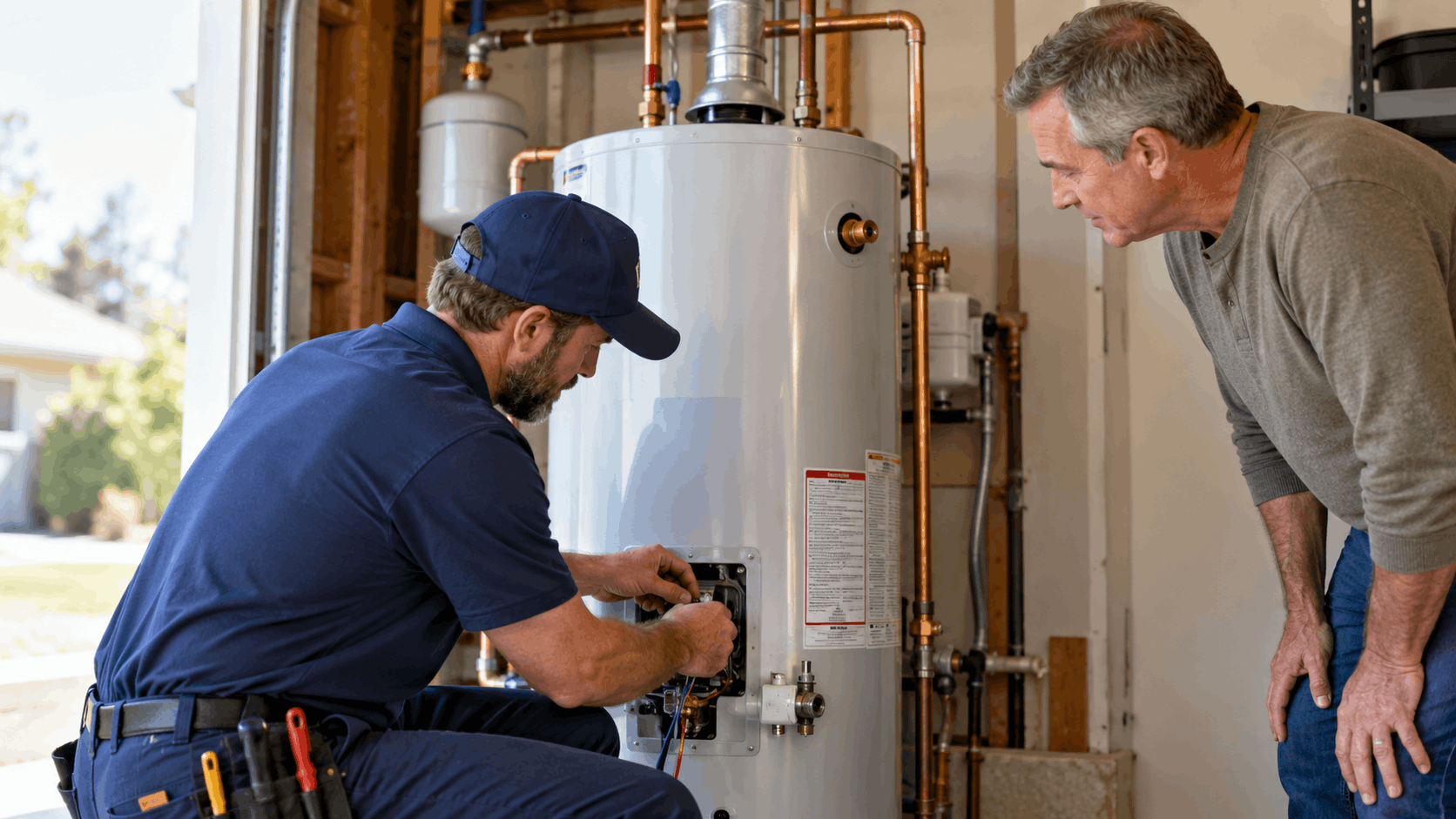
The visit starts with a diagnostic. We confirm the existing unit, its location, the gas or electric feed, and whether a drain pan or any code update applies to the install. On a forty-year-old home, we also check the angle stops, supply connectors, expansion tank and pressure regulator that surround the heater.
That assessment is what makes the price accurate. An attic unit that needs a pan and drain prices differently from an open garage swap with sound hardware. Knowing exactly what the install requires before quoting is how the written number ends up matching the finished job.
For tankless, the diagnostic includes checking the gas load across the whole home, especially where a pool, spa or outdoor kitchen shares the line. Sizing the gas and the pre-filter at this stage prevents the underperformance that comes from skipping those steps.
Many pockets of The Lakes are gated, so access is arranged in advance rather than on arrival. We confirm who authorizes the work and who pays during the first call, since calls here come from owners, tenants and property managers alike. That keeps the appointment smooth once the day arrives.
Written Price Before Work Starts
Active Plumbing gives the customer a written price before work starts. The owner knows the number before anyone picks up a tool, based on what the diagnostic found at that specific home. There is no mid-job surprise on a straightforward replacement.
Technicians arrive in 30 to 60 minutes anywhere in the Las Vegas Valley, including The Lakes. For a failing tank that is leaking, that response window is what keeps a water heater problem from turning into water damage. For a planned replacement, it means the job gets moving quickly.
A written price also lets an owner compare the options plainly: a tank swap against a tankless conversion, with the pre-filter and any code update spelled out. Seeing the figures side by side makes the tank-versus-tankless decision easier rather than abstract.
The price is tied to the actual scope found during the diagnostic, so it accounts for the real condition of the home. That is how a replacement in The Lakes stays honest from the estimate through to the finished install.
Licensing You Can Verify
Active Plumbing is a fourth-generation family business that has served the Las Vegas Valley since 1991. We hold Nevada license NSCB #0047021, along with the certifications required for the work we perform. That history means we have seen the full arc of The Lakes, from the first homes going up to the equipment aging out today.
Licensing is verified free at nvcontractorsboard.com through the Nevada State Contractors Board. Classification, status, bond and workers compensation are all public record. Any homeowner can check the license number before hiring, and we encourage it.
Contractor licensing in Nevada is statewide through the board, not through a city or county. The board licenses contractors; the City of Las Vegas handles the permit for a home in The Lakes. Those are two separate systems, and both are satisfied on a proper install.
You can learn more about the full range of our water heater services and our work in The Lakes, where the build era and the water chemistry shape exactly the jobs we handle every week.
Ready to Replace Your Water Heater in The Lakes?
If your heater is near Lake Sahara and well past its rated life, the next step is a diagnostic that confirms the unit, the location and whether a pan or code update applies, followed by a written price before any work begins. Our team arrives in 30 to 60 minutes anywhere in the valley and arranges gated access in advance.
Call Active Plumbing at (702) 438-3357 to schedule a water heater assessment for your home in The Lakes, or reach us through our contact page.
Frequently Asked Questions
- How much does water heater replacement cost in The Lakes?
- Tank water heater installation typically runs $800 to $1,500, and tankless water heater installation typically runs $1,500 to $3,500, with a pre-filter adding $150 to $300 where the valley's hard water calls for one. These are typical area ranges rather than a quote. The actual price depends on the unit, the location and whether a code update applies, and we give a written price before work begins.
- Why do water heaters fail faster in Las Vegas?
- The Southern Nevada Water Authority reports the valley's water at 280 parts per million, or 16 grains per gallon, which is very hard. Calcium and magnesium settle as scale on the tank bottom and heating surfaces, forcing the unit to run longer and hotter. An unflushed tank works harder and fails earlier than its rated life because that scale layer never clears on its own.
- Do I need a permit to replace my water heater in The Lakes?
- The Lakes sits inside the City of Las Vegas, so permits and inspections run through the city building department, not Clark County, even though neighboring Spring Valley is unincorporated county. Permitted work must be performed by an appropriately licensed contractor. Because scope and rules vary, confirm the permit position for your specific address with the City of Las Vegas rather than assuming one valley-wide rule.
- Is tankless worth it in The Lakes with hard water?
- It can be, with the right protection. A tankless unit has a narrow heat exchanger that scales fast in water at 280 parts per million, so it needs a pre-filter at $150 to $300 and regular descaling at $150 to $250. Against that is a higher install cost and continuous hot water for high-demand homes. For a large plan with multiple bathrooms, the trade-off often pays off.
- How long does a water heater last in Las Vegas?
- Every unit has a rated life, but in very hard water that rating is hard to reach without care. An unflushed tank works harder and fails earlier than its rated life, because scale builds on the heating surfaces and traps heat against the steel. Regular flushing, water treatment and a healthy expansion tank and regulator are what give a heater here a chance at its full life.
- Why is my relief valve dripping on an older unit?
- A dripping temperature and pressure relief valve on an older unit is often a sign that the thermal expansion tank has failed. When that tank can no longer absorb the pressure swings as water heats, the pressure escapes through the relief valve instead. It is common on equipment this age in The Lakes, and the fix is usually replacing the expansion tank, not the heater.
- Does a new water heater need a drain pan?
- Under the 2024 Uniform Plumbing Code with Southern Nevada Amendments, a drain pan is required where a leak would cause damage, such as an attic or a floor-ceiling assembly. The pan must be at least 1-1/2 inches deep with a drain not less than 3/4 inch routed to a visible, approved location. On an older install that lacked one, adding it can increase the cost.
- Who do I call for gas versus electric water heater questions?
- Natural gas in the valley is supplied by Southwest Gas, so gas line work and the gas portion of your bill relate to them. Electricity is supplied by NV Energy, so an electric or heat pump water heater's running cost ties to them. The plumber handles the water heater install itself, whether the unit runs on gas or electricity, and coordinates gas work as needed.
- Does my association need to approve a new water heater?
- Interior work, including a tank in the garage, does not require association approval. Where it comes into play is exterior equipment. An exterior tankless unit, an enclosure, or anything on a street-facing or lake-facing elevation can require architectural approval under Nevada Revised Statutes Chapter 116. That approval is a separate track from the city permit, so an exterior install may need both.
- Are there still tax credits for a heat pump water heater?
- The federal Energy Efficient Home Improvement Credit, Section 25C, for heat pump water heaters applied only to equipment placed in service by December 31, 2025, and it has since ended, so it should not be counted on for a new install. Utility and manufacturer rebates may still exist but change often, so check the current program directly before assuming anything is available.
Licensed plumbing professionals serving Las Vegas and Las Vegas Valley.
Licensed in Nevada · License #0047021
Last updated on
Why trust Active Plumbing?
Founded in 1991, Active Plumbing is a licensed and insured plumber serving Las Vegas and Las Vegas Valley. All content is reviewed by our licensed technicians.

Need Help in Las Vegas?
Active Plumbing serves Las Vegas and all of Las Vegas Valley.
Related Articles
How Much Does Water Heater Replacement Cost in Las Vegas?
Water heater replacement cost in Las Vegas depends on tank vs tankless, size, and permits. Vegas hard water shortens tank life. Here's what to expect and how to get a fair quote.
Water Heater Replacement Cost in Spanish Trail for Multi-Unit and Custom Homes
Water heater replacement cost in Spanish Trail depends on property type, number of heaters, gate access, and very hard water. Get the typical valley ranges and what drives your price.
Water Heater Replacement Cost in Sun City Summerlin for Late 1980s and 1990s Homes
What water heater replacement really costs in Sun City Summerlin homes from 1989 to the 1990s, shaped by unit type, the 2024 code, hard water, and City of Las Vegas permits.