Cost Guides
Water Softener Installation Cost in Las Vegas: Loop vs No-Loop Homes Priced Separately
Key Takeaways
- Las Vegas water from Lake Mead often tests 12 to 16 grains per gallon, putting it in the very hard range.
- Loop homes have pre-plumbed stub-outs and cost less, roughly $300 to $700 for labor or $1,200 to $2,500 with a unit.
- No-loop homes need a loop built from scratch, running about $800 to $1,800 for plumbing alone or $2,000 to $3,500 total.
- Check your garage for two capped pipes, a drain, and an outlet to see if your home already has a softener loop.
- Older homes near Downtown, the Arts District, and North Las Vegas often lack loops and may involve slab plumbing.
- Final price also depends on grain capacity, salt-based versus salt-free choice, permits, and HOA placement rules.
- Active Plumbing tests your water and prices loop and no-loop homes separately with upfront quotes and a free estimate.
In This Article
Anyone who has wiped down a glass in a Las Vegas kitchen knows the frustration. You pull a cup out of the dishwasher, hold it up to the light, and it looks like it went through a sandstorm. White spots cover the glass, the faucet handles have a crusty white ring, and the showerhead spits water in ten directions because half the holes are clogged. That is hard water, and almost every home in the valley deals with it.
Homeowners across Summerlin, Henderson, and North Las Vegas call us with the same complaints week after week. Their skin feels dry after a shower. Their water heater started making popping sounds. Their brand new faucet already looks old. A water softener fixes all of that, but the first question people ask is always the same: how much does it cost to install one?
The honest answer depends on your home. Homes with a pre-plumbed softener loop cost less to set up than homes without one. This guide breaks down water softener installation cost in Las Vegas with loop and no-loop homes priced separately, so you know what to expect before anyone shows up with a wrench.
Why Las Vegas Water Is So Hard on Homes?
Before we talk about price, it helps to understand what we are fighting. Hard water in Las Vegas is not a small problem. It is one of the hardest water supplies in the entire country, and it wears down homes faster than most people realize.
Once you see how much mineral is running through your pipes every day, the cost of a softener starts to make a lot more sense. Let us walk through where the water comes from and what it does inside a house.
What Makes Valley Water So Mineral-Heavy
Most of the water in the valley comes from Lake Mead, which is fed by the Colorado River. That river picks up minerals as it runs across hundreds of miles of rock and desert soil. By the time Lake Mead water reaches your tap, it carries a heavy load of dissolved calcium and magnesium.
Water hardness is measured in grains per gallon. Soft water sits below 3 grains per gallon. Las Vegas water often tests between 12 and 16 grains per gallon, which puts it firmly in the very hard range. Some parts of the valley test even higher depending on the season and blending.
That calcium and magnesium is what leaves the chalky residue on everything. It is not dirt and it is not a cleaning problem. It is rock, dissolved in your water, drying onto every surface it touches. You can read more about how the region manages its supply through the Bureau of Reclamation, which oversees Colorado River operations.
Because the hardness is so consistent across the region, softeners are common here. In many newer neighborhoods, a softener is treated as a normal part of owning a home rather than a luxury add-on.
Signs of Hard Water in Summerlin and Henderson Homes
The most obvious sign is the spotty dishes we mentioned earlier. Those white marks are dried mineral deposits, and no amount of rinse aid fully solves them. Homeowners in Summerlin and Henderson report the same thing again and again.
Scale buildup shows up on faucets, showerheads, and around the base of sink handles. It looks like a white crust and it comes back within days of cleaning it off. On darker fixtures and glass shower doors, the buildup is even easier to spot.
Then there is how the water feels. Many people notice dry, itchy skin and hair that never feels fully rinsed. Soap and shampoo struggle to lather because the minerals fight against them, so people use more product and still feel like they need another rinse.
Inside the walls, the same scale that coats your faucets is coating your pipes and appliances. That hidden buildup is where hard water does its most expensive damage over time.
How Hard Water Shortens Appliance Life
Water heaters take the hardest hit. As hard water heats up, the minerals drop out and settle at the bottom of the tank as scale deposits. That layer of scale forces the heater to work harder, which drives up energy bills and shortens the life of the unit.
We regularly pull water heaters in the valley that failed years early because of scale. A tank that should last 10 to 12 years might quit at 6 or 7 in untreated hard water. If you want to protect that investment, our water heater services team sees this damage constantly.
Dishwashers and washing machines suffer too. Scale clogs the small water passages, coats heating elements, and leaves residue on clothes and dishes. Appliance repair bills add up quietly, one part at a time, until people replace the whole machine.
Faucets and valves are another hidden cost. Mineral buildup wears out cartridges and seals, causing drips and low flow. Softening the water slows all of this down and stretches the life of every appliance that touches water.
Get Your Quote
Tell us what's going on and we'll get back to you fast.
Loop vs No-Loop Homes: What the Difference Means
Here is the single biggest factor in your install price. It is not the brand of softener or even the size of your house. It is whether your home has a softener loop already built in.
This one detail can swing the cost by hundreds of dollars. Figuring out which type of home you own is the first step toward an accurate quote.
| Feature | Loop Home | No-Loop Home |
|---|---|---|
| Pre-plumbed pipe stub-outs | Yes | No |
| Typical home age | Newer builds | Older builds |
| Install difficulty | Simple hookup | Custom plumbing |
| Average install time | 2 to 4 hours | Half to full day |
| Relative cost | Lower | Higher |
What a Pre-Plumbed Softener Loop Actually Is
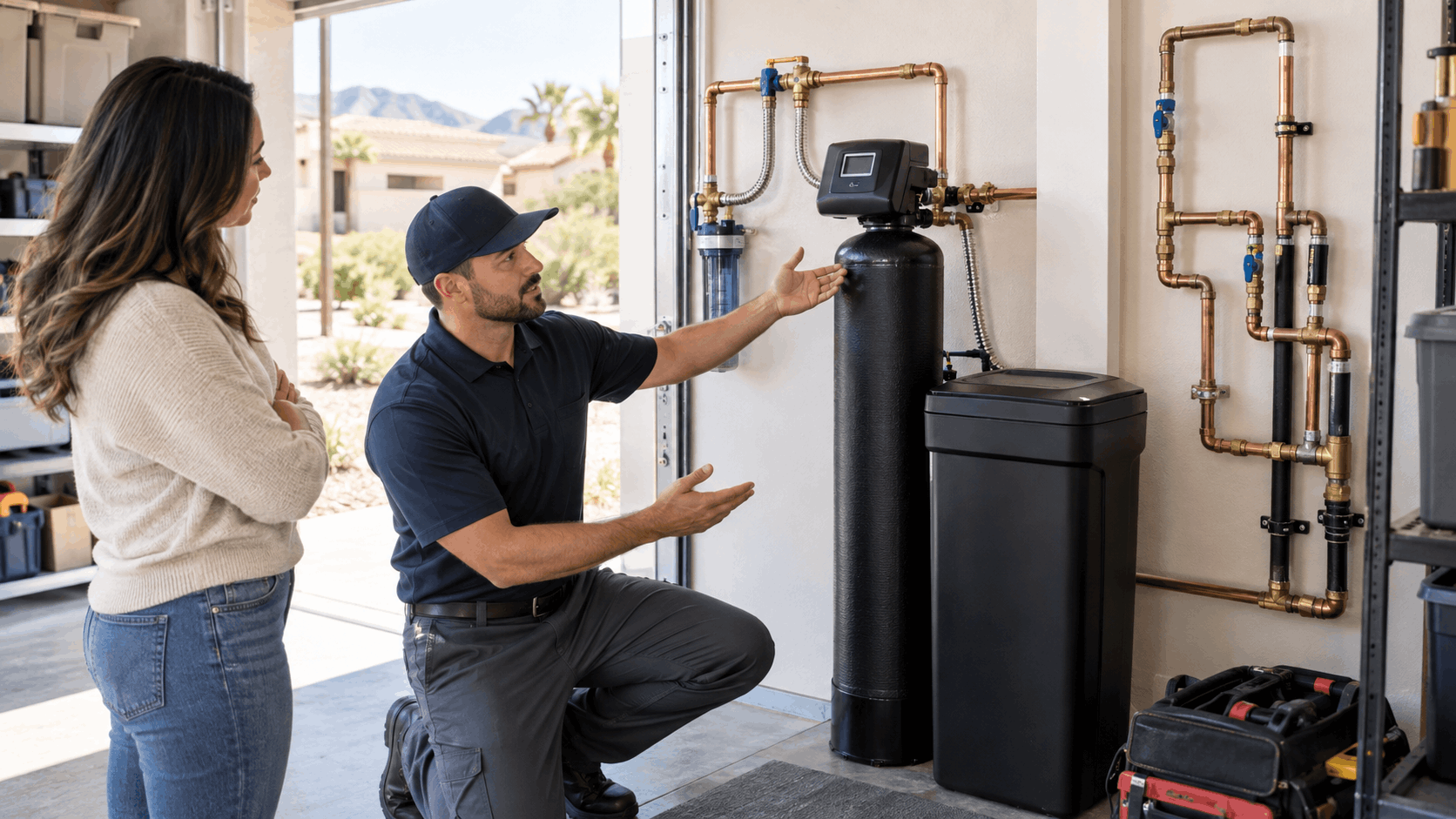
A softener loop is a set of pipe stub-outs the builder roughs in for a future softener. You will usually find them in the garage, sticking out of the wall with two capped pipes and sometimes a nearby drain and outlet. Builders add these because they know valley water is hard.
The loop connection is designed so the water line splits, runs out to where the softener sits, then loops back into the house. That way the softener can treat the water headed to your fixtures without touching outdoor spigots or irrigation. It is a clean, simple setup.
When a home has this garage plumbing already in place, the install is mostly a matter of connecting the unit. The heavy planning work was done when the house was framed. That saved labor is exactly why loop homes cost less to service.
Loops became standard in most new construction across the valley over the last couple of decades. If your home was built recently, there is a strong chance you have one waiting to be used.
How to Tell If Your Home Has a Loop
Start in the garage. Look along the wall that shares plumbing with the house, often near the water heater or the main line coming in. You are searching for two copper or PEX pipes capped off close together, sometimes labeled or painted.
A true loop usually has a nearby drain opening and a 120-volt outlet, since salt-based softeners need power and a place to discharge. If you spot all three near each other, you almost certainly have a loop ready to go. This is very common in newer areas like Skye Canyon and Inspirada.
Sometimes the loop sits on an exterior wall instead of inside the garage. Check the side of the house near the front hose bib, where the main line enters. A pair of capped pipes there points to an exterior loop.
If you are unsure, our team can identify a softener loop during a quick site visit. We check for it during every water treatment assessment so nobody guesses wrong on the quote.
Why Older Homes Near Downtown Often Have No Loop
Older neighborhoods tell a different story. Homes near Downtown Las Vegas and the Historic Westside were built long before softener loops were a standard building practice. Back then, whole-home softening was rare, so builders never left the stub-outs.
That means a no-loop retrofit is needed to add a softener. The plumbing has to be cut and rerouted to create the loop that never existed. It is more work, but it is completely doable on almost any home.
Many mid-century and older ranch homes across the central valley fall into this group. If your house predates the big master-planned communities, assume there is no loop until proven otherwise. We handle these retrofits regularly and know the quirks that come with older construction.
Knowing you have a no-loop home is not bad news. It just changes the scope of the job and the price, which we will break down next.

Need Help in Las Vegas?
Active Plumbing serves Las Vegas and all of Las Vegas Valley.
Water Softener Installation Cost for Loop Homes
Good news for owners of newer homes: if you have a loop, you are looking at the lower end of the price scale. The hard part of the plumbing is already finished.
Let us look at real numbers and what actually drives them. Every home is a little different, but these ranges reflect what we see across the valley.
Typical Price Range for Loop Installs
For a straightforward loop connection, most homeowners pay somewhere in the range of $300 to $700 for the installation labor when supplying their own unit. If the softener is included in a package, the total often lands between $1,200 and $2,500 depending on the system.
That loop hookup cost covers connecting the unit to the existing stub-outs, tying in the drain, and powering the head. Because the pipes are already there, the crew is not cutting into walls or rerouting the main line. That is where the savings come from.
Las Vegas plumbing cost for a loop install stays predictable because the variables are limited. The main things that move the number are the unit you choose and any small extras. You can see our full approach on the water softener installation page.
A clean loop home is about as simple as softener work gets. Many of these jobs wrap up in a single short visit.
What Is Included in a Basic Loop Hookup
A basic loop hookup starts with the labor to mount and connect the softener. The crew attaches the inlet and outlet lines to your stub-outs, sets the bypass valve, and secures the unit so it does not shift.
Fittings are part of the package. This includes the connectors, flexible lines, shutoff or bypass hardware, and the fittings that tie the drain line into the existing drain opening. Quality fittings matter here because a cheap connection is where leaks start.
Testing closes out the job. The crew pressurizes the system, checks every joint for leaks, and runs the softener through an initial cycle. They confirm the drain flows correctly and that soft water is reaching your fixtures.
A proper install checklist also includes programming the head for your household size and hardness level. When the crew leaves, the system should be running and treating water, not just bolted to the wall.
Add-Ons That Raise the Loop Install Price
Even loop homes can pick up extra costs. If the loop was roughed in without a drain line nearby, one has to be added, which means new piping to reach a proper discharge point. That adds labor and materials.
A missing electrical outlet is another common add-on. Salt-based softeners with digital heads need 120-volt power. If there is no outlet by the loop, an electrician has to run one, and that cost sits outside the plumbing bill.
Choosing an upgraded unit also raises the total. A high-capacity or premium metered softener costs more than a basic model, and some homeowners bundle in a whole-home filter or a salt-free water conditioning stage. Those upgrades change the price but not the labor much.
None of these extras are surprises when the home is inspected first. That is why we quote after seeing the loop, not before.
Water Softener Installation Cost for No-Loop Homes
If your home has no loop, expect to pay more, and here is exactly why. The extra cost is not padding. It reflects real plumbing work that has to happen before a softener can even be connected.
Owners of older homes should set expectations early. A no-loop cost reflects a small plumbing project, not just a hookup.
Why No-Loop Jobs Cost More
A no-loop home needs a loop built from scratch. That means extra piping to carry the main water line out to where the softener will sit and back into the house. Every foot of new pipe adds labor and material.
The crew has to reroute the main line, which involves cutting into the existing plumbing and adding a bypass so the softener only treats the water you want treated. This is skilled custom plumbing, not a plug-and-play connection. Higher labor hours are the main reason the price climbs.
Depending on the home, the softener location may be far from the main line entry point. Longer runs mean more pipe, more fittings, and more time. If access is tight, the work slows down further.
All of this is standard for our team, but it is genuinely more involved than a loop hookup. The price reflects the added scope honestly.
Typical Price Range for No-Loop Retrofits
A no-loop retrofit typically runs from about $800 to $1,800 for the plumbing work alone, and more when a unit is included. Total project costs often land between $2,000 and $3,500 depending on the system and the home.
The retrofit price swings based on home layout. A home where the main line runs through an accessible garage wall costs less than one where the line is buried in a slab or tucked behind finished walls. Home age matters too, since older pipe materials sometimes need extra fittings or transitions.
The no-loop range is wider than the loop range for exactly this reason. Two houses on the same street can quote differently based on how their plumbing was originally run. That is why a real inspection beats a phone estimate every time.
Even at the higher end, most homeowners find the retrofit worth it once they factor in appliance protection and daily comfort. It is a one-time cost that pays back over years.
Common Retrofit Challenges in Older Neighborhoods
Older parts of the valley bring their own puzzles. Homes near the Arts District often have plumbing that has been modified over decades, so what we find behind the wall does not always match the original layout. That takes extra care to route cleanly.
In older sections of North Las Vegas, we sometimes run into slab plumbing, where the main line runs under the concrete foundation. Reaching that line for a loop is more involved and shapes both the approach and the price. Our North Las Vegas team handles these homes regularly.
Tight garages are another common hurdle. Some older homes have compact garages already packed with a water heater, so finding a clean spot for the softener and its drain takes planning. We work around these constraints without cutting corners.
None of these challenges stop the job. They just remind us why every no-loop home deserves its own separate quote instead of a blanket price.
What Else Affects Your Final Price
Loop versus no-loop is the big one, but a few other cost factors shape the final number. Knowing these helps you budget without surprises.
These softener price factors apply whether you have a loop or not. Weigh them before you settle on a system.
Softener Size and Grain Capacity
Softeners are rated by grain capacity, which is how much hardness they can remove before regenerating. A bigger household uses more water, so it needs a larger unit that regenerates less often. Sizing correctly keeps the system efficient.
A small home with one or two people might do fine with a 32,000-grain unit. A larger family home in a place like Summerlin often needs 48,000 grains or more. Undersizing leads to constant regeneration and salt waste, while oversizing costs more upfront than needed.
Household size and water use drive the math. We factor in the number of bathrooms, occupants, and the measured hardness to land on the right unit size. Getting this right the first time saves money over the life of the system.
A larger unit costs more, but the correct size almost always pays for itself in efficiency and lifespan. This is where a real assessment beats guessing off a website.
Salt-Based vs Salt-Free Systems
Salt-based softeners are the traditional choice and the most effective at removing hardness. They swap calcium and magnesium for sodium, giving you true soft water that eliminates scale. They cost less upfront in most cases but require salt refills.
Salt-free systems, more accurately called water conditioners, do not remove minerals. They alter the minerals so they are less likely to stick and form scale. They cost more upfront in some cases but need no salt and less maintenance.
For homes with very hard valley water, many people prefer salt-based for the noticeable soft feel. Others choose a salt-free conditioner to avoid adding sodium or hauling salt bags. Both have a place depending on your goals.
We install both and explain the tradeoffs honestly so you pick what fits your home. Neither is wrong, they just serve different priorities.
Permits and HOA Rules in Local Communities
Some softener installs require a plumbing permit, especially when the main line is rerouted for a no-loop retrofit. Pulling the permit and passing inspection keeps the work legal and protects your home value. Our team handles the permit process so you do not have to chase paperwork.
HOA rules matter in communities like Providence and Mountains Edge. Many associations restrict where equipment can sit, often requiring softeners to be hidden inside the garage rather than visible from the street. Placing the unit correctly the first time avoids fines and rework.
Local building requirements are set by the county and city, and you can check general standards through the EPA for water quality context. We stay current on what local inspectors expect across the valley.
Knowing the rules before install day prevents headaches. We fold permit and HOA considerations into the plan from the start.
Ongoing Costs After Installation
A softener is not a one-time expense. Salt-based systems need salt refills, usually one to three bags a month depending on water use and hardness. That runs a modest amount each year, often under $150 for most households.
Maintenance cost stays low but is real. Cleaning the brine tank occasionally, checking the settings, and having the unit serviced every few years keeps it running well. A neglected softener loses efficiency and can foul over time.
Occasional service calls round out the ownership cost. A worn valve or a clogged injector might need attention after several years of use. These are minor compared to the appliance damage a softener prevents.
When you add it up, ownership cost is small next to the savings on water heaters, appliances, and fixtures. That is the real value of softening hard water in this climate.
Need Help in Las Vegas?
Active Plumbing serves Las Vegas and all of Las Vegas Valley.
How the Installation Process Works
Knowing what happens on install day takes the mystery out of it. The process is straightforward, and it changes a bit depending on whether you have a loop.
Here is how our softener setup goes from first visit to running water. No surprises, just a clear path.
The In-Home Assessment and Water Test
Every job starts with a site assessment. A technician visits the home, runs a hardness test on your water, and checks the plumbing to find the best install spot. This is where we confirm whether you have a loop.
The water test tells us exactly how many grains per gallon we are dealing with. That number drives the unit size and the programming, so we never guess. Testing on site beats relying on a regional average.
During the assessment, the tech looks at your main line, drain access, and electrical. They note anything that could add cost, like a missing outlet or a slab-routed line. This is how the quote stays accurate.
By the end of the visit, you get a clear picture of the work and a price. Loop and no-loop homes get separate, honest quotes based on what we actually find.
Install Day Timeline for Loop Homes
For a loop home, install day is short. Most loop connection jobs take about two to four hours from start to finish. The crew arrives, shuts off the water, and connects the unit to the existing stub-outs.
After the physical hookup, they tie in the drain, plug in the head, and program it for your home. Then comes leak testing and an initial cycle to confirm everything works. Many loop installs are done same day with time to spare.
Because the loop is already there, cleanup is minimal and there is no wall cutting. You get soft water by the afternoon in most cases. It is one of the smoother plumbing upgrades a homeowner can make.
We walk you through the settings before we leave so you know how to add salt and read the display. Then the system runs on its own.
Install Day Timeline for No-Loop Homes
A no-loop retrofit takes longer, usually a half day to a full day. The crew has to build the loop, which means cutting into the main line, running new pipe, and adding a bypass. Those extra steps stretch the timeline.
Depending on the home, they may need to route pipe through a wall, along the garage, or around obstacles. Slab-routed homes and tight garages add time. Careful work here prevents leaks down the road, so the crew does not rush it.
Once the loop is built, the rest mirrors a loop install: connect the unit, tie in the drain, power it, test, and program. The longer install reflects the plumbing that had to be created first.
Even on a full-day retrofit, most homeowners have soft water by evening. The one-time effort delivers years of benefit.
Choosing a Local Plumber for the Job
Not every plumber approaches softener work the same way. Picking the right installer protects your home and your wallet. Here is what to look for and how our team handles it.
Local knowledge matters more than most people expect with valley water. The right crew knows the neighborhoods and the plumbing behind their walls.
Questions to Ask Before Hiring
Start with licensing. Ask if the plumber is a licensed contractor in Nevada and insured for the work. A licensed plumber stands behind the job and keeps the install code-compliant.
Ask about warranty next. Find out what covers the labor and what covers the unit, and how long each lasts. A clear warranty tells you the installer expects the work to hold up.
Then ask about loop experience directly. A crew that installs softeners across the valley every week knows how to handle both loop hookups and no-loop retrofits. Loop experience separates a smooth install from a leaky one.
Finally, ask for an itemized quote after a water test, not a guess over the phone. Clear hiring questions upfront save you from surprises on the final bill.
Why Local Experience Matters in the Valley
Valley water is unusually hard, and a plumber who works here daily understands that in a way an out-of-town crew does not. Local experience means sizing the unit for real Las Vegas hardness, not a national average. That difference shows in performance.
Neighborhood plumbing styles vary a lot across the region. A crew that has worked homes in Summerlin, Henderson, and the older central valley knows where loops usually hide and where slab plumbing complicates things. That knowledge speeds up the job.
We have driven these streets and worked hundreds of these homes. From new builds in Skye Canyon to older ranches near Downtown, we know what to expect before we open a wall. That saves time and reduces surprises.
Local experience also means knowing the permit and HOA landscape. We handle the paperwork because we deal with it constantly, not once in a while.
How Active Plumbing Prices Loop and No-Loop Jobs
Our team quotes loop and no-loop homes separately, because they are genuinely different jobs. After a water test and a look at your plumbing, you get upfront pricing that matches your actual home. No blanket numbers.
For loop homes, the quote reflects a simpler hookup. For no-loop homes, it reflects the added piping and labor. Either way, you see the price before any work starts, so there are no mid-job surprises.
We offer a free estimate after the assessment. That way you can compare systems and decide with clear numbers in front of you. You can reach us anytime through our contact page.
Separate quotes are the fairest way to price this work. Your neighbor with a loop should not subsidize your retrofit, and you should not overpay because someone quoted an average.
What We See At Active Plumbing: Installation Process
One of our recent jobs was a no-loop retrofit in an older home near the Arts District. The homeowner was tired of scale on their new fixtures and a water heater that already sounded like a coffee pot. There was no loop anywhere in the garage.
Our crew ran a water test that came back at 15 grains per gallon, deep in the very hard range. We built a fresh loop by tying into the main line at the garage wall, added a bypass, and ran clean pipe to the softener spot. The drain and outlet needed minor work, which we handled the same day.
The retrofit took most of a day because of the older plumbing, but by evening the home had true soft water. The owner noticed the difference in the shower that same night. We also flagged their aging water heater so they could plan ahead before it failed.
Across the valley, from loop homes in Henderson to retrofits near Downtown, this is the pattern we follow. Test the water, inspect the plumbing, quote honestly, and install clean. Every home gets the setup that fits it.

Need Help in Las Vegas?
Active Plumbing serves Las Vegas and all of Las Vegas Valley.
Final Thoughts
Hard water is a fact of life in Las Vegas, but the spotty dishes, crusty fixtures, and early appliance failures do not have to be. A properly sized water softener protects your home and makes daily water feel better. The main question is simply whether your home has a loop.
Loop homes cost less because the plumbing is already roughed in. No-loop homes cost more because a loop has to be built, but the result is the same soft water and the same long-term savings. Pricing each home type separately keeps the quote fair and honest.
If you are ready to stop fighting hard water, our team is here to test your water and give you a clear price. Call Active Plumbing or reach out for a consultation, and we will let you know exactly what your home needs.
Frequently Asked Questions
How much does water softener installation cost in Las Vegas?
Installation costs vary based on your home. Loop homes usually run $300 to $700 for labor, or $1,200 to $2,500 with a unit included. No-loop homes cost more, often $800 to $1,800 for plumbing alone and $2,000 to $3,500 for a full project. We price loop and no-loop homes separately after a water test so the quote matches your actual home rather than a regional average.
Why does a no-loop home cost more to install?
A no-loop home has no pre-plumbed stub-outs, so a loop has to be built from scratch. That means cutting into the main water line, running new pipe out to the softener and back, and adding a bypass valve. This is skilled custom plumbing that takes more time and materials than a simple hookup, which is why no-loop retrofits carry a higher price than loop installs.
How do I know if my home has a softener loop?
Check the garage first, usually near the water heater or where the main line enters. Look for two capped copper or PEX pipes close together, often paired with a drain opening and a 120-volt outlet. Some homes have the loop on an exterior wall near the front hose bib. If you cannot tell, our team confirms it during a quick site visit before quoting.
Do I need a permit for a water softener in Las Vegas?
Some installs require a plumbing permit, especially no-loop retrofits where the main line is rerouted. A simple loop hookup may not always need one, but rerouting plumbing usually does. Our team handles the permit process and inspection so the work stays legal and code-compliant. We fold any permit needs into your quote so there are no surprise fees later.
How long does a water softener installation take?
A loop home install typically takes two to four hours since the plumbing is already in place. A no-loop retrofit takes longer, usually a half day to a full day, because a loop has to be built into the main line. Even on a full-day retrofit, most homeowners have soft water running by evening. Slab plumbing and tight garages can add a little time.
Is a salt-free system cheaper than a salt-based one?
It depends. Salt-free conditioners often cost more upfront but need no salt and less maintenance over time. Salt-based softeners can be cheaper to buy but require ongoing salt refills, usually one to three bags a month. Salt-based systems remove hardness for true soft water, while salt-free systems condition minerals to reduce scale. We help you weigh upfront and long-term costs for your home.
What size water softener do I need for my home?
Size depends on household size, water use, and your measured water hardness. A one or two person home might use a 32,000-grain unit, while a larger family home often needs 48,000 grains or more. Given how hard valley water is, correct sizing prevents constant regeneration and salt waste. We test your water and factor in bathrooms and occupants to recommend the right grain capacity.
How much does it cost to maintain a softener each year?
Ongoing costs are modest. Salt for a salt-based system usually runs under $150 a year for most households, depending on water use and hardness. Occasional brine tank cleaning and a service check every few years keep it running well. Salt-free systems cost even less since they need no salt. Either way, maintenance is small compared to the appliance damage softening prevents.
Will my HOA allow a water softener?
Most HOAs allow softeners but restrict placement. Communities like Providence and Mountains Edge often require the unit to sit inside the garage and stay hidden from street view. Placing it correctly the first time avoids fines and rework. We know the common placement rules across valley communities and set up your system to stay compliant with your association's guidelines.
Can Active Plumbing install a softener in an older home without a loop?
Yes. We handle no-loop retrofits across the valley, including older homes near Downtown, the Arts District, and North Las Vegas. We build the loop by tying into the main line, run new pipe, and add a bypass. After a water test and plumbing inspection, we give you an upfront quote for the retrofit so you know the full cost before we start.
Frequently Asked Questions
- How much does water softener installation cost in Las Vegas?
- Installation costs vary based on your home. Loop homes usually run $300 to $700 for labor, or $1,200 to $2,500 with a unit included. No-loop homes cost more, often $800 to $1,800 for plumbing alone and $2,000 to $3,500 for a full project. We price loop and no-loop homes separately after a water test so the quote matches your actual home rather than a regional average.
- Why does a no-loop home cost more to install?
- A no-loop home has no pre-plumbed stub-outs, so a loop has to be built from scratch. That means cutting into the main water line, running new pipe out to the softener and back, and adding a bypass valve. This is skilled custom plumbing that takes more time and materials than a simple hookup, which is why no-loop retrofits carry a higher price than loop installs.
- How do I know if my home has a softener loop?
- Check the garage first, usually near the water heater or where the main line enters. Look for two capped copper or PEX pipes close together, often paired with a drain opening and a 120-volt outlet. Some homes have the loop on an exterior wall near the front hose bib. If you cannot tell, our team confirms it during a quick site visit before quoting.
- Do I need a permit for a water softener in Las Vegas?
- Some installs require a plumbing permit, especially no-loop retrofits where the main line is rerouted. A simple loop hookup may not always need one, but rerouting plumbing usually does. Our team handles the permit process and inspection so the work stays legal and code-compliant. We fold any permit needs into your quote so there are no surprise fees later.
- How long does a water softener installation take?
- A loop home install typically takes two to four hours since the plumbing is already in place. A no-loop retrofit takes longer, usually a half day to a full day, because a loop has to be built into the main line. Even on a full-day retrofit, most homeowners have soft water running by evening. Slab plumbing and tight garages can add a little time.
- Is a salt-free system cheaper than a salt-based one?
- It depends. Salt-free conditioners often cost more upfront but need no salt and less maintenance over time. Salt-based softeners can be cheaper to buy but require ongoing salt refills, usually one to three bags a month. Salt-based systems remove hardness for true soft water, while salt-free systems condition minerals to reduce scale. We help you weigh upfront and long-term costs for your home.
- What size water softener do I need for my home?
- Size depends on household size, water use, and your measured water hardness. A one or two person home might use a 32,000-grain unit, while a larger family home often needs 48,000 grains or more. Given how hard valley water is, correct sizing prevents constant regeneration and salt waste. We test your water and factor in bathrooms and occupants to recommend the right grain capacity.
- How much does it cost to maintain a softener each year?
- Ongoing costs are modest. Salt for a salt-based system usually runs under $150 a year for most households, depending on water use and hardness. Occasional brine tank cleaning and a service check every few years keep it running well. Salt-free systems cost even less since they need no salt. Either way, maintenance is small compared to the appliance damage softening prevents.
- Will my HOA allow a water softener?
- Most HOAs allow softeners but restrict placement. Communities like Providence and Mountains Edge often require the unit to sit inside the garage and stay hidden from street view. Placing it correctly the first time avoids fines and rework. We know the common placement rules across valley communities and set up your system to stay compliant with your association's guidelines.
- Can Active Plumbing install a softener in an older home without a loop?
- Yes. We handle no-loop retrofits across the valley, including older homes near Downtown, the Arts District, and North Las Vegas. We build the loop by tying into the main line, run new pipe, and add a bypass. After a water test and plumbing inspection, we give you an upfront quote for the retrofit so you know the full cost before we start.
A
Licensed plumbing professionals serving Las Vegas and Las Vegas Valley.
Licensed in Nevada · License #0047021
Last updated on
Why trust Active Plumbing?
Founded in 1991, Active Plumbing is a licensed and insured plumber serving Las Vegas and Las Vegas Valley. All content is reviewed by our licensed technicians.

Need Help in Las Vegas?
Active Plumbing serves Las Vegas and all of Las Vegas Valley.
Related Articles
Cost Guides
Commercial Water Heater Installation Cost for Las Vegas Restaurants and Salons: Sizing, Code, and Recovery Rates
Real commercial water heater installation costs for Las Vegas restaurants and salons, plus sizing math, recovery rates, and Clark County code you need before you buy.
Cost Guides
Tankless Water Heater Installation Cost in Las Vegas: Gas Line Upsizing, Venting, and Permit Line Items
A clear breakdown of tankless water heater installation cost in Las Vegas, including gas line upsizing, venting, permits, and hard water factors for valley homes.
Cost Guides
Tankless Water Heater Installation Cost Vegas: 3-Bedroom vs 5-Bedroom Pricing
Compare tankless water heater installation costs in Las Vegas for 3-bedroom vs 5-bedroom homes, with pricing ranges, sizing tips, local factors, and Clark County permit details.