How-To Guides
Casita and ADU Plumbing in Las Vegas: Tie-Ins, Water Heaters, and Permit Paths
Key Takeaways
- Unit type - casita, guest house, or full ADU - sets the fixture count, pipe sizing, and permit path before any work begins.
- Detached units near the back property line mean long trenches through hard caliche soil, which drives the biggest share of plumbing cost.
- Tie-ins can join the existing sewer lateral or need a new line; a camera inspection of the old pipe decides which is safe.
- Hard valley water shortens water heater life, so a softener and regular tankless descaling protect the investment.
- Permits run through four different jurisdictions - City of Las Vegas, Clark County, Henderson, and North Las Vegas - plus HOA review in master-planned areas.
- Rough-in layout must be set before the slab pours, and both rough and final inspections include a pressure test.
- Lower-elevation detached units may need a sewage ejector pump when gravity drainage will not work.
- Casita plumbing ranges from about $6,000 for a simple bathroom to $40,000 or more for a full ADU, driven by distance, soil, and old pipes.
In This Article
A family near Summerlin West called us last spring with a common request. Their parents were moving from out of state, and they wanted to add a casita in the backyard so everyone could have their own space. The framing plan looked simple enough, but the plumbing was the part that made them nervous. Where would the sewer connect? Would they need a second water heater? And who signs off on all of it?
That situation plays out across the valley every week. From Centennial Hills to Green Valley, homeowners are adding casitas and accessory dwelling units for family, rental income, or a home office with a bathroom. The building part gets a lot of attention, but the plumbing decisions quietly drive the budget and the timeline.
We cover how sewer and water tie-ins work in local soil, how to plan the drain and vent system, how to pick a water heater for hard valley water, and how the permit process runs across City of Las Vegas, Clark County, Henderson, and North Las Vegas. By the end, you will know what to expect before the first shovel hits the ground.
What Counts as a Casita or ADU in Las Vegas?
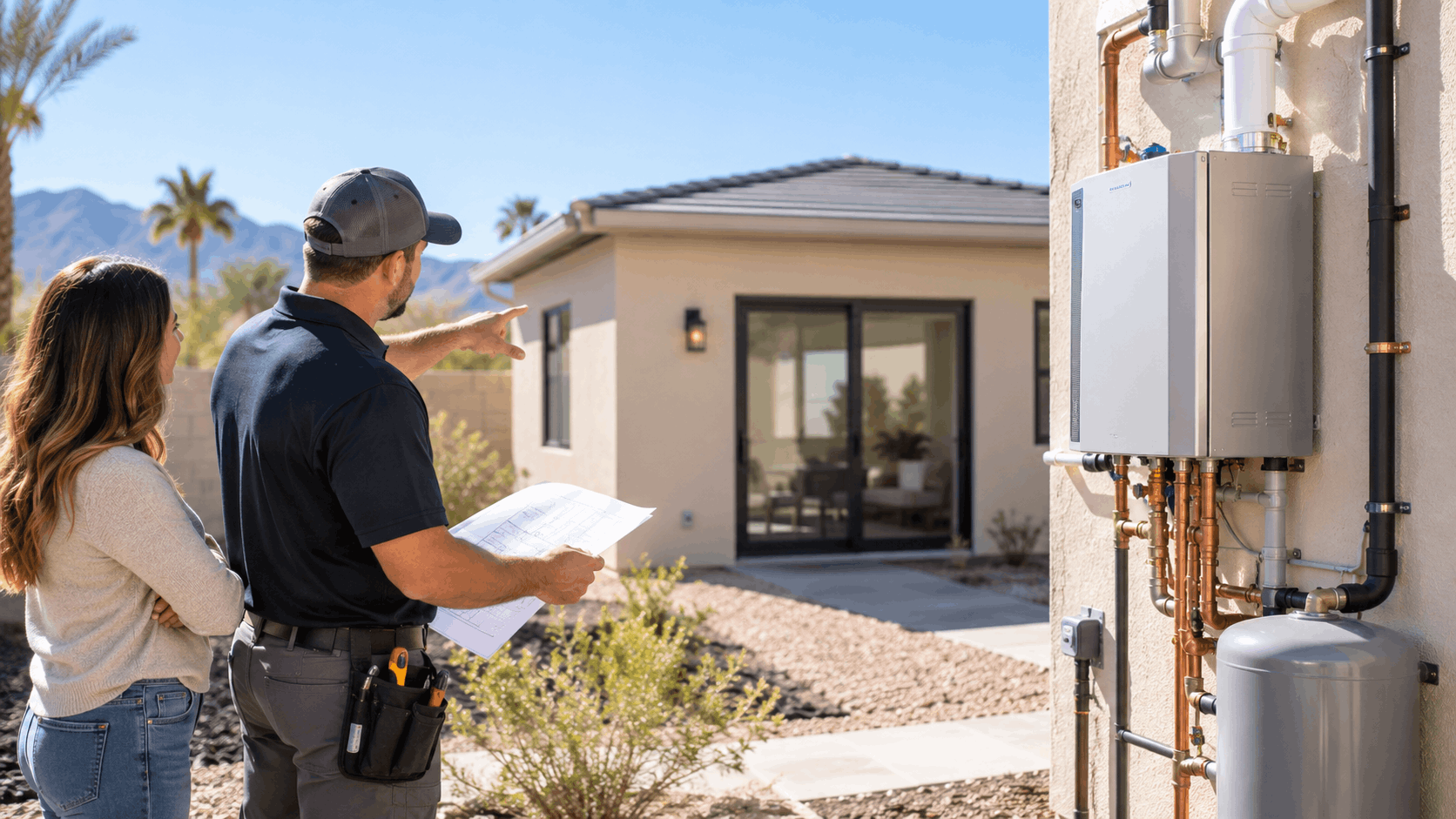
The words casita, guest house, and accessory dwelling unit get tossed around like they mean the same thing. For plumbing, they do not. The classification changes how many fixtures you can add, how big the supply line needs to be, and whether the building department treats it as a full second home.
Getting the definition right early saves money later. A permit reviewer looks at the unit type first, then decides what plumbing code applies. We always sort this out during the planning visit so nobody is surprised at submittal.
Casita vs. Full ADU vs. Guest Suite
A casita in the local sense is usually a small structure with a bedroom and a bathroom. The casita definition most owners have in mind is a guest room that happens to sit apart from the main house. Because there is no kitchen, the plumbing scope stays lighter. You are running a supply line, a drain, and a vent for a casita bathroom with a toilet, sink, and shower.
An accessory dwelling unit is a full second dwelling. It has a kitchen, which means a second kitchen sink, a dishwasher line, and sometimes a gas or electric range hookup. That extra fixture load changes the pipe sizing and pushes the project into a heavier permit category.
A guest house sits in the middle. Many guest houses have a wet bar or small kitchenette rather than a full kitchen. The plumbing depends on exactly what fixtures go in, so we count every drain and faucet before quoting the work. Two units that look identical from the street can have very different plumbing scopes inside.
Knowing your category also affects resale and taxes, so it pays to be clear from the start. We help homeowners match the fixture plan to how they actually want to use the space.
Attached vs. Detached Units
An attached addition shares a wall with the main house. That usually means the sewer and water tie-ins are short, since the existing lines are only a few feet away. Trenching is minimal, and the connection often happens near the home's current plumbing wall.
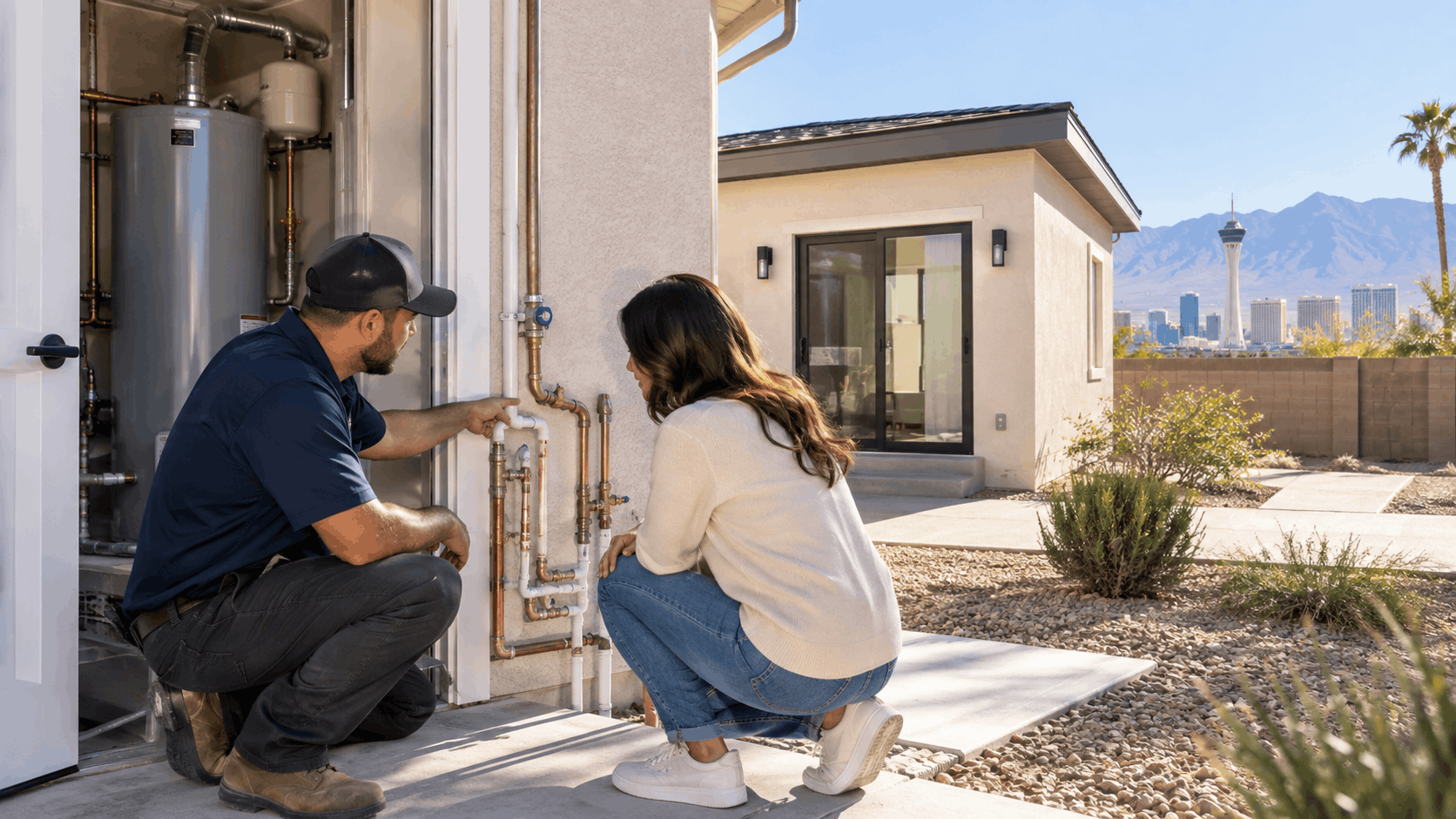
A detached ADU is a different animal. When the unit sits near the back property line, the drain and supply lines might run 40, 60, or even 100 feet across the yard. Every one of those feet is a trench that has to be dug, sloped, and backfilled correctly.
That distance drives both cost and design. A long gravity drain run needs careful slope planning, and a long supply line may need larger pipe to hold pressure. We measure the exact route on site because the map view never tells the full story with sheds, mature trees, and irrigation in the way.
Detached units also raise questions about future access. We place cleanouts along the run so a clog 70 feet out does not turn into a full-yard excavation later.
Local Rules in Clark County and City of Las Vegas
Where your address sits decides which rulebook applies. Unincorporated Clark County zoning is not the same as the City of Las Vegas, and Henderson and North Las Vegas each have their own ADU regulations. A lot on one side of a boundary road may allow a detached unit while the other side does not.
These rules change over time as the region grows. Nevada has pushed to make accessory units easier in some areas, but local setback, size, and hookup requirements still vary. You can review general building and permit information through Clark County before you design anything.
We work across all these jurisdictions regularly, so we know how each one handles second-unit plumbing. That local familiarity keeps a submittal from bouncing back over a formatting or code detail.
Checking zoning first also protects your investment. There is no point designing a full ADU if your parcel only allows a casita without a kitchen.
Why the Unit Type Sets the Plumbing Scope
Plumbers size pipes using fixture units. Every toilet, sink, shower, and appliance carries a value, and the total decides how big the drain and supply lines must be. A casita bathroom might total a handful of fixture units, while a full ADU with a kitchen runs much higher.
That number ripples through the whole plumbing scope. More fixture units can mean a larger sewer lateral, a bigger water line, and a different venting plan. It also affects whether your existing water meter can handle the added demand.
The unit classification and fixture count together drive the permit requirements. A simple bathroom add is a lighter permit than a full second dwelling. We calculate fixture units up front so the design matches the code the first time.
Getting this right avoids the worst outcome, which is tearing open finished work because a line was undersized. Planning the scope around the real fixture load keeps everything above board and inspection-ready.
Get Your Quote
Tell us what's going on and we'll get back to you fast.
Sewer and Water Tie-Ins for a New Unit
The tie-in is where a new casita joins the rest of the world. Fresh water comes in, and waste goes out. How you connect those two things depends on your lot, your existing lines, and the hard ground under your yard.
This is the part homeowners underestimate most. The fixtures inside are the easy part. The sewer tie-in and water line connection across the yard are where the real labor and cost live.
Tapping Into the Existing House Line vs. a New Lateral
Most casitas tie into the home's existing sewer lateral. We locate the main line, cut in a fitting, and route the new drain to meet it. This works well when the existing lateral has enough capacity and sits at a workable depth for gravity flow.
Sometimes a separate line to the main sewer makes more sense. If the existing lateral is old, undersized, or already handling a heavy fixture load, adding more can overwhelm it. In those cases we run a new lateral, which costs more but avoids future backups. Our sewer line repair and replacement crews handle both approaches.
Either way, a cleanout is required at the tie-in point. That access port lets us clear a clog without digging up the yard. We place cleanouts at code-required intervals so the line stays serviceable for decades.
We use a sewer camera inspection to check the existing lateral before we commit to tapping into it. A quick look inside tells us if the old pipe can take the added load or needs replacing first.
Digging Through Caliche and Rocky Valley Soil
Anyone who has tried to plant a tree in the valley knows about caliche. This hard, cement-like soil layer sits under much of the ground here, and it does not dig easily. A trench that would take an hour in soft dirt can take a full day through caliche.
Caliche soil affects both trench depth and cost. Sewer lines need enough depth to keep the right slope, and hitting a thick caliche shelf can mean bringing in heavier equipment or breaking the layer by hand. That labor shows up in the estimate.
Rocky ground also affects backfill. We bed the pipe in the right material so a sharp rock does not press against it and cause a leak years down the road. Cutting corners on bedding is a common cause of failures we get called out to fix.
Because caliche depth varies block to block, we base trench estimates on real local experience rather than guesswork. A yard in older Sunrise Manor can dig very differently from a newer lot in Elkhorn.
Water Meter Sizing and LVVWD Requirements
Adding a unit adds water demand. If your current meter and service line are already sized tight for the main house, a second kitchen and bath can push them past their limit. That shows up as weak pressure when two fixtures run at once.
The Las Vegas Valley Water District, or LVVWD, sets the rules for meters and service lines in most of the valley. Water meter sizing has to match the total fixture demand of the property. Sometimes the existing meter is fine, and sometimes an upgrade is needed before the casita gets approved.
We check the meter size and static pressure during planning. If an upgrade is required, we coordinate the request so it does not stall the rest of the build. You can learn more about local water service through the Las Vegas Valley Water District.
Catching a meter issue early is far cheaper than discovering it after the walls are closed. A five-minute pressure check saves a lot of frustration.
Protecting the Main Line During Backyard Work
Backyards are full of buried surprises. Irrigation lines, old gas stubs, electrical for a pool, and the main water line all hide underground. Digging blind is how those get cut.
We start with utility locating before any trenching. Marking the existing lines lets us route the new casita plumbing around them instead of through them. This alone prevents most of the expensive mistakes we see on DIY or budget jobs.
Backflow protection matters too. Where the new unit ties into the water supply, the connection has to prevent any chance of dirty water flowing back into the clean line. Code requires it, and inspectors check for it.
Protecting irrigation during a detached build is a practical concern owners forget. We map the sprinkler zones so the casita trench does not leave half the yard dry the following summer.
Need Help in Las Vegas?
Active Plumbing serves Las Vegas and all of Las Vegas Valley.
Drain, Waste, and Vent Planning
The DWV system is the plumbing you never see but always rely on. Drain, waste, and vent lines carry water out and let air in so everything flows smoothly. Get this wrong and the casita smells, drains slowly, or fails inspection.
Good DWV planning happens before concrete is poured. Once the slab sets, moving a drain means breaking it back open. We lay this out carefully during the rough-in stage.
Getting the Right Drain Slope
Drain pipes need to fall at the right angle to work. The standard is a quarter inch of drop per foot of pipe. Too little slope and waste sits in the line. Too much and the water races ahead of the solids, which also causes clogs.
Backyard grade makes this tricky for detached units. If the casita sits lower than the tie-in point, holding a quarter-inch-per-foot slope over a long run may not be possible with gravity alone. We shoot elevations across the whole route before finalizing the pipe grade.
The longer the run, the more the slope math matters. A 60-foot line at proper slope drops 15 inches from start to finish. That depth has to work at both ends, which is why we survey the yard rather than guess.
Correct slope is one of the first things an inspector checks. We build it right the first time so the rough inspection passes without callbacks.
Venting a Detached Structure
Drains need air to flow, and that air comes through vents. Traditional venting runs a pipe up through the roof. For a detached casita, that means adding a roof vent to the new structure so the drains breathe properly.
An air admittance valve is another option in some cases. This one-way valve lets air into the drain without a full roof penetration. Inspectors in the valley accept them in certain situations, but not everywhere, and not for every fixture.
We match the venting method to what the local jurisdiction allows and what the layout needs. Sometimes a roof vent is required, and sometimes an air admittance valve solves a tight spot where a vent stack will not fit.
Venting mistakes cause slow, gurgling drains that homeowners blame on clogs. Planning the vents correctly from the start avoids those phantom problems entirely.
When a Sewage Ejector Pump Is Needed
Gravity drainage is always the goal, but it does not always work. If the casita bathroom sits below the level of the sewer line, waste cannot flow uphill on its own. That is when a sewage ejector pump enters the picture.
The pump collects waste in a sealed basin and pushes it up to the main line. This is common for detached units on lower ground or when a long trench cannot keep enough slope. Our team installs and services these systems, including holding tank and lift station setups for tougher sites.
A pump adds cost and requires power, so we only recommend one when gravity truly will not do the job. When it is needed, though, it is the difference between a working casita and one that will not drain.
Pumps also need maintenance access and an alarm so a failure gets caught early. We size and place them for reliability, not just to pass the inspection.
Rough-In Layout for Kitchens and Baths
The plumbing rough-in sets every fixture location. Toilets, sinks, showers, and appliance lines all get their spots before the slab pours. Move a drain after concrete cures and you are cutting and patching the floor.
Slab layout planning is where measurements matter most. We work from the framing and fixture plan to place each stub in the exact right position. A toilet flange off by a couple inches can mean the whole bathroom layout shifts.
For an ADU with a kitchen, we coordinate the sink drain, dishwasher line, and any gas or water for the range in one pass. Getting all of it stubbed correctly before the pour keeps the project moving.
This is the stage where careful planning pays off most. A clean rough-in means the finish plumbing goes fast and the final inspection is smooth.
Choosing a Water Heater for the Casita
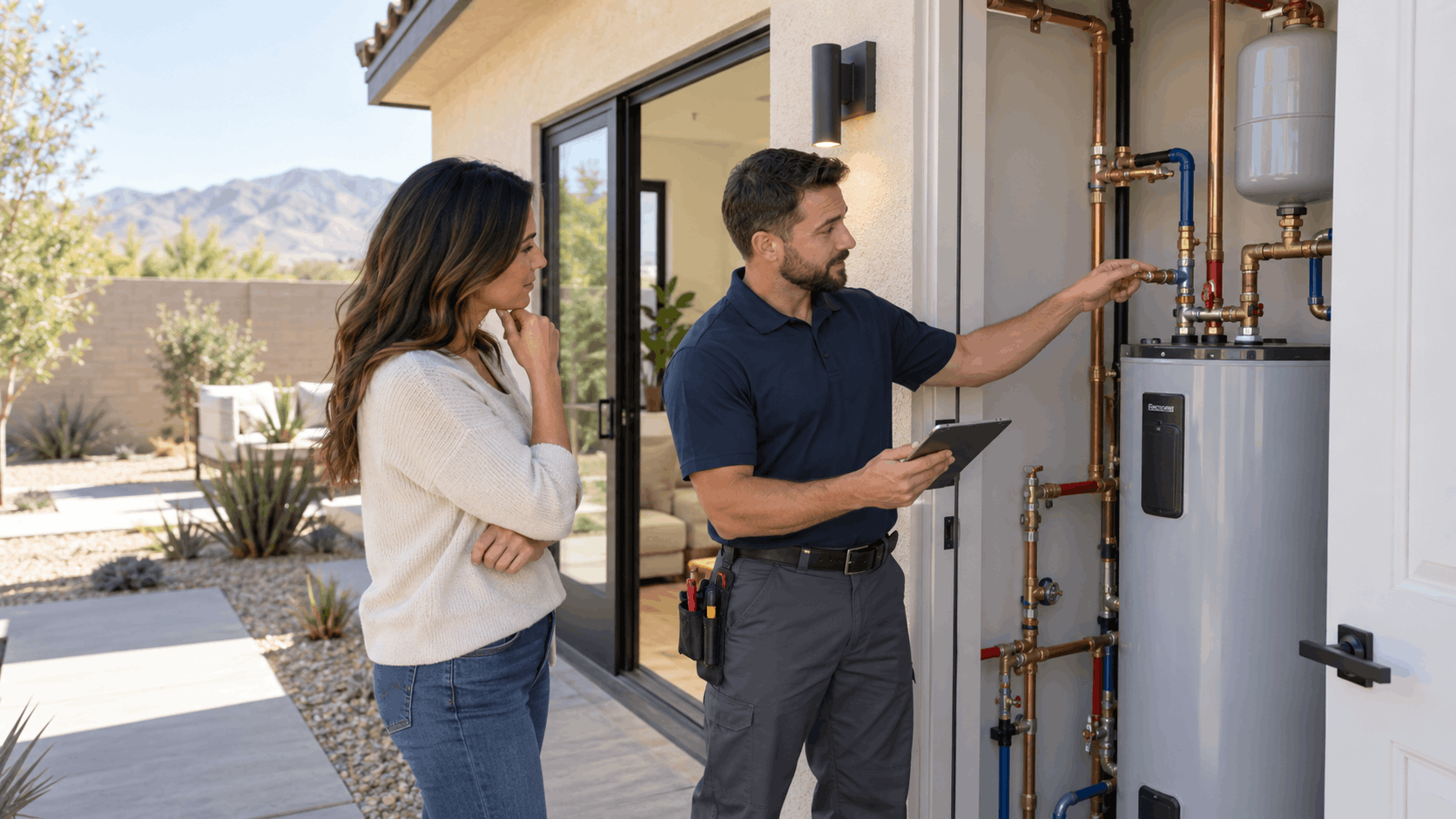
Hot water is one of the biggest decisions for a small unit. The right water heater depends on how many people use the casita, what fuel is available, and how the valley's hard water treats the equipment.
We size heaters for real use, not the biggest tank on the shelf. A one-person casita has very different needs than a full ADU with a family living in it.
Tankless vs. Small Tank Units
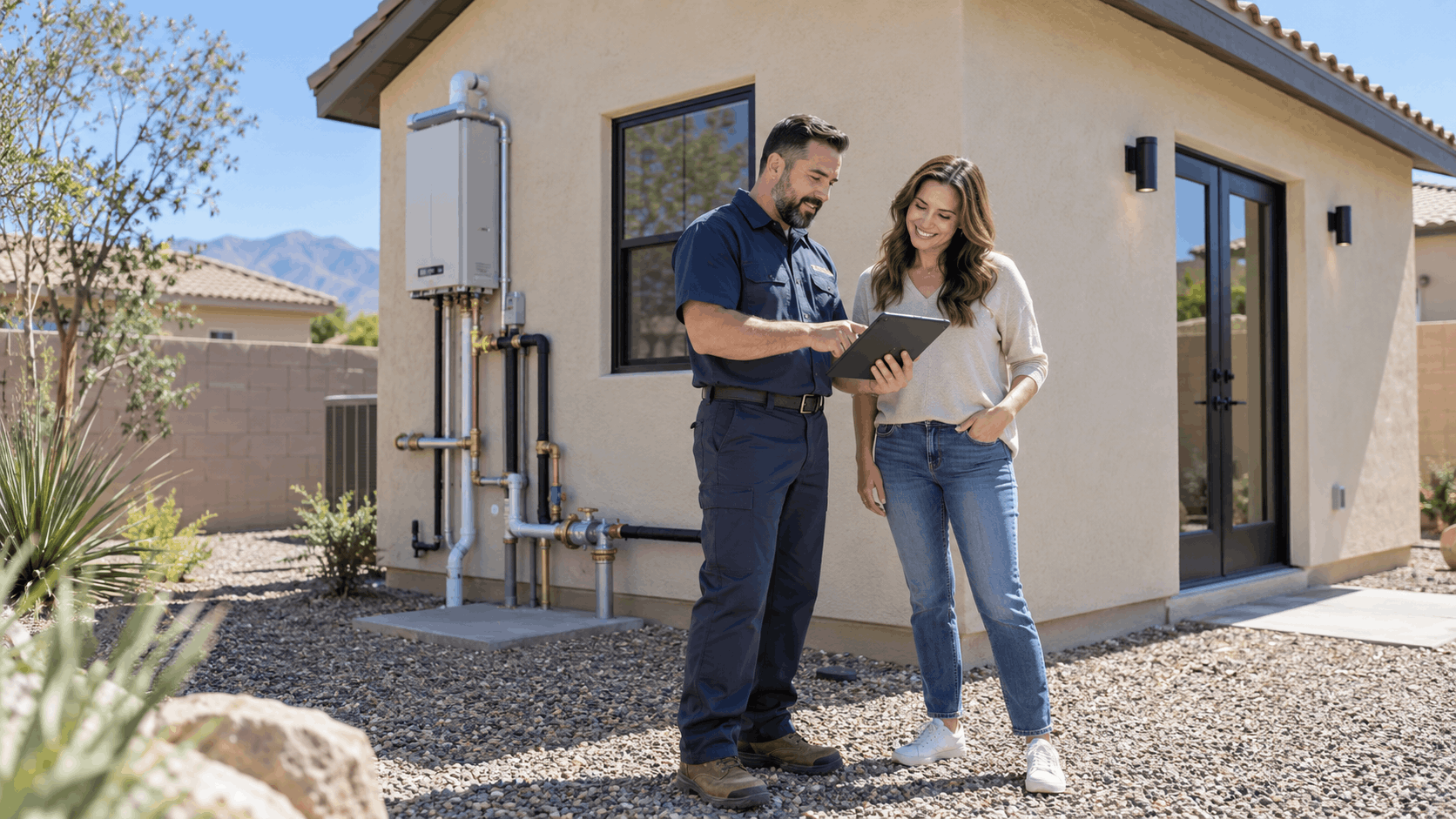
A tankless water heater heats on demand and never runs out. For a one- or two-person casita, that endless hot water and small footprint are appealing. Tankless units mount on a wall and free up floor space in a tight unit. Our tankless water heater installation team handles these regularly.
A compact tank is the simpler, lower-cost option up front. A small 20 to 40 gallon tank holds enough for one or two people and costs less to install. The tradeoff is that it takes up space and eventually runs out during heavy use.
For most casitas we lean tankless when gas is available, since it saves space and lasts longer with proper care. For a bare-bones guest suite, a small tank often makes more budget sense.
We walk through the daily habits of whoever will live there before recommending one. The best choice depends on showers per day, laundry, and whether a dishwasher is in the plan.
Gas vs. Electric Heating
Fuel choice shapes the whole install. A gas water heater heats fast and runs cheaper on energy, but a detached unit may need a new gas line run from the main house. That trench and pipe add cost, which our gas line installation crew factors into the plan.
An electric water heater skips the gas line entirely. The catch is electrical panel capacity. A detached casita often needs its own sub-panel, and a tankless electric unit in particular draws a lot of power that the panel has to support.
We coordinate with the electrician to confirm the panel can handle the load before choosing electric. Sometimes gas is cheaper overall once you weigh the panel upgrade against the gas line run.
Both paths work well when planned correctly. The right answer comes down to what utilities are already at the property and how far they have to travel.
Hard Water and Scale in the Valley
Valley water is hard, full stop. The mineral content leaves scale inside pipes and heaters, and that hard water scale shortens the life of any water heater. Tankless units are especially sensitive since scale builds on the heat exchanger.
A water softener or conditioner protects the investment. Treated water keeps scale from clogging fixtures and lets the heater run efficiently for years. We install water softeners and salt-free conditioners for exactly this reason.
For tankless heaters, regular descaling is a must in this water. Our tankless maintenance and descaling service keeps the unit running at full output and extends its life well past what neglected units reach.
Skipping water treatment in the valley is a false savings. The scale damage shows up as reduced flow, higher energy bills, and early heater failure.
Sharing the Main Home's Water Heater
Sometimes a separate heater is overkill. If the casita sits close to the main house and hot water demand is low, running hot water from the existing heater can work. This is a shared water heater setup.
The challenge is distance. Hot water sitting in a long pipe goes cold, so the casita gets a slow warm-up and wasted water. A recirculation pump solves this by keeping hot water moving to the far fixture. We install recirculation pumps for exactly these layouts.
Sharing only makes sense when the main heater has spare capacity. Adding a full ADU to an already-busy heater leaves everyone short on hot water.
We run the numbers on capacity and distance before recommending a shared setup. For close casitas with light use, it can save the cost of a second heater entirely.
Permit Paths and Inspections
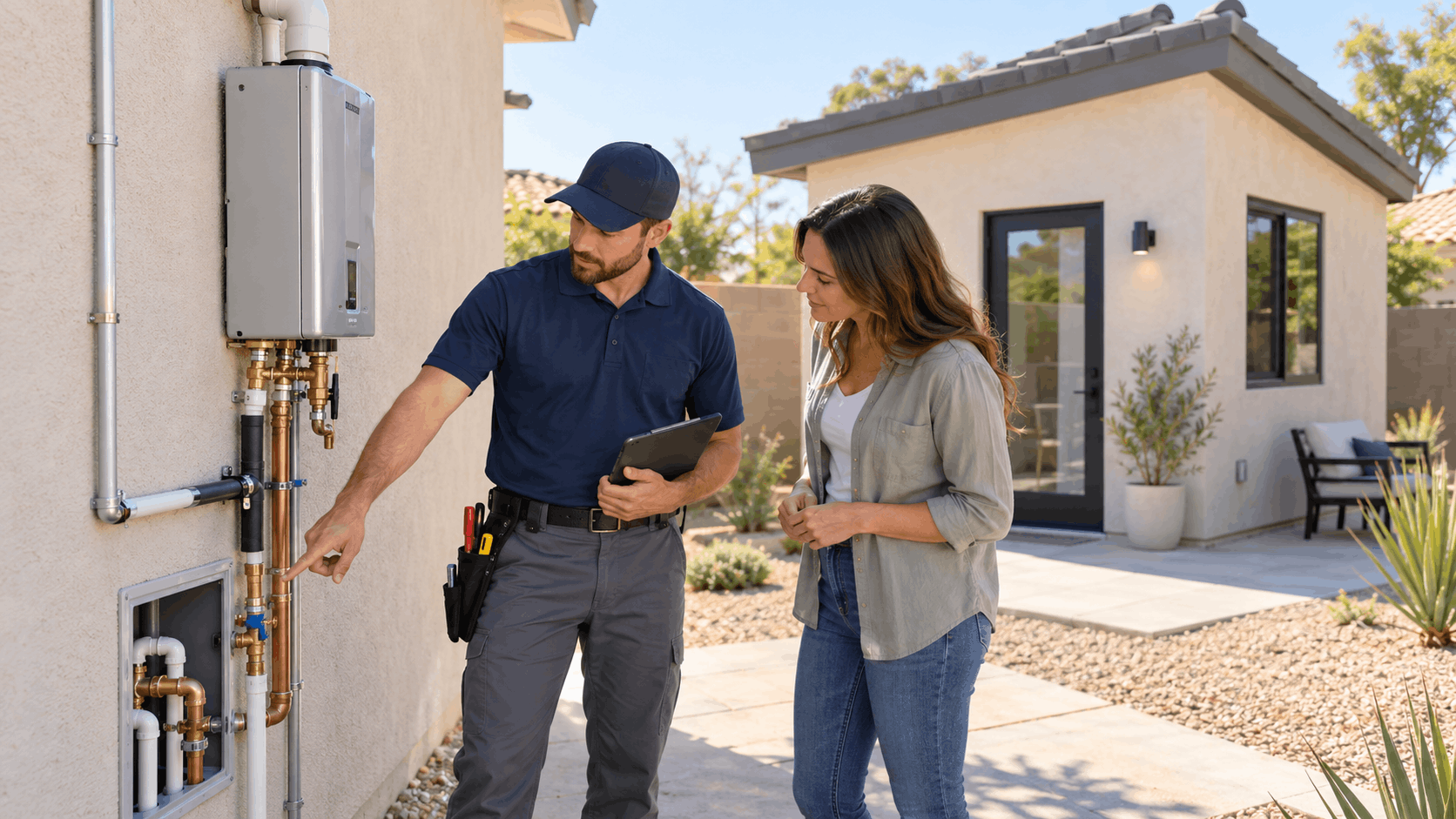
Every casita with new plumbing needs a permit. The process feels intimidating, but it follows a predictable path once you know which department handles your address. Skipping the permit risks fines and problems at resale.
We handle permit coordination for these builds all the time. Knowing what each jurisdiction wants keeps the plumbing permit moving instead of stalling at review.
Which Department Handles Your Address
Your address decides the reviewer. A City of Las Vegas permit covers homes inside city limits, while unincorporated areas go through the Clark County building department. Henderson and North Las Vegas each run their own review too.
The boundaries are not always obvious. A neighborhood that feels like Las Vegas might technically sit in unincorporated Clark County, which changes the permit office and the rules. We confirm jurisdiction by parcel before anything gets submitted.
Each department has its own forms, fees, and turnaround times. We know the quirks of each one from years of filing across the valley, which keeps the process smooth.
Getting the right department the first time avoids weeks of delay. A permit filed in the wrong office just comes back and starts the clock over.
Plans, Fixture Counts, and Submittals
The permit submittal includes plumbing plans and fixture-unit calculations. The reviewer wants to see every fixture, the pipe sizes, the slope, and the venting. A clear fixture count proves the lines are sized for the load.
Incomplete plans are the top reason a submittal bounces. Missing a cleanout location or a vent detail sends the whole package back for revision. We prepare complete drawings so the review moves in one pass when possible.
For a full ADU, the plumbing plan ties into the overall building submittal. We coordinate our part with the general contractor's package so nothing conflicts at review.
A thorough submittal up front is the fastest path to approval. The time spent getting plans right saves far more time waiting on corrections.
Rough and Final Inspection Stages
Plumbing gets inspected twice. The rough inspection happens after the pipes are in but before walls close. This is when the inspector checks slope, sizing, venting, and runs a pressure test to confirm no leaks.
The pressure test is a big moment. We fill the DWV system and hold it under pressure to prove every joint is tight. If it holds, the rough passes and the walls can close.
The final inspection comes after fixtures are set and everything is connected. The inspector confirms the whole system works, drains flow, and there are no leaks at the fixtures. Once it passes, the casita is cleared for use.
We schedule and attend both inspections so any question gets answered on the spot. Being present keeps small issues from becoming return visits.
HOA Approvals in Communities Like Summerlin and Aliante
City and county permits are not the only approval in many neighborhoods. HOA approval is a separate hurdle in master-planned communities. Areas like Summerlin and Aliante have design review boards that weigh in on additions.
The HOA usually cares about the exterior, but a detached casita and its utility routing can fall under their rules. Roof vents, exterior heater vents, and where equipment mounts may all need sign-off. Getting HOA approval before the city permit avoids doing work twice.
Timelines vary between associations. Some review monthly, so submitting early keeps the project on schedule. We factor HOA review into the plan for homeowners in these communities.
Skipping HOA approval can mean fines or an order to undo finished work. It is always worth the extra step in these neighborhoods.
Need Help in Las Vegas?
Active Plumbing serves Las Vegas and all of Las Vegas Valley.
Costs, Timelines, and Common Surprises
Casita plumbing cost swings widely based on scope, distance, and what the ground hides. A simple bathroom add is a different budget than a full ADU kitchen and bath. Knowing the ranges helps you plan the whole project.
We give honest estimates based on real valley conditions. The surprises usually come from things buried underground, which is why we inspect before quoting.
Typical Price Ranges by Scope
The plumbing cost range depends first on fixture count. A casita with one bathroom sits at the lower end. A full ADU with a kitchen and bath, second water heater, and longer runs sits much higher.
| Scope | Typical Plumbing Range | Main Cost Drivers |
|---|---|---|
| Casita bathroom only | $6,000 - $14,000 | Tie-in distance, fixtures |
| Guest house with kitchenette | $10,000 - $20,000 | Extra fixtures, water heater |
| Full detached ADU | $18,000 - $40,000+ | Long trench, second heater, meter upgrade |
These ranges cover plumbing only, not the full build. Your ADU budget should treat plumbing as one line item among framing, electrical, and finishes.
Every lot is different, so we quote after seeing the site. The numbers above give a starting point for planning.
How Long the Plumbing Phase Takes
The plumbing phases spread across the project timeline. The tie-in and trenching usually take a few days, depending on distance and soil. Caliche can stretch this stage.
Rough-in happens next, once framing is up. This takes several days to set all the drain, vent, and supply lines and pass the rough inspection. Then work pauses while other trades finish and walls close.
The final connection happens near the end, when fixtures and the water heater get set and tested. That stage is quicker, often a couple of days plus the final inspection. Across the whole build, plumbing touches the project at three separate points.
Coordination keeps these phases tight. We time our crews with the general contractor so plumbing never becomes the bottleneck.
Hidden Costs From Old Pipes and Distance
The biggest surprises come from what is already in the ground. Older homes near downtown and the historic Westside often have cast iron pipe that is corroded and undersized. Tying a new casita into failing cast iron just moves the problem forward.
When we camera an old lateral and find it is shot, replacing it becomes part of the job. That adds cost, but skipping it guarantees backups later. It is better to know before the walls close.
Distance is the other budget driver. A long trench cost adds up fast, especially through caliche. A casita at the back of a deep lot can double the trenching compared to one near the house.
We flag these risks during the site walk so nobody gets blindsided. An honest look up front beats a change order halfway through.
Where Homeowners Can Save
Smart planning is where real cost savings live. Placing the casita closer to existing sewer and water lines shortens the trench and cuts the biggest variable cost. Even shifting the unit 15 feet can matter.
Grouping fixtures near a shared wall keeps the plumbing compact. A bathroom and kitchenette that back up to the same wet wall need less pipe than fixtures spread across the unit.
Timing the plumbing with other trades avoids repeat trips and mobilization fees. Good coordination during planning keeps the whole job efficient without cutting any corners on quality.
We help homeowners find these savings during design. The goal is a casita that works for decades, built at a fair price.
Neighborhood Considerations Across the Valley
Casita plumbing is not the same everywhere in the valley. Local conditions shift from older central neighborhoods to newer master-planned developments. What works in one area may not fit another.
We work every corner of the valley, so we know the quirks by neighborhood. Here is how the challenges break down across Las Vegas neighborhoods.
Older Homes Near Downtown and the Historic Westside
Homes near downtown Las Vegas and the Arts District were built decades ago. Many still have an old sewer lateral made of cast iron or clay. These lines are often undersized and corroded after years of hard water and settling.
Adding a casita means testing that old line before tying in. We camera the lateral to see its real condition. If it is failing, replacement comes first, or the new unit inherits the same backup problems.
Undersized supply lines are common too in these older properties. A second bathroom can drop the pressure across the whole house if the main line is small. We check both drain and supply before designing the tie-in.
These builds take extra planning, but the older lots often have room for a nice casita. Getting the buried infrastructure right is the difference-maker.
Master-Planned Areas Like Summerlin and Southern Highlands
Newer communities like Summerlin West and Southern Highlands have modern plumbing infrastructure. The lines are newer and properly sized, which simplifies tie-ins. The challenge here is space and rules.
Lot setbacks are tighter in these developments. A detached casita has to fit within the allowed building envelope, which can limit where the plumbing routes. We plan the trench path around those constraints.
HOA design rules add another layer. Where vents and equipment mount matters to the review board. We coordinate the plumbing visibility with what the community allows.
The upside is that the underground work is usually cleaner in these areas. Fewer surprises in the ground offsets the tighter design rules.
North Las Vegas and Aliante Growth
North Las Vegas has grown fast, with newer construction in areas like Aliante and Elkhorn. The homes are recent enough that infrastructure is in good shape, which helps casita projects go smoothly.
Permit review in North Las Vegas runs through its own building department. The process is straightforward once you know their forms and requirements. We file there regularly and know the turnaround.
Newer lots often have known utility layouts, which makes locating easier. That said, we still mark everything before trenching to protect irrigation and gas stubs.
For growing families in these neighborhoods, a casita adds real space. The modern infrastructure makes the plumbing side more predictable than older parts of town.
Henderson and Green Valley Lot Conditions
Henderson and Green Valley sit on varied terrain. Many lots have grading and elevation changes that affect how a casita drains. A unit built on a lower part of the lot may not gravity-drain to the main line.
That is where slope planning and sometimes a sewage ejector pump come into play. We shoot elevations across the lot to see whether gravity works or a pump is needed. Getting this wrong means a casita that will not drain.
Areas like Henderson and Whitney Ranch also have HOA and city review to coordinate. The building department there has its own process we file through routinely.
The elevation changes make site evaluation extra important in these areas. We never assume gravity drainage until we measure the real grade.
Working With Active Plumbing on Your Project
A casita or ADU touches plumbing at every stage, from the first trench to the final inspection. Active Plumbing supports the whole path so homeowners are not juggling the details alone. We treat these builds as long-term investments in your property.
Our casita plumbing service covers planning, tie-ins, rough-in, water heaters, and inspections. Here is how we work with you and your builder.
Site Walk and Planning Visit
Every project starts with a site walk. We come out, look at the yard, and map the tie-in points for sewer and water. This visit tells us the real distances, the grade, and where the existing lines run.
During the planning visit we check the existing sewer lateral and water meter. A camera on the old line and a pressure reading at the meter reveal what the property can handle. Those two checks shape the whole design.
We also flag anything that could add cost, like caliche depth or an aging cast iron line. Knowing this up front means the estimate reflects reality, not a guess.
The site walk is where the project gets its foundation. Good planning here prevents most of the surprises that derail backyard builds.
Coordinating With Your Builder and Inspector
Plumbing does not happen in a vacuum. We coordinate with your general contractor so our crews arrive at the right stage. The rough-in has to happen before walls close, and timing it with framing keeps everyone moving.
Inspection scheduling is part of our job too. We line up the rough and final inspections and attend them to answer any questions on the spot. That keeps the review from adding delays.
Contractor coordination also means avoiding conflicts with electrical and HVAC in the walls. We plan our routes so trades do not fight over the same space.
This teamwork keeps the project on schedule. Plumbing stays on track instead of becoming the reason the build slips.
Service Across the Las Vegas Valley
As a local plumber, we cover the whole valley service area. From North Las Vegas to Enterprise, and from Summerlin to Green Valley, we work these neighborhoods every week.
That range means we know the local soil, the water district rules, and the permit offices in each jurisdiction. A casita in Centennial Hills gets the same care as one in Whitney Ranch.
Being local also means we respond fast if something comes up mid-project. We are already driving these streets, so a site visit is never far off.
Wherever your property sits in the valley, we can support the build. Our team has worked hundreds of homes across these areas.
What to Have Ready Before Calling
A little prep speeds up the quote. Before calling, gather your unit plans or a rough sketch of the casita layout. Knowing the fixtures you want helps us count the load.
Property line information helps too. Where the unit sits relative to the lines and the setback affects the trench and the design. A plot plan or survey is ideal if you have one.
Note whether you have gas at the property and where the panel sits. Those details shape the water heater and utility decisions. The more project details you bring, the faster we can give a real plumbing quote.
When you are ready, reach out to our team and we will set up the site walk. That first visit gets your casita project moving.
Need Help in Las Vegas?
Active Plumbing serves Las Vegas and all of Las Vegas Valley.
Final Thoughts
A casita or ADU can add real space and value to a home, but the plumbing decisions drive the outcome. The tie-ins, the drain and vent layout, the water heater, and the permits all have to line up. Planning them together, before the first trench, keeps the project on budget and on schedule.
Local conditions matter here more than most places. Caliche soil, hard water, and four different permit jurisdictions mean a casita in the valley needs someone who works these streets daily. That is exactly what our team brings to every build.
If you are thinking about adding a casita anywhere from Summerlin to Henderson, we are ready to help. Call Active Plumbing to schedule a site walk, and we will map your tie-ins, check your existing lines, and give you an honest plan for the plumbing. Let us help you build a casita that works for decades.
Frequently Asked Questions
Do I need a permit to add plumbing to a casita in Las Vegas?
Yes. Adding new plumbing fixtures to a casita nearly always requires a permit and inspection, no matter the jurisdiction. The building department reviews your plans, checks fixture counts, and inspects the work at rough-in and final stages. Skipping the permit risks fines and creates problems at resale. We handle the permit coordination across City of Las Vegas, Clark County, Henderson, and North Las Vegas so the process stays on track.
Can a casita share the main house's sewer line?
Often yes. Most casitas tie into the home's existing sewer lateral when that line has enough capacity and sits at a workable depth. We camera the existing lateral first to confirm it can handle the added load. If the line is old, undersized, or corroded, a separate new lateral to the main sewer is the better choice. That call depends on the condition and size of what is already in the ground.
What water heater is best for a small ADU?
For a one- or two-person unit, a tankless water heater is a strong pick when gas is available, since it saves space and lasts longer with proper descaling. A compact 20 to 40 gallon tank costs less up front and works fine for light use. The right choice depends on daily hot water demand, available fuel, and whether the panel can support electric. We size the heater around real usage during the planning visit.
How much does casita plumbing cost in the valley?
Plumbing for a casita bathroom typically runs $6,000 to $14,000, while a full detached ADU with a kitchen can reach $18,000 to $40,000 or more. The biggest drivers are tie-in distance, trenching through caliche, fixture count, and whether a meter or line upgrade is needed. Old cast iron pipe that needs replacing adds cost too. We quote after a site walk so the number reflects your actual lot conditions.
Why is trenching so hard in Las Vegas?
The valley sits on caliche, a hard cement-like soil layer that resists digging. A trench that takes an hour in soft ground can take a full day through thick caliche, and sometimes it needs heavier equipment to break. This shows up in both time and cost, especially for a long run to a detached casita. Caliche depth varies block to block, so we base estimates on real local experience.
Do I need a bigger water meter for a second unit?
Sometimes. Adding a second kitchen and bath raises the total water demand on the property. If your existing meter and service line are already sized tight for the main house, an upgrade may be required before the casita gets approved. The Las Vegas Valley Water District sets these rules. We check the meter size and static pressure during planning so any upgrade is handled before it stalls the build.
How long does the plumbing phase take?
Plumbing touches the project at three points. The tie-in and trenching usually take a few days, longer if caliche is thick. The rough-in takes several days once framing is up, followed by the rough inspection. The final connection of fixtures and the water heater happens near the end, often a couple of days plus the final inspection. We coordinate with your builder so plumbing never becomes the bottleneck.
Does my HOA need to approve the plumbing work?
In master-planned communities like Summerlin, Aliante, and Southern Highlands, yes. HOA design review boards weigh in on additions, including where roof vents, exterior heater vents, and equipment mount. This approval is separate from the city or county permit and should come first to avoid doing work twice. Review timelines vary by association, so we factor HOA approval into the schedule for homeowners in these neighborhoods.
Can a detached casita drain by gravity or does it need a pump?
It depends on elevation. If the casita sits above or level with the sewer tie-in and the run can hold a quarter-inch-per-foot slope, gravity drainage works. If the unit sits lower than the main line, a sewage ejector pump is required to push waste up to the sewer. We shoot elevations across the lot before designing so we know whether gravity works or a pump is needed for your site.
Should I add a water softener for the casita?
In the valley, it is worth considering. Hard water leaves scale that clogs fixtures and shortens the life of any water heater, especially tankless units. A water softener or salt-free conditioner protects the plumbing and keeps the heater running efficiently for years. Skipping treatment usually shows up as reduced flow, higher energy bills, and early heater failure. We can install a softener sized for the casita during the same build.
Frequently Asked Questions
- Do I need a permit to add plumbing to a casita in Las Vegas?
- Yes. Adding new plumbing fixtures to a casita nearly always requires a permit and inspection, no matter the jurisdiction. The building department reviews your plans, checks fixture counts, and inspects the work at rough-in and final stages. Skipping the permit risks fines and creates problems at resale. We handle the permit coordination across City of Las Vegas, Clark County, Henderson, and North Las Vegas so the process stays on track.
- Can a casita share the main house's sewer line?
- Often yes. Most casitas tie into the home's existing sewer lateral when that line has enough capacity and sits at a workable depth. We camera the existing lateral first to confirm it can handle the added load. If the line is old, undersized, or corroded, a separate new lateral to the main sewer is the better choice. That call depends on the condition and size of what is already in the ground.
- What water heater is best for a small ADU?
- For a one- or two-person unit, a tankless water heater is a strong pick when gas is available, since it saves space and lasts longer with proper descaling. A compact 20 to 40 gallon tank costs less up front and works fine for light use. The right choice depends on daily hot water demand, available fuel, and whether the panel can support electric. We size the heater around real usage during the planning visit.
- How much does casita plumbing cost in the valley?
- Plumbing for a casita bathroom typically runs $6,000 to $14,000, while a full detached ADU with a kitchen can reach $18,000 to $40,000 or more. The biggest drivers are tie-in distance, trenching through caliche, fixture count, and whether a meter or line upgrade is needed. Old cast iron pipe that needs replacing adds cost too. We quote after a site walk so the number reflects your actual lot conditions.
- Why is trenching so hard in Las Vegas?
- The valley sits on caliche, a hard cement-like soil layer that resists digging. A trench that takes an hour in soft ground can take a full day through thick caliche, and sometimes it needs heavier equipment to break. This shows up in both time and cost, especially for a long run to a detached casita. Caliche depth varies block to block, so we base estimates on real local experience.
- Do I need a bigger water meter for a second unit?
- Sometimes. Adding a second kitchen and bath raises the total water demand on the property. If your existing meter and service line are already sized tight for the main house, an upgrade may be required before the casita gets approved. The Las Vegas Valley Water District sets these rules. We check the meter size and static pressure during planning so any upgrade is handled before it stalls the build.
- How long does the plumbing phase take?
- Plumbing touches the project at three points. The tie-in and trenching usually take a few days, longer if caliche is thick. The rough-in takes several days once framing is up, followed by the rough inspection. The final connection of fixtures and the water heater happens near the end, often a couple of days plus the final inspection. We coordinate with your builder so plumbing never becomes the bottleneck.
- Does my HOA need to approve the plumbing work?
- In master-planned communities like Summerlin, Aliante, and Southern Highlands, yes. HOA design review boards weigh in on additions, including where roof vents, exterior heater vents, and equipment mount. This approval is separate from the city or county permit and should come first to avoid doing work twice. Review timelines vary by association, so we factor HOA approval into the schedule for homeowners in these neighborhoods.
- Can a detached casita drain by gravity or does it need a pump?
- It depends on elevation. If the casita sits above or level with the sewer tie-in and the run can hold a quarter-inch-per-foot slope, gravity drainage works. If the unit sits lower than the main line, a sewage ejector pump is required to push waste up to the sewer. We shoot elevations across the lot before designing so we know whether gravity works or a pump is needed for your site.
- Should I add a water softener for the casita?
- In the valley, it is worth considering. Hard water leaves scale that clogs fixtures and shortens the life of any water heater, especially tankless units. A water softener or salt-free conditioner protects the plumbing and keeps the heater running efficiently for years. Skipping treatment usually shows up as reduced flow, higher energy bills, and early heater failure. We can install a softener sized for the casita during the same build.
A
Licensed plumbing professionals serving Las Vegas and Las Vegas Valley.
Licensed in Nevada · License #0047021
Last updated on
Why trust Active Plumbing?
Founded in 1991, Active Plumbing is a licensed and insured plumber serving Las Vegas and Las Vegas Valley. All content is reviewed by our licensed technicians.

Need Help in Las Vegas?
Active Plumbing serves Las Vegas and all of Las Vegas Valley.
Related Articles
How-To Guides
Clark County Water Heater Permit Requirements: What Inspectors Flag in Garage Installs
Clark County requires a permit for garage water heater installs. Learn the rules, the top inspector flags, and how to pass the first time in Las Vegas.
Cost Guides
Tankless Water Heater Installation Cost in Las Vegas: Gas Line Upsizing, Venting, and Permit Line Items
A clear breakdown of tankless water heater installation cost in Las Vegas, including gas line upsizing, venting, permits, and hard water factors for valley homes.
How-To Guides
Water Heater Replacement Same Day Las Vegas: Stock and Install Timelines
Learn how same-day water heater replacement works in Las Vegas, from local stock and realistic install timelines to permits, neighborhood factors, and prep tips.