Tips & Advice
What Lake Mead Water Actually Contains By The Time It Reaches Your Las Vegas Tap: Hardness, Chlorine, TDS
Key Takeaways
- About 90 percent of the valley's water comes from Lake Mead, fed by the Colorado River and Rocky Mountain snowmelt, and it picks up heavy minerals along the way.
- Las Vegas water is very hard, typically 16 to 20 grains per gallon, which is more than double the threshold for hard water.
- Chlorine and chloramine keep the water safe across miles of desert pipe, with levels staying under 4 parts per million but causing a pool-like taste and smell.
- Total dissolved solids often run 600 to 700 parts per million, above the EPA's 500 ppm taste guideline, affecting flavor and appliance life.
- The water meets all EPA and Nevada safety standards for drinking, but it is still hard on pipes, fixtures, and appliances.
- Water softeners handle hardness, whole-house carbon filters cut chlorine, and reverse osmosis lowers TDS for clean drinking water.
- Yearly water heater flushes and regular aerator cleaning are key maintenance steps in this hard-water valley.
- Active Plumbing tests water and installs the right treatment systems for homes across Summerlin, Henderson, North Las Vegas, and beyond.
In This Article
Anyone who has lived in the valley for a while knows the drill. That chalky white crust builds up around the base of the faucet in the master bath. Glasses come out of the dishwasher covered in spots, no matter how much rinse aid gets poured in. The shower head starts spraying sideways because the little holes are crusted over. These are not signs of a dirty home. They are signs of what the water carries by the time it reaches the tap.
Most of the water in the Las Vegas Valley starts hundreds of miles away as snow in the Rocky Mountains. It flows down the Colorado River, settles into Lake Mead, and then travels a long path through treatment plants and buried pipe before it ever reaches a kitchen sink in Summerlin or Henderson. Along that journey, it picks up minerals, salts, and disinfectants that change how it tastes and how it treats a home.
Our team at Active Plumbing has worked on thousands of homes across the valley, from older properties near Charleston to newer builds in Centennial Hills. This guide breaks down exactly what Lake Mead water actually contains by the time it reaches a Las Vegas tap, covering hardness, chlorine, and total dissolved solids in plain terms, plus what homeowners can do about each one.
Where Las Vegas Tap Water Comes From?
Before getting into the chemistry, it helps to see where the water starts and how it arrives. The Las Vegas water source is not a local well field or a hidden desert spring. It is a shared river system that supports millions of people across several states.
That long trip matters. Water that travels this far and sits in a large reservoir has plenty of time to collect minerals from the rock and soil it passes through. By the time it reaches a home, it carries a mineral load that shapes nearly every plumbing issue we see across the valley.
The Colorado River And Lake Mead Supply
Roughly 90 percent of the valley's water comes from Lake Mead. That giant reservoir sits behind Hoover Dam, just a short drive southeast of Henderson, and it holds the water that keeps the entire region running. Most residents have seen it from Lakeshore Road or on the way to Boulder City.
Lake Mead is fed by the Colorado River, which begins high in the Rocky Mountains. Snowmelt from those peaks flows down through several states before reaching the reservoir. That means the water in a Summerlin kitchen started as snow far from the desert.
As that snowmelt travels, it flows over rock, soil, and mineral deposits for hundreds of miles. It dissolves calcium, magnesium, and various salts along the way. By the time the river fills the reservoir, the water already carries a heavy mineral content that no amount of local treatment fully removes.
This natural mineral pickup is the root cause of the hard water the valley is known for. It is not a treatment failure. It is simply what happens when a river drains a huge stretch of mineral-rich land in the arid West.
How SNWA And LVVWD Treat And Deliver It
Two agencies handle the bulk of the work getting that water ready and moving it to homes. The Southern Nevada Water Authority, known as SNWA, manages the regional supply and runs the large water treatment plants near the lake. They pull raw water from Lake Mead and clean it up before it heads out.
At those treatment plants, the raw lake water goes through filtration and disinfection to make it safe. Sediment gets removed, and disinfectants get added to kill bacteria. The plants test the water constantly to meet federal and state health rules before any of it enters the pipe network.
The Las Vegas Valley Water District, or LVVWD, then handles much of the local distribution to homes and businesses across the valley. Other city utilities cover certain areas, but LVVWD serves a large share of residents in Las Vegas proper and nearby communities. They manage the pressure, storage tanks, and mains that carry water to each street.
You can read more about the regional supply and treatment process directly from the Southern Nevada Water Authority. Their public reports explain how the water is cleaned and monitored before delivery.
The Path To Neighborhoods Like Summerlin And Henderson
Once treated, the water moves through a vast distribution system of buried mains, pump stations, and storage reservoirs. It climbs in elevation to reach higher areas and gets stored in tanks that keep pressure steady during peak demand. From those tanks, smaller lines branch out to each neighborhood.
Water reaching Summerlin often has to be pumped uphill toward the western edge of the valley near the Spring Mountains. Homes in Henderson sit closer to the lake but still rely on a web of pipes and pump stations. Both areas get the same source water, just routed through different parts of the system.
Growing areas like Centennial Hills and North Las Vegas added new pipe as the valley expanded. Older parts of town near Downtown and East Las Vegas run water through mains that have been in the ground for decades. The age and material of those pipes can affect what the water carries by the last few feet.
No matter the neighborhood, the mineral content stays high. Whether a home sits in Enterprise, Spring Valley, or Sunrise Manor, the water arrives hard and mineral-heavy because it all comes from the same reservoir.
Why The Lake Level Affects Your Water
Anyone who has driven past Lake Mead in the last decade has seen the white "bathtub ring" on the rock walls. That ring shows how far the lake level has dropped during the long drought. A lower lake changes more than the scenery.
As the surface drops, the water intake has to pull from deeper in the reservoir. SNWA built a deep intake and low-lake pumping station for exactly this reason. Pulling from deeper water helps keep the supply flowing even when levels fall.
A smaller volume of water in the reservoir means the same amount of dissolved minerals gets concentrated into less water. That can push mineral concentration and total dissolved solids higher during dry stretches. Homeowners may notice more scale during long droughts than in wetter years.
None of this makes the water unsafe. It simply means the hardness and TDS that define local water can creep upward as the lake shrinks, which affects how hard the water is on pipes and appliances.
Get Your Quote
Tell us what's going on and we'll get back to you fast.
Water Hardness In The Las Vegas Valley
If there is one word that describes local tap water, it is hard. The Las Vegas Valley sits among the hardest water regions in the entire country. That single trait drives most of the plumbing calls our team handles.
Hard water is not dangerous to drink, but it is rough on everything it touches. Understanding what hardness means and how high local readings run helps homeowners make smart choices about treatment and maintenance.
What Hardness Actually Measures
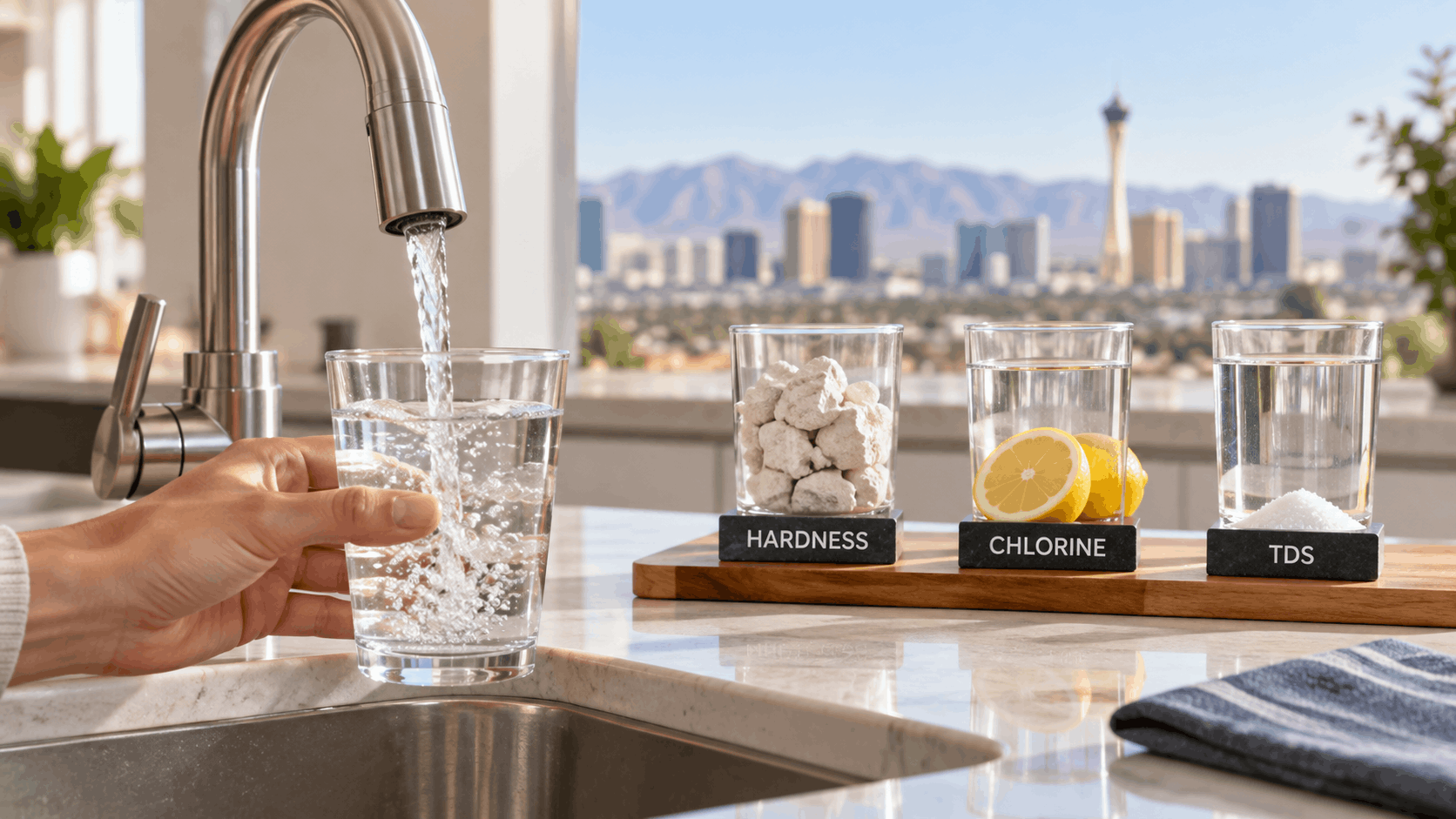
Water hardness measures the amount of dissolved calcium and magnesium in the water. These two minerals come straight from the rock and soil the Colorado River passes through. The more calcium and magnesium the water carries, the harder it is.
Hardness usually gets reported two ways. One is grains per gallon, often shortened to gpg. The other is parts per million, or ppm, which is the same as milligrams per liter. Many local reports list both numbers.
To convert between them, one grain per gallon equals about 17.1 parts per million. So water at 16 grains per gallon works out to roughly 274 parts per million of hardness minerals. Those are large amounts compared to what soft-water regions deal with.
When calcium and magnesium meet heat or sit in a fixture, they leave behind solid mineral deposits. That is the white, chalky scale seen on faucets and shower doors. The higher the calcium and magnesium content, the faster that scale builds.
How Hard Local Water Really Is
Typical hardness in the valley runs around 16 grains per gallon, and in some areas it climbs toward 18 to 20. That range puts local water firmly in the very hard water category by any standard scale. It is not a small difference from average.
For comparison, water is considered hard once it passes about 7 grains per gallon. Many parts of the country sit well below that. The national average is far softer than what comes out of a Las Vegas tap.
So local water is often more than double the threshold for hard water. Homeowners moving from softer regions notice the change fast. Soap does not lather the same, and spots appear on everything.
These hardness levels are steady across the valley because everyone shares the same source. A home in Summerlin West and a home in Historic North Las Vegas both deal with roughly the same mineral load, even if their pipe age differs.
| Hardness Level | Grains Per Gallon | Parts Per Million |
|---|---|---|
| Soft | 0 - 1 | 0 - 17 |
| Moderately Hard | 3.5 - 7 | 60 - 120 |
| Hard | 7 - 10.5 | 120 - 180 |
| Very Hard | 10.5+ | 180+ |
| Typical Las Vegas Water | 16 - 20 | 274 - 342 |
Signs Of Hard Water Homeowners See
The first sign most people notice is white scale buildup on faucets, shower heads, and around drains. That crusty film is dried mineral deposit left behind after water evaporates. It comes back quickly even after cleaning.
Spotty glassware is another classic clue. Dishes and glasses come out of the dishwasher covered in cloudy spots and streaks. Those spots are the same minerals drying on the surface.
Hard water also fights with soap and creates soap scum. It leaves a filmy residue in tubs and sinks, and it can make skin feel dry or tight after a shower. Many residents also notice hair feeling dull or laundry looking faded over time.
These daily annoyances are cosmetic, but they are constant reminders of the mineral load. When the same problems keep returning no matter how much a family cleans, hard water is almost always the cause.
How Hardness Damages Pipes And Appliances
Scale does not just sit on the surface. It builds up inside pipes, water heaters, and appliances where no one can see it. Over time, those deposits narrow pipe openings and reduce flow, especially in older homes near Downtown and East Las Vegas.
Water heaters take the hardest hit. As water heats, calcium and magnesium drop out and settle as sediment at the bottom of the tank. That layer forces the heater to work harder and cuts its efficiency and lifespan.
Appliances that use hot water, like dishwashers and washing machines, also suffer. Scale coats their internal parts and heating elements, shortening appliance lifespan by years in many cases. What might last a decade in a soft-water city often wears out sooner here.
In older homes with galvanized or aging pipe, hardness speeds up flow problems and can lead to leaks. Our team sees this pattern constantly, which is why water treatment comes up in so many service visits across the valley.
Need Help in Las Vegas?
Active Plumbing serves Las Vegas and all of Las Vegas Valley.
Chlorine And Chloramine In Your Tap Water
That pool-like smell some residents notice at the tap is no accident. Disinfectants keep the water safe on its long trip through miles of pipe in the desert heat. They are the reason tap water stays free of harmful bacteria from the plant to the faucet.
Like hardness, these disinfectants come with trade-offs. They protect health but can affect taste, smell, and even certain plumbing parts over the years. Both sides deserve a clear look.
Why Disinfectants Are Added
Water leaving the treatment plant has to stay safe for a long journey. Disinfection kills bacteria and other microbes that could grow in the pipe network. Without it, water sitting in mains during hot months could turn unsafe.
Chlorine is the classic disinfectant, and many systems also use chloramine, which is chlorine combined with a small amount of ammonia. Chloramine lasts longer in the pipes, so it holds its protective power over long distances. That staying power matters in a sprawling valley with miles of mains.
The desert climate adds pressure. Water sitting in pipes and storage tanks during triple-digit summers needs a disinfectant that does not fade too fast. A lasting residual keeps the water safe all the way to the last home on the line.
This is why disinfectants are a health protection, not a flaw. They are the reason water safety holds up across the entire distribution system, even at the far edges of North Las Vegas and Enterprise.
Typical Chlorine Levels At The Tap
Federal rules cap disinfectant levels to keep them safe. Chlorine levels at the tap generally stay under 4 parts per million, which is the maximum allowed. Most of the time, the residual sits comfortably below that ceiling.
The residual is the small amount of disinfectant left in the water when it reaches a home. It has to be high enough to keep working but low enough to stay safe. Water systems balance that number carefully.
Levels can shift with the season. In summer, higher demand and warmer water can change how disinfectant behaves in the pipes, and some residents notice a stronger smell during those months. Systems sometimes adjust dosing to keep the residual steady.
These parts per million figures show up in the annual water quality report for each area. Homeowners curious about their exact numbers can find them listed there for their zip code.
Taste, Smell, And Skin Effects
The most common complaint is a pool-like taste and odor. That smell comes from the disinfectant residual doing its job. It is harmless, but it can make a glass of tap water less pleasant.
The smell tends to be stronger right when the tap first turns on, or during warmer months. Letting water sit in an open pitcher for a bit lets some of that odor fade. Chilling it also helps mask the taste.
Some people with sensitive skin report irritation or dryness after showering. The disinfectant can strip natural oils, and combined with hard water, it can leave skin feeling tight. Those with eczema or sensitive skin often feel this most.
None of these effects signal unsafe water. They are comfort and quality-of-life issues that filtration can address for households that want cleaner taste and gentler water.
How Chlorine Interacts With Home Plumbing
Over many years, disinfectants can be tough on certain plumbing parts. Chlorine slowly breaks down rubber gaskets, washers, and seals inside fixtures and valves. This shows up as small drips and worn parts over time.
Older homes near Rancho and Charleston often have original fixtures with aging rubber components. Decades of exposure can leave those gaskets brittle and prone to leaks. Replacing them with modern, chlorine-resistant parts solves the problem.
Fixtures with rubber O-rings, like faucets and toilet fill valves, wear faster in chlorinated water. When our team services these pipe and fixture repairs, disinfectant wear is a frequent cause. It is a slow process, but it adds up.
A whole-house carbon filter removes most of the disinfectant before it enters the home. That protects both the plumbing and the people, cutting the smell and easing wear on gaskets and fixtures at the same time.
Total Dissolved Solids (TDS) Explained
Hardness only tells part of the story. Total dissolved solids, or TDS, measures the full mineral load in the water, and local readings run high. This number affects taste and how quickly equipment wears.
Getting a handle on TDS helps homeowners see the complete picture of what their water carries. It is a broader measure than hardness alone.
What TDS Includes
TDS captures everything dissolved in the water, not just the hardness minerals. It includes calcium and magnesium, but also sodium, potassium, chlorides, sulfates, and trace metals. All of these dissolved solids add up into one number.
That makes TDS different from hardness. Hardness measures only calcium and magnesium, while total dissolved solids measures the entire mineral and salt content. A home can have high hardness and even higher TDS.
The Colorado River picks up all these minerals and salts as it flows across the arid landscape. Evaporation in the reservoir concentrates them further. By the time water reaches the tap, it carries a wide mix of dissolved solids.
This full mineral content is why local water can taste different from bottled or soft water. The combined load of salts and minerals shapes both flavor and how the water behaves in appliances.
TDS Numbers For Las Vegas Water
Typical TDS readings in the valley often land between 600 and 700 parts per million. Some samples run even higher during dry years when the lake level drops. These are steep numbers compared to many regions.
The EPA sets a secondary standard for TDS at 500 parts per million. That secondary standard is a taste and appearance guideline, not a health limit. Local water regularly sits above it, which is why the taste stands out.
Because the standard is about taste rather than safety, exceeding it does not make the water unsafe to drink. It simply explains why some residents find the flavor flat or slightly mineral-heavy. The high TDS levels are a comfort concern, not a health one.
These readings can vary a little by area and season. Still, most valley homes see TDS well above the 500 ppm taste threshold year-round, from Paradise to Aliante.
How To Test TDS At Home
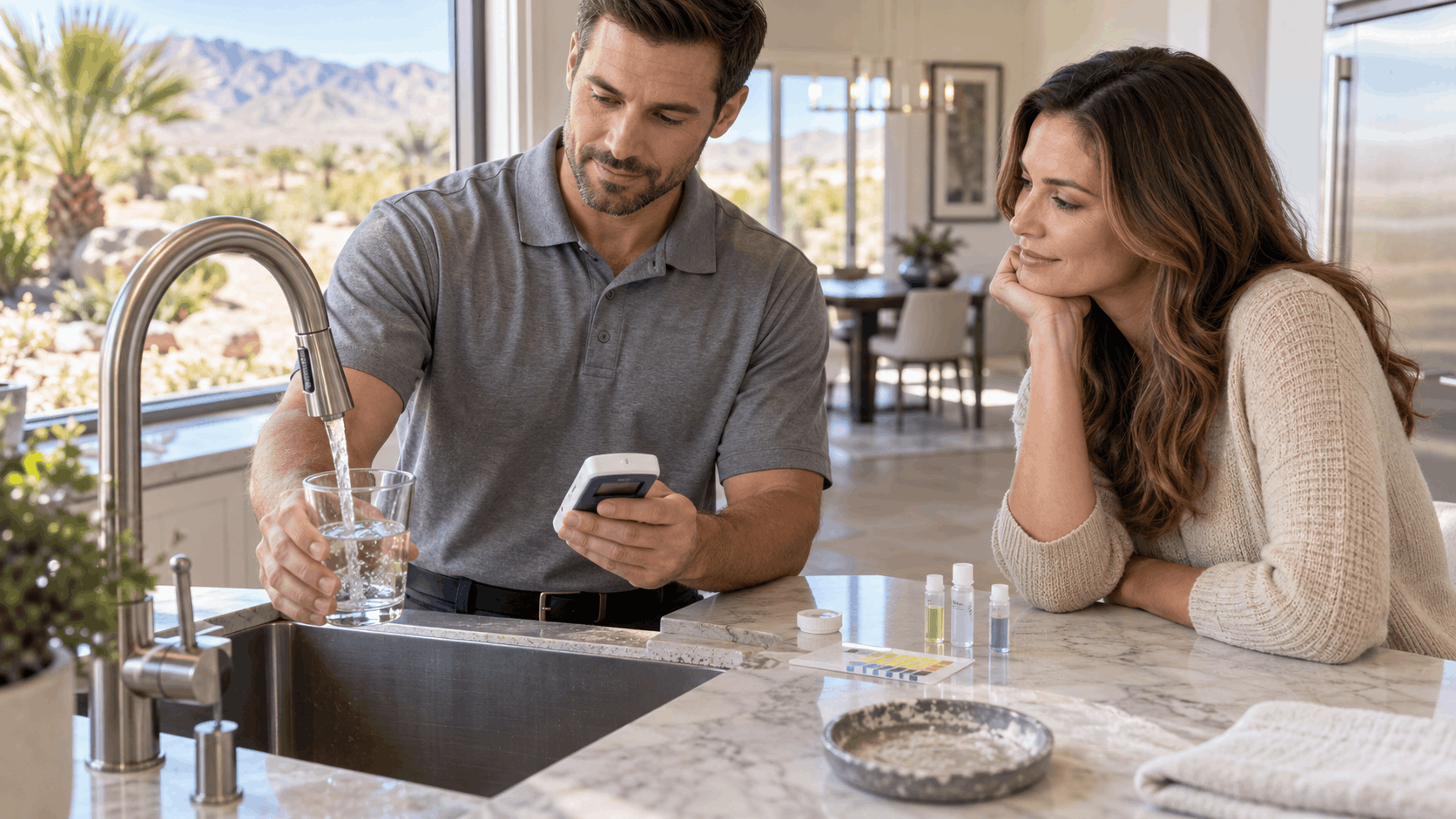
Homeowners do not need a lab to check their water. An inexpensive TDS meter, available for a few dollars, gives a reading in about a minute. It is a small handheld device that shows the number on a digital screen.
To use one, a person fills a glass with tap water and dips the meter in. The display shows the total dissolved solids in parts per million. Comparing that number to the ranges above gives a quick sense of local water quality.
Testing before and after a filter shows how well a treatment system works. Many people check tap water first, then check filtered or reverse osmosis water to see the drop. The difference can be dramatic.
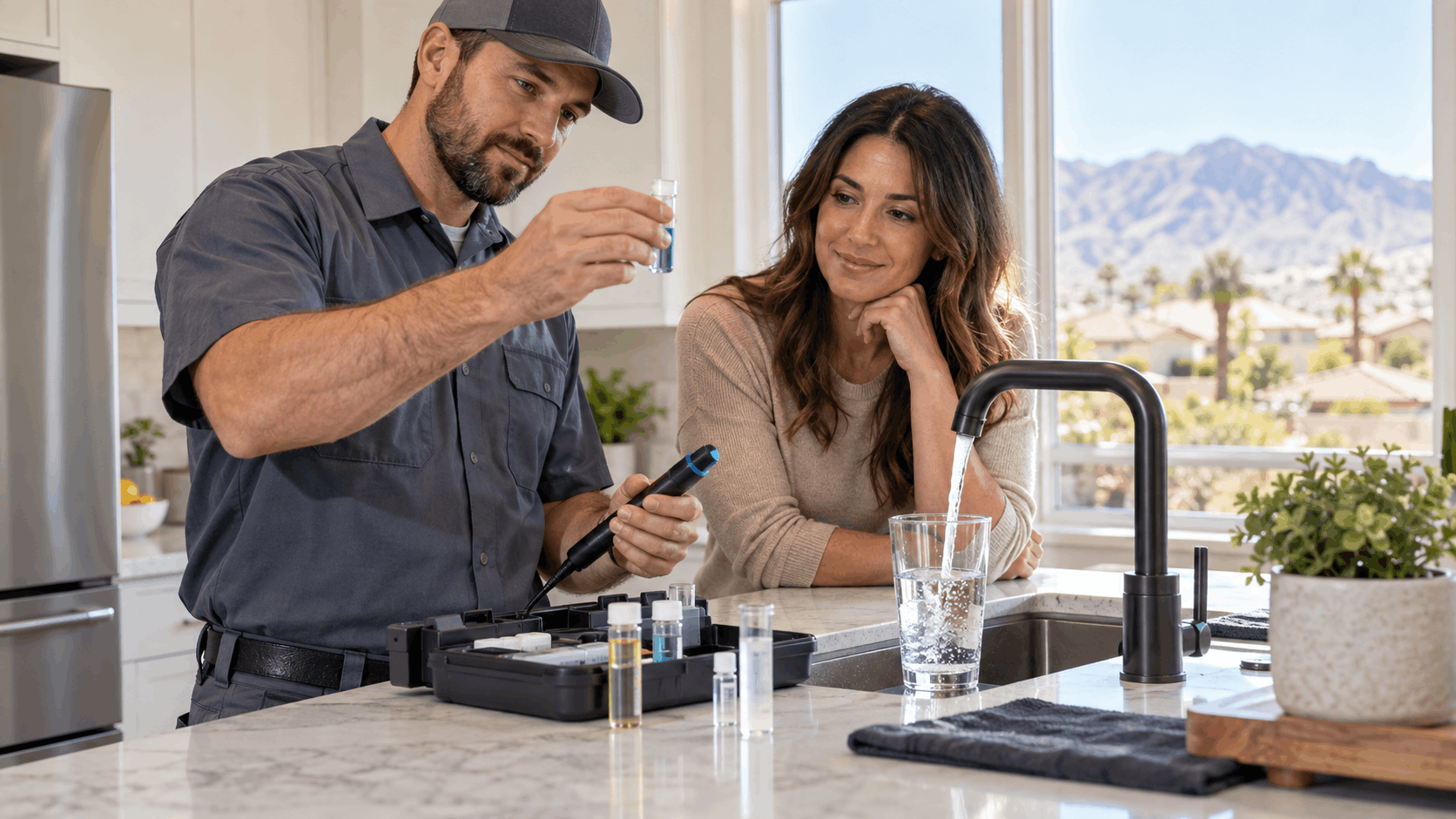
For a fuller picture, our team can perform a detailed water test during a visit. Home testing is a good starting point, but professional testing catches more than a basic meter shows.
Why High TDS Affects Taste And Equipment
High TDS often gives water a flat, heavy, or slightly salty taste. The mix of dissolved minerals and salts changes the flavor from crisp to dull. This is a top reason families switch to filtered water for drinking.
Equipment that uses water suffers too. Coffee makers, ice makers, and humidifiers all build scale faster when TDS is high. Those minerals coat internal parts and shorten the life of small appliances.
Ice from a fridge maker may taste off or turn cloudy because of the dissolved solids. Coffee can taste different from what a recipe intended. The equipment wear and taste issues often push people toward treatment.
Lowering TDS calls for the right system, since a basic filter does not touch most dissolved solids. Reverse osmosis is the common answer for drinking water, which the next sections cover in detail.
Is Las Vegas Tap Water Safe To Drink?
This is the question people ask most. The short answer is yes, local tap water is safe to drink. It meets the health standards set by federal and state regulators.
Safety and comfort are two different things, though. Water can pass every health test and still be hard, mineral-heavy, and tough on a home. Separating those two ideas helps homeowners decide what to do.
Federal And State Standards It Meets
Local water is tested constantly and meets EPA standards for safe drinking water. It also meets Nevada state rules for water quality. Regulators check for a long list of contaminants and require the system to stay in compliance.
The EPA sets legal limits for things like bacteria, lead, and other health-related contaminants. Water providers must test regularly and report the results. When water meets those limits, it is considered safe to drink by federal law.
You can review the national drinking water rules directly from the Environmental Protection Agency. Their standards explain what each contaminant limit means and why it exists.
Local water consistently meets these safety benchmarks. The hardness and high TDS that residents notice fall under taste and appearance guidelines, not health limits. That is a meaningful difference.
Reading Your Annual Water Quality Report
Every year, water providers publish a consumer confidence report, sometimes called the annual water quality report. It lists what was found in the water and how those numbers compare to legal limits. This report is free and public.
Homeowners can find their report on their water provider's website, often searchable by zip code or address. LVVWD and other local utilities post them online each year. A quick search of the provider name plus "water quality report" usually finds it.
The report shows levels for disinfectants, minerals, and any detected contaminants. It also lists hardness and sometimes TDS. Reading it gives a clear, official picture of exactly what a household's water contains.
Anyone concerned about a specific contaminant can check the latest numbers there before spending money on treatment. It is the most reliable starting point for understanding local water quality.
Safe To Drink Versus Hard On Your Home
Safe water and gentle water are not the same thing. The valley's water passes every health test yet still causes real hard water damage to pipes, fixtures, and appliances. Both facts are true at once.
A family can drink the water with confidence while still watching it destroy a water heater over time. The minerals that cause scale are not harmful to health, but they are hard on home plumbing. That is the paradox of desert water.
This is why so many households choose treatment even though the water is safe. They are not fixing a health problem. They are protecting appliances, improving taste, and cutting down on daily cleaning.
Framing it this way helps homeowners set the right goal. The aim is usually to protect the home and improve comfort, not to make unsafe water safe.
When To Consider Extra Filtration
Some situations make added filtration a smart move. Families who dislike the taste or smell of the water often add a point-of-use filter for drinking and cooking. It is a simple upgrade with an immediate payoff.
Renovated homes in older parts of the valley are another case. When someone updates a kitchen or bath in an older neighborhood near Charleston or Downtown, adding filtration protects the new fixtures from scale. It makes the investment last longer.
Households with sensitive skin, high-end appliances, or a strong preference for clean-tasting water also benefit. A whole-house system handles chlorine and sediment, while an under-sink unit handles drinking water. The right mix depends on the goals.
Our team helps homeowners weigh these choices based on a real water test, not guesswork. That way the filtration matches the actual water and the household's needs.
Need Help in Las Vegas?
Active Plumbing serves Las Vegas and all of Las Vegas Valley.
How Hard Water Damages Las Vegas Plumbing
After years of service calls across the valley, the pattern is clear. Hard water is behind a huge share of the plumbing damage our team repairs. The scale buildup works quietly until something fails.
Seeing the specific ways minerals attack a home helps homeowners catch problems early. These are the exact issues we find in neighborhoods from Spring Valley to Sunrise Manor.
Scale Buildup Inside Water Heaters
Water heaters are ground zero for hard water problems. As the tank heats water, calcium and magnesium settle to the bottom as sediment. Layer after layer builds up over months and years.
That sediment layer acts like insulation between the burner and the water. The heater has to run longer and hotter to warm the water, which cuts efficiency. Many homeowners hear popping or rumbling sounds as the sediment traps steam.
All that extra work shortens tank life. A water heater that might last well over a decade in soft water can wear out years sooner here. Sediment also speeds up corrosion and can lead to leaks.
Regular flushing slows this down, and our water heater services keep tanks running longer. For homes that want to skip the sediment problem, a tankless water heater installation paired with softening is a strong option.
Clogged Fixtures And Slow Faucets
Scale loves to collect in small openings. Faucet aerators, the little screens at the tip of a faucet, crust over and choke the flow. Shower heads lose pressure as mineral deposits block the spray holes.
In homes around Spring Valley and Sunrise Manor, we regularly find aerators packed solid with white buildup. The water pressure seems fine at the main, but the fixture itself is clogged. Cleaning or replacing the aerator often restores full flow.
Slow drips and weak streams frustrate homeowners who assume they have a bigger problem. Often the fix is clearing the scale from the fixture. Left alone, though, the buildup keeps growing and can spread deeper into valves.
Regular cleaning of aerators and shower heads keeps them clear. When clogs reach into the plumbing itself, our team handles the deeper fixture work to bring flow back.
Higher Energy Bills From Scale
Scale does not just wear out equipment. It quietly raises energy bills. When a water heater fights through a layer of sediment, it burns more gas or electricity to do the same job.
The same goes for any appliance that heats water. A dishwasher or washing machine coated in scale runs less efficiently and uses more energy. Those small increases add up across a year.
Many homeowners never connect a rising utility bill to their water. Yet efficiency loss from mineral buildup is a real and steady drain. The harder the appliances work, the more the bills climb.
Treating the water and flushing the heater restores efficiency. Removing scale lets equipment run the way it was built to, which shows up as lower bills over time.
Shorter Life For Dishwashers And Washing Machines
Hard water takes years off the life of major appliances. Dishwashers develop scale on their heating elements and spray arms. Washing machines build up deposits in their valves and hoses.
These appliances are expensive to replace, so early failure hurts. In the valley, it is common to see dishwashers and washing machines wear out faster than the manufacturer's estimate. Hard water is usually the reason.
Scale also leaves clothes looking dull and dishes looking spotty, which pushes owners to run extra cycles. Those extra cycles add wear on top of the mineral damage. The whole cycle shortens appliance lifespan further.
A whole-home water softener protects every appliance at once. By removing the hardness before it reaches the machines, it can add years back to their working life across the whole house.
Treatment Options For Las Vegas Homes
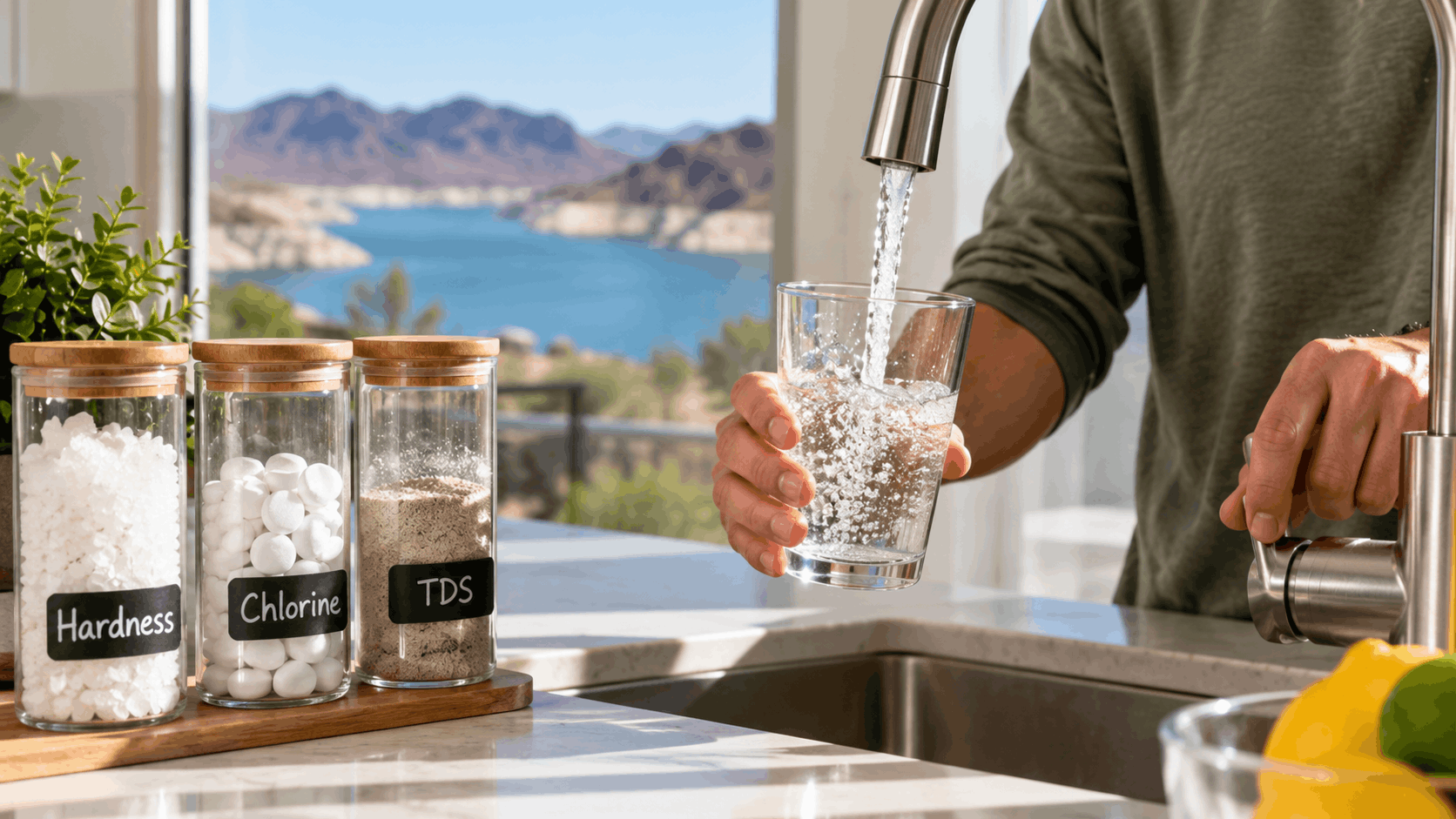
The good news is that every water issue here has a practical fix. The right solution depends on whether the goal is fighting hardness, cutting chlorine, lowering TDS, or all three. Some systems treat the whole house, and others treat one tap.
Matching the system to the problem saves money and gets better results. Here is how the main options stack up for local homes.
Water Softeners For Hardness
An ion-exchange water softener is the standard answer for hard water. It swaps the calcium and magnesium in the water for sodium, removing the minerals that cause scale. The result is soft water throughout the home.
Softeners protect pipes, water heaters, and appliances by stopping scale before it forms. Soap lathers better, spots disappear, and skin feels less dry. For a valley this hard, softening delivers a noticeable change fast.
Some homeowners prefer a salt-free option that conditions the water without adding sodium. Our salt-free water conditioning reduces scale for those who want to avoid salt or cut maintenance. It is a good fit for certain households and diets.
For traditional ion-exchange systems, our water softener installation handles the setup from start to finish. We size the unit to the home and its water use for the best hardness removal.
Whole-House Filtration For Chlorine And Sediment
A whole-house carbon filter tackles chlorine and chloramine at the point where water enters the home. Carbon absorbs the disinfectant, cutting the pool-like taste and smell at every tap. It also traps sediment that comes through the mains.
With a whole-house system, every faucet and shower delivers filtered water. That protects skin and hair from disinfectant exposure and eases wear on gaskets and fixtures. The whole family feels the difference.
These carbon filter systems pair well with a softener. The softener handles hardness while the filter handles chlorine and sediment. Together they cover the two biggest complaints about local water.
Our team sizes the filter to match household demand so flow stays strong. Proper sizing keeps water pressure steady while still removing the chlorine taste and odor.
Reverse Osmosis For High TDS Drinking Water
To lower TDS, reverse osmosis is the proven method. An under-sink reverse osmosis system pushes water through a fine membrane that removes most dissolved solids. It cuts the full mineral load, not just hardness.
Reverse osmosis brings TDS down dramatically, often from 600-plus parts per million to under 50. That produces clean, crisp-tasting drinking water. It is the best fix for the flat or salty taste high TDS causes.
These systems usually install under the kitchen sink and feed a dedicated faucet. They are point-of-use, meaning they treat only the water used for drinking and cooking. That keeps the cost and maintenance reasonable.
For households that want the cleanest possible drinking water, reverse osmosis paired with a whole-house softener and carbon filter covers every base. Each system handles the part of the water it does best.
How Active Plumbing Helps Local Homeowners Choose
Every home is a little different, so the right setup varies. Our team starts with a water test to see the actual hardness, chlorine, and TDS in the home. From there, we recommend systems that match the real numbers.
We install and service water treatment for homes across the valley, from Summerlin West to Henderson and North Las Vegas. We know how the water behaves in each area and how the local pipe network affects delivery. That local knowledge shapes our recommendations.
We also explain the trade-offs plainly, including upfront cost, upkeep, and salt use. Homeowners get honest guidance instead of a hard sell. The goal is the right fit for the household, not the biggest system.
Whether it is a softener, a whole-house filter, a reverse osmosis unit, or all three, our team as your local plumber handles the water treatment installation from testing to final check. We make sure it works with the home's existing plumbing.
Maintaining Your Plumbing Against Valley Water
Even with treatment, some upkeep keeps a home ahead of the minerals. A few simple habits can add years to plumbing and appliances. These are steps homeowners can start on today.
Regular maintenance matters more in a hard-water valley than almost anywhere else. Here is what our team recommends to fight mineral buildup.
Flushing Your Water Heater Yearly
An annual water heater flush clears the sediment that hard water leaves behind. Draining the tank removes the mineral layer at the bottom before it can insulate the burner. This one task protects efficiency and tank life.
In soft-water cities, a flush every couple of years might be enough. Here, the heavy mineral load means a yearly flush pays off. Skipping it lets sediment pile up fast and shortens the heater's life.
Homeowners comfortable with the process can flush the tank themselves by attaching a hose and draining it. Others prefer to have our team handle it during a routine visit. Either way, once a year is the target.
For tankless units, the equivalent is a descaling service. Our tankless maintenance and descaling clears mineral buildup from the heat exchanger to keep it running strong.
Cleaning Aerators And Fixtures
Faucet aerators and shower heads collect scale faster than any other fixture. A simple soak clears them. Unscrew the aerator or shower head, drop it in a bowl of white vinegar, and let it sit for a few hours.
The vinegar dissolves the mineral deposits without harsh chemicals. A quick scrub with an old toothbrush knocks off any leftover crust. Rinse, reattach, and the flow returns to normal.
Doing this every few months keeps fixtures clear and pressure strong. It is one of the cheapest and easiest ways to fight hard water at home. Most people can do it in a few minutes.
For shower heads that will not unscrew, tying a bag of vinegar around them overnight works too. Regular descaling keeps the whole bathroom running better.
Watching For Early Warning Signs
Catching problems early saves money. Watch for reduced flow or low water pressure at faucets, which often signals scale in the fixtures or pipes. A slow, weak stream is an early clue.
Popping or rumbling from the water heater points to sediment buildup in the tank. Rising energy bills with no other change can mean appliances are fighting through scale. These signs call for a closer look.
Cloudy ice, off-tasting water, or new spots on dishes can also hint at a treatment system that needs service. Filters and softeners lose effectiveness if they go too long without upkeep. Watching for these signs keeps small issues from becoming big ones.
When several warning signs show up at once, an inspection is the smart next step. Catching buildup early is always cheaper than replacing a failed water heater or appliance.
When To Call A Local Plumber
Some jobs go beyond a vinegar soak. When flow stays low after cleaning fixtures, or when a water heater keeps rumbling after a flush, it is time for professional service. Deep scale in pipes needs proper tools.
Persistent leaks, especially in older homes near Rancho and Charleston with aging gaskets, also call for a pro. So does any sign of corrosion or repeated fixture failure. These point to wear that only repair or replacement fixes.
Our team as your plumber in Las Vegas handles buildup, repairs, and treatment installs across every neighborhood. We work on homes from Enterprise to Aliante and know how local water affects each area.
If something seems off with the water or plumbing, an early call prevents bigger damage. Our team is ready to help with a check whenever a home needs it.
Need Help in Las Vegas?
Active Plumbing serves Las Vegas and all of Las Vegas Valley.
Final Thoughts
By the time Lake Mead water reaches a Las Vegas tap, it carries a heavy load of hardness, disinfectants, and dissolved solids picked up on its long trip from the Rockies. It is safe to drink and meets every health standard, but it is undeniably hard on pipes, fixtures, and appliances. That is the trade-off of living in one of the hardest-water regions in the country.
The good news is that homeowners have real control here. A water softener tames the hardness, a carbon filter clears the chlorine taste, and reverse osmosis produces clean drinking water. Paired with simple upkeep like a yearly water heater flush, these steps protect a home for years.
Our team knows exactly how valley water behaves in each neighborhood, from Summerlin to Henderson to North Las Vegas. If white crust, spotty dishes, or a worn-out water heater sound familiar, reach out for a water test and honest advice. Call Active Plumbing or contact us to set up a consultation and find the right fit for your home.
Frequently Asked Questions
How hard is Las Vegas tap water?
Las Vegas tap water typically runs around 16 grains per gallon, and in some areas it reaches 18 to 20. That places it firmly in the very hard water category, well above the roughly 7 grains per gallon threshold where water is considered hard. Because everyone shares the same Lake Mead source, hardness levels stay high and steady across the valley, which is why scale and spots are so common in local homes.
Is Las Vegas tap water safe to drink?
Yes, Las Vegas tap water is safe to drink and meets both EPA and Nevada standards for safe drinking water. The system tests constantly for bacteria, lead, and other health-related contaminants and stays in compliance. The hardness and high mineral content that residents notice fall under taste and appearance guidelines, not health limits. So the water is safe, even if many people prefer to filter it for better taste.
What is the TDS level of Las Vegas water?
Total dissolved solids in valley water often measure between 600 and 700 parts per million, and readings can climb higher during dry years when the lake level drops. That sits above the EPA secondary standard of 500 parts per million, which is a taste guideline rather than a health limit. High TDS gives water a flat or slightly salty taste and speeds up scale on coffee makers and ice makers.
Why does my tap water smell like chlorine?
That pool-like smell comes from the disinfectant residual in the water. Chlorine and chloramine are added to kill bacteria and keep water safe across miles of pipe in the desert heat. Levels stay under the 4 parts per million limit, but the smell can grow stronger in summer when demand and warm water shift how the disinfectant behaves. A whole-house carbon filter removes most of it and clears the odor.
Does hard water damage my water heater?
Yes, hard water is tough on water heaters. As the tank heats water, calcium and magnesium settle to the bottom as sediment, forming a layer that insulates the burner from the water. That forces the heater to work harder, cuts efficiency, and often causes popping sounds. Over time the extra strain shortens tank life by years. A yearly flush and a water softener both help protect the heater.
Do I need a water softener in Las Vegas?
For most valley homes, a water softener makes sense given how hard the water is. At 16 to 20 grains per gallon, the water leaves scale on fixtures, wears out appliances, and creates constant spots. A softener stops scale before it forms, protecting pipes, water heaters, dishwashers, and washing machines. If a household is tired of buildup and short appliance life, softening is usually worth it. Our team can test and advise.
Will a filter lower my water's TDS?
It depends on the filter. Basic carbon filters improve taste and remove chlorine but do not lower total dissolved solids much. To reduce TDS, a reverse osmosis system is the proven choice. It pushes water through a fine membrane that removes most dissolved minerals and salts, often dropping TDS from over 600 parts per million to under 50. That is why reverse osmosis is the go-to for clean-tasting drinking water here.
How often should I flush my water heater here?
In the Las Vegas Valley, flushing the water heater once a year is the right target. The heavy mineral load means sediment builds up faster than in soft-water cities, where every couple of years might be enough. An annual flush clears that sediment before it insulates the burner, protecting efficiency and tank life. Tankless units need a yearly descaling instead. Our team can handle either during a routine maintenance visit.
Where can I find my water quality report?
Your water provider publishes an annual consumer confidence report, also called a water quality report, each year. You can find it on the provider's website, often searchable by zip code or address. The Las Vegas Valley Water District and other local utilities post them online. The report lists disinfectant levels, minerals, hardness, and any detected contaminants compared to legal limits, giving an official picture of exactly what your water contains.
Can hard water cause dry skin and dull hair?
Yes, hard water can leave skin feeling dry and hair looking dull. The high calcium and magnesium content reacts with soap to form a filmy soap scum that clings to skin and hair. That residue can strip natural oils and leave skin tight after a shower and hair flat or lifeless. Combined with the disinfectant residual, sensitive skin often feels the effect most. A softener and filter noticeably improve both.
Frequently Asked Questions
- How hard is Las Vegas tap water?
- Las Vegas tap water typically runs around 16 grains per gallon, and in some areas it reaches 18 to 20. That places it firmly in the very hard water category, well above the roughly 7 grains per gallon threshold where water is considered hard. Because everyone shares the same Lake Mead source, hardness levels stay high and steady across the valley, which is why scale and spots are so common in local homes.
- Is Las Vegas tap water safe to drink?
- Yes, Las Vegas tap water is safe to drink and meets both EPA and Nevada standards for safe drinking water. The system tests constantly for bacteria, lead, and other health-related contaminants and stays in compliance. The hardness and high mineral content that residents notice fall under taste and appearance guidelines, not health limits. So the water is safe, even if many people prefer to filter it for better taste.
- What is the TDS level of Las Vegas water?
- Total dissolved solids in valley water often measure between 600 and 700 parts per million, and readings can climb higher during dry years when the lake level drops. That sits above the EPA secondary standard of 500 parts per million, which is a taste guideline rather than a health limit. High TDS gives water a flat or slightly salty taste and speeds up scale on coffee makers and ice makers.
- Why does my tap water smell like chlorine?
- That pool-like smell comes from the disinfectant residual in the water. Chlorine and chloramine are added to kill bacteria and keep water safe across miles of pipe in the desert heat. Levels stay under the 4 parts per million limit, but the smell can grow stronger in summer when demand and warm water shift how the disinfectant behaves. A whole-house carbon filter removes most of it and clears the odor.
- Does hard water damage my water heater?
- Yes, hard water is tough on water heaters. As the tank heats water, calcium and magnesium settle to the bottom as sediment, forming a layer that insulates the burner from the water. That forces the heater to work harder, cuts efficiency, and often causes popping sounds. Over time the extra strain shortens tank life by years. A yearly flush and a water softener both help protect the heater.
- Do I need a water softener in Las Vegas?
- For most valley homes, a water softener makes sense given how hard the water is. At 16 to 20 grains per gallon, the water leaves scale on fixtures, wears out appliances, and creates constant spots. A softener stops scale before it forms, protecting pipes, water heaters, dishwashers, and washing machines. If a household is tired of buildup and short appliance life, softening is usually worth it. Our team can test and advise.
- Will a filter lower my water's TDS?
- It depends on the filter. Basic carbon filters improve taste and remove chlorine but do not lower total dissolved solids much. To reduce TDS, a reverse osmosis system is the proven choice. It pushes water through a fine membrane that removes most dissolved minerals and salts, often dropping TDS from over 600 parts per million to under 50. That is why reverse osmosis is the go-to for clean-tasting drinking water here.
- How often should I flush my water heater here?
- In the Las Vegas Valley, flushing the water heater once a year is the right target. The heavy mineral load means sediment builds up faster than in soft-water cities, where every couple of years might be enough. An annual flush clears that sediment before it insulates the burner, protecting efficiency and tank life. Tankless units need a yearly descaling instead. Our team can handle either during a routine maintenance visit.
- Where can I find my water quality report?
- Your water provider publishes an annual consumer confidence report, also called a water quality report, each year. You can find it on the provider's website, often searchable by zip code or address. The Las Vegas Valley Water District and other local utilities post them online. The report lists disinfectant levels, minerals, hardness, and any detected contaminants compared to legal limits, giving an official picture of exactly what your water contains.
- Can hard water cause dry skin and dull hair?
- Yes, hard water can leave skin feeling dry and hair looking dull. The high calcium and magnesium content reacts with soap to form a filmy soap scum that clings to skin and hair. That residue can strip natural oils and leave skin tight after a shower and hair flat or lifeless. Combined with the disinfectant residual, sensitive skin often feels the effect most. A softener and filter noticeably improve both.
A
Licensed plumbing professionals serving Las Vegas and Las Vegas Valley.
Licensed in Nevada · License #0047021
Last updated on
Why trust Active Plumbing?
Founded in 1991, Active Plumbing is a licensed and insured plumber serving Las Vegas and Las Vegas Valley. All content is reviewed by our licensed technicians.

Need Help in Las Vegas?
Active Plumbing serves Las Vegas and all of Las Vegas Valley.
Related Articles
Tips & Advice
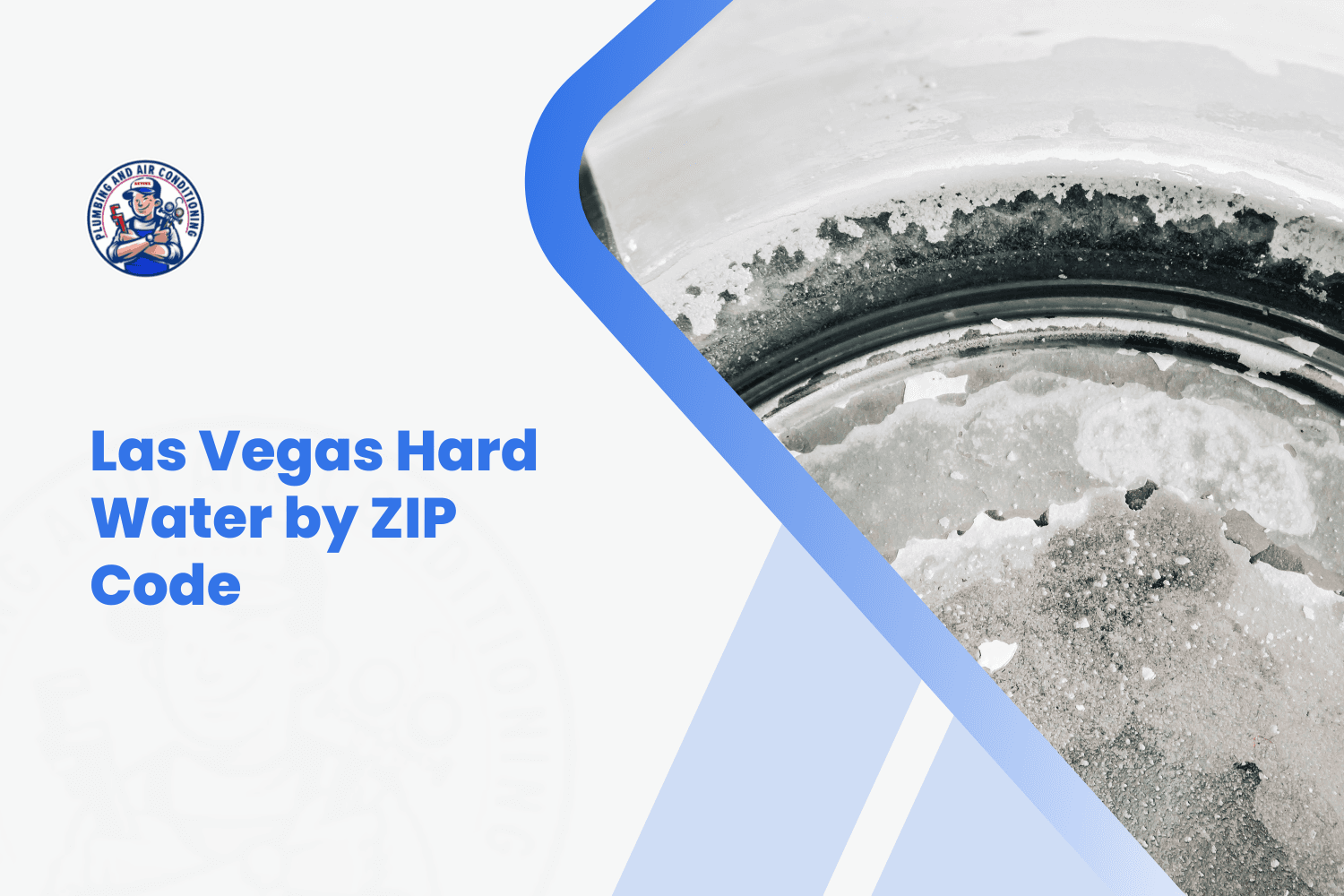
Las Vegas Hard Water by ZIP Code: Actual SNWA Grain Hardness Data
See actual SNWA water hardness data by Las Vegas ZIP code. Learn your neighborhood's GPG level and what it means for your plumbing, appliances, and home.
Tips & Advice
Las Vegas vs Henderson vs North Las Vegas Water Systems: Providers, Pressure, and What It Means for Your Pipes
Las Vegas, Henderson, and North Las Vegas share one water source but run different systems. Learn who supplies your water, why pressure varies, and what it means for your pipes.
Maintenance
How Long Water Heaters Actually Last in Las Vegas Hard Water (With Flush vs Without)
Las Vegas hard water often kills water heaters years early. See real lifespan ranges, how a yearly flush adds 3 to 5 years, and how to protect your tank.