Tips & Advice
Sixty-Five Years of Original Utilities: The Lines Paradise Palms Brought Down Maryland Parkway in 1960

Key Takeaways
- Paradise Palms homes built 1960 to 1964 typically carry copper supply and cast iron drain, waste and vent piping that is now past the age where the first failures begin.
- Palmer and Krisel post-and-beam homes have little or no accessible attic, so a repipe runs through walls and soffits, which takes longer and costs more than a conventional 1960s house.
- These homes are slab-on-grade, so under-slab leaks call for detection first, and rerouting overhead is often the right call to protect restored terrazzo or polished concrete floors.
- Valley water is 280 parts per million, about 16 grains per gallon and very hard, which fouls the narrow passages in the period-correct fixtures owners install during restoration.
- The 2017 Historic Neighborhood Overlay affects only exterior work visible from the street, so confirm placement of a tankless unit or softener with Clark County before mounting it.
- Paradise is unincorporated Clark County, so the Clark County Department of Building and Fire Prevention issues permits, and the Southern Nevada Amendments to the UPC apply.
- Camera inspection beats repeated cabling on sixty-five-year-old cast iron and laterals, and mapping mixed pipe materials reveals dissimilar-metal joints prone to galvanic corrosion.
- Active Plumbing holds Nevada license #0047021, has worked the valley since 1991, gives a written price before cutting, and responds in 30 to 60 minutes on urgent calls.
In This Article
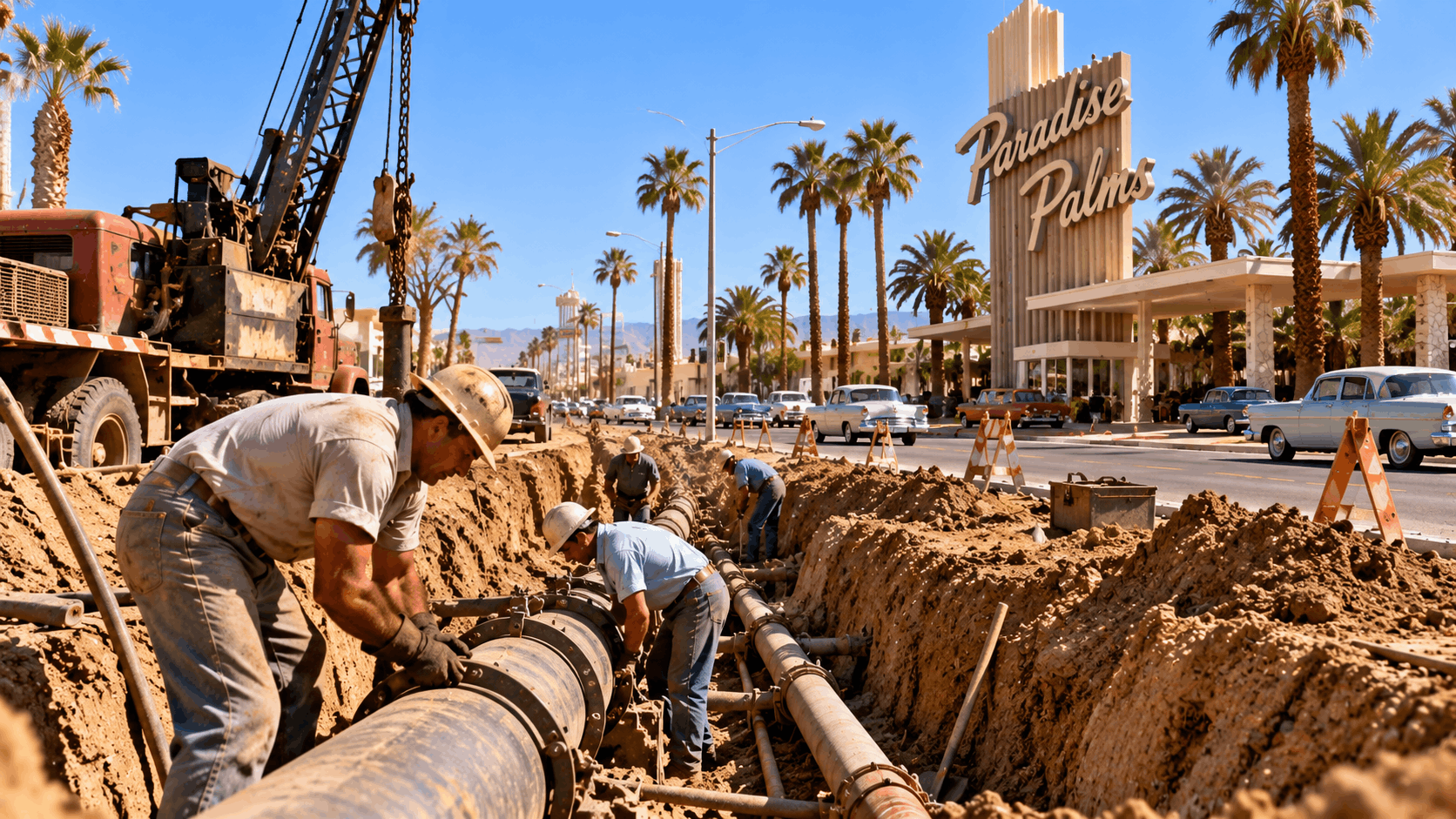
Paradise Palms started coming out of the ground in 1960, just off Maryland Parkway, when Paradise Development broke ground on Clark County's first master-planned community. Irwin Molasky and Merv Adelson built roughly 1,000 homes on 1,044 lots wrapped around what was then the Stardust Country Club, now the Las Vegas National Golf Club. Palmer and Krisel designed about 400 of those homes between 1960 and 1964, and the flat, folded plate, butterfly and pyramid rooflines are still the signature of the valley's most significant mid-century modern neighborhood.
Behind those walls, a lot of the plumbing is still original. Homes built in that window typically carry copper supply of the era and cast iron drain, waste and vent piping. Sixty-five years is a long life for either material, and the way they fail is predictable once you have worked enough of these houses.
Age is only half the story here. The post-and-beam framing with little attic space, the slab-on-grade foundations under restored floors, and very hard water all change how a plumber has to approach the work. This guide walks through what the original 1960 build put in place, why the architecture makes a repipe harder, and how our team handles a Paradise Palms job without wrecking what owners have spent years restoring.

What the Original 1960 Build Put in the Ground and the Walls?
When Paradise Development started selling these homes off Maryland Parkway, the plumbing that went in reflected exactly what the early 1960s used. That means copper for the supply side and cast iron for the drains. Knowing what the first Paradise Palms crews installed tells you a great deal about what is likely still running behind the plaster today.
The reason sixty-five years matters is simple. Plumbing materials have a service life, and both copper and cast iron from 1960 construction are now well past the point where the first failures start showing up. That does not mean every line is on the edge of collapse, but it does mean the original plumbing deserves a real look rather than an assumption that it is fine because it has lasted this long.
Every house in the original tract was built in the same few years, so the aging is happening across the neighborhood at roughly the same time. Owners talk to each other, and a recurring drain problem on one street often turns out to be a shared story of cast iron reaching the end of its run. The pipe should always be confirmed on site, but the build era gives an honest starting point.
Copper Supply From the Early 1960s
Housing built between 1960 and 1964 in this valley typically carries copper supply lines of that era. Copper was the standard choice for good reason, and plenty of it has held up. The problem is time. Sixty-five-year-old copper is past the age where pinhole leaks begin to appear, and those tiny leaks are the ones that do quiet damage inside walls and under cabinets.
Hot lines tend to go first. Hot water moves faster, runs at higher temperature, and wears the inside of the pipe more aggressively than cold. In an old Paradise Palms home, the hot supply serving a kitchen or a primary bath is often the first place a pinhole shows up, sometimes as a faint stain on a wall or a spot of corrosion at a fitting before any real drip appears.
A single pinhole leak is repairable on its own, but a pinhole is rarely a one-time event on aging copper. When one appears, it usually means the rest of the run is reaching the same condition. That is the point where owners start weighing a spot repair against a planned whole house repipe, especially if the leaks are landing on hot lines one after another.
Very hard water speeds the interior wear along. Scale narrows the bore of the supply line over years and puts extra stress on the metal. We cover water hardness in detail below, but it is worth knowing that the copper in these homes has been carrying hard water its entire life.
Cast Iron Drain, Waste and Vent
The drain, waste and vent side of a 1960 to 1964 home is cast iron, and cast iron of this age fails in a slow, recognizable way. It scales on the inside, cracks with time, and separates at the joints where sections were originally joined. None of that happens overnight, which is why owners often live with a declining drain system for years before anything dramatic forces the issue.
The early warning signs are drains that run slow and then clear, then run slow again. A shower that pools a little, a kitchen sink that gurgles, a toilet that empties lazily. These are the symptoms of cast iron that has scaled down its own inside diameter, leaving less room for water and waste to move through.
Recurring blockages are the next stage. When a line has scaled and cracked, debris catches on the rough interior and inside the cracks, so a drain that was cabled last year backs up again this year. Repeated cabling clears the immediate blockage but does nothing about the underlying condition of the pipe, and the calls keep coming.
At the joints, aging cast iron can pull apart entirely, which lets water and waste escape into the surrounding structure or soil. That is when a slow drain problem becomes a serious one. Our drain and sewer services start with finding out the real condition of the cast iron rather than treating the same blockage over and over.
The Sewer Lateral Under Mature Landscape
The sewer lateral is the line that carries everything from the house out to the public sewer, and in Paradise Palms that line has been in the ground for around sixty-five years. Laterals of this age are prime candidates for root intrusion, and this neighborhood has unusually mature landscape. Sixty years of established trees and plantings put roots exactly where an aging lateral gives them a way in.
Golf course frontage makes it more likely still. Many lots back onto the Las Vegas National course, and irrigation feeding that greenery keeps roots active and searching for water. A small crack or a loose joint on an old clay or cast iron lateral is all a root needs to work its way inside, where it grows into a mass that catches waste and slows the whole system.
This is exactly where repeated cabling fails owners. A cable can tear through a root mass and restore flow for a while, but the roots grow back, and the cable never tells you what shape the pipe is actually in. You end up paying to clear the same lateral year after year without ever learning whether the line is cracked, bellied or collapsing.
A sewer camera inspection is the honest diagnostic. Running a camera down the lateral shows the roots, the cracks, the low spots and the joint separations directly, so the decision to repair or replace is based on what the line really looks like rather than a guess. It turns a recurring mystery into a clear picture.
Layers Left by Decades of Restoration
Paradise Palms is full of homes that owners have restored, sometimes repeatedly, over the decades. That restoration work is wonderful for the architecture, but it means one house can hold several generations of plumbing at once. You might find original 1960s copper in the walls, a patch of galvanized or another material from a repair in the 1980s, and modern PEX where a bathroom was redone last year.
Mixed pipe materials are not a problem by themselves, but the joints where they meet can be. When dissimilar metals are joined directly, galvanic corrosion sets in at the connection, eating away at the more reactive metal over time. An old copper-to-galvanized joint from a long-ago repair is a classic spot for a slow leak to develop years later.
The catch is that these layers are invisible until someone opens a wall or runs a camera. An owner who bought the house recently often has no record of what past owners changed, so the plumbing history has to be pieced together on site. That is why we never assume the whole house is one material just because it was built in 1962.
When the mixed materials and corroded joints add up, a planned repipe in a single consistent material often makes more sense than chasing one dissimilar-metal joint after another. It gives the house one system with one expected lifespan instead of a patchwork that keeps springing surprises.
Get Your Quote
Tell us what's going on and we'll get back to you fast.
Why Post-and-Beam Homes Change the Plumbing Job
The Palmer and Krisel homes that define Paradise Palms are post-and-beam construction, with exposed beams, flat or low-pitch roofs and minimal attic space. To an owner that is a beautiful architectural style. To a plumber it is a set of real constraints that change how a repipe or a reroute gets done, and how much it costs.
This is not a style note we mention in passing. The framing decides where new pipe can physically go. On a conventional pitched-roof house from the same decade, a plumber has an attic to work in and can run new supply lines overhead with relative ease. These mid-century modern homes rarely offer that option, so the whole plan has to change.
A contractor who understands this before quoting gives an accurate price and a realistic timeline. One who quotes a Paradise Palms repipe as if it were an ordinary tract house will be wrong on the day, and the owner is the one who feels the difference in delays and change orders. The repipe constraints here are baked into the architecture.
Little or No Accessible Attic
A standard repipe routes new supply lines through the attic, dropping down to each fixture from above. It is the fastest, cleanest path in most houses because the attic gives open space to work. The flat-roof homes of Paradise Palms have little or no accessible attic, which removes that route entirely.
Without an attic, there is nowhere overhead to hide a run of pipe or to stage equipment. The exposed beams and low roof deck that make these homes so striking also mean the space above the ceiling is mostly structure, not void. Every new line has to find a different way from the water source to the fixture.
The same constraint applies to equipment. Ceiling-mounted or attic-mounted units are frequently not an option here, so a water heater, softener or other gear that might live in an attic elsewhere has to be placed somewhere else in a Paradise Palms home. That decision has to be made early, not discovered halfway through the job.
Understanding the attic limitation up front is what separates a smooth project from a frustrating one. It shapes the route, the schedule and the price, and it is the first thing our crew confirms when looking at one of these homes.
Repiping Through Walls and Soffits
When the attic is off the table, a repipe here is planned through walls, soffits and other routes. That means opening wall sections, running new supply lines vertically and horizontally inside the framing, and using soffits or chases where a straight wall run is not possible. It is careful, deliberate work.
All of that takes longer than an overhead attic run and costs more as a result. There is more access to cut and patch, more planning to route around structural beams, and more finish work at the end to put walls and ceilings back the way the owner wants them. That is the honest reason a post-and-beam repipe is not priced like a conventional job.
An accurate quote depends entirely on understanding this before anyone writes a number down. A plumber who has walked the house, identified where walls can be opened and where soffits can carry a run, can give a price that holds. One who has not will be revising it once the work exposes what the framing actually allows.
This is where local knowledge earns its keep. We plan the route through the specific house in front of us, then explain it to the owner before starting, so the path through the walls and soffits is agreed rather than improvised.
Venting and Drainage With a Flat Roof
New drainage and venting has to work with a flat roof structure rather than a conventional attic, and that changes how vent lines are planned. Vents normally rise through an attic and out a pitched roof. Here, the vent routing has to be worked around the exposed beams and the roof deck, which are both structural and visible.
Getting a new vent penetration through a flat roof correctly is its own task. It has to be placed where it clears the framing, sealed properly against a roof that already faces intense desert sun, and routed so it does not interfere with the clean lines the owner is trying to preserve. There is far less room to hide the work than in a standard home.
Drainage runs face the same puzzle. A new drain line needs the right slope to carry waste by gravity, and finding a path that maintains that fall through a flat-roof, post-and-beam structure takes planning. It cannot simply be dropped wherever convenient, because the beams and deck dictate where pipe can travel.
The Southern Nevada Amendments allow certain modern approaches, such as air admittance valves under set conditions, which can reduce the number of roof penetrations a job needs. Whether any of that applies to a given house is a call for the plumber and the Building Official, but it is one more reason the venting plan on these homes deserves real thought rather than a copy of a standard layout.
Need Help in Las Vegas?
Active Plumbing serves Las Vegas and all of Las Vegas Valley.
Slab-on-Grade and the Restored-Floor Problem
Paradise Palms homes are slab-on-grade, which means the supply lines running under the house are cast into or beneath a concrete slab with no basement or crawl space to reach them. When a line under that slab fails, it is not accessible the way an overhead line is. That single fact drives the entire conversation about under-slab repairs here.
The choice comes down to two paths. You can break the slab to reach and repair the failed line, or you can abandon that line and reroute a new one overhead through walls and soffits. Both are legitimate, but in a Paradise Palms house one of them carries a much higher cost than the concrete itself.
That cost is the floor on top of the slab. Many of these homes have original terrazzo, polished concrete or period flooring that owners have spent years and real money restoring. Breaking the slab means destroying that finish, which makes rerouting the obvious recommendation far more often than it would be in an ordinary tract house.
How Under-Slab Failures Show Up
An under-slab supply failure rarely announces itself with an obvious flood. On a hot line, one of the first signs is a warm spot on the floor, a patch that feels heated for no reason because hot water is escaping under the slab. Owners sometimes notice it with bare feet before they notice anything else.
Other signs include a water bill that climbs with no change in usage, the sound of running water when everything is off, or a drop in water pressure. Any of these can point to a supply line leaking beneath the concrete, sending water into the ground or up through the slab where it can eventually damage flooring and framing.
Detection has to come before any decision, and that is doubly true here. You cannot choose between breaking the slab and rerouting until you know exactly where the leak is and how the line runs. Guessing means either cutting the wrong part of a restored floor or rerouting more than the job actually needs.
Our electronic leak detection pinpoints the failure without opening the floor first. That precision is what protects the finished floor, because it lets us plan the least invasive fix rather than exploratory demolition.
Protecting Terrazzo and Period Flooring
In a house with original terrazzo or polished concrete that an owner has restored, breaking the slab is a far worse outcome than in an ordinary tract house. That flooring is often irreplaceable in kind, poured and finished decades ago, and no patch matches the original once it has been cut. The floor is frequently worth more to the owner than the plumbing repair itself.
This is why rerouting becomes the obvious recommendation in these homes. Instead of jackhammering through a restored terrazzo floor to reach a failed line, we abandon the bad line in place and run a new one overhead through walls and soffits. The finished floor stays intact, and the house gets a fresh line with a full service life ahead of it.
The reroute is more involved than a simple slab patch would be in a house without special flooring, but the math changes completely when the alternative is destroying period concrete or terrazzo. For most Paradise Palms owners, the reroute is the right call once they understand what breaking the slab would actually cost them.
This is also where accurate detection pays off twice. Knowing precisely where and how the failed line runs lets us plan the shortest, cleanest reroute, which keeps the wall and ceiling work to a minimum and gets the owner back to normal faster.
Caliche and Exterior Excavation
When a repair does have to go outside and into the ground, caliche enters the picture. Caliche is a cemented calcium-carbonate hardpan common across the valley, and it makes exterior excavation slower and more expensive than digging in softer soil. It is genuinely hard to trench through and hard to bed a pipe into evenly.
The honest mechanism is straightforward. Caliche is abrasive and difficult to cut, so reaching a buried line takes more time and more effort, and that shows up in the cost of any exterior dig. Where a line runs through caliche, the hardpan can abrade the pipe over the years as well.
The other real issue is backfill. Poorly compacted fill settles under a pipe over time and pulls the line out of grade, which is what creates low spots and bellies in a buried run. That settling, along with seasonal ground movement, is what moves lines, not the caliche itself.
What caliche does not do is shift, swell or crack pipes on its own. It is not an expansive soil. Being clear about that keeps the diagnosis honest, so when we tell an owner an exterior repair will take longer and cost more, it is because the ground is genuinely harder to work.
When the Repair Runs to the Yard
Golf course frontage on many Paradise Palms lots adds a whole layer of exterior plumbing to think about. Beyond the house system, there are irrigation lines keeping mature landscape and course-adjacent planting alive, and those lines are exposed to the same intense desert sun and heat that degrades any outdoor plumbing here.
Commercial and irrigation applications require backflow prevention assemblies under the water provider's cross-connection program. Those assemblies protect the drinking water supply from anything in the irrigation lines, and they have to be tested by a certified tester at installation, repair or relocation and at least annually after that.
When a yard line or irrigation repair comes up, it often makes sense to handle it alongside the house system in the same visit. A leak on a buried yard line, a failing hose bibb baking in the sun, or a backflow assembly that needs attention can all be addressed together rather than in separate trips.
Exposed exterior lines, hose bibbs and backflow assemblies all face UV and heat degradation on the sunny sides of these homes. Checking them as part of a broader visit catches the small failures before they become the reason for an emergency call in the middle of a July afternoon.
Very Hard Water in a Neighborhood of Restored Fixtures
The Southern Nevada Water Authority states the valley's water is 280 parts per million, or about 16 grains per gallon, which is categorized as very hard. That is the single most important technical fact about plumbing in this market, and it explains more failures than anything else. In Paradise Palms it matters even more than usual.
The reason is the fixtures. Owners here frequently install period-correct or high-end fixtures during restoration, exactly the kind of hardware with narrow internal passages that hard water scale loves to foul. A stunning restored bathroom loses its shine fast when the fixtures clog with calcium.
Most valley homes, Paradise Palms included, are served with Colorado River water from Lake Mead treated by SNWA and delivered chlorinated. The hardness travels with that water into every home, and it has been depositing scale in these lines and fixtures for as long as the house has stood.
Where the Scale Actually Collects
Very hard water deposits calcium and magnesium scale throughout a system, and the spots it collects are specific and predictable. It builds on water heater elements and tank bottoms, which makes the heater work harder and shortens its life. It narrows the bore of supply lines over the years, quietly reducing flow.
At the fixture end, scale clogs aerators and shower heads and gets into the small passages inside mixing valves and cartridges. Those tiny internal channels are where scale does the most visible damage, causing weak flow, dripping, and valves that no longer move smoothly. It also fouls the inlet screens on dishwashers and washing machines.
This is where the restored-fixture connection hits home. A period-correct faucet or a high-end shower valve has exactly the kind of narrow passages and precise cartridges that hard water fouls fastest. An owner who spent real money on a restored bathroom can watch that investment struggle within a couple of years if the water is left untreated.
The white crusting owners describe as hard water stains on fixtures is the same calcium showing on the outside. It is a nuisance on the surface, but the more expensive damage is happening inside the cartridges and valves where you cannot see it.
Protecting a Restoration Investment
Whole-house softeners and scale-reduction systems are the standard response to very hard water, and in this valley the honest framing is that they extend equipment life rather than being optional luxuries. That is true anywhere in Las Vegas, but it carries extra weight in a neighborhood full of restored fixtures.
Treating the water at the point it enters the house means every fixture downstream gets protected at once. The restored faucets, the high-end shower valves, the water heater and the supply lines all see softened or conditioned water instead of the full 16 grains per gallon. For an owner who has invested heavily in period-correct hardware, that protection is directly protecting the money already spent.
A water softener installation removes the hardness minerals, while a salt-free conditioning system changes how the scale behaves so it does not cling to surfaces. Both approaches reduce the fouling of cartridges and heater components, and the right choice depends on the household and the placement options in the home.
Regular water heater flushing belongs alongside treatment. A tank left unflushed builds scale on the bottom, works harder and fails earlier than its rated life. Combining treatment with periodic flushing gives the whole system the best chance of reaching a full lifespan in very hard water.
Where a Softener Can and Cannot Go
Placement is where the Paradise Palms architecture and the historic overlay both come into play. A softener or scale system has to sit somewhere, and the post-and-beam construction with minimal attic means there is often no overhead spot to tuck it away. That pushes equipment to a garage, an interior utility space or an exterior wall.
An exterior wall placement is where the overlay concern appears. Anything visible from the street sits in a designated historic neighborhood with preservation-minded neighbors, so a softener or treatment system mounted on a visible elevation is worth confirming with Clark County before it goes up. We cover the overlay in detail in the next section.
Water heater placement carries its own code requirement. The Southern Nevada Amendments require a water heater drain pan where a leak would cause damage, such as in an attic or a floor-ceiling assembly, with a drain not less than three-quarter inch running to a visible approved location and a pan at least an inch and a half deep. The relief valve does not discharge into that pan.
In a slab-on-grade home with restored floors, a leaking water heater or softener can do real damage, so getting the pan and drain right is part of protecting the house, not just meeting code. We plan equipment placement around all three factors at once: the framing, the overlay and the drainage requirement.

The Historic Neighborhood Overlay and Visible Equipment
In 2017 Paradise Palms became the first neighborhood in Clark County to adopt a Historic Neighborhood Overlay, covering 216 homes in the original portion of the community. The Clark County Commission later voted unanimously to extend it to an additional 747 homes, making it the largest single-family Historic Neighborhood Overlay in Southern Nevada at over 240 acres, west of Eastern Avenue and south of Desert Inn Road.
It was also the first Clark County neighborhood to have its street signs topped with separate identity signs reading Paradise Palms Historic Neighborhood. For plumbing, the consequence of all this is narrow but real, and it comes down to what is visible from the street.
The overlay is a county process, and it exists because residents are committed to preserving the character of the neighborhood. That commitment is a good thing for the architecture and for property values, and it simply means a plumber has to think about exterior appearance in a way that is not necessary in most of the valley.
Interior Work Does Not Change the Character
The reassuring part for most owners is that interior repairs and repipes do not change the character of a designated neighborhood. A repipe run through walls and soffits, a new water heater in a garage, a cartridge replacement in a restored bathroom, none of that touches the exterior appearance that the overlay is meant to protect.
The large majority of the plumbing work these homes need is interior. Aging copper, scaling cast iron, under-slab reroutes and fixture repairs all happen inside the house. Owners worried that the overlay will complicate every plumbing job can relax about the work that sits entirely within their walls.
That said, the interior work still has to respect the house. Protecting original finishes, planning wall access carefully, and putting things back cleanly matter enormously in a home someone has restored. The overlay does not govern interior work, but the owner culture certainly cares about how carefully it is done.
So the honest message is that most of what we do in Paradise Palms raises no overlay question at all. It is only when equipment or a change becomes visible outside that the extra step comes in.
Exterior Equipment That Neighbors Notice
An exterior tankless unit, a softener on a visible elevation, a new water heater enclosure or a change to a street-facing feature all sit in a neighborhood with an overlay and preservation-minded neighbors. These are exactly the items worth pausing on before installation.
A tankless water heater mounted on an exterior wall is efficient and space-saving, which appeals in homes with no attic room. But if that wall faces the street, the unit becomes a visible addition to a historic elevation, and that is where confirming with Clark County before mounting the equipment is the right move.
The same logic applies to a softener tank, a filtration system or any enclosure that would show from the street. The practical approach is to look for a placement that keeps equipment out of public view, on a side or rear elevation, in a garage, or screened in a way that fits the home. Very often a workable, invisible spot exists.
Where a street-facing placement is the only option, the honest path is to confirm with the county first rather than install and hope. Getting ahead of the overlay question saves an owner the headache of a complaint or a required change after the fact.
Working With an Organized Owner Culture
Paradise Palms residents are knowledgeable, organized and actively preservation-minded, with regular neighborhood socials and owners who have spent substantial sums restoring original features. They ask informed questions, and they talk to each other constantly. In a neighborhood like this, reputation travels fast in both directions.
That culture rewards a contractor who respects the architecture. Explaining the route through the house before starting, protecting restored finishes as the work proceeds, and leaving the home clean are the things owners here notice and mention to their neighbors. A careful job on one street becomes a referral on the next.
It also means honesty is non-negotiable. Owners who have researched their own homes will spot a shortcut or an oversold recommendation, and they will share that too. Straight answers about what the pipe actually needs earn far more trust here than a sales pitch.
We approach these homes as what they are: significant mid-century modern houses that people care deeply about. That respect for the architecture and for the owners is how work gets earned across the neighborhood rather than one call at a time.
Need Help in Las Vegas?
Active Plumbing serves Las Vegas and all of Las Vegas Valley.
Diagnosing Sixty-Five-Year-Old Lines the Right Way
The honest way to diagnose aging cast iron and old sewer laterals is a camera inspection, not repeated cabling. On sixty-five-year-old lines, cabling clears the immediate blockage but tells you nothing about why the blockage keeps coming back. A camera shows the real condition of the pipe, which is what any repair decision should be based on.
The diagnostic sequence for these homes follows a logic. Look at the drains with a camera before cabling again, find under-slab leaks with detection before touching a restored floor, and map the mixed materials in a renovated house before planning a repair. Each step replaces a guess with a fact.
This matters more in Paradise Palms than in a typical home because the stakes are higher. Restored floors, historic character and mixed decades of plumbing all mean a wrong guess is expensive. Good diagnostics are cheap by comparison, and they are what keep a repair proportionate to the actual problem.
Camera the Drains Before Cabling Again
When drains run slow repeatedly and blockages keep coming back, that pattern is a signal to camera the line rather than cable it one more time. Repeated slow drains and recurring blockages in a 1960s home almost always trace back to the condition of the aging cast iron, and a cable cannot see that condition.
A drain camera sent down the line shows exactly what is happening inside scaled and cracked cast iron. It reveals the scale narrowing the pipe, the cracks catching debris, the joints that have separated, and any roots that have found their way in. What looked like a mystery blockage becomes a clear picture on the screen.
That picture changes the conversation entirely. Instead of paying to cable the same line every year, an owner can see whether the pipe needs cleaning, a spot repair, or replacement of a run. The decision is based on evidence rather than repetition.
For a neighborhood where so many homes share the same build era and the same aging cast iron, the camera also builds a realistic sense of what to expect. Once you have seen the inside of a few Paradise Palms drains, the recurring-blockage stories make complete sense.
Finding Under-Slab Leaks Without Guessing
On slab-on-grade homes, finding an under-slab leak by guessing means breaking concrete in the wrong place, and here that concrete might be a restored terrazzo or polished floor. Leak detection removes the guess. It locates the failed line precisely so the crew can plan a reroute path instead of exploratory demolition.
Detection uses the signs the leak leaves behind, a warm spot from a hot line, the sound of escaping water, pressure behavior, to zero in on the location without opening the floor first. That precision is the whole point, because in these homes the finished floor is often the most valuable thing in the room.
Once the leak location and the line path are known, choosing a reroute becomes straightforward. We can see whether abandoning the bad line and running a new one overhead avoids the restored floor entirely, which is usually the outcome an owner wants once the alternative is explained.
Connecting detection accuracy to the finished-floor stakes is what makes it worth doing carefully. A rough guess might save an hour and cost an irreplaceable floor. Accurate detection costs a little time up front and protects everything the owner has restored.
Mapping Mixed Materials in a Renovated House
A renovated Paradise Palms home can hold original 1960s copper, later repairs in other materials, and modern PEX where a bathroom was redone. Mapping those materials means figuring out what runs where, which sections are original and which were changed, and crucially, where dissimilar metals meet.
Those dissimilar-metal joints are the weak points. Where copper meets a different metal from an old repair, galvanic corrosion attacks the connection over time. Finding those joints during the mapping tells a plumber where the next leak is most likely to appear, even if the line is holding today.
The map drives the repair plan. If a house is a patchwork of materials with several corroding joints, chasing one joint at a time is a losing game, and a repipe in a single consistent material solves the whole problem at once. If the mixed materials are limited and sound, a targeted repair may be all that is needed.
Building that map takes some investigation, since past owners rarely left records of what they changed. But it is the difference between a repair plan based on the actual plumbing in the house and one based on an assumption from the build year. In a neighborhood of heavily restored homes, that map is worth having.

Permits, Licensing and the County Counter for This Address
Paradise is unincorporated Clark County, not the City of Las Vegas, so permits, plan check and inspections for Paradise Palms run through the Clark County Department of Building and Fire Prevention. Everyone with an address here calls it Las Vegas, and socially that is fine, but the permitting authority is the county counter.
Getting the jurisdiction right before quoting permitted work is a routine first step in this market, because the valley is not one permitting authority. Confirming that a Paradise Palms address is a Clark County address, and telling the owner so, is a small thing that signals real local knowledge.
The table below lays out who does what for a Paradise Palms plumbing job. The permit position should always be confirmed for the exact address, but for the original Paradise Palms tract the answers are consistent.
| Role | Authority for Paradise Palms |
|---|---|
| Permits, plan check, inspections | Clark County Department of Building and Fire Prevention |
| Applicable code | Southern Nevada Amendments to the Uniform Plumbing Code, as codified by Clark County |
| Authority on alternate materials and methods | The Building Official |
| Historic overlay questions on visible exterior equipment | Clark County |
| Contractor licensing | Nevada State Contractors Board |
| Sewer authority | Clark County Water Reclamation District |
It Is County, Even Though Everyone Says Las Vegas
Paradise sits among the large unincorporated areas of Clark County, alongside places like Spring Valley, Enterprise and Sunrise Manor. These are not part of any city, so an address that residents describe as Las Vegas is legally a county address. Paradise Palms falls squarely in that category.
The practical result is that the Clark County Department of Building and Fire Prevention governs the work. Permits are pulled there, plan check happens there, and inspectors from the county sign off on the job. A contractor who mistakenly treats the address as City of Las Vegas is pulling from the wrong counter.
This distinction is not academic. Each jurisdiction in the valley codifies its own ordinance and runs its own department, so the rule that applies genuinely depends on which authority governs the address. Establishing that Paradise Palms is Clark County is the first step before any permitted work.
For owners, the takeaway is simple. Your mail says Las Vegas, but your plumbing permit comes from Clark County. Any contractor working your home should know that without being told.
The Code That Applies and Who Approves Alternates
The code that applies is the Southern Nevada Amendments to the Uniform Plumbing Code, as codified by Clark County. Nevada has no statewide plumbing code, so the applicable rules are the Uniform Plumbing Code published by IAPMO together with the Southern Nevada Amendments that the county has adopted.
Southern Nevada's jurisdictions adopted the 2024 Uniform Plumbing Code with Southern Nevada Amendments in 2025, replacing the 2018 editions, with Clark County's effective date in January 2026. The amendments cover everything from fixture flow rates to water heater drain pans to the materials allowed for a relief valve drain inside a building.
An important feature of the amendments is that they are not code unless adopted and codified by the individual jurisdiction, and they are not intended to prevent the use of any material or method not specifically prescribed, provided alternates are approved. The Building Official is the authority on any alternate material or method.
That matters on real jobs. If a repipe or reroute in a post-and-beam home calls for an approach that is not spelled out in the standard code, the path forward is the Building Official's approval of that alternate. A plumber who knows how that process works can solve the odd routing problems these homes present.
Licensed Work and How to Verify It
Plumbing work in Nevada is licensed by the Nevada State Contractors Board, and work requiring a permit must be performed by an appropriately licensed contractor. In a market with a real unlicensed trade problem, verifying a license before work starts protects the homeowner directly.
Active Plumbing holds Nevada license #0047021 and has been licensed since 1991. A customer is entitled to ask for a license number and to verify it, and that verification is free at nvcontractorsboard.com, where classification, status, bond and workers compensation are all public record.
Alongside licensing, owners should confirm the permit position for their exact address. For the Paradise Palms tract that means Clark County, but confirming it removes any doubt and makes sure the permitting is handled by the right department from the start.
Licensing is statewide through the board, not something a city or county issues, so a contractor is Nevada-licensed rather than county-licensed. Checking the license and confirming the county permit are two quick steps that keep a Paradise Palms job on solid ground.
Need Help in Las Vegas?
Active Plumbing serves Las Vegas and all of Las Vegas Valley.
How Our Team Handles a Paradise Palms Job
Working these homes well comes down to a repeatable approach: diagnose before deciding, put the price in writing before cutting anything, show up in a real window, and stand behind the work. That approach reflects everything the architecture, the age and the water in Paradise Palms demand.
We have worked the valley since 1991, and Paradise Palms rewards a plumber who slows down enough to plan. The post-and-beam framing, the slab-on-grade foundations and the restored floors all punish improvisation, so a careful sequence protects both the house and the owner's budget.
What follows is how a Paradise Palms job actually runs with our crew, from the first camera to the warranty.
The Diagnostic and the Route Through the House
We start with diagnostics, not demolition. That means camera inspection of aging drains and laterals and electronic leak detection on any suspected under-slab failure, so we know the real condition of the plumbing before anyone commits to a plan. On sixty-five-year-old lines, that first look changes what the right fix is.
Once we know what we are dealing with, we plan the route through the house. Given the post-and-beam framing and the slab, a repipe or reroute here runs through walls, soffits and other routes rather than an attic, and we map that path before starting. The route is planned around the beams, the finished floors and the specific layout of the home.
Then we explain that route to the owner before any work begins. Where walls will open, where soffits will carry a run, how finishes will be protected and put back, all of it gets walked through first. In a restored mid-century home, no owner should be surprised by where the work goes.
This front-loaded planning is what makes a Paradise Palms job go smoothly. The harder the constraints, the more the up-front diagnostic and route planning pay off in fewer surprises on the day.
A Written Price Before Anyone Starts Cutting
The price goes in writing before work begins. After the diagnostic and the route planning, an owner knows the cost of a reroute or a repipe up front, not after the walls are open. That written price is how the higher cost of post-and-beam work stays transparent rather than turning into surprise change orders.
For these homes especially, an accurate written price depends on the plumber having actually understood the constraints. Because we plan the route through walls and soffits before quoting, the number we write down reflects the real job, including the extra access and finish work the architecture requires.
An owner making a decision between breaking a slab and rerouting, or between a spot repair and a full repipe, deserves clear numbers to weigh.
That clarity respects the owner culture in this neighborhood. Informed owners want the real cost of the real work, and a written price they can hold up against their own research is exactly what earns trust here.
Response Window and Warranty
When something fails and it cannot wait, our response window is 30 to 60 minutes. A pinhole leak spraying inside a wall or an under-slab line flooding toward a restored floor is the kind of call where minutes matter, and our emergency plumbing team is set up to move quickly across the valley.
We warranty the work we perform. The specifics of a warranty depend on the job, and we go over them with the owner as part of the written price, so there is no confusion about what is covered on a repipe, a reroute or a repair.
Having worked the valley since 1991, we have seen how these mid-century homes age and how their plumbing fails, which is what lets us plan a repair that actually holds. Experience in this exact housing stock is the difference between a repair that lasts and one that becomes next year's callback.
For a Paradise Palms owner, that combination, fast response when it is urgent, a warranty on the work, and decades of experience in the valley, is what a plumbing partner should offer for a home this old and this cared-for.
Getting Your Paradise Palms Plumbing Right
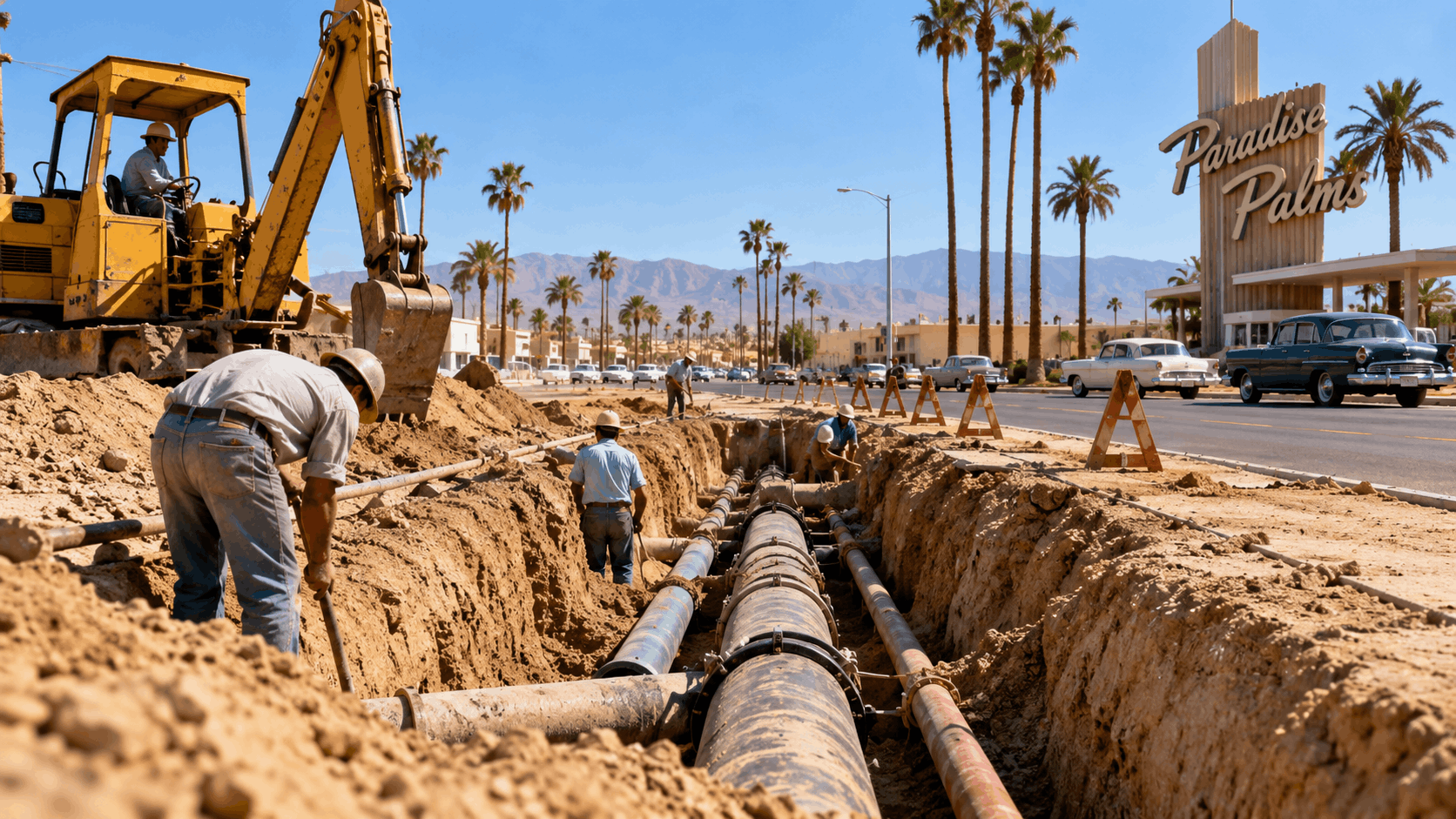
The original copper and cast iron that came down Maryland Parkway in 1960 has done sixty-five years of service, and it is now at the age where the first failures show. In these homes, age combines with post-and-beam framing, slab-on-grade foundations and very hard water to make the plumbing conversation different from anywhere else in the valley.
Doing it right means camera inspection and leak detection before any decision, a route planned through walls and soffits before cutting, treatment that protects restored fixtures, and respect for the Historic Neighborhood Overlay on anything visible from the street. It also means knowing the address is Clark County and confirming the permit and license before work begins.
If your Paradise Palms home is showing slow drains, a warm spot on the floor, pinhole leaks or scaled-up fixtures, reach out to Active Plumbing for a diagnostic and a written price before any work starts. We have worked homes across Paradise since 1991, we respond in 30 to 60 minutes when it is urgent, and we plan the job around the house you have spent years caring for.
Frequently Asked Questions
- What kind of pipe is behind the walls in a 1960s Paradise Palms home?
- Homes built between 1960 and 1964 in this valley typically carry copper supply lines of that era and cast iron drain, waste and vent piping. That is the honest starting point for a Paradise Palms home. It should always be confirmed on site, though, rather than assumed from the build year, because many of these houses have been renovated and may hold later repairs or modern PEX where a bathroom was redone.
- Why does a repipe cost more in a post-and-beam house?
- Palmer and Krisel post-and-beam homes have flat or low-pitch roofs and little or no accessible attic, which is the route a repipe normally takes. Without an attic, new supply lines have to run through walls, soffits and other routes, which means more access to cut and patch and more finish work at the end. That takes longer and costs more than the same repipe in a conventional pitched-roof home from the same decade.
- Do I have to break my terrazzo floor to fix an under-slab leak?
- Usually not. Detection comes first, so we locate the failed line precisely before any decision. In a home with restored terrazzo or polished concrete, breaking the slab destroys an irreplaceable floor, so rerouting is often the recommendation. We abandon the bad line in place and run a new line overhead through walls and soffits, which leaves the finished floor intact while giving the house a fresh line.
- Is my cast iron drain safe or does it need replacing?
- Cast iron of this age scales on the inside, cracks and separates at joints, and it shows up first as repeated slow drains and recurring blockages before anything dramatic happens. Whether it is safe or needs replacing depends on its actual condition, which repeated cabling cannot tell you. A camera inspection sent down the line shows the scale, cracks and joint separations directly, so the decision is based on what the pipe really looks like.
- How hard is the water in Paradise Palms?
- The Southern Nevada Water Authority states the valley's water is 280 parts per million, or about 16 grains per gallon, which is categorized as very hard. That hardness matters more in Paradise Palms because owners often install period-correct and high-end fixtures during restoration, and hard water scale fouls the narrow passages inside those cartridges and mixing valves. Whole-house treatment protects a restoration investment by reducing that scale throughout the system.
- Can I install a water softener or tankless unit on the outside wall?
- Anything visible from the street sits within the Paradise Palms Historic Neighborhood Overlay area, so an exterior tankless unit, a softener on a visible elevation or a new enclosure is worth confirming with Clark County before it goes up. Interior placement or a side or rear elevation that is not visible from the street usually avoids the concern entirely. The post-and-beam framing also limits where equipment can go, so placement is planned around both factors.
- Do I need a permit, and who issues it here?
- Paradise is unincorporated Clark County, not the City of Las Vegas, so the Clark County Department of Building and Fire Prevention handles permits, plan check and inspections for Paradise Palms. Permitted work must be performed by an appropriately licensed contractor. The permit position should be confirmed for your exact address, but for the original Paradise Palms tract the county is the authority, even though the mailing address reads Las Vegas.
- Why do my drains back up after monsoon storms?
- Late-summer monsoon storms produce short, intense rainfall that overwhelms drainage and backs up floor drains and yard drains across the valley. In Southern Nevada, rain, surface and subsurface water are prohibited from the sewer, and combined storm and sewer systems are not allowed, so the storm drainage and the sanitary sewer are meant to stay separate. Backups after a monsoon often point to yard and floor drains struggling with the sudden volume rather than a sewer problem.
- Should I worry about mixed pipe materials from old repairs?
- Renovated Paradise Palms homes can hold original 1960s copper, later repairs in other materials and modern PEX from a redone bathroom, all in one house. Mixed materials are not a problem by themselves, but where dissimilar metals meet, galvanic corrosion attacks the joint over time and can cause a slow leak years later. Mapping which materials run where, and where those joints are, guides the repair plan and shows where the next failure is most likely.
- How do I verify a plumber's license before work starts?
- Plumbing contractors in Nevada are licensed by the Nevada State Contractors Board, and you can verify any license free at nvcontractorsboard.com, where classification, status, bond and workers compensation are all public record. You are entitled to ask for a license number before work begins. Active Plumbing holds Nevada license #0047021 and has been licensed since 1991, and we are happy for owners to confirm it before any work on their home.
A
Licensed plumbing professionals serving Las Vegas and Las Vegas Valley.
Licensed in Nevada · License #0047021
Last updated on
Why trust Active Plumbing?
Founded in 1991, Active Plumbing is a licensed and insured plumber serving Las Vegas and Las Vegas Valley. All content is reviewed by our licensed technicians.

Need Help in Las Vegas?
Active Plumbing serves Las Vegas and all of Las Vegas Valley.
Related Articles
Maintenance
Cast Iron Drain Lifespan in 1950s-60s Las Vegas Homes - Downtown, Huntridge, Paradise Palms
Cast iron drains in 1950s-60s Downtown, Huntridge, and Paradise Palms homes are hitting the end of their 50-75 year life. Learn the warning signs, local factors, and repair options.

Tips & Advice
Drain Cleaning in Downtown Las Vegas and John S. Park: Original Cast Iron and Clay Laterals
A local guide to drain cleaning in Downtown Las Vegas and John S. Park, covering original cast iron and clay laterals, warning signs, cleaning methods, and repair options.
Tips & Advice
Sewer Line Repair in Paradise and Winchester: 60s-70s Clay Pipe Root Intrusion Capital of the Valley
Paradise and Winchester's 60s-70s clay pipes are root intrusion magnets. Learn the warning signs, camera inspection, repair options, and costs from Active Plumbing.