How Long Water Heaters Actually Last in Las Vegas Hard Water (With Flush vs Without)
Key Takeaways
- Las Vegas tap water comes from Lake Mead and tests around about 16 grains per gallon, among the hardest in the country.
- A water heater that is never flushed often fails at 6 to 8 years in local hard water.
- Flushing the tank once a year typically adds 3 to 5 years, pushing lifespan to 10 to 13 years.
- Scale buildup raises NV Energy bills and can void the warranty if maintenance records are missing.
- Tankless units last 15 to 20 years but need yearly descaling or they fail as fast as tanks.
- A water softener, a fresh anode rod, and a 120-degree setting all slow mineral buildup.
- Rust-colored water and leaks at the base mean replacement, while noise and slow heating may just need a flush.
- Active Plumbing flushes, repairs, and installs water heaters across Summerlin, Henderson, North Las Vegas, and the whole valley.
In This Article
A homeowner in Summerlin called us last spring after her water heater quit cold. She bought the house new in 2017 and figured she had years left on the tank. It failed at seven years old, flooding part of her garage off Town Center Drive.
Her story is one we hear across the valley every month. Water heaters here rarely reach the age printed on the sticker. Las Vegas hard water is the reason, and most people never see it coming until the hot water stops.
Why Las Vegas Hard Water Wrecks Water Heaters Quicker?
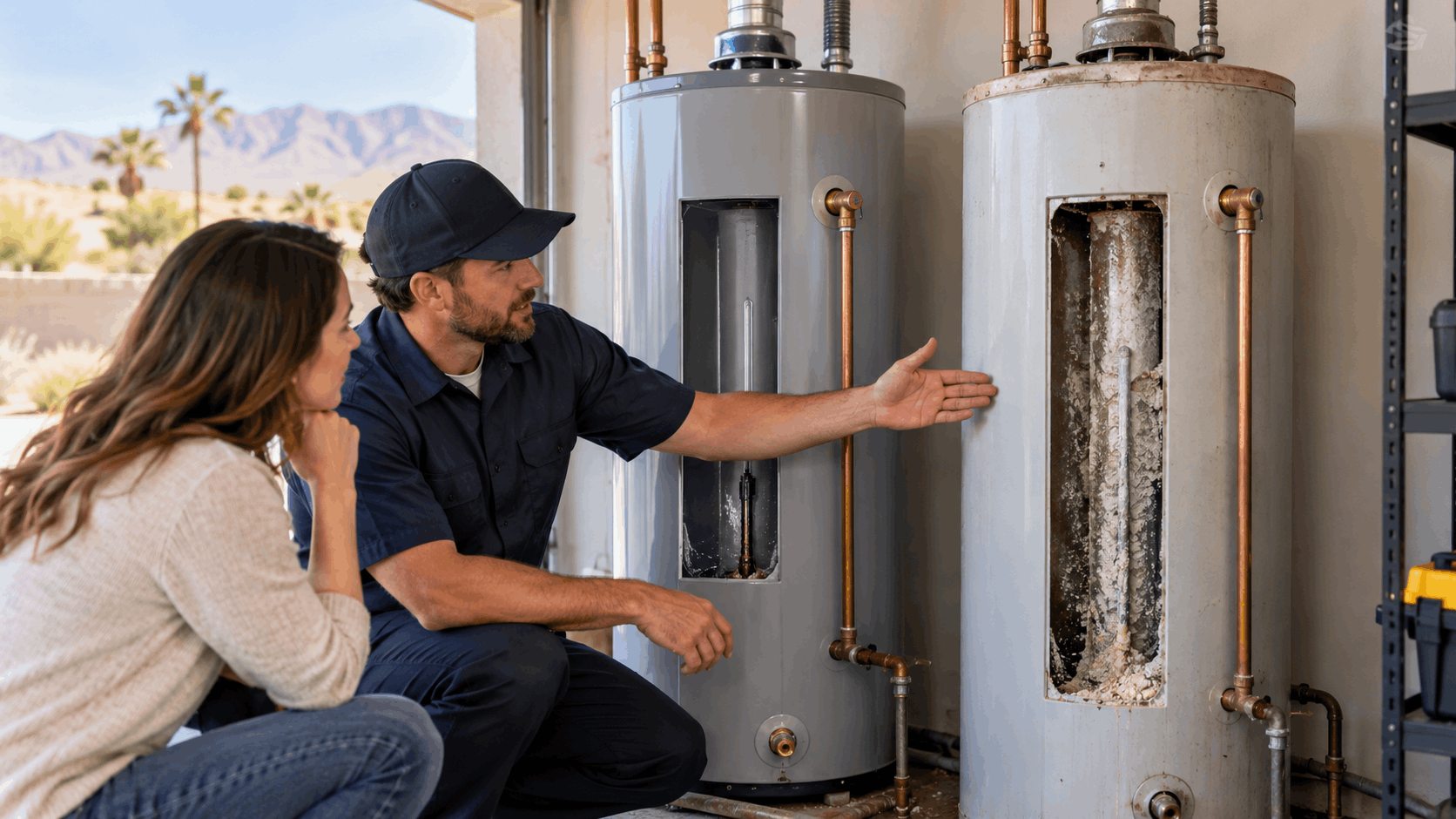
Hard water is the number one reason tanks fail early in Southern Nevada. The water that reaches your home carries a heavy load of dissolved minerals. Those minerals do not disappear when the water heats up. They settle, harden, and slowly destroy the tank from the inside.
Once homeowners understand the basic science, the short lifespans start to make sense. Mineral buildup is not a rare defect. It is the normal outcome of running Las Vegas water through a metal tank year after year.
What Makes Southern Nevada Water So Hard
Almost all of our tap water starts as snowmelt in the Rocky Mountains and flows down the Colorado River into Lake Mead. That water picks up calcium and magnesium along the way as it moves over rock and soil. By the time the Las Vegas Valley Water District (LVVWD) treats it and pipes it to your house, it is loaded with dissolved rock.
Calcium and magnesium are the two minerals that make water hard. They are harmless to drink, but they are murder on plumbing and appliances. When the water sits in a hot tank, these minerals fall out of solution and stick to metal surfaces.
The Las Vegas Valley Water District openly lists local water as hard on its water quality reports. That is not a knock on the utility. The source water simply carries more minerals than most of the country deals with.
Because the mineral level stays high year round, no neighborhood escapes it. A home in Enterprise gets the same hard water as one in Sunrise Manor. The tank pays the price either way.
How Sediment Builds Up Inside the Tank
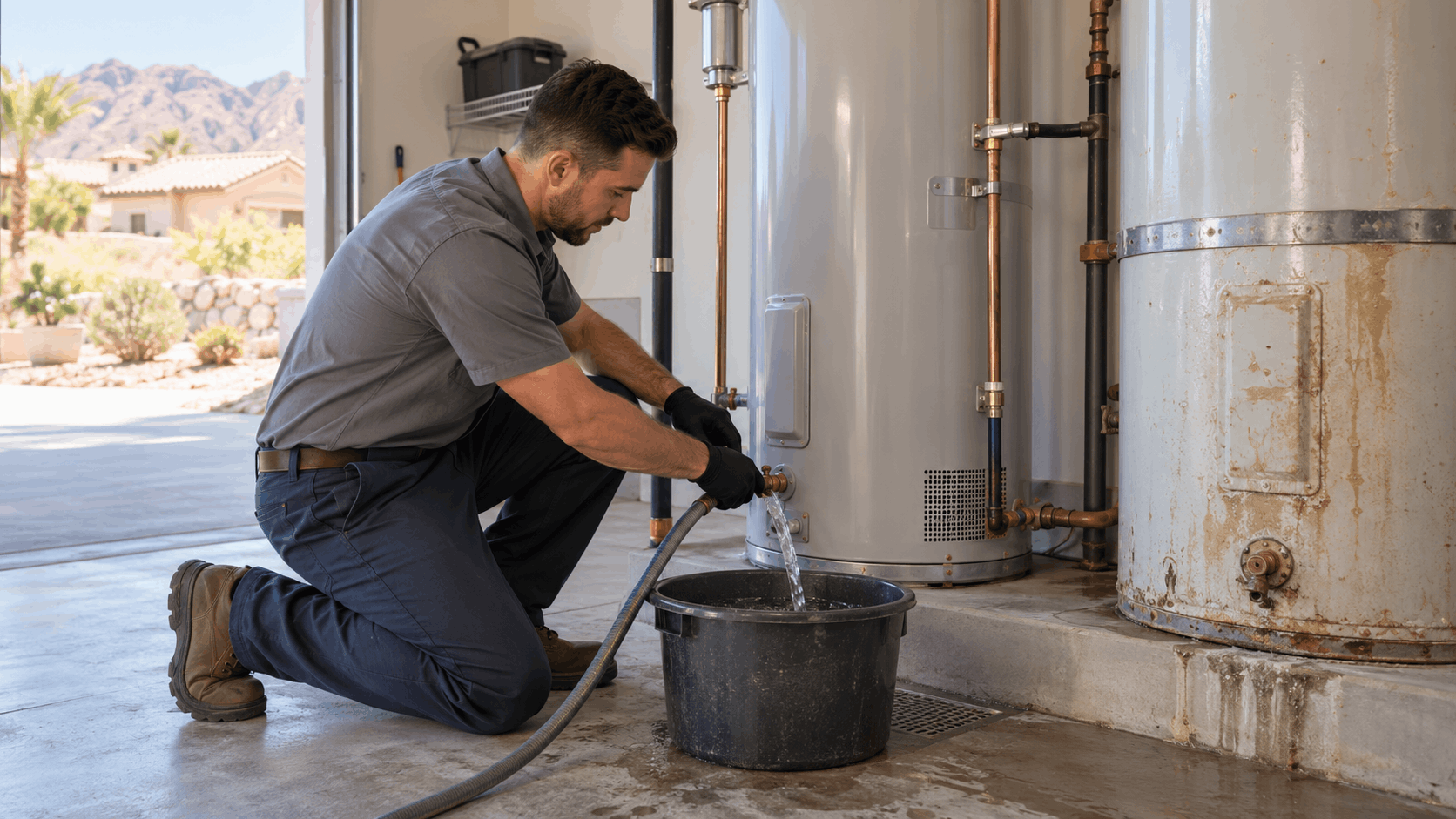
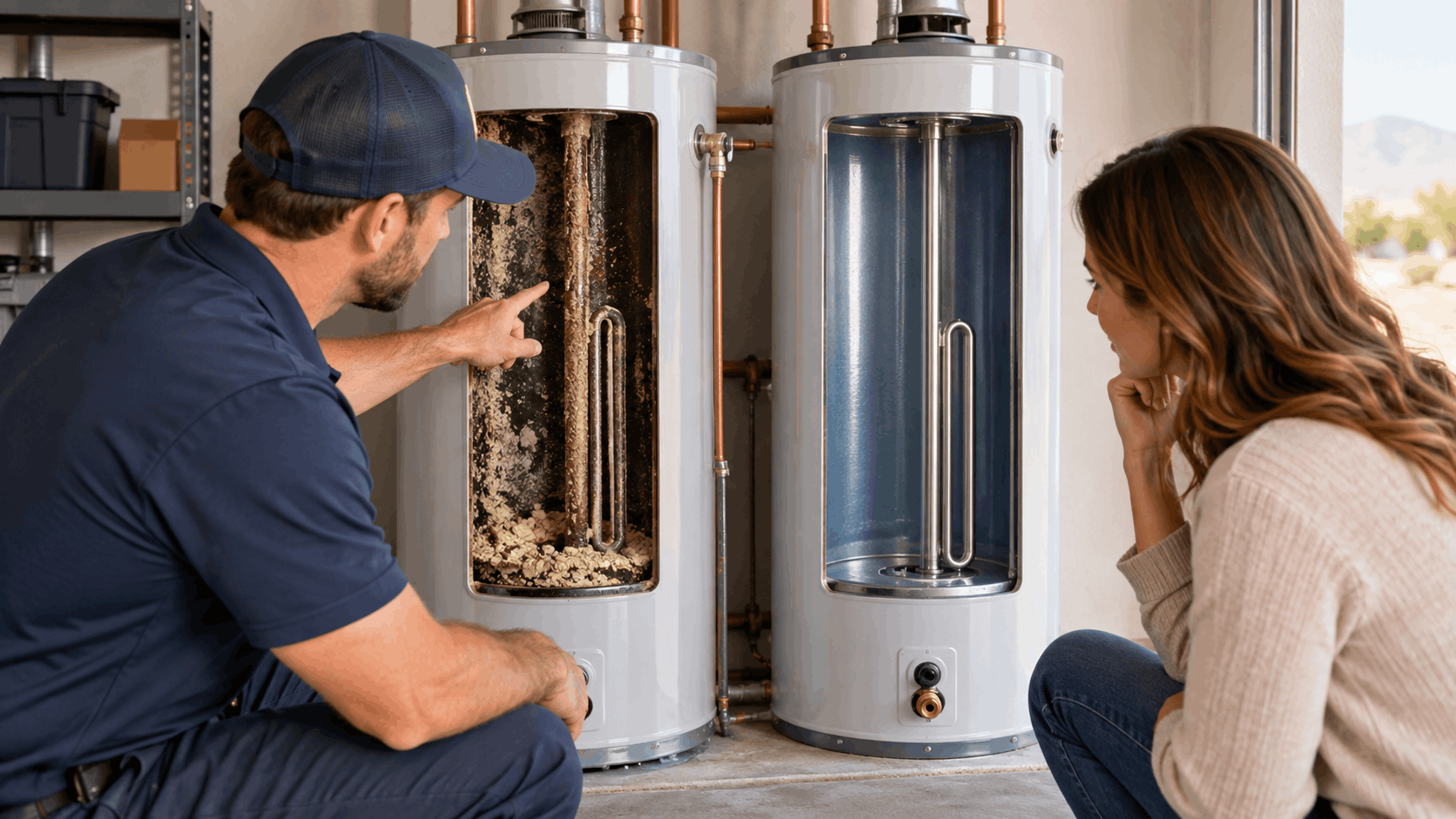
Every time the burner or element heats the water, minerals separate out and drift toward the bottom of the tank. Over months, that loose sediment settles into a thick layer. Left alone, it bakes into a hard crust of scale.
That scale acts like a blanket between the flame and the water in a gas unit. The burner has to run longer and hotter to push heat through the crust. All that extra heat stresses the steel and cooks the tank lining more quickly than normal.
On electric models, sediment buries the lower heating element. The element overheats, burns out, and the tank runs on the top element alone. Homeowners notice they run out of hot water halfway through a shower.
The layer at the tank bottom keeps thickening until a flush removes it or the tank simply gives up. We have drained tanks that poured out cups of gritty white and brown sludge. That is years of Lake Mead minerals collecting in one spot.
The Warning Signs Homeowners Notice First
The earliest clue is usually sound. A popping or crackling noise from the tank means water is boiling under the scale layer and forcing its way out. It is loud enough that people ask if the unit is about to explode.
Cloudy hot water is another common flag. When the hot side runs milky or leaves white flecks in a glass, minerals are shedding off the buildup inside. The cold water usually looks fine by comparison.
Slow heating rounds out the list. If the shower takes longer to warm up or the hot water runs out more quickly than it used to, scale is choking the heat transfer. Many homeowners just crank the thermostat higher, which makes the buildup worse.
Any one of these signs is worth a look. Together, they usually mean the tank has a serious sediment problem that a flush should address before real damage sets in.
Why Grains Per Gallon Matter Here
Water hardness is measured in grains per gallon, or gpg. Soft water sits below 1 gpg, and anything above 10.5 gpg is rated very hard by industry standards. Las Vegas routinely tests in the high teens.
That puts our valley among the hardest water in the entire country. Cities in the Midwest and Southwest fight the same battle, but few match the mineral load coming out of Lake Mead. Local tap water often reads around 16 to 18 gpg.
Those numbers explain why tanks age sooner here than the national data suggests. A tank rated for a decade in soft water is fighting three times the mineral load in Las Vegas. The math simply does not favor a long life without help.
Knowing your hardness rating helps you plan. Homeowners in very hard zones should treat flushing and softening as routine, not optional. The higher the gpg, the shorter the tank runs without care.
Get Your Quote
Tell us what's going on and we'll get back to you. We're open 24/7.
How Long Water Heaters Really Last Around the Valley
Manufacturer warranties promise a lot. Real life in Las Vegas tells a different story. After thousands of service calls across the valley, we have a clear picture of what tanks actually do here.
The single biggest factor is maintenance. A flushed tank and a neglected tank in the same neighborhood can live years apart. Here is what the numbers look like on the ground.
| Scenario | Typical Lifespan in Las Vegas |
|---|---|
| National average (all climates) | 8 to 12 years |
| Tank, never flushed | 6 to 8 years |
| Tank, flushed yearly | 10 to 13 years |
| Tankless, descaled yearly | 15 to 20 years |
| Tankless, never descaled | 8 to 10 years |
The National Average vs What We See Here
The commonly quoted lifespan for a tank water heater is 8 to 12 years. That figure comes from national data spread across soft and hard water regions. It assumes average conditions that Las Vegas does not have.
In our service area, the honest average lands lower. Most tanks we replace are between 7 and 10 years old, and plenty fail sooner. The hard water simply eats through the useful years more quickly.
The gap between the brochure number and the real number surprises many homeowners. They assume a 12 year warranty means 12 years of service. In this valley, that only happens with steady upkeep.
We would rather set honest expectations than sell a fantasy. Knowing the real range helps homeowners budget for replacement and avoid a surprise flood in the garage.
Tank Life Without Any Flushing
A tank that never gets flushed lives on borrowed time from day one. In hard water zones like parts of North Las Vegas, we regularly see neglected tanks fail at 6 to 8 years. Some do not even make it to six.
The reason is the sediment layer we described earlier. With no maintenance, scale keeps stacking until it overheats the metal and cracks the glass lining. Once the steel is exposed, rust and leaks follow fast.
These are the calls that turn into emergencies. A tank that rusts through does not warn you politely. It splits open and dumps 40 or 50 gallons onto the floor, sometimes in the middle of the night.
Homeowners who skip maintenance often pay twice: once for the early replacement and once for the water damage cleanup. A little upkeep prevents both.
Tank Life With Regular Flushing
The picture changes dramatically with an annual flush. The same tank model in the same water can reach 10 to 13 years when the sediment is cleared out every year. That is often double the life of a neglected unit.
Flushing keeps the burner or element working against clean water instead of a crust of scale. The tank runs cooler, the metal lasts longer, and the glass lining stays protected. Small effort, big payoff.
We have customers in Summerlin and Henderson who have kept the same tank past a decade purely through yearly service. They spend a modest amount each year and skip the early replacement bill entirely.
Our water heater services team handles these flushes across the valley. Booking one every year is the simplest way to add years to your tank.
Tankless Units in Hard Water
Tankless heaters last longer than tank models, often 15 to 20 years, because they have no reservoir to rust out. But hard water still threatens them through the heat exchanger. Scale forms inside those tiny passages and blocks flow.
A tankless unit that never gets descaled can fail in 8 to 10 years, no better than a tank. The mineral buildup restricts water flow and triggers error codes that shut the unit down. The repair bill on a clogged exchanger is steep.
The fix is regular descaling, which flushes a mild acidic solution through the system to dissolve scale. In Las Vegas water, tankless units need this yearly or the warranty savings evaporate. Our tankless maintenance and descaling service keeps those exchangers clear.
For homeowners considering the switch, tankless is a solid choice here as long as they commit to upkeep. We install these units through our tankless water heater installation service and set up a descaling schedule at the same time.
Need Help in Las Vegas?
Active Plumbing serves Las Vegas and all of Las Vegas Valley.
Flush vs No Flush: The Real Difference in Numbers
Homeowners often ask if flushing is worth the cost and hassle. The honest answer is yes, by a wide margin. The numbers make the case better than any sales pitch could.
A flush affects three things at once: how long the tank lasts, how much energy it burns, and how much you spend on repairs. Here is how flush vs no flush stacks up side by side.
| Factor | No Flush | Yearly Flush |
|---|---|---|
| Average lifespan | 6 to 8 years | 10 to 13 years |
| Energy efficiency | Drops as scale builds | Stays near new |
| Risk of early failure | High | Low |
| Warranty protection | Often voided | Maintained with records |
Years Gained From Yearly Maintenance
In local homes, a yearly flush typically adds 3 to 5 years of tank life. That is the difference between replacing a heater at year seven or riding it comfortably past year eleven. For most households, those extra years are pure savings.
The added years come from stopping scale before it hardens into a permanent crust. Fresh sediment rinses out easily. Baked-on scale does not, and once it forms, it keeps damaging the tank no matter what you do later.
Think of it like changing oil in a car. Skip it and the engine wears out early. Do it on schedule and the machine lasts far beyond expectations.
The math is straightforward. A handful of yearly flushes costs a fraction of one early tank replacement, and it buys years of extra service.
Energy Bills With and Without Buildup
Scale does not just shorten tank life. It drives up your monthly NV Energy bill the entire time it sits there. A sediment layer forces the burner to work harder to heat the same water.
Even a quarter inch of scale can cut heating efficiency by a noticeable margin. The U.S. Department of Energy notes that sediment buildup lowers water heater efficiency and raises operating costs. That loss shows up every billing cycle.
Over a year, a scaled tank can quietly add real dollars to your gas or electric bill. Multiply that across several years and the waste adds up. The tank costs you more to run while it wears out sooner.
A flushed tank runs close to its rated efficiency. Homeowners often tell us their hot water recovers more quickly and their bills settle down after a service. Clean heat transfer is cheaper heat.
Repair and Replacement Cost Comparison
A professional flush is a modest recurring cost. A new tank plus installation is many times that amount, and an emergency replacement costs even more. The comparison is not close.
When a neglected tank fails, the bill rarely stops at the heater. Water damage to drywall, flooring, and stored belongings piles on. A garage flood in a home off Aliante Parkway can turn a simple job into a major expense.
Routine flushing avoids that whole chain of costs. You pay a small amount yearly and skip the big surprise bill. If a leak ever does start, our emergency plumbing team can respond fast, but prevention is always cheaper.
Spread over the life of a tank, maintenance is the budget-friendly path. It smooths costs into small predictable amounts instead of one painful hit.
Warranty Coverage and Flushing Records
Most water heater warranties require proof of regular maintenance. Skip the flushes and a manufacturer can deny a claim when the tank fails early. Homeowners learn this the hard way when they file for a replacement.
Keeping records protects you. A dated service receipt shows the tank was cared for according to the manufacturer's terms. That paperwork can be the difference between a covered claim and paying out of pocket.
Our team documents every flush and service we perform. Homeowners get a clear record they can hand to a warranty provider if the need ever comes up. It is a small detail that carries real value.
Treating maintenance as part of ownership keeps both the tank and the warranty intact. It is the cheapest insurance a homeowner can buy on a major appliance.
What a Water Heater Flush Actually Involves
Some homeowners picture a flush as a big, messy job. In reality, it is a straightforward service that a trained plumber wraps up in under an hour on most units. Knowing the steps helps you understand what you are paying for.
The goal is simple: remove the sediment sitting at the bottom of the tank before it hardens. Here is how the process works from start to finish.
Step by Step: How a Tank Gets Flushed
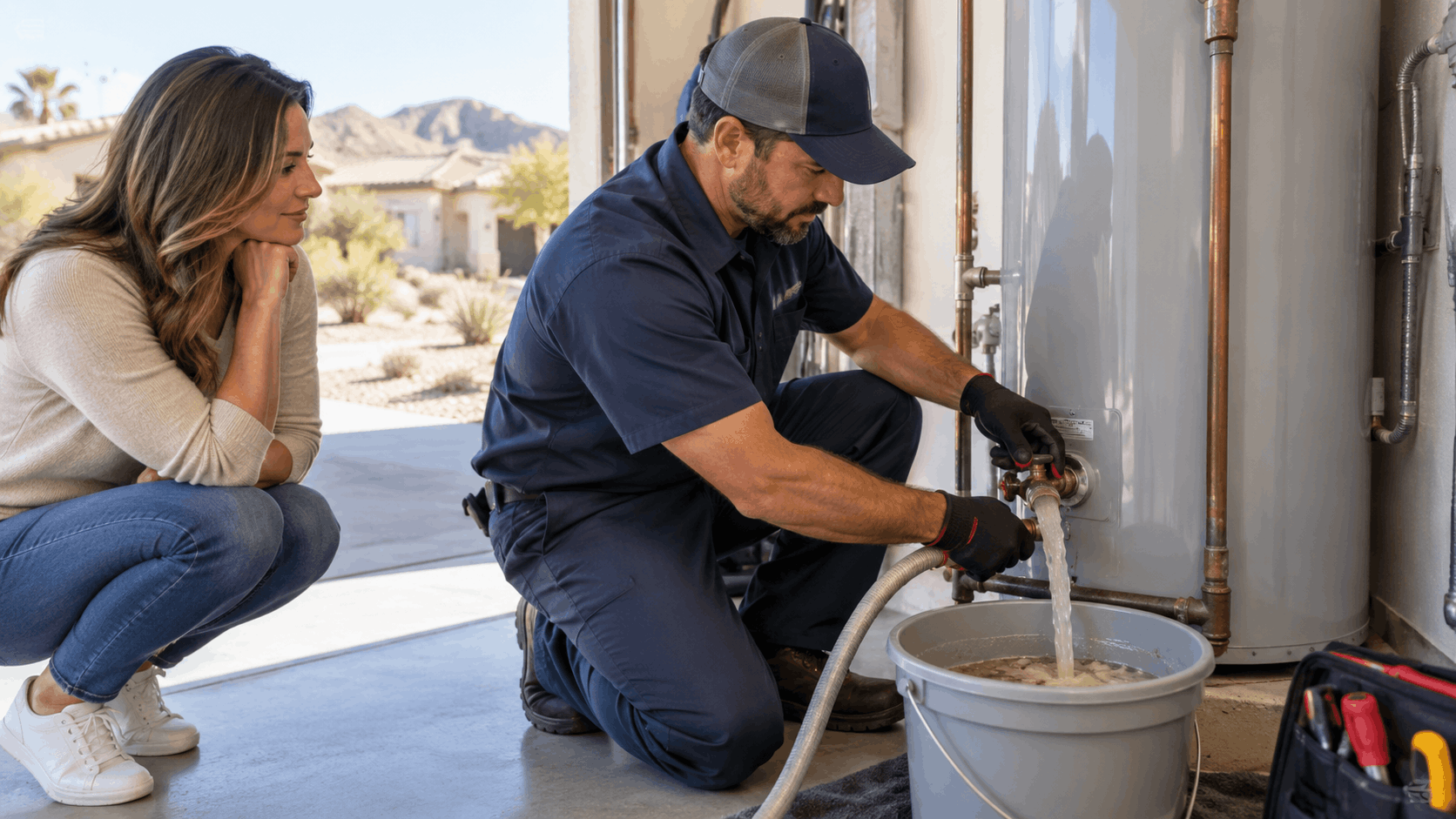
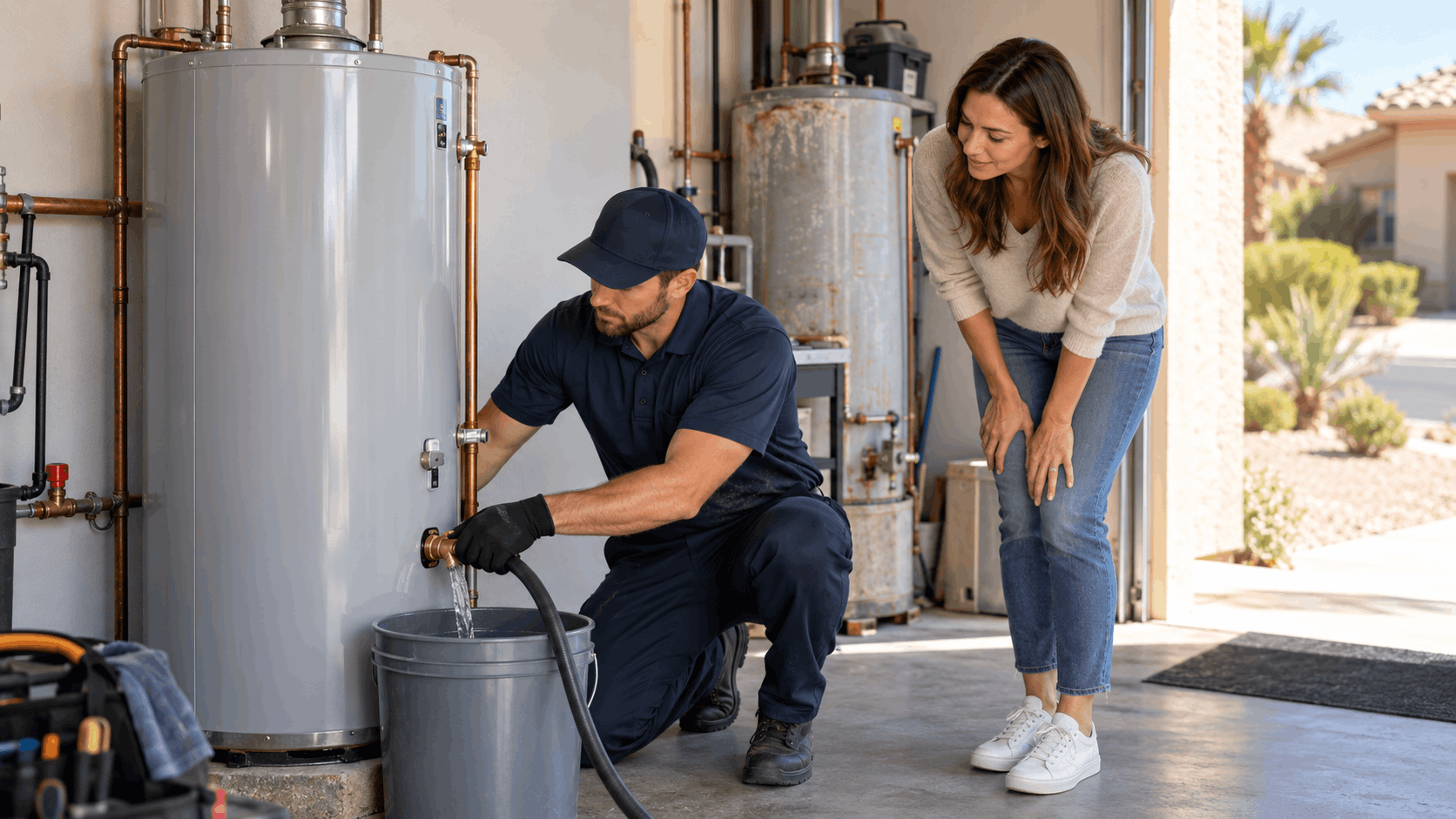
First, the technician shuts off the power or gas and turns off the cold water supply to the tank. This keeps things safe and stops fresh water from stirring up the sediment during the drain. A hose gets connected to the drain valve at the base.
Next comes draining the tank. The water runs out through the hose to a safe spot outside or into a drain. On a scaled-up unit, the first gush often carries out chunks of white and brown mineral grit.
Then the tank gets rinsed. The technician opens the cold supply in short bursts to stir up and flush out any sediment left on the bottom. This sediment removal continues until the water runs clear.
Finally, the tank refills, the air bleeds out through a hot tap, and the power or gas comes back on. Within a short while, the unit is heating clean water again. The whole job is clean and quick when done right.
How Often Local Homes Should Flush
For most Las Vegas homes on city water, once a year is the right flush frequency. That schedule keeps sediment from ever hardening into scale. It matches the mineral load coming from Lake Mead.
Homes on private wells around the outskirts of the valley may need it twice a year. Well water can carry even higher mineral levels than treated city supply. Those tanks fill with sediment more quickly and benefit from a second service.
Larger households also fill sediment more quickly because the heater cycles more often. A family of five uses far more hot water than a couple. More heating cycles mean more minerals dropping out per year.
Setting a fixed annual schedule takes the guesswork out. Pick a month, tie it to another yearly chore, and the flush never slips through the cracks.
DIY Flush vs Calling a Plumber
A handy homeowner can flush a tank, and for a young unit it is a reasonable DIY project. The tools are simple: a garden hose and some patience. Done yearly from the start, it works fine.
The trouble comes with older or heavily scaled tanks. A drain valve that has never been opened can clog with hardened sediment or break off entirely. We have been called to homes where a DIY flush turned into a stuck valve and a flooded floor.
A professional plumber knows how to handle a stubborn valve, clear a blockage, and spot problems while the tank is open. We also check the anode rod and inspect for early corrosion during the visit. That extra set of eyes catches issues before they become failures.
For a newer tank, DIY once a year is fine. For an aging unit or one that has never been serviced, calling a pro is the safer call. Our water heater repair team handles both the routine and the tricky jobs.
Checking the Anode Rod During Service
The anode rod is a sacrificial metal rod inside the tank that corrodes so the tank walls do not have to. It quietly protects the steel by attracting the corrosion to itself. In hard water, it wears out sooner than average.
During a flush, a good technician checks the anode rod's condition. If it is heavily eaten away, the tank has lost its main defense against rust. Replacing it at that point can add years of corrosion protection.
Many early tank failures trace back to a spent anode rod that no one checked. Once the rod is gone, the tank itself becomes the sacrifice. That is when leaks start.
Bundling an anode inspection with the yearly flush is smart. It costs little and can prevent a full replacement. We look at the rod on every water heater service we perform.
Need Help in Las Vegas?
Active Plumbing serves Las Vegas and all of Las Vegas Valley.
Neighborhood Differences Across the Las Vegas Valley
Every part of the valley drinks from the same Colorado River source, so hard water is universal here. But home age, plumbing condition, and a few local factors change how quickly tanks fail. We see clear patterns by neighborhood.
Knowing your area's tendencies helps you plan maintenance. Here is what our crews run into across the different corners of town.
Older Homes Near Downtown and the Historic Westside
Older homes near downtown Las Vegas and the historic Westside carry decades of plumbing history. Aging galvanized pipes and older fixtures add rust and buildup to what the water heater already deals with. The tank fights both hard water and debris from the pipes.
In neighborhoods like John S. Park, the combination shortens tank life further. Sediment from old lines settles into the heater along with the mineral scale. We often find tanks in these homes packed with more debris than newer builds.
These homes benefit most from a full plumbing look, not just a heater flush. Sometimes the pipes feeding the tank are the real problem. Our pipe and fixture services address the whole picture.
Homeowners in these older areas should flush yearly without fail and keep an eye on water color. Rusty hot water in an old home usually means the tank, the pipes, or both need attention. Nearby residents can also review our Arts District drain and sewer services for related plumbing help.
Newer Builds in Summerlin and Southern Highlands
New homeowners in Summerlin and Southern Highlands often assume modern construction protects them from hard water. It does not. The fixtures are new, but the water flowing through them off the 215 Beltway is just as hard as anywhere else.
A five-year-old home in a master-planned community still gets full-strength Lake Mead minerals. The tank collects sediment on the same timeline as an older house. The only difference is the pipes are cleaner to start.
We tell new homeowners not to wait for warning signs. Start flushing from year one and the tank will reach the top of its lifespan range. Skip it and even a brand new heater can fail in six or seven years.
Communities across Summerlin see the same pattern year after year. Residents in Summerlin West and surrounding areas can pair a yearly flush with a softener for the best results. New does not mean immune.
Henderson and Green Valley Considerations
Homes near Green Valley Parkway and throughout Henderson pull from the same Colorado River supply as the rest of the valley. The hardness level barely changes from one city to the next. A tank in Henderson faces the same mineral load as one in Las Vegas.
Henderson has a mix of older established neighborhoods and newer developments. Both deal with hard water, though the older sections add pipe age to the equation. Tank lifespans track closely with maintenance habits here.
We service heaters throughout Henderson, from Green Valley to the communities near Lake Las Vegas. The advice is consistent: flush yearly, check the anode rod, and consider softening. Homeowners in Whitney Ranch and nearby areas follow the same playbook.
Residents can also learn more about our full range of work on our Henderson services page. The same hard water rules apply across the whole city.
North Las Vegas and Aliante Growth Areas
North Las Vegas has grown fast over the past two decades, especially around Aliante. A wave of homes built in the mid-2000s means a lot of first-owner water heaters are hitting failure age right now. We field a steady stream of replacement calls from these neighborhoods.
Many of these tanks were never flushed. The original owners did not know Las Vegas water demanded it, and the heaters quietly filled with scale. Now they are failing at the 12 to 15 year mark despite never being maintained, or dying much earlier.
The growth areas near Aliante Parkway and out toward Elkhorn share this pattern. Homeowners buying resale properties should have the water heater inspected before it fails. An old, unflushed tank is a leak waiting to happen.
We work throughout these neighborhoods and can flush, repair, or replace as needed. Residents can check our Aliante drain and sewer services and broader North Las Vegas coverage for help.
Protecting Your Water Heater From Hard Water Damage
Flushing is the front line of defense, but homeowners have other tools too. A few added steps slow buildup and stretch tank life even further. Combined, they make a real difference in this hard water.
None of these are complicated or expensive. They are practical habits and small upgrades that pay off over years. Here is where we tell homeowners to focus.
Water Softeners and Conditioners
A whole-home water softener removes calcium and magnesium before the water ever reaches the tank. Less mineral in the water means far less scale forming inside the heater. It is the most effective way to attack the root problem.
A softener helps the entire house, not just the water heater. Faucets, dishwashers, washing machines, and shower heads all last longer with softened water. Skin and hair feel different too, which many homeowners notice right away.
We install traditional salt-based softeners and salt-free conditioners depending on what a home needs. Our water softener installation service sizes the unit to your household. For those who prefer no salt, we also offer salt-free water conditioning.
Pairing a softener with a yearly flush is the strongest combination for hard water. The softener cuts the mineral load and the flush clears whatever still gets through. Together they can push a tank to the very top of its lifespan.
Adjusting Temperature to Reduce Scale
Hotter water drops minerals out of solution more quickly. A tank set to 140 degrees or higher builds scale quicker than one set lower. Turning the thermostat down slows the whole process.
The recommended setting is around 120 degrees. It is hot enough for showers, dishes, and laundry while cutting scale formation and saving energy. It also lowers the risk of scalding, which matters in homes with kids or older adults.
Most tanks ship set higher than needed. A quick adjustment to 120 degrees costs nothing and helps on multiple fronts. We check and set this during service visits.
Lower temperature will not stop scale entirely in this water, but it slows it down. Combined with flushing, it is one more way to keep the tank running clean. Small settings add up over years.
Replacing the Anode Rod on Schedule
The anode rod is the unsung hero of tank longevity. It corrodes on purpose to spare the tank walls from rust. In Las Vegas hard water, it wears out in as little as three to five years.
Replacing the rod on schedule keeps corrosion protection active for the tank's whole life. A fresh rod costs a fraction of a new heater and can prevent early failure. It is one of the best-value services for a tank owner.
Many homeowners never know the rod exists until the tank leaks. By then the rod is long gone and the steel has been corroding for years. Regular inspection prevents that silent decline.
We check the rod during every flush and recommend replacement when it is worn. Keeping a good anode in place is a simple way to fight corrosion in this mineral-heavy water. It buys real years.
Setting Up a Maintenance Reminder
The best maintenance plan is one you actually follow. Yearly service only works if the flush gets scheduled and done. A reminder keeps it from slipping past.
Many homeowners tie the flush to another annual task, like changing HVAC filters or testing smoke detectors. Pick a memorable month and stick with it. Consistency is what protects the tank.
We help customers set up a maintenance schedule so the yearly service never gets forgotten. A quick call or reminder keeps the tank on track. It takes the mental load off the homeowner.
Regular yearly service is the single most reliable way to get the full lifespan out of a tank in this water. Set it, keep it, and the heater rewards you with extra years. Reach out through our contact page to get on a schedule.
Need Help in Las Vegas?
Active Plumbing serves Las Vegas and all of Las Vegas Valley.
When to Repair vs Replace Your Water Heater
At some point every tank reaches the end of the road. The trick is knowing whether a repair buys real time or just delays the inevitable. Age and the type of problem guide the decision.
We give honest advice on this. Sometimes a small fix is the right call, and sometimes replacement is the smarter money. Here is how to tell the difference.
Signs the Tank Is Near the End
Rust-colored hot water is one of the clearest warning signs. It usually means the inside of the tank is corroding and the anode rod is spent. Once rust reaches the water, the tank is on its final stretch.
A leak at the base of the tank is even more serious. Water pooling under the unit almost always means the steel has failed. That kind of leak does not get better and often ends in a full rupture.
Repeated repairs are the third signal. If a tank needs a new part every few months, the money is better spent on a replacement. Throwing repairs at a worn-out tank rarely pays off.
Age matters too. A tank past 10 to 12 years showing any of these signs is telling you it is done. Replacing it on your terms beats an emergency at 2 a.m.
When a Flush Can Still Save It
Not every struggling tank needs replacing. If the only issue is sediment buildup, a flush can restore performance and buy more years. A younger tank with popping noises and slow heating is a prime candidate.
When a tank is under eight years old and shows no rust or leaks, buildup is usually the culprit. Clearing the sediment often brings back fast recovery and quiet operation. The tank runs like it did when it was new.
We always try the flush fix before recommending replacement on a sound tank. There is no reason to replace a healthy unit that just needs cleaning. Honest diagnosis saves homeowners money.
The line is drawn at rust and leaks. Sediment is fixable. A corroded or leaking tank is not, no matter how thorough the flush.
Choosing the Right Replacement for Local Water
When replacement is the answer, homeowners face the tank versus tankless choice. Both work in Las Vegas, and both need maintenance to handle the hard water. The right pick depends on the household.
Tank models cost less upfront and are simple to service. Tankless units cost more to install but last longer and save space, as long as they get descaled yearly. Families that use lots of hot water often like the endless supply of tankless.
Water quality plays into the decision too. A softener paired with either type extends its life considerably. We often recommend adding water treatment at the same time as a new heater to protect the investment.
Whichever route a homeowner chooses, proper sizing matters. An undersized unit runs constantly and wears out early, while an oversized one wastes money. We match the heater to the home's real demand.
How Active Plumbing Handles Local Installs
Our team has installed and serviced heaters in nearly every corner of the valley. We size each unit to the household, not to a one-size guess. That means the right capacity for how a family actually uses hot water.
We install both tank and tankless systems and set up maintenance from day one. Every install comes with guidance on flushing, softening, and anode care specific to Las Vegas water. The goal is a heater that reaches the top of its lifespan.
We also handle the whole system, from the gas line to the recirculation pump if a home wants more quickly hot water. Our recirculation pump installation pairs well with a new heater in larger homes.
From Summerlin to North Las Vegas, our crews know the local water and the local homes. Whether you need a flush, a repair, or a full replacement, Active Plumbing handles the job right the first time.
Final Thoughts
Las Vegas hard water is tough on water heaters, but it does not have to catch you off guard. A neglected tank often fails at 6 to 8 years, while a flushed one reaches 10 to 13. That gap is entirely within a homeowner's control.
Yearly flushing, a good anode rod, a softener, and a sensible temperature setting all work together to fight the minerals from Lake Mead. None of it is complicated or costly compared to an early replacement. Small habits add up to real years.
If your tank is making noise, running lukewarm, or simply getting up in age, reach out to our team. Call Active Plumbing or use our contact page to schedule a flush, an inspection, or a consultation on a new install. We will give you an honest look at where your heater stands and how to get the most years out of it.
Frequently Asked Questions
- How long does a water heater last in Las Vegas hard water?
- The honest range is 6 to 13 years, and flushing habits decide where a tank lands. A unit that never gets flushed often fails at 6 to 8 years because scale from Lake Mead minerals overheats and corrodes the metal. A tank flushed once a year commonly reaches 10 to 13 years in the same water. Maintenance is the biggest factor by far in this valley.
- Does flushing really add years to a water heater?
- Yes, and the difference is measurable. In local homes, a yearly flush typically adds 3 to 5 years of tank life by clearing sediment before it hardens into permanent scale. Fresh sediment rinses out easily, but baked-on scale keeps damaging the tank no matter what. A handful of yearly flushes costs far less than one early replacement, which makes the return obvious.
- How often should I flush my water heater here?
- Once a year is the right schedule for most Las Vegas homes on city water. That frequency keeps sediment from ever hardening against the tank. Homes on private wells around the valley outskirts often need it twice a year because well water can carry even higher mineral levels. Large households that use lots of hot water also benefit from more frequent service.
- What happens if I never flush my water heater?
- Sediment stacks up until it bakes into a hard scale layer at the tank bottom. That crust overheats the metal, cuts efficiency, and raises your NV Energy bill every month. The tank fails years earlier than it should, often at 6 to 8 years, and frequently ends in a leak or rupture. The result is an early replacement plus possible water damage cleanup.
- Can I flush the tank myself?
- You can if the tank is fairly new and the drain valve works. A garden hose and some patience are the main tools. The risk comes with older or heavily scaled tanks, where a valve that has never been opened can clog or break off and cause a flood. For an aging or never-serviced unit, a professional plumber is the safer choice.
- Will a water softener help my water heater last longer?
- Absolutely. A softener removes calcium and magnesium before the water reaches the tank, so far less scale forms inside. That protects the heater and every other appliance in the home, from the dishwasher to the shower heads. Pairing a softener with a yearly flush is the strongest combination for Las Vegas hard water and can push a tank to the top of its lifespan range.
- How much does a water heater flush cost in Las Vegas?
- A professional flush is a modest service, generally falling in the low three-figure range depending on the tank and its condition. Heavily scaled tanks or units with stuck valves may cost a bit more due to the extra work. Either way, the price is a fraction of a new tank plus installation. It is one of the best-value maintenance items a homeowner can schedule.
- Are tankless water heaters worth it in hard water?
- They can be, with one condition. Tankless units last 15 to 20 years and save space, but hard water forms scale inside the heat exchanger and can cause failure in 8 to 10 years without care. The fix is yearly descaling, which flushes an acidic solution through the system to clear the buildup. Commit to that schedule and tankless is a strong choice here.
- What are the signs my water heater is failing?
- Watch for leaks at the base of the tank, rust-colored hot water, popping or crackling noises, and inconsistent heat that runs out fast. A leak or rusty water usually points to internal corrosion and a tank near the end. Noise and slow heating often mean sediment buildup that a flush may still fix. Any of these signs is worth a professional look.
- How do I know if I need a repair or a full replacement?
- Age and the type of problem guide the call. A tank under eight years old with no rust or leaks usually just needs a flush or a small repair. A unit past 10 to 12 years showing rust-colored water, a leaking base, or repeated breakdowns is ready for replacement. We give an honest diagnosis so you never pay to replace a tank that only needs cleaning.
Licensed plumbing professionals serving Las Vegas and Las Vegas Valley.
Licensed in Nevada · License #0047021
Last updated on
Why trust Active Plumbing?
Founded in 1991, Active Plumbing is a licensed and insured plumber serving Las Vegas and Las Vegas Valley. All content is reviewed by our licensed technicians.

Need Help in Las Vegas?
Active Plumbing serves Las Vegas and all of Las Vegas Valley.
Related Articles
How Often to Flush a Water Heater in Las Vegas: The 16-Grain Hardness Schedule
Las Vegas water runs about 16 grains hard, so tanks need flushing every 6 months. Learn the 16-grain schedule, warning signs, DIY steps, and pro maintenance.
Sediment Tank Flush: Why Vegas Water Heaters Need It Every 18 Months
Las Vegas hard water causes rapid sediment buildup in water heaters. Learn why an 18-month flush schedule protects your tank, saves energy costs, and prevents expensive failures in the desert.
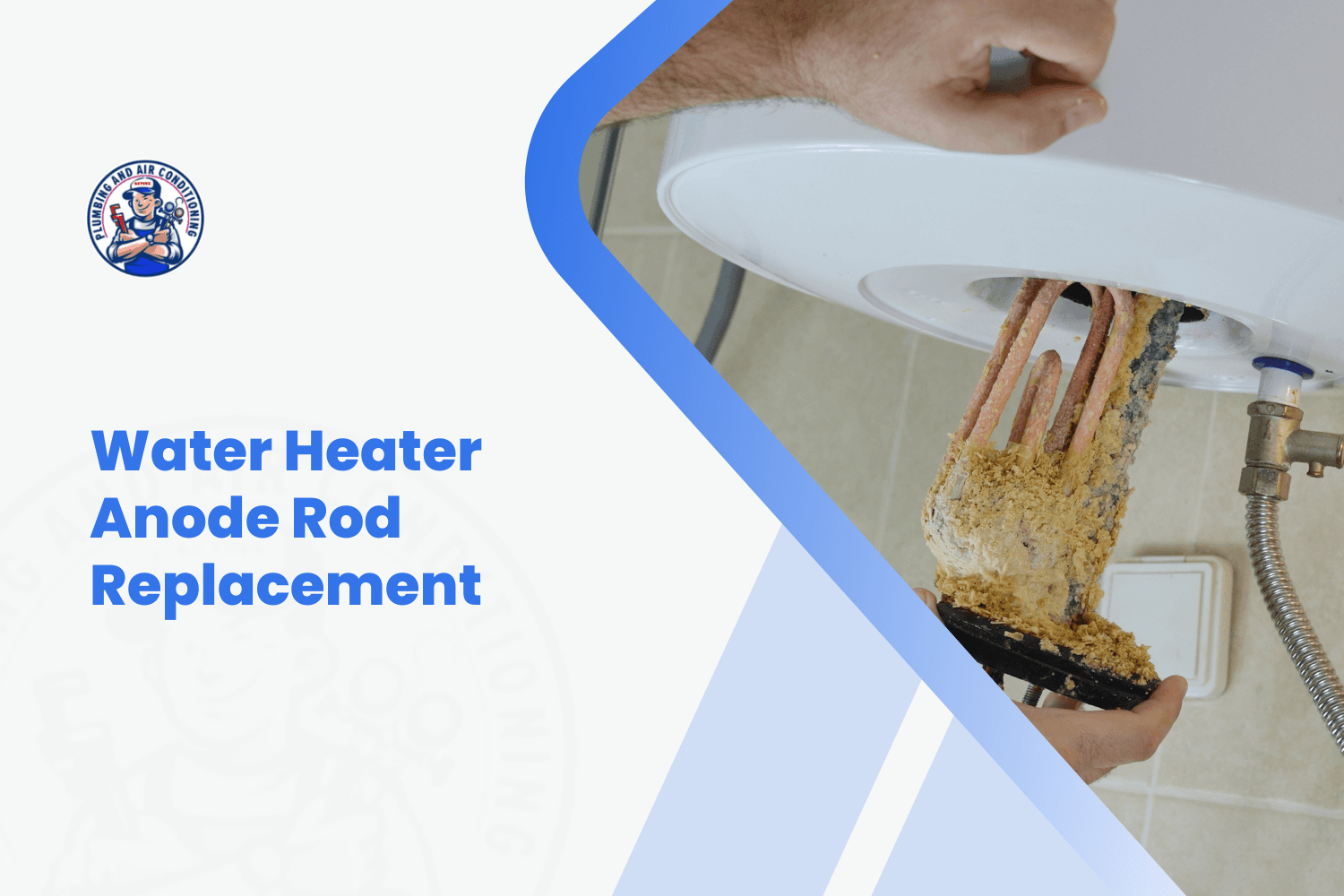
Water Heater Anode Rod Replacement: Why Vegas Hard Water Eats Them in 18 Months
Las Vegas hard water destroys anode rods in 18 months instead of years. Learn the warning signs, replacement costs, and how to protect your water heater long term.