Safety & Prevention
Does Your Las Vegas Home Have Kitec? The 1995-2007 Builds in Summerlin, Green Valley, and Anthem Most Affected
Key Takeaways
- Kitec is a PEX-AL-PEX pipe with high-zinc brass fittings installed in many Las Vegas homes built between 1995 and 2007.
- Hard water from the Colorado River and desert heat speed up corrosion inside the brass fittings, leading to leaks.
- Summerlin's older villages, Green Valley, Green Valley Ranch, Anthem, Sun City Anthem, Aliante, and Southern Highlands carry the highest risk.
- Look for orange hot and blue cold pipes plus printed labels like Kitec, IPEX, or PlumbBetter near the water heater and under sinks.
- Spot repairs rarely work because all the fittings age together; a full repipe with PEX-A or copper removes the risk for good.
- Kitec can raise insurance premiums, trigger non-renewals, and lower home value, and it must be disclosed when selling in Nevada.
- The class action settlement deadline has passed, so current homeowners now cover repair costs themselves.
- A proactive repipe on your own schedule is cheaper and safer than dealing with a sudden burst-fitting flood.
In This Article
A homeowner in The Trails village of Summerlin recently opened the cabinet under her kitchen sink to grab a dish sponge. Instead, she found a white, crusty buildup coating a yellow-brass fitting and a small puddle forming on the cabinet floor. That crusty ring is one of the clearest warning signs we see in homes built during the valley's construction rush.
What she found was almost certainly Kitec plumbing. It is a type of pipe installed in thousands of Las Vegas homes between 1995 and 2007, and it has a well-documented habit of failing early. The problem lives at the brass fittings, and our hard desert water speeds the whole thing up.

What Kitec Plumbing Actually Is?
Kitec plumbing is a brand of flexible pipe that combines plastic and metal in one product. It was sold across North America, and a lot of it landed right here in Las Vegas during the peak building years.
The technical name for the pipe style is PEX-AL-PEX. That mouthful describes how it is built, and it matters because the way it is built is exactly why it fails. Before anyone tries to identify it in their own home, it helps to know how the material was made and why it became so common.
How Kitec Was Made and Marketed
Kitec pipe has three layers. There is an inner plastic layer, a thin aluminum core in the middle, and an outer plastic layer. That aluminum core is what gave the pipe its shape and let it hold a bend without springing back.
The trouble comes from the fittings that connect the pipe. Kitec used yellow-brass fittings with a high zinc content. Those brass fittings corrode from the inside when they sit in mineral-heavy water, and the corrosion slowly chokes off water flow or splits the fitting open.
Manufacturers sold Kitec as a cheaper, faster alternative to copper. It was lighter, it bent around corners without extra elbows, and a crew could run it through a house in a fraction of the time copper took. On paper it looked like a smart upgrade.
In practice, the aluminum core and the brass fittings never held up the way copper did. The marketing promised decades of service, but many systems started showing corrosion within ten to fifteen years of install.
Why Builders Loved It During the Boom
The Las Vegas valley grew at a wild pace between the mid-1990s and 2007. Whole master-planned communities went up in a matter of months, and builders needed materials that let crews move fast.
Kitec fit that building boom perfectly. It shipped in long coils, it needed fewer fittings than rigid copper, and a plumber could install it with basic crimp tools. On a new construction site racing to close homes, speed like that saved real money.
Copper prices were also climbing during those years. A product that cut both labor time and material cost was an easy sell to production builders working on tight margins across Summerlin, Henderson, and the northwest.
So thousands of homes got Kitec instead of copper. The builders were not trying to cut corners on purpose. The product was approved and widely available, and nobody knew yet how badly the brass fittings would age in our water.
The Brand Names It Was Sold Under
Kitec did not always say "Kitec" on the pipe. That is one reason so many homeowners miss it. The same product line was sold under several names depending on the distributor and the year.
Common labels include Kitec, PlumbBetter, IPEX, Kerr Controls, and AmbioComfort. The pipe was manufactured by IPEX, so that name shows up often in the printing along the pipe surface.
Homeowners should read the small text printed on the outside of the pipe near the water heater or under a sink. If you see IPEX or PlumbBetter stamped along the pipe, you are looking at the same material as Kitec.
The color coding is another tell. Orange marked the hot lines and blue marked the cold lines, though the printed brand name is the surest confirmation.
The Class Action Settlement Background
Because Kitec failed so often, it became the subject of a class action lawsuit. A settlement was reached in 2011 that set aside funds to help affected homeowners with repair costs.
The catch is timing. The settlement had a claim deadline, and that window has long since closed. Homeowners who did not file years ago cannot recover money from the settlement fund now.
That leaves current owners on their own for repairs. If you buy a home today with Kitec, or you have owned one for years without knowing, the cost of fixing it falls on you.
You can read background on the case through the official Kitec settlement site. The main takeaway is that waiting for outside help is no longer an option, so planning ahead is the smarter move.
Get Your Quote
Tell us what's going on and we'll get back to you fast.
Why Kitec Fails in the Las Vegas Climate
Kitec has problems everywhere it was installed, but the Las Vegas valley is close to a worst-case setting for it. Our water and our heat both work against the material.
The core issue is corrosion inside the brass fittings. When you add mineral-heavy water and high temperatures, that corrosion runs faster. Here is a quick look at how local conditions push Kitec toward failure.
| Local Condition | Effect on Kitec | Result Over Time |
|---|---|---|
| Hard water minerals | Reacts with high-zinc brass fittings | Internal buildup and blockage |
| Desert heat | Raises pipe and fitting temperature | Faster chemical breakdown |
| Hot water lines | Sustained high temps at fittings | Cracking and splits |
| Water pressure swings | Stress on weakened fittings | Sudden burst leaks |
How Hard Water Speeds Up Corrosion
Las Vegas water comes largely from the Colorado River through Lake Mead, supplied by the Las Vegas Valley Water District, or LVVWD. That water is loaded with dissolved minerals like calcium and magnesium.
Those minerals are what make our water "hard." You see the effect as white scale on faucets and glass shower doors, but the same mineral buildup happens inside the pipes where you cannot see it.
Inside Kitec, the hard water reacts with the high-zinc brass fittings through a process called dezincification. The zinc leaches out of the brass, leaving the fitting brittle and clogged with a chalky deposit.
A whole-home water softener installation can reduce mineral damage on modern plumbing, but it cannot save fittings that are already corroding. For Kitec homes, softening only slows a problem that is already in motion.
Heat and High Water Temperatures
Desert heat is the second force working against Kitec. Attics and wall cavities in valley homes can hit brutal temperatures during summer, and that heat radiates into the plumbing runs.
Heat speeds up almost every chemical reaction, including the corrosion happening inside the brass fittings. A fitting that might last decades in a cool climate can degrade far faster when it bakes for months each year.
Hot water lines take the worst of it. The orange hot lines carry water heated to 120 degrees or more, and that constant high temperature stresses the pipe walls and the fittings at the same time.
That is why we so often find the earliest failures on hot lines near the water heater. If your water heater sits in a hot garage or closet, the fittings around it face double heat exposure.
The Warning Signs of a Failing System
Kitec often gives warning before it bursts, if you know what to watch for. The most common early sign is low water pressure that slowly gets worse over months.
That pressure drop happens as corrosion and mineral buildup narrow the inside of the fittings. Water simply cannot push through the same way it used to, and faucets that once ran strong start to weaken.
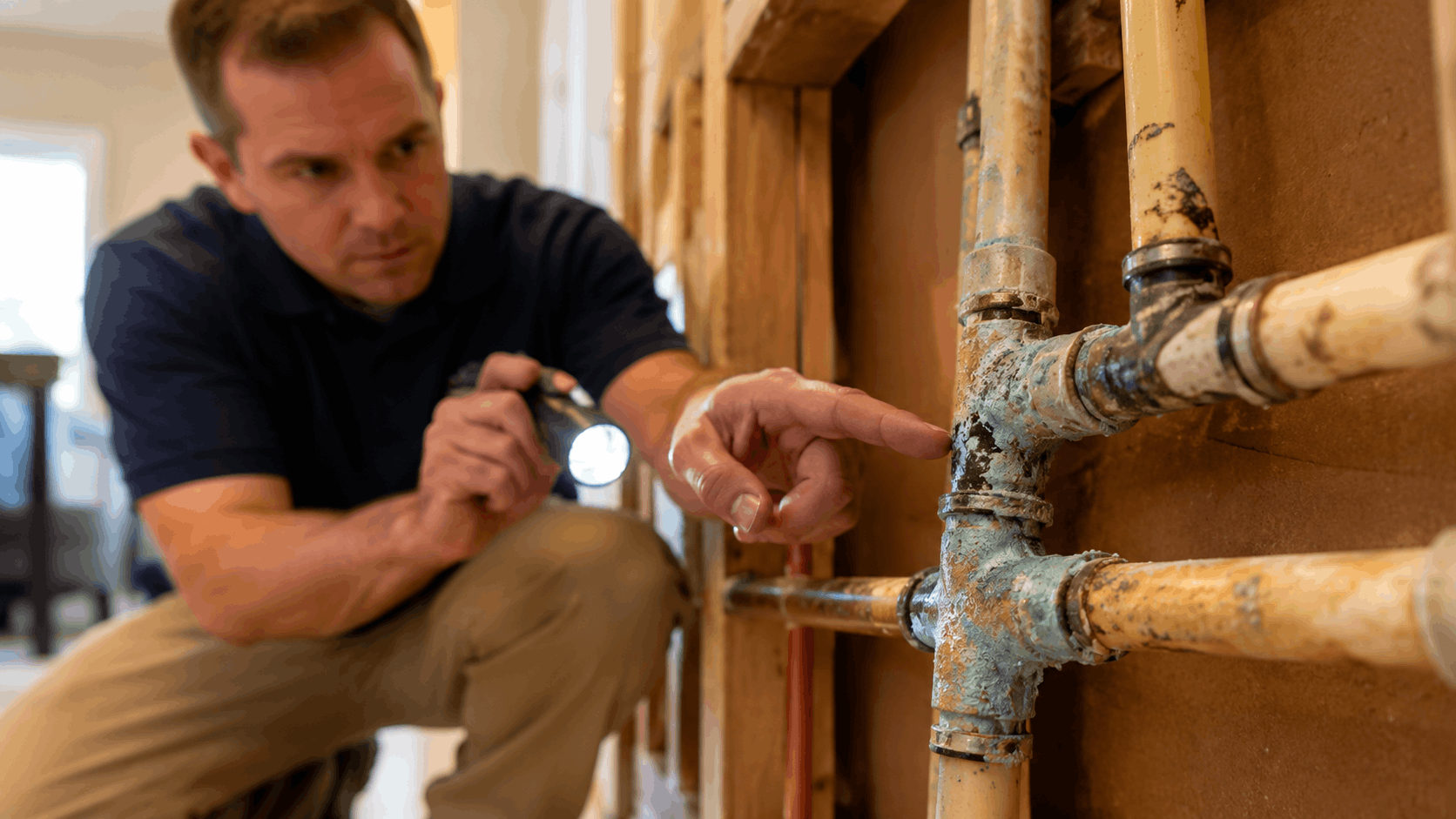
Look for white or greenish powder at the fittings under sinks and around the water heater. That crusty residue is corrosion working its way out, and it points to a fitting that is failing from the inside.
Pinhole leaks are another red flag. A tiny weep at a fitting or a small stain on a ceiling below an upstairs bathroom often signals that a fitting is about to give way completely.
What a Sudden Failure Costs a Homeowner
When a Kitec fitting fails all at once, it usually does not drip politely. It splits and lets water pour out under full pressure, sometimes inside a wall or above a finished ceiling.
The water damage from a burst fitting can run into the thousands fast. Soaked drywall, ruined flooring, warped cabinets, and mold behind the walls all stack up, and much of it may not be covered if the insurer flags the pipe type.
A burst that happens while a family is on vacation is the nightmare case. Water runs for hours or days, and a homeowner comes back to a flooded house and a repair bill far larger than a planned repipe would have been.
If a fitting does let go, shut off the main and call for burst pipe repair right away. Still, the cheaper path is almost always to replace the system before it fails, not after.
Need Help in Las Vegas?
Active Plumbing serves Las Vegas and all of Las Vegas Valley.
Which Las Vegas Neighborhoods Are Most Affected
Kitec risk lines up closely with build year, and build year lines up with specific neighborhoods. The communities that went up during the boom carry the highest odds of having it.
Below is a snapshot of the areas we see Kitec in most often, along with the typical build window and risk level. If your home falls in one of these zones, a check is worth your time.
| Area | Common Build Years | Kitec Risk |
|---|---|---|
| Summerlin (older villages) | 1996-2004 | High |
| Green Valley / Green Valley Ranch | 1997-2006 | High |
| Anthem / Sun City Anthem | 2000-2007 | High |
| Aliante | 2003-2007 | Moderate to High |
| Southern Highlands | 2001-2007 | Moderate to High |
Summerlin Homes From the Late 1990s
Summerlin was booming right during Kitec's peak install years. Several of its older villages went up in the late 1990s and early 2000s, which puts them squarely in the risk window.
Villages like The Trails and The Hills saw heavy construction during those years. Single-family homes and townhomes alike in those Summerlin villages often have the orange and blue Kitec runs behind their walls.
We have opened cabinets and water heater closets across these neighborhoods and found the telltale yellow-brass fittings again and again. Homes near Hillpointe and the older sections off Town Center Drive are common examples.
If you own in Summerlin West or any of the established villages, checking your build year and pipe color is a smart first step. Newer Summerlin construction is far less likely to have it.
Green Valley and Green Valley Ranch
Over in Henderson, the Green Valley and Green Valley Ranch communities grew fast through the same window. Many homes along Green Valley Parkway and Paseo Verde date to the late 1990s and early 2000s.
Green Valley Ranch in particular expanded heavily in the early 2000s. The mix of production homes there makes it one of the higher-risk pockets we see for Kitec in the Henderson area.
Homes near The District and the surrounding neighborhoods often turn up Kitec when we inspect them. The build timing simply matches the years when the product was most widely used.
If you live in Henderson and your home dates to this period, the odds are worth taking seriously. A quick look under the sinks tells you a lot before you ever call anyone.
Anthem in the Early 2000s
Anthem sits on the Henderson side near the I-15 corridor, and its master-planned expansion ran right through the early 2000s. That timing makes Anthem a hotspot for Kitec.
Sun City Anthem, the active-adult community within the larger area, saw a lot of construction between 2000 and 2007. Many of those homes have Kitec, and the original owners often have no idea it is there.
The hillside location means summer heat and long hot water runs are common, which only adds to the corrosion pressure on the fittings. We find failing fittings in Anthem garages and water heater closets regularly.
Homeowners in Anthem and Sun City Anthem should treat a build date in that 2000-2007 range as a clear reason to inspect. Catching it early beats dealing with a flood on the second floor.
Other At-Risk Areas Across the Valley
Kitec was not limited to those three big names. Several other communities that grew during the same period carry meaningful risk as well.
Aliante in North Las Vegas developed largely in the mid-2000s, and Southern Highlands near the southern edge of the valley grew in the same stretch. Both saw Kitec used in production homes.
Parts of the northwest, including newer sections that filled in during the early 2000s, also turn up Kitec from time to time. Any home built between 1995 and 2007 anywhere in the valley deserves a look.
If you are in Aliante or another mid-2000s community, the same checks apply. Build year is the single best predictor, no matter the neighborhood name.
How to Check If Your Home Has Kitec
The good news is that most homeowners can spot Kitec without any special tools. A flashlight and ten minutes are usually enough for a first look.
Here is how to identify Kitec on your own before you call for help. Start at the two easiest access points and work from there.
Look for Orange and Blue Pipes
Kitec is famous for its color coding. The orange pipe carries hot water and the blue pipe carries cold, and that pairing is the first thing to look for.
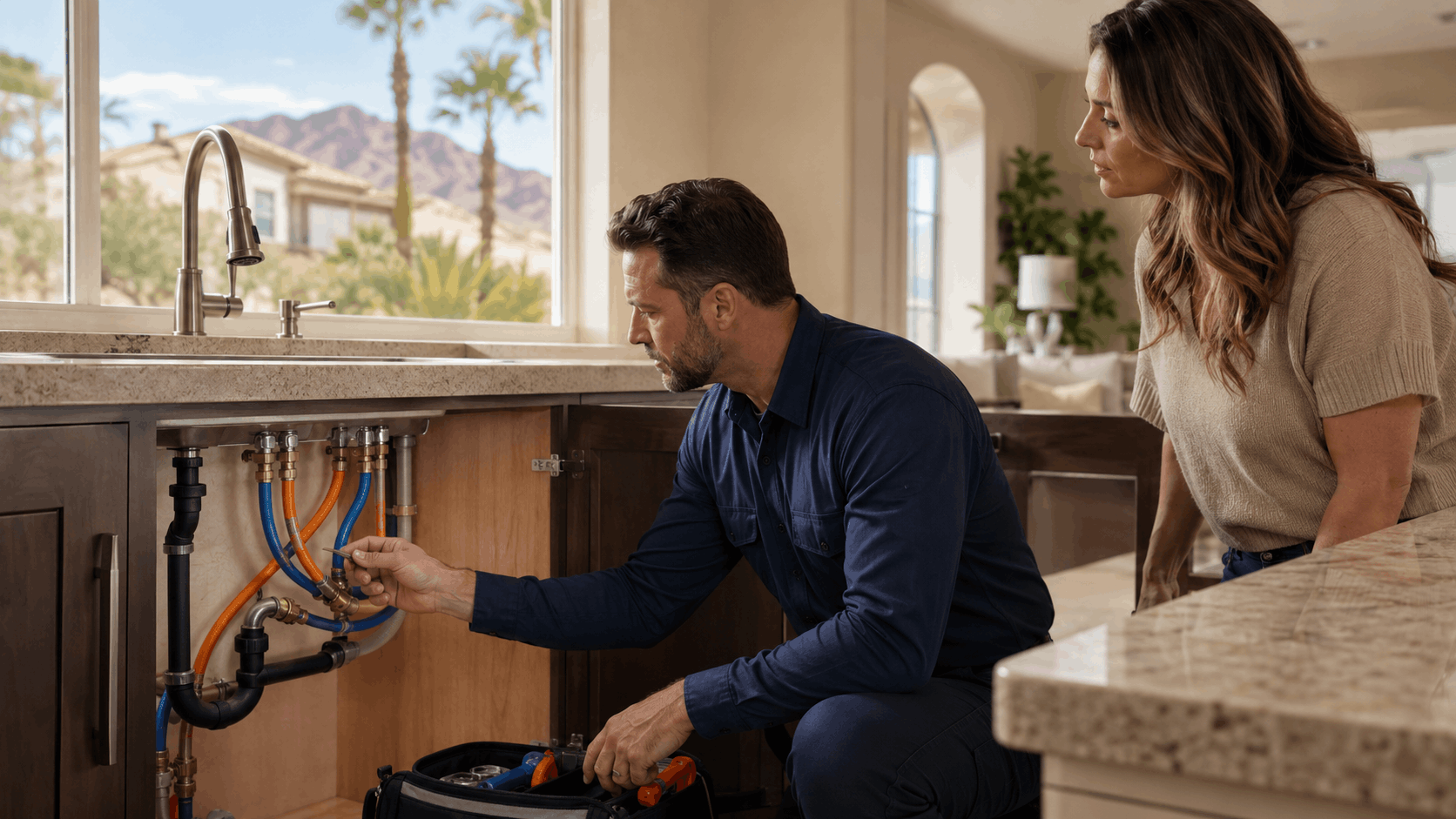
The best places to check are right at the water heater and under your sinks. At the water heater you will often see the pipes rising out of the top, and the orange and blue combination stands out clearly.
- Check the pipes connected to the top of your water heater in the garage or closet.
- Open the cabinets under kitchen and bathroom sinks and look at the supply lines.
- Peek at any exposed pipes in a utility room or unfinished basement.
- Look for the specific orange-hot and blue-cold pairing rather than just any colored pipe.
Keep in mind that some other pipe systems use color too, so color alone is a strong hint but not final proof. The printed label is what confirms it.
Check the Printed Labels on the Pipe
Every run of Kitec has text printed along the outside of the pipe. Reading that printing is the surest way to confirm what you have.
Wipe the pipe clean and shine a light along it. You are looking for brand markings, and the names to watch for are Kitec, IPEX, PlumbBetter, Kerr, or AmbioComfort.
- Look for "Kitec" or "IPEX" stamped in small repeating text.
- Check for "PlumbBetter" or other brand names along the pipe surface.
- Note the pipe size and any temperature ratings printed alongside the brand.
- Take a clear photo so you can share it with a plumber if you are unsure.
If you find any of those names, you have Kitec regardless of the color. That confirmation is enough to start planning your next move.
Inspect the Fittings and Manifolds
The fittings are where Kitec actually fails, so they deserve a close look. Kitec used yellow-brass fittings that crimp onto the pipe with a metal ring.
Look at the connection points under sinks and at the water heater. The brass fittings have a distinct yellow-gold color, and a failing one may show white or green corrosion creeping out around the crimp.
Many Kitec homes also have a central manifold, which is a distribution block where many lines branch out to different fixtures. It often sits in a garage wall or a utility closet and looks like a metal box with several pipes running off it.
If you see corrosion powder, staining, or moisture at any brass fitting or the manifold, that fitting is likely on its way out. Those spots are the earliest failure points in the whole system.
When to Call a Plumber for Confirmation
Not every pipe is easy to reach. Much of a home's plumbing runs inside walls, above ceilings, and under the slab where a homeowner simply cannot see it.
If your visible pipes are copper or another material but your home was built in the Kitec window, hidden Kitec runs are still possible. That is a case where a professional look pays off.
Our team at Active Plumbing inspects hidden lines in walls and slabs across the valley. We use access points and detection tools to confirm Kitec even when it is not sitting in plain view under a sink.
A proper plumbing inspection gives you a clear answer and a plan. You can reach out through our contact page to set one up for your home.

Repair Versus Full Repipe Options
Once you confirm Kitec, the next question is what to do about it. There are really two paths, and one of them solves the problem while the other only delays it.
Here is an honest comparison of a spot repair against a full repipe so you can decide with clear eyes.
| Factor | Spot Repair | Full Repipe |
|---|---|---|
| Upfront cost | Lower | Higher |
| Fixes root problem | No | Yes |
| Risk of repeat leaks | High | Very low |
| Effect on home sale | Still flagged | Resolves concern |
| Long-term value | Poor | Strong |
Why Spot Repairs Usually Fail
A spot repair means fixing the one fitting that failed and leaving the rest of the system in place. It feels cheaper in the moment, and sometimes homeowners try it hoping to buy time.
The problem is that every fitting in a Kitec home came from the same era and sits in the same hard water and heat. If one failed, the others are aging on the same clock.
So a spot repair fixes today's leak while the next fitting quietly corrodes toward its own failure. We often return to homes that had a single fitting patched only to find a new leak a few months later.
Those repeat leaks add up in both repair bills and water damage. Chasing failures one at a time almost always costs more than dealing with the whole system once.
Full Repipe With Modern PEX or Copper
A full repipe replaces every Kitec run and fitting with new material. That is the only approach that actually removes the risk for good.
Most repipes today use modern PEX-A tubing or copper. PEX-A is flexible, resists the scale problems that plague our water, and uses reliable connection methods rather than the failure-prone high-zinc brass.
A copper repipe is another solid option and remains a proven long-term choice, though it costs more in material and labor. Both remove the aluminum-core Kitec entirely.
Once a home is repiped with quality material, the Kitec worry is over. Our pipe and fixture services cover full replacements using materials built to last in valley conditions.
What a Repipe Looks Like Day to Day
A repipe sounds disruptive, and homeowners often worry about living through it. In practice, the process is orderly and most homes are fully usable each evening.
The team maps the existing runs, opens small drywall access points at strategic spots, and routes the new pipe. Water gets shut off for stretches during the work, but rarely for the entire day at once.
A typical single-story home repipe takes two to three days, while larger two-story homes may run three to five. After the new lines pass pressure testing and inspection, drywall gets patched and the home is put back together.
We plan the timeline around your household so you know when the water will be off and when access happens. Most families are surprised how contained the mess stays.
How Active Plumbing Handles Local Repipes
Every valley community has its own rules, and repipes have to follow them. HOA guidelines in places like Summerlin and Anthem can affect scheduling, exterior work, and cleanup expectations.
We pull the proper building permit for the work and coordinate inspections with the local authority. Depending on your address, that means Clark County or the City of Henderson building department.
Handling HOA notice and permit records is part of the job for us, not an afterthought. It keeps the work legal and gives you paperwork that matters later for insurance and resale.
Our crews work across Summerlin, Henderson, and the whole valley, so we know the local permit steps by area. That local knowledge keeps projects moving without surprise delays.
Need Help in Las Vegas?
Active Plumbing serves Las Vegas and all of Las Vegas Valley.
Insurance, Home Sales, and Kitec
Kitec is not only a plumbing issue. It reaches into home insurance and home sales in ways that catch many owners off guard.
These financial angles often push homeowners to act. Understanding them early saves stress when a policy renews or a buyer's inspector walks the house.
Why Insurers Flag Kitec Homes
Insurance carriers track claim data, and Kitec has a track record of costly water losses. That history makes some insurers wary of homes that still have it.
Depending on the carrier, the response ranges from a premium increase to an outright refusal of coverage. Some will write the policy but exclude water damage tied to the plumbing.
When a homeowner files a Kitec-related claim, the insurer may also push for a full repipe before renewing. At that point the repipe is happening either way, often under time pressure.
Replacing Kitec before a renewal review keeps your insurance coverage clean. It removes the flag that drives premium increase notices and non-renewals.
Disclosure Requirements When Selling
Nevada expects sellers to disclose known material defects about a home. If you know you have Kitec, that knowledge generally belongs on your seller disclosure.
Even when a seller is unsure, a buyer's home inspection often finds it. Inspectors in Summerlin and Henderson know to check for orange and blue pipes and yellow-brass fittings, and they flag it in their reports.
Once it shows up in an inspection, it becomes part of the negotiation whether the seller mentioned it or not. Hiding a known issue can also create legal exposure down the road.
Being upfront and, better yet, having already repiped puts a seller in a far stronger spot. It turns a red flag into a selling point.
How Kitec Affects Home Value
Buyers who learn a home has Kitec react in predictable ways. Some negotiate the price down by the cost of a repipe, and others walk away entirely to avoid the hassle.
That can knock thousands off a sale price or stall a deal at a bad time. In a competitive listing, an unaddressed Kitec issue can be the reason an offer never comes.
A completed repipe protects resale value and removes the objection. Buyers see modern PEX or copper and one less thing to worry about, which supports a stronger price.
For homes in high-risk areas, repiping before listing often pays for itself in a smoother sale. The home value benefit is real, not just theoretical.
Getting Documentation After a Repipe
Paperwork matters more than most homeowners expect. After a repipe, keep the permit records, the invoice, and any inspection sign-offs in one place.
That documentation shows insurers the Kitec is gone and the work was done right. It can be the difference between a clean policy and a coverage fight.
The same records reassure future buyers. Handing over permit records and a clear description of the new material answers questions before they turn into price cuts.
We provide the documentation homeowners need at the end of every repipe. Keeping those papers safe is one small step that protects a big investment.
What to Do Right Now If You Suspect Kitec
If you think your home might have Kitec, there is no need to panic. There is a calm, ordered way to move from suspicion to a solid plan.
Here are the next steps for any Las Vegas homeowner, starting with the easiest checks and ending with a plan you control.
Check Your Build Year First
Build year is the fastest risk gauge you have. A home built between 1995 and 2007 carries real risk, while newer construction rarely has Kitec.
You can find the build year in county records through the Clark County Assessor's office online. Your HOA documents and original closing paperwork usually list it too.
If your home falls inside that window, treat the rest of the checks as worthwhile. If it was built well after 2007, your odds drop sharply.
The Clark County Assessor site lets you look up your parcel and confirm the year in a minute or two.
Do a Quick Visual Check
With your build year in hand, run the quick visual check covered earlier. It takes about ten minutes and needs only a flashlight.
Start at the water heater, since the pipes there are usually exposed and the orange and blue coloring shows clearly. Then open the cabinets under your kitchen and bathroom sinks.
Look at the pipe color, read any printed labels, and check the brass fittings for white or green corrosion. Snap a few photos as you go.
That fast look tells you whether to move forward. If you spot the color coding, the brand names, or corrosion, it is time to bring in a professional.
Schedule a Professional Inspection
A professional inspection confirms what your quick check suggested and finds the hidden runs you cannot see. That is the step that turns guesswork into a clear picture.
Our team verifies whether the home has Kitec, checks the condition of the fittings, and looks at lines behind walls and under the slab. We then give a plain-language estimate with no pressure.
Homeowners across the valley call us for this exact service, from Summerlin to Anthem to the northwest. The inspection gives you facts and a fair price to work from.
You can book an inspection through our contact page or by phone. Getting a straight answer is the point.
Plan the Fix Before It Fails
The whole goal is to handle Kitec on your schedule, not during a 2 a.m. flood. A proactive repipe lets you plan the timing, the budget, and the disruption.
An emergency leak forces every one of those choices at the worst moment. You end up paying for water damage cleanup on top of the repipe you needed anyway.
Planning ahead also means you can coordinate around HOA rules, permits, and your family's calendar. That kind of control simply does not exist during a burst-pipe crisis.
If your home is in the risk window, the smart play is to plan the fix now. It is cheaper, calmer, and safer than waiting for the system to force your hand.
Need Help in Las Vegas?
Active Plumbing serves Las Vegas and all of Las Vegas Valley.
Final Thoughts
Kitec plumbing quietly sits inside thousands of Las Vegas homes built between 1995 and 2007. The aluminum-core pipe and high-zinc brass fittings do not age well in our hard water and desert heat.
Homes in Summerlin, Green Valley, Anthem, Aliante, and Southern Highlands carry the highest risk, but any home from that era deserves a check. A flashlight and ten minutes at the water heater and under the sinks tell you a lot.
If you find orange and blue pipes, brand names like IPEX or PlumbBetter, or corroded brass fittings, plan a repipe before a failure floods your home. Our team is ready to inspect your system, confirm what you have, and give you a clear estimate. Reach out to Active Plumbing today to schedule your Kitec inspection.
Frequently Asked Questions
What is Kitec plumbing?
Kitec is a type of plumbing pipe made with a thin aluminum core between two plastic layers, joined by high-zinc yellow-brass fittings. It was installed in many homes built between 1995 and 2007, including across Las Vegas. The brass fittings corrode over time, especially in hard water, which leads to blockages and sudden leaks that make the system a known failure risk.
How do I know if my Las Vegas home has Kitec?
Start by checking the pipes at your water heater and under your sinks for the classic orange hot and blue cold color coding. Then read the small printed text along the pipe for brand names like Kitec, IPEX, or PlumbBetter. Corroded yellow-brass fittings are another sign. If you cannot see the pipes, a professional inspection can confirm hidden Kitec inside walls and slabs.
Which neighborhoods have the most Kitec homes?
The highest-risk areas are communities built during the boom, including Summerlin's older villages like The Trails and The Hills, Green Valley and Green Valley Ranch in Henderson, and Anthem and Sun City Anthem. Aliante, Southern Highlands, and parts of the northwest also saw heavy Kitec use. Any home built between 1995 and 2007 anywhere in the valley is worth checking.
Is Kitec plumbing dangerous?
The main danger with Kitec is sudden leaks and the water damage they cause, not a health hazard. When a corroded brass fitting bursts, water can pour into walls, ceilings, and floors, leading to expensive repairs and possible mold. The pipe itself is not considered a poisoning risk. The real concern is property damage from an unexpected failure, which is why proactive replacement matters.
How much does a Kitec repipe cost in Las Vegas?
Costs vary based on home size, number of bathrooms, and how easy the pipes are to access. A typical single-family repipe in the valley often lands in a range of several thousand dollars, with larger two-story homes costing more. Access, material choice between PEX-A and copper, and drywall repair all affect the price. A professional inspection gives you an accurate estimate for your specific home.
Can I still file a Kitec claim?
No. The class action settlement that once helped affected homeowners had a claim deadline that has already passed. That means the settlement fund is no longer available for new claims. Current homeowners are responsible for the cost of inspecting and replacing Kitec themselves. Because outside help is gone, planning a repipe on your own timeline is the practical path forward.
How long does a repipe take?
Most repipes take a few days. A single-story home commonly runs two to three days, while a larger two-story home may take three to five. The timeline includes mapping the lines, opening access points, running new pipe, pressure testing, passing inspection, and patching drywall. Water is shut off for stretches during the work, but most homes stay usable each evening.
Will Kitec affect my home insurance?
It can. Some insurance carriers raise premiums or decline coverage on homes with Kitec because of its history of water damage claims. Others may exclude plumbing-related water losses. If you file a Kitec claim, an insurer may require a full repipe before renewing your policy. Replacing the system and keeping the documentation helps keep your coverage clean and your rates stable.
Do I have to disclose Kitec when selling?
Nevada expects sellers to disclose known material defects, so if you are aware of Kitec, it generally belongs on your seller disclosure. Even when a seller is unsure, home inspectors in Summerlin, Henderson, and beyond routinely find it during a sale. Once flagged, it becomes part of the negotiation. Repiping before listing removes the concern and protects your sale price.
What should I replace Kitec with?
Modern PEX-A tubing and copper are the two proven choices. PEX-A is flexible, resists the scale issues common in valley water, and uses reliable connections rather than failure-prone high-zinc brass. Copper is a longtime standard that also lasts, though it costs more. Either one fully removes the aluminum-core Kitec and its brass fittings, ending the leak risk for good.
Frequently Asked Questions
- What is Kitec plumbing?
- Kitec is a type of plumbing pipe made with a thin aluminum core between two plastic layers, joined by high-zinc yellow-brass fittings. It was installed in many homes built between 1995 and 2007, including across Las Vegas. The brass fittings corrode over time, especially in hard water, which leads to blockages and sudden leaks that make the system a known failure risk.
- How do I know if my Las Vegas home has Kitec?
- Start by checking the pipes at your water heater and under your sinks for the classic orange hot and blue cold color coding. Then read the small printed text along the pipe for brand names like Kitec, IPEX, or PlumbBetter. Corroded yellow-brass fittings are another sign. If you cannot see the pipes, a professional inspection can confirm hidden Kitec inside walls and slabs.
- Which neighborhoods have the most Kitec homes?
- The highest-risk areas are communities built during the boom, including Summerlin's older villages like The Trails and The Hills, Green Valley and Green Valley Ranch in Henderson, and Anthem and Sun City Anthem. Aliante, Southern Highlands, and parts of the northwest also saw heavy Kitec use. Any home built between 1995 and 2007 anywhere in the valley is worth checking.
- Is Kitec plumbing dangerous?
- The main danger with Kitec is sudden leaks and the water damage they cause, not a health hazard. When a corroded brass fitting bursts, water can pour into walls, ceilings, and floors, leading to expensive repairs and possible mold. The pipe itself is not considered a poisoning risk. The real concern is property damage from an unexpected failure, which is why proactive replacement matters.
- How much does a Kitec repipe cost in Las Vegas?
- Costs vary based on home size, number of bathrooms, and how easy the pipes are to access. A typical single-family repipe in the valley often lands in a range of several thousand dollars, with larger two-story homes costing more. Access, material choice between PEX-A and copper, and drywall repair all affect the price. A professional inspection gives you an accurate estimate for your specific home.
- Can I still file a Kitec claim?
- No. The class action settlement that once helped affected homeowners had a claim deadline that has already passed. That means the settlement fund is no longer available for new claims. Current homeowners are responsible for the cost of inspecting and replacing Kitec themselves. Because outside help is gone, planning a repipe on your own timeline is the practical path forward.
- How long does a repipe take?
- Most repipes take a few days. A single-story home commonly runs two to three days, while a larger two-story home may take three to five. The timeline includes mapping the lines, opening access points, running new pipe, pressure testing, passing inspection, and patching drywall. Water is shut off for stretches during the work, but most homes stay usable each evening.
- Will Kitec affect my home insurance?
- It can. Some insurance carriers raise premiums or decline coverage on homes with Kitec because of its history of water damage claims. Others may exclude plumbing-related water losses. If you file a Kitec claim, an insurer may require a full repipe before renewing your policy. Replacing the system and keeping the documentation helps keep your coverage clean and your rates stable.
- Do I have to disclose Kitec when selling?
- Nevada expects sellers to disclose known material defects, so if you are aware of Kitec, it generally belongs on your seller disclosure. Even when a seller is unsure, home inspectors in Summerlin, Henderson, and beyond routinely find it during a sale. Once flagged, it becomes part of the negotiation. Repiping before listing removes the concern and protects your sale price.
- What should I replace Kitec with?
- Modern PEX-A tubing and copper are the two proven choices. PEX-A is flexible, resists the scale issues common in valley water, and uses reliable connections rather than failure-prone high-zinc brass. Copper is a longtime standard that also lasts, though it costs more. Either one fully removes the aluminum-core Kitec and its brass fittings, ending the leak risk for good.
A
Licensed plumbing professionals serving Las Vegas and Las Vegas Valley.
Licensed in Nevada · License #0047021
Last updated on
Why trust Active Plumbing?
Founded in 1991, Active Plumbing is a licensed and insured plumber serving Las Vegas and Las Vegas Valley. All content is reviewed by our licensed technicians.

Need Help in Las Vegas?
Active Plumbing serves Las Vegas and all of Las Vegas Valley.
Related Articles

Safety & Prevention
Lead and Copper in Las Vegas Tap Water: Should You Test Your Home?
Las Vegas homes built before 1990 may have lead solder or corroded copper pipes affecting tap water quality. Learn how to test, interpret results, and fix the problem.
Cost Guides
Plumber in Green Valley Henderson: Service Costs and Response Times for Sun City Anthem Area
Real plumbing service costs, response times, and local conditions for Sun City Anthem, Green Valley, and the wider Henderson area from Active Plumbing.

Safety & Prevention
Why Las Vegas Homes Built Before 1990 Need a Full Plumbing Inspection
Las Vegas homes built before 1990 face unique plumbing challenges from aging materials, desert conditions, and outdated construction practices that can lead to catastrophic failures.