Tips & Advice
Why Kitec Fittings Fail: Dezincification Chemistry Meets Las Vegas Water
Key Takeaways
- Kitec plumbing, installed from 1995 to 2007, pairs aluminum PEX pipe with high-zinc yellow brass fittings that corrode from the inside.
- Dezincification pulls zinc out of the brass, leaving weak, porous fittings that either crack under pressure or clog and cut water flow.
- Las Vegas hard water, elevated chloride, seasonal pH swings, and desert heat all speed up the corrosion far faster than in cooler regions.
- Warning signs include dropping water pressure, pinhole leaks and wall stains, discolored or metallic-tasting water, and chalky corroded fittings.
- Leaving Kitec in place risks catastrophic bursts, insurance and disclosure problems, and lower home value; the class action settlement fund is closed.
- A full repipe with modern PEX or copper is the lasting fix, and proper permits and inspections through Clark County or the City of Las Vegas are required.
- Active Plumbing inspects and confirms Kitec, maps the system, plans around your schedule, and handles drywall repair and cleanup across the valley.
In This Article
A homeowner in Summerlin West noticed a small brown spot on the laundry room ceiling one morning. By that afternoon, the drywall was soft to the touch, and a slow drip had started behind the wall. The plumber who arrived pulled back a section of Sheetrock and found the culprit: a corroded yellow brass fitting on Kitec pipe, its threads coated in white crust and starting to crack.
Stories like this play out across the valley every week. Kitec plumbing was installed in thousands of Las Vegas homes during the building boom, and much of it is now reaching the end of its short life. The failures are not random. They come from a predictable chemical reaction called dezincification, and our local water makes it happen faster than almost anywhere else in the country.
What Kitec Plumbing Actually Is in Las Vegas
Kitec was marketed as a modern upgrade over copper and standard PEX. It looked clean, installed quickly, and cost builders less. For a while, it seemed like a smart choice for the flood of new homes going up around the valley.
The problem showed up years later. The materials that made Kitec cheap and fast to install are the same materials that fail early. If you bought or built a home in Las Vegas between the late 1990s and mid 2000s, there is a real chance you have Kitec running through your walls.
The Design Behind Kitec Pipe and Fittings
Kitec plumbing uses a pipe design called PEX-AL-PEX. That means a thin layer of aluminum core sits between two layers of cross-linked polyethylene. The aluminum gave the pipe some rigidity and let it hold its shape when bent, which installers liked.
The trouble was never really the pipe itself. It was the fittings. Kitec used yellow brass fittings to connect the aluminum PEX runs, and that brass carried a high percentage of zinc in its alloy.
High-zinc brass reacts badly with certain water chemistry. Over time, the zinc separates out and leaves the fitting weak and porous. So you end up with a decent pipe joined by connectors that quietly fall apart from the inside.
That mismatch is the whole story. Good pipe, bad fittings, and a chemical reaction waiting for the right conditions to speed things along.
When Kitec Was Installed in Valley Homes
Kitec was sold and installed roughly from 1995 to 2007. That window lines up almost perfectly with the biggest building boom Las Vegas has ever seen.
During those years, entire master-planned communities went up fast. Builders needed materials that could be installed quickly by large crews, and Kitec fit that need. Whole neighborhoods in new construction got piped with it before anyone understood the long-term risk.
If your home was built or fully re-plumbed in that timeframe, it is worth checking. Homes finished around 2000 to 2006 are the ones we find Kitec in most often when we open up walls.
The manufacturer stopped selling the product in 2007. Anything built after that is far less likely to have it, though remodels can still surprise people.
How to Identify Kitec in Your House
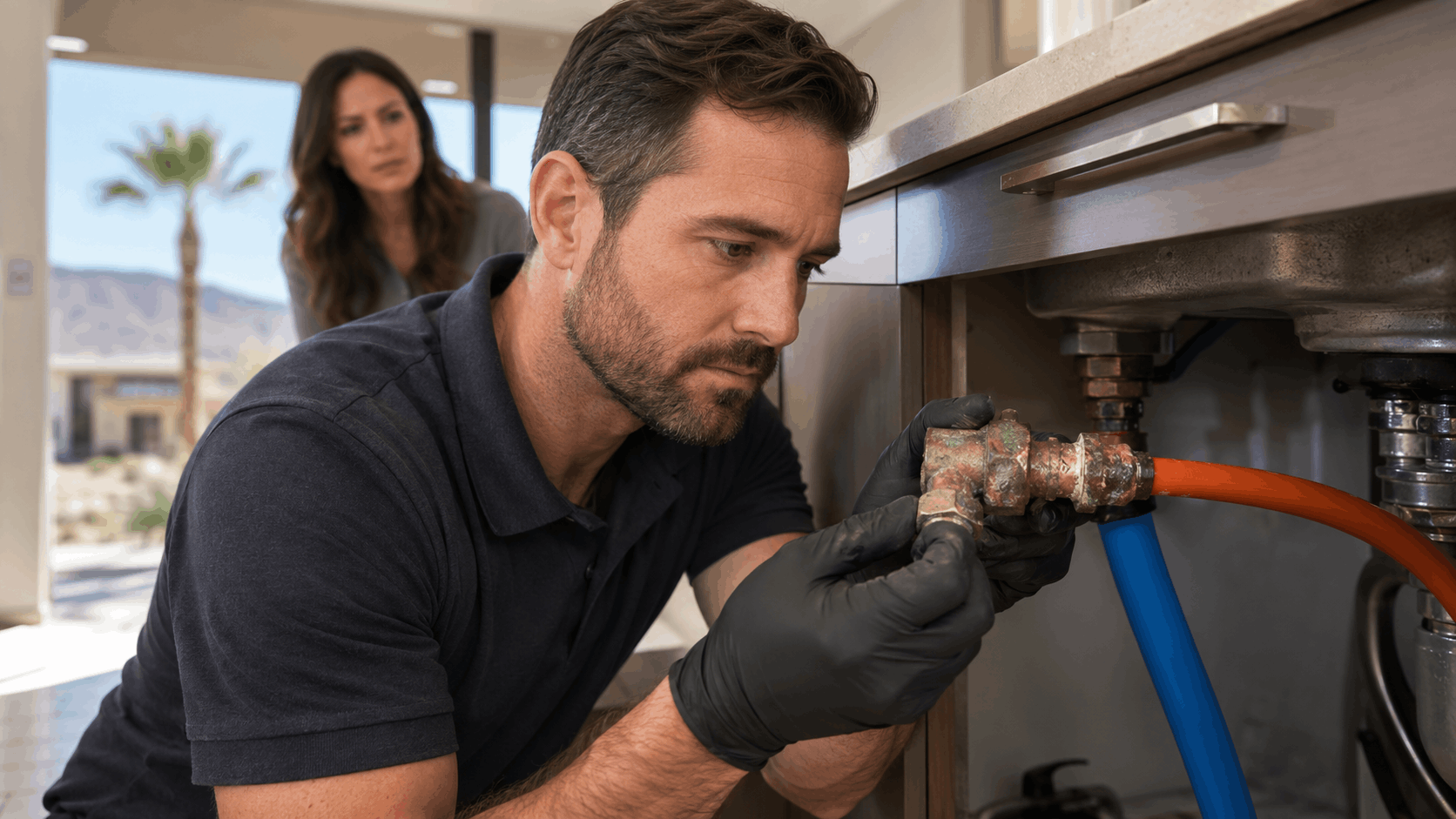
The easiest clue is the pipe color. Kitec runs are usually orange and blue, with orange marking hot lines and blue marking cold. You may also see gray or black versions in some installs.
Start at the water heater and the manifold. The manifold is the central hub where water lines branch out to different parts of the house, often located in a garage, closet, or utility area. Kitec manifolds are frequently brass or have brass fittings that show corrosion first.
Look for printed text along the pipe. The words "Kitec" or a brand name usually repeat every foot or two down the length of the pipe.
If you are not sure what you are looking at, our team can confirm it in a short visit. We check the water heater connections, the manifold, and any exposed runs before giving you a straight answer.
Brand Names Sold as the Same Product
Kitec was not always sold under that exact name. The same product line went out under several labels, which confuses a lot of homeowners.
Watch for names like Kitec, PlumbBetter, IPEX, KERR, AmbioComfort, and XPA. All of these are variations of the same aluminum PEX system with the same vulnerable brass fittings.
The manufacturer, IPEX, produced the pipe and stamped different names on it depending on the market and distributor. So a home labeled PlumbBetter carries the same dezincification risk as one labeled Kitec.
If you spot any of those names on your pipe or fittings, treat it as Kitec and plan accordingly. The material behaves the same no matter what the label says.
Get Your Quote
Tell us what's going on and we'll get back to you fast.
Dezincification Chemistry Explained in Plain Language
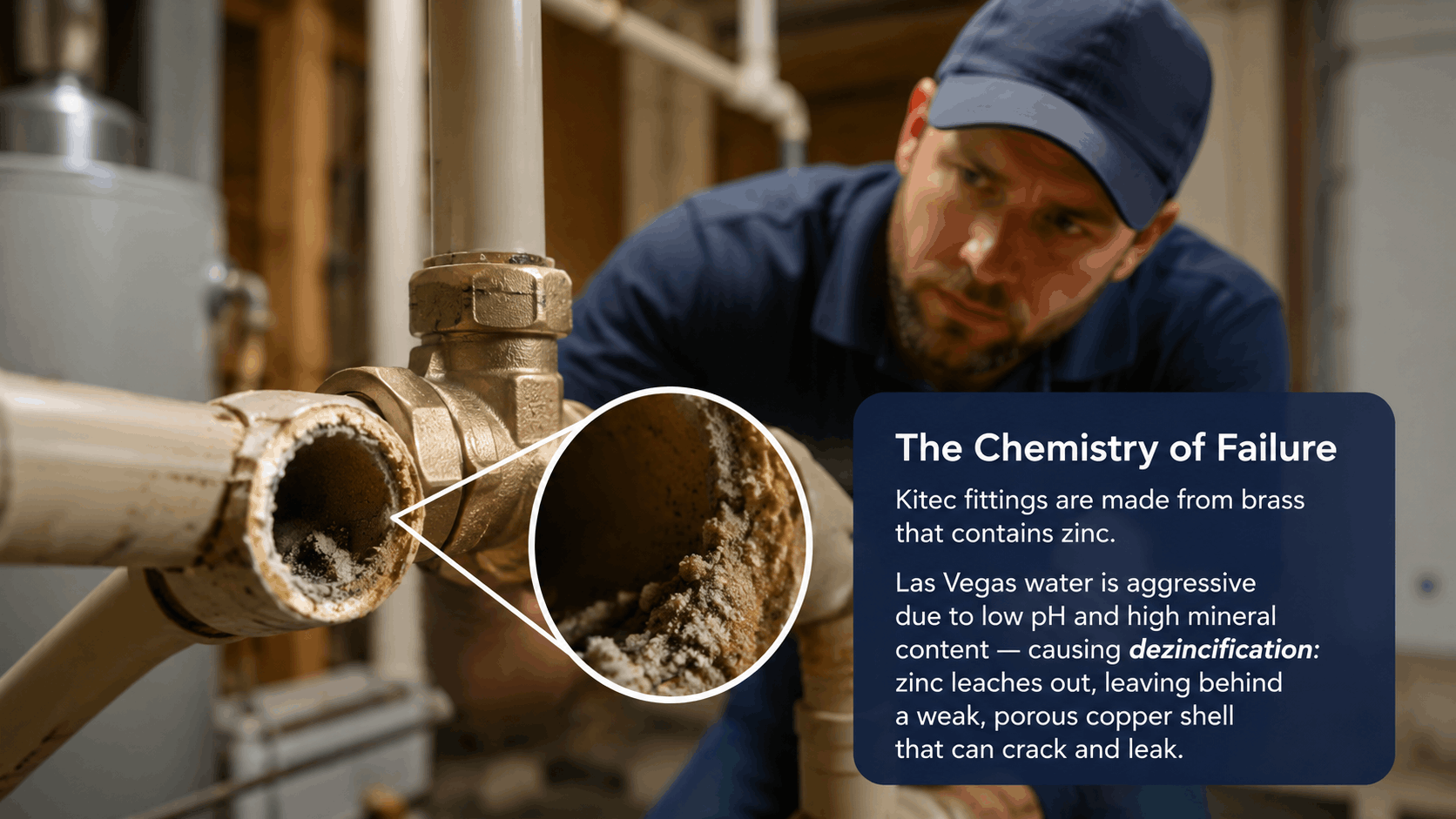
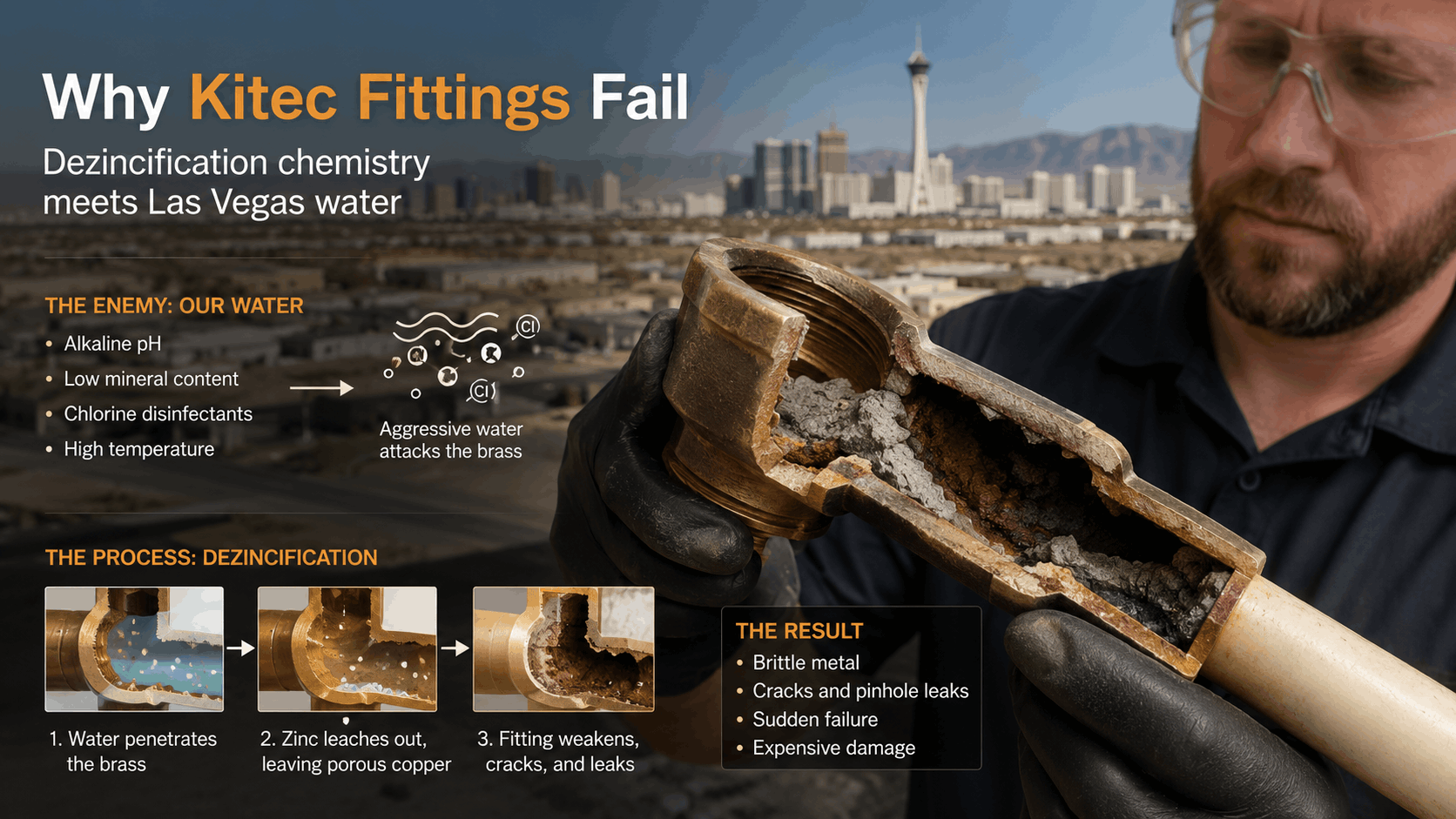
Dezincification sounds like a laboratory term, but the idea is simple. It is a form of brass corrosion where the zinc in the metal slowly dissolves away and leaves the fitting behind as a weak shell.
You do not need a chemistry degree to understand why this ruins plumbing. Here is what happens inside those brass connectors and why the fittings eventually give out.
What Happens Inside the Brass Fitting
Brass is an alloy, which means it is a blend of metals. In Kitec fittings, that blend is mostly copper and zinc, with the zinc content running high.
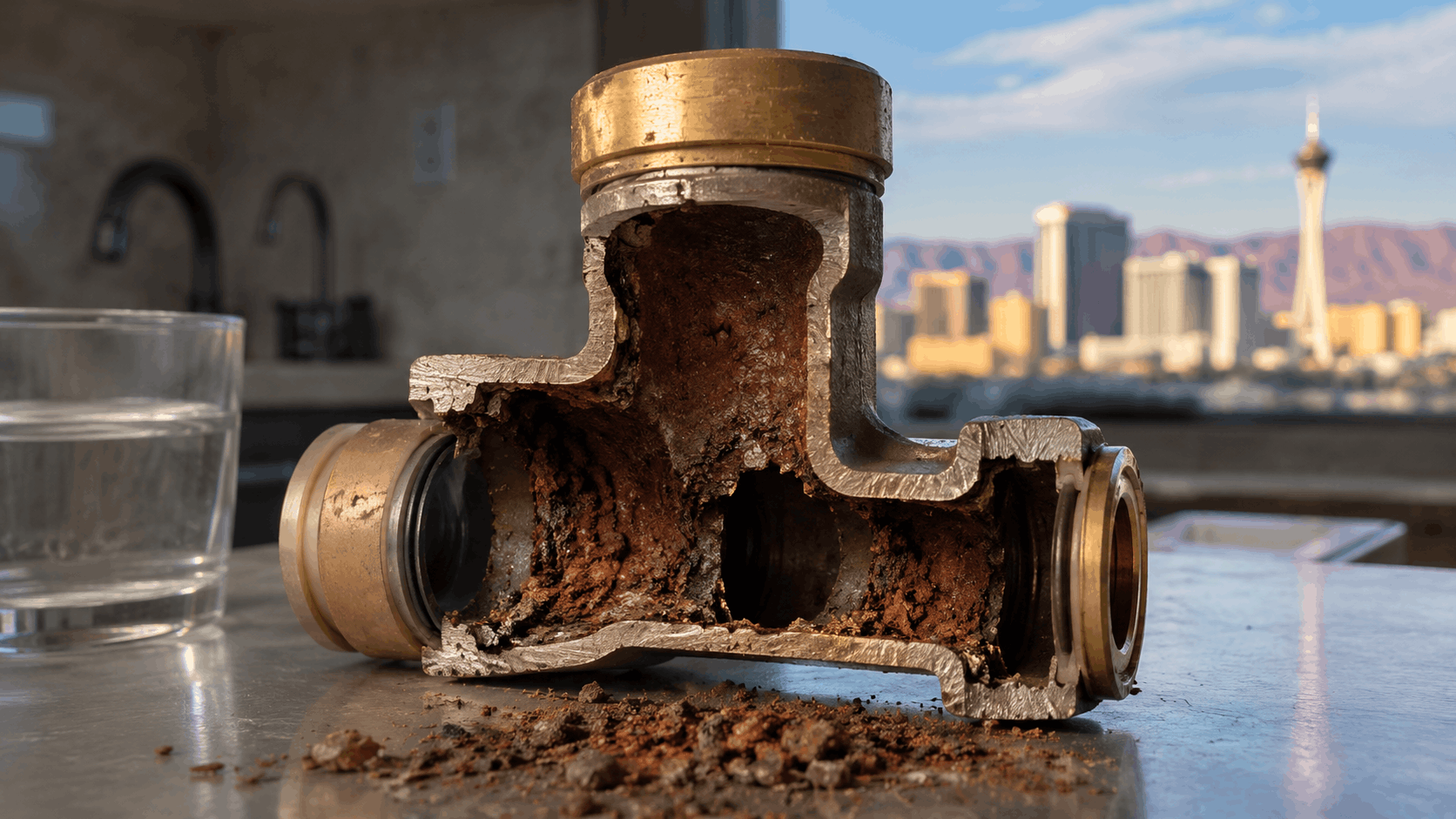
When water with the wrong chemistry flows through, it starts pulling the zinc out of the alloy. The copper stays behind, but the zinc leaching creates gaps where the zinc used to be.
What is left is a copper alloy structure full of tiny holes. The metal looks solid on the outside but has turned into porous metal on the inside, like a sponge dressed up as a fitting.
A few things drive this reaction along:
- High zinc content in the brass alloy
- Mineral-heavy or hard water passing through the fitting
- Higher water temperatures on hot lines
- Chloride and pH conditions that keep the reaction active
The White Powder and Green Buildup You Might See
As the zinc leaves the metal, it does not just vanish. It forms deposits, and those deposits are often visible on exposed fittings.
The most common sign is a chalky white powder around the fitting. That is zinc oxide, the byproduct of the reaction, and it builds up on threads and joints.
You may also see green or blue-green staining from the copper. Together these deposits signal that the fitting is actively corroding.
Inside the pipe, the same buildup causes blockage. The deposits collect in the narrow passages of the fitting and slowly choke off water flow, which is why some homes lose pressure long before a leak ever appears.
Why High-Zinc Brass Is the Weak Point
Not all brass corrodes this way. There is a version called dezincification-resistant brass, or DZR brass, made specifically to hold up against this reaction.
DZR brass keeps the zinc locked in place by adjusting the alloy composition and adding small amounts of other elements. It costs more to produce, so it does not always get used in budget plumbing systems.
Kitec fittings used high-zinc brass, the vulnerable type. That single decision is the root cause of the failures we see today.
When you pair high-zinc brass with aggressive water, the reaction runs fast. The fittings were essentially set up to fail in regions with hard, mineral-rich supply, which describes Las Vegas exactly.
How the Fitting Cracks or Clogs Over Time
Kitec fittings fail in two main ways, and both cause real damage. The first is a fitting fracture, where the weakened metal simply cannot hold anymore.
Once the brass turns porous, it loses strength. Normal household water pressure, or a small pressure spike, can trigger a pressure failure that splits the fitting open and floods the area around it.
The second path is slower. As zinc oxide deposits build up inside, they cause water flow restriction until faucets trickle and appliances struggle to fill.
Sometimes a home experiences both problems at once. A partially clogged fitting raises pressure elsewhere in the system, which then pushes a different weak fitting past its breaking point. If you notice sudden pressure changes, our pipe and fixture services team can trace the cause before it turns into a burst.
Need Help in Las Vegas?
Active Plumbing serves Las Vegas and all of Las Vegas Valley.
Why Las Vegas Water Speeds Up the Failure
Kitec fails everywhere it was installed, but it fails faster in Las Vegas. The reason comes down to what is in our water and how hot it gets here.
Our supply is hard, mineral-heavy, and treated with chlorine, and it travels through hot lines in a desert climate. Every one of those factors pushes dezincification forward.
Hard Water From the Colorado River Supply
Most of the valley drinks water that starts in Lake Mead, fed by the Colorado River. That water is naturally high in dissolved minerals like calcium and magnesium.
The Las Vegas Valley Water District, or LVVWD, delivers this supply to homes across the region. The high mineral content makes our water some of the hardest in the country.
Hard water creates aggressive conditions for brass. The dissolved minerals interact with the alloy and help drive the zinc out of the fittings faster than soft water would.
Many homeowners install a water softener to reduce mineral buildup, and while that helps protect new plumbing, it cannot reverse damage already done to old Kitec fittings.
Chloride, Temperature, and pH in the Valley
Beyond hardness, our water carries chloride and shifts in pH over the year. Chloride is one of the strongest drivers of dezincification, and valley water has plenty of it.
Water temperature matters too. Warm supply lines in a hot climate keep the corrosion reaction running instead of slowing it down.
The pH of the water also swings depending on treatment and season. Those swings keep the fittings under constant chemical stress.
Here is how these factors stack up against the corrosion reaction:
| Water Factor | Local Condition | Effect on Kitec Fittings |
|---|---|---|
| Hardness | Very high from Colorado River supply | Speeds zinc loss |
| Chloride | Elevated in valley water | Strongly drives dezincification |
| Temperature | Warm supply, hot lines | Accelerates the reaction |
| pH | Seasonal swings | Keeps fittings under stress |
Heat Load in Desert Homes
Summer in Las Vegas is brutal on plumbing. Ground temperatures rise, garages turn into ovens, and water sitting in supply lines heats up well beyond normal.
Chemical reactions move faster as temperature climbs. So the desert heat directly speeds the dezincification happening inside your fittings.
Hot water lines take the worst of it. The orange Kitec runs carrying hot water corrode faster than the cold blue lines because they combine heat with everything else working against the brass.
During peak summer temperatures, we see a jump in Kitec calls. The heat load pushes borderline fittings past the point of holding, and that is when the leaks and bursts show up.
Neighborhoods Where We See It Most
Because Kitec tracks with the building boom, certain areas carry more of it. We find it constantly in Summerlin, where large sections were built during the peak Kitec years.
Green Valley in Henderson is another hot spot, along with Aliante and Centennial Hills up north. These communities filled in right when Kitec was the go-to material for builders.
We also see it in Peccole Ranch, Spring Valley, and pockets of Enterprise near Mountains Edge. If your neighborhood boomed between 2000 and 2006, Kitec is worth checking for.
Our crews cover all of these areas. If you are in Summerlin or a home built during that era, an inspection can tell you exactly what is behind your walls.
Warning Signs Your Kitec Is Failing
Kitec rarely fails without warning. Most homes show symptoms for weeks or months before a fitting lets go completely.
Catching these Kitec leak signs early can save you from a flooded home. Here are the symptoms our team runs into most often.
Sudden Drops in Water Pressure
One of the first things people notice is weaker flow. A shower that used to feel strong turns into a trickle, or a faucet takes forever to fill a pot.
This happens because a clogged fitting chokes the line. As zinc oxide builds up inside, the opening narrows and cuts down how much water can pass.
Low water pressure from Kitec often shows up in one part of the house before the rest. A single bathroom or the kitchen sink may drop while other fixtures still run fine.
If reduced flow appears without any change to your fixtures, it is worth looking at the fittings feeding that area.
Pinhole Leaks and Wall Stains
A pinhole leak is a small, slow drip from a weakening fitting. It may release just enough water to stain drywall without ever forming a visible puddle.
Watch for water stains on ceilings and walls, especially brown rings or soft spots. Moisture damage often shows up in laundry rooms, under sinks, and near where hot lines run.
These leaks tend to get worse slowly, then fast. What starts as a faint mark can turn into a steady drip once the fitting cracks further.
If you spot unexplained moisture, our electronic leak detection can find the source inside the wall without tearing everything open.
Discolored or Metallic-Tasting Water
The corrosion byproducts inside failing fittings can end up in your water. That changes both how it looks and how it tastes.
Some homeowners notice discolored water with a slight yellow or brownish tint, especially first thing in the morning. Others report a metallic taste that was not there before.
These changes come from zinc and other corrosion byproducts washing off the inside of the fittings. It is a sign the reaction has progressed inside the pipe.
If your water quality shifts along with any pressure or leak issues, the fittings are the likely cause and should be checked.
Fittings That Look Chalky or Corroded
Sometimes you can spot trouble just by looking. Exposed fittings near the water heater, laundry area, or manifold often show damage before hidden ones do.
Look for a corroded fitting coated in chalky buildup, that white or greenish crust we described earlier. Visible corrosion on the outside usually means worse damage inside.
Any staining, flaking, or powdery residue around a brass connector is a red flag. Healthy fittings stay clean and dry.
Here is a quick reference for reading the warning signs:
| Warning Sign | What It Points To | How Urgent |
|---|---|---|
| Low water pressure | Clogged, corroding fitting | Check soon |
| Pinhole leak or wall stain | Fitting starting to fail | Act quickly |
| Discolored or metallic water | Internal corrosion | Have it inspected |
| Chalky or corroded fitting | Advanced dezincification | Plan replacement |
The Real Risk of Leaving Kitec in Place
It is tempting to wait until something breaks. With Kitec, waiting is a gamble that often ends in expensive water damage.
The consequences reach beyond a wet floor. They touch your insurance, your ability to sell, and the value of your home.
Catastrophic Bursts and Flooding
When a Kitec fitting fractures, it does not leak politely. It releases water under full pressure, and the results can be devastating.
A burst pipe on a supply line can dump hundreds of gallons in a short time. If it happens while you are at work or on vacation, you come home to a flooded house.
This is an especially big risk for second homes and rentals, which sit empty for stretches. The valley has plenty of both, and unattended Kitec failures cause some of the worst home flooding we respond to.
Here is what makes these failures so damaging:
- They often happen without warning once a fitting is weak
- Water runs continuously until someone shuts the main
- Damage spreads to flooring, cabinets, and framing fast
- Empty homes can flood for hours or days before discovery
Our burst pipe repair team responds to these calls around the clock, but preventing the burst is always the cheaper path.
Insurance and Disclosure Concerns
Kitec is on the radar of many insurance companies. Some flag it, raise premiums, or limit coverage on homes that still have it.
A few insurers have declined to write policies until Kitec is replaced. Others may pay a claim but then push for the plumbing to be updated.
In Nevada real estate, Kitec often comes up during a home disclosure. Sellers are generally expected to share known material facts about the property, and failing plumbing can qualify.
None of this is legal advice, but it shows how Kitec can complicate both insurance coverage and the sale process long before a leak ever appears.
Effect on Home Value and Sales
Buyers have gotten smarter about Kitec. Many inspectors know exactly what to look for, and a home inspection that turns up Kitec can stall a deal.
Buyer concerns are reasonable. They see the plumbing as a ticking cost, so they either ask for a price cut or want the system replaced before closing.
That pressure hits property value directly. A home with known Kitec often sells for less or takes longer to move than a comparable home with modern plumbing.
Replacing Kitec before listing removes that obstacle. It turns a red flag on the inspection report into a selling point.
The Expired Class Action Settlement
There was once a class action settlement fund set up to help cover Kitec problems. That fund is closed, and the deadline to file passed years ago.
What that means for homeowners today is simple. The settlement money is gone, and there is no manufacturer program left to tap for replacement cost.
So the full cost of removing and replacing Kitec now falls on the property owner. Waiting does not bring back any financial help that used to exist.
That reality changes the math. Since no one else is footing the bill, planning a replacement on your own schedule beats reacting to a sudden failure.
Need Help in Las Vegas?
Active Plumbing serves Las Vegas and all of Las Vegas Valley.
Replacement Options for Las Vegas Homes
The lasting fix for Kitec is a repipe, which means replacing the failing lines and fittings with modern materials. There are a couple of routes, and the right one depends on your home and budget.
Our team walks every homeowner through the choices before any work starts. Here is how the main options compare.
Full Repipe With Modern PEX
The most common replacement is a PEX repipe using cross-linked PEX, sometimes labeled PEX-A or PEX-B. This is a different, more reliable product than the aluminum Kitec system.
Modern PEX uses proper fittings that resist the corrosion problems that plague Kitec. It handles our hard valley water well and flexes without the weak brass connectors that caused the original failures.
PEX is also faster to install than copper, which keeps labor costs down. For most valley homes, it offers the best balance of price and long-term reliability.
When installed with quality fittings and manifolds, a PEX repipe should outlast the home's owners without the dezincification worries.
Copper Repipe Considerations
Some homeowners prefer copper pipe, and it remains a solid choice. Copper has a long track record and a pipe lifespan that can stretch past fifty years.
The tradeoff is repipe cost. Copper material prices and the extra labor for soldered joints make it noticeably more expensive than PEX.
Copper also reacts to certain water conditions over decades, though far more slowly than high-zinc brass. In our hard water, PEX often makes more sense, but copper is a valid option for those who want it.
We install both and give honest guidance on which fits your home, water, and budget rather than pushing one product.
What a Repipe Looks Like in a Single-Story vs Two-Story Home
The layout of your home shapes the work. A single-story home is usually the simpler job because most lines can be reached through the attic and interior walls with fewer access points.
A two-story home adds complexity. Lines that feed the upper floor run through walls and ceilings, so more access holes are needed to reach every run.
Repipe timeline reflects that difference. A single-story repipe often finishes in two to three days, while a larger two-story home may take three to five days depending on size and fixture count.
We map the whole system first so there are no surprises. That planning keeps the access openings to a minimum and the timeline predictable.
Permits and Inspections With Local Building Departments
A proper repipe is permitted work. Depending on your address, that runs through the Clark County permit process or the City of Las Vegas building department.
The permit triggers a building inspection where an inspector verifies the new plumbing meets code. This protects you and confirms the job was done right.
Code compliance matters for resale too. A permitted, inspected repipe gives future buyers documented proof that the Kitec is gone and the new system is sound.
We handle the permitting and coordinate inspections as part of the job. Homeowners do not have to chase paperwork with the county or city on their own.

How Active Plumbing Handles Kitec Replacement in the Valley
Every Kitec replacement we do follows a clear process. The goal is a clean repipe with as little disruption to your household as possible.
Here is what homeowners can expect when they call Active Plumbing about a Las Vegas repipe.
Inspection and Kitec Identification
We start with a plumbing inspection to confirm what you actually have. Not every orange pipe is Kitec, so proper Kitec identification matters before anyone talks about cost.
Our tech checks the water heater connections, the manifold, and any exposed runs for brand markings and pipe color. We look for the telltale corrosion on fittings too.
Once confirmed, we handle system mapping to trace where the lines run and how the house is fed. That map guides the entire replacement plan.
Only after we understand the full layout do we quote the job. That way the price reflects your actual home, not a rough guess.
Planning Around Your Daily Life
A repipe means the water goes off for stretches, so we plan around your schedule. Our project planning aims to keep the water shutoff time as short as possible each day.
We work in stages so you have water restored by evening on most days of the job. That matters for families, and it matters for the growing number of valley residents running home offices.
Before we start, we walk you through the day-by-day plan. You know when water will be off, which rooms we are working in, and what to expect.
The point is minimal disruption. A repipe is a big job, but it should not shut down your life for a week.
Drywall, Cleanup, and Restoration
Reaching the lines means cutting access holes in walls and ceilings. We keep those openings as small and neat as the job allows.
After the new pipe is in and inspected, we handle drywall repair to patch the access points. That includes cutting in, taping, and finishing the patches.
Cleanup is part of every job. We protect floors and furniture, contain the dust, and haul away the old Kitec and debris when we are done.
Our restoration brings the walls back to a paint-ready state. The finished result should look like the work was never there.
Serving Homes Across the Valley
We cover the whole valley, not just one corner of it. Our crews work in Henderson, North Las Vegas, and Spring Valley regularly.
That includes communities near the 215 Beltway, from Summerlin on the west side to Green Valley and Whitney Ranch on the east. We know the neighborhoods and the era of homes in each.
Because we drive these routes daily, we can usually get to an inspection quickly. Same-day help is available through our emergency plumbing service when a fitting has already failed.
Wherever you are in the valley, if your home has Kitec, we can help you plan the fix.
Need Help in Las Vegas?
Active Plumbing serves Las Vegas and all of Las Vegas Valley.
Final Thoughts
Kitec was built with good pipe and bad fittings, and our hard, hot valley water pushes those high-zinc brass fittings toward failure faster than most places. Dezincification is not a maybe. In Las Vegas, it is a matter of when.
Catching the warning signs early, whether it is dropping pressure, a pinhole leak, or chalky fittings, gives you the chance to plan a repipe instead of cleaning up after a flood. Replacing Kitec also removes the insurance and resale headaches that come with it.
If your home was built between 1995 and 2007, have the plumbing checked. Contact Active Plumbing to schedule a Kitec inspection and get a straight answer about what is behind your walls and what it takes to fix it.
Frequently Asked Questions
What is dezincification in Kitec fittings?
Dezincification is a form of corrosion where the zinc in the brass fitting slowly dissolves out of the metal. The Kitec fittings use high-zinc brass, so this reaction hits them hard. What remains is a porous, weakened fitting that can crack under pressure or clog with white zinc oxide deposits. It is the main reason Kitec fittings leak, restrict water flow, and eventually fail.
How long do Kitec fittings last in Las Vegas?
Kitec was marketed to last for decades, but real-world results fall far short of that, especially here. In the valley, we commonly see fittings fail within fifteen to twenty-five years of install. Our hard water, high chloride, warm supply lines, and desert heat all speed up dezincification. That means Las Vegas homes often see failures earlier than homes in cooler, softer-water regions do.
How do I know if my home has Kitec plumbing?
Check the pipe color first. Kitec runs are usually orange for hot and blue for cold. Look near the water heater and at the manifold, the central hub where lines branch out, since brass fittings there show corrosion first. The pipe often has "Kitec" or a brand name printed along its length. If your home was built from 1995 to 2007, it is worth having checked.
Is Kitec plumbing banned or recalled?
Kitec was removed from plumbing codes and pulled from the market in 2007 because of the failure problems. A class action settlement once existed, but that fund is now closed. This is not legal advice, but the practical takeaway is that the product is no longer approved for new installs and there is no active program to cover replacement. Homeowners now handle the cost themselves.
Can Kitec fittings be repaired instead of replaced?
Spot repairs rarely solve the real problem. If one fitting corroded from dezincification, the others in your home are corroding under the same water conditions. Fixing a single leak just moves the next failure down the line. That is why we recommend a full repipe rather than patching one fitting at a time, which ends up costing more over the long run and leaves the risk in place.
How much does a Kitec repipe cost in the valley?
Cost depends on home size, number of bathrooms, single or two-story layout, and whether you choose PEX or copper. As a general range, most valley repipes fall somewhere between several thousand dollars and the low five figures. Copper runs higher than PEX because of material and labor. We give a firm quote only after mapping your system so the number reflects your actual home rather than a guess.
How long does a full repipe take?
A single-story home usually takes about two to three days from start to finished drywall patching. A larger two-story home often runs three to five days because more access points are needed to reach the upstairs lines. We stage the work so your water is back on by the end of most work days, which limits the disruption to your household during the project.
Will Kitec affect my home sale in Nevada?
It can. Many home inspectors know how to spot Kitec, and it commonly comes up during the inspection. Buyers often ask for a price reduction or want the plumbing replaced before closing. Kitec may also appear on your Nevada seller disclosure as a known material fact. Replacing it before listing turns a red flag into a selling point and helps the sale move faster.
Does insurance cover Kitec water damage?
Coverage varies by insurer and policy. Some companies flag Kitec, raise premiums, or decline coverage until it is replaced. A sudden burst may be covered as accidental water damage, but insurers can push you to update the plumbing afterward. Check your policy and talk with your provider. Replacing Kitec removes the uncertainty and can help keep your coverage in good standing.
Do I need a permit to replace Kitec plumbing?
Yes. A proper repipe is permitted work that runs through either the Clark County or City of Las Vegas building department depending on your address. The permit triggers an inspection where the new plumbing is checked against code. We handle the permits and coordinate the inspection as part of the job, so you have documented proof the work was done correctly, which also helps at resale.
Frequently Asked Questions
- What is dezincification in Kitec fittings?
- Dezincification is a form of corrosion where the zinc in the brass fitting slowly dissolves out of the metal. The Kitec fittings use high-zinc brass, so this reaction hits them hard. What remains is a porous, weakened fitting that can crack under pressure or clog with white zinc oxide deposits. It is the main reason Kitec fittings leak, restrict water flow, and eventually fail.
- How long do Kitec fittings last in Las Vegas?
- Kitec was marketed to last for decades, but real-world results fall far short of that, especially here. In the valley, we commonly see fittings fail within fifteen to twenty-five years of install. Our hard water, high chloride, warm supply lines, and desert heat all speed up dezincification. That means Las Vegas homes often see failures earlier than homes in cooler, softer-water regions do.
- How do I know if my home has Kitec plumbing?
- Check the pipe color first. Kitec runs are usually orange for hot and blue for cold. Look near the water heater and at the manifold, the central hub where lines branch out, since brass fittings there show corrosion first. The pipe often has "Kitec" or a brand name printed along its length. If your home was built from 1995 to 2007, it is worth having checked.
- Is Kitec plumbing banned or recalled?
- Kitec was removed from plumbing codes and pulled from the market in 2007 because of the failure problems. A class action settlement once existed, but that fund is now closed. This is not legal advice, but the practical takeaway is that the product is no longer approved for new installs and there is no active program to cover replacement. Homeowners now handle the cost themselves.
- Can Kitec fittings be repaired instead of replaced?
- Spot repairs rarely solve the real problem. If one fitting corroded from dezincification, the others in your home are corroding under the same water conditions. Fixing a single leak just moves the next failure down the line. That is why we recommend a full repipe rather than patching one fitting at a time, which ends up costing more over the long run and leaves the risk in place.
- How much does a Kitec repipe cost in the valley?
- Cost depends on home size, number of bathrooms, single or two-story layout, and whether you choose PEX or copper. As a general range, most valley repipes fall somewhere between several thousand dollars and the low five figures. Copper runs higher than PEX because of material and labor. We give a firm quote only after mapping your system so the number reflects your actual home rather than a guess.
- How long does a full repipe take?
- A single-story home usually takes about two to three days from start to finished drywall patching. A larger two-story home often runs three to five days because more access points are needed to reach the upstairs lines. We stage the work so your water is back on by the end of most work days, which limits the disruption to your household during the project.
- Will Kitec affect my home sale in Nevada?
- It can. Many home inspectors know how to spot Kitec, and it commonly comes up during the inspection. Buyers often ask for a price reduction or want the plumbing replaced before closing. Kitec may also appear on your Nevada seller disclosure as a known material fact. Replacing it before listing turns a red flag into a selling point and helps the sale move faster.
- Does insurance cover Kitec water damage?
- Coverage varies by insurer and policy. Some companies flag Kitec, raise premiums, or decline coverage until it is replaced. A sudden burst may be covered as accidental water damage, but insurers can push you to update the plumbing afterward. Check your policy and talk with your provider. Replacing Kitec removes the uncertainty and can help keep your coverage in good standing.
- Do I need a permit to replace Kitec plumbing?
- Yes. A proper repipe is permitted work that runs through either the Clark County or City of Las Vegas building department depending on your address. The permit triggers an inspection where the new plumbing is checked against code. We handle the permits and coordinate the inspection as part of the job, so you have documented proof the work was done correctly, which also helps at resale.
A
Licensed plumbing professionals serving Las Vegas and Las Vegas Valley.
Licensed in Nevada · License #0047021
Last updated on
Why trust Active Plumbing?
Founded in 1991, Active Plumbing is a licensed and insured plumber serving Las Vegas and Las Vegas Valley. All content is reviewed by our licensed technicians.

Need Help in Las Vegas?
Active Plumbing serves Las Vegas and all of Las Vegas Valley.
Related Articles
Tips & Advice
Henderson vs Las Vegas Water Pressure: Why Some Neighborhoods Have PRV Issues
Henderson vs Las Vegas water pressure varies by terrain, utility systems, and neighborhood age. Learn why PRV issues hit some areas harder and when to act.
Tips & Advice
The Lakes Las Vegas Plumber: Lakefront Property Water Line Considerations
A local guide to lakefront water line considerations in The Lakes Las Vegas, covering soil movement, pipe materials, leak signs, repair vs. replacement, HOA rules, and care.
Tips & Advice
Las Vegas Hard Water by ZIP Code: Actual SNWA Grain Hardness Data
See actual SNWA water hardness data by Las Vegas ZIP code. Learn your neighborhood's GPG level and what it means for your plumbing, appliances, and home.