Maintenance
Tankless Descaling in Las Vegas - Why Annual Service Is Non-Negotiable Here
Key Takeaways
- Las Vegas water runs about 16 grains per gallon of hardness from the Colorado River, making it some of the hardest in the country.
- Annual tankless descaling is the minimum here, and heavy-use homes or those without a softener may need service every six months.
- Skipped descaling leads to clogged heat exchangers, restricted flow, higher utility bills, and error codes.
- Neglect can void the manufacturer warranty and cut a 15 to 20 year unit down to under 10 years.
- A standard descaling and flush costs about 150 to 300 dollars, far less than a heat exchanger or full unit replacement.
- A water softener or scale inhibitor slows buildup but does not fully replace yearly service.
- A full pro visit includes the flush plus inlet filter cleaning, gas pressure check, venting inspection, and error history review.
- Documented annual service protects your warranty and extends the life of your tankless unit.
In This Article
A homeowner in Summerlin West called us last August after a brutal stretch of triple-digit days. Her tankless unit had started flashing error codes every time someone ran a shower, and the hot water would swing from warm to scalding without warning. She had owned the unit for four years and never once had it descaled.
When our team pulled the flush and ran a descaling cycle, the water that came out looked like chalky milk. That white sludge was years of hardened calcium and magnesium coating the inside of her heat exchanger. It is one of the most common calls we get, and almost every time the story is the same - a good unit slowly choked by local water.
Las Vegas water is some of the hardest in the country, and that changes everything about how often a tankless heater needs care. This guide walks through what descaling actually does, why the valley's water is so tough on these systems, what happens when you skip service, and how to keep your unit running for its full lifespan. By the end you will know exactly why annual tankless descaling is not optional here.
What Descaling Actually Does for a Tankless Water Heater
Descaling is the process of dissolving and flushing out the mineral crust that builds up inside your tankless water heater. Over time, the minerals in your water bake onto the metal surfaces that heat the water. Tankless descaling removes that layer so the unit can heat efficiently again.
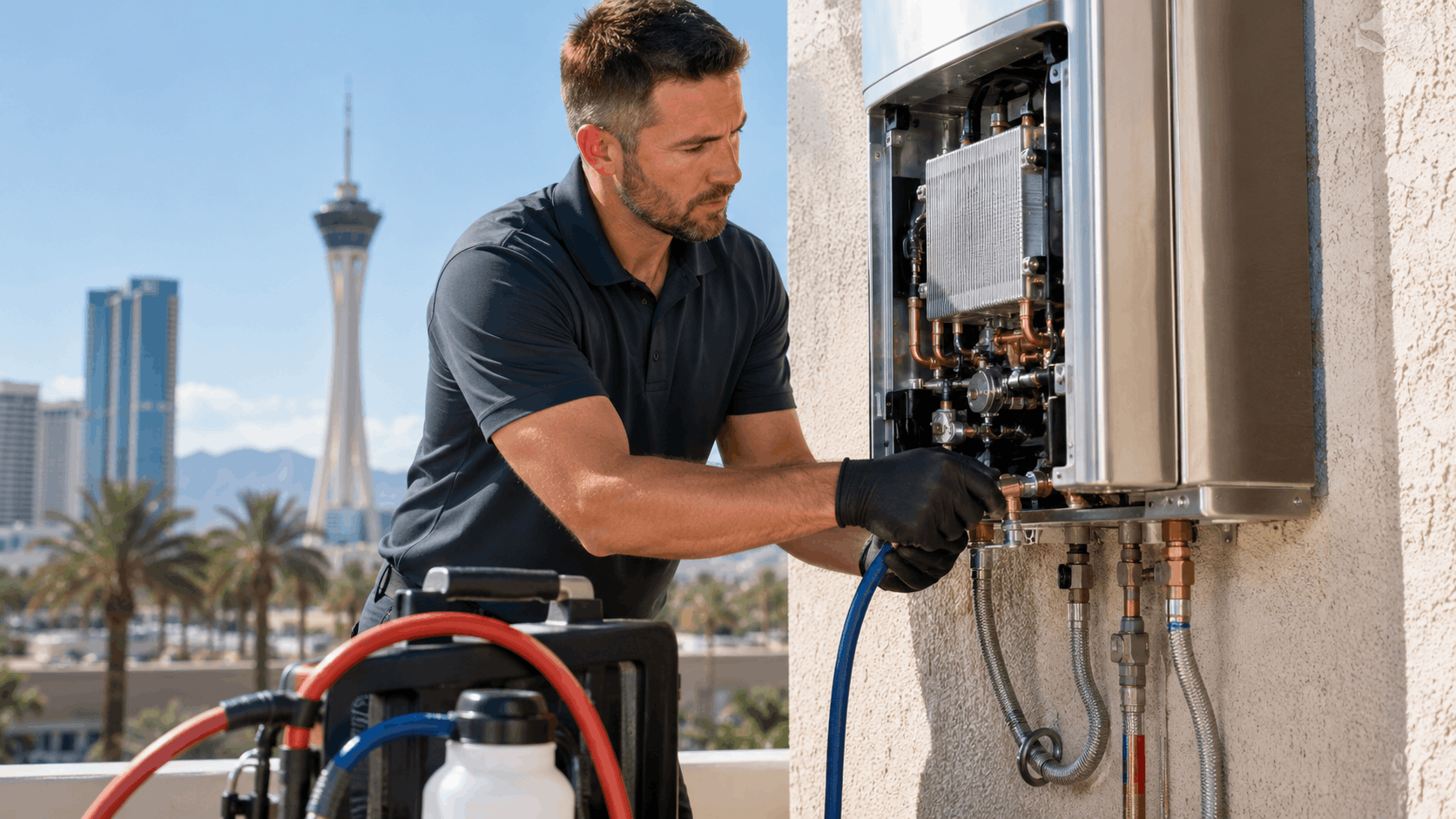
Inside every tankless heater sits a heat exchanger. It is a compact coil or plate of narrow channels that water flows through while a burner or element heats it. When mineral buildup coats those channels, the whole system has to work harder and starts to fail in small ways.
Here is a quick look at how buildup affects a unit over time in a hard water area like ours.
| Time Without Descaling | Typical Scale Level | What You Notice |
|---|---|---|
| 0 to 12 months | Light film | Runs normally, small efficiency loss |
| 12 to 24 months | Moderate crust | Slower heating, minor temperature swings |
| 24 to 36 months | Heavy buildup | Error codes, reduced flow, rumbling |
| 36+ months | Severe blockage | Frequent faults, risk of exchanger failure |
How Scale Builds Up Inside the Heat Exchanger
Our water carries a lot of dissolved calcium and magnesium. When water heats up, those minerals fall out of solution and stick to the hottest surfaces inside the unit. That is the same white stuff you see crusting your shower head or the bottom of a kettle.
The heat exchanger is where this happens fastest because it is the hottest spot in the system. Calcium scale layers on the walls of the narrow water channels a little more with each gallon that passes through. Since those channels are only a few millimeters wide, it does not take much to restrict flow.
Tankless units are far more sensitive to this than old tank models. A traditional tank has a large open space where sediment just settles to the bottom and sits there for years. A tankless heat exchanger has tight passages that clog quickly, which is why local tankless owners need service more often than tank owners ever did.
That sensitivity is the tradeoff for the efficiency and endless hot water a tankless unit gives you. The design that makes it great also makes it demanding. Regular descaling is the price of keeping that performance.
The Flush and Vinegar or Descaler Process Step by Step
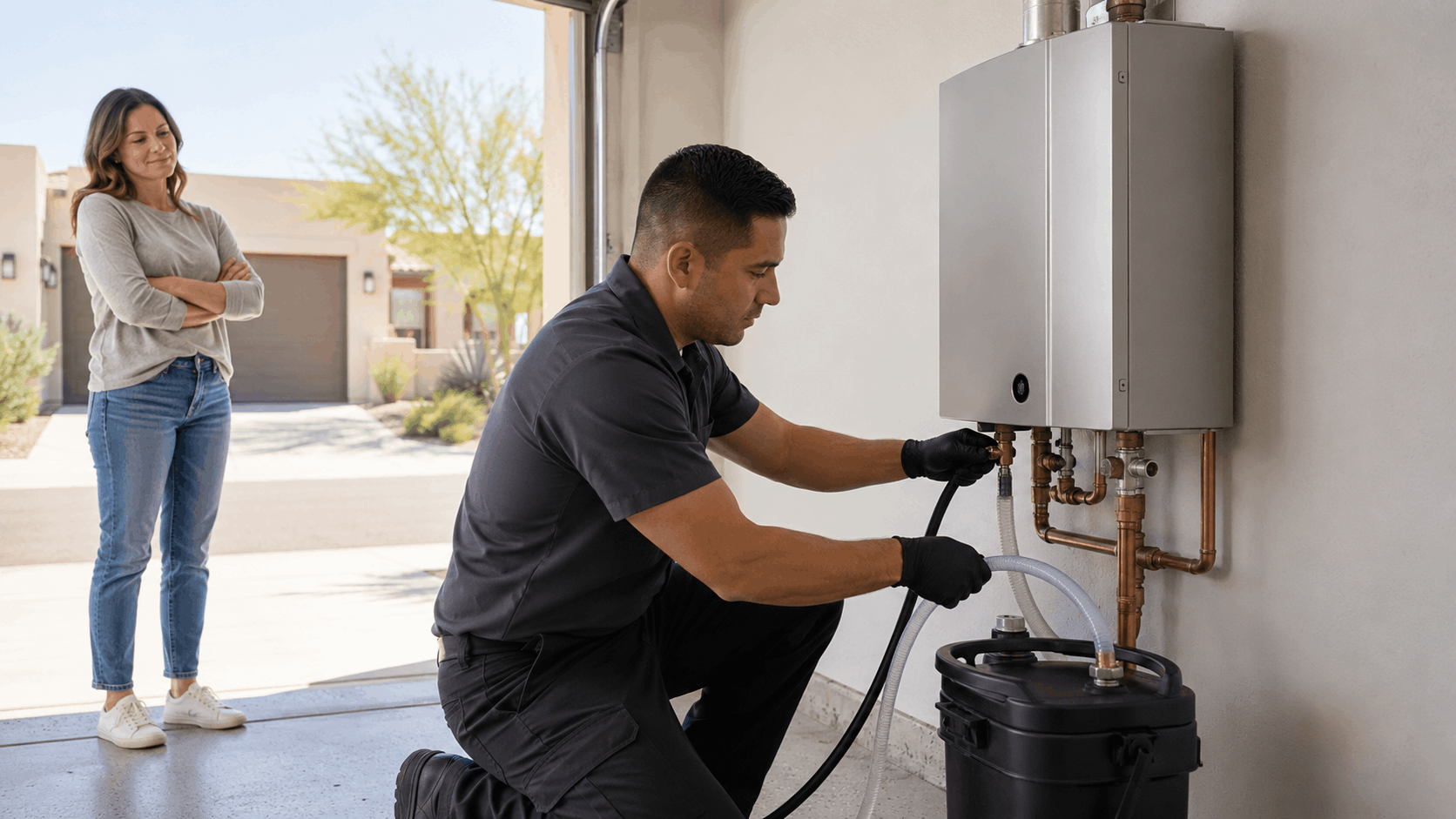
A proper flush starts with the isolation valves. Most modern installs have a set of service valves on the hot and cold lines that let a technician close off the unit from the house plumbing. Without them, the job gets much harder and often requires added parts.
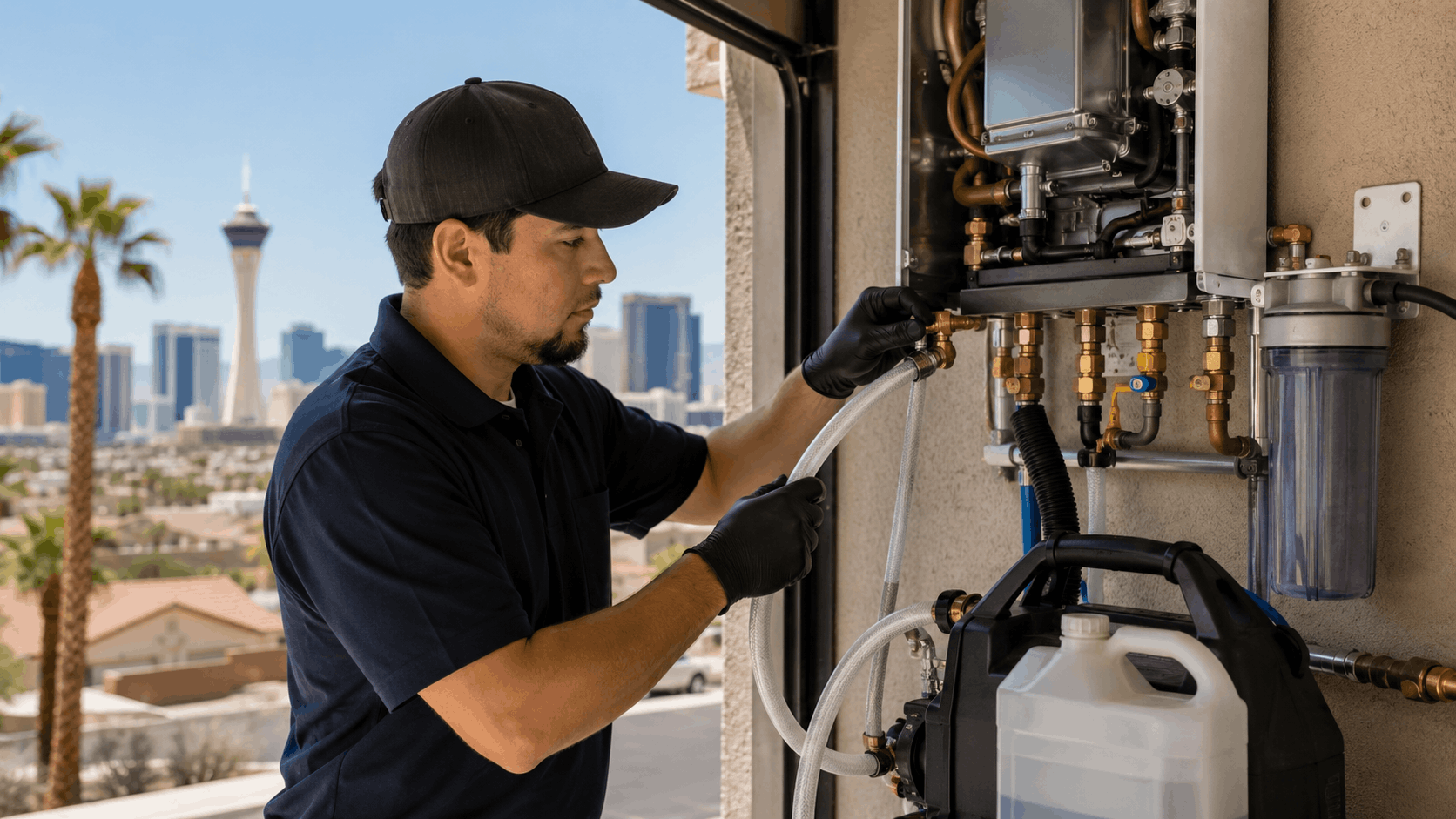
Once the valves are closed, we connect hoses from a small circulation pump to the service ports. The pump pulls descaling solution from a bucket, pushes it through the heat exchanger, and returns it to the bucket in a loop. This runs for 45 to 60 minutes so the solution has time to dissolve the calcium.
For the solution itself, some homeowners use plain white vinegar because it is cheap and food-safe. It works, but it is weak and slow against the heavy scale we see in the valley, often needing longer cycles. Commercial descaling solutions are stronger and made for this exact job, so they clear tough buildup faster and more completely.
After the flush, we run clean water through the system to rinse out any leftover solution. A good flush kit includes the pump, hoses, and bucket sized for the job. Skipping the rinse or using the wrong mix is where DIY jobs tend to go sideways.
Signs Your Unit Is Overdue for a Descale
The clearest warning is water temperature that will not hold steady. If your shower goes from warm to hot to lukewarm on its own, scale is likely blocking the flow the sensors depend on. That temperature fluctuation is the number one thing homeowners describe when they call us.
Error codes are the next big tell. Navien, Rinnai, and Rheem units all throw specific codes when flow or heat readings drift outside normal ranges, and buildup is a frequent cause. If your display shows a fault after a hot summer of heavy use, do not just reset it and move on.
Low flow is another sign. When scale narrows the channels, less hot water reaches your faucets even though the cold side runs fine. You might notice weaker pressure at the kitchen sink or a shower that never quite gets strong.
Finally, listen for rumbling, popping, or crackling sounds from the unit. Those noises come from water fighting its way past mineral deposits and from steam pockets forming on the scale. Any of these signs means it is time to book service, not wait another year.
Get Your Quote
Tell us what's going on and we'll get back to you fast.
Why Las Vegas Water Is So Hard on Tankless Systems
The reason tankless units struggle here comes down to one thing - our water is loaded with minerals. Hard water in Las Vegas is not a mild inconvenience, it is one of the toughest water conditions any plumber deals with in the country.
Most of that mineral content comes from where the water starts its journey. Understanding the source explains why descaling matters so much more here than in other cities.
- Roughly 90 percent of valley water comes from the Colorado River
- The river picks up minerals as it flows through rock and desert
- Water hardness locally runs about about 16 grains per gallon
- Hot desert summers push water usage and scale buildup higher
- Older neighborhoods often sit on aging pipes that add to the problem
Colorado River Water and the Las Vegas Valley Water District
Nearly all of the drinking water in the valley comes from Lake Mead, which is fed by the Colorado River. The Southern Nevada Water Authority draws it out, treats it, and delivers it through providers like the Las Vegas Valley Water District. It is clean and safe to drink, but it is very hard.
The Colorado River earns that hardness naturally. As it winds hundreds of miles through canyons and sediment, it dissolves calcium and magnesium from the rock. By the time it reaches Lake Mead, it carries a heavy mineral load that stays with the water all the way to your tap.
You can read the water quality reports the Las Vegas Valley Water District publishes each year, and the hardness numbers are right there in black and white. Those numbers are why our team treats tankless maintenance as a yearly must, not a suggestion.
This is also why homes across Summerlin, Henderson, and North Las Vegas all deal with the same core issue. The water source is shared, so the mineral problem is shared too. No neighborhood in the valley escapes it.
How Hard the Water Really Is in Grains Per Gallon
Water hardness is measured in grains per gallon or milligrams per liter. Local water typically runs around 250 to 300 mg/L, which works out to roughly about 16 grains per gallon. Anything over 10 grains is considered very hard by industry standards.
To put that in perspective, soft water regions like parts of the Pacific Northwest often sit at 1 to 3 grains per gallon. That means our water can carry five to fifteen times more scale-forming minerals than what homeowners in those areas deal with.
The U.S. Geological Survey classifies water above 180 mg/L as very hard, and we are well past that line. Every gallon that runs through a tankless unit here leaves behind more deposit than the same gallon would in most other states.
Those numbers explain why a maintenance schedule built for average water fails here. Advice written for the whole country assumes softer water than we have. The valley needs its own timeline.
Neighborhood Differences From Henderson to North Las Vegas
While the whole valley shares Colorado River water, hardness varies a little by area and by how old the local pipes are. Homes in Henderson and newer parts of Summerlin often see slightly better numbers thanks to newer infrastructure. Even so, the difference is small and the water is still very hard everywhere.
Older neighborhoods tend to have it worse. Homes near Winchester and the older sections of central Las Vegas often sit on decades-old galvanized pipe that adds mineral pickup and sediment to the mix. We see heavier buildup in those Winchester area homes almost every time.
North Las Vegas and communities like Aliante and Elkhorn deal with the same hard water but often have newer plumbing. That helps a bit, but it does not change the mineral content coming from the source. A tankless unit in a five-year-old home there still needs yearly descaling.
Spring Valley and Paradise fall right in the middle, with a mix of older and newer housing stock. Wherever a home sits in the valley, the safe assumption is that the water is hard enough to demand annual service. The neighborhood only shifts the timeline by a small margin.
Why Desert Heat Speeds Up Scale Buildup
Our climate makes hard water even harder on equipment. During long summers when it stays above 105 degrees for weeks, incoming water arrives warmer than it does in mild climates. Warmer starting water means minerals drop out faster once heating begins.
Summer also spikes water usage. Families run more showers, fill more pools, and do more laundry when it is hot, so more gallons pass through the tankless unit. Every extra gallon leaves behind another thin layer of scale on the heat exchanger.
The combination of warmer water and higher volume accelerates buildup in a way people in cooler regions never experience. A unit that might go two years elsewhere can crust up in twelve months here. That is scale acceleration driven by the desert itself.
This is exactly why the Summerlin homeowner from the opening had trouble after a hot August. Her unit had been quietly collecting scale all summer until the buildup finally tripped the error codes. The heat did not cause the problem, but it sped it up.
Need Help in Las Vegas?
Active Plumbing serves Las Vegas and all of Las Vegas Valley.
What Happens When Homeowners Skip Annual Descaling
Skipped maintenance is the most common reason tankless units fail early in the valley. The damage does not happen overnight, which is exactly why it sneaks up on people. By the time symptoms are obvious, real harm is often done.
The consequences range from annoying to expensive, and they tend to stack on each other. Here is what neglect actually costs a homeowner over time.
Clogged Heat Exchangers and Restricted Flow
As scale layers up inside the heat exchanger, the water channels get narrower and narrower. Less hot water can pass through, so the unit that once fed the whole house now struggles to fill a bathtub. This restricted flow is the first real symptom most people feel.
The decline is slow, which is the trap. You lose a little pressure and a little heat each month, and your family adjusts without noticing. Then one day two showers cannot run at once, and you realize the unit has been failing for a year.
A clogged heat exchanger also throws off the internal sensors. The unit reads bad flow and heat data and starts cycling on and off or shutting down entirely. At that point you are one hot summer away from a hard failure.
We have opened units in the valley that were more than half blocked with calcium. In many of those cases a yearly flush would have kept the passages clear and the unit healthy. Instead the owner faced a repair or replacement.
Higher Gas or Electric Bills From a Struggling Unit
Scale acts like an insulating blanket on the heat exchanger. The burner or element has to push through that layer to heat the water, which wastes energy. A scaled unit burns more gas or draws more electricity to hit the same temperature.
Studies on water heater efficiency show even a thin scale layer can cut efficiency by 10 to 30 percent. That loss shows up on your monthly utility bill month after month. Over a year it can add up to real money quietly leaking out of your budget.
The frustrating part is that the extra cost buys you nothing. You are paying more to get worse performance and a shorter unit life at the same time. A single descaling visit usually costs less than a year of that wasted energy.
Homeowners who keep up with service tell us their bills stay flat and their hot water stays strong. That is the payoff of catching scale before it insulates the exchanger. Efficiency is one of the biggest reasons tankless owners chose the unit in the first place.
Voided Warranties and Shortened Lifespan
Most tankless manufacturers require documented annual descaling to honor the warranty in hard water areas. Navien, Rinnai, and Rheem all spell this out in their terms. If your unit fails and you cannot show maintenance records, the claim can be denied.
That leaves you paying full price for a repair or a whole new unit that should have been covered. We have seen homeowners lose thousands because they skipped a service that would have cost a fraction of that. The paperwork matters as much as the flush.
Neglect also cuts the lifespan hard. A well-maintained tankless unit can run 15 to 20 years, but one left to scale up often fails in under 10. In our valley, that early failure is the norm for units that never get serviced.
Think of descaling as the payment that keeps both the warranty and the full lifespan intact. Skip it and you risk losing both at once. That is why we call annual service non-negotiable here.
How Often Las Vegas Homes Really Need Service
The frequency question comes up on almost every service call. Homeowners have often read online that tankless units only need descaling every couple of years. That advice was not written for water like ours.
The honest answer depends on your household and whether you treat your water, but there is a clear floor for the valley. Here is how to figure out your own schedule.
Why Once a Year Is the Minimum Here
In soft water regions, going 18 to 24 months between descalings is reasonable because scale builds slowly. Those homes might see one grain of hardness for every ten we deal with. Their timeline simply does not apply here.
With about 16 grains per gallon, a valley tankless unit collects in one year what a soft-water unit collects in several. That is why we set annual descaling as the absolute minimum for every home we service. Waiting longer lets scale reach the point where it causes real damage.
The reasoning is straightforward - match the service interval to the water. Hard water means more frequent care, plain and simple. A yearly flush keeps the heat exchanger clear before buildup ever becomes a problem.
We tell customers to think of it like an oil change tied to the miles they drive. Heavy conditions mean shorter intervals. Our water is the heaviest condition there is.
When Twice a Year Makes Sense
Some homes need service every six months. Large households with five or more people run enormous amounts of water through the unit, so scale builds twice as fast. If you have teenagers taking long showers back to back, you are in this group.
Homes without a water softener are also strong candidates for twice-yearly service. With nothing removing the minerals first, the full hardness of the water hits the heat exchanger on every cycle. That accelerates buildup enough to justify two flushes a year.
Heavy usage cases include homes with pools that get topped off, home-based businesses, or vacation rentals with constant guest turnover. Any property that runs hot water hard all day fits here. The extra flush pays for itself in avoided repairs.
If you are not sure which group you fall into, our team can look at your usage and water setup and give you a straight answer. Self-assessing is easy once you know the factors. When in doubt, more frequent service is the safer bet in this valley.
How a Water Softener Changes the Timeline
A whole home water softener removes most of the calcium and magnesium before water ever reaches your tankless unit. That dramatically slows scale buildup and protects the heat exchanger. Homes with a good softener often stretch their descaling interval closer to the standard national advice.
A salt-free whole home conditioner is another option that changes the mineral structure so it sticks less. It does not remove minerals like a softener but still cuts down on buildup. Either one adds years to your unit and reduces how hard your water is on every appliance.
Even with treatment, we still recommend a yearly inspection and flush check. A softener reduces scale but does not stop it completely, and it can fail without warning if the salt runs out or a valve sticks. A quick annual check catches those issues early.
So a softener is a smart investment that extends the timeline, but it does not fully replace descaling. Think of it as reducing the workload, not eliminating it. The combination of a softener plus yearly service is the best protection a valley home can have.
DIY Descaling Versus Hiring a Local Pro
Plenty of handy homeowners ask whether they can descale the unit themselves. The honest answer is that some can, but there are real risks and blind spots. Here is a fair look at both sides so you can decide.
DIY descaling saves money on the flush itself, but a professional visit catches problems a flush alone never will. Knowing where the line is helps you make the right call for your home.
What a Homeowner Can Handle With a Flush Kit
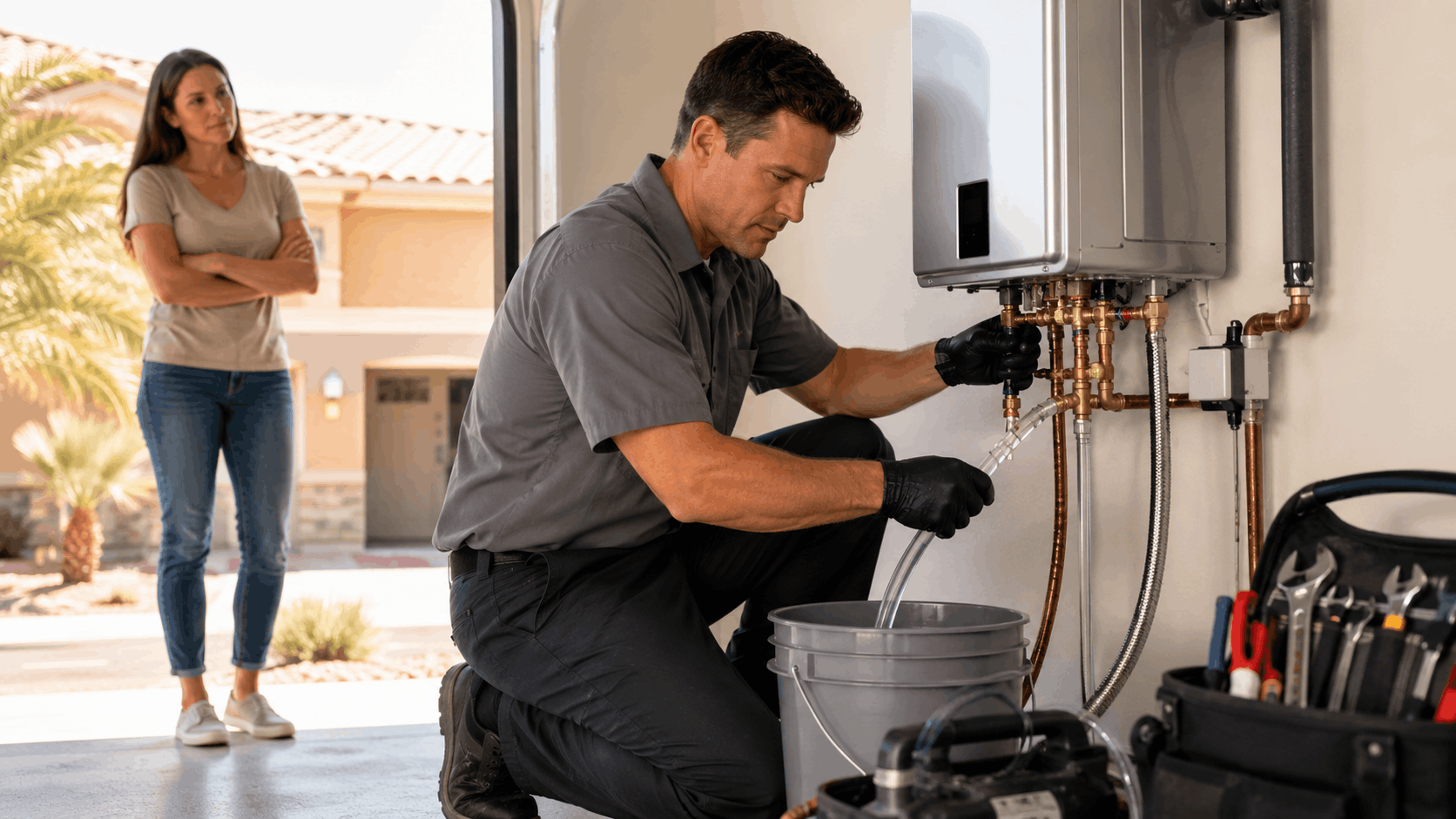
A confident homeowner with isolation valves already installed can run a basic flush. The tools you need are a submersible pump, two washing-machine hoses, a five-gallon bucket, and descaling solution. Kits with all of this run about 80 to 150 dollars.
The process is not complicated. You close the isolation valves, connect the hoses to the service ports, fill the bucket with solution, and let the pump circulate it for an hour. Then you rinse with clean water and reopen the valves.
For someone comfortable with basic plumbing and reading their unit's manual, this is doable. If you own the kit, your only recurring cost is the solution, which is cheap. That is the real appeal of DIY for hands-on owners.
Set realistic expectations, though. A DIY flush handles the scale but skips the full inspection, and it only works well if you actually keep up with it every year. Many people buy the kit, do it once, and never again.
Common Mistakes That Damage the Unit
The most common error is using the wrong solution or mixing it too strong. Some folks reach for harsh chemicals that can damage the heat exchanger seals. Straight vinegar is safe but weak, and industrial acids are too aggressive if you get the ratio wrong.
Missing or absent isolation valves cause another set of problems. If your unit was installed without service valves, there is no safe way to hook up a pump, and improvising can flood the area or damage fittings. Older installs in central Las Vegas often lack these valves entirely.
Forgetting the inlet filter is a frequent oversight. Every tankless unit has a small inlet screen that catches debris, and it clogs with sediment in hard water areas. A flush that ignores this filter leaves flow restricted even after the exchanger is clean.
Other mistakes include not rinsing out the solution fully, running the pump too short, and reopening valves in the wrong order. None of these are catastrophic on their own, but together they can leave the unit worse off. Care and patience matter more than most people expect.
What Active Plumbing Includes in a Full Service Visit
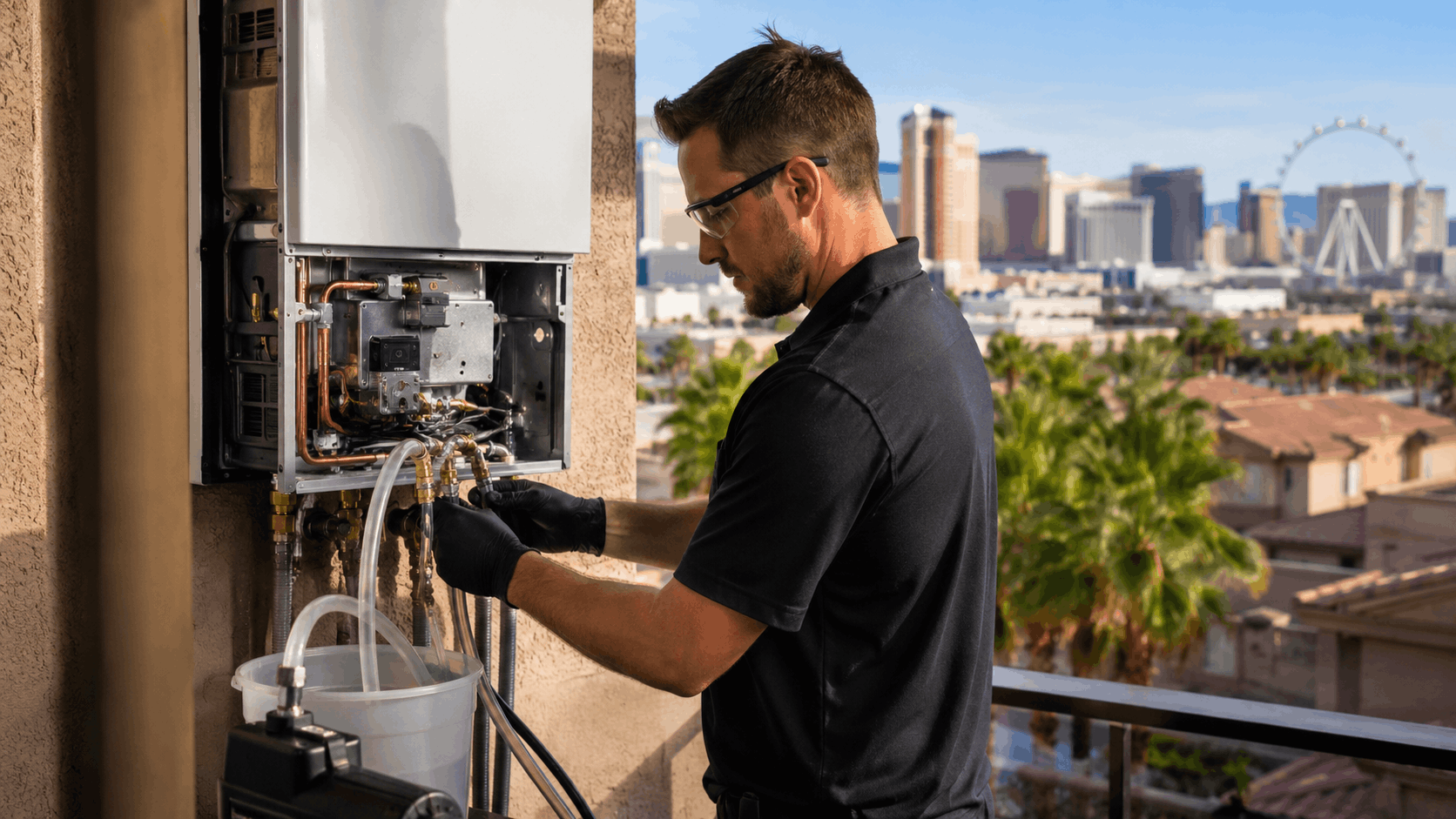
When our team handles a service visit, the flush is only part of the job. We also pull and clean the inlet filter, which DIY flushes almost always skip. That single step often restores flow that the homeowner assumed was gone for good.
We check the gas pressure on gas units to make sure the burner is getting what it needs. Low or high gas pressure causes its own faults and can mimic scale problems. If we find an issue, we can address it or coordinate gas line service right then.
Venting gets inspected too, since a blocked or corroded vent is both a performance and a safety concern. We look at the combustion air path and confirm everything is clear. On the electrical side we verify connections and settings.
Finally, we pull the error history from the unit's memory. Those stored codes tell us what the unit has been struggling with even if it seems fine today. That whole-picture inspection is the added value a full water heater service gives you over a solo flush.
Need Help in Las Vegas?
Active Plumbing serves Las Vegas and all of Las Vegas Valley.
Cost of Tankless Descaling in the Las Vegas Valley
Cost is usually the next question after frequency. The good news is that descaling is one of the more affordable services a plumber offers. Here are realistic local numbers and what moves them up or down.
Knowing the ranges ahead of time lets you budget and avoid surprises. It also makes it clear why maintenance beats waiting for a breakdown.
Typical Price Ranges for a Descale and Flush
A standard tankless descaling and flush in the valley typically runs about 150 to 300 dollars. The range depends on the unit, access, and whether a full inspection is bundled in. Most homeowners land somewhere in the middle.
A bundled visit that adds the inlet filter cleaning, gas pressure check, and full inspection may sit at the higher end. That extra cost buys the whole-system peace we described earlier. For most families it is worth the small premium.
Compare that to the DIY route where the kit runs 80 to 150 dollars up front plus your time. If you value your Saturday and the added inspection, the pro visit is a fair deal. If you already own the kit and stay disciplined, DIY is cheaper year to year.
Either way, the flush cost is minor next to what a neglected unit costs to fix. That contrast is the whole point of staying on schedule. A few hundred dollars a year is cheap insurance.
What Adds to the Bill
The biggest add-on is missing isolation valves. If your unit was installed without them, we have to add them before we can flush, and that valve install adds to the total. It is a one-time cost, though, and it makes every future service faster and cheaper.
Access is another factor. Units crammed into tight closets, high on garage walls, or in cramped attic spaces take more time and effort to service. We see plenty of these tight installs in older Winchester and central valley homes.
Extra parts can raise the bill too. If the inlet filter is damaged, a gasket is worn, or a sensor needs replacing, those parts add to the cost. We always show you the part and explain why before doing any added work.
None of these surprises should catch you off guard because we quote before we start. Understanding these factors up front helps you plan. A clean, valve-equipped, easy-access unit is always the cheapest to maintain.
Why Yearly Service Costs Less Than One Repair
A heat exchanger replacement often runs 500 to 1,000 dollars or more once you factor in the part and labor. A full tankless unit replacement can hit 3,000 to 5,000 dollars installed. Both of those dwarf a yearly flush.
When you do the math over a decade, annual service costs a fraction of a single major repair. Ten years of yearly descaling might total 2,000 dollars, and that keeps you from ever needing the exchanger or unit swap. The maintenance path is simply cheaper.
There is also the hidden cost of downtime. A failed unit means cold showers until a part arrives and a plumber can install it, sometimes days later in peak season. Maintenance keeps you out of that scramble entirely.
This is the clearest argument for treating descaling as a routine expense. Repair versus maintenance is not a close call in a hard water city. Paying a little every year beats paying a lot all at once.
Protecting Your Tankless Unit Between Service Visits
Annual service is the foundation, but there is plenty you can do between visits to slow buildup. A few habits and a couple of upgrades go a long way here. These steps stretch the life of your unit and reduce how hard the water hits it.
None of this replaces the yearly flush, but it all works alongside it. Think of these as ways to make each service last longer.
Installing a Water Softener or Scale Inhibitor
The single biggest protective move is treating the water before it reaches the unit. A whole home softener removes calcium and magnesium and typically costs 1,500 to 3,000 dollars installed. It protects not just the tankless unit but every appliance and fixture in the house.
A phosphate scale inhibitor is a smaller, cheaper option that adds a trace of food-safe phosphate to keep minerals from sticking. These inline units cost far less and are a good fit for homes that cannot fit a full softener. They reduce buildup without removing minerals.
For homes in the hardest zones, we often recommend pairing treatment with the tankless unit from the start. If you are already planning a tankless water heater installation, adding treatment at the same time saves a second visit. It also protects the new unit from day one.
The benefit is fewer descalings, lower energy bills, softer laundry, and cleaner fixtures throughout the house. It is one of the higher-value upgrades a valley homeowner can make. The water is hard enough here that treatment nearly always pays off.
Cleaning the Inlet Filter and Checking for Codes
You can rinse the inlet filter yourself a couple of times a year. Shut off the water, remove the small screen at the cold inlet, rinse the debris out under a faucet, and reinstall it. This simple step keeps flow strong between full services.
Always follow your unit's manual for the exact location and removal steps, since brands differ slightly. If you are not comfortable shutting off the water lines, leave it for the pro visit. It is a five-minute job for a confident owner and a nice habit to build.
Reading error codes is the other easy check. When your display shows a fault, write down the code and look it up in the manual before resetting. Recurring codes tell you the unit needs attention rather than another reset.
If the same code keeps coming back, that is your cue to call for service. Catching a pattern early can prevent a full failure. A quick code check costs nothing and can save a lot.
Setting a Reminder So You Never Miss a Year
The easiest way to stay on schedule is to tie service to a date you already remember. Book it around a birthday, a holiday, or the start of summer so it never slips your mind. Consistency is what protects the unit, and missing years is what kills it.
A calendar reminder on your phone works fine for most people. Set it to repeat every year and give yourself a week of lead time to book the appointment. That small step prevents the slow neglect that damages so many units.
Better yet, a maintenance plan handles the tracking for you. Many of our customers sign up for a plan that schedules the annual descaling automatically so they never have to think about it. It also usually comes with priority scheduling.
However you do it, the goal is to never let a year go by without service. In this valley, a missed year is a real risk to the unit. Make staying on schedule the default and your tankless heater will reward you with a long life.
Why Local Homeowners Trust Active Plumbing for Tankless Care
We have worked on tankless units in nearly every corner of the valley, and that local knowledge shapes how we service them. Water and neighborhoods here have their own quirks, and experience is what tells us where to look first. Here is what sets our tankless care apart.
Our team treats each unit based on the water it drinks and the home it sits in. That grounded, valley-specific approach is why homeowners keep calling us back year after year.
Experience With Valley Water and Every Major Brand
We service Navien, Rinnai, Rheem, and the other major tankless brands installed across the region. Each brand has its own service ports, error code system, and quirks, and our team knows them all. That means faster, cleaner work no matter what unit you own.
We have flushed units in Summerlin master-planned communities, older homes near Winchester, and newer builds out in Centennial Hills. Each area has its own install patterns and access challenges we have learned over hundreds of visits. That familiarity saves time on every job.
Knowing the local water is just as important as knowing the brands. We calibrate our service intervals and expectations to the about 16 grains per gallon we actually see here. That local calibration is something a national chain simply cannot match.
The result is service tuned to your exact unit and your exact neighborhood. We do not guess at the water because we have tested it and worked in it for years. That experience shows up in the quality of the flush.
Documented Service for Warranty Protection
We keep detailed records of every service visit, including the date, the work performed, and the condition of the unit. Those records are exactly what manufacturers ask for when a warranty claim comes up. Having them on file protects you if the unit ever fails under warranty.
As we covered earlier, neglect can void a tankless warranty in a hard water area. Documented annual service is your defense against a denied claim. We make sure you have the paperwork to back up your maintenance history.
If you ever need to file a claim, you or the manufacturer can request the service history and we provide it promptly. That closes the loop on the warranty risk that catches so many homeowners off guard. It is one less thing you have to track yourself.
This recordkeeping is a quiet but real benefit of using the same local team each year. Consistent documentation from one provider is cleaner than a pile of mismatched receipts. It keeps your warranty intact and your mind at ease.
Fast Response Across the Las Vegas Metro
Our service area covers the whole metro, from the 215 Beltway communities out west to the neighborhoods along Boulder Highway in the east. Whether you are in North Las Vegas, Henderson, Spring Valley, or Enterprise, we can reach you. Coverage across the valley means quick scheduling for routine service.
When a tankless unit throws codes in the middle of summer, waiting a week is not acceptable. We keep scheduling tight so you are not stuck with cold water for long. For true breakdowns, our emergency plumbing team responds fast.
Routine descaling appointments are easy to book ahead, and we work around your schedule. Tying it to a maintenance plan makes it even simpler since we handle the timing. That convenience keeps homeowners on track year after year.
No matter where you sit in the valley, help is close by. Our trucks cover these streets every day, so we are rarely far from your door. Fast, local response is part of what makes yearly care easy to keep up.
Need Help in Las Vegas?
Active Plumbing serves Las Vegas and all of Las Vegas Valley.
Final Thoughts
Tankless water heaters are a great fit for valley homes, but our hard water demands respect. With about 16 grains per gallon of minerals coming from the Colorado River, scale builds fast and quietly. Annual descaling is the one habit that keeps your unit efficient, protects your warranty, and gets you the full 15 to 20 year lifespan.
Skip it and you risk restricted flow, higher bills, and an early failure that costs thousands. Stay on schedule and you spend a little each year to avoid all of that. In a city with water this hard, that is an easy trade.
If your tankless unit is due for service or has started throwing codes, our team is ready to help. Contact Active Plumbing today to schedule a descaling visit or ask about a maintenance plan that keeps you on track automatically. One call keeps your hot water strong and your unit healthy for years to come.
Frequently Asked Questions
How often should a tankless water heater be descaled in Las Vegas?
Once a year is the minimum here because of our very hard water. At about 16 grains per gallon, scale builds far faster than in soft water regions. Large households, homes with heavy usage, and homes without a water softener should consider descaling every six months. A yearly flush is the baseline every valley home should meet.
How long does a descaling service take?
A typical descaling and flush runs about 60 to 90 minutes from start to finish. The exact time depends on how much buildup is inside the unit and how easy the unit is to reach. Heavy scale needs a longer circulation cycle to fully dissolve. A full visit that adds the inlet filter cleaning and inspection sits at the longer end of that range.
Can I descale my tankless unit myself?
A confident homeowner can descale their own unit if it already has isolation valves. You need a flush kit with a pump, hoses, a bucket, and descaling solution. The risks are using the wrong solution, skipping the inlet filter, and missing the inspection points a pro would catch. Many owners do it once and then forget, so honest self-discipline matters.
What happens if I never descale my tankless heater?
Without descaling, scale slowly clogs the heat exchanger and restricts your hot water flow. You will see error codes, temperature swings, and higher gas or electric bills as the unit struggles. Neglect can also void the manufacturer warranty and cut the lifespan from 15 to 20 years down to under 10. Eventually the unit fails entirely and needs a costly repair or replacement.
Does a water softener mean I can skip descaling?
No, but a softener does help a lot. It removes most of the calcium and magnesium before water reaches the unit, which slows scale buildup and extends the interval between flushes. Even so, we still recommend a yearly inspection and flush check in the valley. Softeners can fail without warning, and a quick annual visit catches that before it hurts your unit.
How much does tankless descaling cost in the Las Vegas Valley?
A standard descaling and flush usually runs about 150 to 300 dollars locally. A bundled visit with a full inspection sits at the higher end. Costs rise if the unit lacks isolation valves that must be installed first, if the unit is in a tight or hard-to-reach spot, or if worn parts need replacing. We always quote before starting any added work.
What are the signs my unit needs descaling now?
Watch for water temperature that swings from warm to hot to lukewarm on its own. Reduced hot water flow at your faucets and showers is another clear sign. Rumbling, popping, or crackling noises from the unit point to scale, and so do error codes on the display. Any of these mean it is time to book service rather than wait.
Does descaling void or protect my warranty?
Documented annual descaling protects your warranty in almost every case. Manufacturers like Navien, Rinnai, and Rheem require proof of regular maintenance in hard water areas to honor claims. Neglect can void that coverage and leave you paying full price for repairs. Keeping records of each service visit is the safeguard, which is why we document every job we do.
Is vinegar or a commercial descaler better?
White vinegar is cheap, safe, and food-friendly, but it is weak and works slowly against heavy scale. It can take longer cycles to clear the buildup we see in the valley. Commercial descaling solutions are stronger and made for the job, so they clear tough calcium faster and more completely. For our hard water, a commercial solution is usually the better choice.
Does Active Plumbing service my neighborhood?
Yes, our team covers the entire valley. That includes Summerlin, Henderson, North Las Vegas, Spring Valley, Centennial Hills, Enterprise, Paradise, and the older central areas near Winchester. We run from the 215 Beltway out west to Boulder Highway in the east. Wherever you are in the metro, we can schedule your tankless descaling quickly.
Frequently Asked Questions
- How often should a tankless water heater be descaled in Las Vegas?
- Once a year is the minimum here because of our very hard water. At about 16 grains per gallon, scale builds far faster than in soft water regions. Large households, homes with heavy usage, and homes without a water softener should consider descaling every six months. A yearly flush is the baseline every valley home should meet.
- How long does a descaling service take?
- A typical descaling and flush runs about 60 to 90 minutes from start to finish. The exact time depends on how much buildup is inside the unit and how easy the unit is to reach. Heavy scale needs a longer circulation cycle to fully dissolve. A full visit that adds the inlet filter cleaning and inspection sits at the longer end of that range.
- Can I descale my tankless unit myself?
- A confident homeowner can descale their own unit if it already has isolation valves. You need a flush kit with a pump, hoses, a bucket, and descaling solution. The risks are using the wrong solution, skipping the inlet filter, and missing the inspection points a pro would catch. Many owners do it once and then forget, so honest self-discipline matters.
- What happens if I never descale my tankless heater?
- Without descaling, scale slowly clogs the heat exchanger and restricts your hot water flow. You will see error codes, temperature swings, and higher gas or electric bills as the unit struggles. Neglect can also void the manufacturer warranty and cut the lifespan from 15 to 20 years down to under 10. Eventually the unit fails entirely and needs a costly repair or replacement.
- Does a water softener mean I can skip descaling?
- No, but a softener does help a lot. It removes most of the calcium and magnesium before water reaches the unit, which slows scale buildup and extends the interval between flushes. Even so, we still recommend a yearly inspection and flush check in the valley. Softeners can fail without warning, and a quick annual visit catches that before it hurts your unit.
- How much does tankless descaling cost in the Las Vegas Valley?
- A standard descaling and flush usually runs about 150 to 300 dollars locally. A bundled visit with a full inspection sits at the higher end. Costs rise if the unit lacks isolation valves that must be installed first, if the unit is in a tight or hard-to-reach spot, or if worn parts need replacing. We always quote before starting any added work.
- What are the signs my unit needs descaling now?
- Watch for water temperature that swings from warm to hot to lukewarm on its own. Reduced hot water flow at your faucets and showers is another clear sign. Rumbling, popping, or crackling noises from the unit point to scale, and so do error codes on the display. Any of these mean it is time to book service rather than wait.
- Does descaling void or protect my warranty?
- Documented annual descaling protects your warranty in almost every case. Manufacturers like Navien, Rinnai, and Rheem require proof of regular maintenance in hard water areas to honor claims. Neglect can void that coverage and leave you paying full price for repairs. Keeping records of each service visit is the safeguard, which is why we document every job we do.
- Is vinegar or a commercial descaler better?
- White vinegar is cheap, safe, and food-friendly, but it is weak and works slowly against heavy scale. It can take longer cycles to clear the buildup we see in the valley. Commercial descaling solutions are stronger and made for the job, so they clear tough calcium faster and more completely. For our hard water, a commercial solution is usually the better choice.
- Does Active Plumbing service my neighborhood?
- Yes, our team covers the entire valley. That includes Summerlin, Henderson, North Las Vegas, Spring Valley, Centennial Hills, Enterprise, Paradise, and the older central areas near Winchester. We run from the 215 Beltway out west to Boulder Highway in the east. Wherever you are in the metro, we can schedule your tankless descaling quickly.
A
Licensed plumbing professionals serving Las Vegas and Las Vegas Valley.
Licensed in Nevada · License #0047021
Last updated on
Why trust Active Plumbing?
Founded in 1991, Active Plumbing is a licensed and insured plumber serving Las Vegas and Las Vegas Valley. All content is reviewed by our licensed technicians.

Need Help in Las Vegas?
Active Plumbing serves Las Vegas and all of Las Vegas Valley.
Related Articles
Maintenance
Sediment Tank Flush: Why Vegas Water Heaters Need It Every 18 Months
Las Vegas hard water causes rapid sediment buildup in water heaters. Learn why an 18-month flush schedule protects your tank, saves energy costs, and prevents expensive failures in the desert.
Maintenance
Tankless Water Heater Maintenance in Las Vegas: Why Hard Water Makes It Critical
Las Vegas hard water from Lake Mead builds scale fast inside tankless heaters. Learn the warning signs, real maintenance steps, and how often valley homes need service.

Maintenance
Tankless Water Heater Scale Buildup: Why Vegas Units Fail at 5 Years Without Descaling
Las Vegas hard water causes scale buildup that fails tankless units at five years. Learn the warning signs, descaling schedule, and treatment options to protect yours.