Safety & Prevention
T&P Valves: The Safety Device on Every Las Vegas Water Heater Nobody Tests
Key Takeaways
- The T&P valve releases water when tank temperature or pressure climbs too high, preventing a dangerous water heater explosion.
- Clark County code requires this valve and a downward discharge pipe on every installed water heater in the valley.
- Las Vegas hard water, desert heat, and high street pressure wear these valves out faster than in most cities.
- Watch for dripping discharge pipes, rust or white mineral crust, popping tank noises, and a valve that never moves.
- Test the T&P valve at least once a year, but skip DIY on old or corroded valves and call a professional instead.
- A standard valve replacement runs about 150 to 350 dollars and takes 30 to 60 minutes for most valley homes.
- Yearly flushing, an expansion tank, a pressure check, and water treatment all help the valve and tank last longer.
- Active Plumbing offers honest repair versus replace advice and same day help for active water heater leaks across the metro.
In This Article
A homeowner in Summerlin called our team last spring after she noticed a small puddle forming near the base of her water heater in the garage. She had lived in her house near Sun City Summerlin for over a decade and had no idea the tank even had a safety valve. That little brass fitting near the top, the one dripping water down the side, had been quietly protecting her family for years and finally started to fail.
This story plays out across the valley more often than most people realize. The temperature and pressure relief valve, known as the T&P valve, is the one part of a water heater that stands between a normal day and a serious accident. Yet almost nobody checks it, and even fewer know it exists.
What a T&P Valve Actually Does on Your Water Heater?
Every water heater in the valley heats water inside a sealed steel tank. As water heats, it expands and builds pressure. The T&P valve is the release point that keeps that pressure from turning your tank into a hazard.
- It opens when temperature or pressure climbs too high
- It closes and reseals once conditions return to normal
- It works automatically without any input from you
The Job It Was Built to Do
The temperature pressure relief valve has one purpose. When the water inside the tank gets hotter than about 210 degrees or the pressure passes roughly 150 psi, the valve pops open and lets water escape. That release drops the pressure inside the tank back to a safe level.
Think of it like the pressure release on a stovetop pressure cooker. Without a way to let steam and hot water out, the force keeps building with nowhere to go. The valve gives that force a controlled exit instead of a violent one.
This pressure relief happens quietly and quickly. In a healthy tank, the valve might open, release a cup or two of water, and reseal before you ever notice. That small action is the difference between tank safety and tank failure.
Because it protects the entire tank, this one part carries more responsibility than any other fitting on the unit. A water heater can lose a heating element or a thermostat and still be safe. Lose a working relief valve and the whole system becomes a risk.
Where to Find It on Your Tank
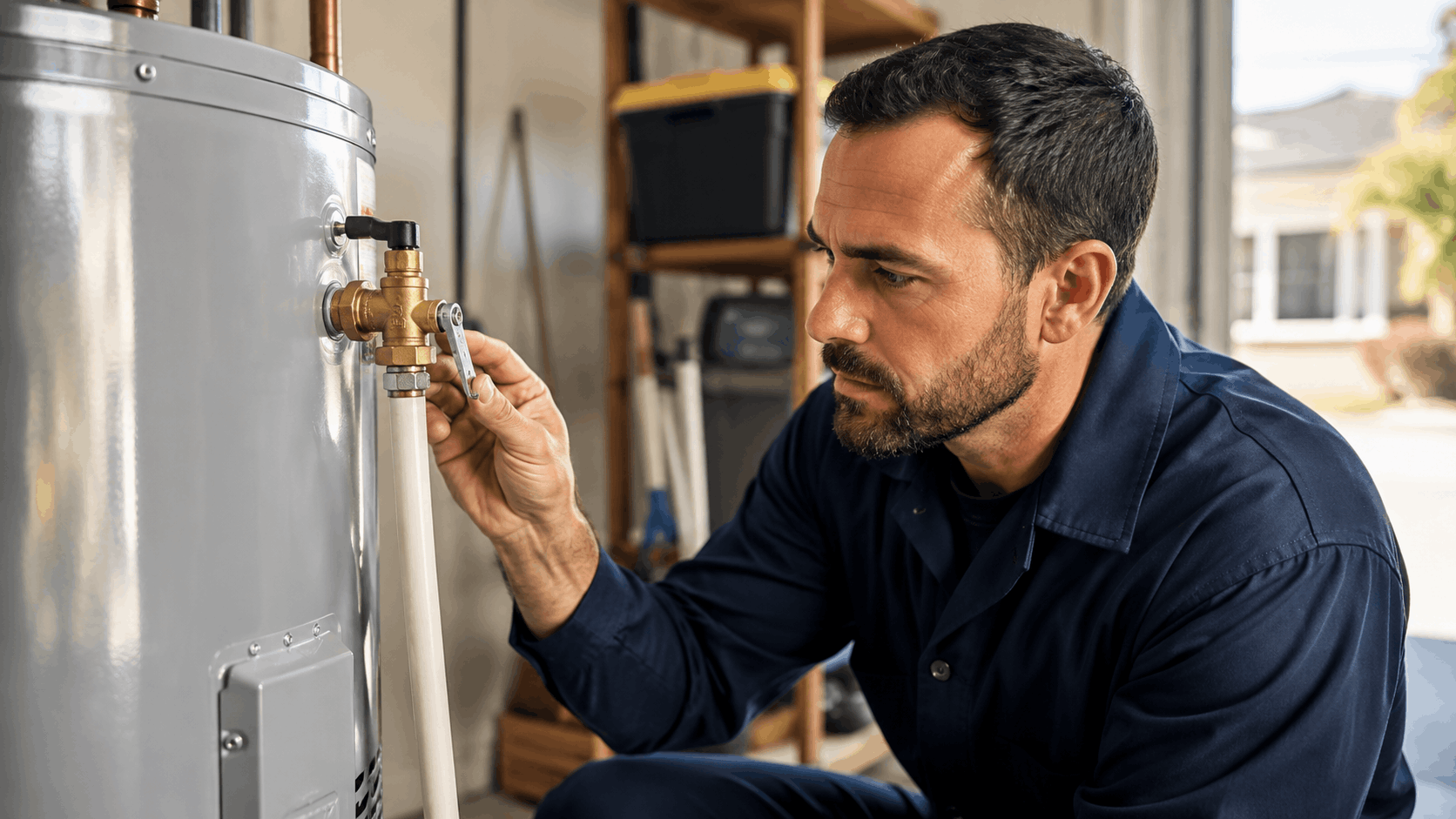
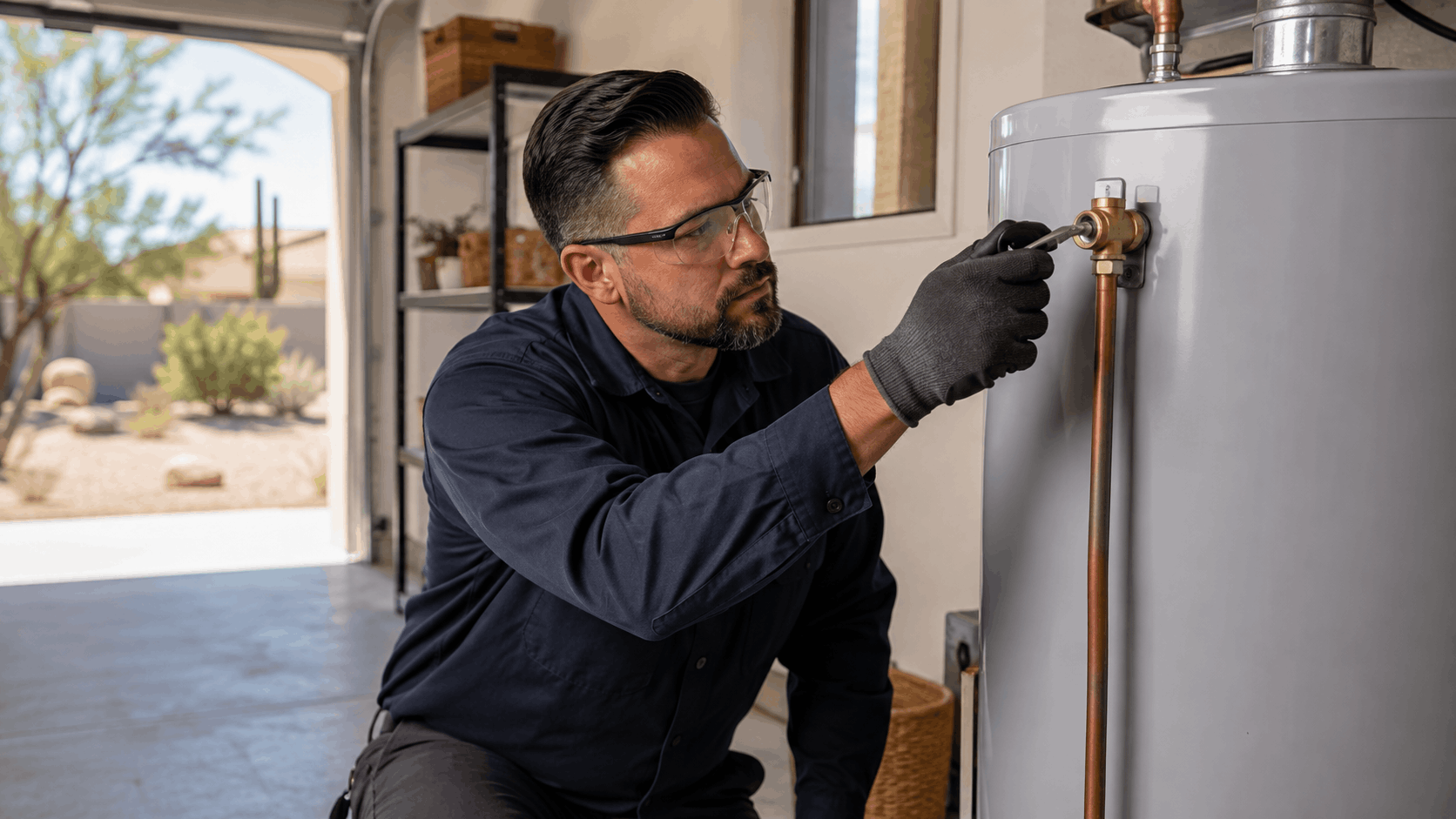
On most tanks in Las Vegas homes, the T&P valve sits near the top or high on the side of the water heater. It looks like a small brass or metal fitting with a lever you can lift by hand. That lever is the test handle.
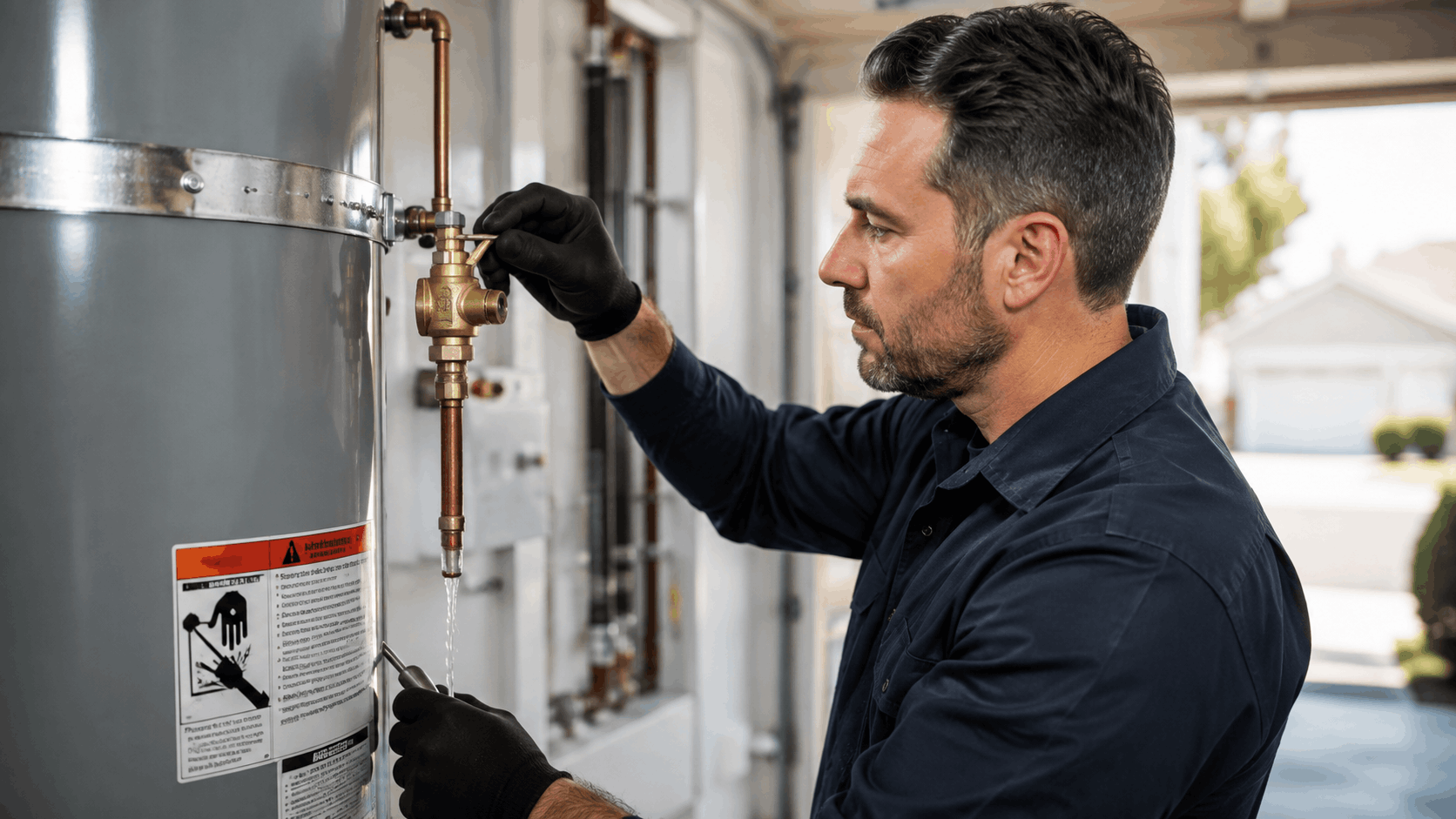
Running down from the valve, you will see a discharge pipe. This pipe carries any released hot water safely toward the floor or a drain. The valve location and the discharge pipe should both be easy to spot once you know what to look for.
Code requires that discharge pipe to point downward and stop within about six inches of the floor. That way, if the valve dumps scalding water, it goes toward the ground instead of spraying outward. If your discharge pipe is missing, capped, or aimed the wrong way, that is a problem worth fixing.
Many homeowners in Enterprise and Henderson have their water heaters tucked into garages or closets where the valve is hard to reach. Even so, taking a minute to locate it now saves confusion later when something goes wrong.
What Happens Without One
A water heater with no working relief valve is a serious danger. When pressure has nowhere to escape, it keeps climbing until the weakest point in the tank gives way. That moment is what people call a water heater explosion.
These are not small events. A failed tank can launch through a ceiling, rupture walls, and cause severe injuries. The combination of superheated water flashing to steam creates enormous force in a fraction of a second.
Tank failure of this kind is rare precisely because the T&P valve does its job. Remove that protection, plug the valve, or let it seize shut, and the odds change fast. A tank that cannot vent pressure is a tank waiting for the wrong moment.
Our team has seen valves that were painted over, capped off during a remodel, or simply crusted shut with mineral buildup. In every case, the homeowner had no idea their safety device was disabled. That is exactly why testing matters.
Why It Is Required by Code
The T&P valve is not optional. Clark County code requires this device on every installed water heater in the region. No licensed plumber can legally set a tank without one.
The plumbing code also spells out how the valve and discharge pipe must be arranged. The rules cover pipe size, direction, and material so that a release drains safely. These standards exist because past accidents proved how dangerous a missing valve can be.
You can read more about water heater safety requirements through the U.S. Consumer Product Safety Commission, which tracks appliance hazards nationwide. Local inspectors follow similar logic when they check installations across the valley.
When our team handles water heater services, matching the valve to code is a standard part of the job. It protects the homeowner and keeps the installation legal and insurable.
Get Your Quote
Tell us what's going on and we'll get back to you fast.
Why Las Vegas Water Puts Extra Stress on T&P Valves
Valves in the Las Vegas Valley have a harder life than valves almost anywhere else. Between the hard water and the desert heat, our local conditions attack these fittings from several directions at once.
- Mineral buildup coats and seizes the valve
- High garage and attic temperatures cycle it more often
- Elevated street pressure in some areas pushes it harder
Hard Water and Mineral Crust
Las Vegas water quality is defined by hardness. The supply from the Las Vegas Valley Water District carries heavy loads of calcium and magnesium. Those minerals do not stay in the water. They cake onto surfaces, including the inside of your T&P valve.
Over time, that calcium buildup forms a crust around the valve seat and spring. The crust can glue the valve shut so it cannot open when pressure rises. It can also foul the seal so the valve leaks even when nothing is wrong.
This is the single most common valve problem we see across the valley. A fitting that should move freely gets locked in place by mineral deposits. The homeowner never sees it happen because it builds slowly year after year.
Hard water is also why flushing and treatment matter so much here. Cutting the mineral load reaching the tank keeps the valve cleaner and extends its working life. We will cover those options later in this guide.
Desert Heat and Attic Installations
Many homes near Henderson and Enterprise place the water heater in a hot garage or an attic space. In summer, a garage in the valley can hit 110 degrees or more. That ambient heat means the tank starts hotter and works harder.
An attic water heater faces even worse conditions. Attic temperatures during a Las Vegas July can climb well past 130 degrees. The tank cycles more often, and every cycle nudges the T&P valve through another round of pressure change.
The higher the garage temperature, the more the water expands inside the tank. More expansion means more frequent small releases through the valve. Each release wears the seat a little more, so the valve ages faster than it would in a cool basement in a milder climate.
This is one reason we always ask where a tank is installed. A water heater in a Mountains Edge attic gets a different level of stress than one in a shaded interior closet. Placement changes how quickly the valve needs attention.
High Street Pressure in Certain Neighborhoods
Water pressure across the valley is not uniform. Some areas like North Las Vegas and Aliante see higher city water pressure than other parts of town. That extra pressure travels straight into the home plumbing and onto the T&P valve.
When incoming pressure runs high, the valve sits closer to its release threshold all the time. It takes less thermal expansion to push it open. That means more frequent drips and faster wear on the internal seal.
We often measure static pressure above 80 psi in homes around these higher pressure zones. Code generally wants household pressure at or below 80 psi for a reason. Past that point, valves, faucets, and connections all take a beating.
If you live in one of these areas and notice regular dripping, the valve may be responding to pressure it was never meant to fight constantly. A pressure regulator often solves the root problem. Our Aliante plumbing team checks pressure as part of any valve call.
Older Homes vs New Builds
Age matters a lot with these valves. Older homes near Downtown and the Charleston corridor often have tanks and valves that have not been touched in fifteen or twenty years. Those aged valves are far more likely to be seized or corroded.
Newer builds in Summerlin and Skye Canyon usually have fresh valves that still move freely. That does not mean they are safe forever. Even a new valve in a hard water home starts collecting mineral crust from day one.
The gap shows up during testing. A valve in a 1990s home near Charleston might crumble the moment it is touched. A valve in a five year old Summerlin house usually tests clean but still deserves a yearly check.
No matter the age of your home, the water is the same across the valley. Our Summerlin service area and our older-home neighborhoods all deal with the same hard water attacking the same part. The difference is only how far along the wear has gone.
Need Help in Las Vegas?
Active Plumbing serves Las Vegas and all of Las Vegas Valley.
The Warning Signs of a Failing T&P Valve
Most valve failures give you clues before they turn into a flood. Homeowners who know what to watch for can catch a problem early. Here are the signs our team tells people to look for.
- Water dripping from the discharge pipe
- Rust, corrosion, or white mineral crust on the fitting
- Popping or rumbling sounds from the tank
- A valve that has never once released
Water Dripping From the Discharge Pipe
The most common warning sign is a wet spot. If you see water trickling from the bottom of the discharge pipe, or a puddle forming near the base of the tank, the valve is releasing. Sometimes that release is normal, and sometimes it means the valve or the pressure behind it has a problem.
A discharge pipe leak that happens only during heavy hot water use may point to thermal expansion. A pipe that drips constantly usually means the valve is no longer sealing. Either way, standing water near a water heater is worth investigating.
A dripping valve should never be ignored just because the amount seems small. Small drips corrode the fitting, damage flooring, and often signal rising pressure inside the tank. What starts as a few drops can become a steady stream.
When homeowners in Green Valley or Spring Valley call about a wet water heater, this is usually the reason. The good news is that catching it at the drip stage is far cheaper than catching it at the burst stage.
Rust, Corrosion, or White Crust
Take a close look at the valve body and the metal around it. A corroded valve often shows orange rust streaks or a chalky white buildup. That white crust is dried mineral deposit from our hard water, and it tells you the valve has been weeping for a while.
Rust around the threads or lever suggests the valve has been leaking slowly and reacting with moisture. Once corrosion sets in, the valve rarely seals well again. The metal pitting keeps water from making a tight closure.
Mineral crust is even more telling. When calcium hardens around the moving parts, the valve can no longer travel freely. It may be stuck partly open, which explains the drip, or stuck fully shut, which is the dangerous case.
If you spot heavy crust or rust during a quick look, do not force the lever. A brittle, corroded valve can break off in your hand. That situation calls for a professional replacement rather than a home test.
Popping or Rumbling Sounds
Strange tank noise is another clue. If your water heater makes popping, rumbling, or knocking sounds when it runs, sediment has likely built up on the bottom. That layer traps water underneath and lets it overheat.
Overheating water expands harder and faster than water at normal temperature. That extra thermal push stresses the T&P valve and forces it to release more often. The noise and the valve strain go hand in hand.
Rumbling in a Las Vegas tank almost always points back to hard water sediment. The mineral layer at the bottom acts like a lid over the burner or element. Water gets superheated below it, then bursts up through the crust with a popping sound.
When we hear about these noises, we know two things need attention. The tank needs a flush to clear sediment, and the valve needs a check to confirm it can still handle the pressure swings. Ignoring the sound lets both problems grow.
The Valve That Never Moves
Here is the sign people miss most. A valve that has never dripped or released in years is often not a healthy valve at all. It may be a seized valve that has crusted completely shut.
A stuck valve gives a false sense of safety. It looks dry and quiet, so the homeowner assumes everything is fine. In reality, a valve locked shut by minerals cannot open when the tank actually needs it to.
This is the scenario that leads to tank failure. The one time the tank builds dangerous pressure, the frozen valve does nothing. All that force stays trapped inside the steel.
That is why we push yearly testing so hard. A valve that lifts and reseals cleanly is doing its job. A valve that will not budge is a warning that the safety system is offline.
How Often a T&P Valve Should Be Tested
The maintenance answer is simple, but almost nobody follows it. A quick yearly check keeps this safety device honest. Here is the schedule our team recommends and why so many people skip it.
The Once a Year Rule
Manufacturers and safety groups agree on the timeframe. A T&P valve should get an annual test at least once each year. That single check confirms the valve can still open and reseal.
The easiest way to remember is to tie the test to a date you already track. Many homeowners run their valve check when they change smoke detector batteries or reset clocks. Linking it to an existing habit keeps it from slipping.
A yearly maintenance schedule also fits well with a tank flush. Since both tasks protect against hard water damage, doing them together makes sense. One visit handles the valve and the sediment at the same time.
The U.S. Department of Energy also recommends regular water heater upkeep to keep the unit running efficiently. An annual test is a small time cost for a large safety return.
Why Most Homeowners Never Do It
Despite how simple it is, this test gets skipped constantly. The biggest reason is that most people never learn the valve exists. Nobody hands new homeowners a lesson on water heater safety at closing.
Another reason is fear. Some homeowners have heard that testing the valve can make it leak, so they avoid touching it entirely. There is a small truth to that worry with very old valves, which we cover next.
Skipped maintenance also comes from the out of sight problem. A water heater in a garage corner or an attic gets ignored until it fails. People rarely think about an appliance that has always just worked.
These homeowner mistakes are understandable, but they carry real risk. The valve that never gets tested is the valve most likely to be seized when it matters. A two minute check each year removes that gamble.
Testing Older Valves Comes With Risk
There is one honest caution about home testing. On a very old valve, lifting the lever can cause it to fail to reseal. The aged seat may not close again, and you end up with a steady leak.
This does not mean you should skip testing. It means an old valve that will not reseal was already at the end of its life. The test simply revealed a valve that could not have done its job anyway.
Tanks that are ten years or older deserve extra care here. If the valve has never been touched and the tank is aging, a reseal failure is a real possibility. In those cases, a pro should handle the check.
Our team can test an aged valve and have a replacement ready if it does not close. That way a failed reseal becomes a planned swap instead of an emergency. Homeowners with older tanks in the Charleston area often prefer this approach.
When to Skip DIY and Call Us
Some situations call for a professional inspection from the start. If your valve shows heavy rust, thick mineral crust, or your tank is well past ten years old, skip the DIY test. Forcing a brittle valve can turn a small issue into a burst.
You should also call when you are simply not comfortable working near hot water and pressure. There is no shame in that. A scalding release can cause real burns, and it is fine to let a plumber handle it.
A professional check also catches related problems a home test misses. We look at pressure, the expansion tank, sediment, and the valve together. That full picture explains why a valve is failing, not just that it is.
If you would rather have a trained set of eyes on it, our team offers water heater repair and inspection across the metro. A quick visit gives you a clear answer about your valve and your tank.
How to Test Your T&P Valve Safely at Home
For newer valves in good shape, a home test is straightforward. The goal is to confirm the valve opens and reseals without hurting yourself. Follow these steps carefully and stop if anything looks wrong.
Before You Touch the Valve
Start with safety prep. Locate the main water shutoff for the tank and know how to turn it off quickly. You want that control ready before you lift anything.
Remember that the water coming out will be hot water, often near 120 degrees or higher. Wear closed shoes and keep hands and face clear of the discharge pipe outlet. A splash of tank water can scald skin fast.
Place a bucket under the end of the discharge pipe to catch the release. If the pipe runs to a floor drain, make sure the path is clear. A little planning keeps the test clean and safe.
Take a quick look at the valve first. If you see heavy corrosion or crust, do not proceed. That valve needs a plumber, not a home test.
Lifting the Test Lever
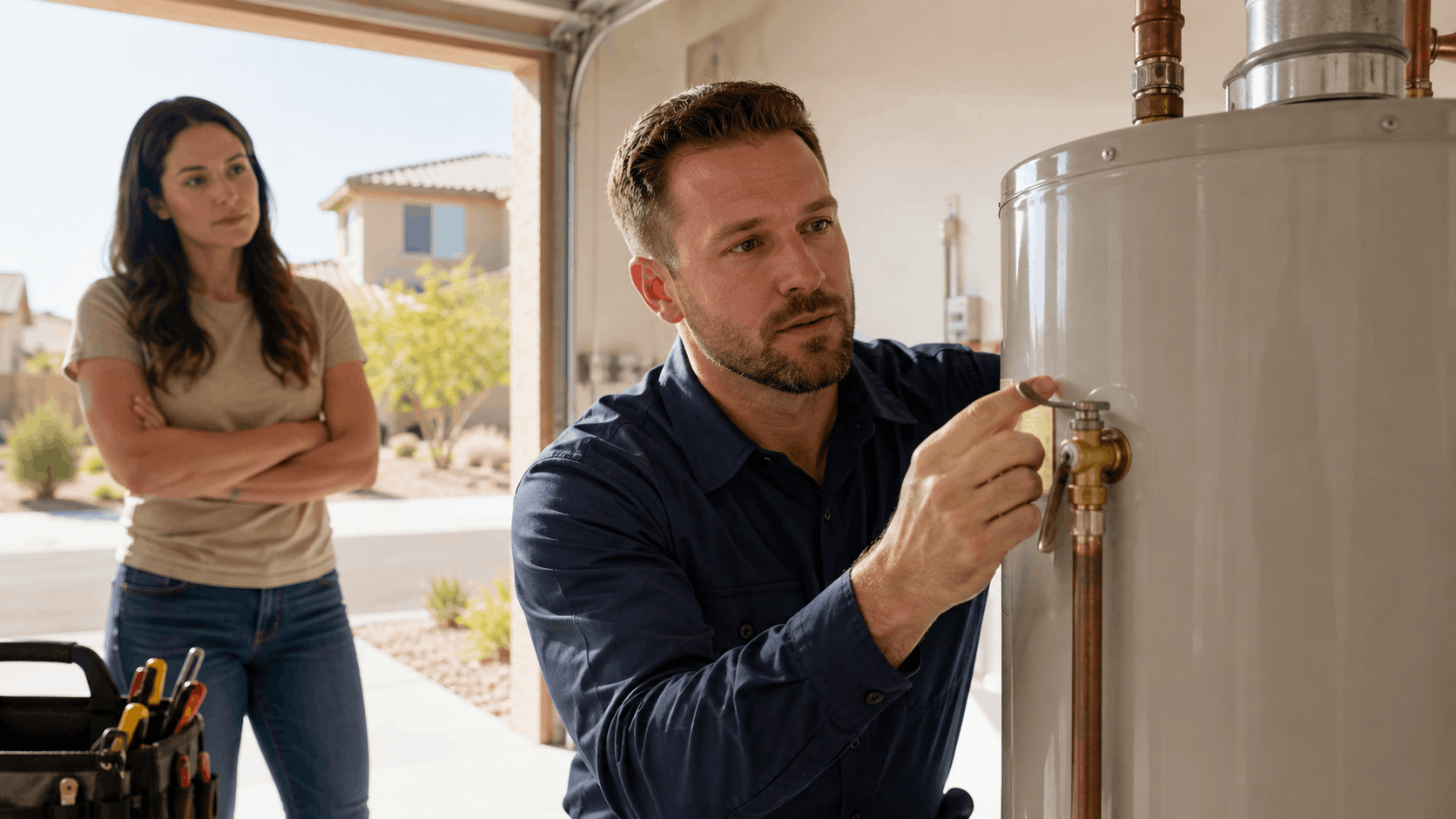
The test itself is simple. Gently lift the test lever on the valve about halfway, then a bit more if it moves freely. You should hear and see hot water rush out through the discharge pipe.
Lift the lever for only a second or two. You are checking that the valve opens and that water flows, not draining the whole tank. A healthy valve check produces a strong burst of water and air.
Then let the lever snap back down on its own. Do not force it closed or hold it in place. The spring inside should pull it shut and reseat the valve.
If the lever feels frozen and will not move at all, stop immediately. A seized valve that refuses to lift is a clear replacement signal. Do not muscle it, since the fitting can crack.
Reading the Results
After the lever snaps back, watch the discharge pipe closely. A good result is a valve that stops flowing within a few seconds. That means it resealed and is doing its job.
A poor result is a valve that keeps leaking after the lever closes. If water keeps trickling out, the seat did not seat cleanly. This is the reseal failure that older valves sometimes show.
Sometimes a valve will drip for a short time and then stop as a bit of debris clears. Give it a couple of minutes to settle. If it truly will not stop, you have a failing valve on your hands.
Either way, you have learned something useful. A clean reseal means your safety device works for another year. A leak means it is time to plan a replacement.
What to Do if It Keeps Dripping
A persistent leak after testing is not an emergency, but it does need action. First, place your bucket to catch the drip and protect the floor. A slow leak can run for a while without flooding.
Next, note how fast it drips. A steady stream calls for a faster response than an occasional drop. Either way, the valve now needs to be replaced to restore full protection.
Do not try to plug or cap a leaking T&P valve. Blocking it defeats the entire safety purpose and creates the exact hazard the valve exists to prevent. A leak is annoying, but a capped valve is dangerous.
At this point, calling for a valve replacement is the right move. Our team can swap the valve quickly and confirm nothing bigger is driving the leak. Homeowners across Las Vegas reach out for exactly this fix.
Need Help in Las Vegas?
Active Plumbing serves Las Vegas and all of Las Vegas Valley.
Replacing a Bad T&P Valve in a Las Vegas Home
When a valve fails, replacement is usually quick and affordable. The job matters more than the part, since a poorly matched valve does not protect the tank. Here is what local homeowners can expect.
| Detail | What to Expect |
|---|---|
| Typical time | 30 to 60 minutes for a standard swap |
| Typical cost range | Around 150 to 350 dollars parts and labor |
| Downtime | Hot water back within an hour in most cases |
| Warranty check | We confirm the valve rating matches your tank |
What the Job Involves
A valve install starts with shutting off water and power or gas to the tank. Then we drain the tank enough to bring the water level below the valve. This keeps the swap clean and controlled.
Next we remove the old valve, often the hardest step when hard water has cemented it in place. A crusted valve can take real effort to break loose. Once it is out, we clean the threads and inspect the fitting.
Then we thread in a code matched replacement, seal it properly, and reconnect the discharge pipe. After that we refill the tank, restore power, and test the new valve. Draining the tank the right way avoids air pockets and leaks.
The whole process is routine for our team, but the details matter. A rushed install with the wrong sealant or a mismatched valve can leak or fail. Doing it correctly the first time protects the home.
Cost and Time Ranges
Most homeowners want a number. In the valley, a straightforward T&P valve replacement usually runs in the range of 150 to 350 dollars including parts and labor. The repair cost depends on tank access and how stuck the old valve is.
Replacement time is short for a standard job. A clean swap takes about 30 to 60 minutes on site. Add time if the tank is in a tight attic or a cramped closet.
Older tanks sometimes surprise us. A valve fused in place by twenty years of minerals takes longer to remove. That extra labor can nudge the price toward the higher end of the range.
These figures cover the valve alone. If the inspection reveals a pressure or expansion issue, that is a separate conversation. We always quote clearly before starting any added work.
Matching the Right Valve to Your Tank
Not every T&P valve is the same. Each one carries a valve rating for maximum temperature and pressure, usually around 210 degrees and 150 psi for residential tanks. The replacement must match the tank spec.
Using an underrated or oversized valve defeats the safety design. A valve set to release at the wrong point either leaks constantly or fails to open in time. Matching the rating is the whole point of the part.
We check the tank data plate and choose a valve built for that unit. The thread size and discharge fitting also have to fit correctly. Small mismatches cause leaks that look like valve failure.
This is one reason a proper install beats a quick hardware store swap. The right valve, correctly rated and sealed, restores the safety margin the manufacturer intended. That precision is what keeps the tank protected.
Why We Check the Whole System First
A leaking valve is often a symptom, not the root problem. When the T&P valve drips constantly, high pressure or a missing expansion tank may be pushing it open. Replacing the valve alone would only delay the next leak.
That is why our system check looks past the valve itself. We measure incoming pressure, inspect for an expansion tank, and check the tank temperature setting. Fixing the cause keeps the new valve dry.
In closed plumbing systems, thermal expansion has nowhere to go without an expansion tank. That pressure lands on the T&P valve every heating cycle. Adding the right tank often ends chronic dripping for good.
Homeowners appreciate this approach because it solves the real issue. Anyone can bolt on a new valve, but understanding why the old one failed prevents a repeat call. That full look is standard on every water heater visit we make.
Protecting Your Water Heater for the Long Run
The valve is one part of a larger care picture. A little routine maintenance keeps the whole tank healthy and helps the valve last. Local water conditions make this upkeep matter even more.
| Task | How Often | Why It Helps |
|---|---|---|
| Tank flush | Once a year | Clears hard water sediment |
| T&P valve test | Once a year | Confirms safety release works |
| Pressure check | Every year or two | Catches high pressure early |
| Expansion tank check | Every year | Eases pressure on the valve |
Flushing Out the Hard Water Sediment
The single best thing you can do for a valley tank is flush it yearly. A tank flush drains the mineral sludge that our hard water leaves behind. That sediment builds up fast in Las Vegas homes.
Left in place, the sediment layer causes the popping noises and overheating we discussed earlier. It also cuts the tank's efficiency, so you pay more to heat water. Flushing removes that layer and restores normal operation.
The process drains the tank through the bottom valve until the water runs clear. In hard water homes, the first flush after years of neglect can pull out a shocking amount of mineral grit. After that, yearly flushes stay quick.
Regular flushing also protects the T&P valve indirectly. Less sediment means less overheating, which means fewer pressure spikes forcing the valve open. A clean tank puts less strain on every part.
Adding an Expansion Tank
An expansion tank is a small tank installed on the cold water line near the heater. It gives expanding hot water a place to go during each heating cycle. That extra room keeps pressure from spiking against the T&P valve.
In homes with a pressure regulator or a check valve, the plumbing is a closed system. Water cannot flow backward into the street main, so all that expansion pressure stays inside. The expansion tank absorbs it for pressure control.
Without one, the T&P valve becomes the only relief point every single cycle. That constant duty wears it out years early and causes the chronic dripping we see so often. Adding the tank often stops the leak entirely.
Many newer valley homes already have an expansion tank installed. Older homes frequently do not. If your valve drips after every hot shower, a missing expansion tank is a likely culprit worth checking.
Checking Your Home Water Pressure
Home water pressure drives a lot of plumbing wear. Since some parts of the valley run high, testing your static pressure is a smart move. A simple gauge on an outside spigot gives the reading.
Healthy household pressure sits around 50 to 70 psi. Once you pass 80 psi, valves, fixtures, and connections all suffer. High pressure keeps the T&P valve near its release point and speeds up wear.
If your pressure reads high, a pressure regulator is the fix. This device sits where the water line enters the home and holds pressure at a safe level. It protects the whole plumbing system, not just the water heater.
Homeowners in higher pressure zones like North Las Vegas benefit most from this check. Our North Las Vegas team tests pressure regularly on service calls. It often explains a valve that keeps failing for no obvious reason.
Whole Home Water Treatment Options
The deepest fix for our hard water is treatment at the source. A water softener removes the calcium and magnesium before they reach any pipe or valve. That cuts mineral buildup across the entire home.
Softeners use salt to strip hardness from the water. Salt free conditioners take a different route, changing how minerals behave so they do not stick as easily. Both reduce the crust that seizes T&P valves over time.
Hard water treatment pays off in many ways. Cleaner fixtures, longer appliance life, and better soap performance all come with softer water. The water heater and its valve are among the biggest winners.
Our team installs and services these systems across the valley. If you want to slow the mineral damage at its root, our water softener installation options are a strong long term move. Softer water means a valve that stays free far longer.
Why Local Homeowners Trust Active Plumbing for This Work
Water heater safety is not a side job for our team. We work on tanks and valves across the valley every week. Here is what sets our approach apart.
- Daily hands on experience with valley hard water
- Regular work in neighborhoods across the metro
- Honest calls on repair versus replacement
- Fast response for active leaks
We Know the Valley's Water
Our local experience with hard water shapes everything we do. We see the same mineral crust on valve after valve, home after home. That pattern taught us exactly how valley water attacks a tank.
Because we work here every day, we know what a five year old Summerlin valve looks like versus a twenty year old Charleston valve. We can often predict the wear before we even open the panel. That knowledge speeds up every diagnosis.
Hard water is the common thread in almost every valve failure we handle. Understanding it lets us fix the cause, not just the symptom. That is why our repairs tend to last.
A plumber who does not account for local water will keep replacing valves that fail again. We build our recommendations around the water you actually have. That difference shows up in how long our work holds.
Neighborhoods We Serve Every Week
Our trucks cover a wide stretch of the valley. We handle water heater calls in Henderson, Green Valley, and Centennial Hills on a regular basis. Familiar routes mean faster arrival times.
We also work throughout Enterprise, Summerlin, Spring Valley, and North Las Vegas. Each area has its own quirks, from attic tanks in newer builds to aging units in established homes. We know what to expect in each one.
That neighborhood knowledge helps us plan a job before we arrive. We know which communities tend to run high pressure and which have older plumbing. That head start makes for a smoother visit.
No matter which part of the metro you call from, our team has likely worked a similar home nearby. From Lake Las Vegas to Mountains Edge, the water heaters share the same challenges. We bring that shared experience to your door.
Honest Recommendations, Not Upsells
We built our reputation on honest advice. When a valve just needs replacing, we say so and swap it. When a tank is failing beyond the valve, we tell you that too.
The repair versus replace question comes up often. A five year old tank with a bad valve is worth a simple repair. A rusted fifteen year old tank leaking from the base is a different story.
We give homeowners the real picture so they can decide. There is no pressure to buy a new water heater when a valve fix will do. That straight talk keeps customers calling us back.
Our goal is a tank that runs safely for years, not the biggest ticket we can write. Trust is earned by telling people the truth. That approach has served our neighbors well.
Same Day Help for Leaks
An active water heater leak does not wait for a convenient time. Our team offers same day service for leaks anywhere in the metro area. A dripping or gushing tank gets a fast response.
Water damage grows quickly, so speed matters. Getting to a leak in hours instead of days saves flooring, drywall, and stress. That is the point of a responsive local crew.
For urgent situations, our emergency plumbing team is ready to move. Whether it is a failed valve or a burst connection, we treat active leaks as the priority they are.
Homeowners across the valley keep our number handy for exactly this reason. When water is where it should not be, quick help makes all the difference. We aim to be that call.
Need Help in Las Vegas?
Active Plumbing serves Las Vegas and all of Las Vegas Valley.
Final Thoughts
The T&P valve is the quiet guardian on every water heater in the valley. It protects your tank, your home, and your family from dangerous pressure. Yet it only works if it can still open when needed.
Our hard water, desert heat, and high pressure zones all wear these valves out faster than most cities. A yearly test and a simple maintenance routine keep the valve honest and the tank safe. Catching a drip early beats dealing with a burst later.
If your valve is dripping, crusted, or has never once been tested, reach out to our team. Contact Active Plumbing for a valve check, a water heater inspection, or fast help with a leak. We are ready to keep your water heater safe for the long run.
Frequently Asked Questions
What is a T&P valve on a water heater?
A T&P valve is the temperature and pressure relief valve on your water heater. It is a small brass fitting near the top or side of the tank with a lever and a pipe running down. Its job is to open and release water if the temperature or pressure inside the tank climbs too high. This prevents dangerous pressure buildup that could otherwise cause the tank to fail or burst.
How often should a T&P valve be tested in Las Vegas?
The valve should get an annual test at least once each year. Local hard water makes this even more important, since calcium and mineral buildup can seize the valve shut over time. A valve crusted closed cannot protect the tank when it matters. Tying the test to a memorable date, like when you change smoke detector batteries, helps keep it on schedule year after year.
Why is my T&P valve leaking water?
A leaking valve usually points to one of a few causes. High incoming water pressure keeps the valve near its release point, so it drips often. Overheating from sediment buildup causes pressure spikes that push water out. A worn or corroded valve may simply no longer seal. A missing expansion tank is another common reason valves drip in valley homes.
Is it dangerous if the valve is stuck shut?
Yes, a seized valve is a real hazard. If minerals crust the valve fully shut, it cannot release pressure when the tank overheats. That trapped pressure keeps building with nowhere to escape. In the worst case, it can lead to tank failure or an explosion. A valve that never moves is not safe, it is a warning that the safety system may be offline.
Can I replace a T&P valve myself?
Replacing a valve involves shutting off water and power, draining the tank, and matching a new valve to the correct pressure and temperature rating. Getting the rating or seal wrong defeats the safety design. Hard water also cements old valves in place, making removal tough. For those reasons, most homeowners are better off calling a professional who can match the valve and confirm nothing bigger is wrong.
How much does T&P valve replacement cost in Las Vegas?
A standard T&P valve replacement in the valley usually runs around 150 to 350 dollars including parts and labor. The final price depends on how accessible the tank is and how stuck the old valve has become. A valve fused in place by years of mineral buildup takes more labor to remove. We always quote clearly before starting any work.
Does hard water really damage the valve?
Yes, hard water is the leading cause of valve failure across the valley. The calcium and magnesium in our water district supply cake onto the valve seat and spring. Over time this crust either seals the valve shut so it cannot open, or fouls it so it leaks. Yearly flushing and whole home water treatment both slow this mineral damage.
Do I need an expansion tank with my water heater?
You likely need one if your home has a pressure regulator or check valve, which creates a closed plumbing system. In that setup, expanding hot water has nowhere to go and pushes against the T&P valve every cycle. An expansion tank absorbs that pressure and often stops chronic valve dripping. Many newer valley homes have one, while older homes frequently do not.
What should I do if the valve keeps dripping after testing?
First, place a bucket to catch the drip and protect your flooring. Never cap or plug a leaking valve, since that removes the safety protection entirely. A persistent leak means the valve failed to reseal and needs replacement. Call our team so we can swap the valve and check whether high pressure or a missing expansion tank is driving the leak.
How long does a T&P valve last?
A T&P valve often lasts around five to ten years under normal conditions. In Las Vegas, hard water, desert heat, and high pressure can shorten that life considerably. Some valves seize or corrode within just a few years without any care. Yearly testing, tank flushing, and water treatment all help the valve reach the longer end of that range.
Frequently Asked Questions
- What is a T&P valve on a water heater?
- A T&P valve is the temperature and pressure relief valve on your water heater. It is a small brass fitting near the top or side of the tank with a lever and a pipe running down. Its job is to open and release water if the temperature or pressure inside the tank climbs too high. This prevents dangerous pressure buildup that could otherwise cause the tank to fail or burst.
- How often should a T&P valve be tested in Las Vegas?
- The valve should get an annual test at least once each year. Local hard water makes this even more important, since calcium and mineral buildup can seize the valve shut over time. A valve crusted closed cannot protect the tank when it matters. Tying the test to a memorable date, like when you change smoke detector batteries, helps keep it on schedule year after year.
- Why is my T&P valve leaking water?
- A leaking valve usually points to one of a few causes. High incoming water pressure keeps the valve near its release point, so it drips often. Overheating from sediment buildup causes pressure spikes that push water out. A worn or corroded valve may simply no longer seal. A missing expansion tank is another common reason valves drip in valley homes.
- Is it dangerous if the valve is stuck shut?
- Yes, a seized valve is a real hazard. If minerals crust the valve fully shut, it cannot release pressure when the tank overheats. That trapped pressure keeps building with nowhere to escape. In the worst case, it can lead to tank failure or an explosion. A valve that never moves is not safe, it is a warning that the safety system may be offline.
- Can I replace a T&P valve myself?
- Replacing a valve involves shutting off water and power, draining the tank, and matching a new valve to the correct pressure and temperature rating. Getting the rating or seal wrong defeats the safety design. Hard water also cements old valves in place, making removal tough. For those reasons, most homeowners are better off calling a professional who can match the valve and confirm nothing bigger is wrong.
- How much does T&P valve replacement cost in Las Vegas?
- A standard T&P valve replacement in the valley usually runs around 150 to 350 dollars including parts and labor. The final price depends on how accessible the tank is and how stuck the old valve has become. A valve fused in place by years of mineral buildup takes more labor to remove. We always quote clearly before starting any work.
- Does hard water really damage the valve?
- Yes, hard water is the leading cause of valve failure across the valley. The calcium and magnesium in our water district supply cake onto the valve seat and spring. Over time this crust either seals the valve shut so it cannot open, or fouls it so it leaks. Yearly flushing and whole home water treatment both slow this mineral damage.
- Do I need an expansion tank with my water heater?
- You likely need one if your home has a pressure regulator or check valve, which creates a closed plumbing system. In that setup, expanding hot water has nowhere to go and pushes against the T&P valve every cycle. An expansion tank absorbs that pressure and often stops chronic valve dripping. Many newer valley homes have one, while older homes frequently do not.
- What should I do if the valve keeps dripping after testing?
- First, place a bucket to catch the drip and protect your flooring. Never cap or plug a leaking valve, since that removes the safety protection entirely. A persistent leak means the valve failed to reseal and needs replacement. Call our team so we can swap the valve and check whether high pressure or a missing expansion tank is driving the leak.
- How long does a T&P valve last?
- A T&P valve often lasts around five to ten years under normal conditions. In Las Vegas, hard water, desert heat, and high pressure can shorten that life considerably. Some valves seize or corrode within just a few years without any care. Yearly testing, tank flushing, and water treatment all help the valve reach the longer end of that range.
A
Licensed plumbing professionals serving Las Vegas and Las Vegas Valley.
Licensed in Nevada · License #0047021
Last updated on
Why trust Active Plumbing?
Founded in 1991, Active Plumbing is a licensed and insured plumber serving Las Vegas and Las Vegas Valley. All content is reviewed by our licensed technicians.

Need Help in Las Vegas?
Active Plumbing serves Las Vegas and all of Las Vegas Valley.
Related Articles
Maintenance
Sediment Tank Flush: Why Vegas Water Heaters Need It Every 18 Months
Las Vegas hard water causes rapid sediment buildup in water heaters. Learn why an 18-month flush schedule protects your tank, saves energy costs, and prevents expensive failures in the desert.
Safety & Prevention
Water Heater Explosions in Las Vegas: How Sediment and Pressure Cause Failures
Learn how Las Vegas hard water sediment and pressure buildup cause water heater failures, the warning signs to watch for, and how to prevent a dangerous burst.
Safety & Prevention
Water Heater Leaking From the Bottom in Las Vegas: What to Shut Off in the First 5 Minutes
A water heater leaking from the bottom in Las Vegas? Learn exactly what to shut off in the first 5 minutes, why tanks fail here, and when to repair or replace.