Bellied Sewer Lines in Las Vegas: How Caliche and Fill Soil Create Low Spots That Collect Waste
Key Takeaways
- A bellied sewer line is a structural low spot in the pipe that traps waste, not a simple clog that clears for good.
- Caliche hardpan is hard to trench and hard to bed a pipe into evenly, and poorly compacted fill settles under the pipe, pulling it out of grade over time.
- Imported fill soil in newer areas like Summerlin, Skye Canyon, and Inspirada keeps settling and can cause bellies in homes under ten years old.
- The clearest warning sign is a drain that clears when snaked but backs up again within weeks.
- A sewer camera inspection with locating confirms the belly, its depth, and rules out roots or offset joints.
- Trenchless lining follows the existing sag and does not correct grade; a belly needs excavation and re-grading with solid bedding.
- Excavation and replacement require permits from the City of Las Vegas, Henderson, or Clark County, and the lateral is the homeowner's responsibility.
- Managing irrigation, controlling yard drainage, and routine camera checks help prevent and catch bellies early.
In This Article
A homeowner in Summerlin calls us with the same story we hear every week. Their kitchen sink drains slow, the toilet gurgles when the washer runs, and no matter how many times a plumber snakes the line, the trouble comes back within a month or two. They think they have a stubborn clog. Most of the time, they have a bellied sewer line.
Out here in the Las Vegas Valley, the ground itself works against buried pipe. Caliche and imported fill soil create low spots that trap waste and water, and those low spots do not clear with a cable or a bottle of drain cleaner. That gurgling drain in Henderson or the soggy patch in a Spring Valley backyard is often the first sign of a structural problem underground.
What a Bellied Sewer Line Actually Is?
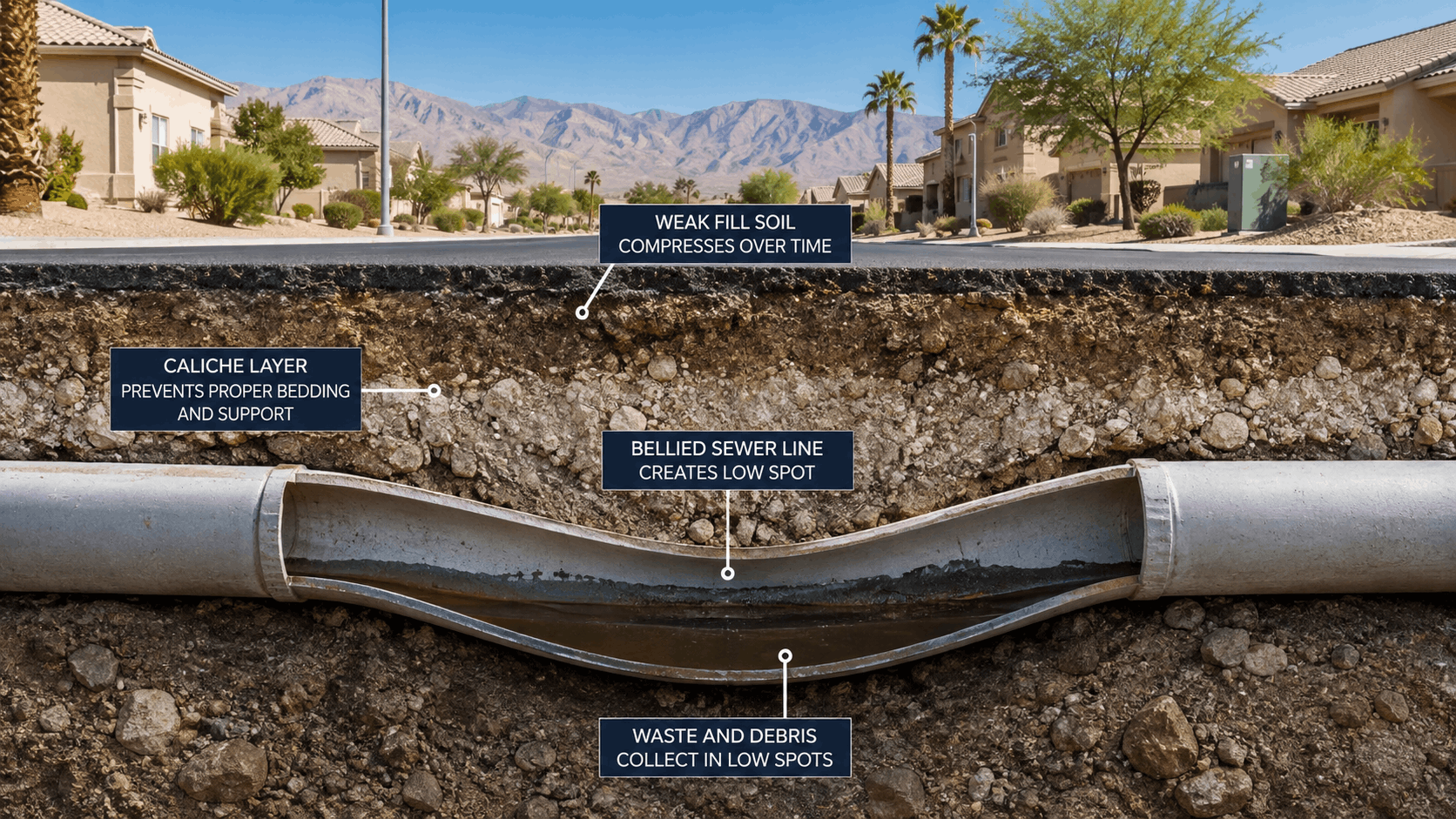
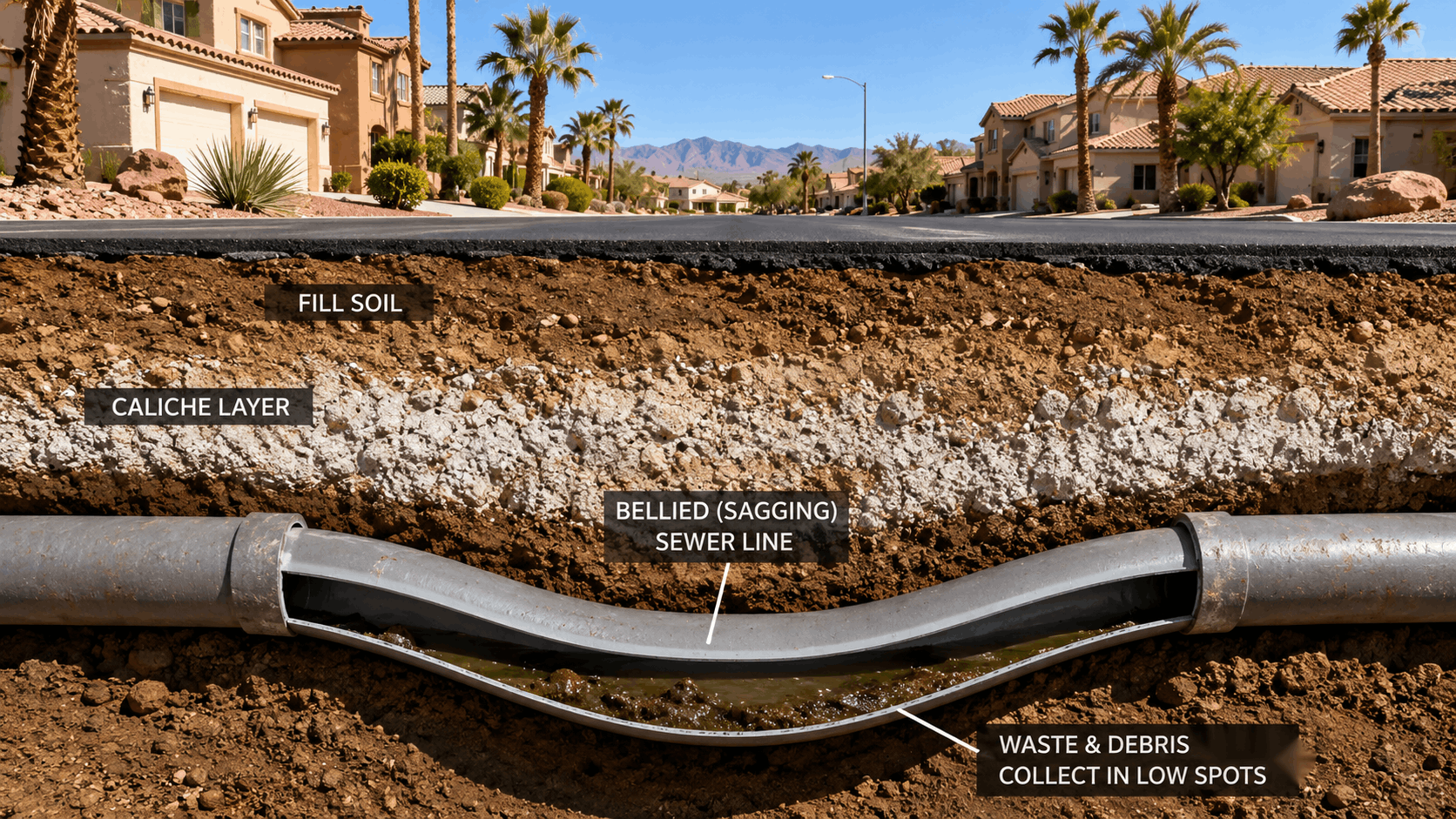
A bellied sewer line is a section of pipe that has dropped below the level it was installed at, creating a dip or sag in the middle of the run. Instead of a straight downhill path to the city main, the waste hits a low spot and sits there. Plumbers call this a pipe belly or a sagging sewer, and it is one of the more common problems we find under Valley homes.
When water and solids reach that dip, gravity stops helping. The waste pools, drains slow down, and over time solids settle out and harden. A single belly can turn a whole sewer system into a slow, backup-prone mess.
| Feature | Healthy Sewer Line | Bellied Sewer Line |
|---|---|---|
| Slope | Steady downhill fall | Reverses in the low spot |
| Flow | Waste keeps moving | Waste pools and slows |
| Backups | Rare | Recurring after snaking |
| Fix | Simple cleaning | Excavation and re-grading |
The Difference Between a Belly and a Blockage
A clog is stuff stuck inside the pipe. Grease, wipes, roots, or a toy blocks the flow, and once you clear it out, the line runs fine again. A belly is different because the pipe itself is bent into a low spot. The pipe wall is intact, but the shape is wrong.
This is where the clog vs belly confusion starts. When a plumber snakes a bellied line, the cable pushes through the pooled sludge and the drain works for a few days. Homeowners think the problem is solved. Then the low spot fills back up with solids and the recurring backup returns.
That pattern is the giveaway. A real clog, once cleared, usually stays cleared for a long time. A belly comes back on a schedule because you never fixed the reason waste collects there in the first place. If a drain has been snaked three or four times in a year, we stop guessing and put a camera down the line.
We see this constantly across older parts of the Valley, where a cable service becomes a monthly ritual. Paying for repeat snaking on a bellied line is throwing money at a symptom. The drain and sewer team looks for the cause instead.
How Slope and Grade Keep Waste Moving
A sewer line depends on gravity, and gravity only works if the pipe has the right fall. The standard for most residential drain lines is a quarter inch per foot of slope, which means the pipe drops one inch for every four feet it travels toward the main. That grade is enough to carry both water and solids along together.
When the slope is too flat, water outruns the solids and leaves them behind. When the slope actually reverses in a low spot, everything stalls. The pipe grade in a belly might run downhill, then briefly uphill, which is exactly the opposite of what waste needs.
In that reversed section, water backs up and pools until it rises high enough to spill over the far lip of the dip. Solids drop out and stay put. A quarter inch per foot line with a belly can behave like a clogged line even though nothing is technically stuck.
This is why proper grade matters so much during any repair. Simply reconnecting pipe without resetting the fall just recreates the problem. Getting the slope right is the whole point of fixing a sag.
Why Standing Waste Turns Into a Bigger Problem
A minor belly might only trap a little water at first. Left alone, it gets worse in ways that are hard to reverse. Standing waste means constant moisture and sediment buildup in one spot, and that combination attacks the pipe from the inside.
In older cast iron or clay lines, pooled water speeds up pipe corrosion. The bottom of the pipe thins out, scale forms, and the rough surface catches even more debris. Waste pooling in one place gives tree and shrub roots a target too, since they follow moisture and can push into any small crack or joint.
Over months and years, that low spot narrows as sediment hardens like concrete. What started as an occasional slow drain becomes frequent backups, then a full stoppage. The decline is slow, which is why so many homeowners tolerate a marginal line far longer than they should.
The lesson is simple. A small belly rarely stays small. Catching it early, before corrosion and root intrusion set in, keeps the repair contained to one section instead of a full replacement.
Get Your Quote
Tell us what's going on and we'll get back to you fast.
How Caliche Soil Around Las Vegas Damages Sewer Lines
Anyone who has tried to dig a fence post hole in the Valley knows caliche. You hit a layer so hard it feels like concrete, because in a sense it is. That caliche soil is one of the main reasons sewer lines around Las Vegas develop bellies.
The hardpan under our homes does not behave like normal dirt. It resists digging, settles unevenly, and shifts with moisture. Here is why local soil conditions give buried pipe such a hard time:
- Caliche forms a rock-hard barrier that installers must cut through
- Backfill over that hard layer often settles unevenly
- Moisture and heat make the surrounding soil expand and contract
- Older neighborhoods were built before better bedding practices
What Caliche Is and Where It Sits
Caliche is a natural layer of calcium carbonate that has cemented soil particles together over thousands of years. It ranges from a thin crust to solid slabs several feet thick. Across the Valley, the caliche layer sits anywhere from a few inches to several feet below the surface.
In areas like Spring Valley and Enterprise, homeowners often find caliche within the first foot or two of digging. That cement-like calcium carbonate makes trenching for sewer pipe slow and expensive, which is where corner-cutting starts.
Because caliche is so hard, it does not compress or drain like ordinary soil. Water can pool on top of it or run sideways along the layer instead of soaking in. That behavior sets up the uneven conditions that later push pipe out of grade.
We work on homes across Spring Valley and Enterprise where the caliche is thick enough to dull excavation teeth. Knowing where that layer sits helps us plan a repair that will actually hold.
Trench Backfill Problems Over Hard Rock
When a crew digs a sewer trench through caliche, they break up that hard layer to lay the pipe. The problem comes with the backfill. The loose, broken-up material that goes back into the trench does not pack the same way undisturbed ground does.
Good practice calls for a stable pipe bed of compacted sand or fine gravel that fully supports the pipe along its whole length. When installers skip that step and dump native rubble back on top, the pipe rests on high and low points. Over time that uneven support leads to uneven settling.
The pipe bedding is what holds your line at the right grade for decades. Poor bedding lets sections sag as the loose backfill compresses under the weight of soil and traffic above. A pipe that was straight the day it was installed slowly droops into a belly.
This is why we pay so much attention to bedding on every excavation. Resetting slope without fixing the support underneath just invites the belly to return. The material under the pipe matters as much as the pipe itself.
How Bedding and Fill Pull Pipe Out of Grade
Desert soil is not static. Our extreme temperature swings and occasional heavy rain cause caliche and the surrounding soil to expand and contract. During monsoon season, water saturates the ground, then bakes out under summer heat.
Each cycle of soil movement nudges buried pipe a little. Expansion pushes, contraction pulls, and the pipe has no way to resist. Over years, that repeated pressure works a straight line into a sag, especially where the backfill was already weak.
Caliche adds another twist because water tends to move sideways along the hard layer rather than draining down. That can concentrate moisture under one part of the pipe run, softening the support there while the rest stays firm. The result is a pipe shift right at that spot.
Homeowners rarely see any of this happening. The line looks fine from above while the ground quietly rearranges itself below. By the time drains slow down, the belly has already formed.
Older Neighborhoods Built on Difficult Ground
Established parts of the Valley carry the extra burden of age. Homes near Charleston Boulevard and throughout older North Las Vegas were built decades ago, when installation standards and materials were not what they are today. Many original sewer runs cut corners on bedding and grade.
A lot of these older homes still have their first-generation clay pipe or early ABS. Clay pipe joins in short sections with joints that offset and crack as soil moves. Early plastic pipe was not always bedded well either.
Combine aging pipe with decades of soil movement and you get bellies, offset joints, and root intrusion all in the same line. The neighborhoods around Historic North Las Vegas are a good example, where original laterals have been in the ground longer than the current owners have been alive.
We handle a steady stream of these calls in Historic North Las Vegas and nearby areas. Older ground and older pipe together make for the toughest sewer problems in the Valley.
Need Help in Las Vegas?
Active Plumbing serves Las Vegas and all of Las Vegas Valley.
The Role of Fill Soil in Newer Las Vegas Developments
New homes are supposed to be free of these headaches, yet we find bellied lines in houses less than ten years old. The culprit in newer master-planned areas is fill soil. When builders level rocky, sloped desert lots, they bring in truckloads of dirt, and that engineered fill can keep settling for years.
The Valley has seen enormous building activity, and a lot of those fresh pads sit on deep fill. Lot settling under a new house pulls the sewer line down with it, creating a belly in a pipe that is barely broken in.
Why Builders Bring in Fill Dirt
The natural desert floor around here is rarely flat or clean. It is full of caliche, boulders, and grade changes that make it hard to pour a level foundation. To get a buildable surface, developers scrape, cut, and fill lots with imported fill hauled in by the truckload.
In areas cut into hillsides or washes, the grading can be dramatic. Some lots carry only a foot or two of fill, while others sit on ten feet or more where a low spot on the desert lot had to be built up. The deeper the fill, the more settling potential it holds.
Fill dirt lets builders create uniform pads across an entire subdivision quickly. The trade-off is that all that new material has to be compacted correctly, or it will keep sinking under load. Depth and compaction are what separate a stable lot from a future belly.
When we inspect a newer home with sewer trouble, one of the first questions is how much fill sits under it. That single detail often explains a sag in a pipe that should still be like new.
Compaction Failures Under New Homes
Fill soil only performs if it is compacted in thin layers with the right moisture and equipment. Rush the job, skip lifts, or compact dry material, and the fill keeps consolidating for years after the house is finished. That slow drop is called differential settling because different parts of the lot sink at different rates.
A sewer lateral runs from the house out to the main, often crossing zones of deeper and shallower fill. When one zone settles more than another, the pipe bends to follow it. New construction gives the appearance of solid ground while the fill underneath quietly compresses.
Poor soil compaction shows up in other ways too, like hairline cracks in slabs, sticking doors, and settling patios. A bellied sewer line is the hidden version of the same problem. The pipe simply goes where the ground takes it.
Because this settling plays out over a decade, warranty windows often close before the belly reveals itself. That leaves the homeowner holding a repair on a house they thought was trouble-free.
Fast-Growing Areas Where This Shows Up
The Valley's growth pushes into rougher terrain every year, which means more deep fill. We see bellied lines in young homes across Summerlin, Inspirada in Henderson, and Skye Canyon, where fresh pads climb into the foothills. These are beautiful communities built on challenging ground.
In Summerlin West, newer villages sit on graded slopes where fill depth varies house to house. Skye Canyon carries similar conditions on the north end, and Inspirada in Henderson was carved into hilly desert that needed heavy grading.
Homeowners in these areas are often shocked to learn their eight-year-old house needs sewer work. The pipe is fine. The fill under it moved. Young homes can absolutely develop bellies when they sit on deep, imperfectly compacted fill.
We cover all of these growth corridors, from Summerlin to Henderson. Knowing the fill history of a community helps us diagnose more quickly.
Warning Signs a Homeowner Should Watch For
The tricky part about a bellied line is that it hides behind symptoms that look like ordinary plumbing gripes. Learning to read those sewer warning signs helps you catch a belly before it becomes a flood. Here are the patterns that point to a low spot rather than a simple clog:
- Slow drains that keep coming back after being snaked
- Gurgling toilets and drains, plus sewer odors
- Soggy or sunken spots in the yard over the sewer path
- Multiple fixtures backing up at the same time
Slow Drains That Return After Snaking
The single most reliable sign of a belly is a slow drain that clears with snaking and then comes back within weeks. A cable pushes through the pooled sludge in the low spot, waste flows for a while, and then the dip fills again. That is a recurring clog on a schedule.
A true one-time blockage, once removed, tends to stay gone for a year or more. If you find yourself calling for drain snaking every couple of months, the repeat backup is telling you the pipe shape is wrong. The cable treats the symptom, not the sag.
We track how often a line has been cleared before we ever open a truck. Three service calls in a year on the same drain is a strong hint. At that point a camera saves money by ending the cycle of temporary fixes.
If snaking has become a habit at your house, that habit is a warning. The pipe is trying to tell you it has a low spot.
Gurgling, Odors, and Wet Yard Spots
A gurgling toilet means air is trapped and struggling to move past pooled water in the line. When you flush and hear bubbling in a nearby drain, waste is passing a restriction, often the belly itself. It is the sound of a line fighting to breathe.
Sewer odor is another red flag. When waste sits and stagnates in a low spot, it releases gas that can push back up through drains or vents. A persistent sewer smell inside or around the house points to standing waste somewhere in the system.
Outside, watch for a wet yard or a soft, sunken strip of ground running from the house toward the street. Pooled waste in a cracked belly can seep into the surrounding soil, and settling fill often shows as a depression right over the pipe. Grass that stays green and lush in one line while the rest goes dormant is another tell.
Any one of these on its own might be minor. Together, gurgling, odor, and a wet yard spot make a strong case for a camera inspection.
Multiple Fixtures Backing Up at Once
When trouble is limited to one sink, the problem is usually local to that fixture. When several fixtures back up together, the issue lives in the main line that serves the whole house. A belly deep in the sewer lateral affects everything upstream of it.
The lowest fixtures show it first. A ground-floor tub, shower, or floor drain will fill with dark water when the main line cannot keep up, because waste from the whole house takes the path of least resistance. If flushing a toilet makes the shower drain bubble or rise, that is a main line backup.
A floor drain in the garage or laundry that overflows is one of the clearest red flags there is. That drain sits at the bottom of the system and catches whatever the main line cannot carry away. It is often the first place a bellied line spills over.
When multiple fixtures act up at once, we treat it as a main line issue until a camera proves otherwise. That is the moment to stop plunging and call for a proper diagnosis. Our emergency plumbing team handles active backups quickly.
How a Camera Inspection Confirms the Problem
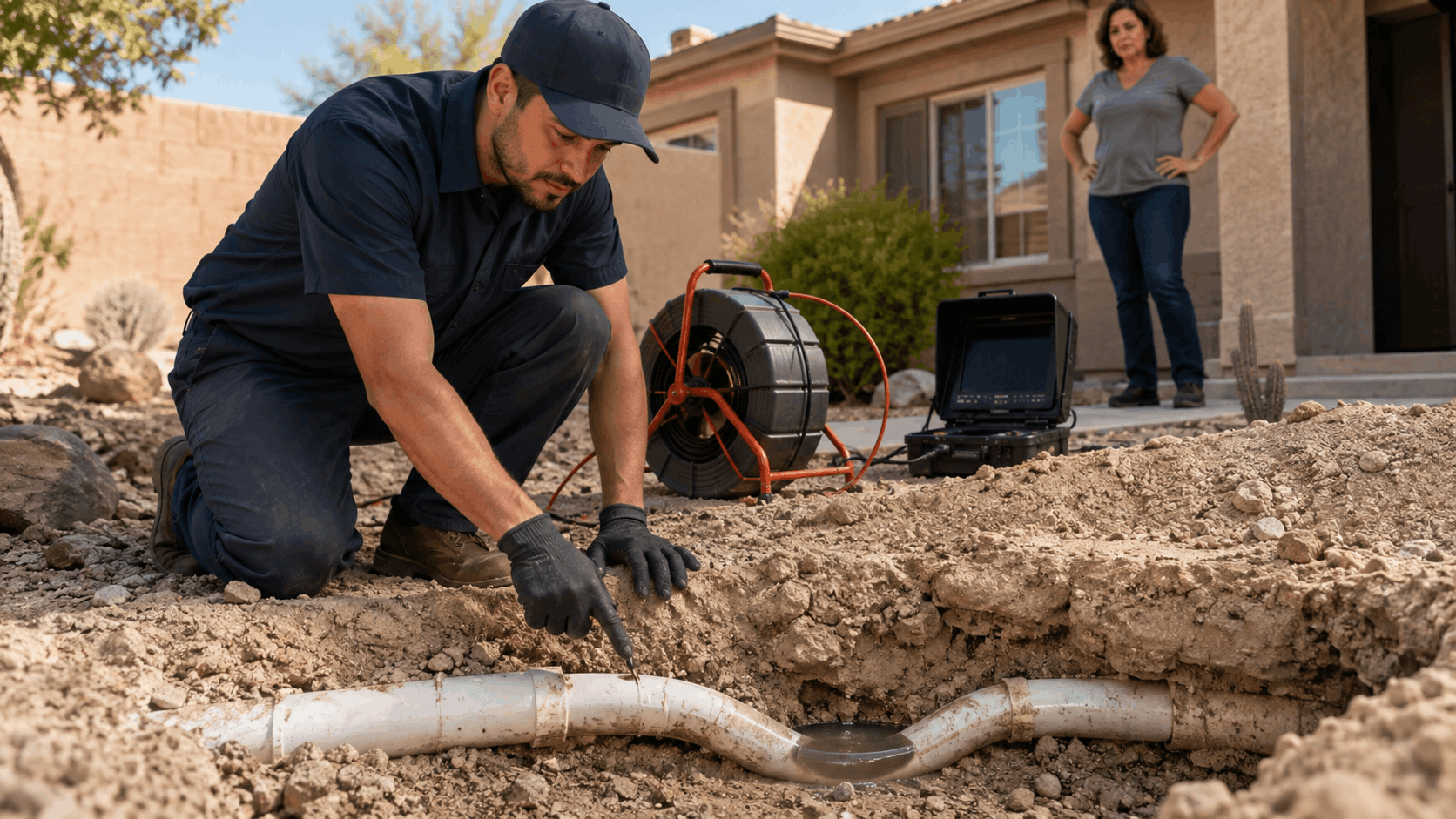
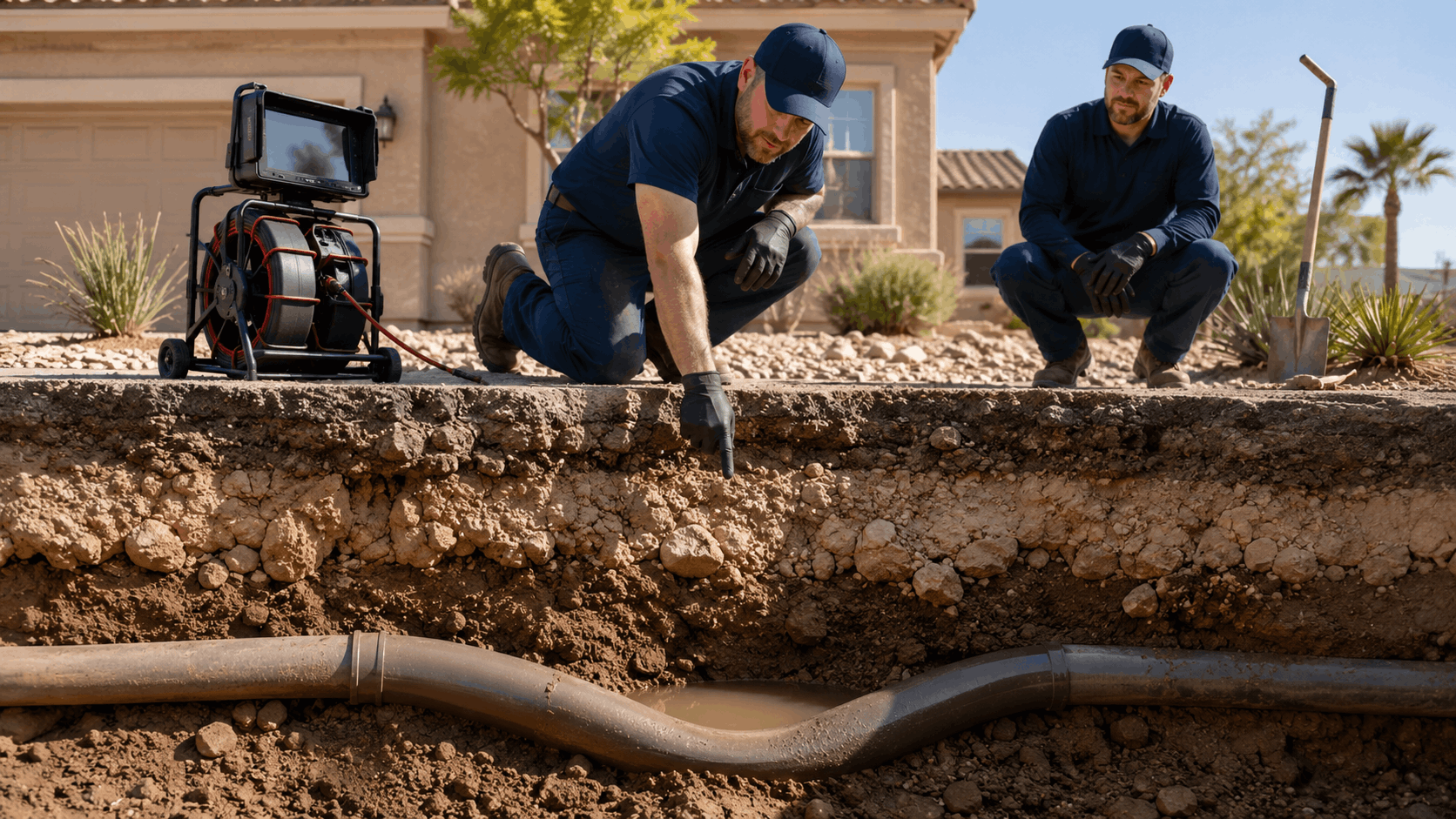
Guessing at a buried pipe problem wastes money and yard. The only way to know for sure whether you have a belly, a clog, roots, or a broken joint is to look. A sewer camera inspection puts eyes inside the line and shows exactly what is happening.
A video pipe inspection paired with line locating turns a mystery into a map. We see the problem, mark where it sits, and measure how deep it runs before anyone digs.
What the Camera Shows Inside the Pipe
As the camera travels down a healthy line, it moves along a clean pipe wall with water flowing past. When it reaches a belly, the picture changes. The lens dips underwater into standing water pooled in the low spot, and the flow stalls.
That pool of standing water is the signature of a pipe belly. A shallow puddle points to a mild sag, while water that submerges the whole camera signals a deep belly holding a lot of waste. The belly depth we see on screen tells us how serious the grade problem is.
We also watch how the water sits and drains as we push through. A belly holds water even when nothing is running elsewhere in the house. That standing pool, recorded on video, is proof the pipe has dropped out of grade rather than just clogged.
Showing homeowners that footage removes all doubt. Once you watch the camera sink into a pool of trapped waste, the diagnosis explains itself. You can learn more on our sewer camera inspection page.
Locating the Exact Spot and Depth
Finding a belly on camera is only half the job. We also need to know precisely where it sits underground and how deep. The camera head carries a transmitter called a sonde, and a handheld locator on the surface picks up its signal.
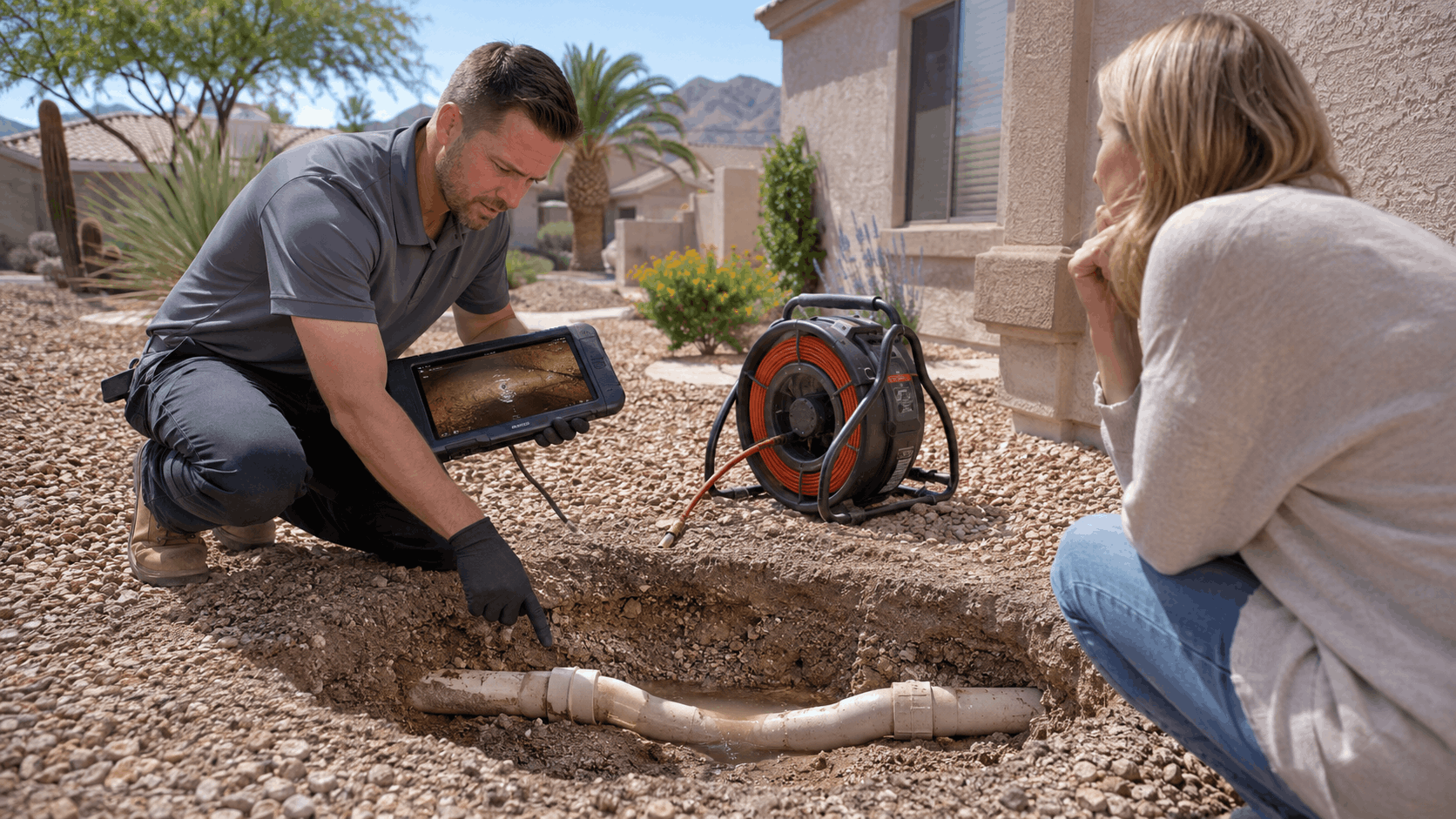
By tracing the signal, we mark the exact spot on the ground above the belly and read its excavation depth. That pipe locating step means we dig one targeted hole instead of trenching the whole yard hoping to find the problem. Precision keeps the repair small and the landscaping damage minimal.
Depth matters for planning too. A belly four feet down is a straightforward dig, while one eight or ten feet deep in fill soil calls for more shoring, more time, and a bigger budget. Knowing this up front lets us give an honest estimate.
Accurate locating is the difference between a clean spot repair and a torn-up yard. We invest the time here so the excavation goes right the first time.
Ruling Out Other Causes First
Not every recurring backup is a belly. Root intrusion, offset joints, grease buildup, and collapsed pipe can all mimic the same slow-drain symptoms. A proper inspection tells these apart so you pay to fix the actual problem.
Roots show as fine hairs or thick masses pushing through a joint. An offset joint appears as a step or misalignment where two pipe sections no longer line up. Grease coats the pipe wall in a way that looks and behaves very differently from a clean belly holding water.
Getting the diagnosis right saves real money. Lining a pipe to stop roots does nothing for a belly, and re-grading a belly does nothing for a grease problem in a different section. Sometimes a line has more than one issue, and only a camera reveals the full picture.
We would rather spend an hour confirming the cause than have a homeowner pay for the wrong repair. The camera pays for itself by pointing the shovel at the right spot.
Need Help in Las Vegas?
Active Plumbing serves Las Vegas and all of Las Vegas Valley.
Repair Options for a Bellied Sewer Line
Once a camera confirms a belly, the conversation turns to fixing it. Here is the hard truth many homeowners do not want to hear: a belly is a grade problem, and you cannot coat or line your way out of a grade problem. Real sewer repair for a sag means getting the pipe back to the right slope.
The right choice depends on how bad the belly is, how old the pipe is, and how deep the line sits. Options range from a focused spot repair to a full pipe replacement.
Spot Excavation and Re-Grading
For a single belly in otherwise sound pipe, spot repair is usually the practical answer. We dig down to the low section, remove the sagging pipe, and reset it at the correct fall. The goal is a clean quarter inch per foot slope through the repaired run.
The part that actually prevents the belly from coming back is the bedding. We pack a stable base of compacted material under the new pipe so it holds grade instead of drooping again. Skipping that step just recreates the original mistake, so we re-slope and re-bed together as one job.
Spot excavation makes sense when the rest of the line checks out on camera. There is no reason to replace fifty feet of good pipe to fix one dip. A targeted repair costs less and disturbs less yard.
Most single-belly repairs on a line four to six feet deep wrap up in a day or two. The homeowner gets a solid fix without a full-scale project.
Why Trenchless Lining Often Falls Short Here
Trenchless lining, also called CIPP, is a great tool for the right problem. A liner is pulled into the old pipe and cured in place, forming a new pipe inside the old one. It seals cracks and blocks roots without digging.
The catch is that a liner follows the shape of the existing pipe. If the old pipe sags, the liner sags with it. Lining a bellied line gives you a smooth new surface at the same wrong grade, so the low spot and the pooling stay exactly where they were.
That is the pipe lining limit homeowners need to understand. Trenchless works beautifully for cracked, root-invaded, or corroded pipe that still holds its slope. It does not correct a sag, because it has no way to lift the pipe back into grade.
When a sales pitch promises to fix a belly with lining alone, be skeptical. A belly needs the pipe physically moved back up, and only excavation does that.
Full Line Replacement for Severe Cases
Some lines are beyond a single spot fix. When a run has multiple bellies, aging clay or early ABS pipe, and offset joints all at once, patching one spot just moves the trouble down the line. In those cases a full sewer replacement is the smarter long-term call.
Replacing the whole lateral lets us set consistent grade from the house to the main and bed the entire run properly. Proper pipe bedding along the full length is what stops new bellies from forming in our shifting soil. A modern PVC line on a compacted base can last for generations.
Full replacement costs more up front, but it ends the cycle of repeat repairs on a failing line. For a home with original pipe that has been snaked a dozen times, it is often the cheaper path over five years. We help homeowners weigh the math honestly.
You can read more about the process on our sewer line repair and replacement page.
How Active Plumbing Handles Local Soil Conditions
What sets a lasting repair apart in the Valley is respect for the ground. Any crew can drop a pipe in a trench. Making it hold grade in caliche and fill soil takes local know-how, and that is where our team focuses.
When we re-bed pipe, we account for the caliche layer below and the settling fill above. That means compacting the base correctly, choosing bedding material that supports the pipe evenly, and setting slope with the knowledge that this soil moves. A repair built for desert conditions outlasts one built by the book alone.
We work across the whole Valley, from central Las Vegas to Henderson and Summerlin. That daily experience means we already know the fill history in a Skye Canyon subdivision or the caliche depth off Charleston Boulevard before we arrive.
Homeowners hire us because a soil-aware repair does not come back. As a Las Vegas plumber that fixes these lines week in and week out, our whole approach is built around ground that fights back. Reach out through our contact page to talk through your line.
Permits, Codes, and Local Utility Considerations
Sewer work is not a free-for-all. Digging into a lateral or replacing a line involves permits and inspections, and the rules vary by which jurisdiction you live in. Knowing who to call and what to expect keeps a repair legal and smooth.
The Valley is split among the City of Las Vegas, the City of Henderson, and Clark County, plus the sewer district that owns the mains. Each has a say in how sewer work gets done.
When a Permit Is Required for Sewer Work
Most excavation and sewer replacement work requires a permit. Depending on your address, that permit comes from the City of Las Vegas Building Department, the City of Henderson, or Clark County for unincorporated areas like Enterprise and Spring Valley. Simple drain cleaning does not need one, but opening the ground almost always does.
An excavation permit exists to make sure the work meets code and gets inspected. After a repair or replacement, an inspector checks the slope, the materials, and the connection before the trench is backfilled. That sewer inspection protects the next owner as much as the current one.
Skipping the permit can cause real trouble later, from fines to problems selling the home. Code compliance is not just paperwork, it confirms the pipe was installed to standard. We pull the correct permits as part of the job so homeowners do not have to chase the process.
You can verify current requirements through Clark County Building and Fire Prevention. Rules shift, so we always confirm before we dig.
Sewer District Versus Homeowner Responsibility
A common surprise is learning that the public sewer main is not the homeowner's problem, but the pipe connecting to it is. The line from your house to the point of connection is the sewer lateral, and that lateral belongs to you. The main in the street belongs to the district.
In most of the Valley, the Clark County Water Reclamation District owns and maintains the mains. The responsibility line is usually at the property line or the point where your lateral ties into the main. A belly almost always sits in the lateral, which puts the repair on the homeowner.
Knowing where responsibility changes matters when a backup happens. If the problem is in your lateral, calling the district will not fix it. If it is truly in the main, the district handles it, though that is far less common for a belly.
We help homeowners figure out which side of the line their problem falls on. That saves time and points the repair at the right party.
HOA and Landscaping Concerns in Master-Planned Areas
Many Valley homes sit in master-planned communities with active HOAs, and those associations have rules about digging and restoration. In Summerlin and Green Valley, for example, HOA guidelines can govern how a torn-up yard must be restored and what plantings go back. Ignoring them can bring fines on top of the repair cost.
Some communities require notice before excavation, especially where the lateral runs under common landscaping or shared easements. Coordinating with the HOA up front avoids surprises and keeps the project on good terms with the association.
Landscape restoration is part of a good sewer repair in these neighborhoods. Matching decorative rock, replacing shrubs, and restoring irrigation lines after the dig keeps the yard looking right. We plan for that restoration rather than leaving a scar.
We handle these details across communities from Summerlin to Green Valley in Henderson. Smooth coordination with the HOA is part of doing the job well.
Need Help in Las Vegas?
Active Plumbing serves Las Vegas and all of Las Vegas Valley.
Preventing Future Bellies and Protecting the Line
You cannot change the caliche or fill under your home, but you can slow the damage and catch problems early. Smart sewer maintenance and drainage control go a long way toward protecting a line in Valley soil. A little attention now prevents a big dig later.
Prevention comes down to managing water, checking the line periodically, and paying attention to what your fixtures are telling you.
Managing Irrigation and Yard Drainage
Water is what softens fill soil and speeds settling, so how you water your yard affects your sewer line. Overwatering saturates the ground around the pipe and helps it sink more quickly. Desert landscaping and efficient irrigation protect both your water bill and your buried pipe.
Check that sprinklers and drip lines are not running longer than needed, especially over the sewer path. A leaking irrigation valve can dump gallons into one spot day after day, undermining the soil right where the lateral runs. Fixing those leaks matters more than most people realize.
Grading also counts. The yard should slope so rain and runoff move away from the house and away from the sewer trench, not pool over it. Good yard drainage keeps water from collecting where it can wash out pipe support.
Small changes in watering habits add up over years. Keeping the ground around the line as stable as possible slows the settling that creates bellies.
Routine Camera Checks on Older Systems
For any home over 20 years old, a periodic camera check is cheap insurance. So is one for a house that has had past backups or that sits on deep fill. A preventive inspection catches a minor sag while it is still a spot repair instead of a full replacement.
We suggest a camera look every few years for older systems, or right away if slow drains start creeping in. Early detection lets you plan a repair on your schedule and budget rather than during an emergency backup. Finding a shallow belly today beats finding a flooded floor drain next winter.
A camera check is also smart before buying an older home. Knowing the condition of the lateral protects you from inheriting someone else's failing line. It is one of the best few hundred dollars a buyer can spend.
Regular inspection turns a hidden risk into a known quantity. You get to make decisions instead of reacting to disasters.
Watching Fixtures for Early Signs
The cheapest prevention is simply paying attention. Note when a drain starts running slower than it used to, when a toilet gurgles, or when a faint sewer smell shows up. Those early signs are your line asking for help before it fails.
Keep a mental or written record of how often you plunge or snake a drain. A pattern of repeat trouble on the same fixture is worth investigating rather than tolerating. Quick action on a small belly keeps it from deepening into a full stoppage.
Simple habits help. Avoid flushing wipes and grease, watch your slow drains, and act on the first gurgle rather than the tenth. Monitoring costs nothing and often buys years of warning.
If something feels off with a drain, trust it. Catching a belly early is always cheaper than fixing a flooded line, and our hydro jetting and rooter service can clear buildup while you plan the real fix.
Final Thoughts
A bellied sewer line is not bad luck, it is a byproduct of the ground the Valley is built on. Caliche resists proper bedding, and imported fill keeps settling for years, both of which drag pipe out of grade and create low spots that trap waste. That is why a snaked drain in Summerlin or Henderson keeps backing up.
The good news is that bellies are fixable when you diagnose them correctly. A camera inspection confirms the sag, locating pinpoints it, and a proper excavation with solid bedding sets the pipe back to grade for good. Lining alone will not do it, because a belly is a slope problem, not a wall problem.
If you have a drain that will not stay clear, do not keep paying for temporary snaking. Let our team put a camera down the line and tell you exactly what is going on. Call Active Plumbing or reach out through our contact page to schedule an inspection and get a straight answer about your sewer line.
Frequently Asked Questions
- What causes a bellied sewer line in Las Vegas?
- Two local factors cause most bellies here. Caliche, the hard calcium carbonate layer under Valley homes, resists proper bedding, and installers often backfill trenches poorly over it. In newer areas, imported fill dirt keeps settling for years under the house. Both conditions pull the sewer lateral out of grade, creating a low spot that traps waste and water long after the pipe was installed correctly.
- Can a bellied sewer line fix itself?
- No. A belly is a structural low spot in the pipe, not a temporary clog. Because the ground under the line has settled or shifted, the pipe stays sagged and cannot rise back into grade on its own. Left alone, it collects more sediment, corrodes, and gets worse over time. The only real correction is excavating the low section and resetting the pipe to proper slope.
- How do I know if I have a belly or just a clog?
- Watch the pattern. A true clog, once cleared, usually stays gone for a long time. A belly clears when snaked but backs up again within weeks because waste keeps pooling in the low spot. If a drain has been snaked several times in a year, that repeat cycle points to a belly. A camera inspection confirms it by showing standing water in the sag.
- How much does bellied sewer line repair cost in Las Vegas?
- Cost depends on the fix and the depth. A single spot repair on a line four to six feet deep typically runs a few thousand dollars, while a full lateral replacement can reach well into five figures for a long, deep run in fill soil. Depth, access, and landscaping restoration all affect the price. A camera inspection and locating give you an accurate estimate before any digging.
- Will trenchless lining fix a bellied pipe?
- Not on its own. Trenchless CIPP lining follows the shape of the existing pipe, so if the pipe sags, the liner sags right along with it. You end up with a smooth new surface at the same wrong grade, and the low spot still traps waste. Lining is excellent for cracks, roots, and corrosion in pipe that holds its slope, but a belly needs excavation and re-grading.
- Do newer homes get bellied sewer lines too?
- Yes, more often than people expect. Homes in fast-growing areas like Summerlin West, Skye Canyon, and Inspirada in Henderson sit on deep imported fill. When that fill was not compacted perfectly, it keeps settling for years and pulls the sewer line down with it. We regularly find bellies in houses under ten years old, well after the builder warranty has closed.
- Do I need a permit to repair my sewer line?
- For excavation or replacement, almost always yes. The permit comes from the City of Las Vegas, the City of Henderson, or Clark County depending on your address. It requires an inspection of slope, materials, and connection before the trench is backfilled. Basic drain cleaning does not need a permit, but opening the ground does. We pull the correct permits as part of the job.
- How long does a bellied sewer line repair take?
- A single spot repair on a moderately deep line usually takes one to two days, including digging, re-grading, bedding, inspection, and backfill. A full lateral replacement can take several days to a week depending on length, depth, and site access. Deep lines in fill soil that require shoring take longer. We give a realistic timeline after the camera inspection and locating are done.
- Is the sewer belly my responsibility or the city's?
- Almost always yours. The sewer lateral running from your house to the point of connection at the main belongs to the homeowner. The Clark County Water Reclamation District owns and maintains the public main in the street. A belly nearly always sits in the lateral, which makes it the homeowner's repair. We can help you confirm which side of the responsibility line your problem falls on.
- How can I prevent a bellied sewer line?
- You cannot change the soil, but you can manage water and watch for early signs. Avoid overwatering, fix irrigation leaks near the line, and grade the yard so runoff moves away from the sewer path. Get a camera check every few years on homes over 20 years old or on deep fill. Acting on the first slow drain or gurgle keeps a small belly from becoming a full stoppage.
Licensed plumbing professionals serving Las Vegas and Las Vegas Valley.
Licensed in Nevada · License #0047021
Last updated on
Why trust Active Plumbing?
Founded in 1991, Active Plumbing is a licensed and insured plumber serving Las Vegas and Las Vegas Valley. All content is reviewed by our licensed technicians.

Need Help in Las Vegas?
Active Plumbing serves Las Vegas and all of Las Vegas Valley.
Related Articles
How Caliche Soil Shapes Every Underground Pipe Decision in the Las Vegas Valley
Caliche soil shapes every buried pipe decision in the Las Vegas Valley. Learn how this hardpan affects trenching, pipe materials, sewer and water lines, and cost.
Sewer Line Replacement Cost in Las Vegas: Trenchless vs Open-Dig Per Foot in Caliche
See real per-foot sewer line replacement costs in Las Vegas for trenchless vs open-dig, and learn how caliche soil affects your quote and which method fits your home.
Tree Roots in Las Vegas Sewer Lines: Mulberry and Olive Roots vs Your Clay Joints in Older Neighborhoods
Mulberry and olive roots invade clay sewer joints in older Las Vegas homes. Learn the warning signs, camera diagnosis, and repair options that stop backups for good.