Tips & Advice
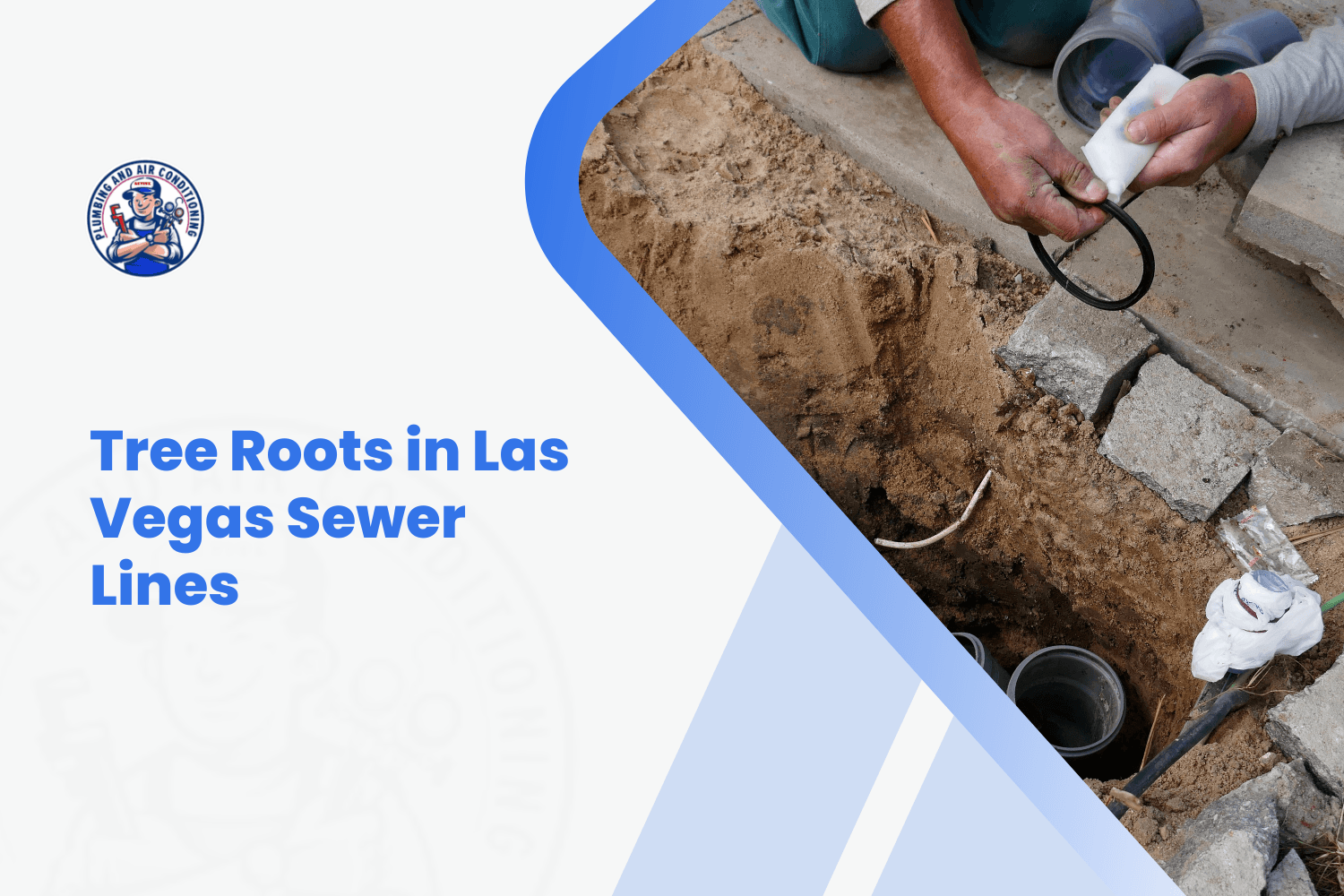
Tree Roots in Las Vegas Sewer Lines: Mulberry and Olive Roots vs Your Clay Joints in Older Neighborhoods
Key Takeaways
- Mulberry and olive trees cause most root-related sewer backups in older Las Vegas neighborhoods because their fast fibrous roots invade cracked clay pipe joints.
- Homes built before the 1980s in areas like Huntridge, John S. Park, and Paradise Palms commonly still run original clay laterals that roots exploit.
- Early warning signs include slow drains, gurgling toilets, recurring backups, green or soggy yard patches, and sewer odors near cleanouts.
- A sewer camera inspection confirms whether the problem is roots, grease, a bellied pipe, or a collapse before any repair is quoted.
- Rooter cutting and hydro jetting clear a line temporarily, while trenchless lining or bursting seals the joints against roots for decades.
- Root foam treatments, root barriers, smart tree placement, and scheduled camera checks help keep roots from returning after a repair.
- Trenchless lining often lets homeowners keep a mature tree while permanently ending backups, avoiding the need for removal.
- Active Plumbing inspects every line with a camera before quoting, offering clear options at different price points across the valley.
In This Article
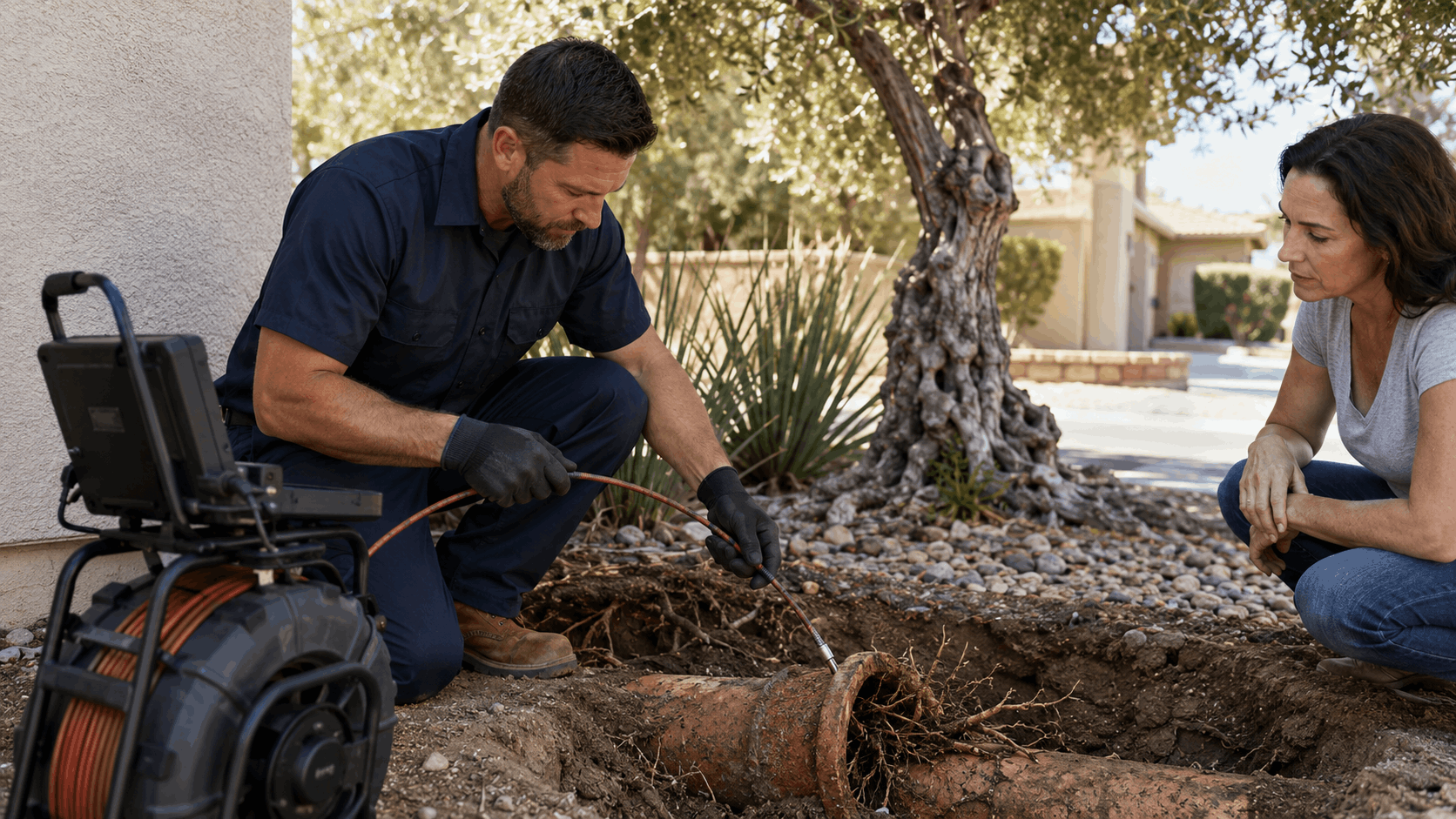
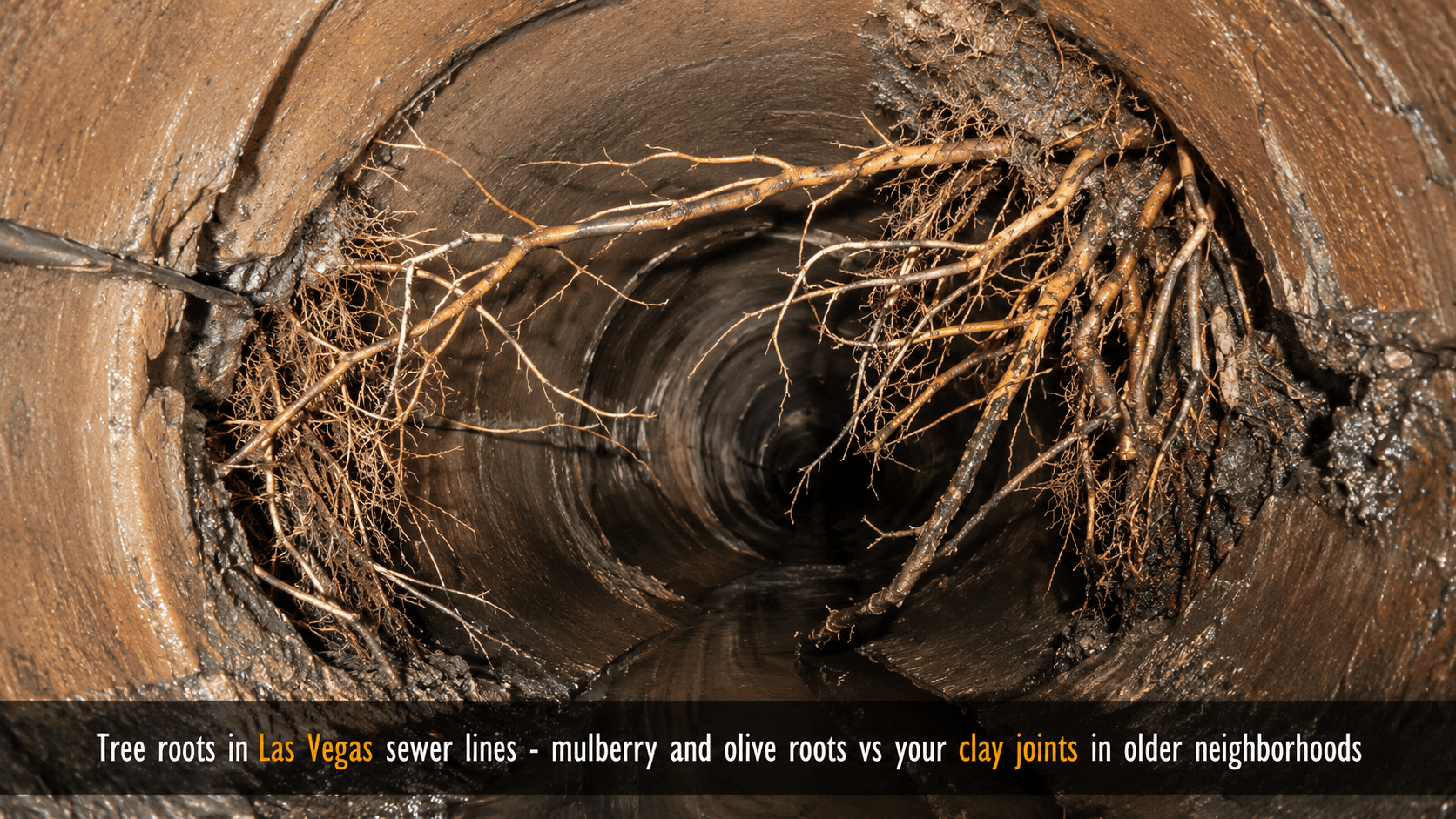
It usually starts with a bathtub that drains slower than it used to. Then the toilet gurgles when the washing machine runs. A homeowner over in Huntridge called us last spring after a full weekend of plunging did nothing, and when we ran a camera down the line, there it was: a thick white tangle of roots wrapped through a cracked clay joint about 30 feet from the house.
That story plays out every month across the older parts of the valley. Two trees cause most of it - the fruitless mulberry and the olive. Both were planted by the thousands in mid-century Las Vegas yards, and their roots have spent decades hunting for the one reliable source of water in a desert: your sewer line.
Why Tree Roots Target Sewer Lines in Older Las Vegas Homes
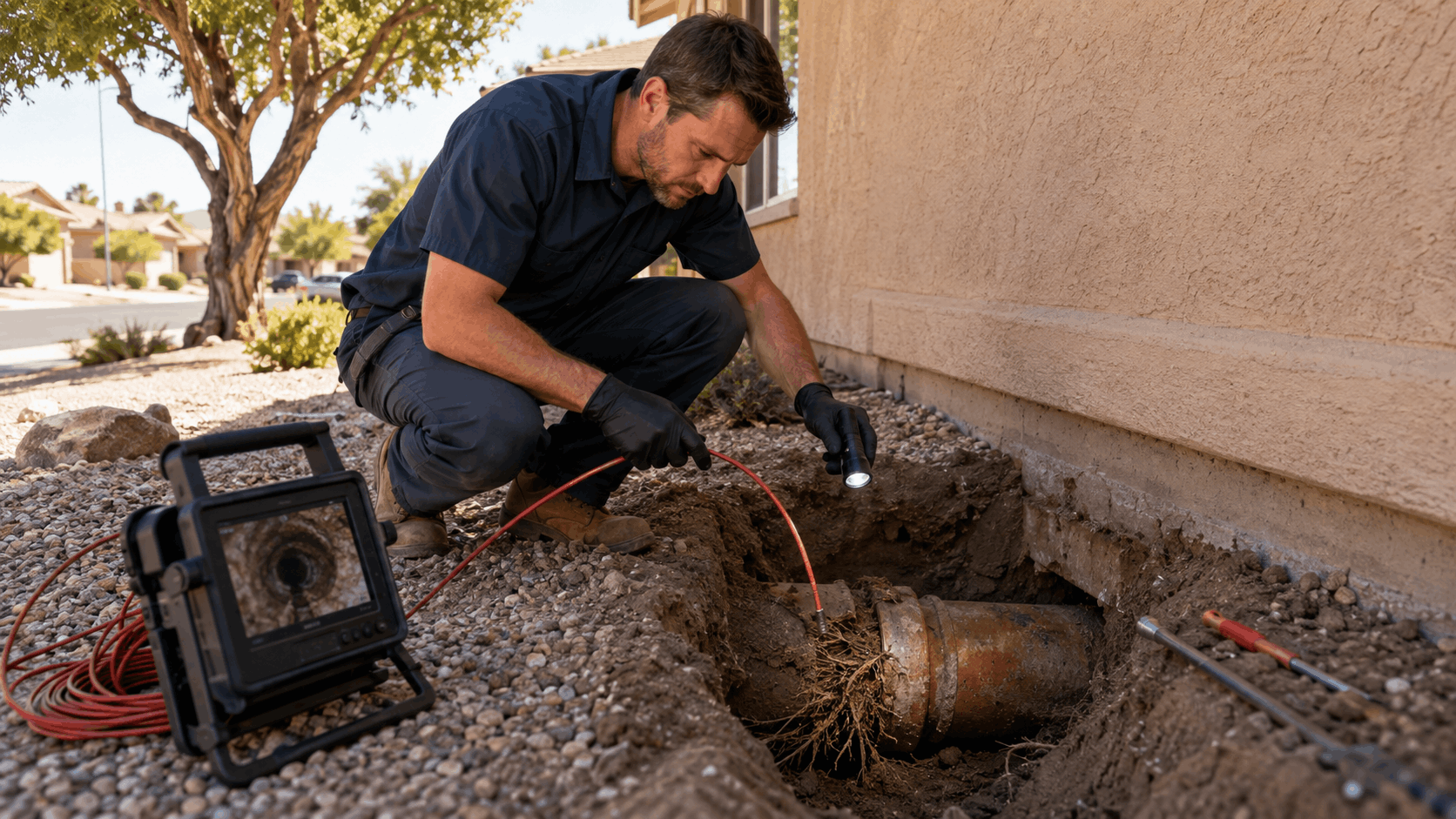
Tree root intrusion is not random. Roots grow toward what keeps them alive, and in the Mojave, the richest source of moisture underground is often the sewer line itself. Older Las Vegas homes with clay sewer pipe sit at the center of this problem because their pipe material and joint design practically invite roots in.
The combination that causes the most trouble looks like this:
- Mature trees planted 40 to 70 years ago with fully developed root systems
- Original clay sewer pipe joined with mortar that has cracked over time
- Long dry summers that push roots toward buried water sources
- Warm soil around a sewer line that stays slightly moist year round
When all four line up, roots find the pipe within a few seasons and keep coming back. Homes built before the 1980s carry the highest risk simply because that is when clay tile was the standard.
How Roots Find Water in the Desert
Roots are opportunists. In Mojave desert soil, surface water evaporates fast and rainfall barely registers most years, so a tree sends its roots deeper and wider in search of anything wet. A sewer line running a few feet underground gives off a steady trace of moisture and warmth, which acts like a beacon.
During July and August, when the ground bakes and homeowners water less, that buried pipe becomes the most reliable drink around. Roots follow the moisture gradient in the soil, growing toward the damp zone that surrounds even a lightly leaking joint. The drier the surface, the harder they push toward the pipe.
Once a root finds a crack or a loose mortar seam, it does not stop at a sip. It threads a hair-thin tip through the gap, then thickens inside the warm, nutrient-rich flow. What starts as a single strand can become a dense mat over a couple of years.
This is why root moisture problems spike after the hottest stretches of summer. The tree is doing exactly what it evolved to do, and the sewer line is the easiest target in the yard.
Why Clay Pipe Joints Are the Weak Point
Clay tile pipe was the go-to sewer material for decades because it resists corrosion and holds up well against normal wastewater. The problem is not the pipe body - it is the joints. Older clay lines come in short sections, usually a few feet each, connected with mortar or a cement-style collar.
Over 40 or 50 years, that mortar shrinks, cracks, and washes away in tiny amounts. Ground movement, settling soil, and the freeze-and-heat swings of the desert all work the seams loose. Even a gap the width of a business card is enough for a root tip to enter.
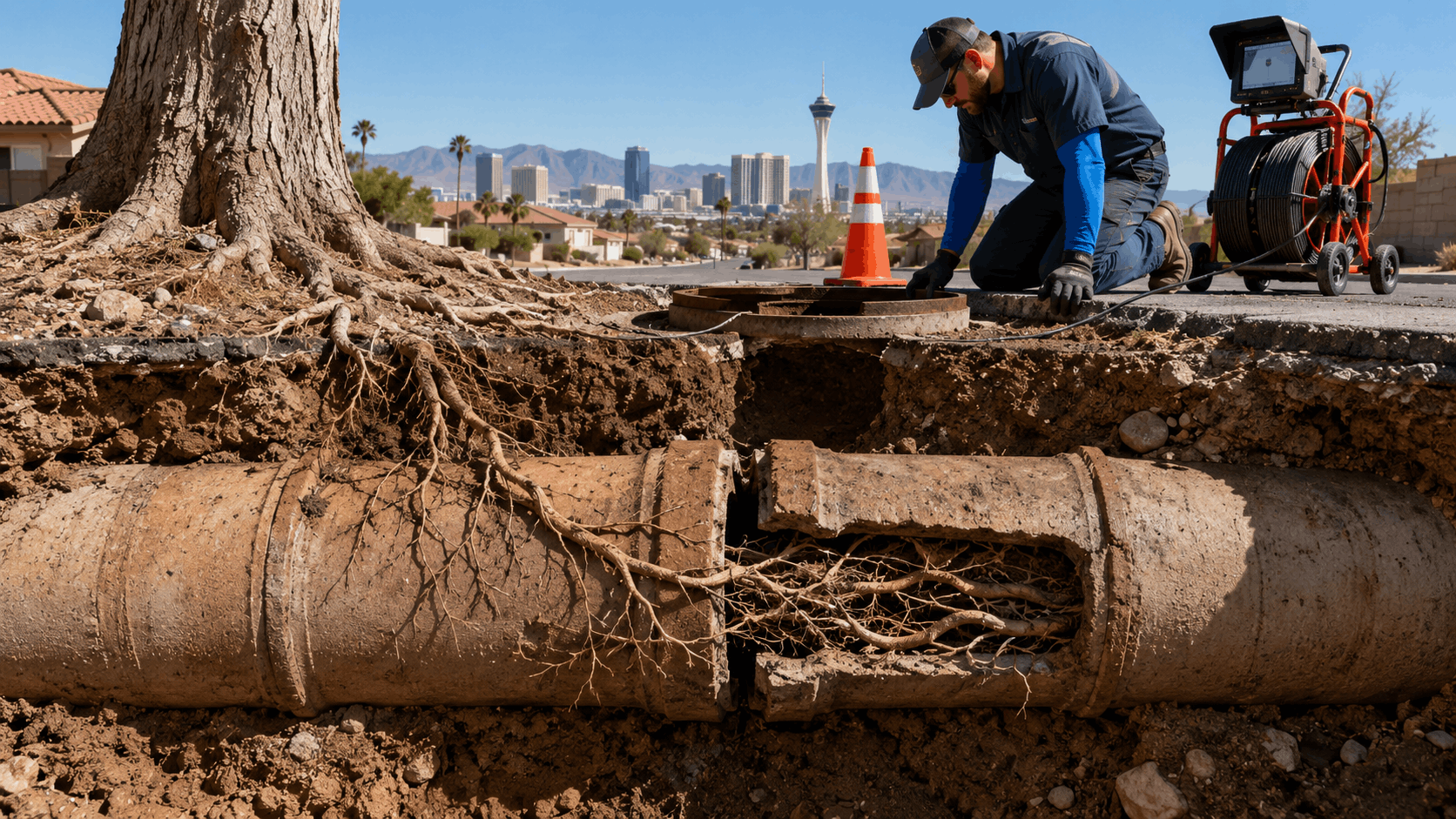
Once inside, the root widens the opening every year as it grows thicker. The pressure can crack the clay bell around the joint, offset the pipe sections, or eventually break a length of pipe entirely. Those mortar seams are almost always where our camera finds the first intrusion.
Newer PVC and ABS lines use rubber gasket seals and glued fittings that give roots far fewer openings. That is the core reason older homes deal with this so much more than newer builds.
The Age of the Neighborhood Matters
Neighborhood age is the fastest way to gauge risk. Homes built before the 1980s across areas like John S. Park, Huntridge, and Paradise Palms very often still have their original clay sewer laterals in the ground. Those 1980s clay lines were installed when the trees now towering over them were saplings.
We see it constantly in the streets south of Charleston and around the historic core. The lots are generous, the landscaping is mature, and the sewer lateral runs right under decades of root growth. Many owners have no idea their line is clay until we show them on the camera screen.
Contrast that with a newer master-planned area, where PVC and modern jointing are standard. The same tree over a modern line rarely causes the same grief. Age of the pipe, not just the tree, drives the difference.
If a home in one of these older districts has never had its drain and sewer line inspected, the odds of undiscovered root activity climb every year the trees keep growing.
Get Your Quote
Tell us what's going on and we'll get back to you fast.
Mulberry and Olive Trees: The Two Biggest Offenders in the Valley
Plenty of trees can crack a sewer line, but in this valley two species stand out. Mulberry roots and olive tree roots cause more of the calls we run than every other species combined. Both were planted heavily in older yards, and both grow the kind of invasive roots Las Vegas clay lines cannot withstand for long.
Understanding why these two are so aggressive helps homeowners judge their own risk. If either tree stands within 30 or 40 feet of the house, the sewer lateral is very likely in its path.
Why So Many Older Yards Have Mulberry Trees
The fruitless mulberry was the shade tree of choice in mid-century Las Vegas. It grew fast, threw dense shade over a hot backyard, and asked for little care, which made it the default pick for tract homes going up in the 1950s and 60s. Drive through Huntridge or Paradise Palms today and you can still spot the survivors towering over single-story ranch houses.
The trouble is that the same fast growth above ground happens below it. A mulberry pushes out an enormous, shallow, hungry root network that spreads far past the drip line. In tight older lots, that network runs straight across the yard and over the sewer lateral.
Mid-century landscaping did not account for what those roots would do to clay pipe 40 years on. Homeowners who inherited these trees inherited the sewer problem with them. By the time symptoms show, the root mass in the pipe can be years old.
We have cut mulberry roots out of a single line and watched them return within 18 months. The tree simply grows too fast to leave the pipe alone.
Olive Trees and Their Persistent Root Systems
Olive trees were another favorite, prized for their silvery leaves and drought tolerance. They show up all over older Spring Valley lots and eastside streets, often planted as ornamentals decades ago. Their looks are easy to love, but their roots are stubborn.
Olive tree roots spread wide and shallow, fanning out in search of water rather than diving straight down. That horizontal spread is exactly what carries them into a lateral sewer line running across the yard. On a standard older lot, the reach of a mature olive easily covers the pipe run.
Olive roots are also persistent. Cut them back and they resprout with determination, both above ground as suckers and below ground toward the pipe. Homeowners in the older sections around Spring Valley trees often report the same recurring backups we see with mulberries.
Because olives are so drought-hardy, they thrive on almost no supplemental water, which pushes them even harder toward the moisture in a sewer joint. The tree that needs the least watering is often the one working hardest to reach your pipe.
How These Roots Behave Differently Than Others
Not all roots invade the same way. Mulberry and olive both send out fibrous roots - fine, hair-like masses rather than a few thick anchors. Once a fibrous root finds a joint, it explodes into a dense sponge inside the pipe that traps everything flowing past.
That fibrous structure is why these two refill a cleared pipe so fast. Slower species like many desert natives may take years to find a joint and even longer to fill it. A mulberry or olive can re-clog a freshly cut line in a single growing season.
The fast root regrowth changes the repair math. With a slow-growing tree, a rooter clearing might buy several quiet years. With mulberry or olive over the line, clearing alone becomes a recurring chore rather than a solution.
This is the single biggest reason we push homeowners with these two trees toward a permanent joint seal instead of repeated cutting. The biology of the root is working against any temporary fix.
The Valley Ban and Why Old Trees Remain
Clark County and the City of Las Vegas restricted the planting of new mulberry and olive trees years ago, largely under a pollen ordinance aimed at allergy relief. The mulberry ban and olive restrictions mean nurseries no longer sell them for new landscaping in most of the valley.
The catch is that the rules apply to new planting, not existing trees. Every mature mulberry and olive planted before the ordinance is still standing, and many sit directly over a sewer lateral. The county did not require removal of the trees already in the ground.
So while no one is adding new offenders, the old ones keep growing and keep hunting for water. That is why an ordinance from decades ago has not slowed down the sewer calls we run in older neighborhoods. The problem trees were already planted.
For a homeowner, the takeaway is simple: a ban on the books does nothing for the 50-year-old mulberry shading the backyard. That tree is still the one to plan around.
Need Help in Las Vegas?
Active Plumbing serves Las Vegas and all of Las Vegas Valley.
Warning Signs of Root Intrusion Homeowners Should Watch For
Roots rarely block a line overnight. They build up slowly, which means there are usually weeks or months of warning before a full backup. Knowing the root intrusion symptoms lets a homeowner act while the fix is still cheap.
Here are the sewer backup signs we tell every customer to watch for:
- Drains that empty slower than they used to across multiple fixtures
- Toilets that gurgle or bubble when a sink or washer drains
- Backups that clear, then return every few months
- Unexplained wet or lush patches in the yard over the sewer path
- Sewer odors near a cleanout, a floor drain, or in a bathroom
Any one of these deserves attention. Two or more at once usually means roots.
Slow Drains and Gurgling Toilets
The earliest sign is almost boring: a tub or sink that drains a little slower each week. One slow fixture is often a local clog, but when several fixtures slow down together, the problem is deeper in the main line. Roots narrowing the pipe restrict flow long before they block it fully.
A gurgling toilet is the classic tell. When water drains from a sink or the washing machine and the toilet bubbles or the water level moves, air is being forced past a partial blockage downstream. That trapped air escaping through the toilet is a strong hint that something is choking the main line.
Homeowners often live with these signs for months, plunging and pouring drain cleaner without lasting results. Those store products may loosen a little debris but do nothing to a root mass. The slow drain simply returns.
When a plunger and a bottle of cleaner stop working on a recurring basis, it is time to look at the line itself rather than the fixture.
Recurring Backups That Keep Coming Back
A one-time clog usually has a one-time cause - a flushed wipe, a grease slug, too much paper. A recurring backup that returns every few months is a different animal. That pattern almost always points to roots regrowing in the same spot.
We hear the same story constantly: the line backed up, someone snaked it, it worked for a while, and now it is backing up again. Each cycle the gap between backups tends to shrink as the root mass rebuilds faster. That shrinking interval is the fingerprint of a repeat sewer clog driven by roots.
If a home has needed the line cleared more than once in a year, roots are the leading suspect. Grease and debris do not reappear on a schedule the way a growing root does. The calendar itself becomes the diagnosis.
At that point, repeated clearing is just renting time. A camera inspection tells everyone exactly what is regrowing and where.
Wet Spots and Sudden Green Patches in the Yard
The sewer line leaks before it fully fails, and the yard often shows it first. A strip of grass that stays greener and thicker than everything around it, following a straight path across the lawn, frequently traces the sewer run. The pipe is fertilizing and watering that strip through a crack.
Soggy or spongy ground with no sprinkler nearby is another red flag. If one patch stays damp days after watering while the rest of the yard dries out, wastewater may be seeping from a broken joint below. That same leak is what draws the roots in.
These yard wet spots point to a sewer leak in the lawn even when the drains inside still work fine. The pipe can leak long before it clogs. Catching it at the green-patch stage often means a smaller, cheaper repair.
We always ask homeowners to walk the yard and look for that telltale green line. It has helped us locate breaks before a single fixture backed up.
Sewer Odors Inside or Outside the Home
A sewer smell is never normal. Inside, a faint rotten-egg or sewage odor near a bathroom or floor drain can mean the line is partly blocked and gases are backing up instead of venting out. Roots holding water in the pipe give those gases a place to pool.
Outside, a drain odor around the cleanout or over the buried line often signals the same thing. When a line runs slow, waste sits and stagnates, and the smell finds its way up through the soil or the cleanout cap. A strong outdoor sewage smell after a warm day is worth investigating.
Some homeowners chase the odor with air fresheners for weeks before realizing the source is the sewer line itself. The smell is the pipe telling you flow is restricted. Masking it only delays the real fix.
Paired with slow drains or gurgling, a persistent sewer odor moves roots to the top of the suspect list.
How a Camera Inspection Confirms the Problem
Guessing at a sewer problem wastes money. A sewer camera inspection removes the guesswork by showing exactly what is inside the pipe before anyone digs or quotes a repair. This video pipe inspection is the foundation of an honest sewer diagnosis.
Here is what the process gives a homeowner:
- A live look at roots, cracks, and blockages inside the line
- An exact location and depth of the problem under the yard
- Proof of whether the issue is roots, grease, or a collapsed pipe
- A recorded reference to compare against after any repair
We run a camera before recommending work so the homeowner sees the same thing we do.
What a Sewer Camera Actually Shows
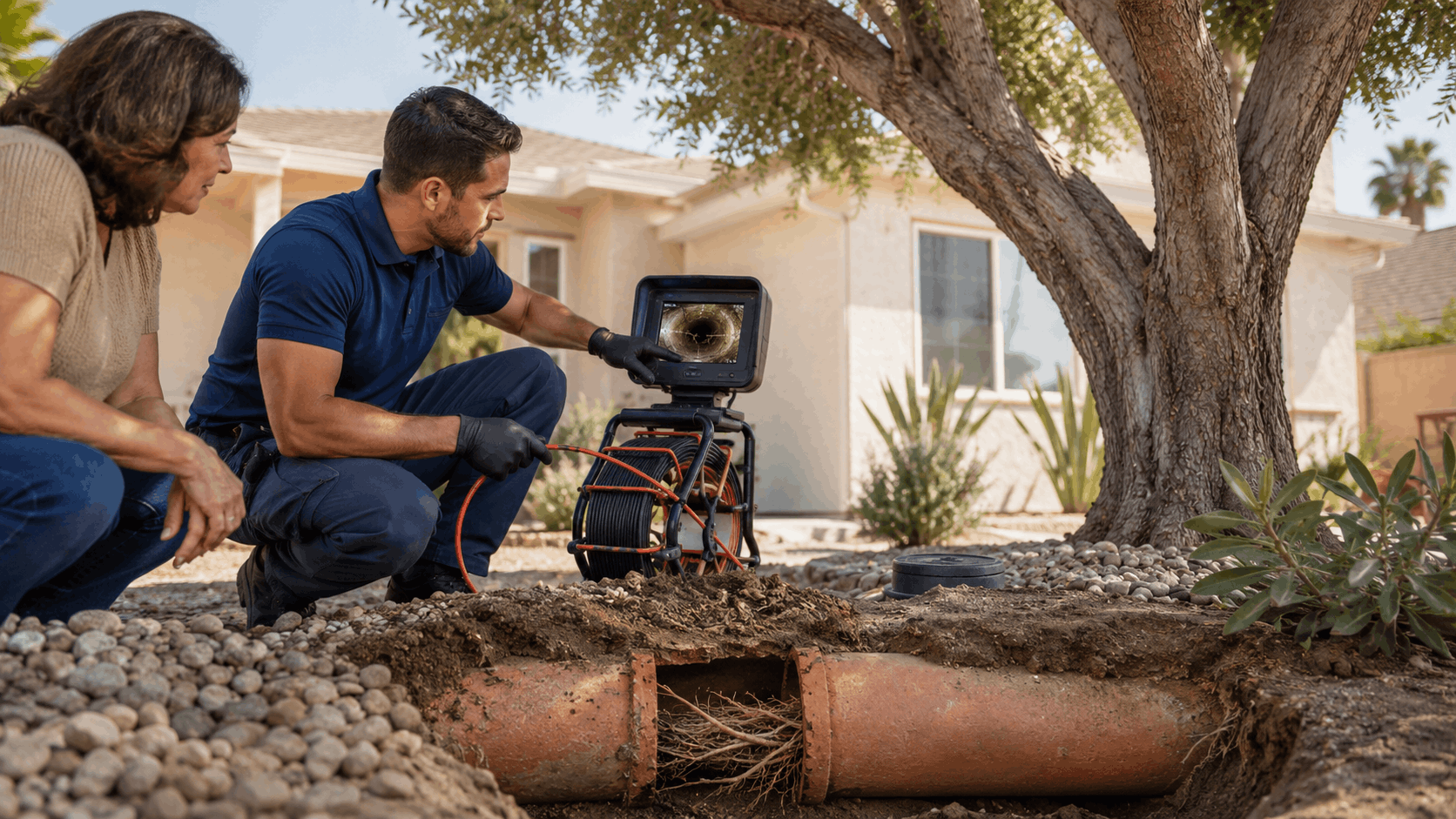
A sewer camera is a waterproof lens on a flexible cable, fed down the line from a cleanout. On the monitor, a root mass looks like a white or tan tangle hanging into the pipe, often with debris caught in it. There is no mistaking a heavy intrusion once you see it on screen.
The camera also reveals cracked joints, offset pipe sections where one length has shifted out of line, and standing water that signals a low spot or blockage. Each of these tells a different part of the story. A clear picture of the pipe interior guides every decision that follows.
We walk homeowners through the footage in plain terms, pointing out where the clay joint has opened and where the roots enter. Seeing it firsthand usually settles any doubt about whether a repair is real or oversold. The screen does not exaggerate.
Our sewer camera inspection service gives that visual confirmation before a dollar is spent on digging.
Locating the Exact Break Under the Yard
Finding the problem is only half the job - the other half is knowing precisely where it sits underground. The camera head carries a transmitter, and we use a locator wand above ground to trace its position and read the depth. That pipe locating step marks the exact spot on the surface.
Knowing the sewer line depth and location means any excavation targets a small area instead of trenching the whole yard. On older lots with mature trees, that precision protects roots, patios, and irrigation lines from needless digging. It also keeps the repair cost down.
We mark the location with paint or a flag so everyone knows where the work will happen. There is a big difference between digging one measured hole and guessing across 60 feet of lawn. Accurate locating is what makes the difference.
This same information tells us whether a trenchless approach is even possible, since access points and depth shape those options.
Telling Roots Apart From Grease or Collapse
Not every backup is roots, and the camera keeps us honest about that. Grease buildup shows as a smooth, dark coating narrowing the pipe, very different from the fibrous tangle of a root mass. Treating grease with the wrong method wastes time and money.
The camera also spots a bellied pipe, where a section sags below grade and holds standing water that traps waste. A belly needs a different fix than roots, since cutting roots does nothing for a low spot in the line. Only a visual inspection tells them apart with confidence.
Worst case, the camera reveals a collapsed sewer section, where the pipe has broken apart and lost its shape entirely. That level of failure often means the camera cannot pass, which itself is diagnostic. A collapse points toward replacement rather than cleaning.
Distinguishing roots, grease, a belly, and a collapse up front prevents paying for the wrong repair. That is the whole point of looking before digging.
Repair and Clearing Options for Root-Filled Clay Lines
Once the camera confirms roots, the homeowner has choices that range from a quick clearing to a permanent replacement. Each option for sewer line repair and root removal buys something different, and being honest about that matters. A rooter clears the line today; trenchless work seals it for decades.
Here is how the main options compare:
| Option | What It Does | How Long It Lasts | Digging Involved |
|---|---|---|---|
| Mechanical Rooter | Cuts roots to restore flow | Months to a year on clay | None |
| Hydro Jetting | Scours pipe walls with water | Longer than a rooter | None |
| Pipe Lining | Seals a new liner inside old pipe | Decades | Minimal |
| Pipe Bursting | Replaces pipe through the old path | Decades | Minimal |
| Full Excavation | Digs and replaces the line | Decades | Extensive |
Mechanical Rooter Cutting
A rooter machine feeds a rotating cable with a cutting head down the line. The blade spins through the root mass and shears it off flush with the pipe wall, restoring flow within an hour or two. For an active backup, it is the fastest way to get drains working again.
The honest limit is that mechanical cutting only removes what is inside the pipe at that moment. The joint stays open, and on a mulberry or olive line the roots start regrowing almost immediately. A rooter service buys relief, not a cure.
We are upfront that on clay joints with aggressive trees, a rooter is a short-term fix. It is the right call for an emergency or for a homeowner who wants time to plan a bigger repair. Just expect the roots to return.
Many homeowners start here, then move to a lasting solution once the crisis passes. There is nothing wrong with that order.
Hydro Jetting for a Deeper Clean
Hydro jetting takes clearing a step further. A high-pressure water nozzle blasts the pipe walls at thousands of psi, cutting through roots and scouring off the grease and scale a blade leaves behind. The result is a pipe cleaned closer to its full diameter.
Because high-pressure cleaning strips the walls so thoroughly, it usually keeps a line clear longer than a rooter alone. It also flushes the loosened debris all the way out rather than leaving fragments to snag new growth. For root-heavy lines, it is the more complete clean.
Jetting still does not seal the joint, so on mulberry and olive lines the roots will eventually come back. But it resets the pipe to a better baseline and is often the step we take right before lining. A clean pipe accepts a liner better.
Our hydro jetting and rooter service handles both the fast clearing and the deeper clean depending on what the camera shows.
Trenchless Pipe Lining and Bursting
Trenchless repair is where a temporary problem becomes a permanent fix. With pipe lining, we insert a resin-saturated sleeve into the old clay pipe and cure it in place, creating a smooth, jointless pipe inside the old one. The seams roots exploited simply no longer exist.
Pipe bursting takes a different path for badly damaged lines. A bursting head is pulled through the old pipe, fracturing it outward while dragging a new seamless pipe into the same space. Both methods need only small access pits instead of a full trench.
For older lots with mature mulberry or olive trees, trenchless work is often the ideal answer. It seals the line against future roots while sparing the yard, the driveway, and usually the tree itself. The homeowner keeps the shade and loses the backups.
These methods carry a higher upfront cost than clearing, but they end the cycle of repeat visits. Over the life of the pipe, that math favors trenchless for a line under an aggressive tree. Our sewer line repair and replacement team scopes each line to see if it qualifies.
Full Excavation and Replacement
Some lines are too far gone for a liner. When the camera shows a fully collapsed clay section or the pipe has crumbled and lost its shape, there is nothing left to line against. That is when dig-and-replace becomes the answer.
Full sewer replacement means opening a trench along the pipe run, removing the failed clay, and laying new PVC with modern gasketed joints. On an older lot with a big mulberry or olive, that trench has to work around or through part of the root system, which adds time and care.
Pipe excavation is the most involved option, but for a collapsed line it is also the only real fix. The upside is a brand-new pipe that should outlast the home and give roots nothing to grab. It resets the sewer completely.
We reserve full replacement for cases that genuinely need it, and the camera footage makes that call clear to everyone. No homeowner should dig up a yard on a guess.
Need Help in Las Vegas?
Active Plumbing serves Las Vegas and all of Las Vegas Valley.
Which Older Las Vegas Neighborhoods See This Most
Root problems cluster in the older Las Vegas neighborhoods where clay sewer lines and mature trees grew up together. If a home sits in one of these areas and predates the 1980s, the odds of clay pipe and root activity climb sharply. Knowing the local pattern helps homeowners gauge their own risk before trouble hits.
Here is where we run the most root-related sewer repair Las Vegas calls:
| Area | Typical Era | Common Trees | Risk Level |
|---|---|---|---|
| Huntridge / John S. Park | 1940s-1950s | Mulberry | High |
| Beverly Green | 1950s | Mulberry, olive | High |
| Paradise Palms | 1960s | Mulberry | High |
| Older Spring Valley | 1970s-early 1980s | Olive | Moderate to high |
| Near Decatur / central | 1970s | Olive, mulberry | Moderate |
Historic Districts Near Downtown
The historic districts south and east of downtown are ground zero for this. Huntridge, John S. Park, and the Beverly Green area were among the first neighborhoods built out, and many still run their original clay laterals. The mulberries planted alongside those homes are now enormous.
We see Huntridge sewer calls month after month, usually the same story of a slow drain that turned into a backup. The lots are modest, so the tree, the house, and the sewer line all sit close together. That tight geometry gives roots a short trip to the pipe.
Beverly Green shows a similar mix, with both mulberry and olive over aging lines. Homeowners in these historic pockets who value their mature trees are often the best candidates for trenchless lining. It keeps the character of the yard intact.
For anyone in these districts, plumbing help near the Arts District and downtown core is close at hand when a line acts up.
Established Eastside and Central Streets
Move east and central and the pattern continues. Neighborhoods around Charleston Boulevard, Maryland Parkway, and Paradise Palms carry decades of mature landscaping over aging sewer lines. The mid-century ranch homes there almost define the clay-and-mulberry combination.
Paradise Palms in particular is known for its architecture and its old-growth trees, both of which sit over original laterals. The same shade that makes the neighborhood beautiful is fed by roots that reach the sewer. It is a trade-off baked into the area.
Streets near Maryland Parkway show a blend of housing eras, so the risk varies block to block. Where the homes predate the 1980s, clay is likely, and the trees have had plenty of time to find it. A camera inspection settles the question fast.
These central corridors are an easy reach for our crews, and quick response matters when a line backs up mid-week.
Older Sections of Spring Valley and the Southwest
The southwest side tells a slightly different story built around olive trees. Pre-1980s pockets in Spring Valley and near Decatur often have olives planted directly over the clay lateral. Those wide, shallow roots reach the pipe from farther away than people expect.
A Spring Valley sewer call in one of these older sections usually turns up olive roots in a mortar joint. The trees were popular for their looks and low water needs, and now they double as the neighborhood's most common sewer offender. Homeowners are often surprised the culprit is the pretty olive out front.
Areas near Decatur mix olive and mulberry depending on the block and the builder. The common thread is age - once a home crosses into pre-1980s territory, clay pipe and root risk come with it. Newer infill nearby rarely shares the problem.
Our crews cover these southwest streets regularly, and Spring Valley near West Sahara is a familiar stop for root-related backups.
How to Prevent Roots From Returning
Clearing a line is only worthwhile if the roots stay out afterward. Real root prevention combines the right treatment, smart placement, and steady sewer maintenance. For a home with a known problem tree, a plan beats waiting for the next backup.
The goal is to break the cycle of clog, clear, and repeat. That takes a mix of physical and chemical defenses plus regular checks.
Root-Inhibiting Treatments
Foaming root treatments are a common first line of defense after a clearing. A root foam treatment fills the pipe and coats the walls, where it kills the fine root tips on contact without harming the tree above ground. The foam reaches spots that liquid pours miss.
These treatments work best right after a rooter or jetting job, when the roots are already cut back and the foam can reach the joint. Applied on a schedule, usually a couple of times a year, a quality root killer slows regrowth noticeably. It does not seal the joint, but it buys time between cleanings.
We stress that foam is a management tool, not a permanent cure, especially against mulberry and olive. It keeps a moderate problem in check while a homeowner decides on a lasting fix. For fast-growing roots, it works alongside other steps rather than alone.
Used correctly, it can stretch the interval between clearings from months to a year or more. That alone makes it worth the routine on a problem line.
Root Barriers and Smart Tree Placement
A root barrier is a physical panel installed in the soil between a tree and the sewer line. It redirects roots downward or sideways, away from the pipe, rather than letting them cross straight over the joint. Installed during a repair or new planting, it adds a lasting line of defense.
Placement matters as much as barriers. When adding any new tree, keeping it well clear of the known sewer path saves years of future grief. A general rule is to plant well away from the lateral and to favor species with less aggressive roots.
For existing trees, a barrier trenched in along the pipe run can slow the intrusion without touching the tree itself. It is not foolproof against a determined mulberry, but it changes the odds. Combined with a lined pipe, it is a strong pairing.
We advise homeowners on where the line runs before they plant anything new. A five-minute conversation can prevent a five-figure problem down the road.
Scheduled Camera Checks and Cleaning
The surest defense on a problem line is not waiting for symptoms at all. Preventive maintenance means a periodic sewer camera check to catch regrowth while it is still small, paired with jetting before it becomes a blockage. Staying ahead of the roots is far cheaper than reacting to a backup.
For a home with a mature mulberry or olive over the line, we usually suggest a camera look every one to two years. That interval catches the fast fibrous regrowth these trees produce before it chokes the pipe. The footage also tracks whether the joint is degrading further.
Scheduled jetting keeps the pipe walls clean and the diameter open, extending the life of a clay line that is not yet ready for replacement. It turns an emergency into a routine appointment. Homeowners who adopt the schedule rarely see a surprise backup.
Think of it like servicing a car - a small regular cost that prevents a large sudden one. On an aggressive-tree line, that trade is worth making.
Deciding Whether to Remove the Tree
Sometimes the honest conversation is about the tree itself. Removing a mature mulberry or olive ends the source of the sewer tree conflict permanently, but it also erases decades of shade and yard character. It is a real trade-off, not an obvious call.
For many homeowners, tree removal feels like too much to lose, and that is where trenchless lining shines. Sealing the pipe lets the tree stay while the roots lose their entry point. The homeowner keeps the shade and the drains keep flowing.
Removal makes more sense when the tree is unhealthy, poorly placed, or sitting directly on top of a line slated for full replacement. In those cases, taking it out simplifies the repair and prevents a repeat. The stump and major roots come out with the old pipe.
We help weigh the two paths honestly, factoring in the tree's health, the pipe's condition, and what the homeowner values. There is no single right answer - only the one that fits the yard.
Why Homeowners Trust Active Plumbing for Sewer Root Problems
Root and clay pipe work rewards experience with the specific pipe and soil of this valley. Active Plumbing has run these jobs across the older neighborhoods for years, and that history shapes how we approach every line. As a Las Vegas plumber focused on getting the diagnosis right, our sewer service starts with looking, not guessing.
Here is what homeowners can expect from our team:
- Local knowledge of which streets run clay pipe and how desert soil behaves
- A camera inspection before any repair quote
- Clear options at different price points, explained in plain terms
- Honest recommendations, including when clearing is enough and when it is not
The goal is a fix that fits the home, not the biggest possible invoice.
Local Knowledge of Valley Soil and Old Lines
Working the same neighborhoods for years teaches patterns no manual covers. We know that a pre-1980s home in Huntridge or Paradise Palms almost certainly has clay pipe, and we know how the mulberries and olives in those yards behave. That local plumber knowledge speeds up the diagnosis.
Valley soil adds its own wrinkles. The caliche layers and shifting desert ground affect how a line settles, where joints pull apart, and how an excavation has to be dug. Understanding the soil means fewer surprises once the digging starts.
That familiarity also tells us which trees to expect on which streets. When a homeowner near Decatur describes a recurring backup, olive roots are already high on our list before we arrive. Local pattern reading saves everyone time.
We cover the whole valley, from the historic core to newer suburbs, and adjust our approach to what each area's pipes and soil demand.
Camera Diagnosis Before Any Quote
We do not quote a repair we have not seen. Every root job starts with a camera so the homeowner and our crew look at the same footage before any decision. That commitment means no one pays for repairs they do not need.
The camera settles the honest quote. If the line just needs a clearing, we say so. If a joint is cracked and roots will return in a season, we show the crack and explain the trenchless option. The screen backs up every recommendation.
This approach also protects homeowners from being talked into a full replacement when a liner would do, or a liner when a clearing is enough for now. Seeing the pipe keeps the conversation grounded in facts. Guesswork does not enter into it.
Reach out through our contact page to schedule a camera look before committing to any repair.
Repair Options for Every Budget
Once we know what the line needs, we lay out the choices side by side. That usually means clearing, lining, and replacement, each with a clear range of what it costs and what it buys. The homeowner picks the path, informed rather than pressured.
For a tight budget or an active emergency, a rooter or jetting gets drains working now. For a permanent end to the cycle, lining or bursting seals the pipe for decades. We explain the trade-offs so the sewer pricing makes sense against the value each option delivers.
We also flag when spending less today costs more later, and when it does not. On an aggressive-tree line, repeated clearings can add up past the cost of a one-time liner. Knowing that math up front helps homeowners choose wisely.
For sudden backups that cannot wait, our emergency plumbing team responds across the valley to get the line flowing again fast.
Need Help in Las Vegas?
Active Plumbing serves Las Vegas and all of Las Vegas Valley.
Final Thoughts
Tree roots in Las Vegas sewer lines are not bad luck - they are a predictable result of old clay pipe, aggressive mulberry and olive roots, and a desert that pushes those roots toward buried water. In older neighborhoods like Huntridge, Paradise Palms, and the pre-1980s pockets of Spring Valley, the combination is common.
The good news is that homeowners have real control. Watching for slow drains and gurgling toilets, confirming the cause with a camera, and choosing a repair that matches the line - from a quick clearing to a permanent trenchless seal - breaks the cycle for good.
If a home in an older valley neighborhood is dealing with recurring backups or a suspicious green strip in the yard, the smart first step is a camera inspection. Call Active Plumbing to schedule one, and let our team show you exactly what is happening inside your line before you spend a dollar on repairs.
Frequently Asked Questions
How do I know if tree roots are in my sewer line?
The top signs are drains that empty slowly across several fixtures, toilets that gurgle when other fixtures run, backups that keep returning every few months, and unusually green or soggy patches over the sewer path. A sewer smell near a cleanout adds to the case. None of these confirm roots by itself, but a camera inspection down the line shows the root mass and cracked joint for certain.
Are mulberry and olive roots really worse than other trees?
Yes. Both grow fast, spread wide, and send out fine fibrous roots that explode into dense mats once they reach a pipe joint. That structure lets them refill a freshly cleared line in a single growing season, far quicker than most other valley trees. Olives reach the pipe with wide shallow roots, and mulberries push an aggressive network across small older lots, making both the most common offenders we find.
Can roots break a clay sewer pipe completely?
They can. A root enters through a small gap in a mortar joint, then thickens year after year, widening the opening and putting pressure on the clay. Over time that pressure can crack the bell around the joint, shift pipe sections out of alignment, and eventually fracture or collapse a length of aging clay tile. A full collapse blocks the line entirely and usually calls for replacement rather than cleaning.
How much does it cost to clear roots from a sewer line?
A mechanical rooter clearing is the least expensive option, followed by hydro jetting for a deeper clean. Trenchless lining and full replacement cost more upfront but last for decades. Actual pricing depends on the pipe's length, depth, access, and how much damage the camera reveals. We give a firm quote only after inspecting the line, so a homeowner sees what drives the number before deciding.
Will cutting the roots fix the problem for good?
No. Cutting or jetting removes what is inside the pipe at that moment, but the joint stays open and the roots regrow. With mulberry and olive over the line, that regrowth can refill the pipe within months. Clearing is a temporary fix that restores flow and buys planning time. A lasting solution seals the joint with a trenchless liner or replaces the failed section entirely.
Do I have to remove my tree to fix the sewer?
Usually not. Trenchless pipe lining creates a smooth, jointless pipe inside the old clay, sealing off the entry points roots used. That lets most homeowners keep their mature mulberry or olive while ending the backups. Removal makes sense only when the tree is unhealthy, poorly placed, or sitting directly on a line that needs full dig-and-replace anyway.
How often should older homes have their sewer inspected?
For a pre-1980s home with clay pipe and a mature mulberry or olive over the line, we suggest a camera check every one to two years. That interval catches the fast fibrous regrowth these trees produce before it becomes a blockage. Homes without aggressive trees over the line can stretch the interval, but any older clay lateral benefits from an occasional look to track joint condition.
Is trenchless repair available in older Las Vegas neighborhoods?
Yes. Trenchless lining and pipe bursting work well in areas like Huntridge and Paradise Palms, where they seal old clay against future roots with minimal digging that spares mature yards. The main exception is a fully collapsed line, where there is nothing left to line against and full excavation is required. A camera inspection tells us which path a given line qualifies for.
Does my homeowners insurance cover root damage?
Coverage varies widely, and many standard policies exclude damage caused by tree roots or gradual wear on a sewer line. Some insurers offer a separate service line endorsement that can help cover buried pipe repairs. Homeowners in older neighborhoods should check with their carrier about that add-on before a problem arises. We can provide documentation and camera footage to support a claim where coverage does apply.
How fast can Active Plumbing respond to a sewer backup?
A sewer backup is treated as an emergency, and our crews cover the entire Las Vegas valley from the historic core to the outer suburbs. For active backups we aim to respond same day, often within a few hours depending on location and call volume. If a line is backing up into the home, call right away so we can get a truck rolling and stop the mess quickly.
Roots may be relentless, but they are also predictable, and a home in an older valley neighborhood does not have to keep fighting the same backup. From a first camera look to a permanent trenchless seal, our team handles the whole path with honest recommendations and clear pricing. Contact Active Plumbing today to schedule an inspection and finally put the root problem behind you.
Frequently Asked Questions
- How do I know if tree roots are in my sewer line?
- The top signs are drains that empty slowly across several fixtures, toilets that gurgle when other fixtures run, backups that keep returning every few months, and unusually green or soggy patches over the sewer path. A sewer smell near a cleanout adds to the case. None of these confirm roots by itself, but a camera inspection down the line shows the root mass and cracked joint for certain.
- Are mulberry and olive roots really worse than other trees?
- Yes. Both grow fast, spread wide, and send out fine fibrous roots that explode into dense mats once they reach a pipe joint. That structure lets them refill a freshly cleared line in a single growing season, far quicker than most other valley trees. Olives reach the pipe with wide shallow roots, and mulberries push an aggressive network across small older lots, making both the most common offenders we find.
- Can roots break a clay sewer pipe completely?
- They can. A root enters through a small gap in a mortar joint, then thickens year after year, widening the opening and putting pressure on the clay. Over time that pressure can crack the bell around the joint, shift pipe sections out of alignment, and eventually fracture or collapse a length of aging clay tile. A full collapse blocks the line entirely and usually calls for replacement rather than cleaning.
- How much does it cost to clear roots from a sewer line?
- A mechanical rooter clearing is the least expensive option, followed by hydro jetting for a deeper clean. Trenchless lining and full replacement cost more upfront but last for decades. Actual pricing depends on the pipe's length, depth, access, and how much damage the camera reveals. We give a firm quote only after inspecting the line, so a homeowner sees what drives the number before deciding.
- Will cutting the roots fix the problem for good?
- No. Cutting or jetting removes what is inside the pipe at that moment, but the joint stays open and the roots regrow. With mulberry and olive over the line, that regrowth can refill the pipe within months. Clearing is a temporary fix that restores flow and buys planning time. A lasting solution seals the joint with a trenchless liner or replaces the failed section entirely.
- Do I have to remove my tree to fix the sewer?
- Usually not. Trenchless pipe lining creates a smooth, jointless pipe inside the old clay, sealing off the entry points roots used. That lets most homeowners keep their mature mulberry or olive while ending the backups. Removal makes sense only when the tree is unhealthy, poorly placed, or sitting directly on a line that needs full dig-and-replace anyway.
- How often should older homes have their sewer inspected?
- For a pre-1980s home with clay pipe and a mature mulberry or olive over the line, we suggest a camera check every one to two years. That interval catches the fast fibrous regrowth these trees produce before it becomes a blockage. Homes without aggressive trees over the line can stretch the interval, but any older clay lateral benefits from an occasional look to track joint condition.
- Is trenchless repair available in older Las Vegas neighborhoods?
- Yes. Trenchless lining and pipe bursting work well in areas like Huntridge and Paradise Palms, where they seal old clay against future roots with minimal digging that spares mature yards. The main exception is a fully collapsed line, where there is nothing left to line against and full excavation is required. A camera inspection tells us which path a given line qualifies for.
- Does my homeowners insurance cover root damage?
- Coverage varies widely, and many standard policies exclude damage caused by tree roots or gradual wear on a sewer line. Some insurers offer a separate service line endorsement that can help cover buried pipe repairs. Homeowners in older neighborhoods should check with their carrier about that add-on before a problem arises. We can provide documentation and camera footage to support a claim where coverage does apply.
- How fast can Active Plumbing respond to a sewer backup?
- A sewer backup is treated as an emergency, and our crews cover the entire Las Vegas valley from the historic core to the outer suburbs. For active backups we aim to respond same day, often within a few hours depending on location and call volume. If a line is backing up into the home, call right away so we can get a truck rolling and stop the mess quickly. Roots may be relentless, but they are also predictable, and a home in an older valley neighborhood does not have to keep fighting the same backup. From a first camera look to a permanent trenchless seal, our team handles the whole path with
A
Licensed plumbing professionals serving Las Vegas and Las Vegas Valley.
Licensed in Nevada · License #0047021
Last updated on
Why trust Active Plumbing?
Founded in 1991, Active Plumbing is a licensed and insured plumber serving Las Vegas and Las Vegas Valley. All content is reviewed by our licensed technicians.

Need Help in Las Vegas?
Active Plumbing serves Las Vegas and all of Las Vegas Valley.
Related Articles
Tips & Advice
Drain Cleaning in Downtown Las Vegas and John S. Park: Original Cast Iron and Clay Laterals
A local guide to drain cleaning in Downtown Las Vegas and John S. Park, covering original cast iron and clay laterals, warning signs, cleaning methods, and repair options.
Tips & Advice
Floor Drains in Las Vegas Garages and Laundry Rooms: Dry P-Traps and That Sewer Smell
That sewer smell in a Las Vegas garage or laundry room usually means a dry P-trap. Learn why it happens in the desert, how to fix it, and when to call a plumber.
Tips & Advice
Sewer Line Repair in Paradise and Winchester: 60s-70s Clay Pipe Root Intrusion Capital of the Valley
Paradise and Winchester's 60s-70s clay pipes are root intrusion magnets. Learn the warning signs, camera inspection, repair options, and costs from Active Plumbing.