Tips & Advice
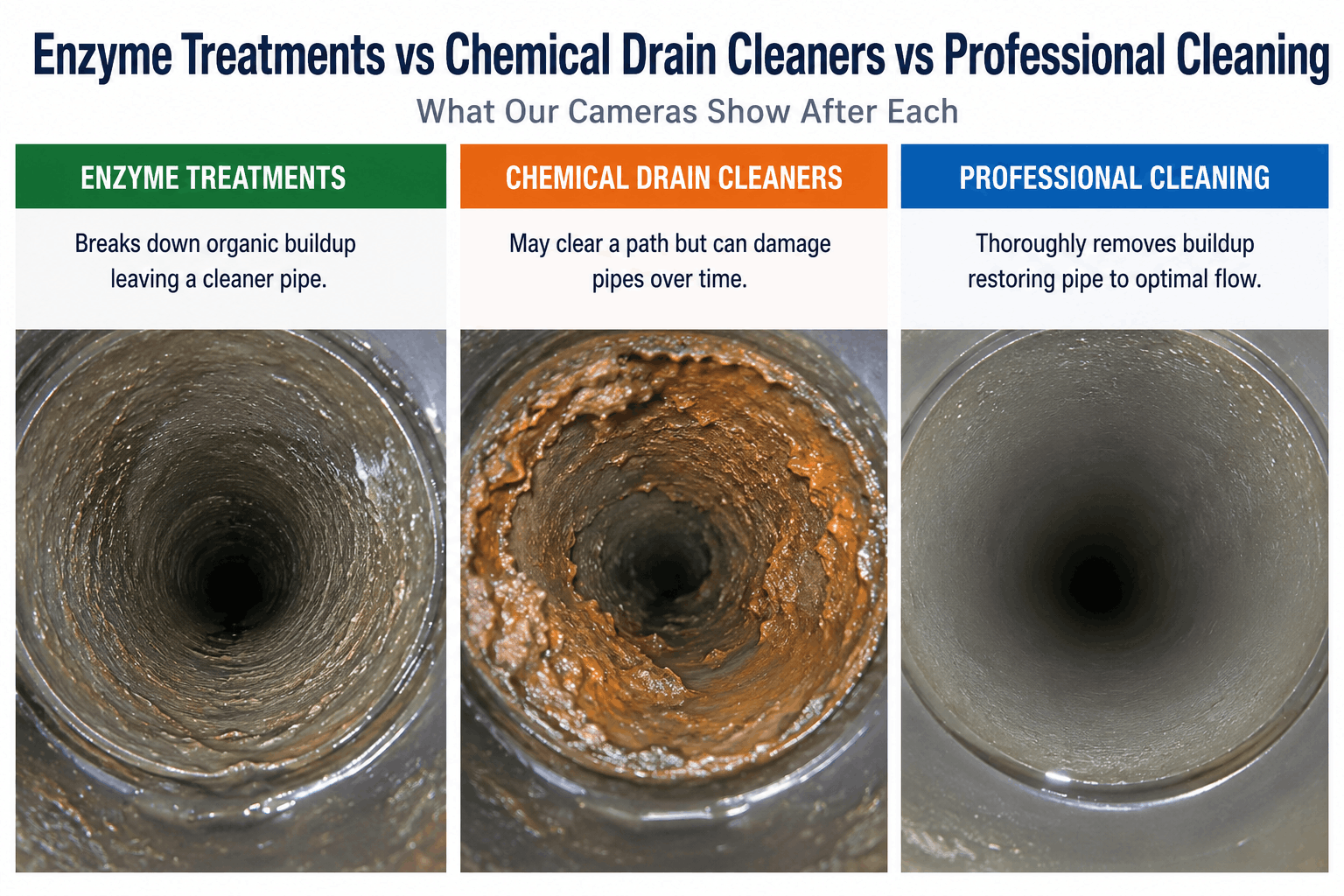
Enzyme Treatments vs Chemical Drain Cleaners vs Professional Cleaning: What Our Cameras Show After Each
Key Takeaways
- A drain camera shows the true condition of a pipe that no surface drain test can reveal, turning guesswork into facts.
- Enzyme cleaners work well for light organic buildup and maintenance but do nothing for hard water scale, roots, or heavy clogs.
- Chemical drain cleaners often bore a small channel while leaving most of the clog behind and can corrode or warp pipes over time.
- Professional methods like hydro jetting and cable machines clean the entire pipe wall and produce footage close to a new pipe.
- Las Vegas hard water builds mineral scale fast, so mechanical cleaning plus a water softener gives the longest-lasting results.
- Older cast iron lines near downtown face extra risk from harsh chemicals and benefit most from gentle mechanical cleaning.
- Multiple slow drains, gurgling toilets, and sewer smells signal a main line issue that needs professional eyes, not another bottle.
- One professional cleaning usually costs less over a year than repeat DIY treatments and avoids pipe damage that leads to replacement.
In This Article
A slow kitchen drain in a Summerlin home has a way of turning a quiet weekend into a standoff. The water pools around the strainer, drops an inch every few minutes, and the whole family starts debating what to pour down the pipe next. One person swears by the enzyme bottle from the hardware store. Another wants the harsh chemical stuff that fizzes and smells. A third just wants someone to fix it for good.
We hear this exact argument every week across the valley, from Peccole Ranch to the newer builds off the 215. The problem is that nobody can actually see inside the pipe, so the debate runs on guesswork and old advice from a neighbor. That guesswork costs people money and, sometimes, a whole section of pipe.
So we decided to settle it with footage. Our team runs a drain camera before and after cleaning jobs, and that video tells the real story. In this guide, we walk through what the camera shows after enzyme treatments, after store-bought chemical cleaners, and after professional cleaning. You will see what each method really does inside a Las Vegas pipe, and which one fits the clog you are staring at right now.
Why Camera Inspections Change the Whole Drain Cleaning Conversation
For years, homeowners judged a drain by how fast the sink emptied. That test tells you almost nothing about the shape the pipe is really in. A line can drain fine while a thick ring of grease or scale sits an inch below the surface, waiting to close up again.
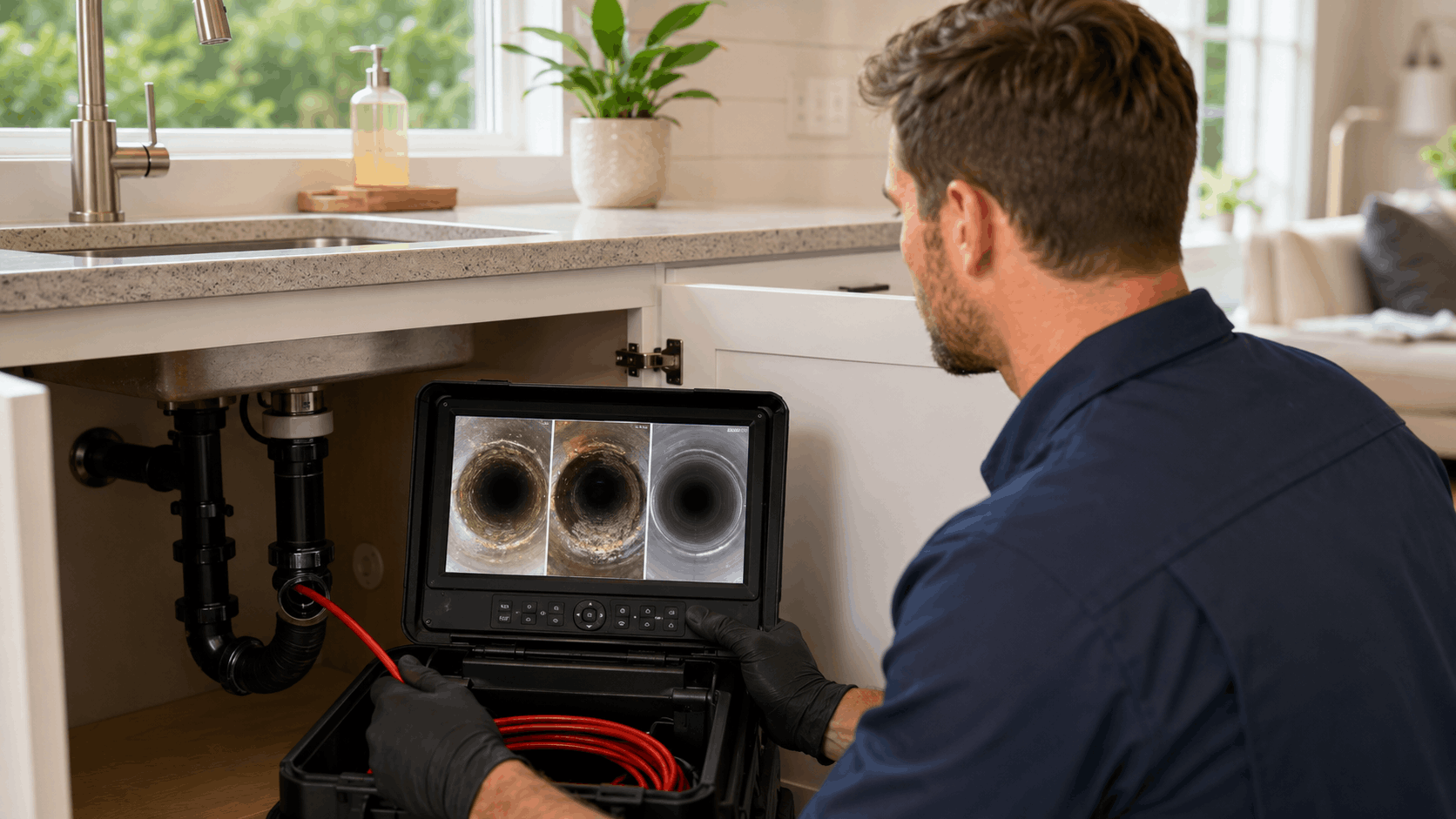
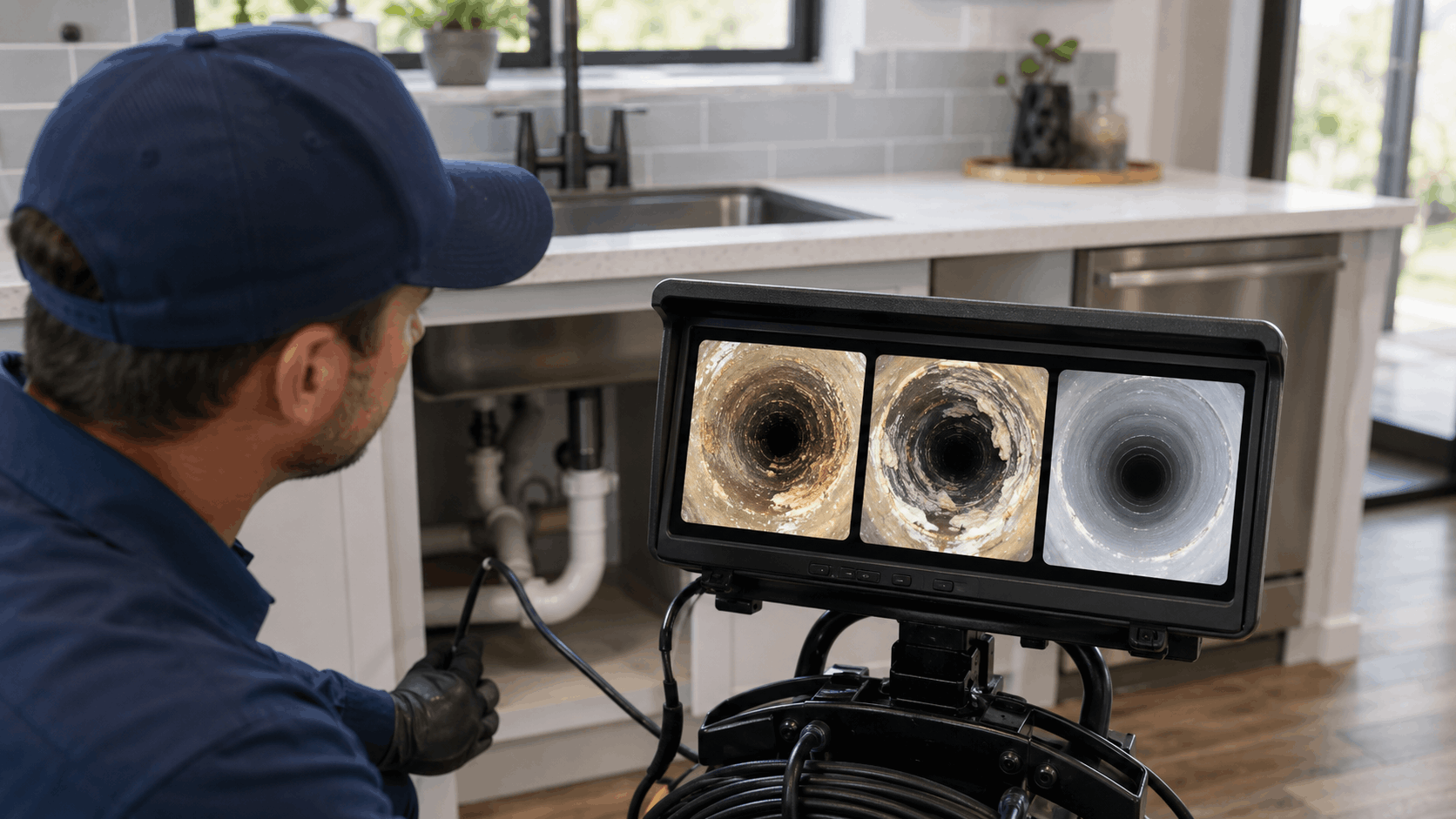
A drain camera inspection changes that. It puts a live picture of the pipe wall on a screen, so nobody has to guess. Our team relies on video before and after every serious cleaning job because it turns opinions into facts. When we do a sewer camera inspection, we can show you exactly what we found and exactly what changed after cleaning.
That honesty matters in Las Vegas plumbing, where hard water and older lines create problems you simply cannot spot from the top of the drain.
What a Sewer Camera Actually Records
The camera is a small waterproof head mounted on a flexible push cable. We feed it into a cleanout or drain opening and guide it down the line while watching the video feed on a monitor. A locator on the head even tells us how deep the camera is and where it sits under the yard or slab.
As it travels, the sewer camera picks up things a plunger never will. We see grease rings coating the top of a kitchen line, white mineral scale narrowing the pipe, and roots pushing through joints like fingers. The video pipe footage also shows cracks, low spots that hold water, and offsets where two pipe sections no longer line up.
All of that gets recorded so you can watch it too. There is no mystery and no upsell based on a hunch. The pipe shows us its condition, and we plan the cleaning around what is actually there instead of what we assume.
That recording also becomes a baseline. If the same drain acts up in a year, we compare the new footage to the old and know right away whether it is fresh buildup or something structural.
Why Guessing at Clogs Costs Homeowners More
When people cannot see the pipe, they treat the symptom over and over. A slow drain gets a bottle of cleaner, drains for a week, then slows again. Another bottle goes down, and the cycle repeats until something bigger fails.
That pattern is expensive. Each bottle costs money, and the recurring clog never actually clears at the wall. In older neighborhoods like John S. Park or the streets near downtown, that repeat treatment can quietly damage aging pipe while the real blockage sits untouched.
A proper drain diagnosis breaks the loop. We look, we identify the true cause, and we clean it once instead of masking it five times. Homeowners who skip the guesswork almost always spend less over a year than those who keep buying product after product.
We have walked into homes where a family spent well over a hundred dollars on cleaners for a clog that a single professional visit fixed in under an hour. Seeing the pipe first is what saves that money.
Common Buildup We See in Las Vegas Pipes
Valley water is hard, and the camera proves it every day. The most common thing we record is hard water buildup, a chalky mineral scale that lines the inside of the pipe and slowly shrinks the opening. It shows up as rough white or tan crust along the pipe wall.
In kitchen lines, we see grease clog rings on top of the scale. Warm grease goes down as a liquid, cools, and hardens against the pipe. Add soap and food particles, and the ring thickens fast, especially in homes that cook often.
Mineral scale is the tricky part because it is hard as rock and grows in every home fed by the local supply. Softer buildup like grease responds to some treatments, but the scale needs mechanical force. That difference is the whole reason the three cleaning methods produce such different footage, which is exactly what we compare next.
Get Your Quote
Tell us what's going on and we'll get back to you fast.
Enzyme Treatments: What the Camera Shows Before and After
Enzyme and bacterial cleaners are the gentle option on the shelf. They do not fizz or heat up. Instead, they seed the pipe with helpful bacteria that eat organic gunk over several days. Many customers in maintenance-minded communities pour them in monthly and hope for the best.
The camera gives us a fair look at whether they earn their spot. The short version is that an enzyme drain cleaner does real work on the right kind of buildup and nearly nothing on the wrong kind. Setting honest expectations keeps people from trusting a bacterial drain treatment to handle a job it was never built for.
| Buildup Type | Enzyme Result on Camera | Timeframe |
|---|---|---|
| Soft grease and soap scum | Noticeable thinning of the ring | 5 to 10 days |
| Food particle sludge | Broken down and flushed | 3 to 7 days |
| Hard water mineral scale | No visible change | Any |
| Tree root intrusion | No effect | Any |
| Heavy full blockage | No effect | Any |
How Enzyme Cleaners Break Down Waste
Enzyme products work through biology, not chemistry. The bottle contains bacteria and the enzymes they produce, and those enzymes digest organic matter into smaller pieces the bacteria can consume. The organic breakdown targets things like food residue, hair binding agents, soap, and fats.
The process is slow on purpose. Enzyme action needs time and a warm, moist pipe to keep the colony alive and working. That is why the label tells you to pour it in at night when no water runs, giving the bacteria hours to feed without getting flushed away.
Because it is biological, it keeps working between treatments if you stay consistent. A colony that establishes in the line will keep nibbling at fresh buildup as it forms. That steady maintenance is where enzymes genuinely shine, and the camera backs that up on well-maintained kitchen drains.
The tradeoff is patience. You will not see a dramatic overnight change, and a fully clogged pipe does not give the bacteria enough contact or flow to do anything meaningful.
Camera Results on Grease and Soap Buildup
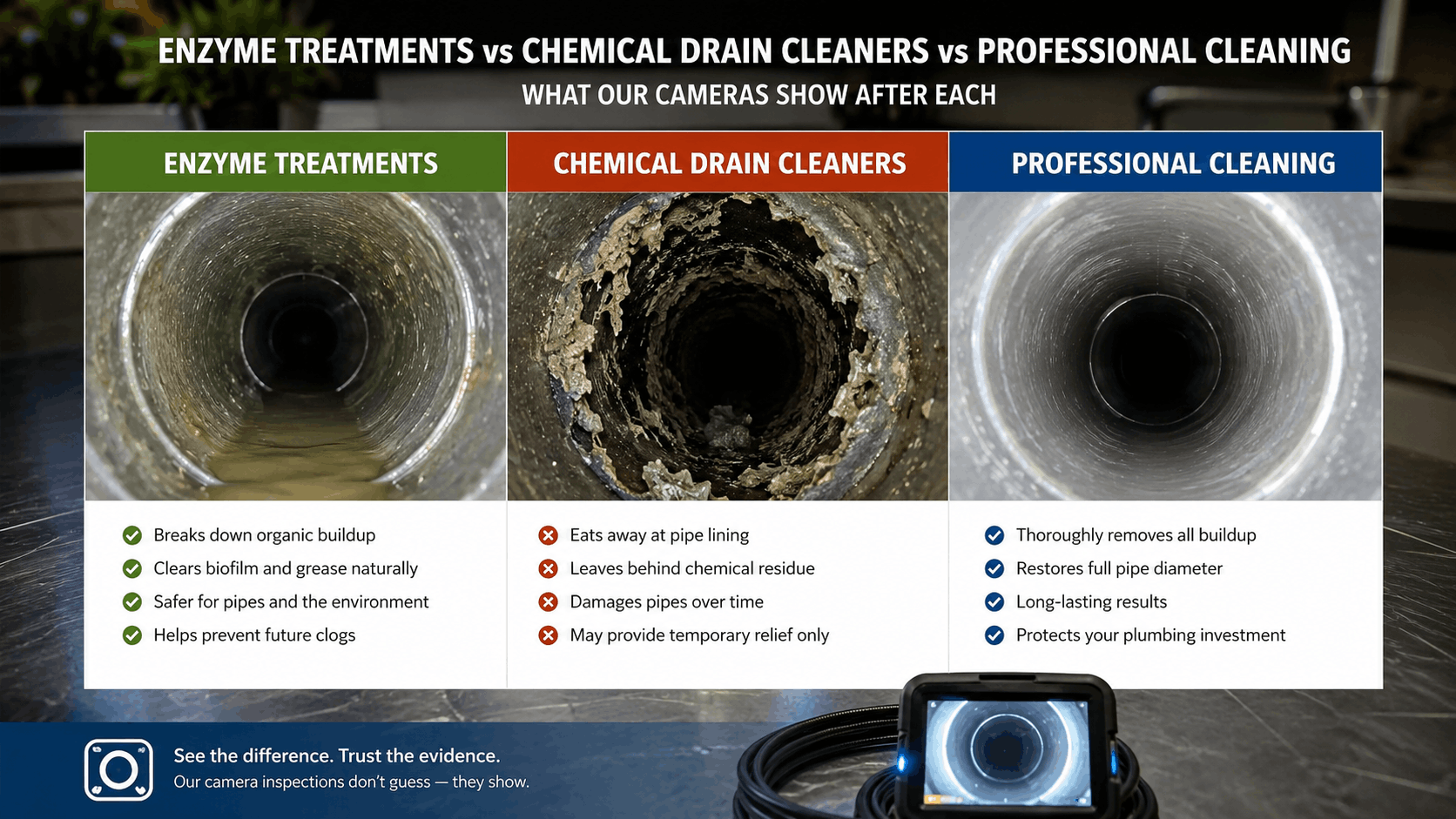
When we scope a kitchen line after about a week of consistent enzyme use, the grease clog footage looks noticeably cleaner than a fresh clog. The thick, glossy ring turns dull and thinner, and loose bits of soap scum have washed downstream. The pipe opening looks a bit wider.
Compare that to a fresh grease clog on camera and the difference is clear. A new clog shows a solid, shiny mass narrowing the pipe, sometimes leaving only a pencil-width channel for water. Enzymes cannot chew through that fast enough to save you from a backed-up sink today.
So the honest read is this. Enzymes maintain and slow the buildup, but they do not rescue an already-clogged line. On a drain that was cleaned recently and gets monthly treatment, the footage stays impressively clear over time.
We often recommend enzymes as a follow-up habit after a professional cleaning, not as an emergency fix when the water is already standing in the sink.
Where Enzymes Fall Short
The enzyme limitations show up the moment the problem is not organic. Hard water scale is mineral, not living matter, so the bacteria have nothing to eat. On camera, a scaled pipe looks identical before and after weeks of enzyme treatment.
Roots are the same story. A bacterial treatment will not touch a root ball that has pushed into a clay or cast iron joint. Those roots are common in older Henderson-adjacent yards and near mature trees, and they need cutting, not digesting.
Heavy blockages also defeat enzymes because the product cannot reach the whole clog or sit long enough. If a line is fully packed with debris, the treatment mostly pools on top and drains away. The colony never gets the contact it needs.
Knowing these limits saves frustration. When we see scale or roots on the camera, we tell people plainly that no bottle will fix it, and we point them toward mechanical cleaning instead.
Best Uses for Enzyme Products in Local Homes
Enzymes fit best as drain maintenance in homes with light, recurring organic buildup. Households near Centennial Hills and other family-heavy areas that cook a lot benefit from a monthly treatment that keeps grease from settling in.
They also work well as preventive treatment for bathroom drains that collect hair and soap. Used regularly, they slow the slow-down and stretch the time between deeper cleanings. That is a smart, low-cost habit for a well-behaved drain.
We suggest pairing enzymes with good habits: scraping plates into the trash, running hot water after dishes, and catching hair with a strainer. The camera consistently shows the cleanest lines belong to homes that combine these habits with occasional professional attention.
Think of enzymes as toothbrushing for your pipes. Great for upkeep, useless for a cavity that already needs a dentist.
Need Help in Las Vegas?
Active Plumbing serves Las Vegas and all of Las Vegas Valley.
Chemical Drain Cleaners: What the Camera Reveals After Use
The chemical drain cleaner is the aggressive bottle under most sinks. It promises to melt a clog in minutes, and sometimes it opens a small path. What the label rarely mentions is what the leftover chemical does to your pipe once the clog is gone.
Our camera has documented the aftermath many times. A caustic drain cleaner can bore a channel while leaving the bulk of the blockage behind, and repeat use quietly eats at older pipe. Here is what we consistently see and why we urge caution.
- Partial channels bored through clogs while most debris remains
- Chemical residue coating the pipe wall after the reaction
- Corrosion and pitting inside older metal lines
- Warped or softened plastic at joints from repeated heat
- Standing chemical trapped in low spots and traps
How Acidic and Caustic Cleaners React in Pipes
Most store cleaners fall into two camps. A caustic cleaner uses lye or similar bases, while an acidic cleaner uses strong acids like sulfuric acid. Both create a chemical reaction that generates heat as they contact the clog.
That heat is the point. It helps melt grease and dissolve some organic matter. On a soft, fresh grease clog, the reaction can open a channel and get water moving again for a while.
The trouble is that the reaction does not stop at the clog. The chemical keeps reacting with whatever it touches, including your pipe wall and the rubber gaskets at joints. In a partially clogged line, the product sits against one spot for a long time, concentrating all that heat and corrosion in one place.
The more stubborn the clog, the longer the chemical sits, and the more the pipe absorbs the damage while the blockage barely moves.
Camera Evidence of Partial Clearing and Residue
When we scope a line treated with chemicals, the footage usually shows a partial clog rather than a clean pipe. The chemical carves a narrow channel straight through the center of the blockage, water starts flowing, and the homeowner assumes the problem is solved. The camera says otherwise.
Around that little channel, most of the original clog is still there, coating the pipe wall. Fresh grease and debris grab onto that remaining mass quickly, so the drain slows again within days or weeks. That is the classic reason a chemically treated drain keeps clogging in the same spot.
We also see residue buildup, a slick or crusty film the chemical leaves behind as it dries. That film can actually trap new debris faster than a clean pipe would. So the quick win often sets up the next clog.
On video, a chemically treated line and a truly clean line look nothing alike, and that gap is what convinces most homeowners to change their approach.
Pipe Damage We Have Documented
Repeat chemical use leaves marks the camera captures clearly. In older metal lines we find pipe corrosion, rough pitted surfaces where the chemical has eaten into the wall. That pitting gives future buildup even more to cling to and weakens the pipe overall.
In plastic ABS drains, we have recorded chemical damage as warped, softened, or discolored sections, usually near joints where product pooled. Softened joints can start weeping, and a small leak inside a wall or slab is a far bigger repair than the original clog.
The worst cases involve homeowners who used chemicals repeatedly over months. By the time we scope the line, the damage is baked in and the only real fix is replacing a section. A sewer line repair or replacement costs far more than the cleanings would have.
We are not against every product on the shelf, but the footage makes it hard to recommend repeat chemical use on any pipe you want to keep.
Safety Risks for Older Plumbing Near Downtown Las Vegas
Homes near the Historic Westside and older downtown pockets often run on cast iron pipe that has been in the ground for decades. That metal is already thinning from age and hard water, so harsh chemicals speed up a failure that was coming anyway.
Chemical safety is also a personal issue. These products can splash back, release fumes, and burn skin and eyes, especially if they mix with a previous cleaner already in the line. Combining two different products can create dangerous gas in a closed drain.
If your home sits in one of the valley's older neighborhoods, the odds that a chemical will damage the pipe go way up. The EPA and other agencies warn about the hazards of strong household chemicals for good reason. We would rather scope the line and clean it mechanically than risk both your pipe and your safety.
When a drain in an aging home acts up, seeing it first is the safest move you can make.
Professional Drain Cleaning: What the Camera Shows After Our Team Finishes
Professional cleaning uses mechanical force instead of chemistry, and the camera shows the difference instantly. Where enzymes thin a ring and chemicals bore a channel, professional methods clean the entire pipe wall down to the original surface.
Our team chooses the right tool based on what the camera reveals. Sometimes that is high-pressure water, sometimes a cable machine with a cutting head. Either way, our drain and sewer services aim for a fully clear line, not a temporary opening.
Hydro Jetting and Full Pipe Wall Cleaning
Hydro jetting sends water through a specialized nozzle at very high pressure, often several thousand PSI. The nozzle sprays jets forward and backward, scouring grease, scale, and sludge off the entire inside of the pipe. It cleans the whole circle, not just the center where water was still trickling.
On camera, a jetted line looks close to new. The pipe wall shows bare material instead of crust, and the full diameter is open again. That is why the results last so much longer than any chemical channel.
High-pressure cleaning also flushes the debris out of the system entirely rather than leaving it to reform. For grease-heavy kitchen lines and restaurant drains, our hydro jetting and rooter service is the method that consistently produces the cleanest footage.
We match the pressure to the pipe. Older or fragile lines get a gentler setting, which is another reason we scope first before choosing the approach.
Cable Machines and Cutting Root Intrusion
A cable machine, often called a drain snake, feeds a rotating steel cable down the line. Different heads attach to the end, including cutting blades built to slice through root intrusion. The spinning action grabs and clears the blockage physically.
This is the go-to for mature tree roots, which are common in older Paradise and Spring Valley yards with big established trees. Roots find the tiny gaps at pipe joints and grow into a dense mat that no bottle can touch. The cutting head shears them back to the pipe wall.
Snaking is also effective on solid blockages and foreign objects lodged in the line. Kids' toys, wipes labeled flushable, and buildup chunks all come out with the right head. The camera confirms whether the cut was complete or whether the roots need a follow-up jetting.
For recurring root problems, we often cable to clear, then jet to clean the wall, and finally scope to plan the maintenance schedule.
Before and After Footage Comparison
The before and after footage is the most convincing part of any job. Before cleaning, the video shows a narrowed pipe crusted with scale, ringed with grease, or invaded by roots. It is easy to see why the water crawled.
After professional cleaning, the clean pipe footage shows a smooth, open wall with the full diameter restored. There is no residue film like a chemical leaves and no thick remaining ring like enzymes cannot remove. It simply looks like the pipe the builder installed.
Setting the two clips side by side ends the debate for most homeowners. They can see that the chemical channel was a bandage while the mechanical clean was the actual repair. That visual proof is why we record every job.
It also protects you. You get to verify the work was real instead of taking anyone's word that the line is clear.
How Long Professional Results Actually Last
In the valley's hard water conditions, a fully cleaned kitchen line commonly stays clear for one to two years before scale and grease build up enough to slow it. Main sewer lines cleaned of roots often run well for a similar stretch, though fast-growing roots may need annual attention.
Drain cleaning longevity depends on habits and pipe age. Homes that cook heavily or run on old cast iron will scale faster than newer PVC systems. Hard water speeds the buildup everywhere, which is why maintenance still matters after a great cleaning.
We usually suggest a scope every year or two to catch buildup early. Pairing that with enzyme upkeep and a home water softener stretches the clean interval even further. A water softener installation reduces the mineral load feeding your scale problem at the source.
Done right, one professional cleaning outlasts a dozen bottles, and the footage keeps everyone honest about when the next service is really due.
Side by Side: Comparing All Three Methods on Camera
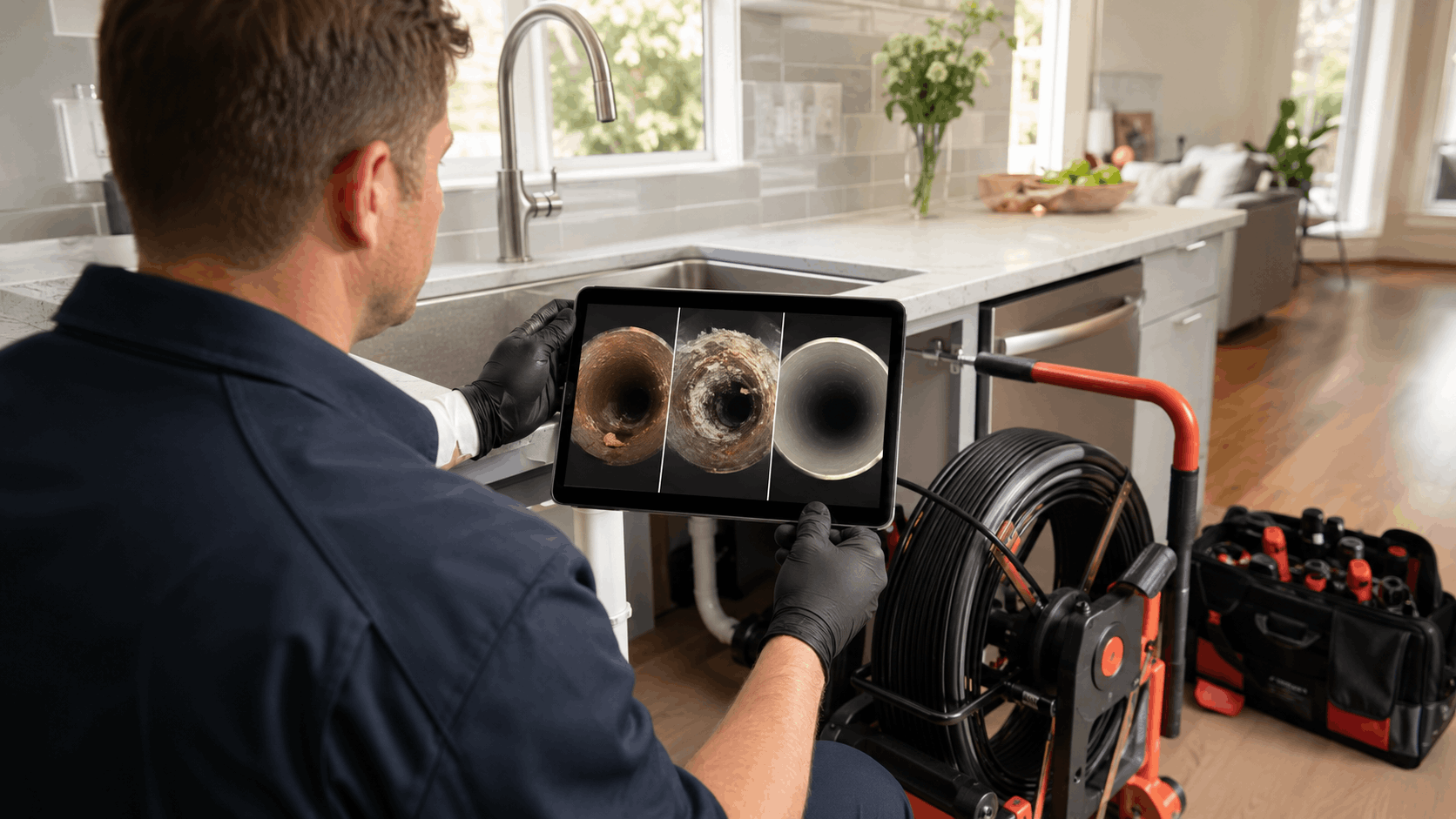
Put the three approaches next to each other and the footage tells a consistent story. Each method has a place, but they are not interchangeable. This drain cleaning comparison helps you match the clog removal method to the problem in your own home.
Clearing Power on Different Clog Types
Clog type decides everything. On light grease and soap, enzymes slowly help and chemicals open a fast channel, but professional jetting clears it all the way. On the camera, only the jetted line shows a fully bare wall.
On hard water scale, enzymes do nothing and chemicals mostly damage the pipe while barely denting the mineral crust. Mechanical cleaning is the one method with real clearing power against scale. The footage of a jetted, descaled line is dramatic compared to either DIY attempt.
Roots and foreign objects belong entirely to the cable machine. No liquid product removes a root ball or a lodged toy. When the camera finds those, we reach for the snake, not the shelf.
So the honest ranking depends on the clog. Enzymes for maintenance, professional tools for anything real, and chemicals for almost nothing we would recommend.
Effect on Pipe Health Over Time
Pipe health separates these methods sharply. Enzymes are gentle on every pipe material and never harm ABS, PVC, or cast iron. That safety is their strongest trait even if their power is limited.
Chemicals are the opposite. Repeated use corrodes cast iron, pits metal, and warps plastic, as our camera has documented across the valley. The damage is cumulative and permanent, which makes the cheap bottle expensive in the long run.
Professional cleaning, done with the right pressure and head, protects the pipe. We adjust the tool to the material, so a fragile old line gets gentler treatment than sturdy new PVC. The goal is a clean pipe that is also an intact pipe.
Over ten years, the drain treated only with enzymes and occasional professional cleaning almost always shows the best wall condition on camera.
Cost Versus Real Results
Drain cleaning cost looks different when you count the whole year. A bottle of enzyme or chemical cleaner is cheap, but repeat purchases add up, and chemicals can create a repair bill that dwarfs any cleaning fee. That is the hidden cost of the DIY loop.
One professional cleaning costs more upfront but clears the line completely and lasts a year or more. When you divide the price over that time, the value comparison usually favors the professional visit, especially once you factor in avoided pipe damage.
The most expensive path is repeated chemical use that corrodes a pipe into needing replacement. We have seen homeowners spend a small fortune on bottles and then thousands on a pipe repair that a single early cleaning would have prevented. Seeing the pipe first almost always saves money.
Cheap is not the same as inexpensive. The footage shows which dollars actually solved the problem.
Which Method Fits Which Situation
Here is the plain guide. For routine upkeep on a healthy drain, use enzymes monthly and keep good kitchen habits. That is the right drain solution for prevention.
For a drain that is already slow or clogged, skip the chemicals and get the line scoped and cleaned. If the camera shows grease or scale, jetting fits. If it shows roots or an object, a cable machine fits.
For older homes near downtown or any home on cast iron, avoid harsh chemicals entirely and lean on mechanical cleaning. The homeowner decision gets easy once you know what is actually in the pipe.
When you are unsure, a camera inspection answers the question before you spend a dime on the wrong fix.
Need Help in Las Vegas?
Active Plumbing serves Las Vegas and all of Las Vegas Valley.
Las Vegas Water and Home Conditions That Affect Your Drains
Local conditions shape which method works, and the valley has its own quirks. Between the water hardness and the mix of old and new housing, no single answer fits every street. Our team sees these Las Vegas water hardness effects and local plumbing conditions firsthand every week.
Why Hard Water Builds Scale So Fast Here
The supply from the Las Vegas Valley Water District carries a high mineral load, mostly calcium and magnesium drawn from the Colorado River and local sources. Those minerals drop out of the water and cling to pipe walls as hard water scale. It happens faster here than in most of the country.
That scale narrows drains and water lines alike, and it gives grease something rough to stick to. On camera, valley pipes show mineral crust that homes in soft-water regions rarely develop. It is the number one reason our drains slow down over time.
A water softener or conditioner slows this dramatically by removing or altering those minerals before they reach your pipes. The USGS water hardness data confirms just how hard the water is across the Southwest. Reducing hardness at the source is the single best long-term move for your drains.
Without softening, expect scale to keep returning no matter which cleaning method you use.
Older Homes and Aging Sewer Lines
Older areas like John S. Park and neighborhoods near downtown often run on cast iron sewer or even clay lines. Cast iron corrodes from the inside over decades, roughening the wall and catching debris. Clay joints crack and invite roots.
These aging pipes are the ones most easily damaged by chemicals and most in need of gentle mechanical care. On camera, we regularly find cast iron that looks like the inside of a rusty can, with buildup filling the pits. Cleaning helps, but some sections are simply worn out.
When the footage shows a failing line, we talk honestly about repair versus replacement. Patching a badly corroded pipe wastes money if the whole run is going. Seeing the full length on video guides that call.
For these homes, a yearly scope catches trouble before a backup or a collapse forces an emergency.
New Builds in Summerlin and Southern Highlands
Newer communities like Summerlin West and Southern Highlands run on modern PVC drain lines. PVC has smooth walls that resist buildup better than old metal, so these homes clog less often from scale alone. New construction plumbing gives us cleaner baseline footage.
That said, PVC still collects grease and still suffers from bad habits like flushing wipes. The smooth wall helps, but it is not clog-proof. Hard water scale still forms, just a bit slower than in rough cast iron.
The good news is that PVC responds beautifully to jetting and tolerates cabling well. Cleaning a newer line usually restores it to like-new condition on camera. These homes are the easiest to keep clear with light maintenance.
Even in a new build, we still recommend against harsh chemicals, since heat and residue can soften plastic joints over time.
Seasonal Issues During Monsoon and Summer Heat
Summer brings its own drain problems to the valley. Monsoon debris washes dirt, gravel, and yard waste toward outdoor drains and main sewer cleanouts. A hard August storm can push grit into lines that were flowing fine the week before.
Extreme summer heat also bakes grease harder in kitchen lines and can stress older outdoor pipe. When a sewer backup happens, it often follows a storm or a long hot stretch that pushed a marginal line over the edge. We field more main-line calls in monsoon season than any other time.
Keeping cleanouts clear and scoping the main before summer helps you avoid a storm-day emergency. If a backup does hit, fast action limits the mess and the damage. Our emergency plumbing team handles those urgent calls across the valley.
A little pre-season attention beats a flooded floor during the worst heat of the year.
When to Call Active Plumbing Instead of Reaching for a Bottle
Some clogs are a job for a plunger and a good habit. Others are a warning that something bigger is wrong down the line. Knowing when to call a plumber saves both money and stress, and it keeps a small problem from turning into a major drain repair in Las Vegas.
- More than one drain running slow at the same time
- A toilet that gurgles when you run the sink or tub
- Sewer smell coming from drains or the yard
- Water backing up into a tub or shower when you flush
- The same drain clogging again within weeks of clearing it
Warning Signs a Clog Is Bigger Than You Think
A single slow sink is usually a local clog. But when several fixtures slow down together, that often points to a main line clog deeper in the system. The blockage is downstream where all the branches meet.
Gurgling toilets are another red flag. If flushing one fixture makes another bubble or drain oddly, air is getting trapped by a blockage in the main. That is not a bottle-of-cleaner situation.
A sewer smell inside the home or over the yard suggests the line is partly blocked or damaged. Waste is sitting where it should be moving. When you notice these signs, stop pouring product and get the line scoped before a full backup hits.
Acting on early warnings almost always means a cheaper, cleaner fix than waiting for sewage on the floor.
What Happens During a Professional Inspection
When our team arrives, the drain inspection process starts with questions about what you have noticed and tried. Then we locate a cleanout and feed the camera into the line to see the real condition. You watch the same screen we do.
The camera diagnosis shows us the type and location of the blockage, whether it is grease, scale, roots, or a break. We can pinpoint how far down the problem sits, which tells us the right tool and the true scope of the job. No guessing and no vague estimates.
From there we recommend the cleaning method that fits, clean the line, and scope again to confirm the result. You see the before and after for yourself. If the footage reveals a damaged pipe, we lay out the repair options plainly.
The whole point is that you make decisions with real information instead of a sales pitch.
How the Team Serves Neighborhoods Across the Valley
As a local Las Vegas plumber, our team covers the whole valley, from Henderson to North Las Vegas and everywhere between. We know the older lines downtown, the root-prone yards in Paradise and Spring Valley, and the newer PVC systems out in the growing communities.
We route along the 215 and the 95 to reach jobs quickly, which matters when a drain backs up on a hot afternoon. Our local service area includes Summerlin, Enterprise, Whitney, Sunrise Manor, and the neighborhoods in between. Chances are we have scoped a pipe on a street near yours.
Knowing each area's typical pipe material and water conditions lets us plan the right approach before we even pull the camera out. That local knowledge speeds up every call. It is the difference between a plumber who guesses and one who already knows what the footage will likely show.
Wherever you are in the valley, we are close enough to help fast.
Need Help in Las Vegas?
Active Plumbing serves Las Vegas and all of Las Vegas Valley.
Final Thoughts
The camera settles the old kitchen-drain argument for good. Enzymes maintain a healthy line, chemicals bore a risky channel while damaging your pipe, and professional cleaning restores the full pipe wall. The footage shows those differences every single time.
For a Las Vegas home dealing with hard water, older lines, or stubborn roots, the smartest move is to see the pipe before you spend on the wrong fix. If your drain is slow, gurgling, or clogging again and again, let our team scope it, clean it right, and show you the proof. Reach out to Active Plumbing today to schedule a camera inspection and get your drains flowing clean.
Frequently Asked Questions
Do enzyme drain cleaners actually work?
Enzyme drain cleaners work for light organic buildup and ongoing maintenance. The bacteria digest grease, soap scum, and food residue over several days, which slows the return of clogs. Our camera confirms they thin a soft grease ring nicely on a well-kept line. What they cannot do is clear a heavy clog, hard water scale, or tree roots. Use them for upkeep, not emergencies.
Are chemical drain cleaners safe for my pipes?
Often no, especially with repeat use. Our camera has recorded corrosion and pitting in cast iron, plus warped and softened joints in plastic ABS lines after chemical use. These products generate heat and keep reacting against the pipe wall, not just the clog. In older downtown homes with aging metal lines, the risk is even higher. The damage is permanent, so we rarely recommend them.
What does a drain camera inspection cost in Las Vegas?
A standalone drain camera inspection in the valley typically runs somewhere in the low hundreds, depending on line access and length. Many companies, including ours, often waive or credit the fee when you book a cleaning service based on what the camera finds. That makes seeing the pipe an easy call. Contact us for current pricing and to ask about the inspection fee on your job.
How often should I clean my drains?
In our hard water conditions, a professional cleaning every one to two years keeps most home drains clear. Kitchen lines in heavy-cooking households and older cast iron systems may need attention yearly. Pair that with monthly enzyme maintenance and simple habits like strainers and hot-water flushing. Homes with a water softener can stretch the interval, since less mineral scale forms in the first place.
Is hydro jetting better than snaking a drain?
They solve different problems. Hydro jetting scours the entire pipe wall clean of grease and scale, so it lasts longer and works best for buildup. Snaking with a cable machine cuts through roots and breaks up solid blockages or foreign objects. For root intrusion, we cable first, then often jet to clean the wall. The camera tells us which method your line actually needs.
Can I use enzymes after a professional cleaning?
Yes, and we recommend it. After a full cleaning restores the bare pipe wall, monthly enzyme treatment keeps fresh grease and organic buildup from settling back in. The bacteria establish a colony in the clean line and keep working between visits. It is a low-cost habit that stretches your professional results and keeps the footage clear longer, especially on kitchen and bathroom drains.
Why does my drain keep clogging in the same spot?
Repeat clogs in one spot usually point to something the camera can pinpoint. Common causes are a buildup ring where grease and scale keep collecting, a bellied pipe that sags and holds water and debris, or root intrusion at a joint. Chemical cleaners make this worse by leaving residue that catches new debris. A scope shows the real cause so we can fix it once.
Will chemical cleaners hurt my septic or city sewer connection?
They can. Chemical cleaners kill the helpful bacteria that break down waste, which upsets the balance in a septic system and adds harsh chemicals to the city sewer. That bacterial disruption reduces how well waste breaks down downstream. Enzyme products are the gentler choice because they add helpful bacteria instead of destroying them. For any home, mechanical cleaning avoids the chemical load entirely.
How long does professional drain cleaning last in hard water areas?
In the valley's hard water, a professionally cleaned line usually stays clear for one to two years. Fast-scaling kitchen lines and old cast iron may need service sooner, while smooth PVC in newer homes goes longer. Heavy cooking, mature trees near the line, and skipping maintenance all speed up buildup. Adding a water softener and enzyme upkeep stretches the clean interval noticeably.
Does Active Plumbing serve my neighborhood?
Very likely yes. Our team serves the entire valley, including Summerlin, Henderson, North Las Vegas, Enterprise, Spring Valley, Paradise, Whitney, Sunrise Manor, and Winchester. We route along the 215 and 95 for quick response, whether you are in a new build or an older downtown home. Reach out with your address and we will confirm coverage and schedule your inspection.
Frequently Asked Questions
- Do enzyme drain cleaners actually work?
- Enzyme drain cleaners work for light organic buildup and ongoing maintenance. The bacteria digest grease, soap scum, and food residue over several days, which slows the return of clogs. Our camera confirms they thin a soft grease ring nicely on a well-kept line. What they cannot do is clear a heavy clog, hard water scale, or tree roots. Use them for upkeep, not emergencies.
- Are chemical drain cleaners safe for my pipes?
- Often no, especially with repeat use. Our camera has recorded corrosion and pitting in cast iron, plus warped and softened joints in plastic ABS lines after chemical use. These products generate heat and keep reacting against the pipe wall, not just the clog. In older downtown homes with aging metal lines, the risk is even higher. The damage is permanent, so we rarely recommend them.
- What does a drain camera inspection cost in Las Vegas?
- A standalone drain camera inspection in the valley typically runs somewhere in the low hundreds, depending on line access and length. Many companies, including ours, often waive or credit the fee when you book a cleaning service based on what the camera finds. That makes seeing the pipe an easy call. Contact us for current pricing and to ask about the inspection fee on your job.
- How often should I clean my drains?
- In our hard water conditions, a professional cleaning every one to two years keeps most home drains clear. Kitchen lines in heavy-cooking households and older cast iron systems may need attention yearly. Pair that with monthly enzyme maintenance and simple habits like strainers and hot-water flushing. Homes with a water softener can stretch the interval, since less mineral scale forms in the first place.
- Is hydro jetting better than snaking a drain?
- They solve different problems. Hydro jetting scours the entire pipe wall clean of grease and scale, so it lasts longer and works best for buildup. Snaking with a cable machine cuts through roots and breaks up solid blockages or foreign objects. For root intrusion, we cable first, then often jet to clean the wall. The camera tells us which method your line actually needs.
- Can I use enzymes after a professional cleaning?
- Yes, and we recommend it. After a full cleaning restores the bare pipe wall, monthly enzyme treatment keeps fresh grease and organic buildup from settling back in. The bacteria establish a colony in the clean line and keep working between visits. It is a low-cost habit that stretches your professional results and keeps the footage clear longer, especially on kitchen and bathroom drains.
- Why does my drain keep clogging in the same spot?
- Repeat clogs in one spot usually point to something the camera can pinpoint. Common causes are a buildup ring where grease and scale keep collecting, a bellied pipe that sags and holds water and debris, or root intrusion at a joint. Chemical cleaners make this worse by leaving residue that catches new debris. A scope shows the real cause so we can fix it once.
- Will chemical cleaners hurt my septic or city sewer connection?
- They can. Chemical cleaners kill the helpful bacteria that break down waste, which upsets the balance in a septic system and adds harsh chemicals to the city sewer. That bacterial disruption reduces how well waste breaks down downstream. Enzyme products are the gentler choice because they add helpful bacteria instead of destroying them. For any home, mechanical cleaning avoids the chemical load entirely.
- How long does professional drain cleaning last in hard water areas?
- In the valley's hard water, a professionally cleaned line usually stays clear for one to two years. Fast-scaling kitchen lines and old cast iron may need service sooner, while smooth PVC in newer homes goes longer. Heavy cooking, mature trees near the line, and skipping maintenance all speed up buildup. Adding a water softener and enzyme upkeep stretches the clean interval noticeably.
- Does Active Plumbing serve my neighborhood?
- Very likely yes. Our team serves the entire valley, including Summerlin, Henderson, North Las Vegas, Enterprise, Spring Valley, Paradise, Whitney, Sunrise Manor, and Winchester. We route along the 215 and 95 for quick response, whether you are in a new build or an older downtown home. Reach out with your address and we will confirm coverage and schedule your inspection.
A
Licensed plumbing professionals serving Las Vegas and Las Vegas Valley.
Licensed in Nevada · License #0047021
Last updated on
Why trust Active Plumbing?
Founded in 1991, Active Plumbing is a licensed and insured plumber serving Las Vegas and Las Vegas Valley. All content is reviewed by our licensed technicians.

Need Help in Las Vegas?
Active Plumbing serves Las Vegas and all of Las Vegas Valley.
Related Articles
How-To Guides
Best Drain Cleaning Method for Las Vegas Hard Water Buildup
Las Vegas hard water ranks among the harshest in the US. Learn which drain cleaning methods actually work on mineral scale - and when to call a professional.
Tips & Advice
Drain Cleaning in Downtown Las Vegas and John S. Park: Original Cast Iron and Clay Laterals
A local guide to drain cleaning in Downtown Las Vegas and John S. Park, covering original cast iron and clay laterals, warning signs, cleaning methods, and repair options.
Tips & Advice
Floor Drains in Las Vegas Garages and Laundry Rooms: Dry P-Traps and That Sewer Smell
That sewer smell in a Las Vegas garage or laundry room usually means a dry P-trap. Learn why it happens in the desert, how to fix it, and when to call a plumber.