Heat Pump Water Heaters in Las Vegas Garages: Do They Make Sense at 115° Ambient?
Key Takeaways
- A hot Las Vegas garage actually helps a heat pump water heater run more efficiently because warm intake air raises its coefficient of performance.
- Most units operate within a range up to 120 to 145 degrees, so a 115 degree garage sits within spec, though sustained extreme heat can add compressor wear.
- Garage conditions vary across the valley, with older uninsulated homes near Downtown running hotter than newer insulated builds in Summerlin and Mountain's Edge.
- NV Energy rebates, when available, can narrow the cost gap with a mid range gas install; the federal tax credit ended for units installed after 2025.
- Typical households save $300 to $450 a year versus standard electric, giving a payback period of roughly two to four years.
- Install needs include a 240 volt circuit, adequate air volume, condensate drainage, and a required Clark County permit.
- A gas tankless or standard tank is a better fit for tiny closets, very high hot water demand, or spots next to bedrooms.
- Regular filter cleaning, anode rod checks, and annual flushing help these units last 10 to 15 years in hard valley water.
In This Article
A Summerlin homeowner called our team last July after her garage thermometer read 115 degrees by two in the afternoon. Her old electric water heater sat against the west wall, sweating in that heat, and she wanted to know if one of those newer heat pump models would survive out there. It is one of the more common questions we hear once summer hits the valley.
The short answer surprised her, and it might surprise you too. A hot garage is not the enemy some people assume it is. In fact, warm air is part of what makes these units run cheaply.
How a Heat Pump Water Heater Actually Works?
Most people picture a water heater as a tank with a flame or a big electric coil at the bottom. A heat pump water heater flips that idea on its head. It does not make much heat at all. It moves heat.
That single difference is why garage temperature matters so much. A hybrid water heater pulls warmth out of the air around it and pushes that warmth into the water. The warmer the surrounding air, the easier that job becomes.
Pulling Heat From the Air Instead of Making It
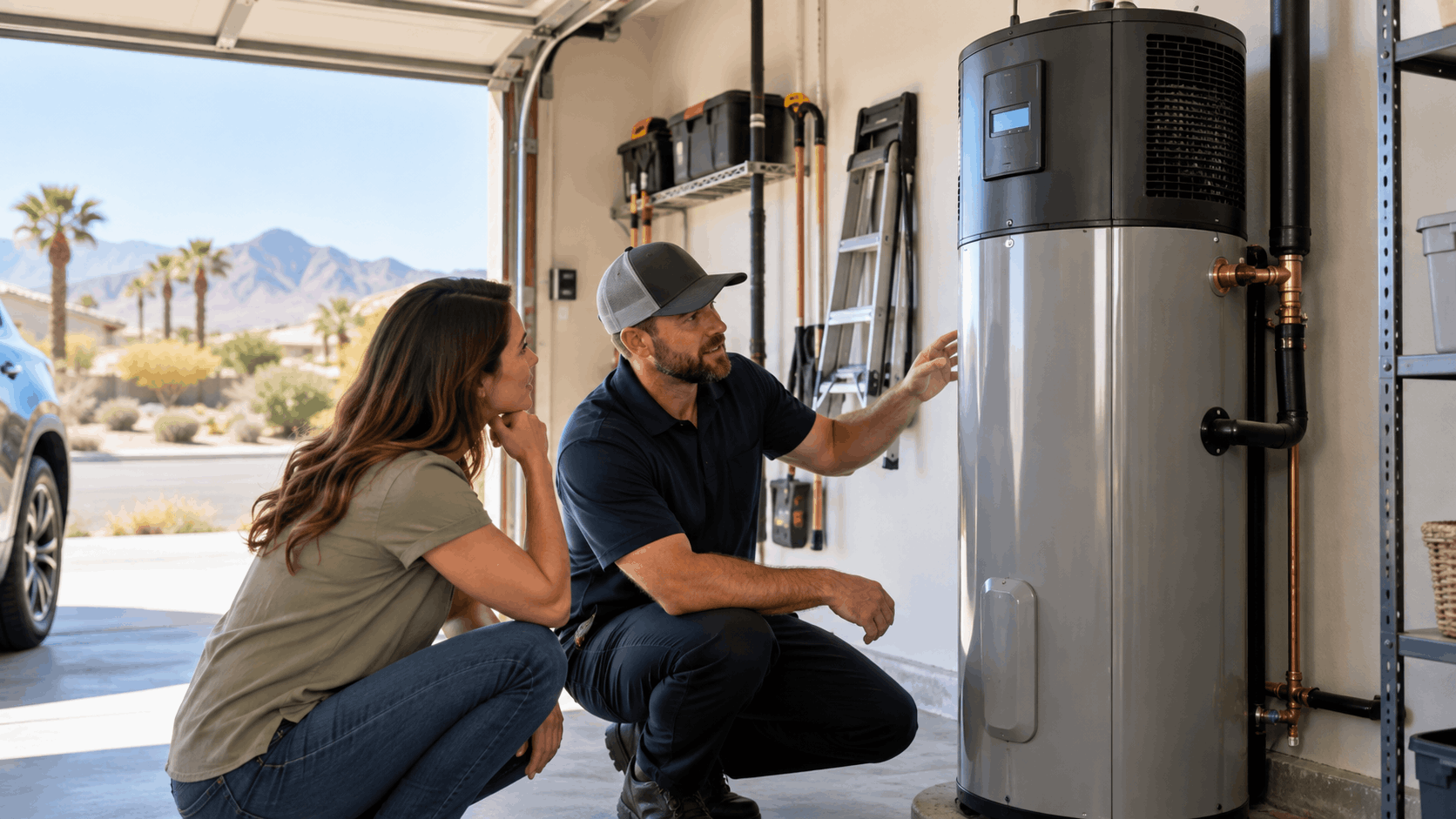
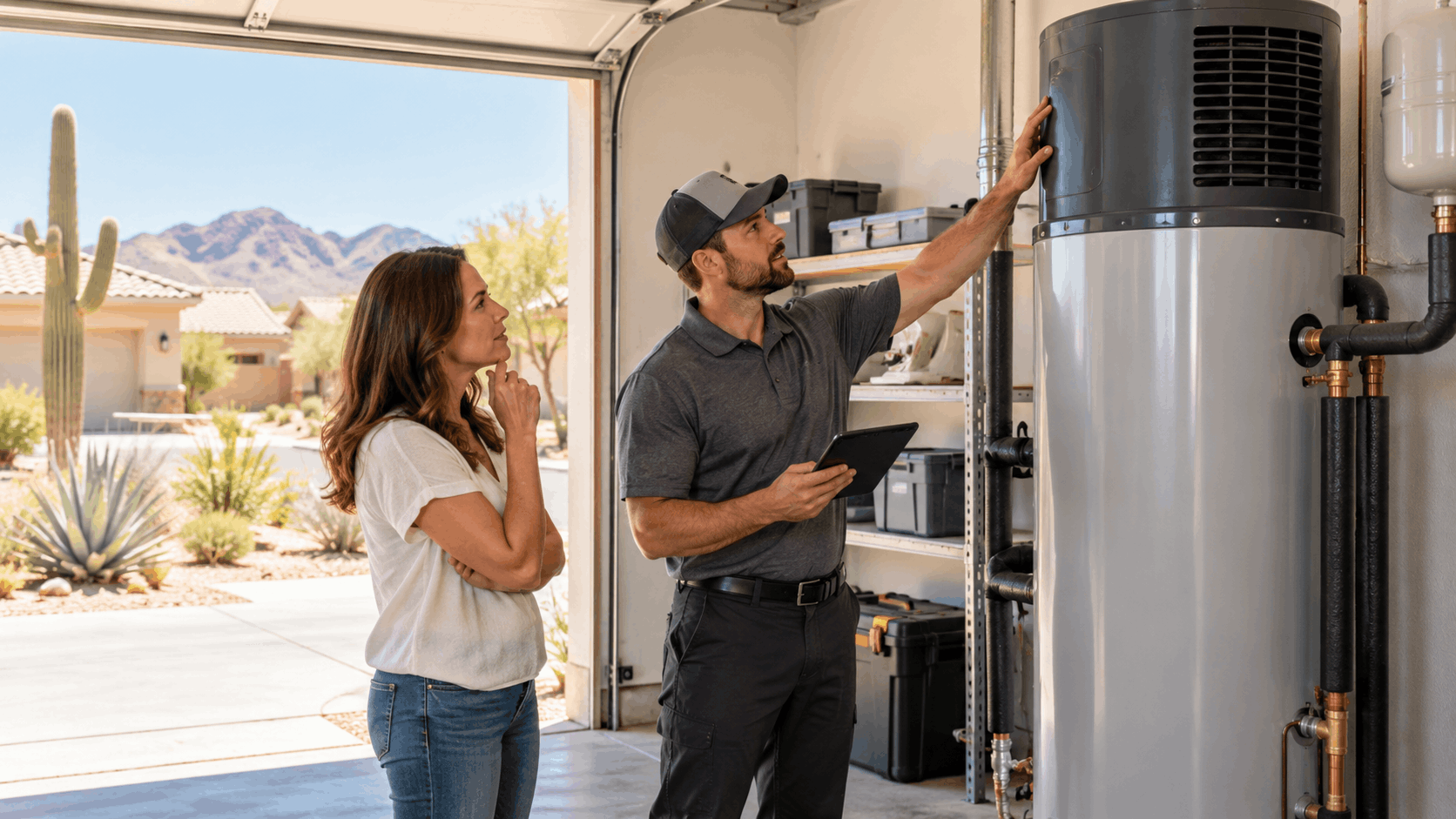
The unit sits on top of a normal storage tank and looks a bit like a water heater wearing a small backpack. Inside that top section is a compressor, a fan, and a set of coils. The fan pulls in ambient air from the garage and runs it across cold refrigerant coils.
The refrigerant absorbs the heat from that air, then the compressor squeezes it to raise the temperature even higher. That hot refrigerant travels through a coil wrapped around the tank, and the heat transfer warms the water inside. It is the same basic process your refrigerator or air conditioner uses, just running in reverse.
Because it moves existing heat rather than burning gas or firing large elements, it uses a fraction of the energy. A standard electric water heater might use around 4,500 watts to make heat directly. A heat pump does similar work while drawing far less power, which is why the electric bill drops.
The catch is simple. If there is no warm air to pull from, the unit has less to work with. That is exactly why a Las Vegas garage, hot as it gets, is often a good home for one.
Hybrid Mode vs. Full Heat Pump Mode
These units are called hybrids for a reason. They come with backup electric elements, and a control board decides which parts run based on the mode you pick. Understanding the modes helps you balance cost against speed.
In full heat pump mode, only the compressor and fan run. This is the cheapest way to heat water, but it is slower. If a family drains the tank with back to back showers, it can take a while to recover.
Hybrid mode is the middle ground most homeowners choose. It runs the heat pump for everyday use and calls on the electric backup only when demand spikes or the water gets cold fast. There is also a high demand or electric only setting for holidays and house guests, though running the electric backup often erases most of the savings.
For a typical Las Vegas home, we usually set the unit in hybrid mode and let it lean on the heat pump the vast majority of the time. That keeps operating costs low while still giving the family a cushion for heavy use.
Why Warm Air Is Fuel for These Units
Here is the part that trips people up. A heat pump loves warm intake air. The more heat there is floating around the garage, the more efficient the unit becomes.
Think of the surrounding air as fuel. A garage sitting at 50 degrees gives the unit thin pickings, so the compressor works harder for every gallon. A garage sitting at 90 or 100 degrees hands the unit a buffet of free heat, so intake air temperature that would feel miserable to you is a gift to the machine.
This is why the same model that struggles in a cold Midwest basement thrives in a Nevada garage. The efficiency climbs as the air warms, and our long hot season means the unit spends most of the year in its happy zone.
So the counterintuitive truth is that a hot garage does not fight a heat pump water heater. For most of the year, it feeds it.
Get Your Quote
Tell us what's going on and we'll get back to you. We're open 24/7.
What 115° Garage Heat Does to Performance
Now to the real question. Does 115 degree garage heat help or hurt one of these units? The honest answer is that it does a bit of both, depending on how long that heat sticks around.
Understanding the extreme heat performance of these units means looking at efficiency gains, manufacturer limits, and long term compressor wear all at once. Let us break each one down.
Hot Air Boosts Efficiency, Up to a Point
Efficiency for these units is measured by something called the coefficient of performance, or COP. It compares how much heat energy the unit delivers versus the electricity it consumes. A COP of 3 means you get three units of heat for every one unit of power.
As intake air warms, the COP rises. A unit rated around COP 3.5 in mild conditions can push higher when the air is hot, which is why summer savings in Las Vegas are so strong. The unit is basically harvesting the excess heat baking your garage and turning it into cheap hot water.
During June through September, this effect is at its peak. Homeowners near Mountain's Edge and the southwest often see their smallest water heating bills in the very months their garage is roasting. The desert heat that drives up the air conditioning bill quietly lowers the water heating side.
The phrase up to a point matters, though. There is a ceiling where more heat stops helping and starts stressing the equipment, and that brings us to the manufacturer limits.
The Upper Temperature Limits Manufacturers Set
Every heat pump water heater has an operating temperature range printed in the manual. Common brands list a range somewhere between roughly 37 and 145 degrees Fahrenheit for the heat pump function. A few cap the top end closer to 120 degrees.
A 115 degree garage sits inside most of those ranges, but it does not leave much headroom. During a brutal July heat wave, a poorly ventilated west facing garage can climb past the outdoor reading and brush the upper limit of the manufacturer specs. When that happens, the unit does not break, but it may throttle back or lean more on the electric backup.
The exact operating temperature range varies by model, so we always check the spec sheet before recommending a unit for a specific garage. A model with a higher ceiling is the safer pick for a hot, sun exposed garage along the 215 corridor.
This is one reason a professional assessment beats a guess. Matching the right unit to the actual conditions of your garage keeps the heat pump in its comfort zone even in peak summer.
Heat, Compressor Wear, and Warranty Concerns
The compressor is the heart of the unit, and heat is the thing that ages compressors fastest. Sustained triple digit intake air makes the compressor work in a hotter environment than it would in a mild climate, and over years that can add wear.
This does not mean the unit will fail early. It means placement and ventilation matter more here than in cooler regions. A garage that stays around 90 to 100 degrees is close to ideal, while one that regularly bakes past 115 for hours puts more strain on the parts.
Warranty coverage ties directly into this. Running a unit outside its rated operating range can give a manufacturer grounds to deny a compressor claim. Most quality units carry a 6 to 10 year warranty on the tank and sealed system, and keeping the garage within spec protects that coverage.
Our team factors this in during every install. When a garage runs very hot, we look at added ventilation or a model with a higher temperature ceiling so the warranty stays intact and the compressor lives a full life. If you ever need service, our water heater repair crew works on these units across the valley.
The Side Benefit: A Cooler Garage
Here is a bonus most homeowners do not expect. A heat pump water heater exhausts cool, dry air as a byproduct of pulling heat out of the room. It is essentially acting like a small air conditioner for your garage.
The cool exhaust air will not turn a 115 degree garage into a walk in cooler, but it can shave a few degrees off the space. For a homeowner who uses the garage as a workshop, that small drop is a welcome perk during the hottest weeks of the year.
There is also a dehumidification effect. The unit pulls moisture out of the air as it runs, which cuts humidity near laundry areas and can help homes around Spring Valley that battle dampness in an attached garage. Drier air means less musty smell and less chance of mildew on stored items.
So while the main job is cheap hot water, the second job is a slightly cooler, drier garage. In a valley summer, both of those are welcome.
Need Help in Las Vegas?
Active Plumbing serves Las Vegas and all of Las Vegas Valley.
Garage Conditions Around the Las Vegas Valley
Not every garage in the valley bakes the same way. We have worked in enough homes from the older core to the newest master planned communities to know that Las Vegas garage temperature swings wildly based on age, insulation, and orientation.
That local variation changes the right approach for each install. What works in a tight Summerlin garage is not the same as what a 1950s bungalow near Downtown needs.
Older Homes Near Downtown and the Huntridge Area
The older neighborhoods around Downtown and the Huntridge historic district have a lot of charm and a lot of uninsulated garages. Many of these were built in the 1940s through the 1960s with block walls and thin roofs that soak up desert sun all day.
An uninsulated garage in these areas can swing much hotter than the outdoor reading during the afternoon, then cool off slowly at night. That wide swing is fine for the heat pump most of the year, but the peak summer spikes deserve a closer look. We often recommend a model with a higher temperature ceiling for these homes.
Electrical is the other wrinkle in older homes. Many of these houses still run smaller panels that were never meant for a modern 240 volt appliance, so the install plan usually includes a panel check. We handle those upgrades as part of the job.
These older garages also tend to be a little cramped and cluttered, so clearance and air volume come into play. A quick measurement during the assessment tells us whether the space can support the unit or needs adjustments.
Newer Master-Planned Communities Like Summerlin and Mountain's Edge
Homes built in the last twenty years across Summerlin and Mountain's Edge tell a different story. These garages usually have insulated walls, a sealed door, and drywall that holds temperatures more moderate than the older core.
An insulated garage in a place like Summerlin West might peak in the low 100s rather than brushing 115, which keeps the heat pump comfortably inside its range all season. That steadier temperature is close to ideal for these units and helps the compressor last.
Newer homes in Enterprise and around Mountain's Edge also tend to have modern electrical panels with room to spare. That usually means a simpler install with fewer surprises once we open the panel. The homeowner in Mountain's Edge often gets the smoothest path to a working unit.
These builds still deserve an assessment, since garage layouts and water heater closets vary from plan to plan. But as a rule, the newer the home, the easier the fit tends to be.
West-Facing Garages and Afternoon Sun on the 215 Corridor
Orientation might be the single biggest factor after insulation. A garage that faces west catches the full brunt of the afternoon sun, and that garage will read hotter inside than the number on your phone.
We see this constantly along the 215 beltway, where rows of homes near the Summerlin Parkway and the southwest arc get slammed with low afternoon heat. A west facing garage door can turn into a giant heat collector by 4 or 5 in the afternoon. That afternoon heat pushes the interior well above the outdoor high.
For these homes, garage orientation drives the model choice and any ventilation we add. A unit with a higher operating ceiling, or a small added vent, keeps everything within spec during the worst summer hours.
North and east facing garages have it easier and rarely hit the extremes. During the assessment, we note which way the garage faces because it changes the recommendation more than most homeowners expect.
Cost, Rebates, and NV Energy Savings
The math is where a heat pump water heater wins or loses for a household. The unit costs more upfront than a basic water heater, but the operating cost and local incentives usually swing the total in its favor over time.
Here is a straight look at the numbers we quote most often for valley homes.
| Water Heater Type | Unit + Install Range | Est. Annual Operating Cost |
|---|---|---|
| Standard Electric Tank | $1,200 - $2,000 | $450 - $600 |
| Gas Tank | $1,500 - $2,500 | $250 - $350 |
| Heat Pump / Hybrid | $2,800 - $4,500 | $120 - $200 |
| Gas Tankless | $3,000 - $5,000 | $200 - $300 |
Upfront Cost Compared to Gas and Standard Electric
A heat pump water heater with installation usually lands between $2,800 and $4,500 in our market, depending on tank size and any electrical work. That is a real jump over a standard electric tank, which often runs $1,200 to $2,000 installed.
The installation cost varies based on what the garage needs. A home with a ready 240 volt circuit and good clearance sits at the lower end. A home that needs a panel upgrade, a new circuit, or a condensate line lands higher.
Compared to a gas unit, the price comparison is closer than people think. A quality tankless water heater installation can reach $3,000 to $5,000, so the heat pump is not always the most expensive option on the table.
The upfront number is only half the story, though. The operating cost and rebates change the real total dramatically, which is where these units earn their reputation.
NV Energy Rebates and the End of the Federal Tax Credit
NV Energy has offered rebates for high efficiency heat pump water heaters, and the amounts shift year to year. Checking the current NV Energy rebate program before you buy can knock several hundred dollars off the total, so we always point homeowners to the latest offer.
The federal Energy Efficient Home Improvement tax credit, which covered 30 percent of the cost of a qualifying heat pump water heater, ended for units installed after December 31, 2025, so it no longer applies to new installs. You can read the details straight from the U.S. Department of Energy and the IRS energy credit page.
The NV Energy rebate, when one is available, is where the numbers get friendlier. A unit that lists at $3,500 can drop toward the price of a mid range gas install once both incentives apply.
These programs have deadlines and qualifying model lists, so timing matters. Our team keeps track of which models qualify so a homeowner does not buy a unit that misses out on the energy rebate.
Monthly Savings on a Las Vegas Power Bill
The daily win shows up on the power bill. A heat pump water heater typically uses 60 to 70 percent less energy than a standard electric tank to heat the same water.
For a household replacing an old electric unit, that often means $25 to $40 a month in energy savings during the year. In our long summer, the higher intake air temperature pushes those numbers toward the top of the range for months at a stretch.
A family in Spring Valley that swapped an aging electric tank saw their water heating portion of the power bill drop by more than half. The garage was hot, the unit ran efficiently, and the meter slowed down.
Over a full year, the savings for a typical home usually land between $300 and $450 versus standard electric. That yearly figure is the engine behind the payback calculation.
Payback Timeline for a Typical Household
The payback period is the number that decides it for most people. It measures how long the energy savings take to cover the higher upfront cost.
After any available rebate, the price gap between a heat pump and a standard electric tank narrows. Dividing that gap by yearly savings of $300 to $450 gives a payback period of roughly two to four years for many valley homes.
That return on investment beats most home upgrades, and everything after payback is money back in your pocket. Since these units often last a decade or more, the back half of that lifespan is pure savings.
Homes replacing a gas unit see a longer payback because gas is cheaper to run than electric to begin with. We walk each homeowner through their own numbers so the decision is based on their real bills, not a generic estimate.
Need Help in Las Vegas?
Active Plumbing serves Las Vegas and all of Las Vegas Valley.
Install Requirements Homeowners Should Know
These units have a few needs that a basic water heater does not. Knowing the installation requirements ahead of time keeps install day smooth and avoids surprises.
Space, electrical, drainage, and permits all come into play. Here is what our team checks before a single tool comes out of the truck.
Air Volume and Clearance Around the Unit
A heat pump needs air to breathe, and it needs a lot of it. Most manufacturers call for a minimum of around 700 to 1,000 cubic feet of air space, or louvered doors that let air move freely into a smaller room.
A typical two car garage in the valley easily clears that air volume, which is a big reason garages are the preferred spot here. A cramped closet does not, and that changes the whole plan. Air clearance around the top of the unit also matters so the fan can pull and exhaust air without choking.
Ventilation ties directly to the heat issue we covered earlier. In a very hot, sealed garage, we sometimes add a vent or louver so the unit gets fresh air and stays inside its temperature range. Proper airflow protects both efficiency and the compressor.
We measure the space during the assessment and confirm the clearances the manufacturer requires. If the garage is tight, we find a layout that works or recommend a different unit.
Electrical Circuit and Panel Upgrades
A heat pump water heater runs on a dedicated 240 volt circuit, the same class of circuit as an electric dryer or range. Homes that already had an electric water heater usually have that circuit ready to go.
Homes converting from gas do not have that circuit, so a new 240 volt line has to be run from the panel to the garage. That is a normal part of the job, but it adds cost and time. Our licensed team handles the wiring to code.
Older homes near Downtown and Huntridge sometimes need a panel upgrade before anything else. A panel that is already full or undersized cannot safely take on another large circuit. When we open the panel and find it maxed out, we lay out the upgrade options before moving forward.
Getting the electrical right on the first pass keeps the install on schedule and keeps the unit protected. It is one of the biggest reasons a professional install beats a DIY attempt on these models.
Condensate Drainage in a Dry Climate
Because the unit pulls moisture out of the air, it produces condensate that has to go somewhere. Even in our dry desert, a running heat pump can generate a small but steady stream of water.
Condensate management means a drain line, a nearby floor drain, or a small condensate pump that sends the water where it belongs. Skipping this step leaves a puddle on the garage floor and can lead to slow damage over time. In a valley garage, we plan the drain line as part of every install.
Some garages have a convenient floor drain, and some do not. When there is no drain, we route the line to an approved discharge point or set up a pump. The dry climate reduces the volume but does not remove the need entirely.
Getting condensate handled right also protects any stored items and keeps the area safe to walk. It is a small detail that separates a clean install from a messy one.
Permits and Clark County Building Rules
Water heater replacements require a permit in Clark County, and a heat pump swap with electrical work is no exception. The Clark County permit process protects the homeowner and confirms the work meets code.
Our team pulls the permit, schedules the inspection, and handles the paperwork so the homeowner does not have to chase the county. You can review the local rules through the Clark County Building and Fire Prevention Department.
The inspection covers the electrical connection, the drainage, and the seismic or mounting details. Passing it means the install is documented and up to standard, which matters if you ever sell the home. A permitted, inspected install also keeps any warranty claim clean.
Skipping the permit to save a step can cause headaches at resale and voids protections. We treat the permit and inspection as a standard part of every job across the valley.
When a Heat Pump Water Heater Is the Wrong Call
These units are a strong pick for many valley homes, but not every home. Being honest about that saves homeowners money and frustration.
There are a few clear cases where water heater alternatives make more sense. Here is when we steer people toward something else.
Tiny Utility Closets and Interior Installs
Condos and townhomes near the Arts District often tuck the water heater into a small interior closet. Those closets rarely have the air volume a heat pump needs to work well.
A small closet without louvered doors starves the unit of air, which kills efficiency and can trip fault codes. In those spaces, a standard tank or a tankless model usually fits the reality of the home better. We would rather tell a homeowner the truth than cram a unit into a spot where it will underperform.
Sometimes a closet can be modified with vented doors or a ducted air kit to make a heat pump work. That adds cost, and it only makes sense if the numbers still pencil out. During the assessment we measure the space and give a straight answer.
For many condo owners near the Arts District, a compact water heater service plan around a tankless or standard tank is the smarter route. The right unit is the one that actually fits the space.
Homes With Existing Gas Lines and Big Hot Water Demand
A large family with an existing gas line and heavy hot water demand is a different case. When four or five people need showers back to back, recovery speed becomes the priority.
A gas tankless unit heats water on demand and never runs out, which suits big households near Henderson adjacent neighborhoods. If the home already has the gas line and venting, the case for gas gets stronger. Our gas line services team can size and route the line correctly.
A heat pump in full efficiency mode recovers more slowly, so a huge family that constantly drains the tank may lean on the electric backup often. That backup use eats into the savings that make these units attractive. In that scenario, a gas tankless or a large gas tank can serve the household better.
The decision comes down to demand, existing infrastructure, and how the family uses hot water. We map that out before recommending a direction.
Noise Sensitivity and Living Space Proximity
A heat pump water heater has a fan and a compressor, so it makes noise while it runs. Most units land around 40 to 55 decibels, similar to a window air conditioner or a quiet dishwasher.
In a garage, that operating noise is a non issue. The concern comes up when the unit sits in a closet that shares a wall with a bedroom or living room. Placement near quiet living space can turn a mild hum into a nightly annoyance.
For homes where the only spot is next to a bedroom, we weigh the noise against the savings. Sometimes a standard tank is the more peaceful choice. Garage placement almost always solves the problem, which is another reason valley garages suit these units so well.
We talk through placement early so no one is surprised by the sound after install. Managing expectations up front keeps homeowners happy long term.
Need Help in Las Vegas?
Active Plumbing serves Las Vegas and all of Las Vegas Valley.
How Active Plumbing Sizes and Installs These Units
Getting a heat pump water heater right is about more than dropping in a box. Our water heater installation process at Active Plumbing matches the unit to the home and the garage, then handles the details that make it last.
Here is how our team approaches these jobs across the valley.
The In-Home Garage Assessment
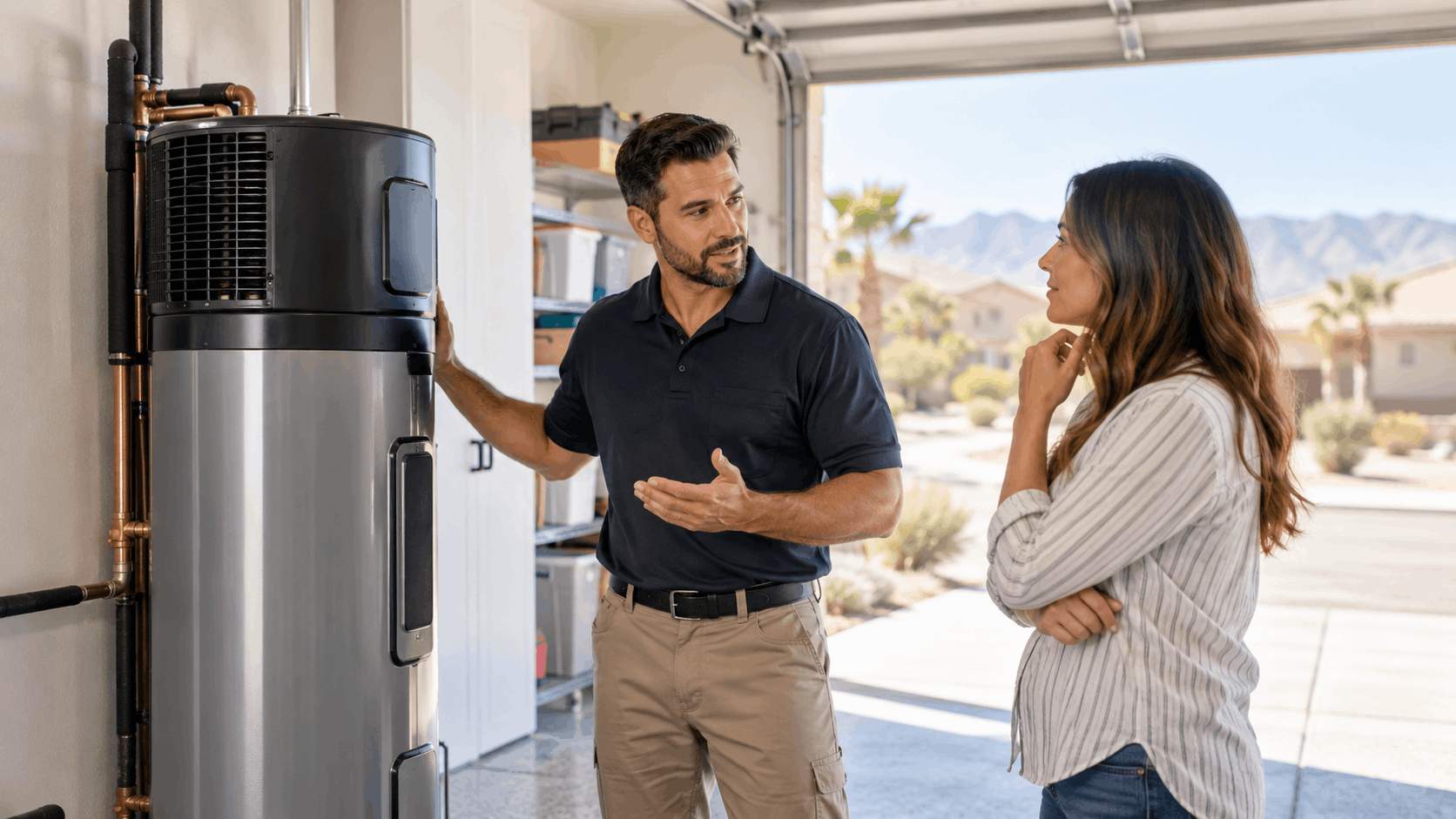
Every job starts with a home assessment. We measure the garage, note which way it faces, and get a read on how hot the space runs during the afternoon.
We check the electrical panel to see whether a 240 volt circuit exists or a new one is needed. We look at clearances, air volume, and where condensate can drain. That sizing visit tells us which models fit the space and the temperature range of that specific garage.
For a very hot west facing garage on the 215 corridor, the assessment might steer us toward a unit with a higher operating ceiling or an added vent. For a moderate insulated garage in Summerlin, a standard model is often perfect. The recommendation always fits the real conditions.
This step prevents the two biggest install day surprises, which are electrical shortfalls and space problems. Solving them on paper first keeps the job smooth.
Matching Tank Size to Household Use
Tank size is the next call. Heat pump models commonly come in 50, 65, and 80 gallon capacities, and the right one depends on the household.
A couple or small family usually does well with a 50 gallon unit. A busy home with three or four people and multiple bathrooms often needs a 65 gallon tank to avoid running short. Larger households with heavy fixtures, soaking tubs, or many back to back showers lean toward the 80 gallon capacity.
Because the heat pump recovers a bit slower than a gas unit, we sometimes size up a notch to give the family a comfortable cushion. A slightly larger tank means the electric backup kicks in less often, which protects the savings.
We base the choice on the number of people, the number of bathrooms, and how the family uses hot water. Right sizing keeps everyone in hot water without wasting energy on a tank that is too big.
Removal, Setup, and Testing on Install Day
On install day, our team starts by shutting off the water and power and draining the old unit. Old unit removal includes hauling the tank out of the garage and disposing of it properly, so the homeowner is not left with a heavy tank to deal with.
Next we set the new unit, connect the water lines, run or connect the 240 volt circuit, and set up the condensate drain. We level the unit, secure it, and confirm every connection is tight. If the garage needed a vent or a panel upgrade, that work happens as part of the same visit.
Then we fill the tank, power it up, and test hot water flow at the fixtures. We set the operating mode, usually hybrid, and confirm the unit is heating correctly and quietly. A typical install runs three to five hours, longer if a panel upgrade or new circuit is involved.
Before we leave, we walk the homeowner through the controls and modes. They know how to switch to high demand mode for guests and back to efficiency mode for daily use.
Maintenance We Recommend for Desert Homes
Desert homes deal with hard water and dust, and both affect these units. A little maintenance keeps them running well for years.
The air filter on the heat pump needs cleaning every few months since valley dust clogs it more quickly than in wetter climates. A clogged filter chokes airflow and drags down efficiency, so we show homeowners how to rinse it. It takes only a couple of minutes.
The anode rod inside the tank fights corrosion, and our hard water eats through it more quickly than average. We recommend checking the anode rod every couple of years and replacing it when needed to extend tank life. Pairing the unit with a water softener installation slows scale buildup and protects the whole system.
A yearly flush clears sediment from the bottom of the tank, which matters a lot with valley water. We offer maintenance visits that cover the filter, the anode rod, and a flush in one stop. That routine care is the difference between a unit that quits early and one that runs a full lifespan.
Final Thoughts
A 115 degree garage does not doom a heat pump water heater. For most of the year, that heat is exactly the fuel these units want, which is why they run so cheaply through a valley summer.
The real work is matching the right unit to your garage, handling the electrical and drainage, and keeping the compressor inside its rated range during the worst July afternoons. Done right, a hybrid unit delivers strong savings, a slightly cooler garage, and a payback that lands in just a few years.
If a heat pump water heater is on your list, our team can look at your specific garage and give you a straight recommendation. Reach out to contact Active Plumbing for a consultation, and we will help you decide whether it is the right call for your home.
Frequently Asked Questions
- Does a 115° garage damage a heat pump water heater?
- Not usually. Most units are rated to operate up to roughly 120 to 145 degrees, so a 115 degree garage sits within range for common models. The bigger concern is sustained triple digit heat over years, which can add compressor stress. We handle this by choosing a model with a higher ceiling or adding ventilation for very hot, west facing garages so the unit stays inside its rated range.
- Will a hot garage actually make the unit more efficient?
- Yes, and this surprises most homeowners. A heat pump pulls warmth from the surrounding air, so warmer intake air raises the coefficient of performance. That means a hot Las Vegas garage often makes the unit run cheaper during summer, not more expensive. The efficiency climbs with the temperature up to the manufacturer limit, which is why these units are a strong fit for our long, hot valley season.
- How much can Las Vegas homeowners save each year?
- Compared to a standard electric tank, most homes save between $300 and $450 a year on the water heating portion of the power bill. A heat pump uses roughly 60 to 70 percent less energy for the same job. Our long summer pushes savings toward the top of that range for months at a time, since the hot garage air keeps the unit running at high efficiency.
- Are there rebates in the Las Vegas area?
- Yes. NV Energy has offered rebates for qualifying high efficiency heat pump water heaters, and the amount changes year to year. The federal Energy Efficient Home Improvement tax credit, which covered 30 percent of the cost, ended for units installed after December 31, 2025. Stacking the two can drop the real price toward that of a mid range gas install. We track which models qualify for current programs.
- Do these units cool down the garage?
- They do, a little. A heat pump water heater exhausts cool, dry air as it pulls heat from the room, acting like a small air conditioner. It will not turn a 115 degree garage cold, but it can shave off a few degrees and cut humidity. Homeowners who use the garage as a workshop often notice the difference during the hottest weeks of the year.
- How loud is a heat pump water heater?
- Most units run around 40 to 55 decibels, similar to a window air conditioner or a quiet dishwasher. In a garage, that noise is a non issue for daily life. The concern only comes up when the unit sits in a closet sharing a wall with a bedroom. Garage placement, which is the norm here in the valley, keeps the sound well away from living space.
- What size do I need for my Las Vegas home?
- Heat pump models come in 50, 65, and 80 gallon capacities. A couple or small family usually fits a 50 gallon unit, while a home with three or four people and multiple bathrooms often needs 65 gallons. Larger households with soaking tubs or many back to back showers lean toward 80 gallons. We size based on people, fixtures, and how your family uses hot water.
- Do I need a permit in Clark County?
- Yes. Water heater replacements require a permit in Clark County, and a heat pump swap with electrical work is no exception. The permit and inspection confirm the electrical, drainage, and mounting all meet code. Our team pulls the permit, schedules the inspection, and handles the paperwork so you do not have to chase the county. A documented install also protects your warranty and resale value.
- How long does installation take?
- A typical install runs three to five hours. That covers draining and hauling out the old unit, setting the new one, connecting water lines, wiring the 240 volt circuit, and setting up condensate drainage. Jobs that need a panel upgrade or a brand new circuit run longer. Before we leave, we test hot water flow, set the operating mode, and walk you through the controls.
- How long do these units last in the desert?
- With regular maintenance, most heat pump water heaters last 10 to 15 years. Our hard valley water is the biggest threat, since it wears the anode rod and builds scale more quickly. Cleaning the air filter, checking the anode rod every couple of years, and flushing the tank annually all extend that lifespan. Pairing the unit with a water softener helps it reach the top end of that range.
Licensed plumbing professionals serving Las Vegas and Las Vegas Valley.
Licensed in Nevada · License #0047021
Last updated on
Why trust Active Plumbing?
Founded in 1991, Active Plumbing is a licensed and insured plumber serving Las Vegas and Las Vegas Valley. All content is reviewed by our licensed technicians.

Need Help in Las Vegas?
Active Plumbing serves Las Vegas and all of Las Vegas Valley.
Related Articles
Gas vs Electric Water Heaters in Las Vegas: NV Energy Rates vs Southwest Gas, Real Monthly Numbers
Compare gas vs electric water heaters in Las Vegas with real monthly numbers, NV Energy rates vs Southwest Gas rates, install costs, and which fuel fits your home.
Water Heater Replacement in Aliante and North Las Vegas - Builder-Grade Unit Failures at Year 10
Builder-grade water heaters across Aliante fail right around year 10. Learn the warning signs, replacement costs, tank vs tankless choices, and how to make a new unit last in North Las Vegas hard water.
Why Las Vegas Water Heaters Fail in July: 115° Garages, Thermal Stress, and Demand Spikes
Learn why Las Vegas water heaters fail in July as 115 degree garages, thermal stress, hard water, and summer demand spikes all pile on your unit at once.